
Natural Slate vs. Clay Roof Tiles: Which Is Right for Your Project?
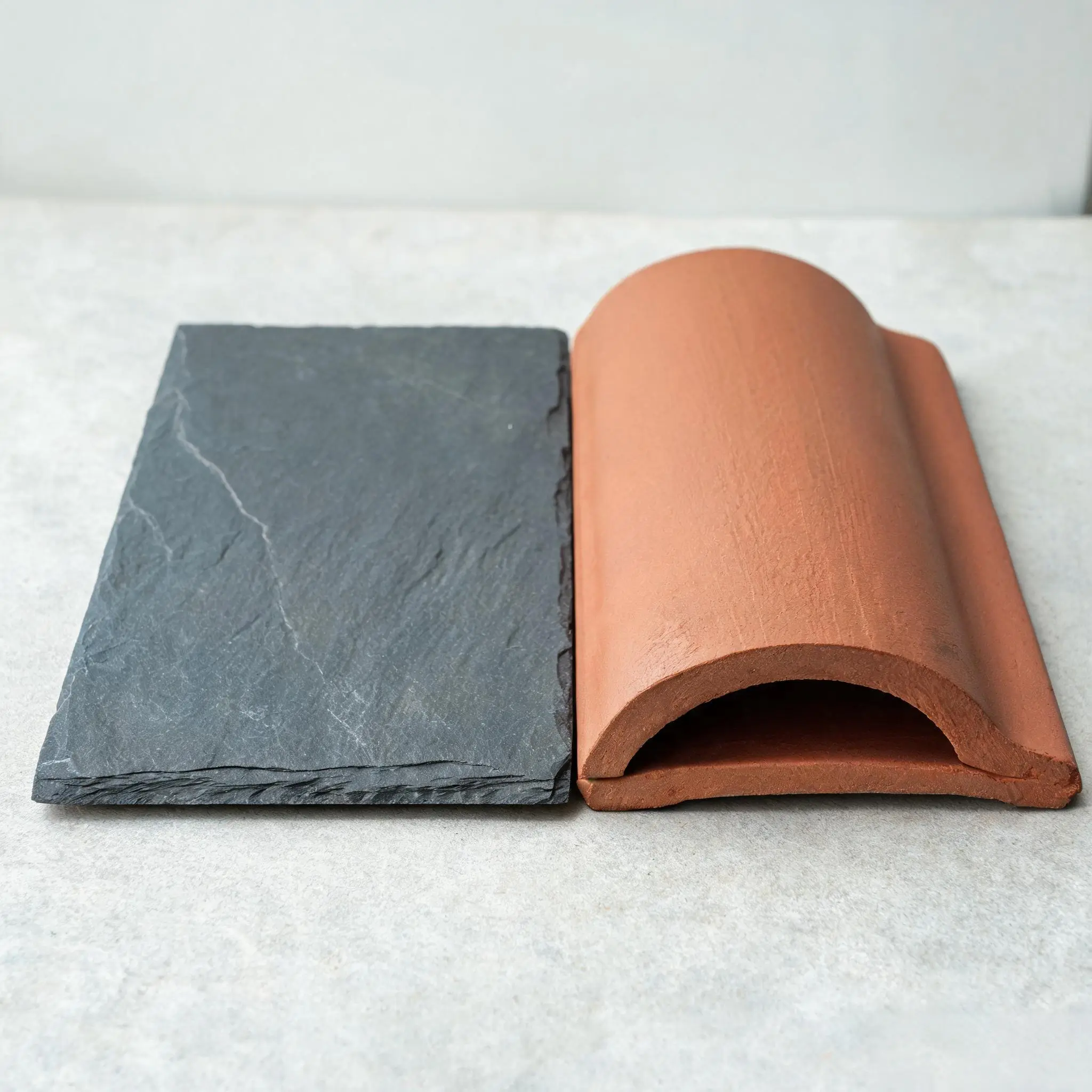
Two Materials, Two Stories
Walk down any street in an old European town and you will eventually see them side by side — a dark grey slate roof that looks like it was laid yesterday, next to a warm terracotta clay tile roof that has been there just as long. Both are premium. Both are natural. Both have been used for centuries. But beneath the surface, they are fundamentally different materials with different strengths, different weaknesses, and very different ideas about how long a roof should last.
I have spent fifteen years surveying roofs across England, France and the Mediterranean coast. When someone asks me "slate or clay?" the honest answer is always "it depends" — but there are some clear patterns worth knowing before you decide. This article is not a sales pitch for either material. It is a field guide to how they actually behave, decade after decade, on real buildings.
Where Each Material Comes From
Slate is a metamorphic rock. It started as mud on the floor of an ancient ocean roughly 300 to 400 million years ago. Over geological time, heat and pressure realigned the mineral grains into thin, flat layers. When a quarry worker strikes a block of slate with a chisel, it splits along these layers — that is why slate tiles are naturally flat and thin, often as thin as 5 mm, without any grinding or polishing.
Clay tiles are ceramic. Someone digs up clay, presses it into a mould, dries it, and fires it in a kiln at temperatures above 1,000 degrees Celsius. The firing drives off chemically bound water and fuses the clay particles together. The result is hard and durable, but it is a manufactured product — its properties depend on the clay source, the firing temperature, and the kiln atmosphere, all of which can vary from batch to batch.
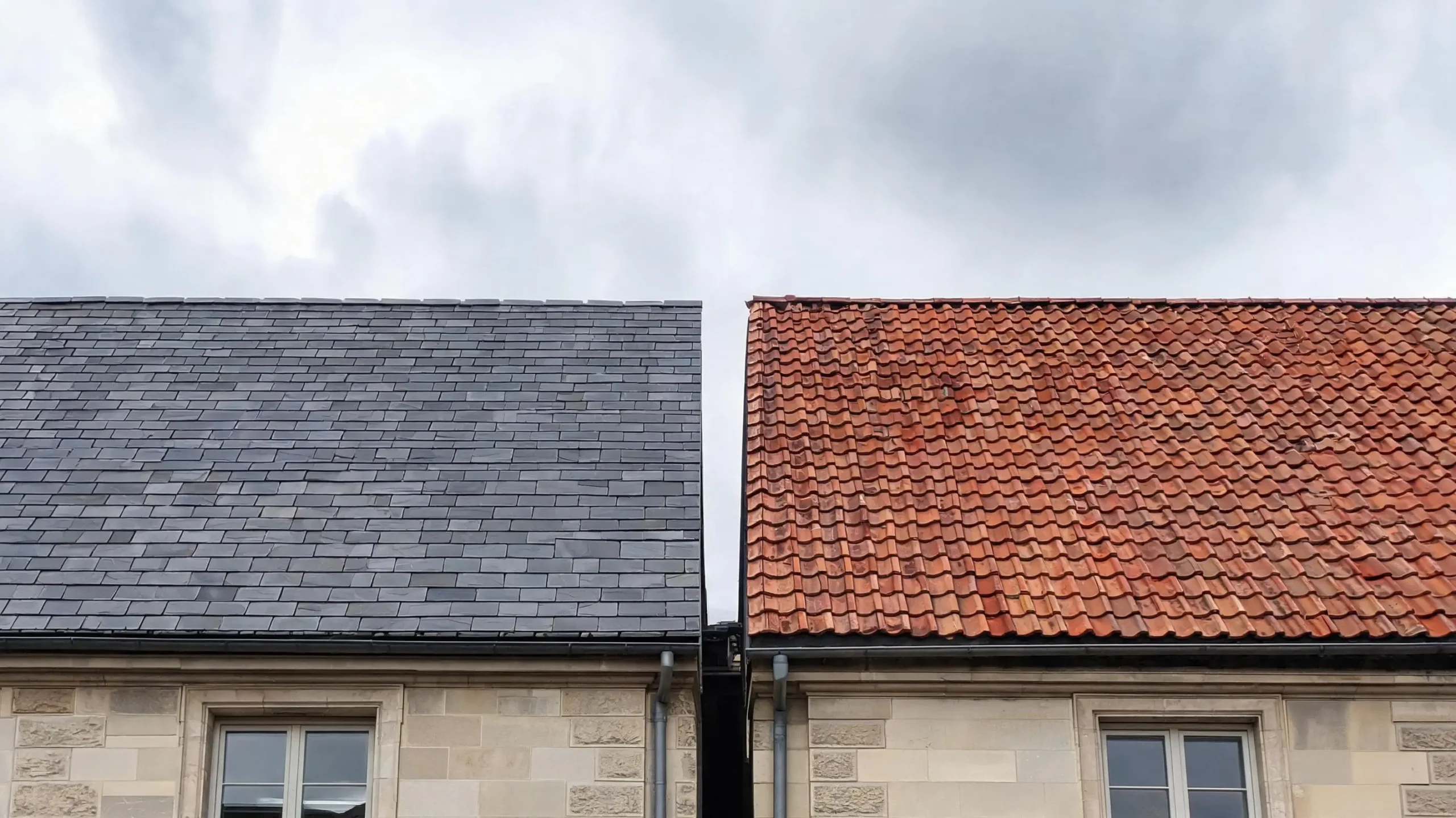
This origin difference matters more than most people realise. Slate's properties were set by geology hundreds of millions of years ago — the rock is what it is, and a good quarry produces consistent material. Clay tile properties were set by a manufacturing process last month, and that process can drift.
That does not make clay tiles inferior. It means you need to ask different questions when buying. With slate, you ask about the quarry and the test report. With clay tiles, you ask about the firing standard and the freeze-thaw rating. Both are answerable questions — but they are different questions.
How They Age: Lifespan and Weathering
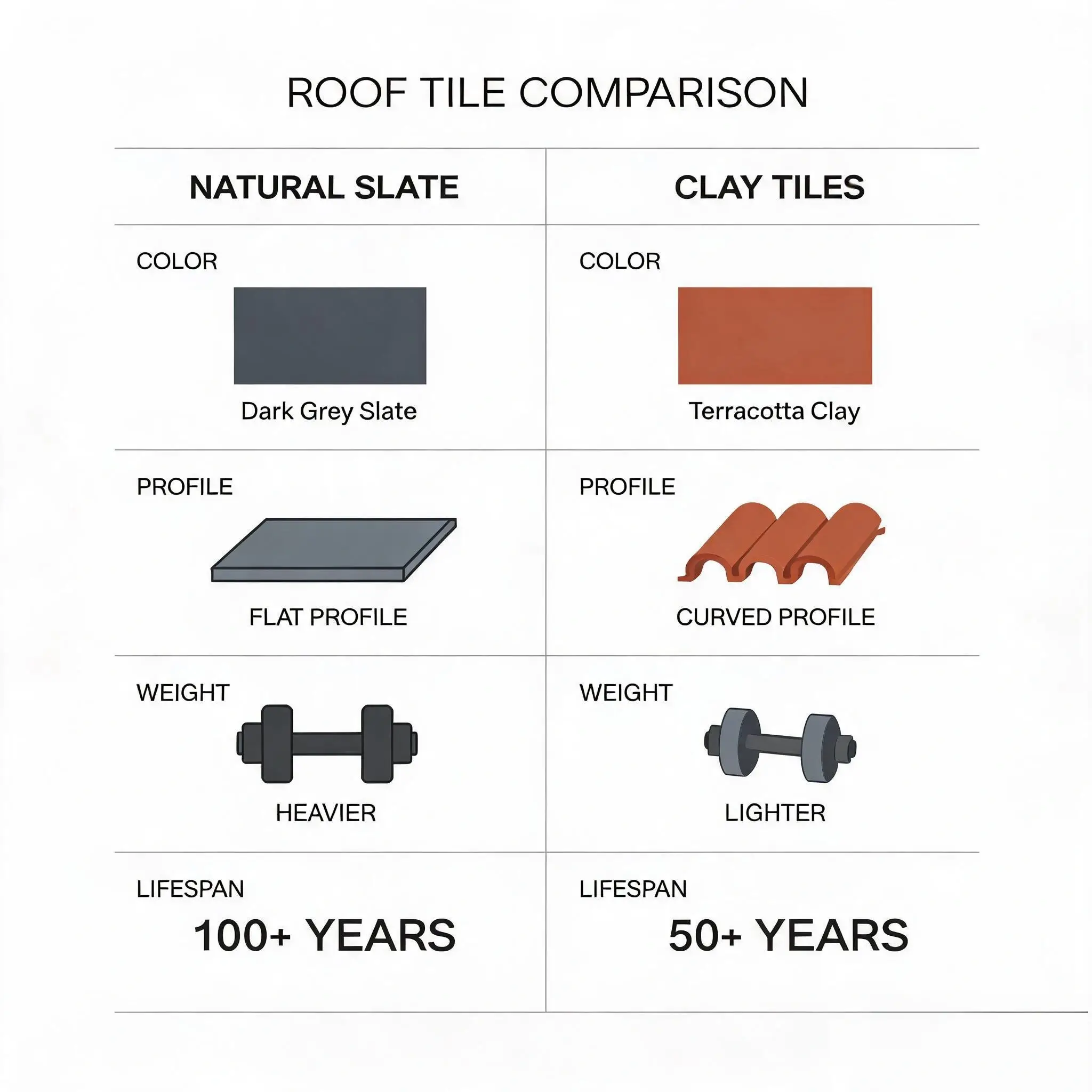
Natural slate, when properly selected and installed, routinely lasts 100 to 150 years. Some Welsh slate roofs from the 1850s are still in service. The colour does not fade because it is mineral, locked into the stone at a molecular level. Slate does not erode in acid rain. It does not become brittle under UV exposure because it is a rock, not a polymer. A hundred years from now, a grey slate will still be grey.
Clay tiles typically last 50 to 100 years. Good quality clay tiles can last longer — there are clay tile roofs in southern Spain and Italy that are centuries old. But clay tiles are more vulnerable to surface spalling in freeze-thaw conditions because they absorb more water. They can also show slight colour shifts over decades as mineral surfaces slowly weather, though high-quality fired clay holds its colour remarkably well.
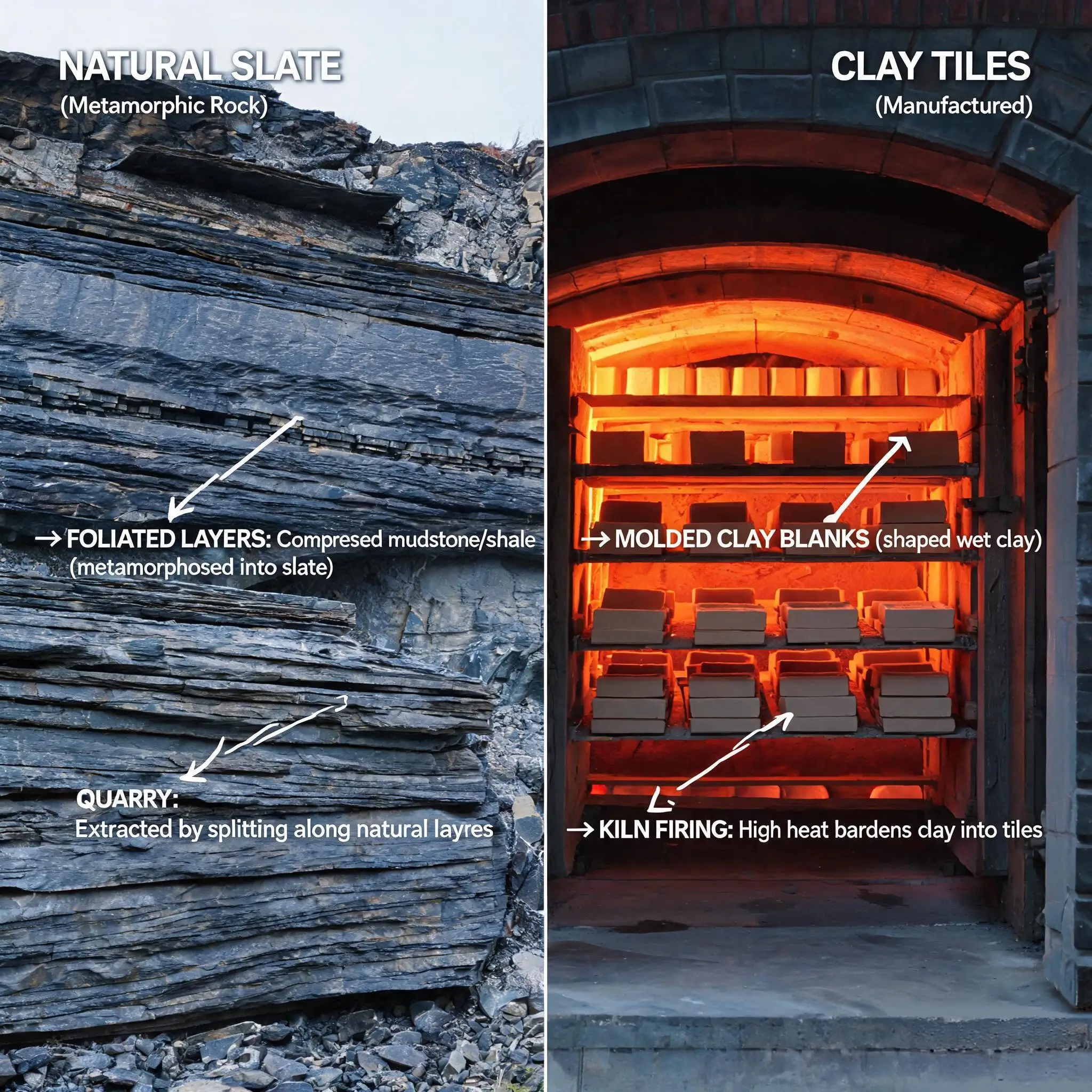
Both materials can outlast the building they sit on. The difference is reliability across climates. Slate achieves its century-plus lifespan almost anywhere — cold, wet, windy, polluted, you name it. Clay tiles achieve exceptional longevity mainly in the warm, dry climates where they evolved. Move them to a harsh northern winter without careful selection, and that 100-year promise shrinks fast.
If you want to dig into the specifics, our slate roof lifespan guide breaks down the factors that decide service life — slate quality, installation, and maintenance — in more detail.
The Weight Question: It Is Not What Most People Think
Here is a fact that surprises most homeowners and quite a few builders: natural slate is lighter per square metre than clay tiles.
The density of slate is higher — about 2.7 to 2.8 g/cm³ versus clay's 1.8 to 2.0 g/cm³. But slate is split much thinner. A standard roofing slate at 7–9 mm thickness weighs about 19–24 kg/m². Clay tiles, which are typically 15–20 mm thick to achieve structural strength, weigh 35 to 70 kg/m² depending on the profile.
| Material | Typical Thickness | Weight per m² (installed) |
|---|---|---|
| Natural slate (5–6 mm) | 5–6 mm | ~14–16 kg/m² |
| Natural slate (7–9 mm) | 7–9 mm | ~19–24 kg/m² |
| Natural slate (13–15 mm, thick grade) | 13–15 mm | ~35–40 kg/m² |
| Plain clay tiles (peg tiles) | ~15–20 mm | ~65–70 kg/m² |
| Interlocking clay tiles | ~15–20 mm | ~35–45 kg/m² |
| Roman clay tiles | ~15–20 mm | ~40–55 kg/m² |
So while an individual slate feels dense and heavy in your hand, a completed slate roof actually puts less load on your structure than most clay tile roofs. This is worth checking if you are considering switching from clay to slate — you might not need structural reinforcement at all. Our roofing slate weight guide covers this in more depth, including how to calculate the total load on your roof timbers.
Water Absorption and Freeze-Thaw
This is where the two materials diverge most sharply, and it is the single biggest factor in cold-climate performance.
Natural slate typically absorbs less than 0.3% water by weight. Our Lushan slate, for example, tests at 0.2% water absorption and passes 120 freeze-thaw cycles with zero weight loss. That is because slate is a dense metamorphic rock with extremely low porosity — water simply cannot get in.
Clay tiles typically absorb 3 to 10% water by weight. This varies by manufacturer, clay source, and firing temperature, but even the best clay tiles absorb an order of magnitude more water than slate.
In a freeze-thaw climate, that difference is decisive. Water that soaks into a tile during a damp day expands by roughly 9% when it freezes overnight. Over hundreds of winter cycles, this internal pressure causes surface spalling — the tile face flakes off, the tile thins, and eventually it cracks. Slate's near-zero absorption means freeze-thaw damage is essentially a non-issue. Clay tiles in cold climates need to be specifically rated for freeze-thaw resistance, and even then, they will degrade faster than slate.
If you are in a cold or mixed climate and want to understand the test numbers behind these claims, our water absorption guide and freeze-thaw resistance guide walk through EN 12326 and ASTM C406 testing in detail.
Installation: Two Different Crafts
Slate and clay tiles are installed in fundamentally different ways, and this affects both labour cost and how easily a roof can be repaired.
Every single slate tile is individually fixed — nailed or hooked to a wooden batten. This means more labour per square metre, because each tile is a separate operation. But it also means a broken tile can be removed and replaced without disturbing its neighbours. A skilled slater can swap a single slate in about ten minutes using a slate ripper, and the roof looks as if nothing happened.
Clay tiles, especially interlocking types, clip together by their profile. Not every tile needs nailing — often only every fourth or fifth tile in a course is mechanically fixed, and the rest hold themselves in place by interlocking lips. This makes installation faster. But replacing a broken interlocking tile means lifting the tiles above it, which can crack them, especially on an older roof where the tiles have settled and bonded with dirt and moss.
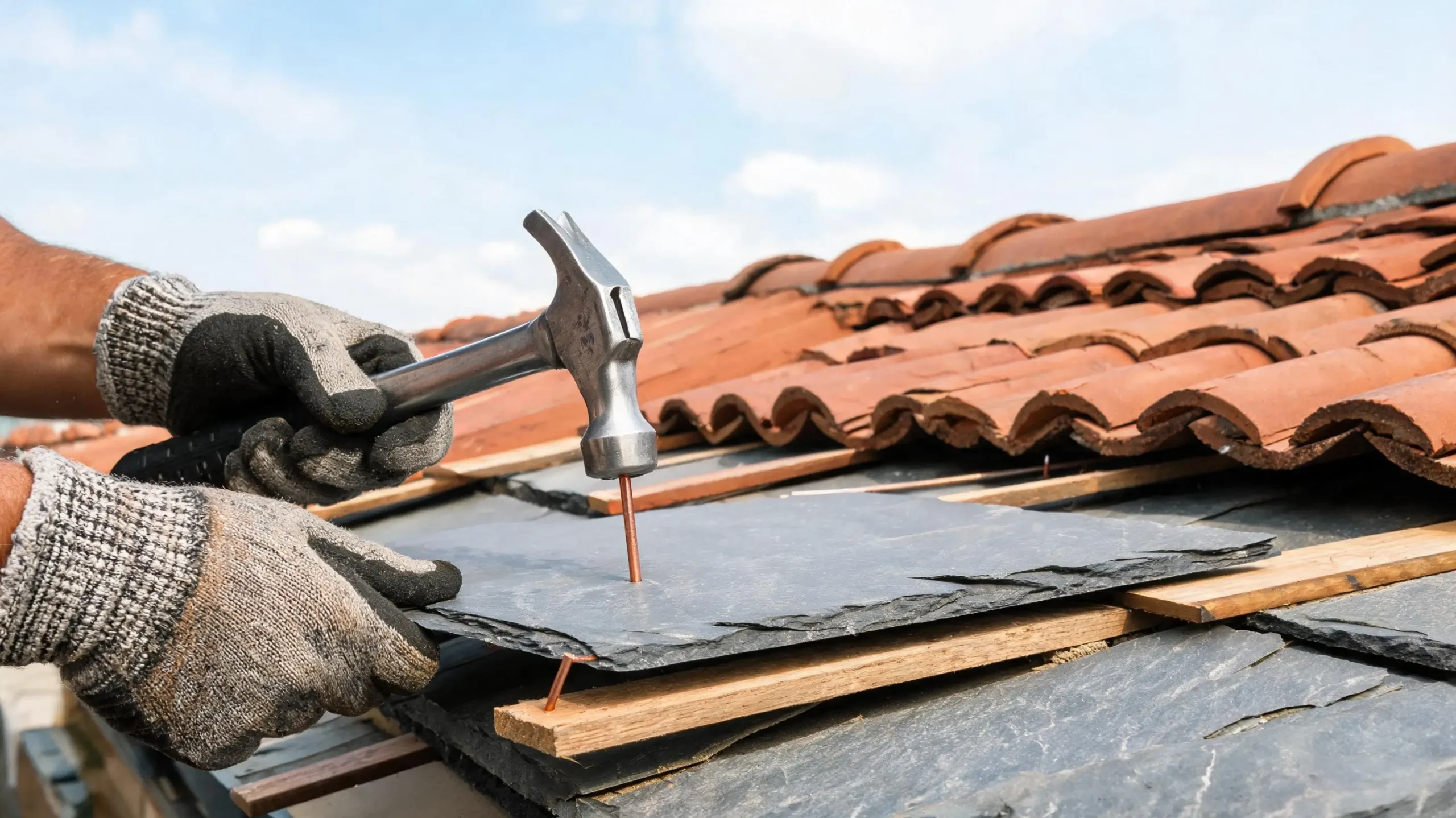
The fixing method also matters for wind resistance. Because every slate is individually secured, a well-nailed slate roof holds up well in storms. Interlocking clay tiles that are not individually nailed can lift in high winds — a known failure mode in exposed coastal locations. Our fixing methods guide covers the nails-vs-hooks decision in detail if you want to go deeper.
Appearance and Architectural Fit
Slate gives a roof a clean, flat, geometric look. The surface is smooth, the courses are straight, the colour is typically grey or black (though green, purple and rustic variants exist). Slate suits formal architecture — Georgian, Victorian, ecclesiastical, and contemporary minimalist buildings. It is the default choice for British and northern European architecture, and for good reason: it looks right.
Clay tiles give a roof warmth, texture and undulation. Curved profiles — pantiles, Roman tiles, S-shapes — create a rhythm of light and shadow that flat slate cannot match. Clay suits Mediterranean, Spanish, Mission, and vernacular rural architecture. It is the default choice for southern Europe, and there too, it looks right.
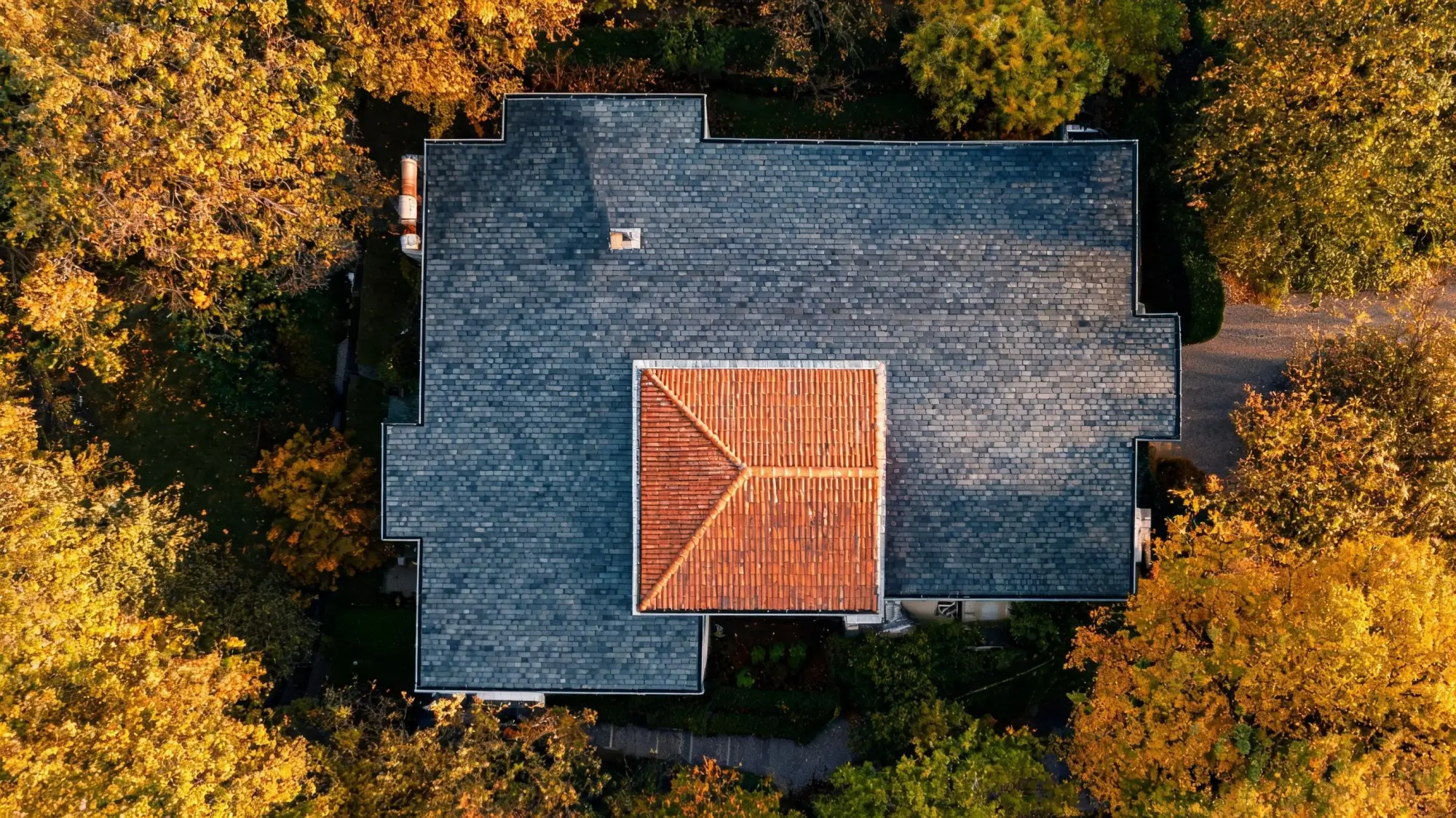
Neither material is better looking than the other. They suit different architectural languages. A slate roof on a Spanish hacienda would look as wrong as a clay tile roof on an English parish church. If you are matching an existing streetscape or a listed building, the choice may already be made for you. For new build, the architecture should drive the material, not the other way round. Our slate colour guide covers the natural colour range if you want to see what slate can offer beyond standard grey.
Cost: Upfront and Over a Lifetime
The upfront material cost of natural slate is typically higher than clay tiles. Slate costs more to produce — it requires quarrying, skilled splitting, and individual inspection of every piece. Clay tiles are mass-produced in kilns, which is inherently more efficient.
But the lifecycle cost tells a different story. Over 100 years, a clay tile roof in a cold climate may need at least one full replacement and several patch repairs. A slate roof in the same climate may need only routine maintenance — replacing the occasional broken tile, repointing ridges, swapping corroded nails. The cost of a full roof replacement — stripping, disposing, reordering, reinstalling — can easily exceed the original installation cost, especially with inflation over 50 or 75 years.
This is not an argument that slate is always cheaper in the long run. If you are in a warm, dry climate where clay tiles last 80-plus years, and you do not plan to own the building for more than 30 years, clay tiles are the rational economic choice. But if you are building or renovating for the long term — a family home, a public building, a heritage property — the lifecycle arithmetic tends to favour slate. Our roofing slate cost guide breaks down the numbers per square metre and per roof.
Which Material Suits Your Climate?
Climate is the single most important factor in this decision — more important than cost, more important than appearance. A material that is perfect in one climate can fail prematurely in another.
| Climate | Natural Slate | Clay Tiles |
|---|---|---|
| Cold, wet, freeze-thaw (UK, Northern Europe) | Excellent — near-zero water absorption handles hundreds of freeze-thaw cycles | Fair — needs freeze-thaw rated tiles; expect faster degradation |
| Coastal, high wind (Cornwall, Brittany, Ireland) | Excellent — every tile individually fixed, dense stone resists salt air | Good — but unfixed interlocking tiles can lift in gales |
| Warm, dry, Mediterranean (Spain, Italy, Portugal) | Good — performs well but may look out of place architecturally | Excellent — traditional, proven over centuries, ages beautifully |
| Temperate, mixed seasons (France, Belgium, Netherlands) | Excellent — the standard choice for this climate band | Good — acceptable with correct tile selection |
| Hot, intense UV (Middle East, Australia) | Excellent — UV does not affect stone | Good — quality fired clay resists fading; cheaper tiles may discolour |
Quick Decision Guide
If you have read this far, you probably have a sense of which material fits your project. Here is a simple way to confirm:
| If your priority is… | Choose | Because |
|---|---|---|
| Maximum lifespan in a cold climate | Slate | 0.2% absorption means freeze-thaw is a non-issue |
| Lower upfront cost | Clay tiles | Mass production keeps material cost down |
| Mediterranean or Spanish architecture | Clay tiles | Warm tones and curved profiles match the style |
| Heritage or listed building (UK/Northern Europe) | Slate | Matches original material; conservation officers expect it |
| Lighter load on roof structure | Slate | 19–24 kg/m² vs 35–70 kg/m² for clay — slate wins |
| Easy single-tile repair | Slate | Each tile independently fixed; swap one without touching neighbours |
| Fast installation | Clay tiles | Interlocking profile means fewer nails per square metre |
| Warm, dry climate on a budget | Clay tiles | Proven in Mediterranean for centuries; lower cost; performs well |
Both materials are available from our roofing slate range — and if you are not sure which grade or thickness suits your project, send us the details and we will help you decide.
Frequently Asked Questions
Is natural slate always more expensive than clay tiles?
Not always. Material for material, slate costs more per square metre. But because slate is thinner and lighter per square metre, you may save on structural reinforcement. And over a 100-year period, a slate roof may need no replacement while a clay tile roof might need at least one. The real question is lifecycle cost, not material unit price. If you only plan to own the building for 20 years, clay tiles are usually the cheaper choice. If you are building for generations, slate often wins on total cost.
Can I mix slate and clay tiles on the same roof?
It is not recommended. The two materials have different thermal expansion rates, different weights, and different installation methods. Mixing them creates a weak transition point where water can penetrate. If you want visual contrast on a roof, use different slate colours or different clay tile profiles within one material family rather than mixing stone with ceramic.
Which material is better for listed buildings or conservation areas?
In the UK and much of northern Europe, listed building consent usually requires matching the original roofing material. Many historic buildings in Britain were roofed in slate, while those in southern Europe were roofed in clay tiles. The conservation officer will typically specify the original material, and sometimes even the original source. Always check with your local planning authority before specifying either material on a listed building.
Do clay tiles fade over time while slate does not?
Slate colour is mineral and permanent — a grey slate will still be grey in 200 years. Clay tiles can experience slight surface colour changes over decades due to UV exposure and weathering of mineral surfaces. However, high-quality fired clay tiles hold their colour remarkably well, and the slight weathering that does occur is often seen as desirable patina rather than a defect. This is rarely a decisive factor in choosing between the two.
Which is easier to repair — slate or clay tiles?
Slate is generally easier to repair individually because each tile is independently fixed. A slate ripper slides under the broken tile, hooks the nail, and pulls it out — the replacement slate drops in without disturbing adjacent tiles. Clay interlocking tiles require lifting the tiles above to access the broken one, which can crack the surrounding tiles during the repair process, especially on older roofs where tiles have settled together.
Can I replace my clay tile roof with natural slate without reinforcing the roof structure?
Often yes. Because slate is lighter per square metre than clay tiles (19–24 kg/m² for 7–9 mm slate versus 35–70 kg/m² for clay tiles), the existing structure may already be strong enough to support the change. However, this must always be confirmed by a structural engineer who can assess the specific roof — rafter size, span, pitch, and existing load all affect the calculation. Never assume; always verify.
Related Reading
Not sure which material fits your project?
Send us your project details — roof area, pitch, location and budget — and we will recommend the right material, grade and thickness for your climate. No obligation, just honest advice from 30 years of roofing slate production.