
How Billiard Slate Is Mined and Processed: From Quarry to Championship Table
Most buyers meet their billiard slate in a photograph — a grey slab sitting flat on a workshop floor, clean and even. What the photo never shows is that by the time the stone reached that camera, it had passed through eight gates where quality was either locked in or quietly lost.
I run a slate processing yard in Lushan, Jiangxi. This article is the exact route every block takes through our yard — and, just as important, the question you should ask at each gate. You do not need to memorise any of this. You need to know which gates actually decide whether your table plays true for thirty years or starts developing problems in three.
The route at a glance
1. Quarry gate — block selection
2. Cutting — splitting the block to thickness
3. CNC flatness pass — grinding to ±0.1 mm
4. Drilling and seam milling — frame fit
5. Sealing — six sides, not one
6. Inspection — every single piece
7. Crating and loading — the container comes to the slate
8. What to check before you buy
Gate 1 — The Quarry Decides More Than the Factory Does
Slate is a metamorphic rock, formed when old clay and ash deposits were crushed and heated over millions of years. That pressure is what gives slate its one superpower: it splits into flat sheets along planes called cleavage. No other natural stone does this as reliably, which is why billiard beds are slate and not granite or marble.
But cleavage is also the first quality gate, and it is decided in the quarry, not the factory. A block with micro-cracks, uneven grain, or heavy mineral banding will fight every later stage. You can grind it, seal it, and crate it, and it will still telegraph its flaws through the cloth.
Here is what this means in practice at our yard. When a block arrives from the hills around Lushan, the first inspection is not a machine test — it is an experienced pair of hands running water over the block and watching where it beads and where it seeps, then tapping the stone and listening to how it rings. A clean block rings; a block with internal fractures thuds. That one step happens before anything is cut.
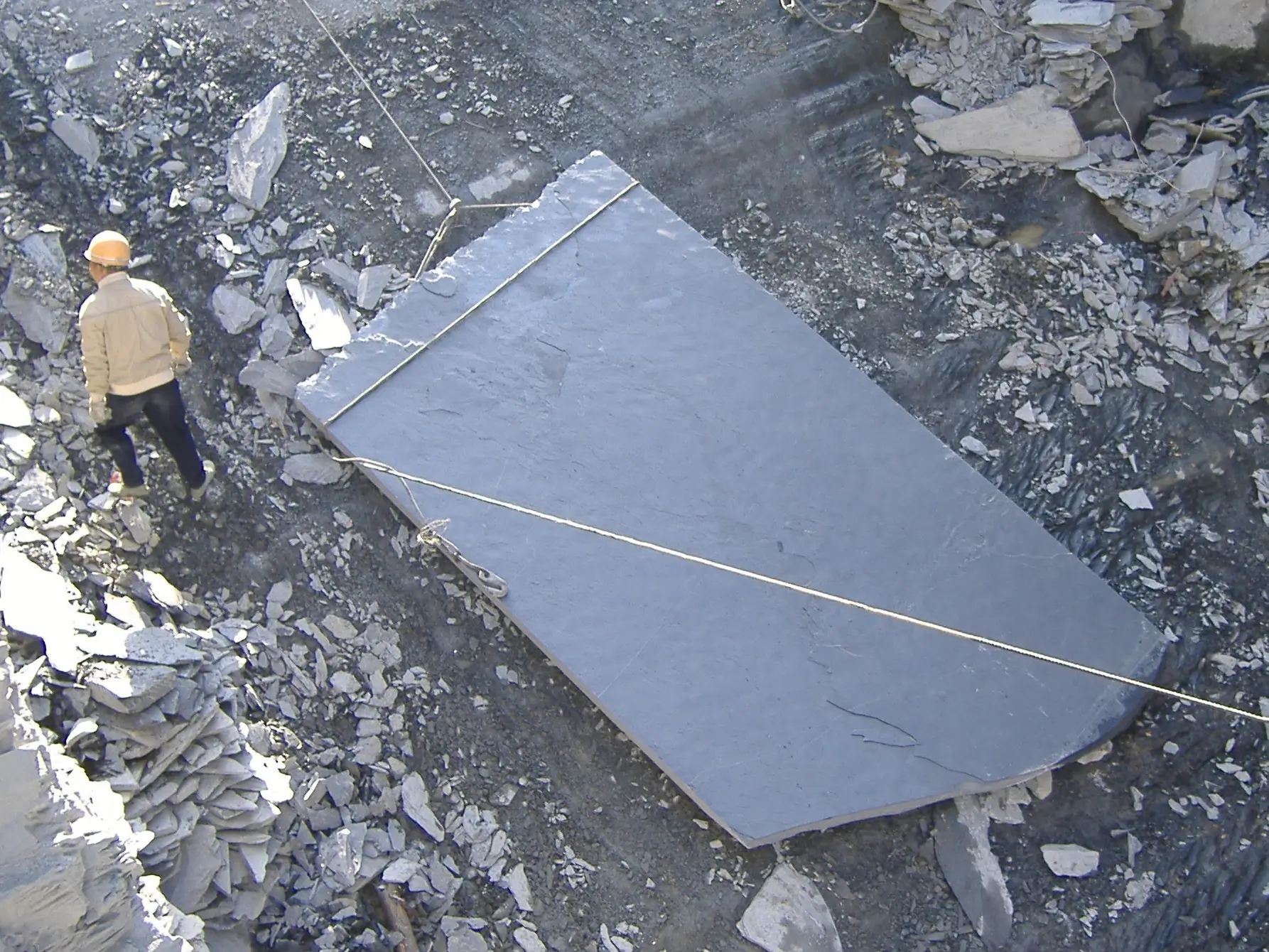
What to ask your supplier: “Do you choose quarry blocks yourself, or do you buy whatever the quarry sells you?” If you hear that blocks are purchased as-is from a local quarry with no further selection, ask how grade differences are managed.
Deeper dive: Our step-by-step panel journey covers block selection and the cutting sequence in detail, and the complete order journey from quarry to table shows how selection decisions echo through an entire order.
Gate 2 — Cutting — Following the Grain Instead of Fighting It
Once a block passes selection, it is cut into panels of the thickness the order needs. In the billiard trade that is normally 45 mm, 30 mm or 25 mm. Two methods are used in the industry: diamond wire sawing, where a steel cable embedded with diamond segments cuts through the block, and gang sawing, where multiple blades work together for high volume.
Slate gives you one advantage here that granite does not: because it splits along natural cleavage planes, a skilled operator can split a block into rough sheets with less waste and fewer internal stresses. For billiard beds, though, splitting alone is never enough — the thickness tolerance would be off by millimetres. That is why the rough sheet still goes through the saw and, later, the grinder.
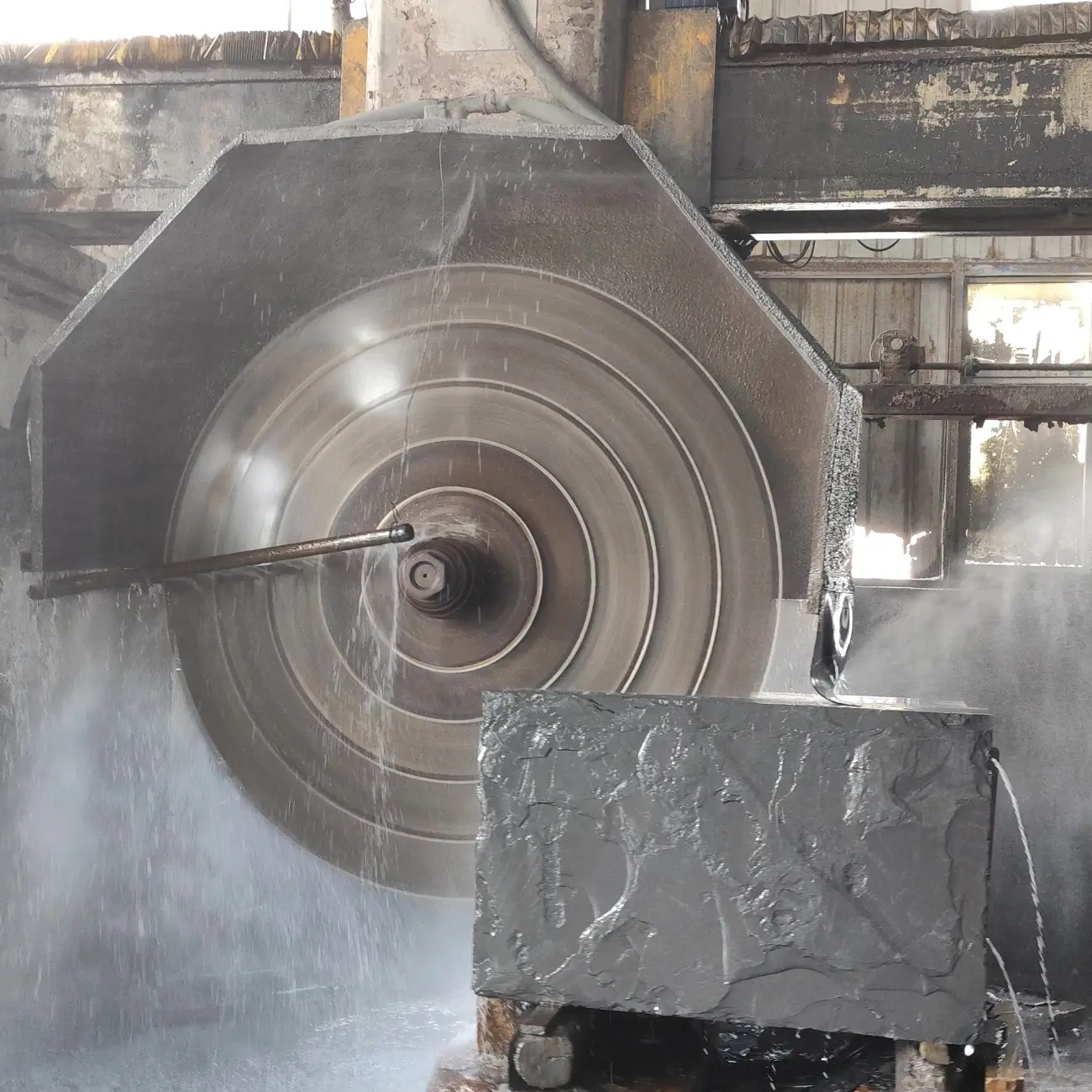
What to ask: “What thickness tolerance do you hold at the saw?” A supplier who cannot hold ±0.5 mm after cutting will struggle to reach a flat, uniform bed later.
Gate 3 — The CNC Pass — Flatness Is the Product
This is the gate that separates a billiard bed from a piece of stone. A rough-sawn panel looks flat to the eye but is not flat to a straightedge. It needs to be ground flat with a CNC surface grinder, which removes material in measured, repeatable passes instead of relying on a worker’s arm.
What number should you care about? Tournament-grade flatness is usually quoted at ±0.3 mm over a metre. We set our own production limit at ±0.1 mm — tighter than the common spec — because flatness is what a cue ball feels every time it rolls. That margin is not magic; it comes from CNC machines and from checking every single panel rather than sampling every tenth.
Two things go wrong in the market here. First, some low-cost suppliers grind by hand or on old machines, which cannot hold ±0.3 mm, let alone ±0.1 mm. Second, some factories will show you one perfectly ground sample and ship ten others that never went through the same pass. That is why we number every panel and keep its grinding record with it.
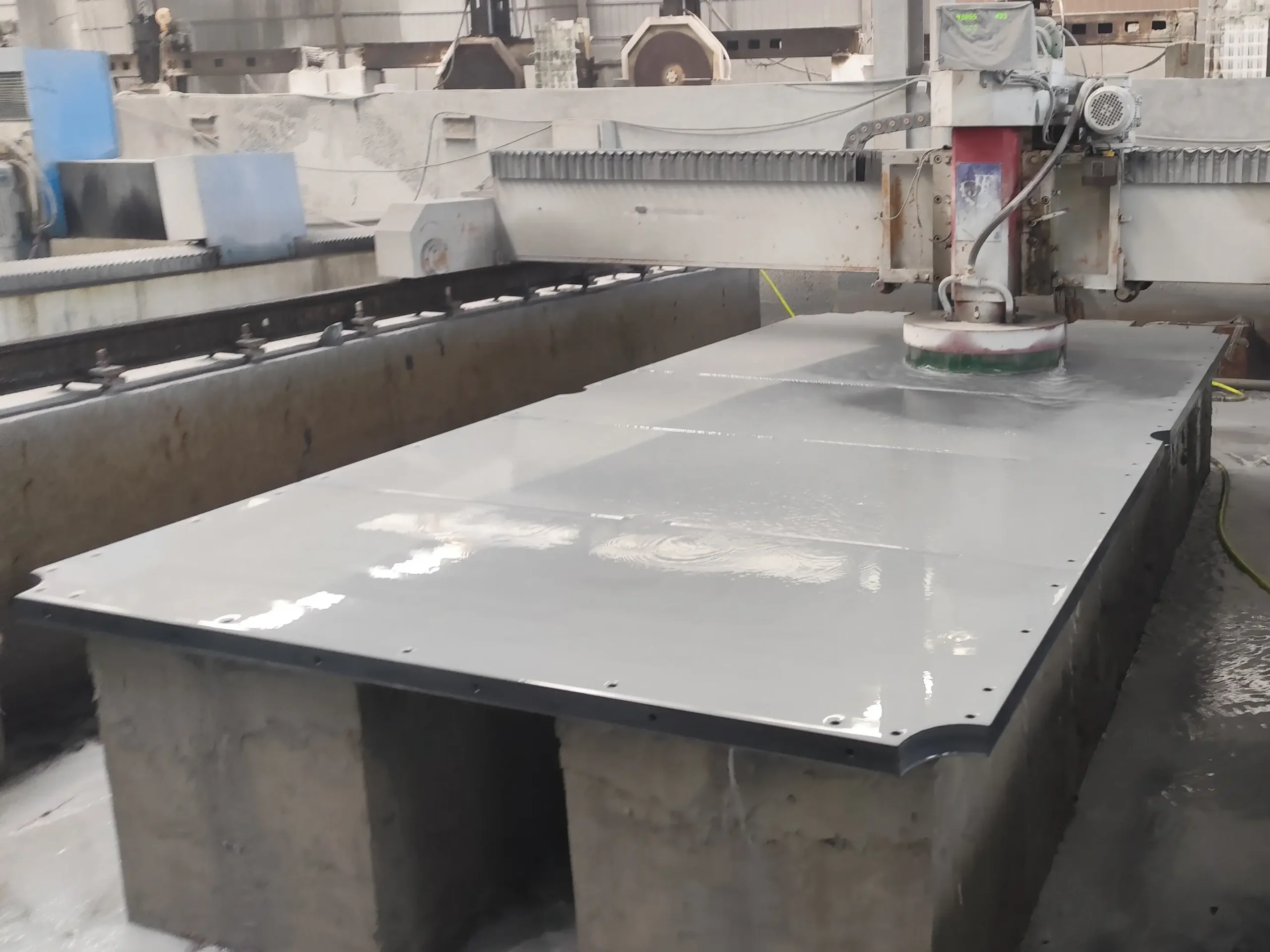
What to ask: “Do you do your own CNC grinding, and can you send a flatness record for the panels you ship?” A flatness record on paper is worth less than a photo of the machine, but a photo of the machine is worth less than a record numbered to your actual panels. Our CNC machining page shows the machines behind the numbers.
Gate 4 — Drilling and Seam Edges — Where the Frame Meets the Stone
Flatness alone does not make a playable table. The panels have to bolt onto the table frame without stress, and — for three- or five-piece beds — the seam where two panels meet has to be almost invisible. Both of these are decided here.
Bolt holes are drilled on CNC to match the customer’s frame drawing. We ask customers for their drawing in DXF or PDF before production, and we return a counter-signed drilling drawing before anything is cut. A supplier that drills holes by template or by eye will cost you more time on site than any saving in price. The seam edges, meanwhile, are milled straight and square — we target a gap between mating edges of 0.05 mm, which is about a hair’s width. At that level the seam plays as one continuous surface.
Seam quality is where the cheapest slate is usually made. A slightly bowed seam edge shows up not on the delivery photos but on the felt, two months after installation, and it is nearly impossible to fix without reopening the table.
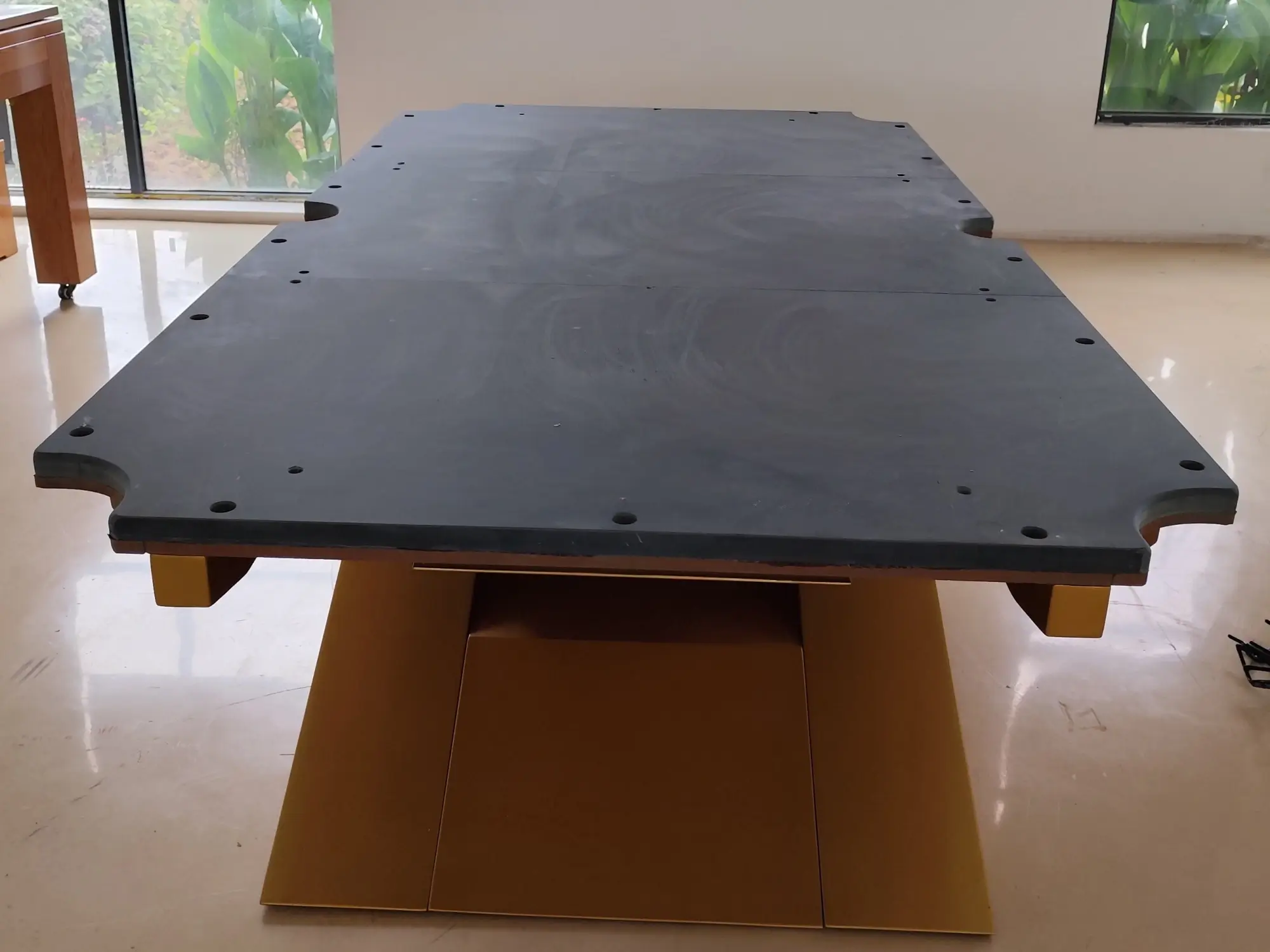
What to ask: “Can you mill the seam edges, and what seam tolerance do you hold?” And then: “Will you send the drilling drawing back to me to approve before you drill?” The second question separates factories that do engineering from factories that only cut stone.
Gate 5 — Sealing — Six Sides, Not Just the Top
Slate is porous. It drinks moisture from the air, from the cloth, from a concrete floor beneath the table. Left unsealed, a bed can absorb moisture unevenly and warp over time. That is why professional beds are sealed before they leave the factory — not just on the playing surface, but on the underside and all four edges: six sides in total.
We use a water-based sealer, two coats minimum, and check the result with a water bead test: a drop should sit on the surface like a dome for at least 30 seconds instead of soaking in. It is a small test, but it is the whole job in one drop.
What to ask: “Is the slate pre-sealed on all six sides, and can I see a water bead test photo?” If a supplier says sealing is optional or ‘done by your installer’, count on losing at least a day of installation to your own sealing — and getting worse coverage than a factory would.
Gate 6 — Inspection: Every Single Piece, Not a Sample
The quality that matters to you is the quality of the specific panels that end up on your table — not the quality of the sample photo you were shown. That is why inspection at our yard is 100% of the pieces, not a sampling. Each panel is checked for flatness with a straightedge and feeler gauge, thickness at multiple points, edges, and bolt-hole fit with a test bolt in every hole.
Beyond the shop-floor checks, the physical properties that protect the bed for decades — density, water absorption — are confirmed against standards such as EN 12326 and ASTM C97. We publish our test results rather than only quoting them; you can look at the reports in our quality test results.
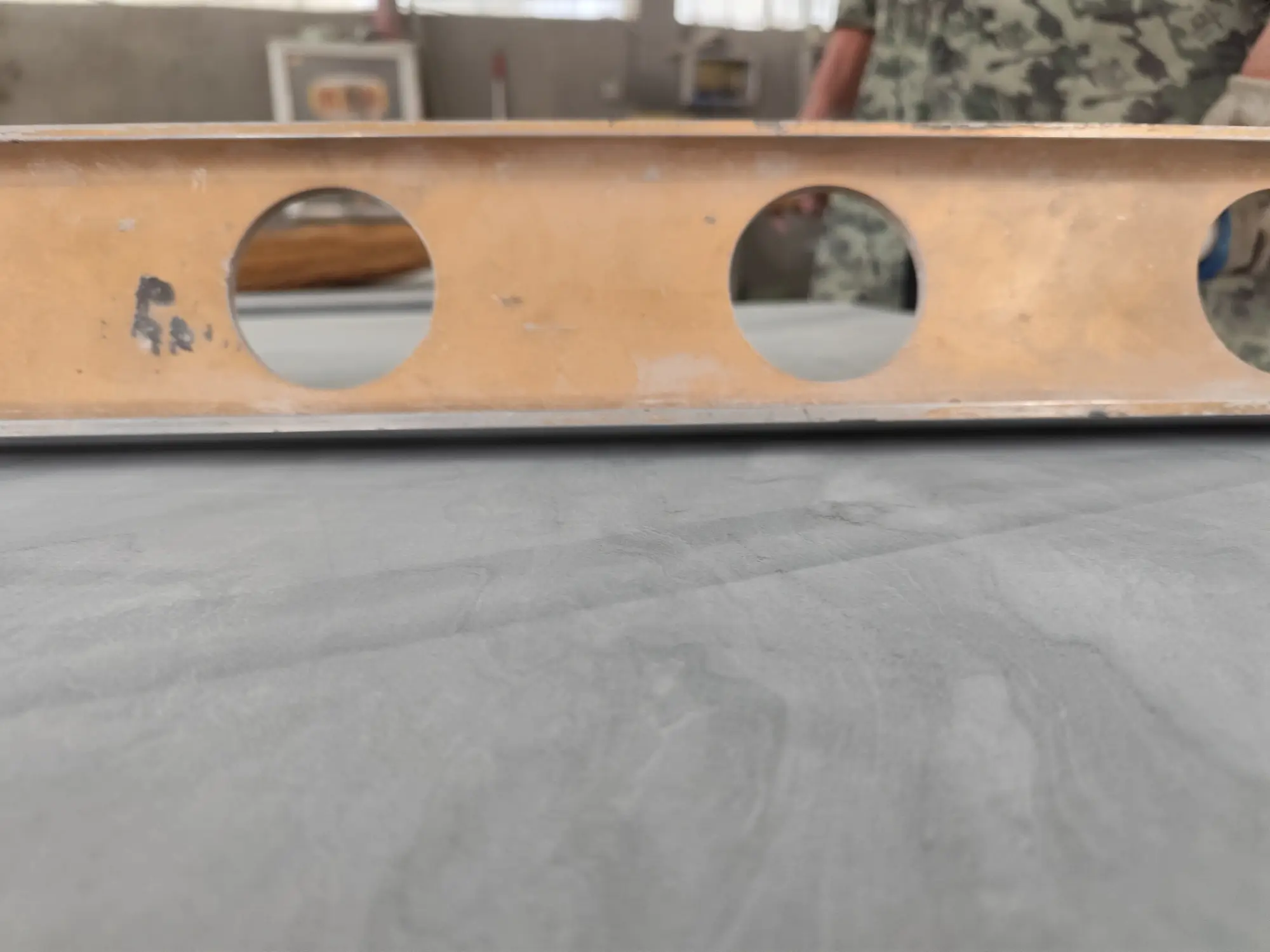
What to ask: “Is the inspection 100%, and how do I know the pieces photographed are the pieces shipped?” Numbering every panel and including the inspection sheet in the crate is the only honest answer to both.
For the full inspection protocol, see how 100% inspection works.
Gate 7 — Crating and Loading: The Container Comes to the Slate
A perfectly ground, sealed bed is worthless if it reaches you cracked. Two details matter more than anything else in packing.
First, the panels travel in a fixed wooden crate with foam on all sides and steel strapping, marked with ISPM-15 on the wood. Second — and this is something we do a little differently — we do not send slate to a third-party warehouse for packing. We have the empty container brought to the yard, load the crates ourselves, and seal the door with our own staff present. The container comes to the slate; the slate does not bounce around a warehouse with three other suppliers’ cargo.
Our factory sits about forty minutes by truck from the port of Jiujiang, so the whole door-to-door loop — empty container arriving, loading, container returning — runs in a single day.
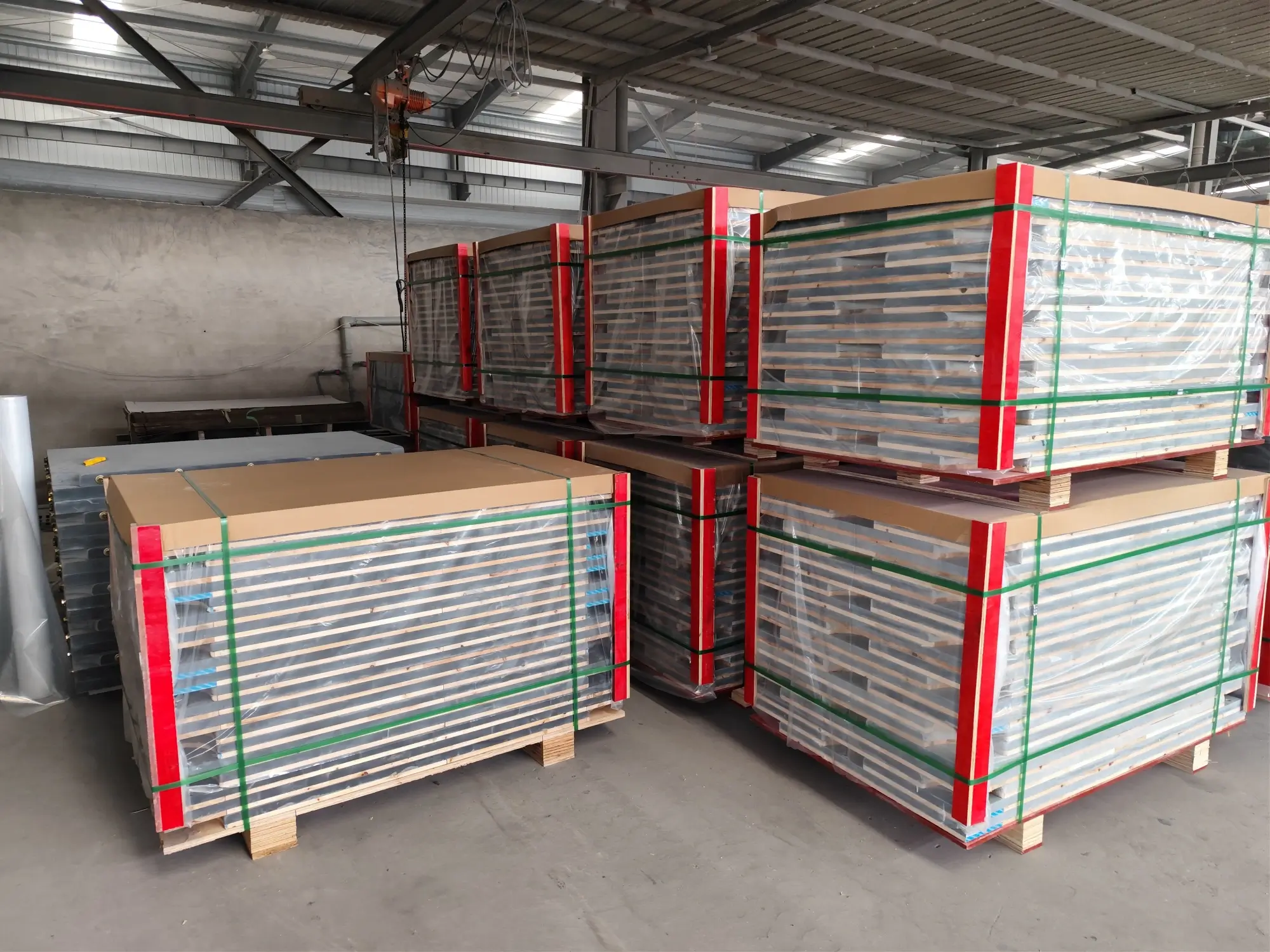
What to ask: “Who packs the container — you, or an agent?” and “Can you share pre-shipment photos of my crates before the door closes?” The second question has an extra benefit: it is your only proof that the panels in the photos are the panels in the container. The full loading sequence, milestone by milestone, is told in our order journey from Jiujiang to your table.
Gate 8 — What This Means When You Buy
Every gate above is a place where quality is either added or removed. Put them together and you get a short checklist that works with any supplier:
- Quarry: Can they name where the block came from — not “China”, a quarry?
- Flatness: What tolerance does their CNC hold, and can they prove it on the actual panels?
- Fit: Will they send a drilling drawing back for your sign-off before drilling?
- Seams: What seam gap do they hold on multi-piece beds?
- Sealing: Six sides, water-based, and a bead test?
- Inspection: 100% of pieces, with photos tied to the shipment?
- Packing: Who loads the container, and can you see pre-shipment photos?
If a supplier hesitates on even two of these, the difference will show up in your workshop. If they wave you to a sample slab instead of answering, that is usually an answer in itself.
For the supplier-side version of this same route — why table builders in Europe and the UK keep coming back to Jiujiang, and how to run the check as a professional buyer — read why billiard builders source from Jiujiang.
Frequently Asked Questions
What flatness does a billiard table slate really need?
Most manufacturers quote ±0.3 mm over a metre as tournament-level flatness. We produce to ±0.1 mm, tighter than the common spec, because the bed’s behaviour over years depends on the quality of the grinding pass — not the spec written on an email. Always ask for a flatness record tied to your actual panels, not to a sample.
Is Chinese slate from Jiujiang good quality compared to Italian or Brazilian slate?
All three regions supply the billiard market, and each has its own character. The point is not which origin is “best” — it is whether the specific supplier controls the process from quarry to crate. Jiujiang slate has the properties the trade needs (density around 2,700 kg/m³, low absorption) and, importantly, the production volume and CNC capacity to supply consistent panels at scale. If you want the honest comparison, we lay out the differences in our quality test reports.
Do I need to seal slate myself if it arrives pre-sealed?
No. If the factory has sealed all six sides — playing surface, underside, and the four edges — with a water-based sealer and the bead test passes, your installer can go straight to fitting the cloth. Pre-sealing at the factory also gives a more even coverage than on-site sealing by hand. Always confirm the sealing before it leaves, because retro-sealing a bed on site costs at least a full day.
How is billiard slate packed for export?
Each panel is fixed inside a wooden crate with foam on all sides, steel strapping and corner protectors, with ISPM wood treatment on the crate. Panels are loaded into the container at our own yard — the container is hauled empty to us and the door closes on our staff’s check. Pre-shipment photos of the crates are shared before the container is sealed.
Can I visit the factory to see the process?
Yes. Customers usually fly to Nanchang, and the yard is about a 40-minute drive from there. You can walk the whole route in this article — quarry selection, CNC pass, inspection, packing — and put a straightedge on the panels yourself. A visit is the fastest way to answer every gate in this article in one afternoon.
Buy a slate bed that has been through every gate — not just the one you can see in a photo.
We send flatness records, inspection photos and pre-shipment pictures with every order, and we will walk you through the route above on a video call.