
Architectural Slate Technical Data
Two buyers are comparing the same 20 mm slate paver. One asks how much stone the order will ship. The second asks whether the paver can take the load on its supports. A third question usually decides the purchase: what can the supplier actually document for the stone being quoted? This page keeps the reference numbers and the documents behind them in one place, so you do not have to guess between a density figure, a thickness band and a test report.
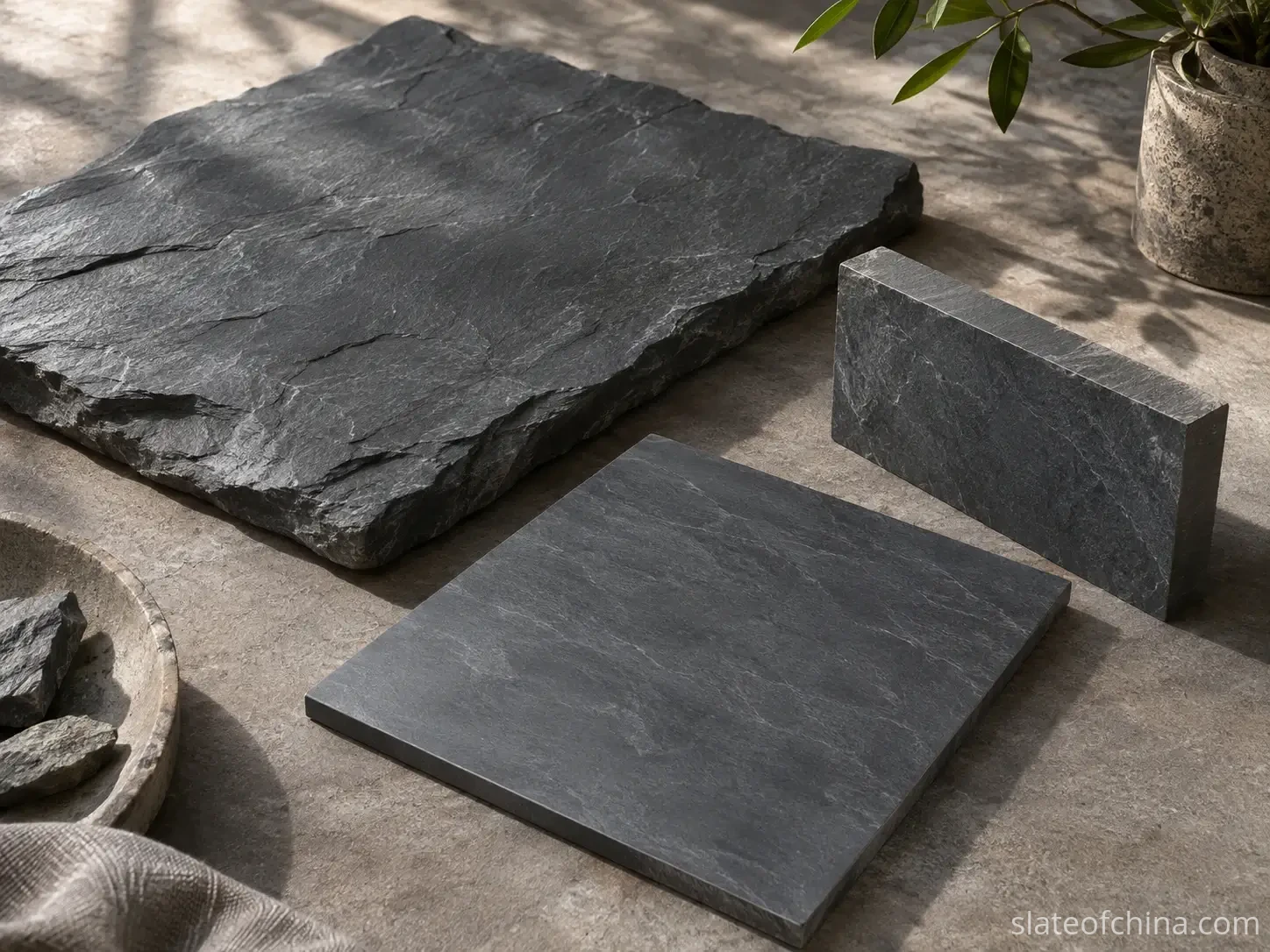
| Property | Quick reference | What to request for your order |
|---|---|---|
| Water absorption | Measured as a percentage of dry mass under a specified immersion method. The figure depends on the stone offered — request the result rather than assume a range. | Request the water absorption result for the offered stone and the test method used. EN 13755 measures absorption by immersion at atmospheric pressure. |
| Apparent density | 2,700–2,800 kg/m³ (2.70–2.80 g/cm³) — the calculation assumption behind the weight table below; confirm the apparent density for the offered stone. | Apparent density for the offered stone, for example from an EN 1936 report. Use actual piece and crate weights for dispatch. |
| Flexural strength | Expressed in MPa (N/mm²). EN 12372 determines flexural strength under a concentrated load. | The reported value and statistic, specimen conditioning, and orientation relative to the slate cleavage where relevant. |
| Breaking load | Reported in N or kN. The result is tied to the specimen size, span and test setup. | Performance evidence relevant to the finished format and the proposed support arrangement. |
| Thickness | 10–15 mm and 20–30 mm are useful first enquiry bands for tile and paving formats. | Nominal thickness, acceptable limits, surface and back finish, and how measurements are taken. |
| Weight per square metre | 20 mm = 54–56 kg/m² at 2,700–2,800 kg/m³. | Measured piece mass for irregular formats and gross crate mass for transport. |
The density band above is a planning assumption for the weight table, not a guarantee. Confirm every figure against the exact stone and application before writing acceptance limits into a purchase order. The thicknesses are starting points for a quote; the required size, thickness and performance settle with the installation.
How much does slate weigh per square metre?
For a reasonably uniform slate tile or slab, multiply apparent density by thickness in metres. The arithmetic is simple and worth keeping handy because it lets you turn a density figure into a shipping number.
Stone mass (kg/m²) = apparent density (kg/m³) × thickness (mm) ÷ 1,000
| Slate thickness | Indicative stone mass at 2,700–2,800 kg/m³ |
|---|---|
| 8 mm | 21.6–22.4 kg/m² |
| 10 mm | 27–28 kg/m² |
| 12 mm | 32.4–33.6 kg/m² |
| 15 mm | 40.5–42 kg/m² |
| 18 mm | 48.6–50.4 kg/m² |
| 20 mm | 54–56 kg/m² |
| 25 mm | 67.5–70 kg/m² |
| 30 mm | 81–84 kg/m² |
| 40 mm | 108–112 kg/m² |
Each extra millimetre adds roughly 2.7–2.8 kg per square metre. Moving a surface from 20 mm to 30 mm raises it by about 27–28 kg/m². Across 100 m² of net stone coverage that is approximately 2.7–2.8 tonnes of extra stone before you add anything else.
Example. A rectangular 600 × 400 × 20 mm paver covers 0.24 m² and weighs about 13.0–13.4 kg. One hundred pieces are roughly 1.30–1.34 tonnes of stone. Add crates and protective material for freight planning, and account separately for the bedding, adhesive, grout, backing, rails or fixings when working out the installed dead load.

For riven slabs with noticeable thickness variation, weigh representative pieces and divide their total mass by their total measured face area. For random shapes, use the actual face area rather than the rectangle around each piece. Order coverage, net stone coverage and gross shipping weight serve three different jobs. See the slate density guide for more worked examples.
What to ask next: request the density for the exact offered stone and a real crate weight for your quantity. The table is a planning aid, not a substitute for a weighed shipment.
Thickness bands for flooring, paving and cladding
Thickness is a decision, not a catalogue column you fill in once. Different jobs land in different thickness bands, and each band comes with its own set of questions. Use the table below as the first draft of an enquiry.
| Application | What to put in the first enquiry | What settles the thickness |
|---|---|---|
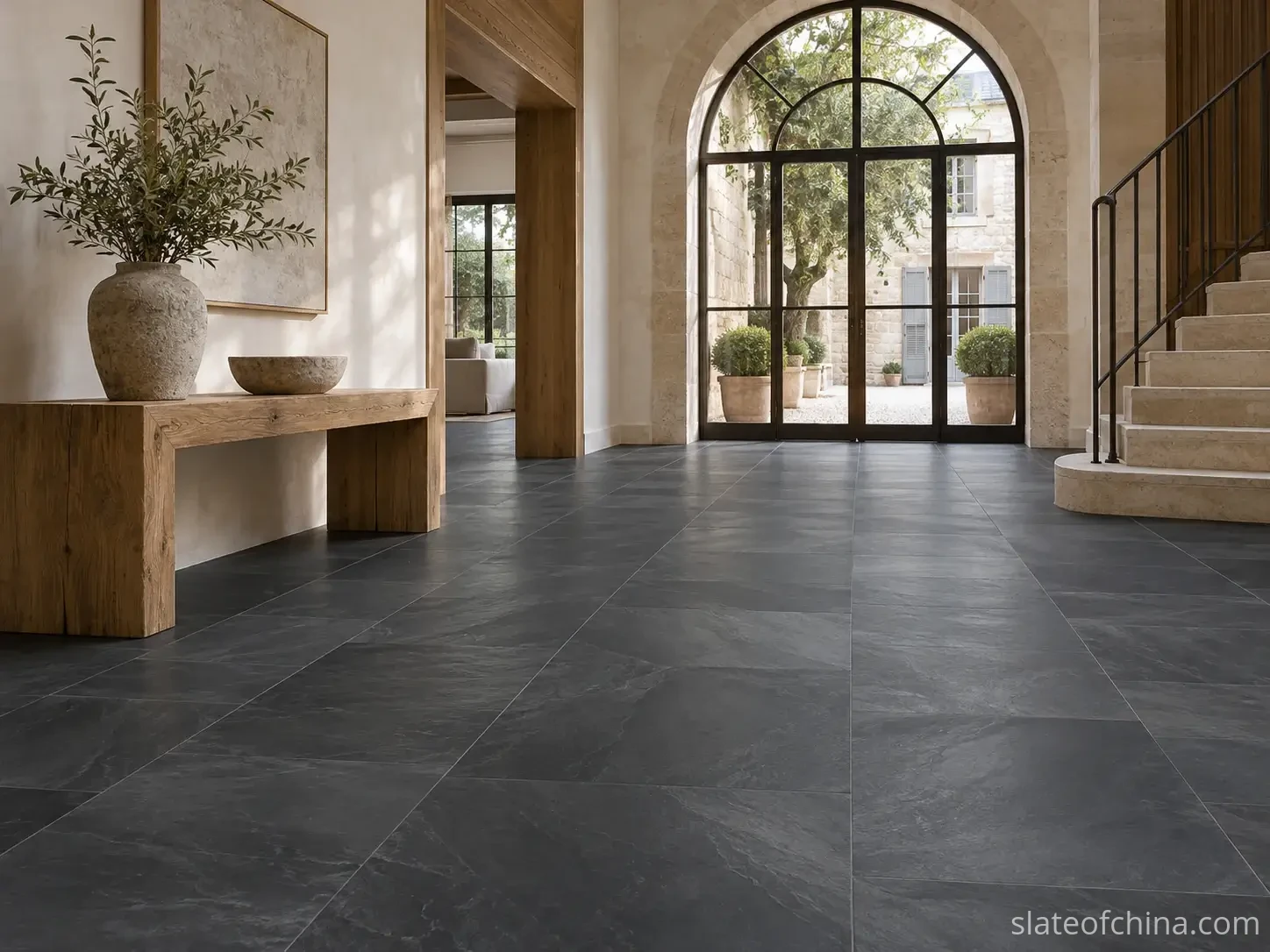
| Interior slate flooring | 10–15 mm as an enquiry range for selected tile formats on continuous support. State format, face finish and whether a calibrated back is needed. | Substrate, installation system, tile format, floor build-up and thickness variation. |
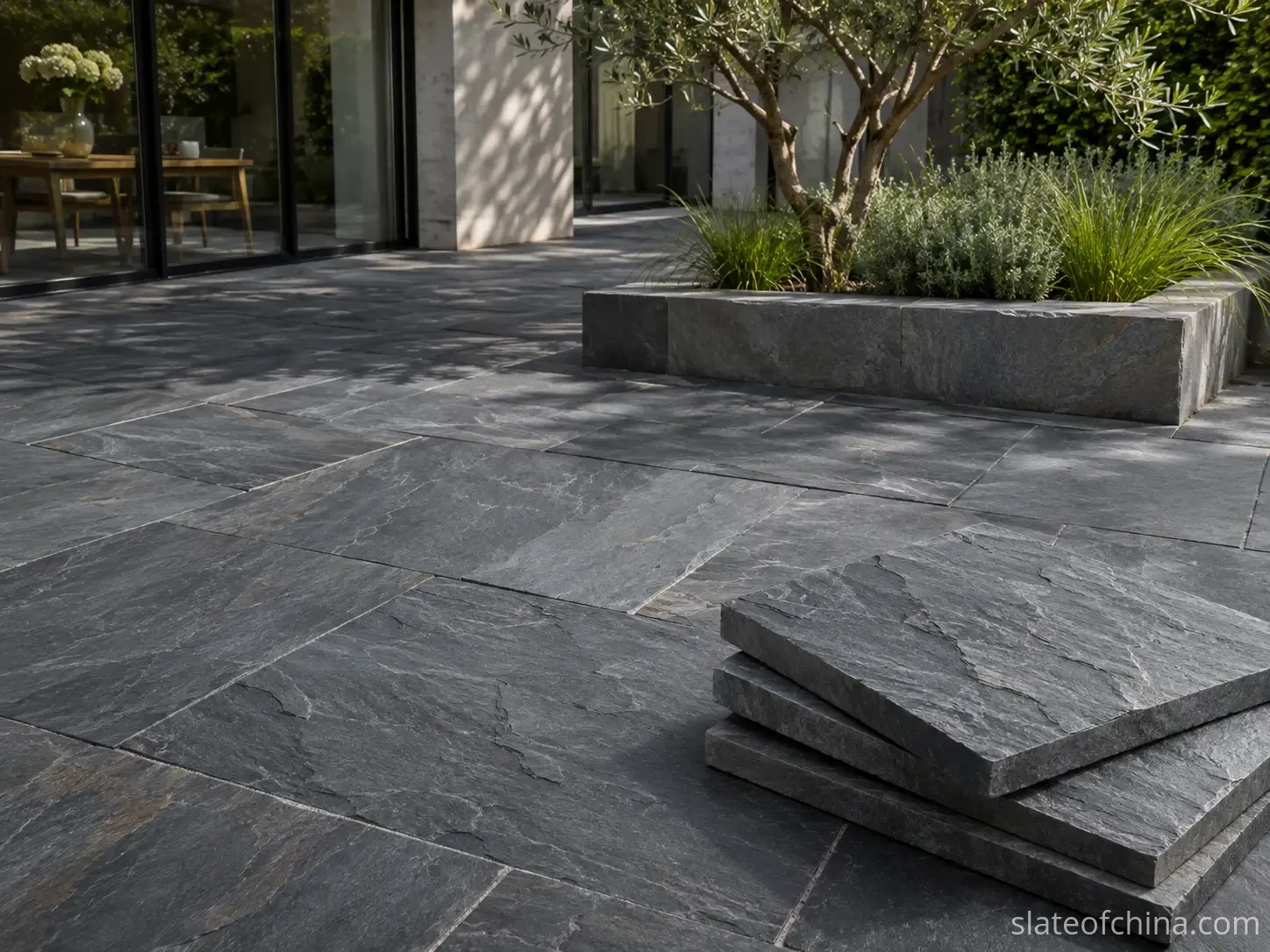
| External slate paving | 20–30 mm as an enquiry range for selected paving formats. Include traffic type, slab dimensions and bedding or support. | Evidence for the supplied format, exposure and support. For pedestal paving or vehicle traffic, set project-specific requirements. |
| Bonded slate wall tiles | Give the face format, substrate, setting system and exposure. For thin solid-stone tiles, ask what is available around 8–15 mm. | Permitted unit size and weight, bond and substrate suitability, and local project requirements. |
| Mechanically fixed slate cladding | Send panel sizes, fixing concept, joint layout and exposure before picking a thickness. | Panel and fixing design, wind actions, anchor-zone geometry and relevant stone and fixing evidence. |
| Landscape slate | Quote the item by use: stepping stone, edging or coping. Ask for the available range and actual piece weights. | Support, exposure, expected loading, size variation and handling. |
A natural-cleft face has high and low points. A calibrated back can improve thickness consistency while keeping a face texture. For a repeat order, agree the points of measurement and the acceptable readings. If the design calls for it, record the minimum at fixing zones separately. Compare bedding and pedestal options in the slate paving support systems page.
Water absorption, freeze–thaw and wet use
Water absorption tells you how much water a specimen takes up under the method used, expressed as a percentage of its dry mass. At 0.3%, a 1 kg dry specimen gains 3 g under the stated test. Compare like-for-like methods, and confirm which stone was tested before comparing two supplier figures.
For an exposed patio in a freezing climate, ask for the relevant freeze–thaw evidence and check how the assembly drains. For wet walking surfaces, ask for slip-resistance evidence for the finish and conditions that apply. Absorption, freeze–thaw behaviour and wet slip resistance are separate properties; a low absorption figure does not automatically certify the other two. See the water absorption guide and the freeze–thaw resistance guide.
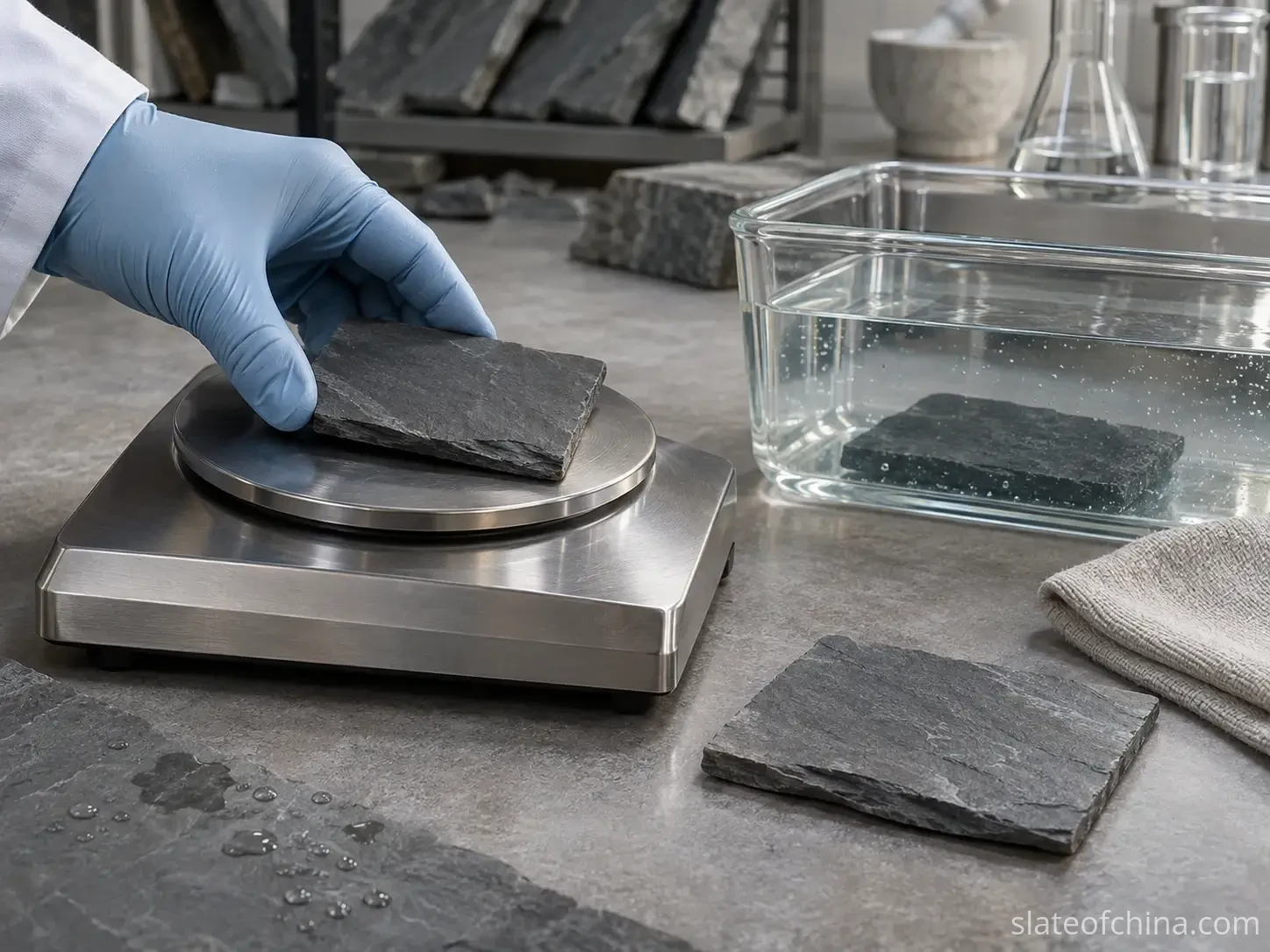
What to ask for the absorption of architectural slate: the tested stone, the test method, and the result basis. Ask for the freeze–thaw and slip data separately, tied to the finish and the conditions of the site.
Breaking load and flexural strength
Flexural strength in MPa describes the calculated bending stress at failure in the test specimen. Breaking load in kN describes the force at failure in the test setup. Two specimens with similar flexural strength can break under different loads if their thickness, width or support span differs.
If a sheet says breaking load: 4 kN, ask for the specimen dimensions, span, loading arrangement and result basis. A paver on pedestal heads works differently from a tile on continuous support. For a wall panel, ask separately for evidence tied to its fixing detail. Use the designer’s acceptance criteria for either system. The slate breaking load and flexural strength page explains the mechanics and gives examples.

Which test report goes with which slate product?
The product standard describes requirements for a product within its scope; the test method describes how a property is measured. Matching a report to the right product standard is where many errors creep in. A roofing report may describe material from the same source, but a floor, paver or façade needs evidence for that product and use.
| What you are buying | Product-standard reference to check for European specifications |
|---|---|
| Natural stone slabs for external paving | EN 1341 |
| Natural stone slabs for floors and stairs | EN 12058 |
| Natural stone modular tiles | EN 12057, where the product falls within its scope |
| Natural stone slabs for cladding | EN 1469 |
| Slate for discontinuous roofing or cladding | EN 12326 series, where that product scope applies |
Confirm the applicable edition, product scope and market requirements. The distinction between a method and a product standard matters most when someone hands you a single sheet and expects it to cover every use. See architectural slate standards for the scope boundaries.
What to send when requesting a technical data sheet
Keep the enquiry short but complete. Include the intended use, project location, piece dimensions, quantity, face and back finish, the proposed support or fixing, and any specified test methods or acceptance values. Ask the supplier to name the quarry or product reference and to separate representative test reports from any lot-specific checks.

Please quote 600 × 400 mm natural-cleft slate paving for a pedestrian courtyard on a continuously supported bed. We are comparing nominal 20 mm and 30 mm. Please confirm available thickness limits, estimated piece mass, gross crate weight and relevant test reports for the proposed stone. The site is exposed to winter freezing. Please identify any freeze–thaw and wet slip-resistance data available for the quoted product and finish.
Use the slate specification sheet to prepare a complete enquiry, and request the data together with the quotation and a sample that represents the proposed finish.
Technical references
The documents behind the reference numbers. Product standards describe requirements for a product within their scope; test methods describe how a property is measured. EN standards are named by title and edition here as text references; the official standard pages below are current at the time of writing.
- EN 13755 — determination of water absorption at atmospheric pressure.
- EN 1936 — determination of density and porosity.
- EN 12372 — determination of flexural strength under a concentrated load.
- EN 1341 — natural stone slabs for external paving.
Frequently asked questions
How much does architectural slate weigh per square metre?
A reasonably uniform tile at 20 mm weighs about 54–56 kg/m² when the apparent density is 2,700–2,800 kg/m³. Each extra millimetre adds roughly 2.7–2.8 kg/m², so 30 mm is about 81–84 kg/m².
Which thickness band should I start with for flooring?
For interior flooring on continuous support, 10–15 mm is an enquiry range for selected tile formats; 20–30 mm is an enquiry range for selected paving formats. Confirm the format, finish and support before fixing the figure.
What is the typical density of natural architectural slate?
2,700–2,800 kg/m³ (2.70–2.80 g/cm³) is the calculation assumption behind the weight table on this page. Confirm the apparent density for the exact stone offered, and use real piece and crate weights for dispatch.
What water absorption figure should I ask for?
Request the water absorption result for the offered stone and the test method used. Compare like-for-like methods before comparing two supplier figures.
How is breaking load different from flexural strength?
Breaking load in kN is the force at failure in the test setup; flexural strength in MPa is the calculated stress at failure. The same strength can give different loads when thickness, width or span differs.
Which test standard covers external slate paving slabs?
EN 1341 covers natural stone slabs for external paving. EN 12058 covers floors and stairs, EN 1469 covers cladding slabs, and the EN 12326 series covers discontinuous roofing or cladding within its scope. Match the report to the product and use.
What should I include when requesting a slate technical data sheet?
Include intended use, location, piece size, quantity, face and back finish, the proposed support or fixing, and any acceptance values. Ask the supplier to name the quarry or product and to separate representative reports from lot-specific checks.
Need a technical reference matched to your stone? Tell us the application, dimensions, thickness, finish and destination port. We’ll point to the right density, weight, test report and packing estimate for your order. Request a slate technical quote.