
Water Absorption in Architectural Slate: The First Number to Ask For
A supplier sends over a technical data sheet for the slate you are considering for a terrace or a façade. You scan down the columns. The first figure you pause on is almost always water absorption — and that is exactly where you should stop first.
Water absorption is a useful first signal for natural slate. It is standardized, it is quick to compare, and it tells you something about how the stone responds to moisture. But it is a first signal, not a final verdict. The rows that follow on the same data sheet — frost resistance, strength, slip, fixing performance — are what turn that single number into a workable specification.
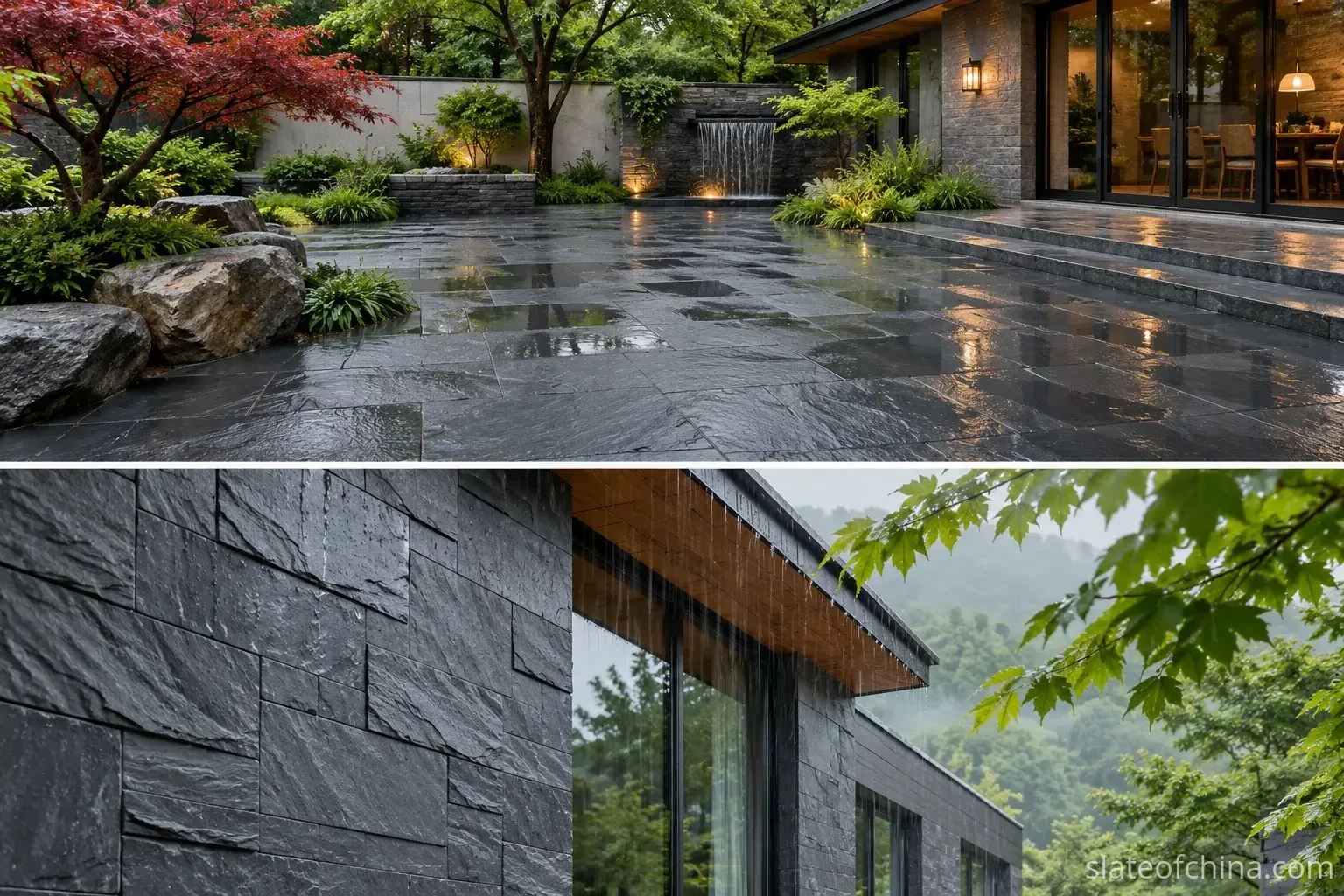
What the first number of a slate data sheet measures
Water absorption is the amount of water a stone specimen takes in during a defined test, expressed as a percentage of its dry mass. Natural slate is a fine-grained metamorphic rock with a layered fabric; its pores, microcracks and cleavage planes all influence how moisture moves into and through the stone. Two slates can look similar and still absorb water very differently.
The calculation is straightforward: take the dry mass, measure the saturated mass after the test, and express the gain as a percentage. For example, a specimen with a dry mass of 1,000 g that reaches 1,004 g after immersion has absorbed 0.4% of its own weight.
That 0.4% does not mean 0.4% of the surface is porous, and it does not mean 0.4% of the rain falling on a patio enters the stone. It means that, under those test conditions, the specimen gained water equivalent to 0.4% of its dry mass.
Why absorption is the number buyers ask for first
Absorption is useful because it is standardized, quick to compare, and relevant to almost every outdoor application. Moisture is hard to avoid for architectural slate: rain falls on patios and walkways, wind-driven rain reaches exterior walls, ground moisture affects poorly drained paving, and in cold climates absorbed water becomes part of a more complicated freeze–thaw story.
A single absorption figure gives you a first point of comparison between candidate materials. It helps you decide where to focus next. Treat it as a screening parameter — not as a complete durability rating.
Reading the number: 0.3% versus 0.6%
There is no universal percentage that guarantees every slate application. The right target depends on the project, the applicable standard, the climate and the exposure. The figures below are illustrative examples for comparison — not universal pass or fail marks.
| Reported absorption | What a buyer should consider |
|---|---|
| 0.2% | Low measured uptake; still verify the test method and the supporting properties. |
| 0.4% | Relatively low measured absorption; suitability must be verified against application-specific performance requirements. |
| 0.6% | Review frost performance, pore characteristics and the intended exposure. |
| 1.0% | Investigate moisture-related risks and the applicable specification carefully. |
Two candidate slates reporting 0.3% and 0.6% may come from different test methods, different batches, or different geological fabric. So the comparison only makes sense once you confirm both numbers were produced the same way. The useful question is never simply "is it below 0.5%?". It is "does this stone meet the complete set of requirements for this application and this climate?".
How the number is produced: ASTM C121 and EN 13755
Reliable absorption figures come from an identifiable test method. Two references matter for architectural slate: ASTM C121/C121M, which is specifically written for water absorption of slate, and EN 13755, which covers water absorption of natural stone at atmospheric pressure.
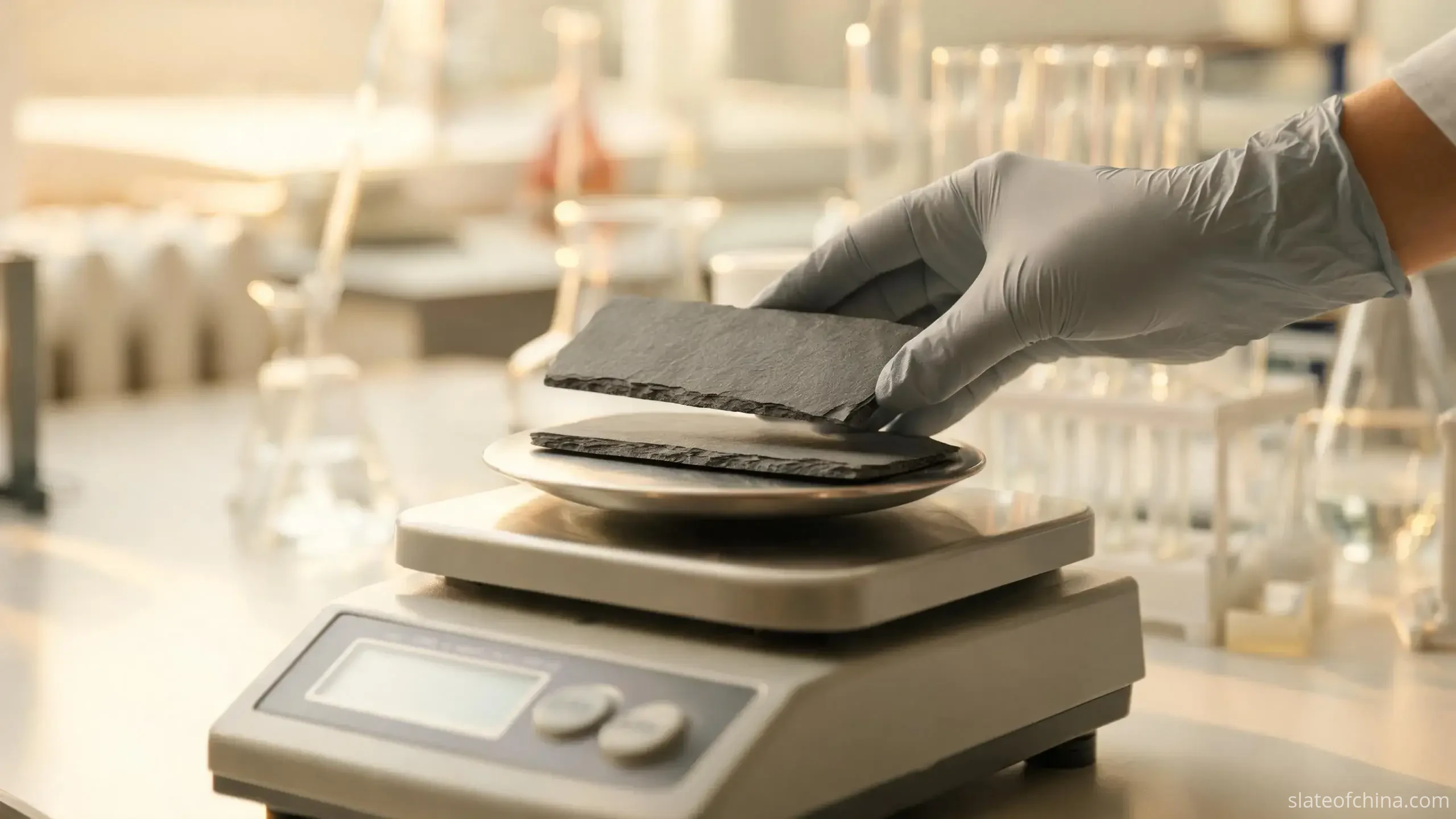
In both methods the general sequence is the same: the specimen is dried to a constant mass and weighed, then immersed under controlled conditions, then surface-wiped and re-weighed, and the result is calculated from the two weights and reported with specimen identification.
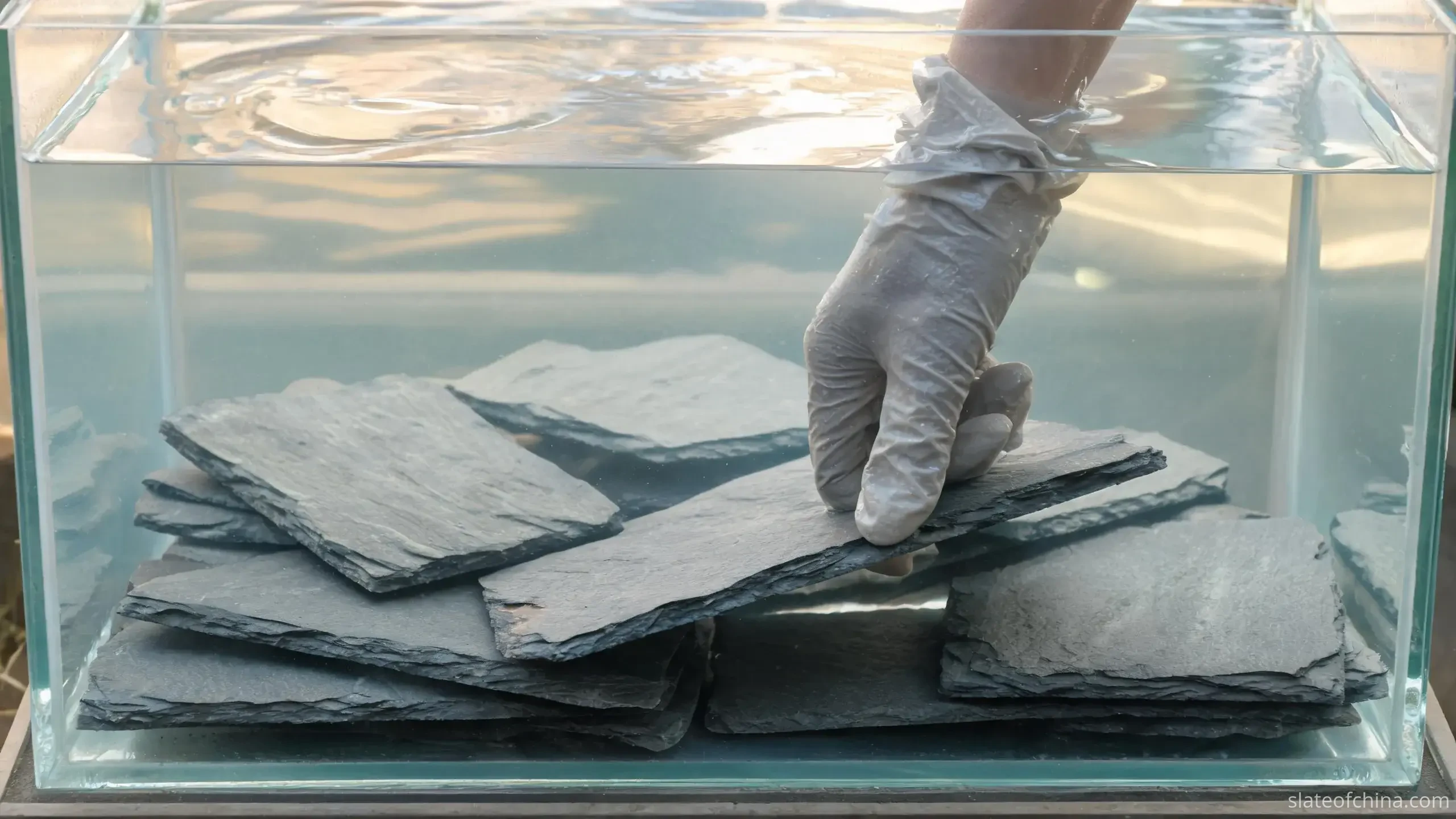
ASTM C121/C121M describes its result as one element in comparing slate materials, not as a complete performance assessment. EN 13755 does the same for natural stone in general. Do not treat the two standards as automatically interchangeable: if two suppliers report different figures, confirm they used the same method first.
A real-world reference: published results for our Jiujiang slate
For a concrete example of how these figures look when published: our Lushan (Jiujiang) material has been tested by independent accredited laboratories, with water absorption achieving the highest EN 12326-1 grade for this property (Code A1, within the 0.6% ceiling for that code) and meeting the ASTM S1 roofing classification, whose absorption ceiling is 0.25%. The same report set covers freeze–thaw testing (no visible damage, EN frost class F1) and chemical composition.
One caveat belongs in writing: those reports were issued for roofing-slate and approximately 10 mm floor-slate specimens. They are verified evidence for this material from this source — not a certification that automatically covers a specific paving or cladding product. For a project, ask for tests aligned with the application standard; the full published data sits on the slate quality and test results page.
Why the first row cannot do freeze–thaw on its own
Freeze–thaw performance is one of the main reasons absorption matters outdoors. When moisture enters a stone and the temperature falls below freezing, ice can build up stress inside pores and microcracks; repeated cycles may contribute to cracking or surface damage.
But the relationship is not set by the absorption percentage alone. Pore size and connectivity, degree of saturation, existing microcracks, the mineral fabric, and the number and severity of freezing cycles all matter. A low-absorption slate can still contain structural weaknesses, and two slates with the same absorption figure can respond differently to frost.
For exterior paving in cold climates, ask for relevant frost-resistance evidence (for example testing under EN 12371 where it applies) rather than relying on the absorption row. A low absorption number is useful supporting evidence — not a substitute for a frost test. For the full treatment of freeze–thaw selection, see Freeze–Thaw Resistance for Outdoor Slate.
The rows that must follow for slate paving
For patios, paths, terraces and pedestrian areas, the absorption figure deserves attention because paving is regularly exposed to rain and surface water. But the installed paving system performs as a system, not as a stone alone. Several other rows should sit next to absorption on your review list:
- Drainage and falls — poor drainage lets water sit under or between units; see the drainage and joint guidance in Falls, Drainage and Joint Design in Slate Paving.
- Slip resistance — low absorption does not make a surface slip-proof; wet and dry slip testing is covered in How Slip Resistance Is Measured.
- Flexural strength or breaking load — the unit must carry the intended loads across its supports.
- Abrasion resistance — relevant where people and traffic will be routine.
- Frost resistance — where winters freeze, request the frost test alongside absorption.
- Thickness, dimensional tolerance and joint design — the unit and the lay plan together carry the load.
When you are ready to shortlist units for a project, the slate paving range lists the formats, thicknesses and finishes worth specifying for outdoor work.
| Paving row | What to ask for |
|---|---|
| Water absorption | Measured by the identified method, on the material being supplied. |
| Frost resistance | Relevant freeze–thaw test where the climate freezes. |
| Strength | Flexural strength or breaking load for the intended support. |
| Slip | Wet/dry slip test data for the finished surface. |
| Wear | Abrasion test appropriate to expected traffic. |
A different set of rows for wall cladding
Slate cladding and slate paving may look alike, but they face different demands. Paving carries foot traffic, wear and direct contact with the support. Cladding must stay securely attached to the building while exposed to weather. For wall cladding the absorption row still helps describe moisture response, but it cannot establish the safety of the façade system. The rows that follow are different.

- Flexural strength — panels must be adequate for their dimensions, support conditions and design loads.
- Fixing performance — anchors, kerfs, drilled holes and panels all need design and verification.
- Panel thickness and orientation — slate is directional; the geological fabric and cleavage orientation affect performance.
- Moisture management — the façade must drain and ventilate where appropriate, with flashings, joints and weather-proofing.
- Weathering and frost exposure — both the stone and the whole wall assembly must suit the site.
For natural stone cladding in European projects, EN 1469 is an important product-standard reference (see the Architectural Slate Standards guide). A slate with excellent absorption results can still be unsuitable for a particular cladding system if its strength, fixing arrangement or panel dimensions are wrong. For the panel families and formats used on walls, see the slate wall cladding range.
What the first number cannot tell you
An absorption figure cannot, by itself, answer several questions a project needs to settle. Slate's layered structure makes this especially true: the natural cleavage that gives slate its attractive surface and its ability to split into slabs is not the same as a tendency to deteriorate in service. A low absorption row says nothing by itself about whether a particular material will shed, crack, wear or stain as it weathers.

| Property | Can absorption alone verify it? | Better evidence |
|---|---|---|
| Frost resistance | No | Relevant freeze–thaw testing |
| Flexural strength | No | Appropriate flexural testing |
| Slip resistance | No | Wet/dry slip tests |
| Abrasion resistance | No | Abrasion test results |
| Delamination risk | No | Petrographic review + material history |
| Stain resistance | No | Application-specific stain testing |
| Long-term weathering | No | Weathering data + service history |
Two more things to keep distinct. "Low water absorption" is not the same as "waterproof": an installed surface includes joints, bedding, edges and interfaces, and water can move through the system even when the slab itself absorbs little. And low absorption is not a guarantee of stain resistance, which depends on the contaminant, the finish and the cleaning method. On both points, the safest wording in a spec is "low water absorption", not "waterproof slate".
Checking a supplier's first row: where the number came from
A supplier sheet might simply state "Water Absorption: 0.3%". Useful — but an experienced buyer checks what supports the figure. Reported low values are tied to the tested specimens and the method that produced them; treat them as belonging to that sample and its report, not as a promise about a future batch.

Slate water absorption report checklist — eight lines to print or paste into a sourcing file:
- ☐ Test standard & edition — the full reference (ASTM C121/C121M or EN 13755) and the edition used
- ☐ Stone source & sample — quarry, material and specimen identified in the report
- ☐ Test date — recent enough to represent current production
- ☐ Specimen count — individual results plus the reported mean
- ☐ Laboratory — identity and any accreditation noted
- ☐ Order match — the tested material is the stone being delivered
- ☐ Supporting frost evidence — freeze–thaw results where the climate freezes
- ☐ Supporting strength evidence — flexural or breaking-load data for the intended support
A credible sheet makes it easy to trace the number back to a test. If a supplier cannot explain where the figure came from, treat it as an unverified claim rather than a confirmed material property. When we at our Jiujiang plant issue absorption results, we report the test method, the specimen set and the batch it represents — that traceability is what a responsible buyer is asking for.
Two suppliers, one first number
Consider a landscape contractor choosing slate for an outdoor terrace in a region that freezes in winter. Two suppliers offer visually similar charcoal-grey slate.
| Evaluation factor | Supplier A | Supplier B |
|---|---|---|
| Water absorption | 0.3% | 0.5% |
| Test method identified | Yes | Yes |
| Frost-resistance evidence | Not supplied | Supplied |
| Flexural strength | Supplied | Supplied |
| Wet slip-resistance evidence | Not supplied | Supplied |
| Material traceability | Unclear | Documented |
Illustrative comparison only; the figures and suppliers are fictional. Supplier A looks better at first because its absorption is lower. But Supplier B has supplied a more complete set of evidence for the intended use. That does not automatically make B's stone superior — the results still need checking against the project's acceptance criteria. It does, however, make B's proposal easier to evaluate responsibly. Procurement decisions should rest on a coordinated set of properties, not on one headline figure.
Writing the row into the specification
Instead of a vague "low absorption slate" requirement, project teams can use measurable, verifiable language.
Spec example
Natural slate shall be tested for water absorption in accordance with the specified edition of EN 13755 or ASTM C121/C121M, as applicable. Test reports shall identify the material source, specimen details, test method and reported results. Acceptance criteria shall be established by the project specification, taking account of the intended application and exposure.
Then list the other rows separately: for paving, frost resistance, strength, abrasion, slip and dimensional tolerances; for cladding, panel dimensions, strength, fixing arrangement and façade-system design. This makes supplier comparisons transparent and reduces the risk of choosing stone on an isolated laboratory value alone.
Frequently Asked Questions
Is 0.3% water absorption good for slate?
A measured 0.3% indicates relatively low water uptake by mass under the reported conditions. It is not a universal guarantee. Check it against the project specification and support it with the other relevant tests.
Is slate suitable for outdoor paving in cold climates?
Some natural slate is, but suitability depends on the specific material, its frost performance, mechanical properties and the installation design. Absorption alone does not confirm freeze–thaw durability.
Does slate absorb more water than granite?
There is no reliable single answer for all slate and granite. Both are natural stone categories with large variation in mineral make-up, microstructure and absorption. Compare the specific materials under the same test standard.
Can a low-absorption slate still delaminate?
Yes. Absorption does not fully describe cleavage quality, microcracks or mineral alteration. Selection should weigh the geological structure and relevant performance evidence, not just the absorption row.
Does sealing slate reduce water absorption?
Some impregnating treatments can reduce liquid uptake on a surface, depending on the product and stone. A treated surface is not a substitute for drainage or for the material's own test data; see the sealing and maintenance guidance.
Which absorption test should I request for natural slate?
ASTM C121/C121M is written specifically for slate; EN 13755 covers natural stone water absorption at atmospheric pressure. The choice depends on the project spec and market.
Is low absorption the same as frost-proof?
No. A low absorption figure is supporting evidence but not a frost test. Frost performance depends on more than the absorption bar; request the relevant freeze–thaw evidence for cold-climate work.
Technical references
The following references are useful starting points for further verification. They describe test methods rather than establishing universal acceptance limits for every paving or cladding project, so applicable editions and project requirements should be checked before specification.
- ASTM C121/C121M — Standard Test Method for Water Absorption of Slate (official ASTM page; confirm the current edition in the ASTM catalogue)
- BS EN 13755:2008 — Determination of Water Absorption at Atmospheric Pressure
- ASTM C217/C217M — Weather Resistance of Slate (historical edition)
Ask for the first number — then ask for the evidence.
If you are specifying slate for a terrace, a walkway or a wall, tell us the application, dimensions, finish, exposure and any testing you need. In return, the discussion can cover material specifications, physical samples, the test documentation available for the material, finish options and export packing — before anything is committed to production.