
Sealing and Maintaining Slate Paving: What a Sealer Changes, and What It Cannot
Sealing slate paving is a decision, not a step of the build. No material standard asks for it, no laying system requires it, and nothing in a can replaces the two things that actually decide how long an outdoor slate surface lasts: the stone you bought, and the construction it sits on. What a good sealer does is slower and more modest — and genuinely useful. It buys time. Time between a spill and a stain, time between one cleaning and the next, and, with some products, a deeper, quieter version of the colour you chose the stone for.
Natural slate paving does not always need sealing. Whether a slate patio, a garden path or an outdoor terrace should be sealed depends on the stone’s water absorption, its surface finish, the installation conditions and the exposure to staining. A suitable penetrating sealer can reduce liquid absorption and make certain stains easier to remove — but it cannot replace proper drainage, suitable stone selection or regular cleaning.
That modesty is worth stating at the top, because sealing is where enthusiasm does the most damage. Sealer applied over damp stone traps the damp. Sealer applied over dirt locks the dirt in. Sealer bought to stop moss, frost damage or pooling water fails at all three, because none of those problems live on the surface. This page takes the question seriously in both directions: what sealing slate paving genuinely changes, what it never touches, and how to write a maintenance plan around the finish and the setting you actually have — a plan that adjusts on evidence, not on anniversaries. It is written for homeowners, landscape contractors, importers and the specifiers who answer to all three: anyone, in short, who will either pay for the maintenance plan or have to write one.
Quick answer: an option with conditions — not a guarantee
A sealer changes three things: how quickly the treated face takes in liquid, how long a stain sits on the surface before it becomes a stain, and how the face reads in colour and tone.
It never changes two: the stone’s own tested body — its strength, its frost record, the absorption of that particular batch — and the construction beneath it: the falls, the drainage, the bedding and the joints.
The plan that follows: routine cleaning, a handful of inspection triggers, and re-treatment only when the surface asks for it — never simply because a number of years has passed.
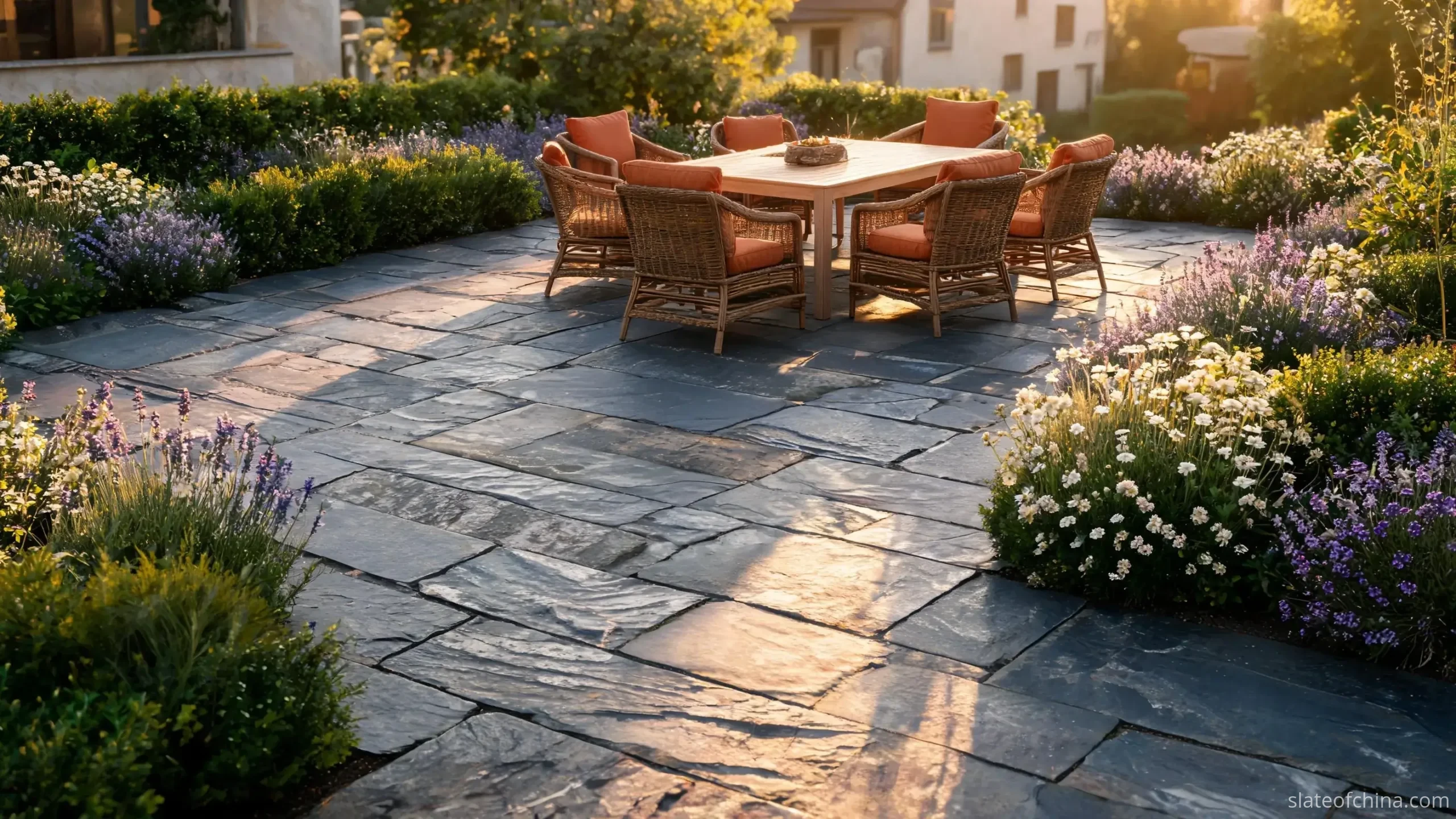
What a sealer actually changes: three things
Before choosing any product, be clear about the size of the prize. Sealing slate paving is worth doing exactly where the changes below matter, and worth skipping where they don’t.
Change one — how fast the face takes in liquid. A penetrating sealer occupies the fine near-surface openings of the treated face, so water, wine and rain sit on top of the stone instead of entering it in the first seconds. Note the wording: the treated face. The underside, the edges and the joints are not treated, and most quality impregnators are deliberately formulated to stay vapour-permeable, so moisture already inside the construction can still leave. This is surface behaviour, not waterproofing — the route water takes through the paving itself is a drainage design question, and it has its own guide.
Change two — how long a stain keeps its options open. Grill grease, oak-leaf tannin, coffee at a terrace table: with a compatible sealer the contaminant sits nearer the surface for longer, which stretches the window in which plain water and a pH-neutral stone cleaner can lift it. That window is hours, not weekends. A spill left overnight on treated slate still marks — the sealer delays a stain, it does not veto it.
Change three — how the face reads. Natural-look penetrating products leave the face close to untreated. Colour-enhancing impregnators deepen it — charcoal moves toward ink-grey, and the contrast between pieces gets stronger, which is worth knowing before falling for a showroom photo, because piece-to-piece colour variation is part of what slate is. Topical coatings add sheen. All three treatments can change the appearance of the slate, but in different ways: natural-look impregnators aim to preserve the original finish, colour enhancers deepen the stone’s tone, and topical coatings create a visible surface film. Unlike penetrating treatments, topical coatings may wear, peel or require removal and renewal over time — which is where the caution belongs.
Three changes, and each one is real. What keeps them honest is what a sealer does not do — which is the next section’s worth of reading, and the reason this page is a maintenance guide rather than a product guide.
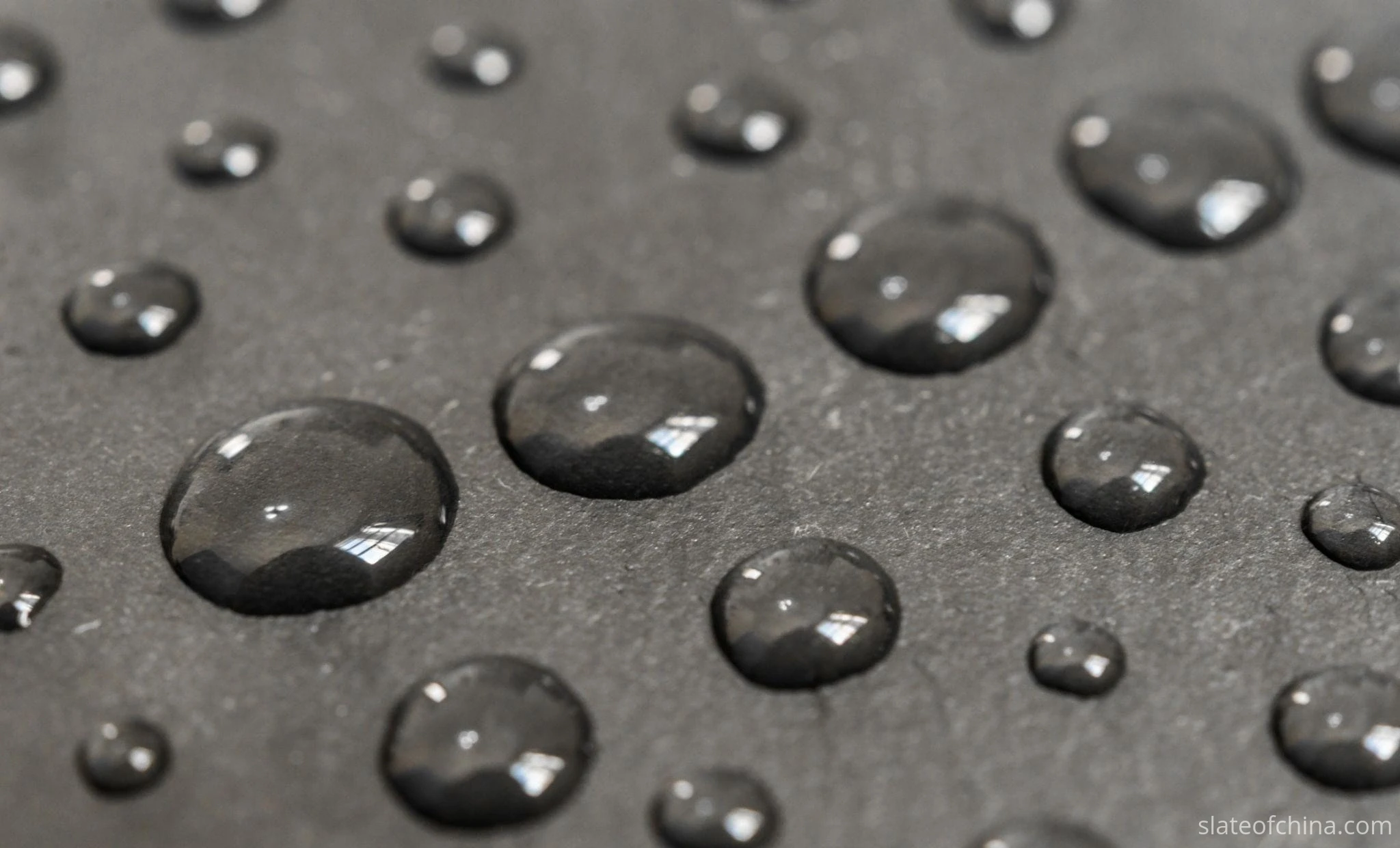
What no sealer changes: two constants and two classic mistakes
Constant one — the stone you bought. Flexural strength, freeze–thaw resistance, water absorption: these are properties of the material, measured in a laboratory on the actual batch and declared under product standards such as EN 1341, the European standard for natural stone slabs for external paving. A sealer adds nothing to any of them. Slate that is right for a terrace was right for it before the can was opened, and slate that is wrong for a frost pocket is wrong with two coats on.
Constant two — the construction it sits in. Falls, drainage, bedding, jointing, supports: the drainage and joint design and the support build-up carry the water and the loads. Sealing the top face of a pavement that holds water beneath it is cosmetic bookkeeping — the failure continues under the finish.
Which sets up the two ways sealing goes wrong, because both are predictable:
- Sealing the wrong surface. Over damp stone, over dirt, over uncured jointing or over fresh white deposits — the treatment locks the problem in instead of keeping it out. Hazing, cloudy patches and blotchy colour are the usual receipts.
- Sealing for the wrong reason. Buying a coating to stop algae in a shaded corner, to fix a puddle, or to spare an unsuitable stone a hard winter — money spent on the surface while the actual failure continues underneath it.
Both mistakes are avoidable, and the rest of this page is mostly the machinery for avoiding them: match the product to the finish and the setting, respect the timing, and re-treat on evidence.
The three chemistries on the shelf
Products come and go; the three families don’t. Knowing which family a product belongs to tells you most of what its label will not.
Penetrating, or impregnating, sealers work inside the near-surface pores of the stone rather than on top of it, which is why the slate still looks like slate. A penetrating sealer for slate is the usual starting point for exterior work where the aim is stain resistance without changing the face. Within the family there is a real split: some are water-repellent only, others add oil resistance, and the technical data sheet — not the adjective on the front — says which. Both forms, water-based and solvent-based, exist, and the data sheet also holds the temperature and moisture limits that decide whether your week is an application week.
Colour-enhancing sealers are impregnators that also deepen the tone of the stone. Used well, they give grey slate a rich, just-rained-on depth; used carelessly, they exaggerate every difference between pieces and darken the jointing wherever the product strays. Before buying one, there is a free preview on any sample: wet a spare piece with clean water and look at it. The wet colour is a close approximation of what the enhancer will leave behind — reversible in the preview, not so reversible on the terrace. Test several pieces, light through dark, before treating a whole area.
Topical, film-forming sealers sit on the surface and build a visible layer: satin or gloss, a more uniform finish, sometimes real short-term protection. On exterior paving they earn every caution they get. Films wear in traffic paths, can peel and whiten over damp stone or unsuitable substrates, can change how the surface behaves when wet, and when they fail they generally have to be stripped before anything else can be done. If a film is genuinely wanted outdoors, it has to be a product explicitly rated for exterior natural stone paving — and even then, plan for its eventual removal as part of owning it.
| Family | What it does | Effect on the look | Exterior behaviour | What it asks of you |
|---|---|---|---|---|
| Penetrating (impregnating) | Occupies the near-surface pores of the face and slows liquid entry | Close to natural; slight deepening with some products | The default candidate; product-specific moisture and temperature limits apply | A clean, dry, sample-tested surface and the applicator the manufacturer names |
| Colour-enhancing | Impregnates and deepens the tone | Darker, richer; stronger contrast between pieces | Works outdoors when rated for it; jointing may darken where product strays | Sample testing across light and dark pieces before the full area |
| Topical (film-forming) | Builds a layer on top of the stone | Satin or gloss; more uniform | The riskiest family outdoors: wear, peel, whitening, changed wet behaviour | A product rated for exterior paving, a maintenance plan, and eventually a strip |
One more compatibility layer that gets skipped at the price of a callback: the joints. Slate paving is a system, and a sealer that suits the stone can still darken a resin joint, sit badly on uncured mortar, or be forbidden before jointing by the jointing manufacturer’s own instructions. When two technical data sheets disagree, the paving system’s documentation wins — seal the stone where the system allows it, not where the can would prefer it.
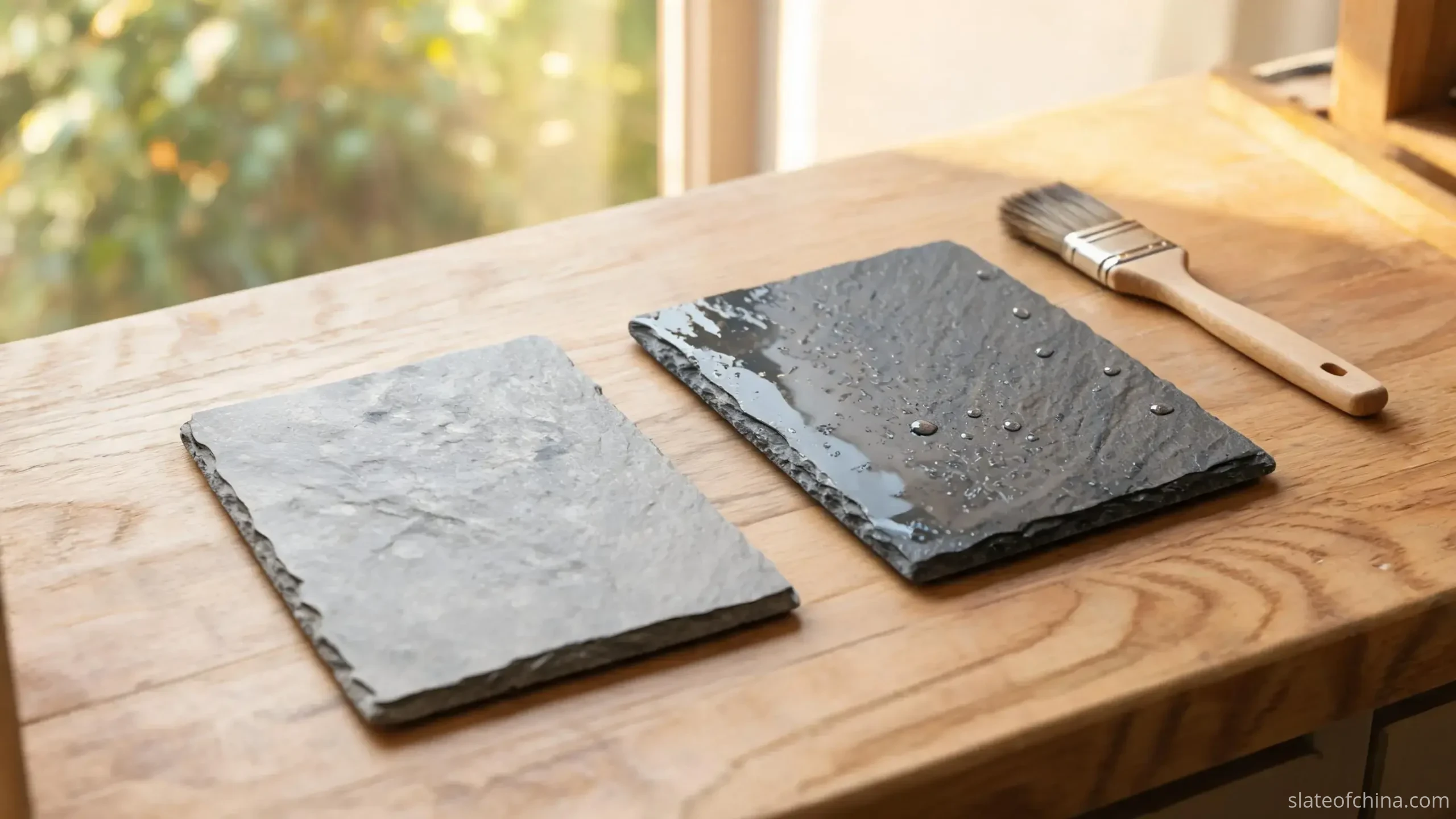
The finish writes the cleaning schedule
The face finish of the slate decides how dirt arrives and how quickly you notice it — which is a maintenance question long before it becomes an aesthetic one.
A naturally riven, cleft face holds dust and leaf litter in its hollows. It forgives a lot visually — grit disappears into the texture — but it rewards broom discipline, because whatever settles in the relief stays until it is swept. A honed or sawn face is the opposite economy: it wipes clean easily and shows a film of dust, a dried drip or a patchy treatment immediately. Water absorption is primarily a property of the stone — its mineral structure, porosity and condition — rather than of the surface texture alone, though different finishes can still change how liquids sit on the exposed face and how readily dirt accumulates. A riven, honed or sawn slate should therefore be assessed on both counts, material and surface, and the cleaning routine should acknowledge which one is actually installed. The back of the slab and the thickness and format belong to the bedding conversation rather than the sealing one, but on a maintenance visit they earn a glance too: consistent calibrations keep beds even, and even beds are what keep slabs from rocking and joints from cracking.
The setting writes the stakes
The same slate lives three different lives depending on where it lands. A quiet path under birches never sees a wine glass; a restaurant terrace sees two hundred a night; a parking bay sees oil every week of the year. A maintenance plan that treats them the same is a plan written for nobody.
| Setting | What arrives on the stone | Where the plan leans |
|---|---|---|
| Shaded garden path | Leaf tannin, soil, algae spores | Sweeping, light and air, drainage of the low spots |
| Family dining patio | Food, drink, grease, furniture marks | Prompt spill response, pH-neutral washing, seasonal checks |
| Outdoor kitchen and BBQ edge | Hot grease, soot, marinades | An oil-resistant penetrating product and same-day cleaning |
| Commercial entrance and frontage | Traffic, litter, gum, cleaning chemicals | A written duty cycle and products rated for it |
| Pool surround | Constant water, pool chemicals, bare feet | Wet-tested products, caution with films, water management |
| Driveway and parking | Oil, tyre dust, winter grit | Source control and a degreasing protocol |
Two of those rows deserve a sentence more. The commercial row is its own discipline — the public-project guide covers how duty, cleaning regimes and evidence get written into a specification, and sealing there is a scheduled maintenance operation, not a one-off. The residential row, meanwhile, is where most of the slate patio sealing enquiries come from, and the patio guide covers the format, finish and edge decisions that arrive before any of this. The honest read of the table: the harsher the setting, the more the plan leans on behaviour — sweeping, spill response, seasonal checks — and the less on chemistry.
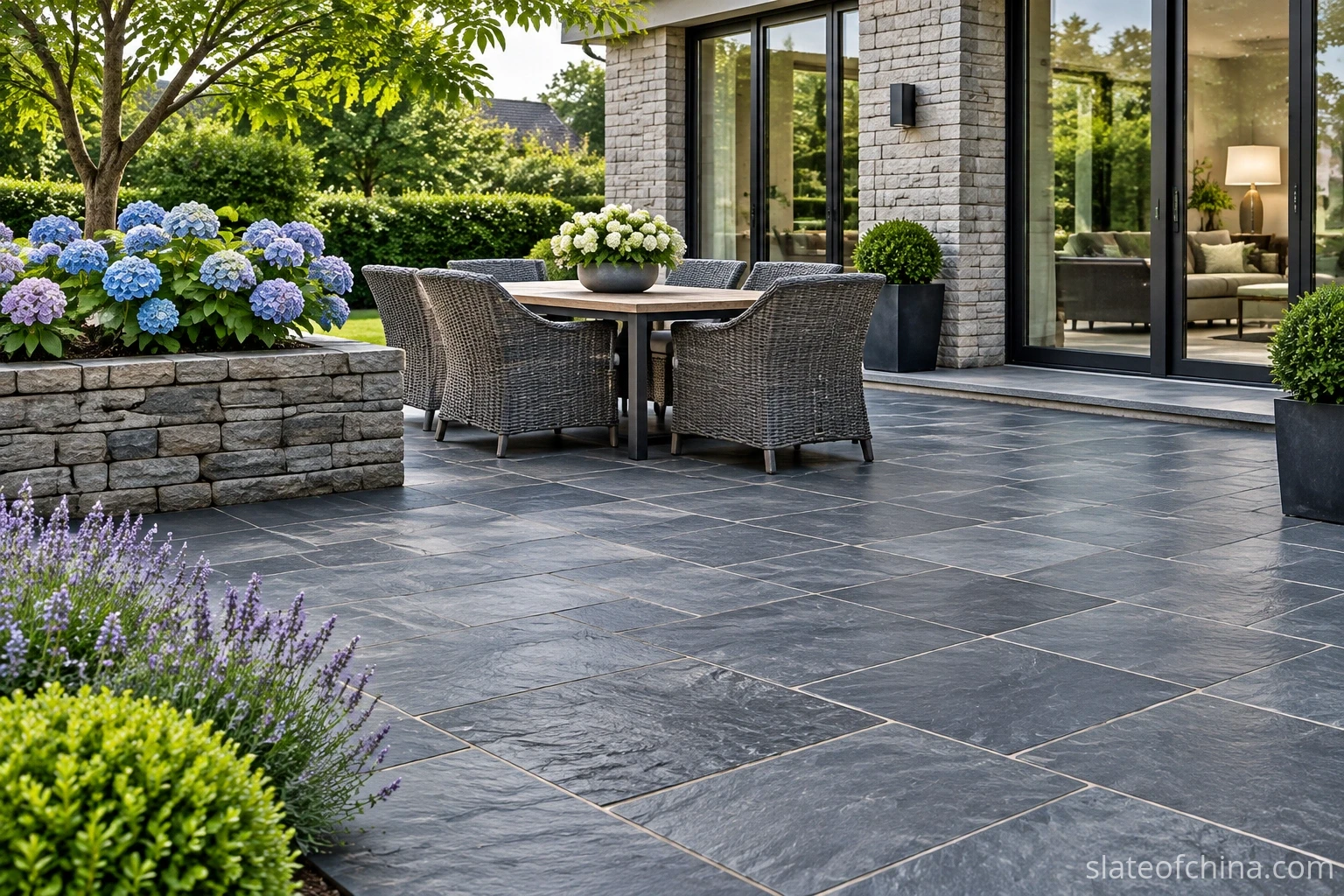
When new paving is ready for its first treatment
Timing is where sealing earns or wastes its money, and there is no waiting period that suits every build. What has to be true before any product goes on: the bedding and jointing have reached the cure their own system specifies, the stone and joints are dry through — not just dry to the touch — the surface is free of construction residue, and the weather fits the data sheet.
There are three legitimate windows, and they suit different systems:
- Pre-sealing the exposed faces before laying. Protects slabs from construction dirt and jointing stains during the build — but the faces that need to bond with the bed must stay untreated, and the product must be compatible with the mortar, adhesive or jointing that follows.
- After laying, before jointing. In systems that allow it, this keeps grout haze and pigment bleed off the face. Whether it is allowed is written in the jointing manufacturer’s documentation, not in the sealer’s.
- After completion and cure. The default for most projects — one clean, dry, inspected surface; one final treatment; one curing period.
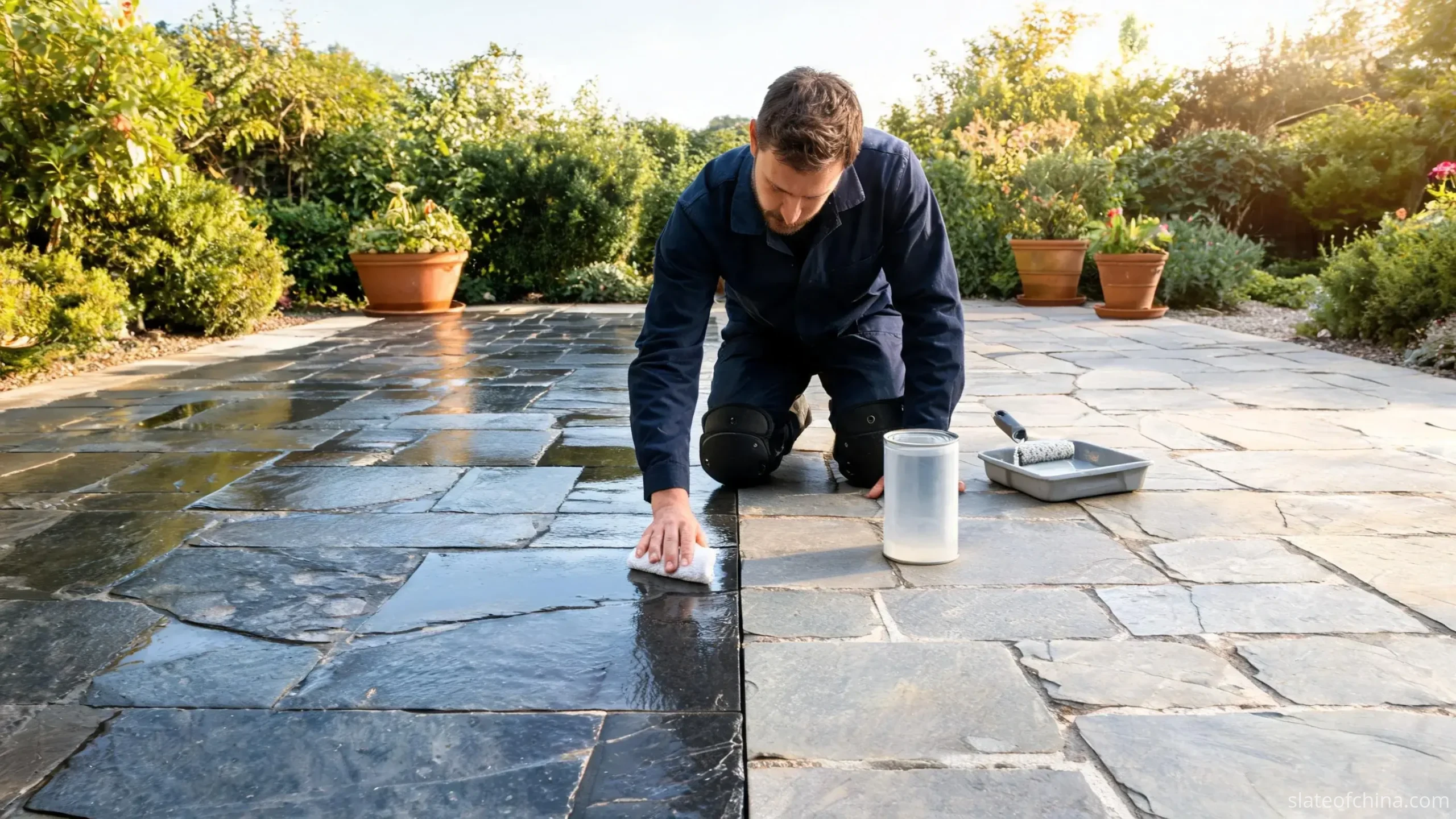
There is also a mistake that travels in containers. Slate shipped over long distances may occasionally arrive with a faint white film or surface deposits, and these should not automatically be read as defects in the stone. Possible causes include moisture-related residue from the voyage, mineral deposits, packaging contamination or other transport-related conditions. The right response is the same in every case: clean a small test area, let the slabs dry properly and identify what the deposit was before any sealer touches them; sealing a slab in that state is sealing the cause in. The same patience applies to genuine efflorescence, the white salts that ride moisture out of fresh beds and joints: let the construction dry, brush the deposit, identify the source, and only then decide whether the surface is ready. Where the moisture keeps coming from is a drainage question, and the drainage and joint guide covers it in detail.
Before the first coat, walk the paving through this list:
- Bedding and jointing cured to the system’s specified stage.
- Surface clean — no cement haze, no construction debris, no existing stains.
- Any white deposits identified and dealt with, not merely present.
- Stone and joints dry to the product’s requirement — through the slab, not on it.
- Weather inside the data sheet’s limits, with the curing window clear of rain.
- A sample area treated, cured and approved — several pieces, light through dark.
How to seal slate paving without the classic mistakes
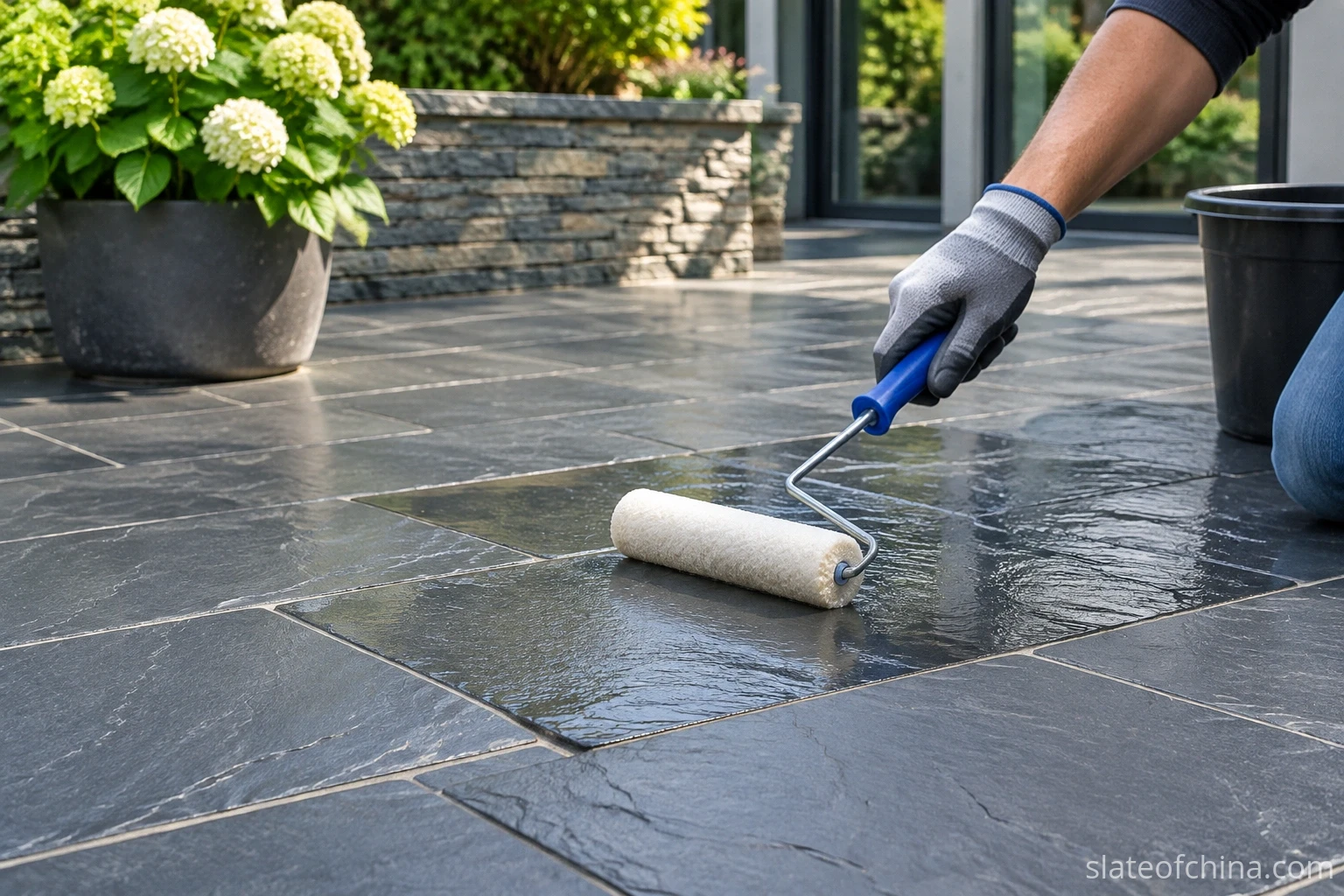
This is not a method statement — the product’s technical data sheet is the spec, and it wins every disagreement. What follows is the shape of the job and the places it goes wrong.
- Clean first. Soft or medium brush; a pH-neutral natural stone cleaner where the dirt sits. Strong acids are not cleaning — they are chemistry with side effects.
- Treat existing stains before sealing. A sealer does not remove a stain; applied over one, it can fix it.
- Dry to the product’s standard. Surface-dry is not construction-dry. If there is doubt, there is doubt — wait.
- Test on a sample area. Several pieces across the colour range, full cure, then judge colour, sheen, feel and how water behaves on it. An unsatisfactory test area is the cheapest information in the whole project.
- Apply thin and even with the applicator the manufacturer names — roller, pad or lambswool. Flooded areas and lap marks are application errors, not product features.
- Remove the excess in the stated time window. The sticky or cloudy patch later is almost always excess left too long to dry.
- Respect the cure. Keep rain, traffic and furniture off for the stated period. Touch-dry is not in service, and a treatment that cures under a table leg is a mark forever.
The routine that outperforms the chemistry
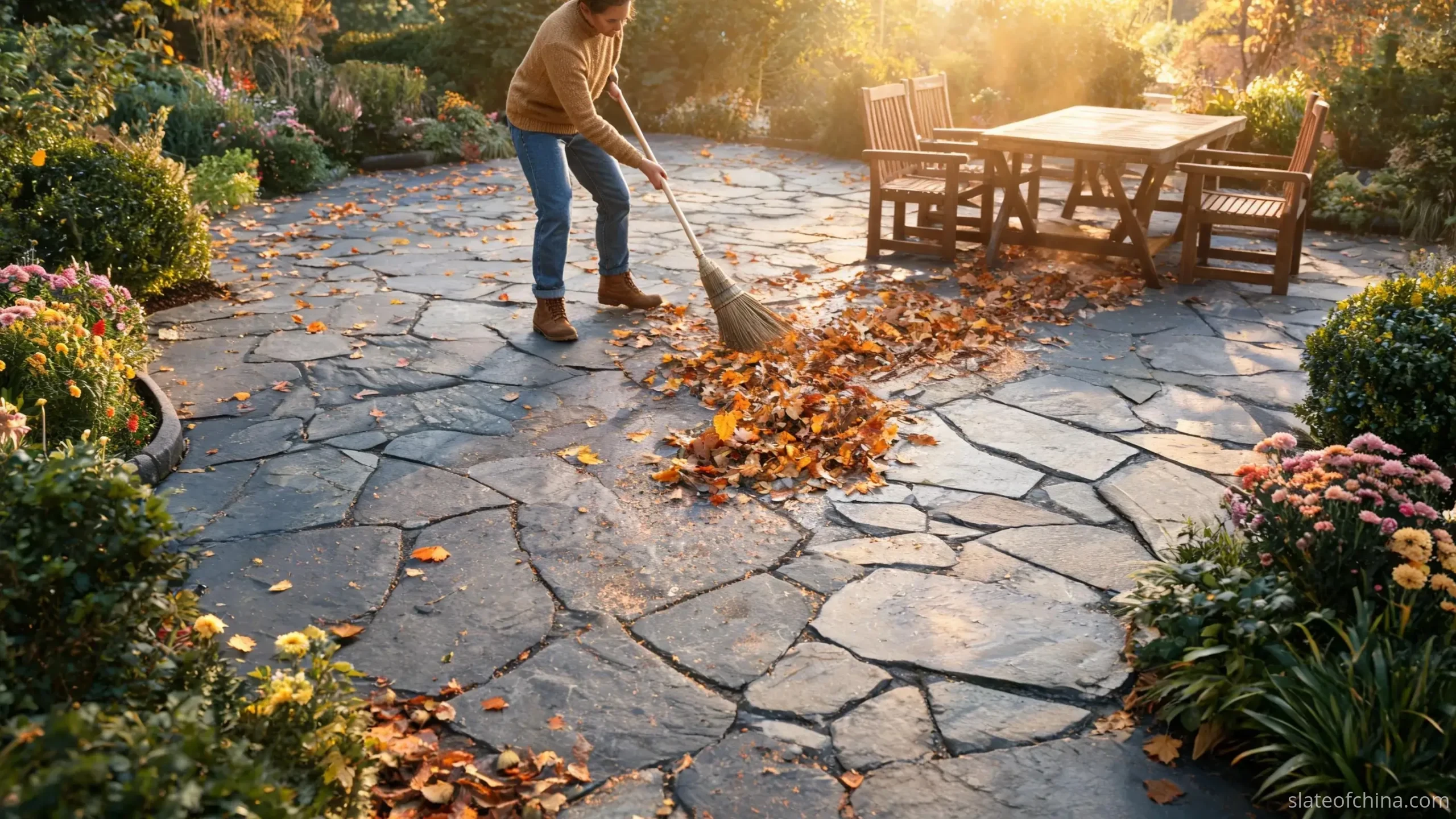
How to clean outdoor slate paving is the least glamorous and most valuable half of this page, and it comes down to three tools and a short discipline. Sweep — and in autumn, sweep like it matters, because leaves left to overwinter feed algae and leave tannin shadows where they sat. Wash with clean water when the film of dirt builds, and with a pH-neutral stone cleaner when water alone stops being enough. Deal with spills the day they happen, blotting grease rather than rubbing it in. Check the joints twice a year — cracked mortar, washed-out sand or loose resin is a construction warning, and the joint design guide explains what each failure is telling you.
What the routine should not contain: strong acids — including the vinegar that household folklore keeps recommending for stone — aggressive alkalis, and solvent-soaked rags on resin joints. All three can mark slate or damage jointing faster than any dirt they remove. A pressure washer is a tool of last resort, not a monthly habit: fan nozzle, moderate setting, working distance, and never a concentrated jet pointed into a joint. For most residential slate, a broom, water and the right cleaner carry the whole year.
Maintain on triggers, not anniversaries
“How often should slate paving be resealed?” is the question this page exists to un-answer. There is no honest universal interval. The product, the climate, the traffic, the cleaning routine and even the direction the terrace faces all move the answer, and a manufacturer’s stated years are a claim to be read and verified — a review date, not a due date.
What works instead is a short set of triggers, checked twice a year and after any hard season:
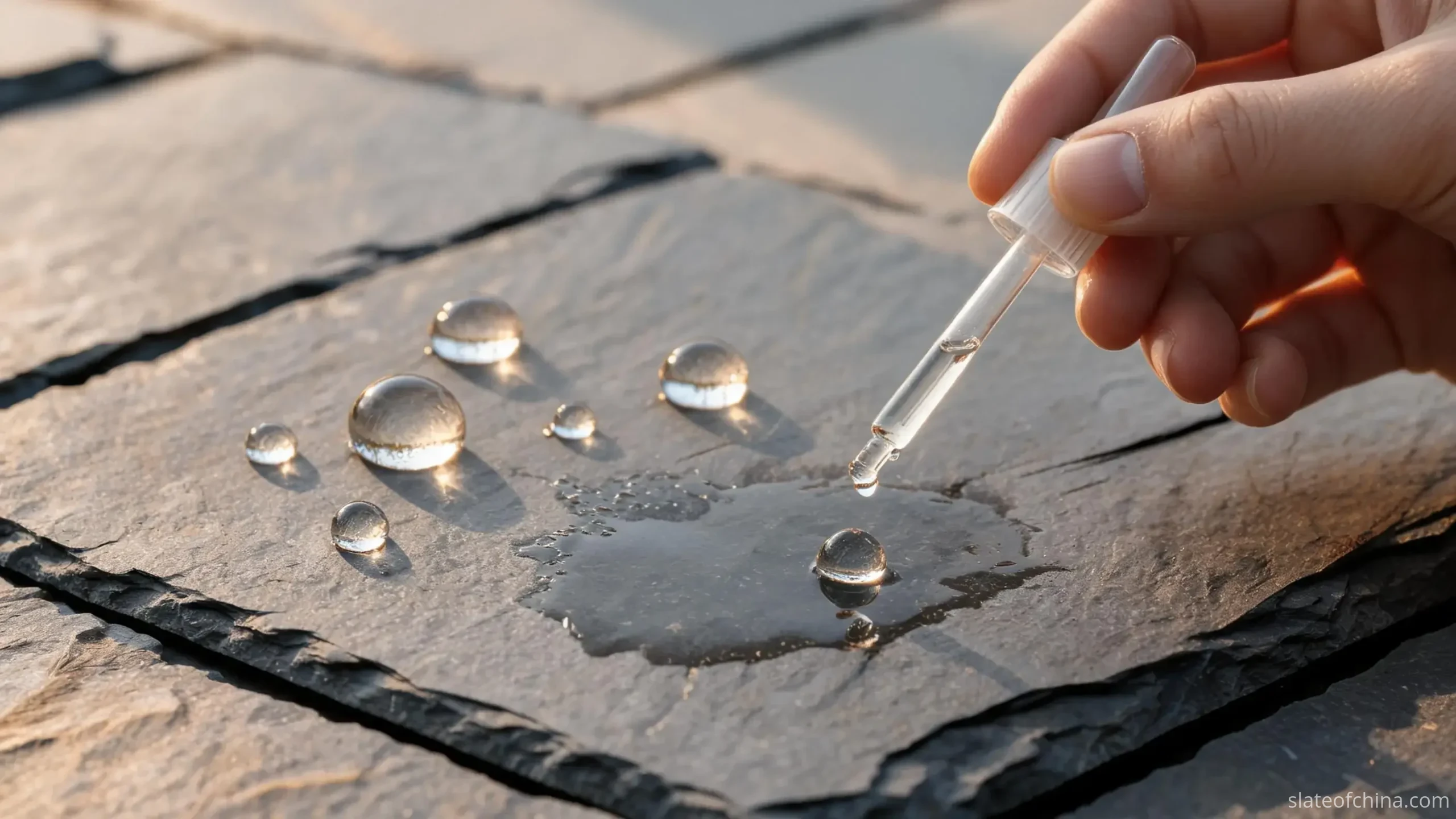
- Water stops beading: a drop on a clean, dry face soaks in and darkens within minutes instead of sitting.
- Stains begin to grab where they used to wipe away.
- An enhanced colour fades unevenly — patches of treated-looking stone among untreated-looking ones.
- Cleaning takes more effort, or more repeats, than it used to.
Any one of those is an instruction to investigate, and the water-drop check is the fastest of them: on a dry day, put drops in three or four places — a sheltered spot, a busy route, a quiet edge — and watch them for ten minutes or so. It is an indication, not a measurement: it says the surface’s behaviour has changed, not how much protection remains or why.
One caution belongs beside the drop test itself. A water-drop test is a useful screening tool, but it is not a complete measure of sealer performance: some impregnating products provide water repellency without equivalent oil resistance, others may continue to offer stain protection even when water no longer forms obvious beads, and surface cleanliness itself can change how a drop behaves. Read the drop test together with the original product’s specifications, and judge the surface under realistic conditions before deciding on re-treatment.
Before adding any product, identify what is already on the stone. Penetrating treatments usually accept a maintenance coat of their own kind on a clean, dry surface; topical films generally need full removal first. And a second coat obeys the same rules as the first — clean, dry, tested — because the two classic mistakes do not retire just because the can is half-finished.
Reading the surface: five problems and their first moves
Almost every problem blamed on sealers is a message about something else. Read the signal before reaching for a can.
| What you see | Usual source | First move | Not this |
|---|---|---|---|
| White, chalky deposits | Salts from fresh beds and joints, hard-water residue, over-applied sealer | Let it dry, brush, identify the source | Sealing over it to hide it |
| Green algae and moss | Shade, still air, damp, organic debris | Sweep, clear the drainage, let light in, treat with a stone-compatible cleaner | A stronger acid wash, or expecting a sealer to prevent it |
| Uneven colour after sealing | Absorption differences between pieces, rushed application, excess left to dry | Re-read the sample test; plan an even maintenance coat on clean, dry stone | Another full coat to even it out |
| Cloudy or peeling film | Topical product over damp stone, incompatible layers, excess application | Assess and strip properly, then decide with a sample | Sealing over the failed coating |
| Dark patches that never dry | Trapped moisture under the slab or in the bed | Read it as a drainage and construction issue | Any surface treatment whatsoever |
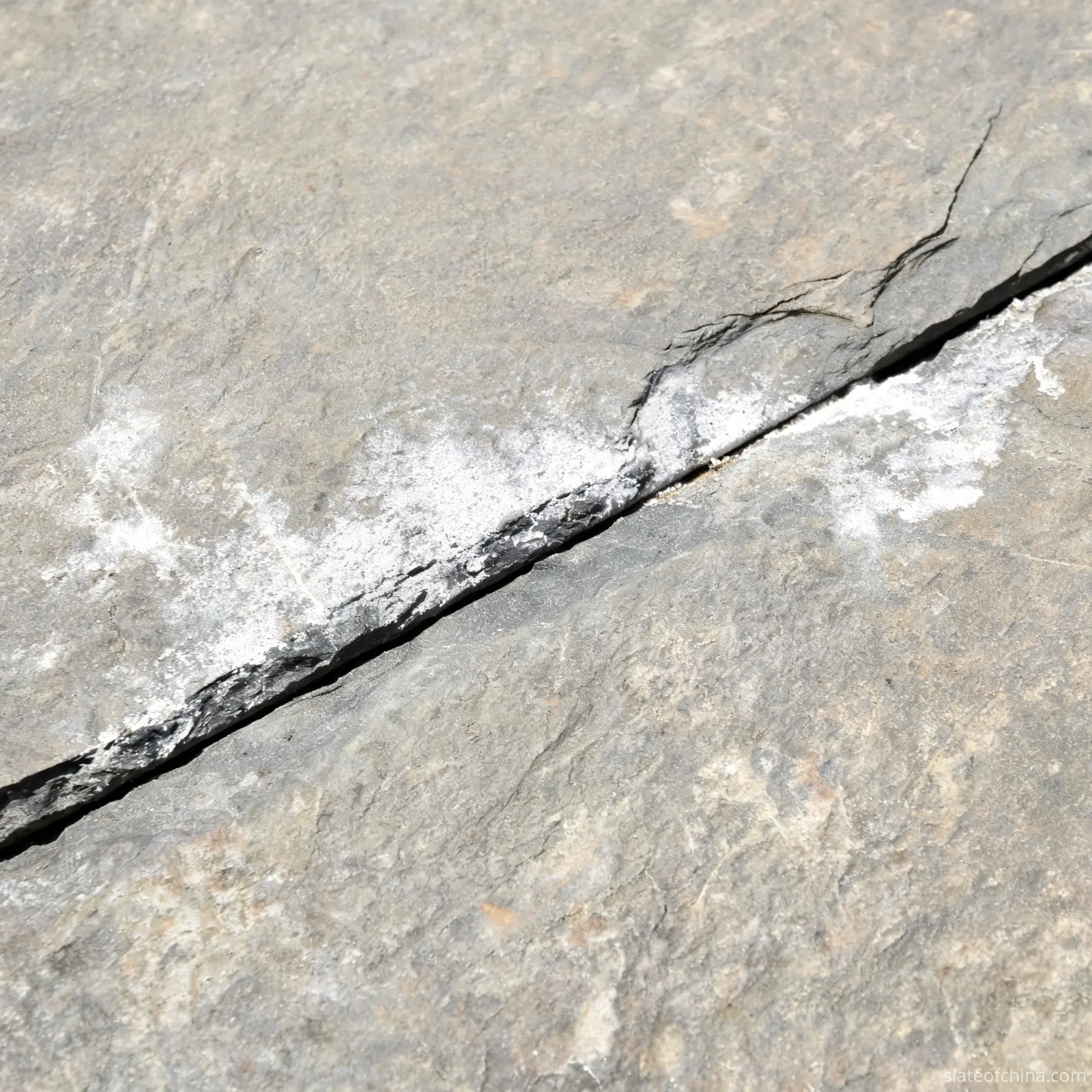
White deposits deserve their own paragraph, because they attract the most impulsive responses. True efflorescence on slate paving is minerals carried out by moisture from the bedding and jointing, and on a young pavement it usually diminishes as the construction dries — brushing and dry weather do most of the work. Hard-water residue from sprinklers and cleaner residue behave the same way and clear even faster, by removing the cause. Over-applied sealer curing in the pores looks similar, and is fixed by nothing except time or stripping. Three sources, one symptom, three different remedies — which is why identification comes first and the can comes last. If the deposit keeps returning, the moisture feeding it is a drainage matter, and it has its own guide.
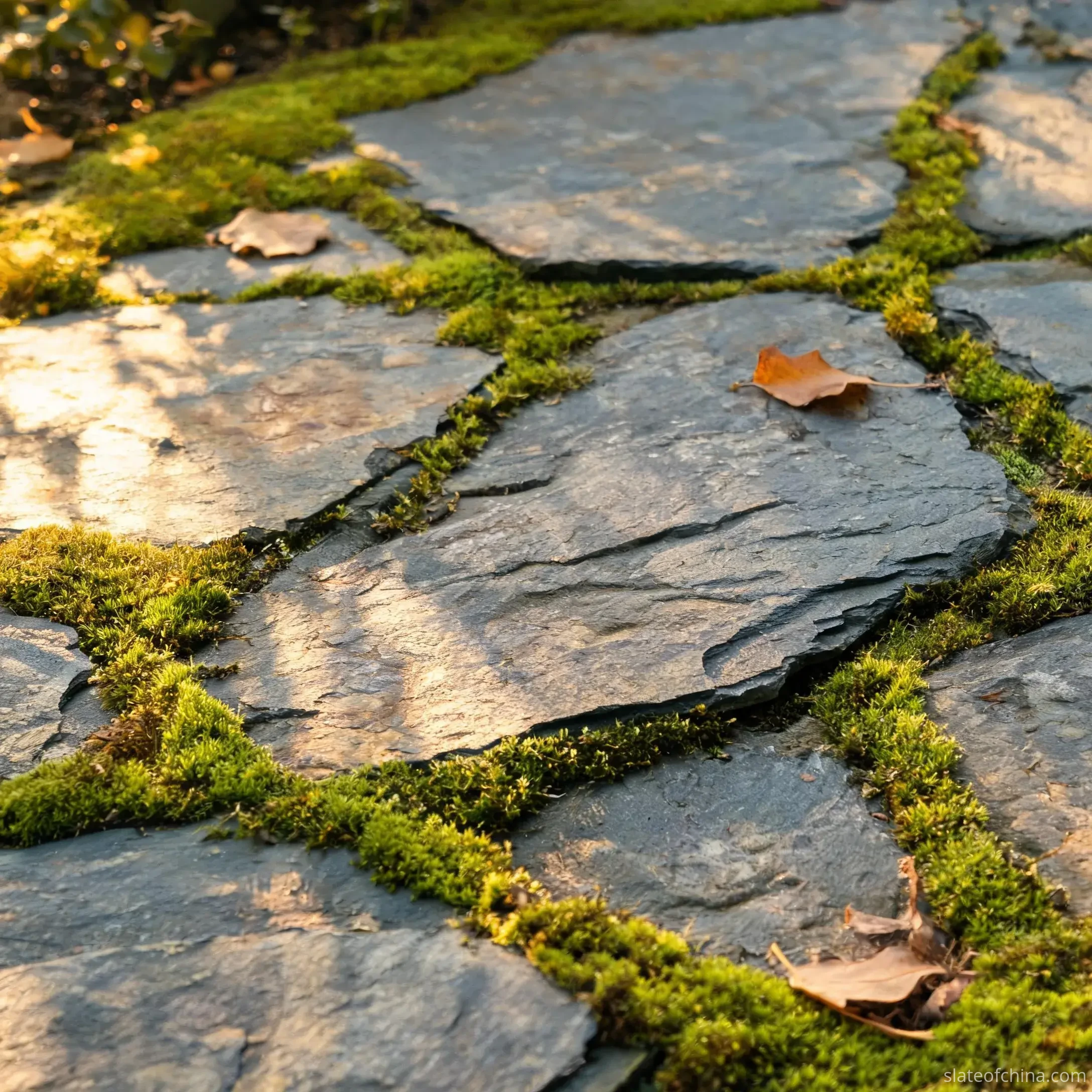
Moss and algae are the same lesson written in green. They follow shade, still air, damp and a steady supply of leaf litter — conditions, not stone vices. A sealer can make the surface easier to clean once growth arrives, but no treatment changes the shade, the still air or the puddle. Sweep the debris, let the drainage work, open the light if the planting allows it, and use a cleaner formulated for natural stone and compatible with the jointing. One caution that belongs beside every wet surface: films and biofilms cause slipperiness long before stone does, and slip resistance under the conditions of use is a measured, documented property — worth demanding as evidence rather than assuming from a texture.
Choosing slate that asks less of you
The cheapest maintenance on any paving project is bought at specification, months before the first broom. Stone that starts with a low absorption and a clean test record asks less of every plan that follows it — and the numbers are on paper, if you ask for them.
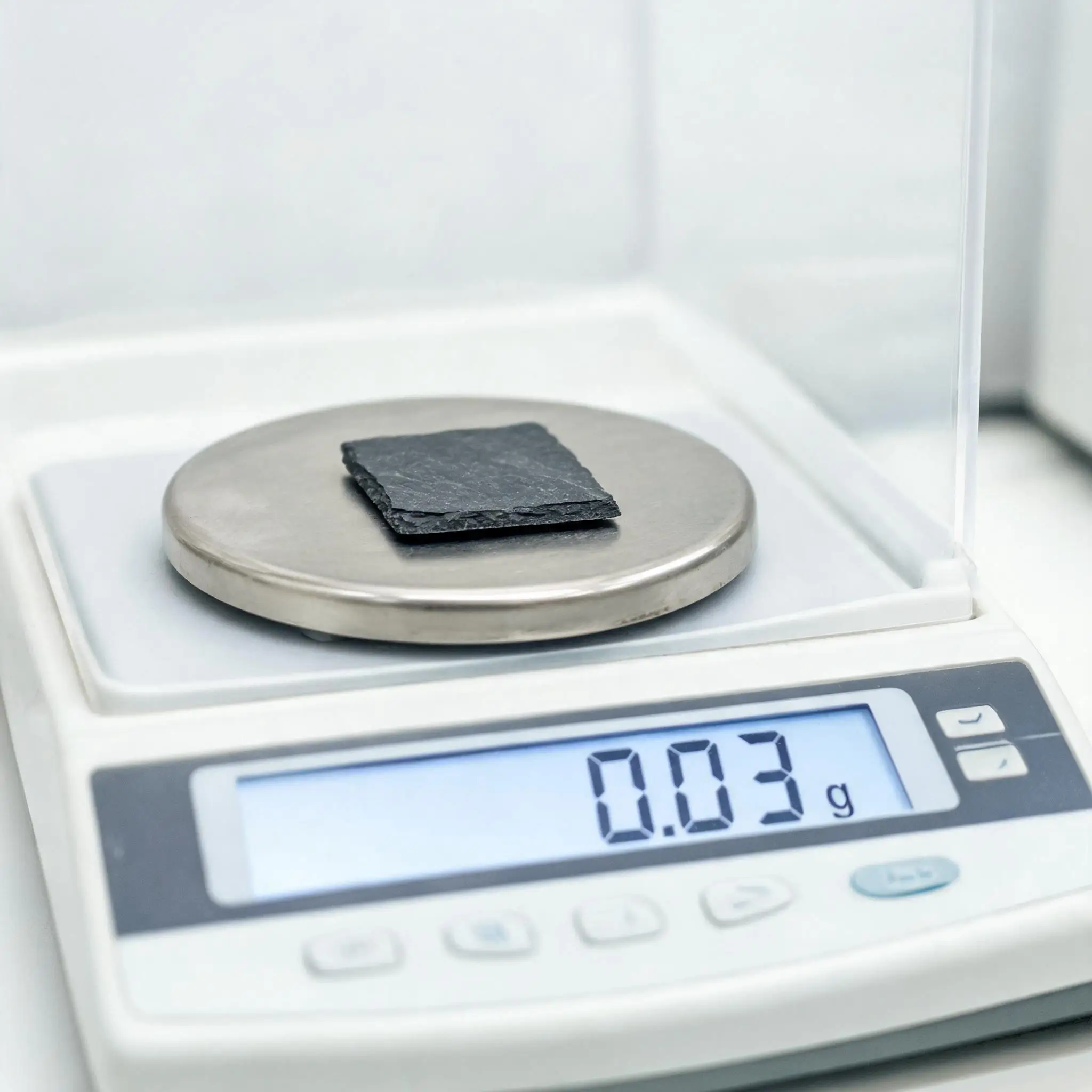
Selected paving slate supplied by Slate of China has recorded water absorption values of approximately 0.1–0.2 per cent in specific batch tests. Those figures refer to the tested samples: they are evidence about those batches, not an assumption that applies to every slate variety or production run. For project specifications, the document to request from any supplier is the batch-specific test report covering water absorption, frost resistance and flexural strength for the actual material being supplied, declared under the relevant product standard. The test results page shows what that looks like in practice, and the paving properties guide explains what those numbers do and do not mean for an outdoor order.
Around the numbers sit the quieter choices: a calibrated back for consistent bedding, a face finish matched to the setting, a thickness appropriate to the traffic — and a construction designed from day one to shed water, because no maintenance regime can out-sweep a puddle. When comparing suppliers, the short version of this whole page fits into five questions:
- What are the absorption, frost and flexural figures for this batch, and under which standard?
- Which face finishes are available for this setting, and how does each behave with dirt and cleaning?
- Do the slabs leave the factory treated with anything, or untreated?
- What maintenance does the supplier actually recommend for this product — in writing?
- If a sealer is to be used, which products have been found compatible with this stone and this jointing?
A maintenance plan you can hang on the wall
A slate paving maintenance plan fits in one table when it is honest about what is fixed and what is a trigger:
| Task | When it is due | What it protects |
|---|---|---|
| Sweep leaves and grit | Weekly in autumn; as needed otherwise | The face, the joints and the tannin question |
| Blot and rinse spills | The day they happen | The window between a spill and a stain |
| Wash the surface | When water alone stops cleaning | The colour and the finish of the face |
| Inspect joints and drainage | Spring and autumn | The construction that carries the loads and the water |
| Run the trigger checks | Twice a year, and after hard seasons | The evidence for any re-treatment |
| Re-treat, if treated at all | On trigger, on a clean dry surface, with a tested product | The money not wasted on a calendar |
The seasons each add one job. Spring is the inspection: joints, drainage, levels, anything winter loosened, with repairs booked early. Summer is the comfortable application window if a treatment is justified — warm, dry, long days for curing. Autumn is leaf discipline: the sweeping that decides whether next spring starts with a stain or a clean slate. Winter is water management: drains clear, no sealing in frost, and de-icing products checked for compatibility with the stone and the jointing rather than scattered hopefully.
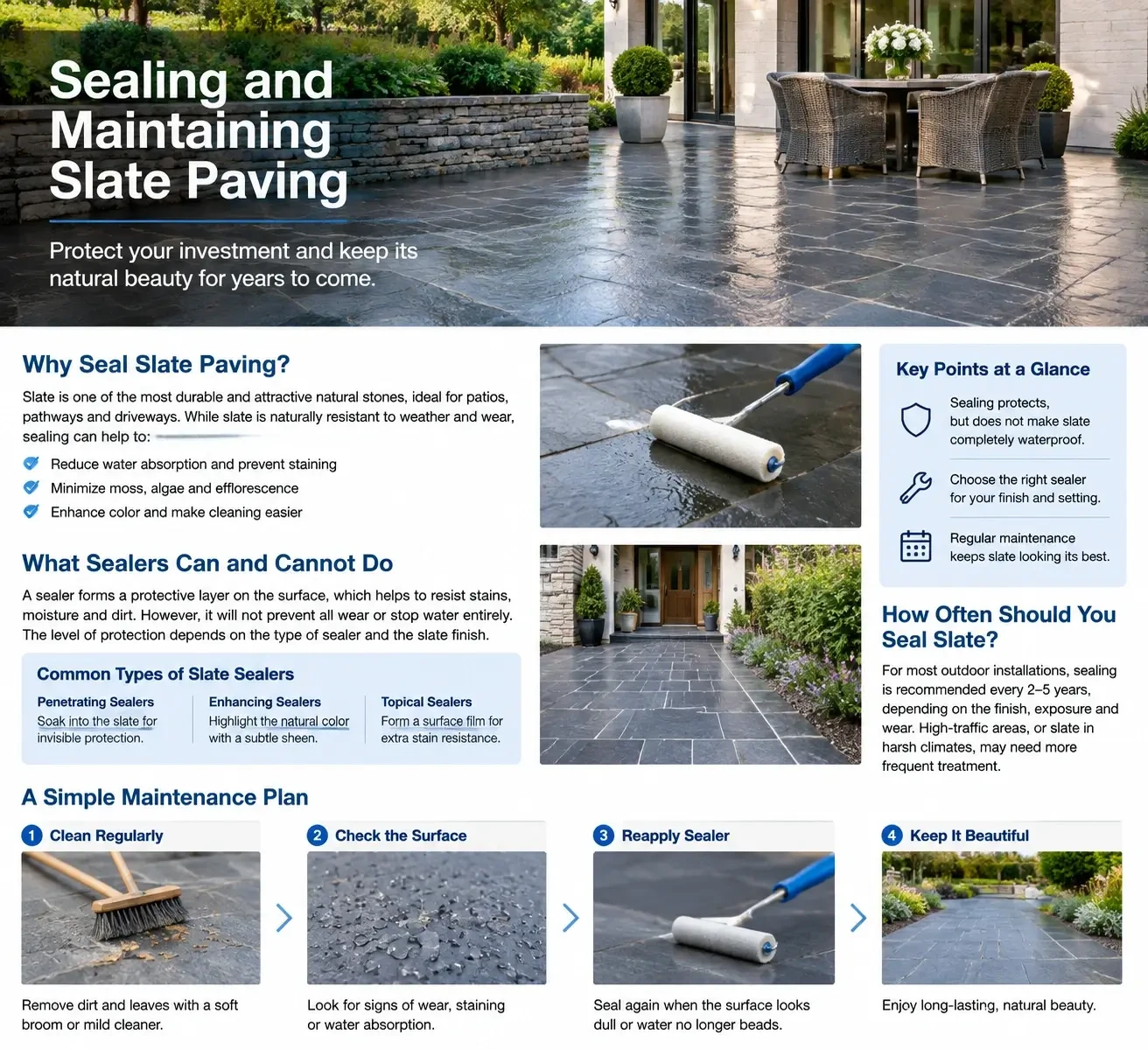
Sealed or untreated, the closing argument is the one this page opened with. A sealer changes three things and forgives none of the rest: the stone still has to be the right stone, the construction still has to drain, and the surface still has to be swept. Maintain on triggers, not anniversaries; seal a clean, dry, proven surface or don’t seal at all; and let the finish and the setting — not an adjective on a label — write the schedule. That is the whole care plan, and it fits on one page.
Sealing and maintaining slate paving — common questions
Does natural slate paving need to be sealed?
Not automatically. Slate paving performs well in many projects with no treatment at all. Sealing slate paving earns its place where the surface meets food, grease, heavy soiling or difficult cleaning, and only when the stone is clean, dry and compatible with the product. The decision belongs to the finish, the setting and the expectations, not to a rule.
What is the best sealer for outdoor slate paving?
There is no single best sealer for outdoor slate, only the best match. A penetrating impregnator is the usual starting point when the aim is stain resistance with a natural look; a colour-enhancing impregnator when a deeper, richer tone is wanted; a topical coating only where the product is specifically rated for exterior paving. A sample test on several pieces decides it, not a brand.
Can I seal slate paving without changing its colour?
Usually yes, but never with a guarantee. Natural-look penetrating sealers are designed to leave the face close to untreated, yet slight deepening still occurs on some slates. Wet a spare sample with clean water for a free preview of the direction the colour will move, and confirm on a test patch before treating the whole surface.
Does sealing make slate paving waterproof?
No. A penetrating sealer slows liquid entry through the treated face. It does not treat the underside, the edges or the joints, and it is not a moisture barrier for the paving construction. Keeping water out of an external paved area is a drainage design task, not a coating.
Will sealing stop moss and algae growing?
No. Moss and algae follow shade, still air, damp and organic debris. A sealer can make a surface quicker to clean once growth arrives, but the lasting fix is mostly horticultural and hydraulic: sweep the debris, move the water away, let light and air in, and treat growth with a cleaner compatible with the stone and the jointing.
How long does a slate paving sealer last?
There is no honest universal figure. Service life shifts with the product, the exposure, the traffic and the cleaning routine. Treat the manufacturer’s stated life as a claim to verify, and let the surface decide: when water stops beading and stains begin to grab, the treatment is due, whether that is earlier or later than the label suggested.
Can a new sealer be applied over an old one?
Not automatically. Some penetrating products accept a maintenance coat over their own kind on a clean, dry surface; topical coatings generally need full removal first. Identify what is on the stone, water behaviour and a small test patch help, and confirm compatibility with the technical data sheet before adding anything.
Can I use a pressure washer on slate paving?
With restraint, and only on suitable installations. Use a fan nozzle, a moderate setting and a working distance, keep the jet off the joints, and never concentrate it on one point. For routine cleaning, a broom, water and a pH-neutral stone cleaner are usually enough; the washer belongs to the stubborn annual clean, not the weekly one.
Related reading
Looking for natural slate paving for your project?
Choosing the right slate is the first step towards a durable, attractive and manageable outdoor paving installation. Slate of China supplies natural slate paving in different colours, thicknesses, sizes and surface finishes for residential landscaping, commercial courtyards and architectural projects. What we can provide:
- Natural slate samples for colour and finish evaluation — wet and dry, so the decision is made with water rather than adjectives.
- Product specifications and available dimensions for the intended format and finish.
- Batch-specific water absorption and frost resistance test reports for the actual material supplied.
- Technical information to assess suitability for different paving applications and settings.
Contact Slate of China to discuss your project requirements and request samples.