
Architectural Slate Buying Guide: Seven Locks From Specification to Container
Most things that go wrong with an imported architectural slate order are not stone problems. The stone was usually fine. What went wrong was sequence: a specification that never named the finish, a supplier chosen on price before anyone asked about capability, a sample approved from a photograph, an order confirmed without inspection terms, a container packed to no written plan, a shipment held at customs because its documents argue with each other. Each of those is a door that closed — and reopening a closed door in this trade costs far more than closing it properly the first time.
This architectural slate buying guide is written for the people who sign those orders: importers, distributors, contractors and project buyers sourcing natural slate — paving, flooring, wall cladding and landscape stone — particularly from China. It is the third page of this guide's start-here set. What Is Architectural Slate? defined the material and its product families. How to Choose Architectural Slate: Spec First ordered the decisions that build a specification. This page takes over at the point where the specification exists and the buying begins: suppliers, samples, orders, inspection, packing, container loading and import documents — in the order they actually happen, and the order they lock.
Seven stages, seven locks. Each stage ends by fixing something in writing — a product, a partner, a reference, a price, a proof, a plan, a paper trail — and every lock is cheap to set and expensive to break. Run them in order and the purchase is a process. Skip one and it becomes a series of improvisations, each priced by whoever holds the advantage at that moment.
The whole path at a glance:
| The seven locks | What happens there | What it fixes, in writing |
|---|---|---|
| Lock One — the specification | Product, dimensions, thickness, finish, tolerances, standards, quantity | The one product every later conversation is about |
| Lock Two — the supplier | Capability, export record, communication — before price | The partner who will receive the deposit |
| Lock Three — the sample | Physical samples requested, measured, approved | The reference the whole order is judged against |
| Lock Four — the order | Quotations compared line by line; terms, Incoterm, payment fixed | The commercial frame of the purchase |
| Lock Five — production and inspection | Progress records and pre-shipment checks against the spec | Proof the goods match, while correction is still cheap |
| Lock Six — packing and the container | Export packing, timber treatment, loading plan, payload arithmetic | The stone's survival plan for the longest day of its journey |
| Lock Seven — the documents | Invoice, packing list, bill of lading, origin, test reports | The paper trail that moves and clears the goods |

Lock One — The Specification: Buying One Product, Not the Word Slate
The most common cause of mismatched quotations is not dishonesty. It is an open specification. Two suppliers asked to quote grey slate are not quoting the same product: one prices a 20 mm calibrated flag from standing production, the other a riven 25 mm band cut to order; one includes sorting and export crates, the other sends both as extras. Until the specification names the product, every price it attracts is a price for a different thing.
A specification for architectural slate is a short document — a page, not a manual — but it has to fix every line a supplier could otherwise fill in their own way:
| The line | What to fix before any quotation |
|---|---|
| Product form | Paving flag, floor tile, cladding panel, tread or landscape unit — by name, one line per form |
| Material | Natural slate, and the agreed supply region or quarry |
| Dimensions | The module list exactly as drawn, each size with its piece count |
| Thickness | A nominal for sawn and calibrated stock; a stated natural band for riven — labelled which |
| Finish | One named finish per surface — cleft, honed, brushed — never the word natural alone |
| Machining | Holes, kerfs, chamfers, anchor positions — on the drawing, inside the price |
| Tolerances | Dimensional and thickness tolerances, and how and where they are measured |
| Duty and standards | Interior, exterior or roofing-adjacent duty; the standard that matches the product form in the destination market |
| Quantity | Net coverage, a labelled waste allowance, deliberate spares |
| Packing | Crate or pallet type — on the order, not decided on loading day |
How those lines are decided — which exposure, which load, which module — is the whole subject of the previous page in this guide, and it is worth running before this one. What matters here is the change of register: from choosing to committing. A natural slate specification only starts to work when a second party can be held to it, which is why the finish, the tolerance and the machining list matter more in writing than they ever did in conversation. Colour belongs on the page too, but as an agreed range around approved samples rather than a word — that conversation belongs to Lock Three.
The live formats behind the paving and cladding lines are listed under natural slate paving and natural slate wall cladding — the specification sheet above is what turns a catalogue entry into an order.
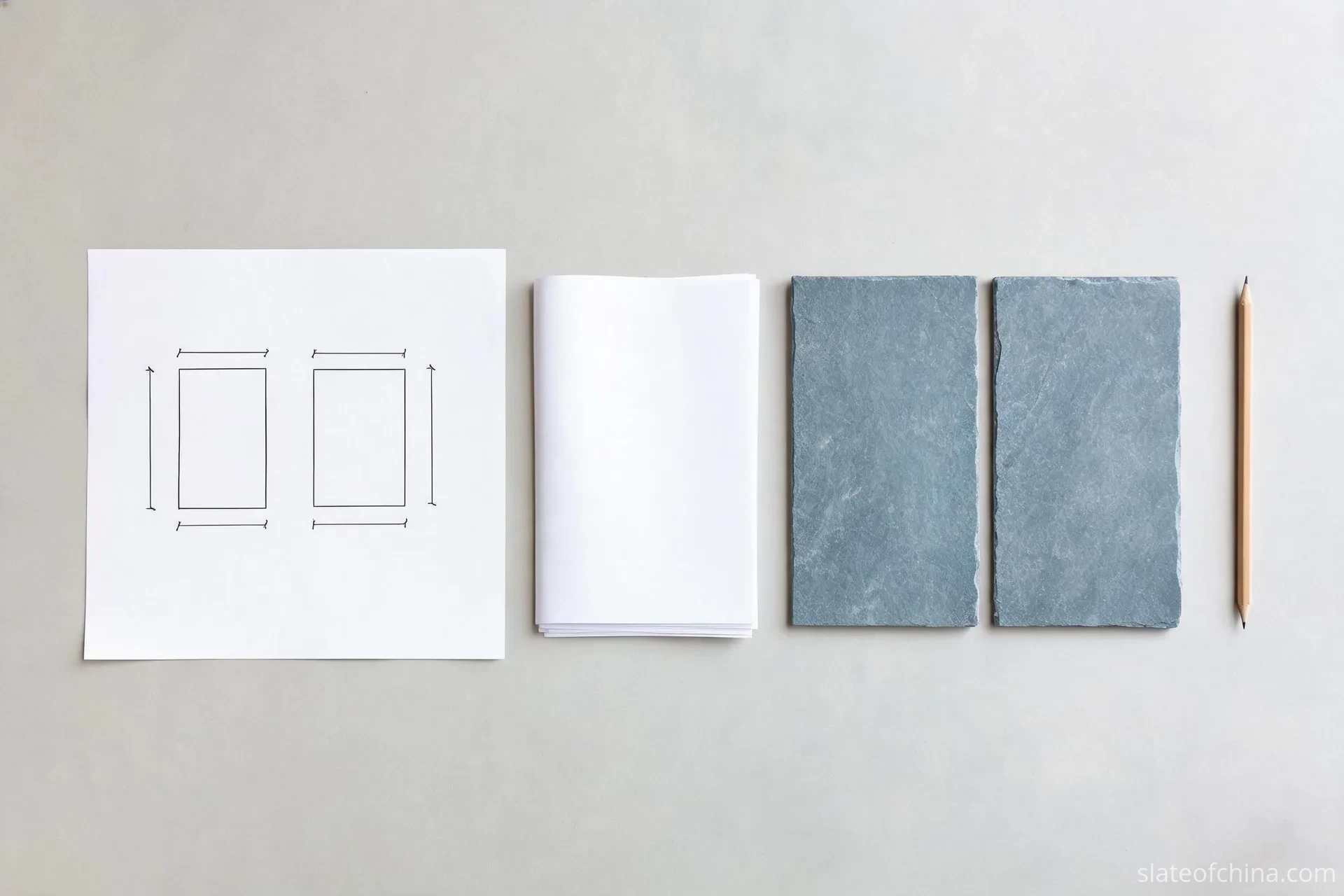
What this lock holds: the exact product. Until it is written, nothing later can be checked against anything.
Lock Two — The Supplier: Capability Before Price
Finding a low price for architectural slate is easy. Finding a supplier who can hold one specification across a whole order, and then across the repeat order two seasons later, is the actual purchase. The two are not the same search: the first looks at websites, the second looks at how a company is built.
The industry is not made of one kind of company, and each kind controls something different:
| Supplier type | What it usually controls | The question that matters |
|---|---|---|
| Integrated producer | Quarry access and its own splitting, cutting and finishing lines | Can it hold one specification across batches? |
| Processing factory | Sawing, calibration, finishing; raw blocks bought in | Where does the raw slate come from, and how is it selected? |
| Trading company / export agent | A supplier network, export documents, consolidated shipments | Which factory will make this order — and can it be named? |
| Regional distributor | Local stock, mixed orders, short delivery | Is the stock one consistent batch, or a blend of several? |
None of those rows is a verdict — each type serves a different buying situation honestly. What the table changes is the direction of the conversation: an architectural slate supplier is evaluated on what it can evidence, not on what it claims. Export experience is not a sentence on a website; it is a supplier who can talk fluently about loading schedules, port routings and which Incoterm puts which responsibility on whose desk. Custom capability is not the word CNC; it is a drawing answered with a drawing, tolerances answered in numbers the factory actually measures. Quality control is not a slogan; it is a batch numbering system, a retained-sample shelf, and someone who can explain what happens to a piece that fails.
The full questionnaire — the twenty questions, the red flags, the scoring — has a page of its own later in this guide. For the first approach, three requests sort most suppliers in one exchange: a recent production photo dated inside the last month, the specification of an order currently running, and a straight answer to who machines the drawings. Suppliers who answer those three comfortably are worth a quotation; suppliers who answer them with catalogues rarely are. For a structured walk through the verification itself, the buyer checklist on the origin guide is the deep end of this lock.
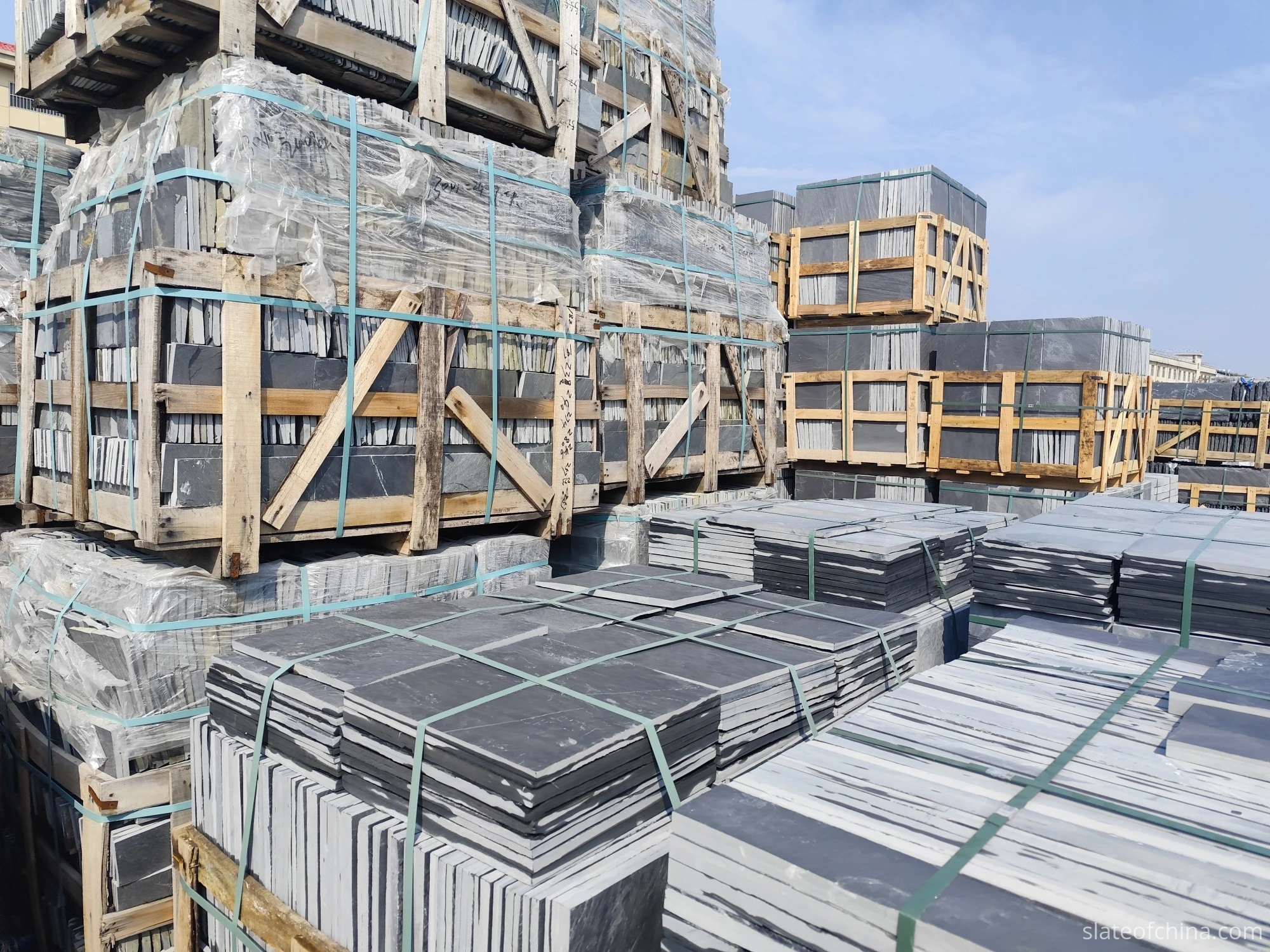
What this lock holds: the partner. The deposit has one destination from here on.
Lock Three — The Sample: The Reference That Judges the Order
Photographs are for shortlisting; they are not for approving. A photo cannot be measured, cannot be turned over, cannot show how a cleft face reads under raking light, and — the part that matters — cannot show how far variation runs between pieces of the same batch. That is why architectural slate samples — physical pieces from the production lot, requested before any bulk order — settle what pixels cannot.
A sample request worth making asks for five things at once: a representative piece of the proposed material; two or three pieces from the same lot showing the natural spread of colour and marking; the finish as it will actually be produced; the thickness as it will actually be supplied; and one finished piece showing the edge treatment and dimensional accuracy of the production line. When the samples arrive, the checks are equally concrete. Measure them against the specification. Look for the defects that matter for the application — weak layers, delamination, damaged corners — rather than the character that does not. Ask the supplier, in writing, to confirm that the sample comes from the production lot the order will be cut from, not from a display shelf kept for photographs.
Natural slate varies; that is not a defect to negotiate away but a range to agree. The instrument is the approved reference sample: a set of pieces kept by both sides, from which the acceptable band of tone and marking is defined in the order. A pallet of samples is not a reference sample — one selected, measured, labelled and referenced in the purchase order is. For large or phased projects, the reference pair is what keeps the second container matching the first, and it is the cheapest insurance in this whole guide: it costs a conversation at sample stage and a claim at every later stage without one. The roofing side of the site walks the same ceremony in detail, on the sample approval page; the full product-side process has a page of its own later in this guide.
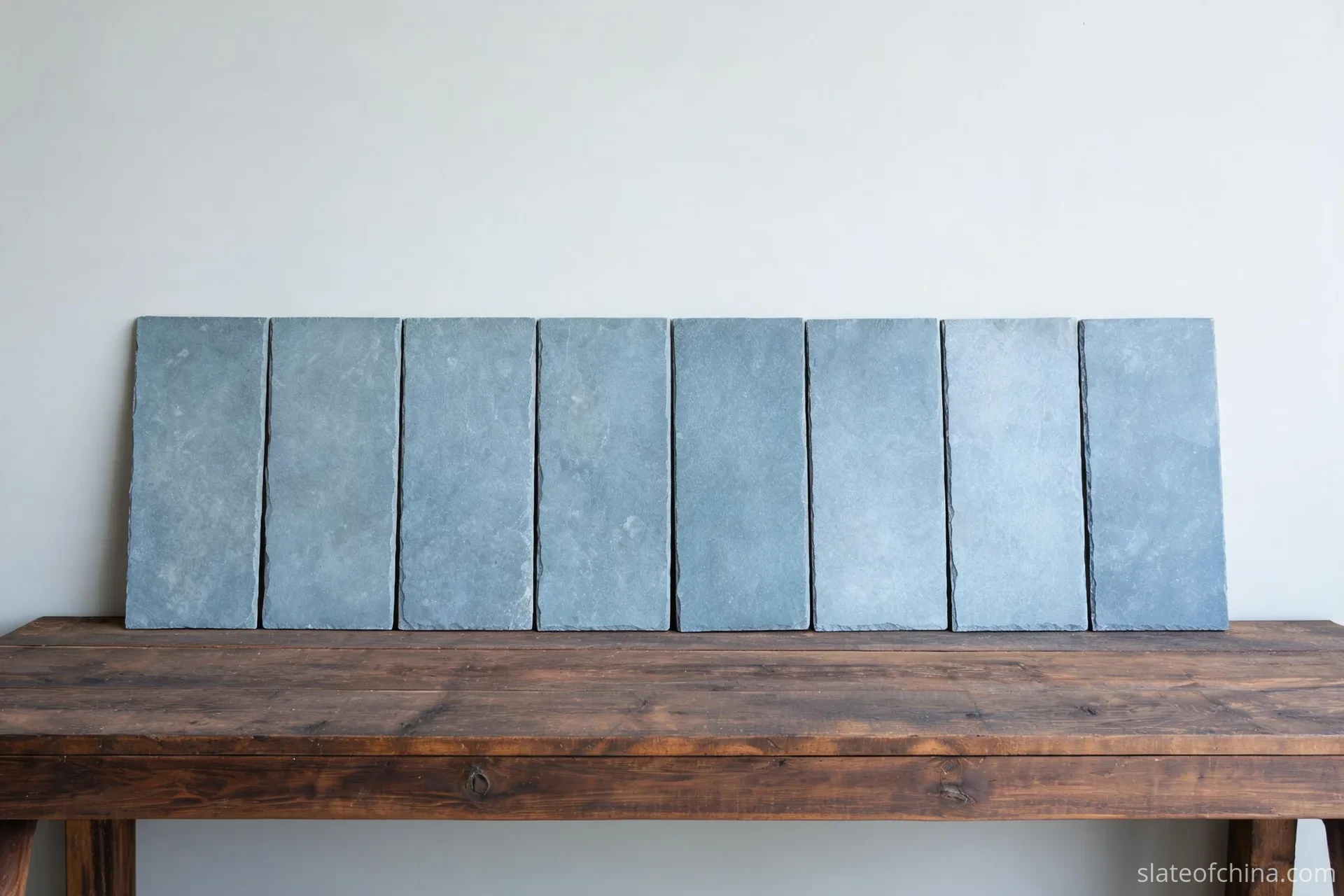
What this lock holds: the benchmark. From here, quality is not an opinion — it is a comparison.
Lock Four — The Order: Comparing Prices and Fixing Terms
With a specification, a shortlist and an approved reference in hand, quotations finally mean something. Comparing them is mechanical work, and the discipline is to compare like with like: same trade term, same currency, same unit basis, same quantity — and then line by line against the specification, not only at the total. A price that looks low because machining is excluded is not a lower price; it is an invoice that has not finished arriving.
The trade term deserves its own attention, because it allocates the whole rest of the journey:
| Incoterm | Who arranges what | Risk passes to the buyer |
|---|---|---|
| EXW — ex works | Buyer collects at the factory gate; buyer handles all freight and export clearance | When the goods are placed at the seller's premises |
| FOB — free on board | Seller delivers and clears export at the loading port; buyer books the vessel | Once the goods are on board the vessel |
| CFR — cost and freight | Seller pays freight to the named destination port; buyer insures and clears import | Once the goods are on board the vessel |
| CIF — cost, insurance and freight | As CFR, with the seller also providing marine insurance for the voyage | Once the goods are on board the vessel |
Under CIF, the seller arranges cargo insurance — but the coverage level, exclusions and claims procedure are worth confirming, rather than assuming that every transport risk is fully covered.
Payment structure and protection belong on the same page. A deposit with balance against shipping documents is the working pattern of this trade; the split and the trigger documents are negotiated, and high-risk payment structures are a reason to walk away rather than negotiate harder. What is not optional is the small print that most orders skip: an agreed inspection procedure before shipment, the reference sample named in the contract, and a written procedure for handling non-conforming goods — how they are documented, who decides, and what remedy applies. None of that language is aggressive; it is what lets both sides sleep through the production weeks. The roofing side of the site runs the same comparison exercise with a quotation page of its own.
For architectural slate wholesale orders and large construction projects, two questions join the frame. The first is quantity structure: order volumes are set from the total project requirement plus expected wastage, spare stock and any phased delivery schedule — not from a round number per container. The second is repeatability: before a programme commits to one supplier, confirm that a repeat production run can hold the same colour range, the same finish and the same dimensional tolerances as the approved reference.
What this lock holds: the frame — price, terms and consequences — inside which production begins.
Lock Five — Production and Inspection: Proof While Correction Is Still Cheap
The purpose of inspection is not ceremony; it is timing. A problem found on the factory bench is corrected in hours by people who are standing next to the machine. The same problem found in a distributor's warehouse is corrected in months, through claims, freight and disputed responsibility. Everything in this lock exists to move discovery forward in time.
The inspection itself covers the material and the processing in one pass:
| Check | What it answers |
|---|---|
| Appearance against the reference | Does the batch sit inside the approved colour and marking range? |
| Surface condition | Cracks, delamination, weak layers, visible defects — by application, not by eye alone |
| Dimensions | Length and width against the drawing, on measured pieces |
| Thickness | Actual thickness against the specified nominal or natural band |
| Machining | Holes, kerfs and edge details against the drawing — position, size, finish |
| Quantity | Pieces and square metres, counted against the packing plan |
| Packing | Crate condition, protection, strapping, labelling — before the container door opens |
| Records | Batch numbers, retained samples, test documents tied to the material actually shipped |
How many pieces to check is agreed, not guessed: for large orders, a representative sampling plan is settled before production starts, and for custom-cut and machined products the dimensional and edge checks carry the most weight. Two boundaries keep the exercise honest. First, the factory's own pass is a production record, not the buyer's acceptance — the QC sheet says the factory is satisfied; the inspection says the specification is met, and they are different documents. Second, material testing and production inspection are different proofs: test reports speak for the stone against the standard, the inspection speaks for the order against the specification. The test results published for the slate we supply sit on the test results page; the roofing side of the site keeps a full pre-shipment inspection checklist that transfers to architectural slate almost line for line.
When a visit is not practical, production photos and video are the visibility layer: raw material selection, the cutting and finishing lines, close-ups of finished surfaces, a tape measure on representative pieces, the pallet packing, and — most requested of all — the container loading video. None of it replaces an inspection, but a supplier who documents production fluently is also telling you something about how they run it. For high-value orders, an independent inspection agency before shipment is standard practice, arranged at a defined point in the production schedule that both sides have agreed in the order.
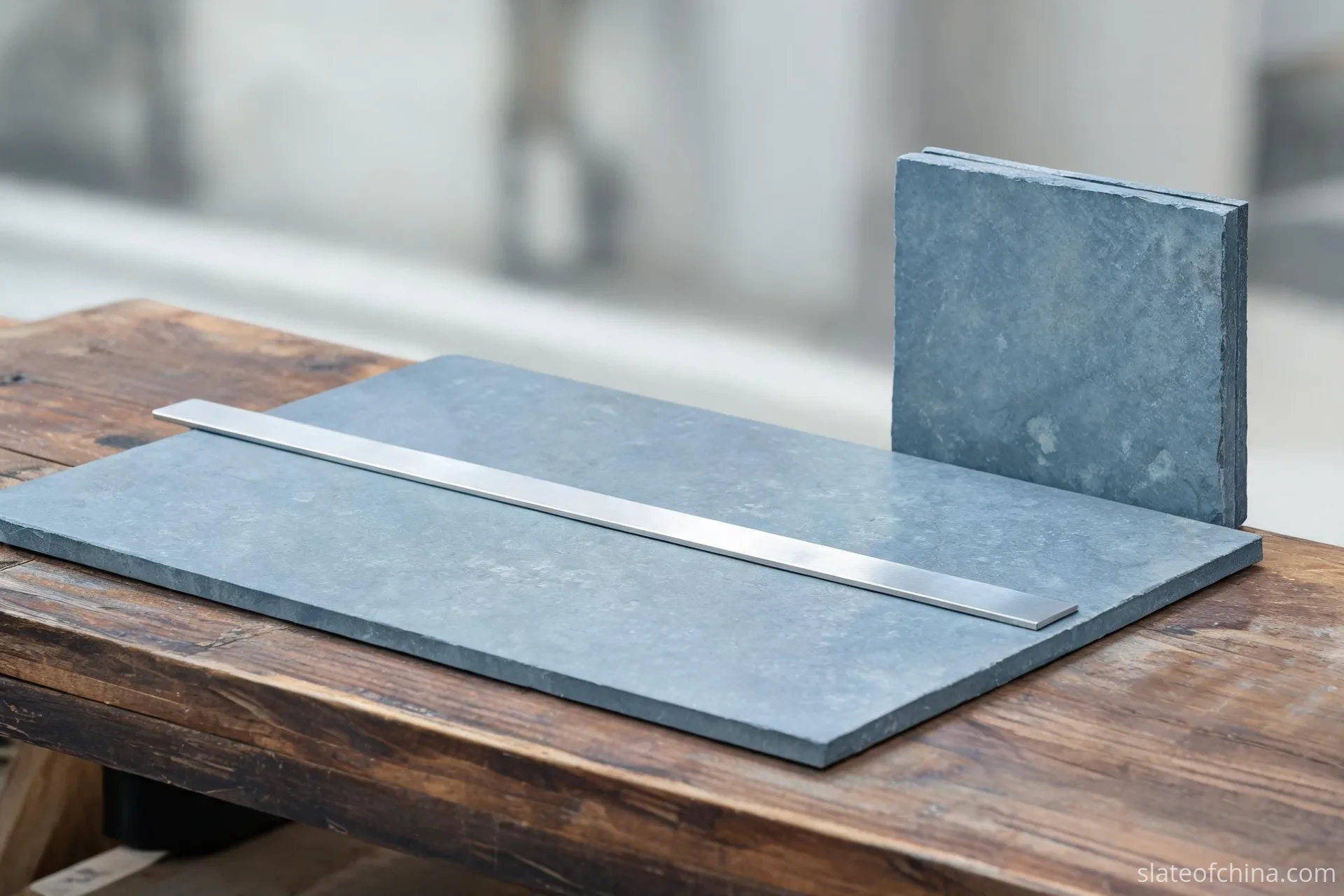
What this lock holds: the proof. After it, problems belong to logistics; before it, they still belong to production.
Lock Six — Packing and the Container: The Stone's Survival Plan
Architectural slate is dense, heavy and unforgiving of impact — three properties that make it permanent on a wall and vulnerable in a container. Slate packaging for export is therefore not a detail of the order; it is the order's survival plan, and it is written before production, not improvised at the loading dock.
Three packing formats do almost all of the work, matched to the product rather than chosen by habit. Wooden pallets carry tiles and cut-to-size products: they forklift cleanly, stack in warehouses, and organise a container by size and batch — provided the pallet is built for the actual stone weight, not the generic kind a loading crew happens to have. Wooden export crates add protection where it is needed: small-format tiles, fragile pieces, machined products and any part-load that will be handled more than once. A-frame racks carry large-format slabs and panels vertically, supporting the stone along its own plane — stable when designed and secured correctly, catastrophic when improvised. Whatever the format, the lines worth confirming in writing are the same: internal protection and interleaving, corner and edge protection, strapping, forklift access, and the loading arrangement inside the container. Regulated solid wood packaging must meet the applicable ISPM 15 requirements for the destination market — approved treatment and the official mark — and the precise scope, treatment and marking requirements are confirmed with the buyer's side before the crates are built. The roofing side of the site works through crate standards line by line, and the origin guide shows how one production region packs and ships.
Container arithmetic is where architectural slate buying most often meets an unwelcome fact: heavy stone runs out of payload before it runs out of space. For dense natural slate products, a 20ft container is often worth considering because the payload limit can become the main constraint before the available volume is fully used — but the most suitable box is decided by the actual cargo weight, the packing dimensions, the container's own specifications, its floor loading limits and any road weight restrictions at the destination. A 40ft container adds volume, not payload; whether that volume is usable depends on the same arithmetic. The quantity that fits is always calculated, never quoted from a memorised number:
Weight per square metre comes from density and thickness. Natural slate runs roughly 2,700–2,800 kg per cubic metre; the density measured in the published test results for the slate we supply is approximately 2,819 kg per cubic metre — a figure that belongs to the tested sample, with an actual order calculated from the measured density and thickness of the material supplied. At an indicative 2,800 kg/m³, a 10 mm tile weighs about 28 kg per square metre in stone alone, and every additional millimetre adds about 2.8 kg. A quick reference for planning follows; the full worked examples — size libraries and container arithmetic — sit on the paving sizes and thicknesses page.
| Thickness | Approximate stone weight per m² |
|---|---|
| 10 mm | ≈ 28 kg |
| 15 mm | ≈ 42 kg |
| 20 mm | ≈ 56 kg |
| 25 mm | ≈ 70 kg |
| 30 mm | ≈ 84 kg |
Stone only, packaging excluded, at the indicative density above — a planning reference, with the order calculated from the measured density and actual thickness of the material supplied.
From weight to loading plan takes six steps: confirm the actual weight per square metre of the specified product; take the container's permitted payload; subtract pallets, crates, protection and dunnage; divide what remains by the product weight; check that the resulting quantity physically fits the container's volume with the planned stacking; and close the plan with the freight forwarder before loading day. A supplier who answers how many square metres fit in a container without asking which product, which thickness and which packing has not answered the question — architectural slate container loading is arithmetic done on your order, not a number carried over from someone else's.
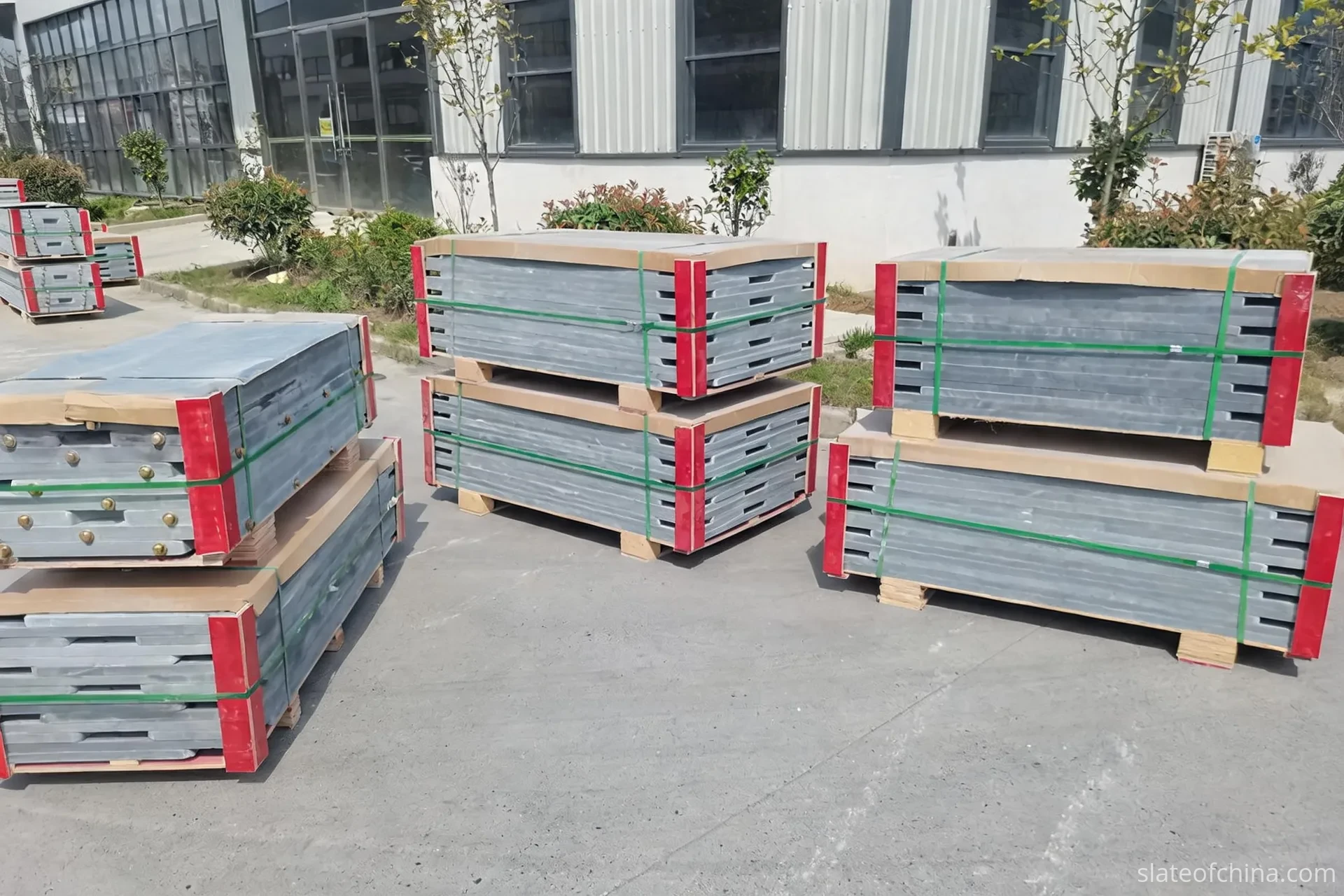
What this lock holds: the plan. Once the doors close, the stone travels on the strength of this page and nothing else.
Lock Seven — The Documents: The Paper Container
While the stone crosses the ocean in its timber, the purchase crosses the same distance again on paper. Natural slate import documents are what the container actually presents at customs, at the bank and at the claim, and a shipment that arrives physically perfect can still spend days at a port because its paperwork disagrees with itself.
The set, in the shape most shipments take:
| Document | What it does |
|---|---|
| Commercial invoice | Declares the product, the transaction value and the terms of sale |
| Packing list | Piece counts, crate by crate: sizes, quantities, weights, dimensions |
| Bill of lading | The carrier's receipt for the cargo and, depending on the type of bill issued, a document of title or a non-negotiable transport document — its details are checked against the invoice and packing list before release |
| Certificate of origin | States the country of origin; often requested, sometimes tariff-relevant |
| Insurance certificate | Evidences cargo cover where the terms or the buyer require it |
| Test reports | Support the specification's standards references, tied to the shipped material |
| ISPM 15 / treatment records | Evidence the timber packing meets the destination's phytosanitary rules |
| Customs declarations | Export and import filings supporting clearance on both sides |
Not every shipment needs every line — insurance follows the trade term, origin certificates follow the destination, test reports follow the specification — so the set is confirmed for the specific market, bank and broker before documents are issued. Two details earn their own care. The HS code: natural slate products classify differently depending on whether the stone is raw, simply cut, or further worked, and the correct classification for the actual product and destination is confirmed with the customs broker, not assumed from a previous order. And consistency: quantities, weights and descriptions must state the same numbers in the same way across the invoice, the packing list and the bill of lading — one number, one spelling, everywhere — because the mismatch is what customs officers are trained to find. The document set, and the mistakes each document punishes, is walked through in full on the importing documents page of the origin guide, with a roofing-side version alongside it.
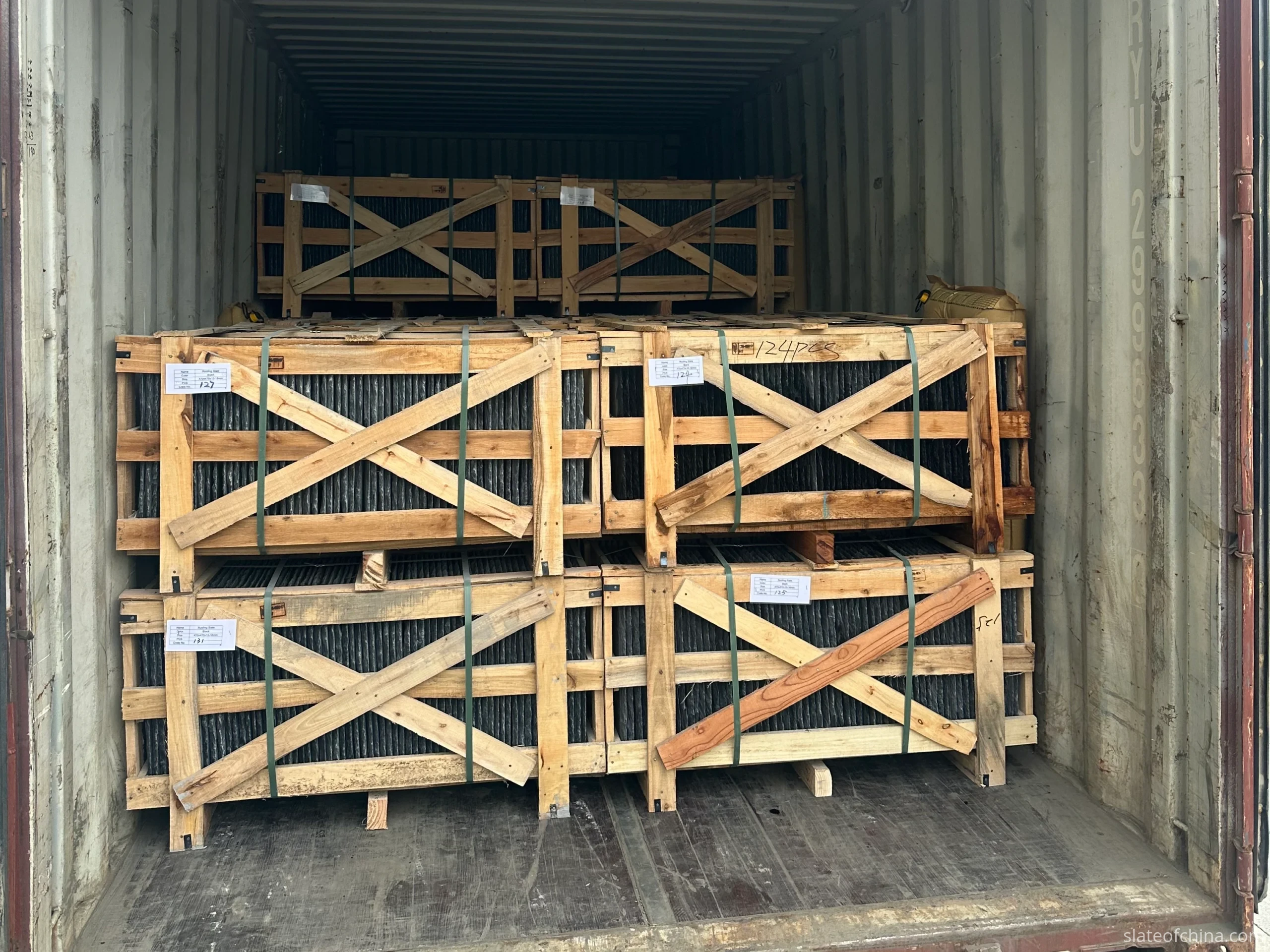
What this lock holds: the clearance. With documents consistent and complete, the goods move on arrival — and any claim has its evidence in order.
The Purchase on One Page
Seven locks, condensed for the desk. Each group assumes the one above it has closed.
The product.
- Specification written: form, dimensions, thickness, finish, machining, tolerances, duty, standards, quantity, packing.
- Standards confirmed for the destination market — one per product form, treated as a set.
The partner.
- Supplier type understood; capability evidenced, not claimed.
- Current production, batch control and export experience checked.
The reference and the frame.
- Physical samples from the production lot measured and approved; the reference named in the order.
- Quotations compared line by line; Incoterm, payment and dispute procedure fixed in writing.
The voyage.
- Inspection agreed and executed before shipment — reference, dimensions, machining, packing.
- Loading plan calculated on payload, not quoted from habit; packing format and ISPM 15 confirmed.
- Document set confirmed for the market, broker and bank; one number, one spelling, everywhere.
That is the whole of buying architectural slate well. Not luck, not the perfect supplier — a sequence, closed in the right order. The cheapest purchase in this trade is never the one with the lowest first number; it is the one where each door closed once, properly, and never had to be reopened. When the invoice matches the packing list, the packing list matches the crates, the crates match the reference sample and the reference matches the specification, importing natural slate from China is quietly uneventful — which is exactly what a well-bought container of stone should be.
Frequently Asked Questions
The questions this sequence raises most often, answered within it — the sections above carry the full treatments.
How do I buy architectural slate from China, step by step?
The short form of how to buy architectural slate: write the specification first — product, dimensions, thickness, finish, machining, standards, quantity; qualify suppliers on evidenced capability; approve physical samples from the production lot; compare quotations line by line and fix the Incoterm and payment structure; inspect before shipment against the specification; confirm export packing and the container loading plan; and close the document set before the goods move. Each step locks the one before it — run them in order and the purchase is a process, not a series of recoveries.
Should I buy from a manufacturer or a trading company?
Both can serve a buyer honestly, but they are verified differently. A manufacturer offers direct control of processing and closer technical answers; a trading company offers sourcing breadth, consolidation and export coordination. The questions that matter are the same either way: which factory will produce the order, can it be named, can it hold one specification across batches, and who stands behind the documents. Judge the company in front of you on evidence, not on its label.
What documents do I need to import natural slate from China?
The core set is a commercial invoice, a packing list and a bill of lading. Around it, as the market and the deal require: a certificate of origin, an insurance certificate, test reports supporting the specification, ISPM 15 records for timber packing, and the customs filings on both sides. Confirm the exact set with your customs broker and bank before production finishes — and insist that quantities, weights and descriptions match across every document in it.
How much architectural slate fits in a 20ft container?
There is no honest single number. Dense stone is usually weight-limited, not volume-limited, so the answer depends on the product's thickness, its weight per square metre, the packing format and the container's permitted payload. The calculation is simple — payload minus packaging weight, divided by product weight — and it belongs to your specification, not to a memorised figure. A supplier who answers with a fixed square-metre number before asking which product has not run the calculation.
Is pre-shipment inspection necessary for slate orders?
For any order large enough to matter, yes — because inspection is about timing, not suspicion. A defect found at the factory bench is corrected in hours; found in a warehouse, it becomes a claim measured in months. Agree the sampling plan and inspection points in the order, check the goods against the approved reference and the drawing, and for high-value shipments appoint an independent inspector. The factory's own QC is a production record; your inspection is the acceptance.
What payment terms are usual for a first architectural slate order?
The working pattern of the trade is a deposit with the balance released against shipping documents. The split and the trigger documents are negotiated case by case, and the point to hold is structural: the balance should be tied to documents you can verify — the bill of lading, the packing list, the inspection record — rather than to a date. Payment structures that remove verification entirely are a reason to decline the order, not to negotiate it.
Can I order samples before committing to a full container?
Yes, and you should. Samples are how a photograph becomes a decision: measure them against the specification, read the natural variation across several pieces from the same lot, and approve a reference set that both sides keep. The reference sample named in the purchase order is what keeps the bulk shipment — and the repeat order after it — inside the range you actually approved.
How long does an architectural slate order take to produce and ship?
It depends on the product form, the quantity, the machining content and the season — and it is settled in writing with the quotation, not estimated from averages. What you can control is the sequence: a finished specification, an approved sample and a confirmed drawing all remove weeks of back-and-forth before production even starts. Treat the schedule as part of the order, and the order as the schedule's evidence.
What should I consider when buying architectural slate in bulk?
Bulk buying multiplies what the earlier locks decide rather than replacing them: batch consistency across a whole programme, samples approved from the actual production lot, a production capacity that can hold the delivery schedule, inspection agreed before the first container, packing that survives repeated handling, and a delivery plan that sequences the containers. The questions are the same seven locks, asked at scale — and answered in writing before the first deposit.
Related Reading
Buying architectural slate and want the sequence run properly? An enquiry that arrives with these five things in it gets a real answer on the first pass:
- The product and application — paving, flooring, cladding or landscape, and where it will serve
- Dimensions, thickness and finish — a nominal or a natural band, labelled
- Quantity and destination — square metres with spares, country and port
- The fixing assumption — so machining and anchors arrive with the stone, not after it
- Drawings or reference samples — anything that turns a description into a product
Where the specification is still open, we can help close it — formats, finishes, packing and container plans — before anything is committed.