
What Is Architectural Slate? Natural Slate for Buildings, Gardens and Grounds
The enquiry usually arrives as a short sentence: we are looking for architectural slate for a project. Behind that sentence sits a word covering more ground than most buyers expect. Architectural slate is natural slate — and closely related layered stone — split, sawn and finished into products for use in and around buildings: paving and outdoor flooring, interior floor tiles, wall cladding panels, steps, coping and garden stone. When suitable natural slate is processed into thin, regularly sized pieces for overlapping roof installation, the trade classifies it as roofing slate. The material may share a geological origin with architectural slate; what differs are the selection criteria, the processing and the installation — a distinction of application, not of geology.
The question what is architectural slate has a short answer, given above, and a longer one that saves specification arguments later. The longer answer runs through four things: what the term actually covers in the stone trade, why the rock can be split and cut the way it is, how the material moves from quarry block to finished product, and where the boundary with roofing slate sits. That is the order this page follows. It is written for the people who put the term on drawings and purchase orders — architects, landscape designers, contractors, importers and distributors.
One boundary belongs in the opening. This page is about the product domain, not any single origin. Where the rock comes from, and why the geology suits building use, is the business of the Jiujiang Slate Guide; the roof side of the same material belongs to the Roofing Slate Guide. This page opens the Architectural Slate Guide, and the sections that follow it take each product family in turn.
Quick answer: architectural slate is natural slate split, sawn and finished into building and landscape products — paving, flooring, wall cladding, steps, coping and garden stone.
- The term is defined by application: it names a product domain, not one size, thickness or finish.
- The making runs split, saw, calibrate, finish — the route a product takes is decided by where it will be installed.
- Roofing slate is the same rock worked for a different job: split thin, hung in courses, tested and fixed by roofing rules.
- On paper the noun specifies nothing by itself — dimensions, a named finish, a thickness and the relevant test reports do the specifying.
The word starts the enquiry. The writing after the word closes it.
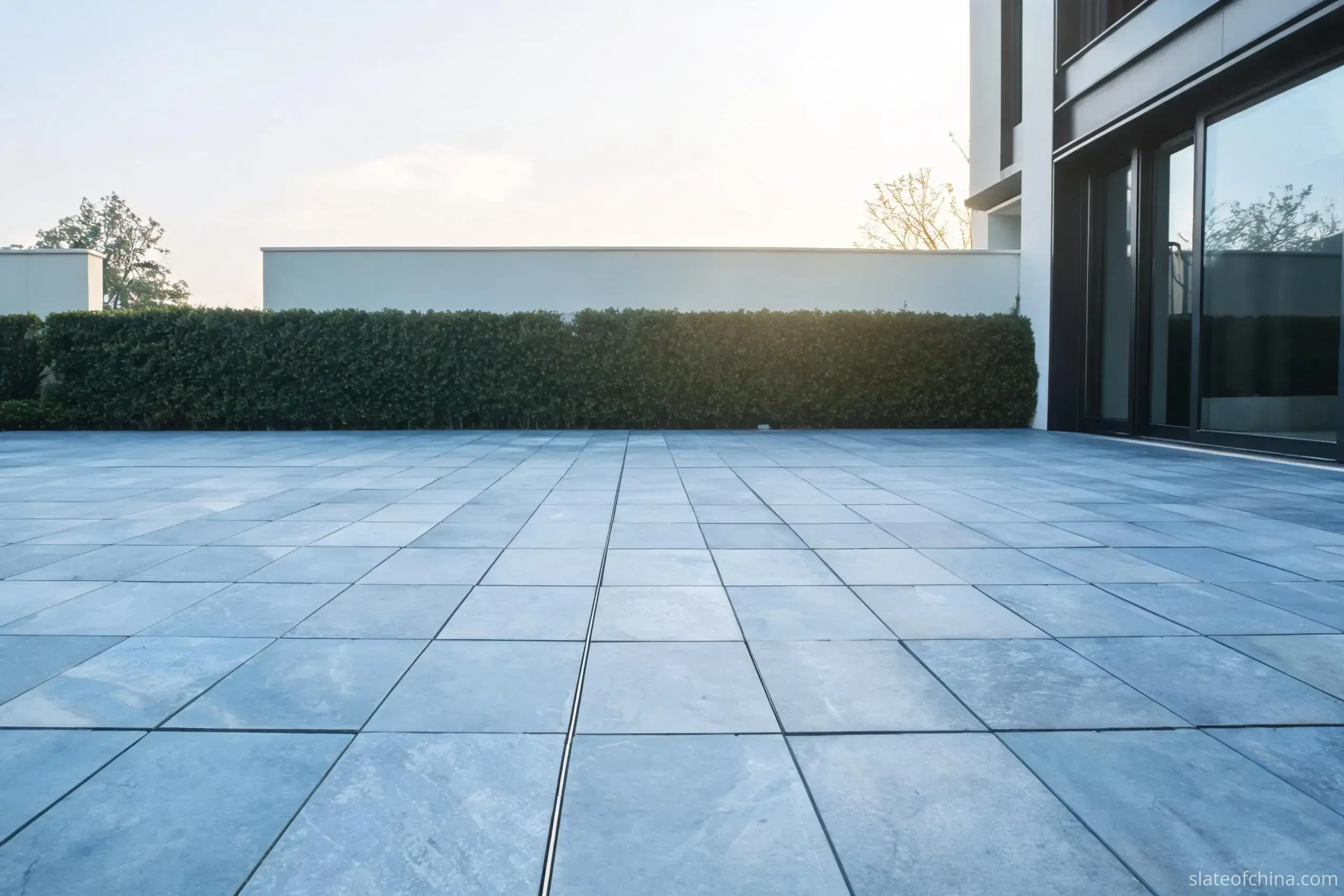
A Trade Term Before It Is a Rock
In the natural stone trade, architectural slate works the way dimension stone works: it names a family of products by what they are for, not by a single recipe. The word exists because the industry needed one term for slate that goes into buildings and grounds — as distinct from the material's two other traditional destinations, the roof and, in one producing region, the billiard table. What a buyer actually receives under the term can be a riven flag from a splitting shed, a calibrated floor tile from a saw line, a split-face cladding panel, a stair tread, a wall capping or a stepping stone. All of it is architectural slate; none of it is interchangeable without asking.
Geologically, slate is a fine-grained metamorphic rock — clay-rich sediment, buried, compressed and gently heated until its platy minerals realigned and gave the rock its signature cleavage, the ability to part along flat, parallel planes. The commercial term runs looser than the geological one. Certain layered stones a petrographer would not call true slate — quartzitic and carbonaceous layered stones among them — are traded and installed under the slate name, because they look, split and weather in ways the building trade recognises. Nothing is dishonest about that, provided both sides know what is being described. When performance matters, the material should be identified by its petrographic description and its test report, not by the word on the quotation.
In daily use, architectural slate products divide into five working families, and a buyer who learns to hear them separately has already learned most of the vocabulary:
| Product family | Trade names you will meet | Where it goes |
|---|---|---|
| Paving and outdoor flooring | flags, flagstones, riven paving, calibrated paving | terraces, paths, courtyards, driveways where the spec allows |
| Interior flooring | slate tiles, modular tiles, gauged tile | kitchens, halls, lobbies, bathrooms |
| Wall cladding | split-face panels, cladding slabs, ledger and veneer panels | facades, feature walls, fireplaces, entrance walls |
| Steps and edge stone | treads, risers, coping, capping | stairs, garden and boundary walls, pool surrounds, borders |
| Garden and landscape stone | stepping stones, edging, feature and monolith stone | gardens, water features, borders, paths off the grid |
The families are taken one by one further into this guide. What matters at the definitional stage is the coverage itself: one term, five families, and behind all of them one material logic — which is where the rock itself comes in.
The Rock Behind the Word
What makes slate useful as building stone is the same thing that makes it splittable: the cleavage. Under compression and low-grade heat, the flat minerals in the original mud — micas, mostly — grew with their faces aligned, and the rock still remembers that direction. Struck the right way, a block parts along that memory into flat sheets; a quarry working with the grain of its beds can rive a thick block into usable layers without a single saw cut. The face that opens when the stone parts is the cleft face: subtly ridged, never quite repeating, and the surface most people picture when they picture slate.
That is not a footnote of geology; it is the economics of the material. A block that splits into eight usable layers delivers eight stone faces from one bed and spends almost nothing but labour. The same block sent entirely to a saw delivers one face per pass and pays for every face in blades, water and time. Splitting and sawing are not stages of one process so much as two different economies, and they carry different cost structures. Riven products lean on the stone's own cleavage, but they still pay for labour, thickness sorting and the yield the natural band allows; sawn and calibrated products pay for machinery, energy and the material the blades remove, and recover it in dimensional consistency. The final price of either depends on stone yield, labour, processing requirements, tolerances and order volume. Neither route is superior — they answer different briefs.
The rest of the material's character follows from the same origin. The grain runs fine, which is why slate reads quiet at close range rather than sparkling like a coarse-grained rock. The colours — black, grey, blue-grey, green and their regional variations — come from mineral content, not from dye lots, which is why two beds in one quarry can sit a shade apart. And the beds vary, because no two beds consolidated under identical conditions: two quarries in the same mountain can yield recognisably different stone, which is why experienced buyers specify the quarry or the batch, never just the word slate. Some beds carry iron-bearing minerals that weather to rust tones on exposed edges — a warm rim on a riven path reads as character, while the same streak through a honed foyer floor reads as a claim. The geology behind these differences has its own treatment in the Jiujiang geology guide; for specifying purposes the working rule is shorter. The name on the quotation is not a property. The test report is.
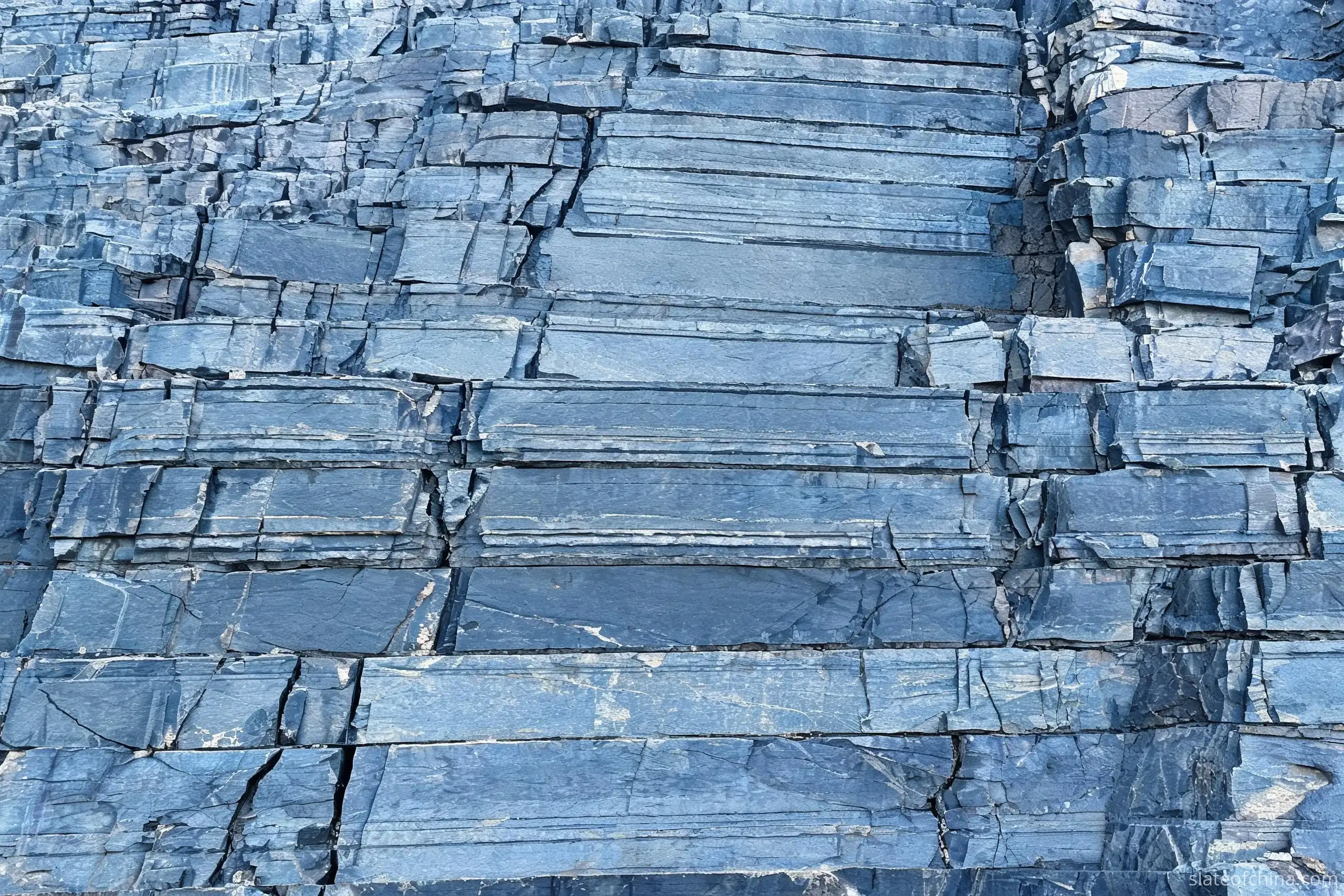
Split, Saw, Calibrate, Finish
Between quarry block and finished product, four verbs carry most of the work: split, saw, calibrate, finish. Every architectural slate product is a mixture of the four, and knowing the mixture tells a buyer most of what a photograph cannot.
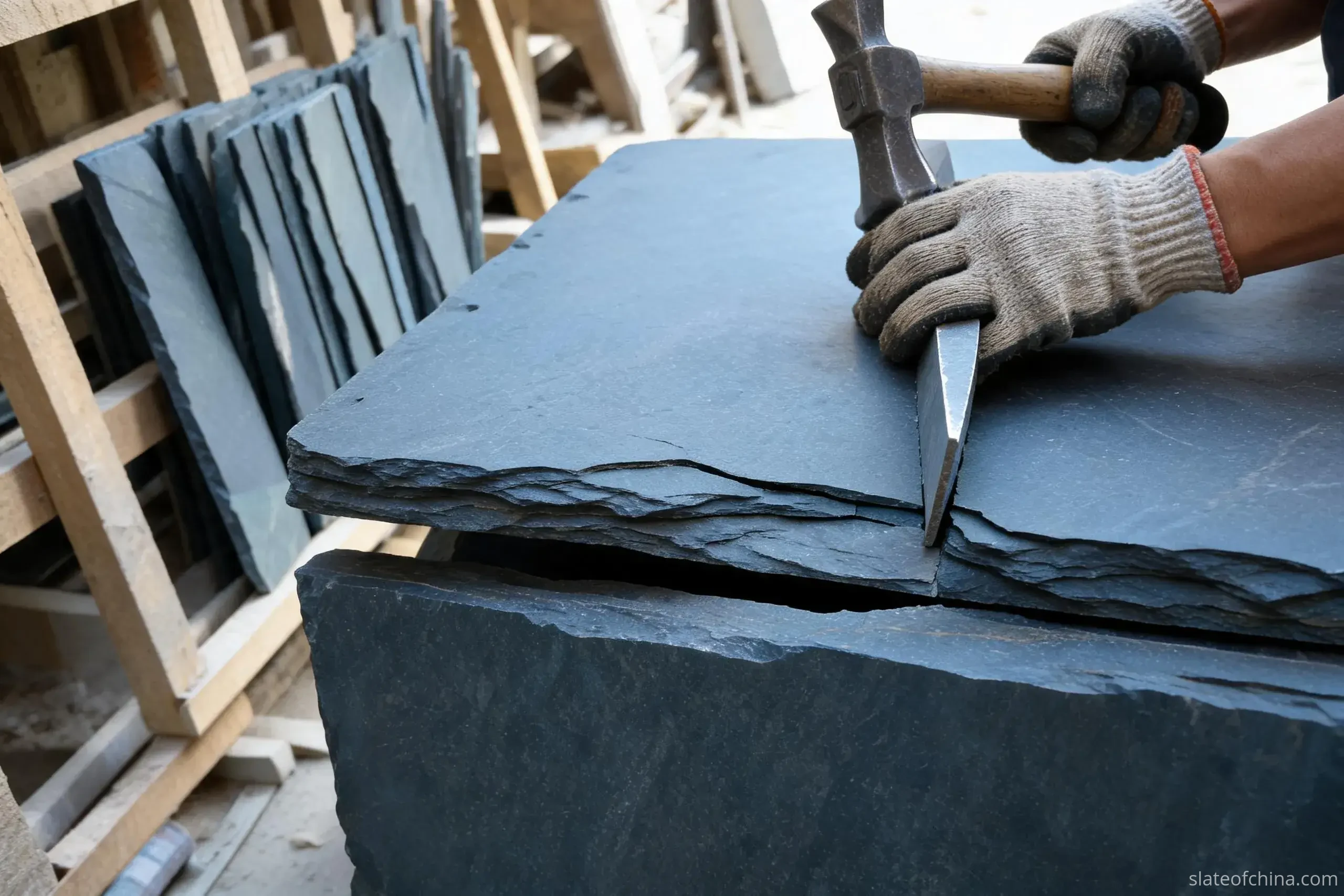
Split. Riving follows the cleavage. A chisel or a wedge, a steady hand or a hydraulic splitter: the stone is parted along its natural planes and comes away as cleft-faced product. The split route is the economical one and the characterful one — each piece carries the record of its own parting plane, and no two faces repeat. Its limits are equally real: thickness varies across a piece, flatness is approximate, and dimensions cannot be promised the way a sawn product's can. Riven paving, split-face cladding, stepping stones and rustic floor tile live on this route, with thickness stated as a band rather than a nominal.
Saw. Sawing trades character for geometry. Diamond blades on circular, bridge and gang saws cut blocks and slabs into square-edged products with repeatable dimensions: paving flags for modular laying, calibrated floor tiles, stair treads, copings, cut-to-size cladding panels. The sawn face is flat but carries blade lines, so most sawn product goes on to a further finish. Where a project runs to drawings — joints at fixed widths, tiles setting out from a grid — the sawn route is the only one that holds the geometry. Sawn edges also machine cleanly: chamfers, arrises and nosings belong to the saw, not to the riving iron.
Calibrate. Calibration is the quiet step that makes modular laying possible at scale. Slabs pass under grinding heads that bring thickness to a written nominal, so a setter lays a floor without shimming every piece. It is a processing decision, not a natural state of the stone: an order either asks for calibrated material and gets a repeatable nominal, or accepts the natural band of hand-split stock. How that choice is written into a specification — and how to read the back of a tile for the treatment it received — is a page of its own later in this guide.
Finish. The finish sets the surface a project will actually touch: cleft, the split face left as it parted; sawn, flat with a faint blade texture; honed, ground smooth and matte; and, where the stone's mineralogy suits it, brushed or thermal finishes. A finish is a duty decision as much as an appearance decision — what reads well underfoot dry may not read safely wet, and what suits a covered hall may not suit an uncovered terrace. The finishes are taken one by one later in this guide. At the definitional level one rule is enough: a specification that names no finish has not yet specified the product.
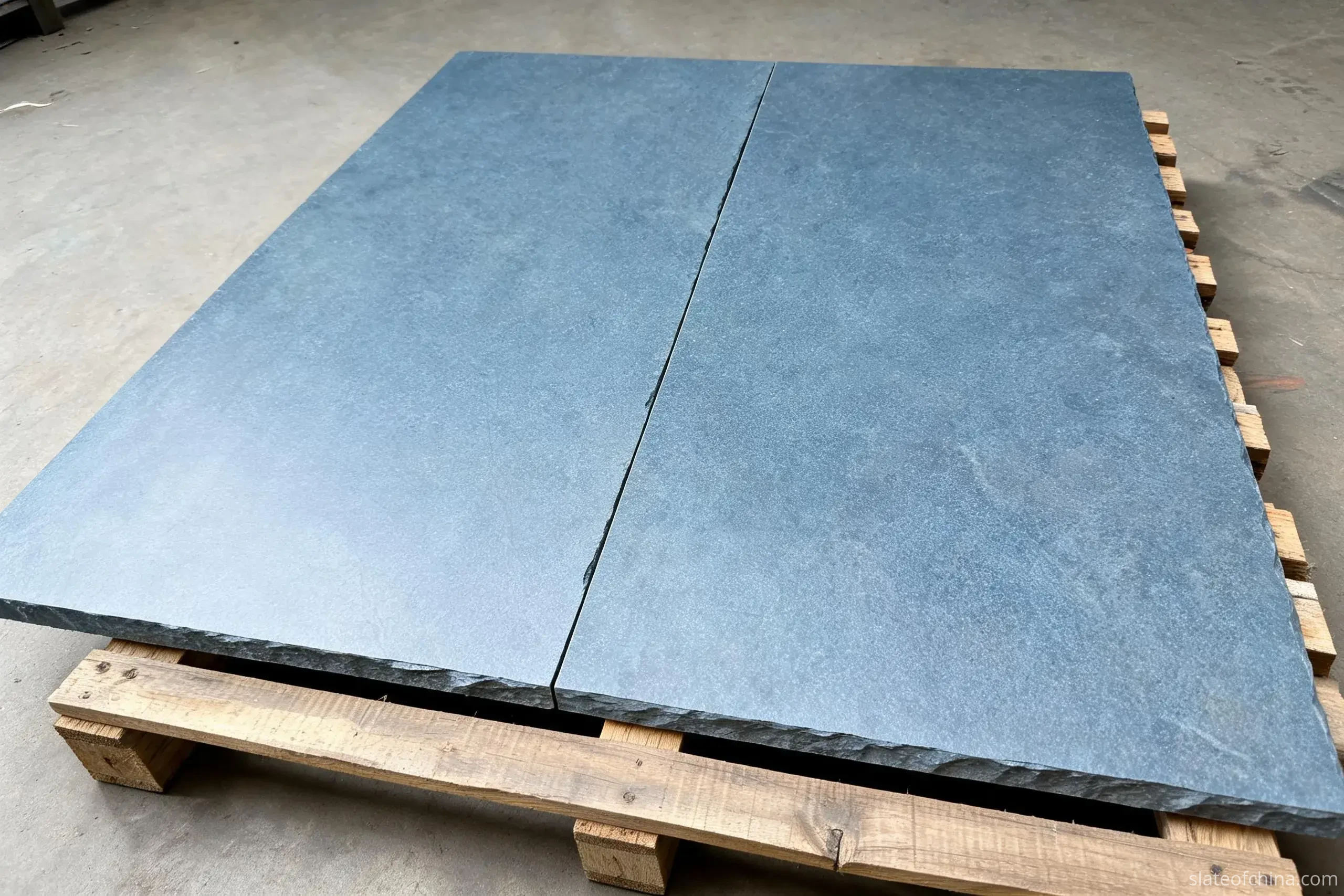
Thickness follows the same route logic. Riven products carry their natural band; sawn and calibrated products hold a nominal. For orientation only: roofing slates sit at the thin end of the material's range, and some pedestrian paving products fall within the 20–40 mm range. That is a reference point, not a specification — the required thickness depends on slab dimensions, stone strength, expected loading, support conditions and the installation system, and steps, copings, vehicle areas and unsupported applications require separate assessment. The honest answer to how thick architectural slate should be is thick enough for what sits on top of it and what sits underneath, and the pages that follow this one take that arithmetic family by family.
How the whole route runs in a working region — from quarry face to finished and packed product — is walked through in the origin guide's slate processing pages. The route is worth one visit from any buyer, because it explains most of what a slate quotation is actually pricing.
What the Families Look Like on the Ground
Definitions hold up best against real products, so one pass through the five families at street level — what each one is, and what a buyer is really buying in each case.
Paving. Outdoor paving is the family most enquiries mean. Riven flags answer gardens, courtyards and traditional settings; sawn and calibrated flags answer projects that want modular geometry, tight joints and a setting-out from drawings. The specifying questions are the outdoor ones — slip behaviour when wet, water absorption, freeze–thaw performance, thickness against load, joint and drainage design — and they are exactly the questions the paving section of this guide takes up. Finished paving programmes in the catalogue sit under paving slate.
Flooring. Natural slate flooring takes the calmer end of the same material: honed or calibrated tile, consistent thickness, edges that meet in even joints. Moving indoors removes some of the outdoor questions — frost, mainly — and adds others: flatness across a large floor, behaviour over underfloor heating, abrasion under chairs and traffic, and the maintenance regime the finish will support. Flooring is also where calibration earns its keep most visibly: a floor is the one surface where every piece lies in the same plane as its neighbour, and the eye is unforgiving about a tile that sits proud.
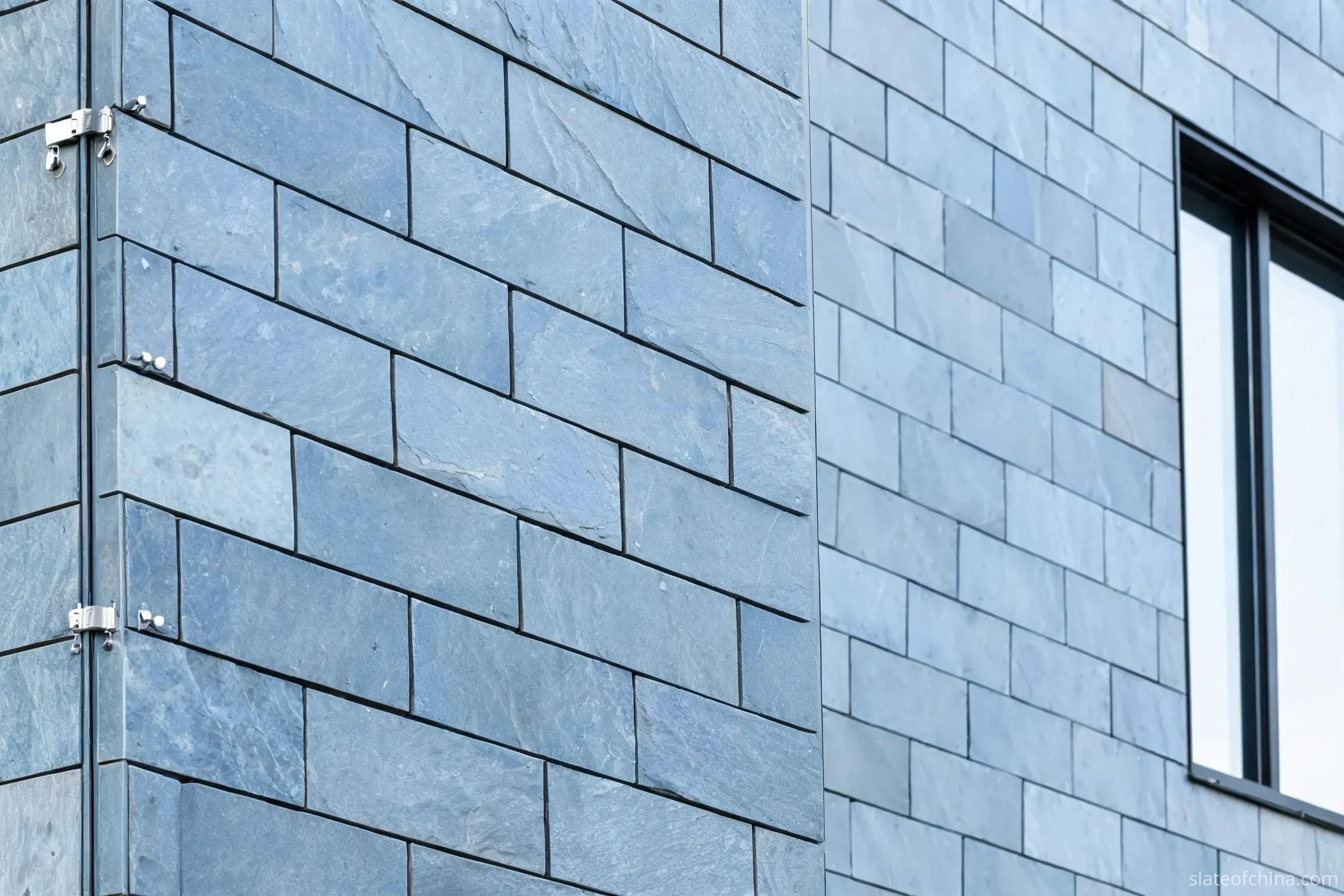
Cladding. Cladding turns the material from surface underfoot to surface on a wall: thin panels — split-face where the design wants texture, sawn where it wants geometry — fixed to facades, entrance walls, fireplaces and feature walls. Weight, fixing and exposure do the engineering. Sound substrate in sheltered positions can carry adhered thin panels; larger panels and exposed facades call for mechanical fixing designed with the panel dimensions and the wind load. The cladding range sits under wall cladding slate.
Steps and edge stone. Treads, risers, copings and cappings are the load-carrying end of the catalogue: stone with a job to hold an edge — a nosing that survives decades of feet, a wall cap that throws water clear of the masonry beneath. These products are nearly always sawn and dimensioned; riven character, where a project wants it, is chosen with the nosing line in mind, because a stair is the one place where texture and safety negotiate hardest.
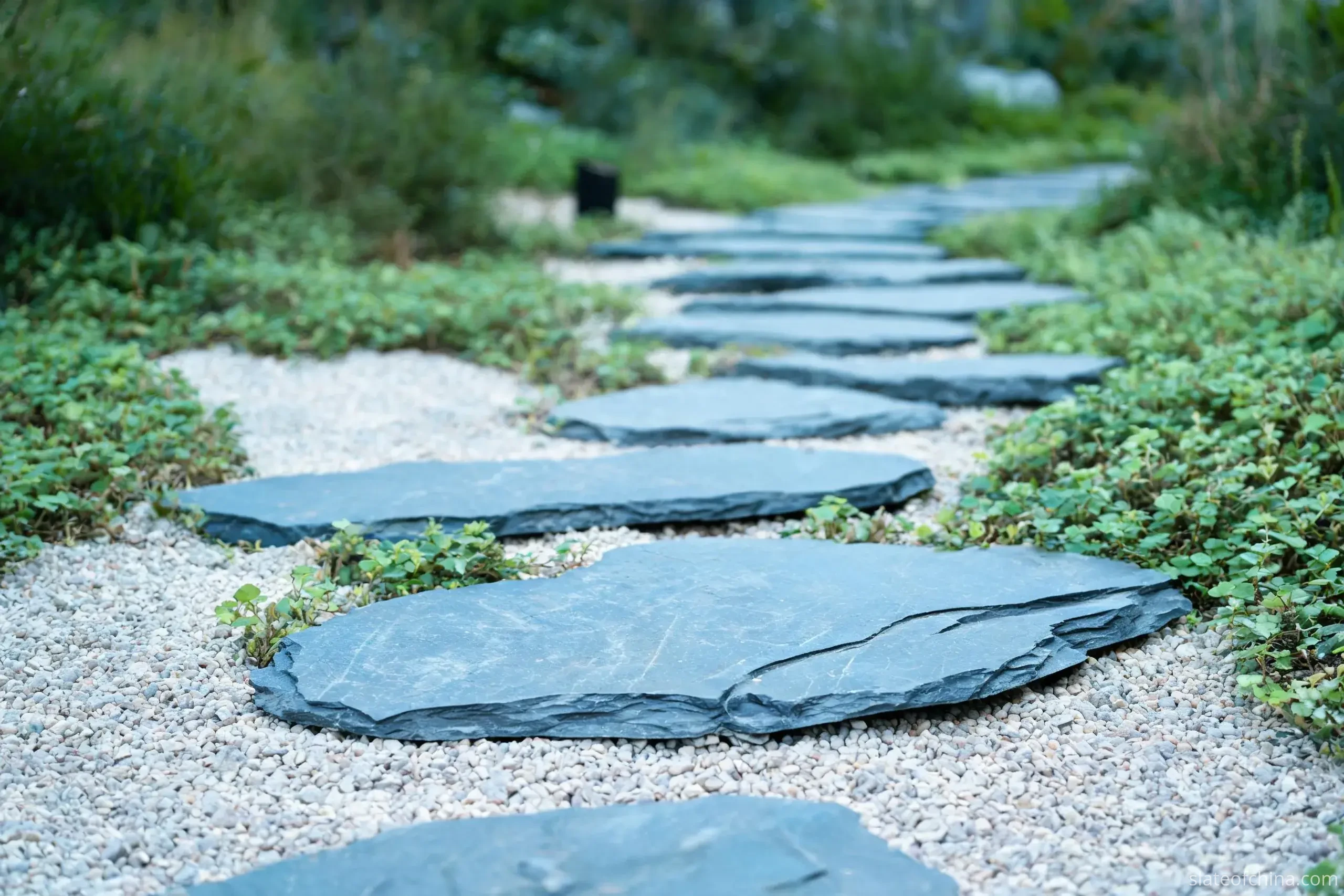
Garden and landscape stone. Natural slate for landscaping is the freest family of the five: stepping stones, edging, borders, monoliths and water-feature surrounds, more often split than sawn and sized to the planting rather than the drawing. This is where the material's natural variation stops being a tolerance question and becomes a design asset — the same bed-to-bed drift a floor specification must control is precisely what makes a garden path look planted rather than poured.
The four domains these families serve — ground, floor, wall and garden — are mapped, with the product decisions each domain actually buys, in their own sections of this guide.
Where the Roofing Line Sits
No confusion in this trade costs more than the one between architectural slate and roofing slate, so the boundary deserves precision. The two are not different materials; they are the same stone, selected and worked for different jobs. Roofing slate is split thin, trimmed, holed or hooked, sorted, and hung in overlapping courses on battens — engineered for what a roof does: shed water, survive wind and freeze, stay light enough for the structure, hold for generations. Architectural slate is split or sawn thicker, finished, and fixed flat — bedded, adhered, anchored or pedestalled — engineered for what a ground, floor or wall does: carry load, stay flat, resist abrasion, drain.
| — | Roofing slate | Architectural slate |
|---|---|---|
| The job | shed water from a pitched roof | carry, cover and face grounds, floors, walls and gardens |
| The products | thin slates in modular sizes | flags, tiles, cladding, steps, coping, garden stone |
| The working | split, trimmed, punched or hooked, sorted | split, sawn, calibrated, finished |
| The standards that lead | EN 12326-1 (Europe) / ASTM C406 (North America) | EN 1341, EN 12057, EN 12058, EN 1469 (Europe) / ASTM C629 (North America) |
| The fixing | nailed or hooked, overlapping, on battens | bedded, adhered, anchored or pedestalled |
The standards follow the same line, and the two families must not borrow each other's certificates. In Europe, EN 12326-1 covers slate and carbonate slate used for discontinuous roofing and certain external cladding systems; its scope does not extend to every kind of façade installation, including bonded cladding and some mechanically fixed systems. Other products answer to application-specific standards: external paving slabs to EN 1341, modular tiles to EN 12057, slabs for floors and stairs to EN 12058, and natural stone slabs for cladding to EN 1469. In North America, ASTM C406 covers roofing slate, while ASTM C629 covers slate dimension stone for general building purposes. The two systems overlap in intent and differ in method: an EN result and an ASTM result describe the same property in different dialects, and the numbers are not interchangeable. A slate that satisfies a roofing slate standard is not automatically a paving stone, and a paving stone is not a roof covering — the applicable specification is chosen by product form, intended use and installation system, and a quotation that attaches the wrong certificate to the right stone has attached nothing. The full comparison between the two families — specification, thickness, testing scope — is worked through on its own page in this guide; the roof side itself, with its fixing rules and standards, is the Roofing Slate Guide's ground.
The boundary is real, but the two families share one inheritance: both live on the cleavage, the density and the mineral honesty of the bed they were rived from. That is why architectural supply tends to mature where a roofing-slate trade already runs — the Jiujiang belt in China among them: the splitting sheds, the saw lines and the thickness discipline exist, and the same selection, cutting and finishing capacity answers both families of orders. For a buyer the practical meaning is supply depth — a region able to quote paving, cladding, flooring and roof stone from one material base, with batch selection and finishing held to one written standard; the origin behind that supply has a guide of its own. Across the whole line, the buyer's question never changes: not is this good slate, but is this slate good for this job.
The Term on Paper
Used alone on an order, architectural slate specifies nothing. It is a noun waiting for its numbers. A quotation that stops at the noun can deliver, within the same term, a hand-riven flag of variable thickness or a tile calibrated to drawings — both legitimately, both correctly described, and a world apart on site. What turns the term into a product is the writing that follows it: nominal dimensions and the tolerance they carry; a named finish — cleft, sawn, honed — rather than the word natural; a thickness stated as a band or a nominal with its tolerance; the fixing the design assumes, so the supplier can judge the stone against it; and, wherever performance is being bought, the test reports that apply to the application, for the batch being quoted.
Application-first is the discipline that keeps the term honest. Outdoor paving wants the wet-condition behaviour — slip, water absorption, freeze–thaw — read from the actual material's report. An interior floor wants flatness, abrasion and dimensional consistency. A facade wants the fixing engineering and the exposure record. None of these properties live in the word architectural; all of them live in documents a competent supplier can produce for the batch in question. Where tested figures rather than terms are wanted, the published EN and ASTM results for the material we supply are collected on the test results page.
Because the material is geological, colour and variation are written down as well: an agreed range around an approved sample, not a single swatch. Natural slate does not arrive in dye lots; it arrives in beds. How to read that variation at sampling — and what to fix in writing before an order — is treated on the colour and texture page of this guide. Until it is fixed, the honest description of any slate colour is a range, and the honest object of approval is a sample from the production lot.
Where the Term Sits Today
The word slate carries associations — old roofs, heritage buildings, museum restoration — that hide how the architectural families are used in current work: calibrated floors under contemporary kitchens, sawn paving grids against glass and steel, split-face feature walls in hotels and lobbies, dark blue-grey stone at the entrances of new housing. The material's quiet planes suit modern detailing precisely because they are quiet: against glass, timber and render, slate does not compete — it grounds.
None of that makes slate the answer to every surface. Where a project wants gloss and figure, polished granite and marble carry it honestly. Where thin, perfectly uniform large-format panels are the brief, porcelain is engineered for exactly that. Where budget or programme rules, concrete and stone-effect alternatives do the work without apology. Slate's case is narrower and sturdier: a natural material that splits flat, wears slowly, reads quiet, and — specified for the exposure it will actually meet — stays in service for decades. An installed slate surface is low-maintenance, not maintenance-free: drainage, cleaning method and finish decide the second decade as surely as the stone does.
The Definition, Once More
Stripped back to one sentence, the answer to what is architectural slate is: natural slate, split and sawn into the products buildings and gardens are made of — judged by application, made by cleavage and saw, specified by what follows the noun.
Everything on this page followed from that. The term covers five families and no single product; the rock behind it carries one cleavage and many beds; the working routes are two economies, split for character and sawn for geometry; the roofing line is a change of job, not a change of stone; and the discipline is paperwork — dimensions, finish, thickness and test evidence, in writing, before the order. The pages that follow this one take each family to the depth a project needs. This one only had to define the ground they stand on.
Frequently Asked Questions
The questions below are the ones the term itself raises — coverage, boundaries, colours, finishes and thickness. Each answer gives the working rule first; the sections above carry the full treatments.
What is architectural slate used for?
Outdoor paving and flooring, interior floor tiles, wall cladding panels, steps and stair treads, coping and capping stones, garden stepping stones, edging, landscape features and custom-cut architectural elements. The term covers the whole product domain; the specification for each use — dimensions, finish, thickness and the relevant tests — is what turns it into an orderable product.
Is architectural slate the same as natural slate?
It is natural slate — plus, in commercial practice, closely related layered stones that are traded and installed as slate. When performance matters, the geological identity of a specific material is confirmed by petrographic description and test report rather than by the trade word, which describes behaviour and appearance more than mineralogy.
What is the difference between architectural slate and roofing slate?
Application, and everything that follows from it. Roofing slate is split thin, holed or hooked and hung in overlapping courses, and answers to roofing standards (EN 12326-1 in Europe, ASTM C406 in North America). Architectural slate is worked thicker and finished for grounds, floors, walls and gardens, and answers to the paving, flooring, tiling and cladding standards. Same rock, different job.
Can architectural slate be used outdoors?
Yes, where the material is selected for the exposure. Frost resistance, water absorption, slip behaviour when wet and thickness against load are the working checks, read from the stone's own test report rather than from generic tables, and installed with drainage and jointing that suit the climate. Sheltered and covered positions relax some requirements; exposed and northern ones tighten them.
What colours does natural architectural slate come in?
Black, dark grey, blue-grey, green and regional variations, set by mineral content rather than added colour. Beds vary within a quarry and between quarries, so colour is agreed as a range around an approved sample from the production lot, not as a single shade.
What surface finishes are available on architectural slate?
Natural cleft (riven), sawn, honed, calibrated, and — where the stone's mineralogy suits it — brushed or thermal finishes. A finish is a duty decision as much as an appearance decision: it changes slip behaviour, weathering and maintenance, and it should be named on the order rather than assumed from the word natural.
Is architectural slate suitable for modern buildings?
Yes. Calibrated flooring, sawn paving, cladding panels and dimensioned steps are routine in contemporary residential, hospitality and public projects, and the material's quiet planes sit naturally against glass, steel, timber and render. Suitability still runs through exposure, load and maintenance planning rather than appearance alone.
How thick should architectural slate be?
Thick enough for what sits on it and how it is fixed. Some pedestrian paving products fall within the 20–40 mm range — a reference point, not a specification. Steps and copings run heavier at their edges and nosings, cladding panels are dimensioned together with their fixing system, and vehicle areas or unsupported spans push thickness up again. The number is set by slab dimensions, stone strength, loading, support conditions and the installation system — confirmed with the supplier against the project, never taken from a generic table.
Related Reading
Sourcing architectural slate for a project? Whether the enquiry is paving, wall cladding, flooring, steps or landscape stone, the fastest route to a quotation that means something is a specification that follows the noun — so this is what helps:
- Project drawings or a reference layout — the geometry the design assumes, even a marked-up sketch
- Dimensions, thickness and a named finish — a band for riven stock, a nominal for calibrated, the finish chosen for the duty
- Estimated quantity and the destination country — they frame the batch, the sample and the freight
- The fixing the design assumes — so the stone can be judged against the job it will actually do
Not every enquiry arrives finished — a drawing and a rough quantity are a workable start. We can help identify suitable slate materials, finishes, samples and customized production requirements before anything is committed.