
Glossary of Architectural Slate Terms
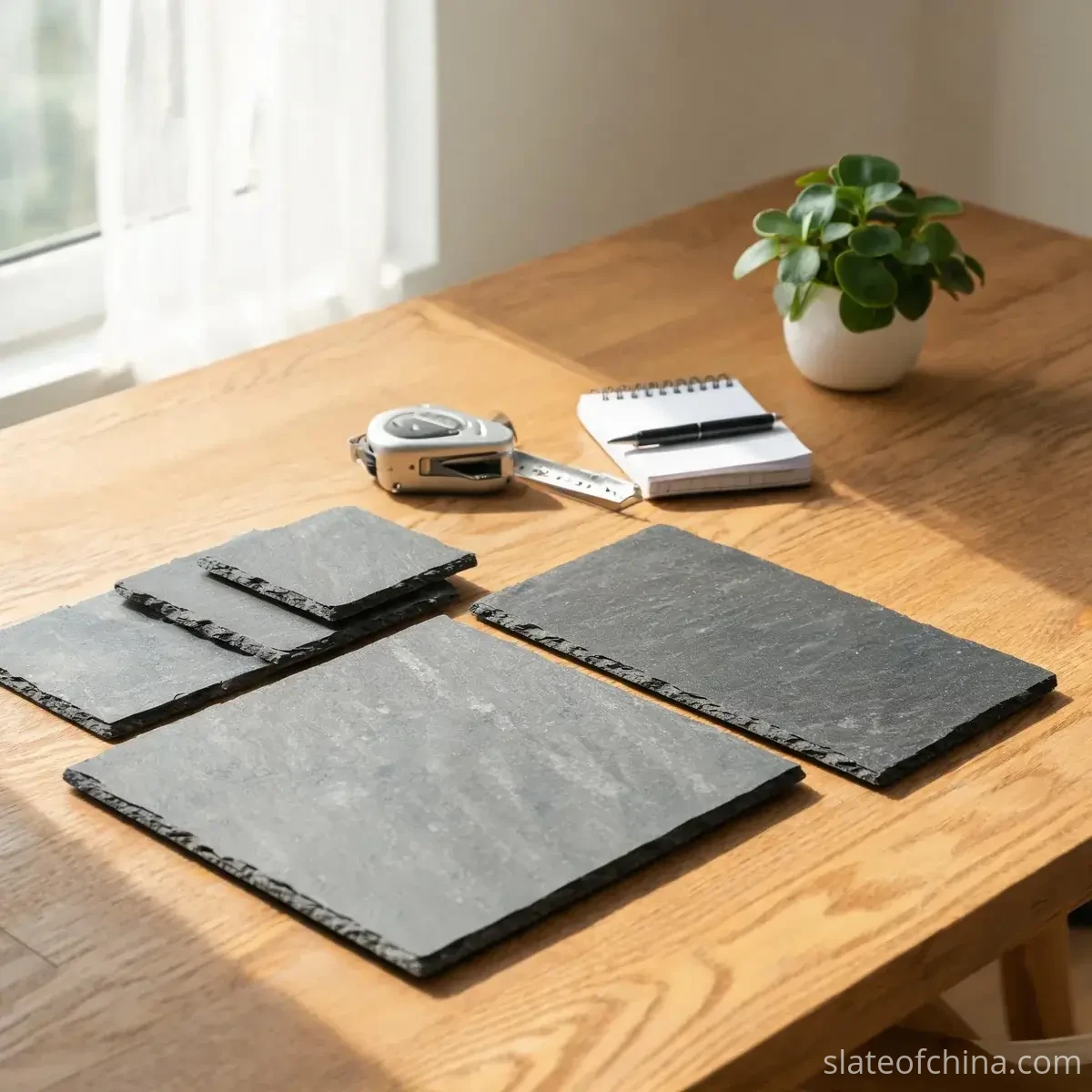
A slate quote reads “600 × 400 × 20 mm nominal, natural riven face, calibrated back, sawn edges.” The riven face tells you what you will see and feel. The calibrated back tells you how the supplier controls thickness. The sawn edges tell you how the sides are cut. You still need the actual thickness range and the method used to measure it.
Every term in that line names one surface. The questions underneath name the decision. This glossary reads an architectural slate quote and a spec sheet the way a buyer does — the plain meaning first, then the one thing worth confirming before you order slate for paving, floors, walls or landscape work.
| How to use this page. Each term is explained in one sentence, then given the question to ask. Compare the “common mix-ups” first — those are the places a mismatch is born. |
Jump to common mix-ups · finishes and edges · dimensions and formats · support and fixing · test reports and standards · samples and orders · example quote
Five terms buyers look up most: riven · calibrated · ledger · rainscreen · PTV

Common mix-ups that break a quote
Most order problems start in the places two words sit close together. They look interchangeable on paper and are not. The table keeps them apart, and each row points at what to confirm.
| Terms you might see together | What each describes |
|---|---|
| Riven face / calibrated back | Natural texture on the visible face / machining on the back to control thickness. A single tile can have both. |
| Honed face / sawn edge | An abrasively smoothed face / a saw-cut side. The order should name each surface separately. |
| Nominal size / actual size | A stated or trade size / the finished dimensions of the piece. Confirm whether a quoted module includes a joint. |
| Ledger panel / rainscreen | A stacked-stone product format / an exterior wall assembly designed to manage rain. |
| Wet PTV / ramp R-rating | Outputs from different slip-test methods. Compare results within the method and conditions the project calls for. |
| Flexural strength / breaking load | Bending stress at failure, usually in MPa / force at failure in a particular test setup, usually in N or kN. |
Finishes and edges
The visible face, the underside and the cut sides are three separate specs. Many quotes write one word for the face and assume the rest. Ask for each surface you can see once installed — the face, the exposed edge, and the back where it matters.
| Term | Plain meaning and what to check |
|---|---|
| Face / back / edge | The exposed surface, the underside or rear, and the side of the piece. Give a finish for each surface that matters. |
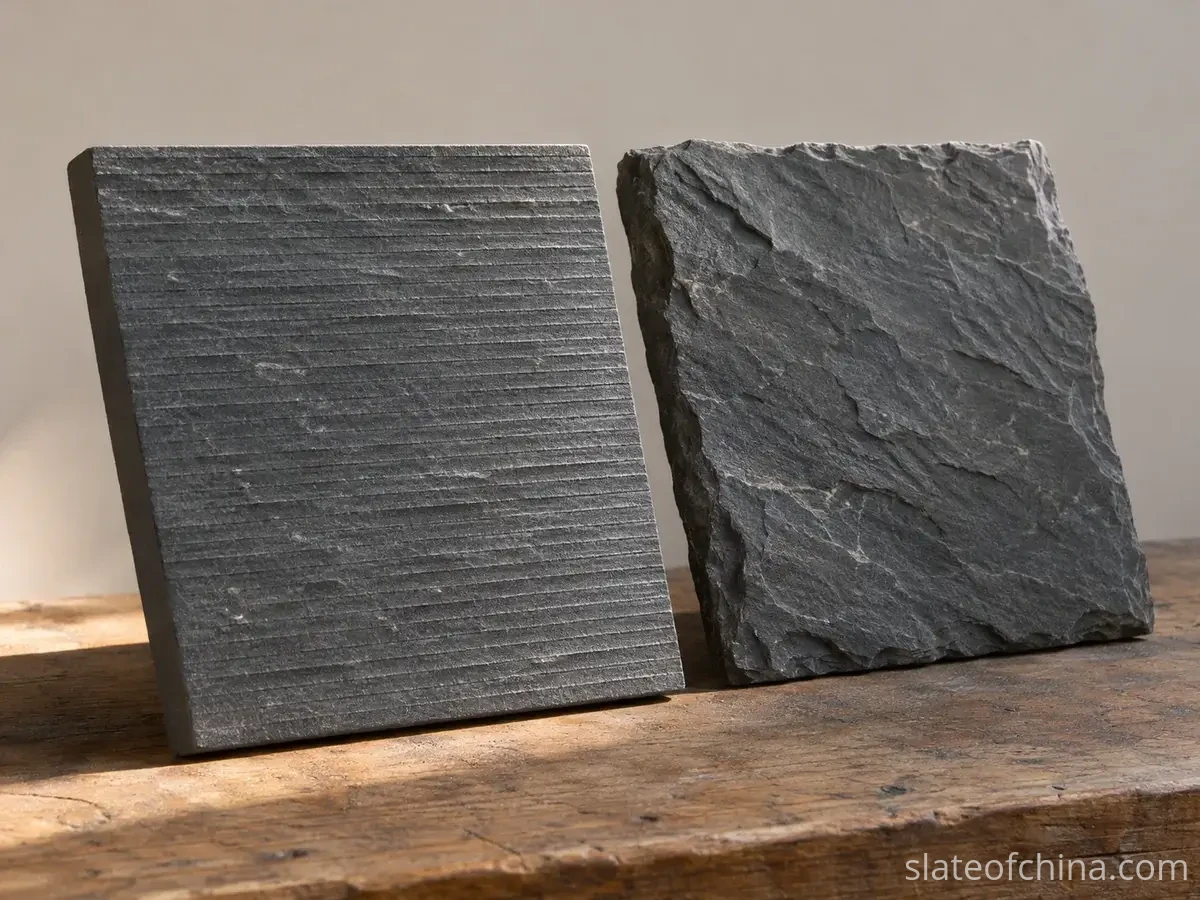
| Natural cleft / natural riven | The textured face created by splitting slate along its cleavage. “Natural cleft” is common in North American listings and “riven” in UK listings. Approve the expected highs, lows and texture variation on samples. |
| Hand-cleft / hand-split | Slate split by hand. A hand-cleft face can be paired with a machined back. Confirm what was split and how thickness is controlled. |
| Sawn face / sawn edge | A surface produced by a saw, sometimes with visible machining marks. State whether the face, the edges or both are sawn. |
| Honed slate | Slate whose exposed face has been abrasively smoothed, generally to a matte or satin look. Ask to see the agreed sheen and any slip data for that finish. |
| Brushed slate | Slate worked with abrasive brushes to change the feel of its surface. The degree of smoothing varies with the starting texture. Approve a physical sample. |
| Polished slate | Slate finished for a higher sheen where the material allows. Confirm the expected gloss and which faces or exposed edges are included. |
| Split edge / dressed edge | A split edge has an irregular broken profile. A dressed edge has been worked to an agreed profile. Ask for a side-on sample when the joint line matters. |
| Arris / eased edge / chamfer | The arris is where two faces meet. Easing softens that line. A chamfer makes a small flat bevel. Put the visible edge detail on the drawing. |
| Tumbled edge | An edge softened and irregularised by tumbling. Approve the amount of corner rounding and expected appearance. |
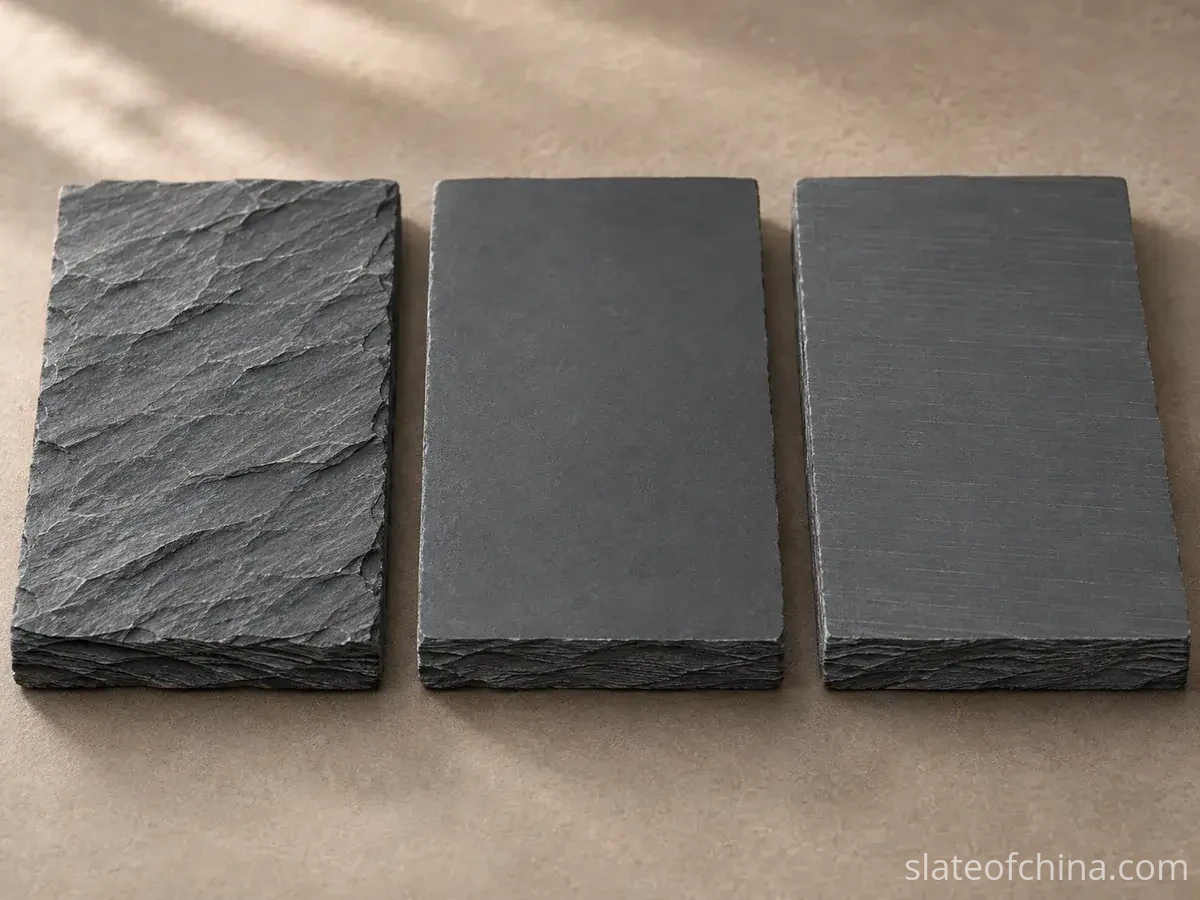
For a fuller comparison of the main surface families, see the slate surface finishes guide.
Dimensions and product formats
A size on a quote is a target, not a single number. The band, the measurement points and how the texture is treated all have to be written down. A format word like “tile” or “slab” changes meaning between markets, so put the finished dimensions on the order.
| Term | Plain meaning and what to check |
|---|---|
| Calibrated slate | Slate machined to control thickness, often on the back so the natural cleft face stays visible. Some North American catalogues write “gauged” for the same step. Confirm the thickness band in writing, where to measure and how face relief is assessed. See the calibrated vs hand-cleft guide. |
| Uncalibrated slate | Slate supplied without that thickness-machining step; sometimes listed as “ungauged”. It may still be sorted into an agreed thickness band. Ask for the actual limits in writing before ordering. |
| Nominal thickness | A stated target or trade thickness, such as 20 mm. Write the permissible minimum and maximum separately. |
| Actual size / modular size | Actual size is the physical piece. A modular dimension may include an allowance for the joint — a 600 mm module with a 5 mm joint might use a 595 mm piece, if the drawing says so. |
| Thickness tolerance | The permitted variation from a target or within a stated range. Define the measurement points and how high or low cleft features are treated. |
| Flatness / face relief | Flatness is departure from a reference plane under an agreed method. Face relief is the visible highs and lows in a textured face. Specify how both are assessed when they matter. |
| Squareness | How closely corners conform to the required angle. Agree the check method for tight grids or prefabricated layouts. |
| Tile / flag / slab | A tile often means a repeatable flooring or wall unit. A flag is a paving unit. A slab often means a larger flat piece or stock cut to size. Trade usage varies — put finished dimensions on the quote. |
| Setts / cobbles | Small paving units. Setts commonly have a block-like shape; “cobbles” can also describe rounded or tumbled pieces. Confirm dimensions, edge and depth. |
| Cut-to-size slate | Stone fabricated to a drawing or piece schedule. Mark visible faces, returns, holes, rebates and edge profiles. |
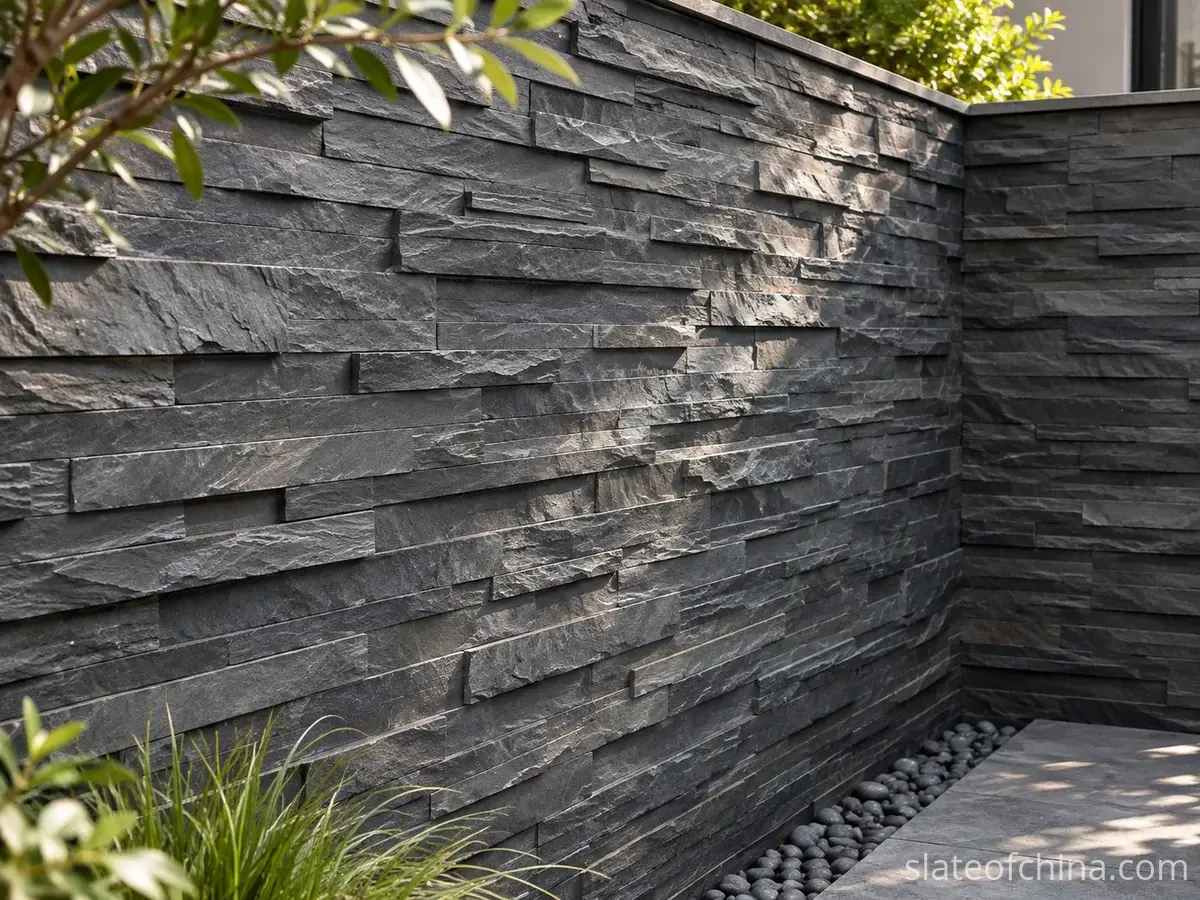
| Ledger / ledgestone / stacked stone | Narrow stone strips or units that create a layered wall appearance. They may be loose pieces or preassembled panels. Confirm panel backing, installed depth and available corner pieces. See the stone veneer and ledger panels guide. |
| Stone veneer | A facing layer of stone. Ask whether the quote means individual pieces, preassembled natural stone panels or another product. |
| Corner return | Stone that continues around a corner or into a reveal. Specify both leg lengths, orientation and the visible corner treatment. |
| Stepping stone / edging / chippings | Individual walking pads, boundary pieces and loose graded fragments. Give dimensions and thickness for pieces, and a grading range for loose stone. |
Support and fixing
How slate is held is where a quote and a drawing meet. These words name the layers and the hardware, and each has a hidden requirement — the substrate build-up, the support spacing, the movement detail.
| Term | Plain meaning and what to check |
|---|---|
| Substrate / sub-base | The substrate receives the installation system. In paving, the sub-base is a supporting layer below the bedding or overlying base construction, depending on the build-up. Check the section drawing. |
| Bedding / full mortar bed | Bedding is the layer supporting a paving unit. A full mortar bed provides continuous support across the underside as detailed. Confirm the specified build-up and bonding. |
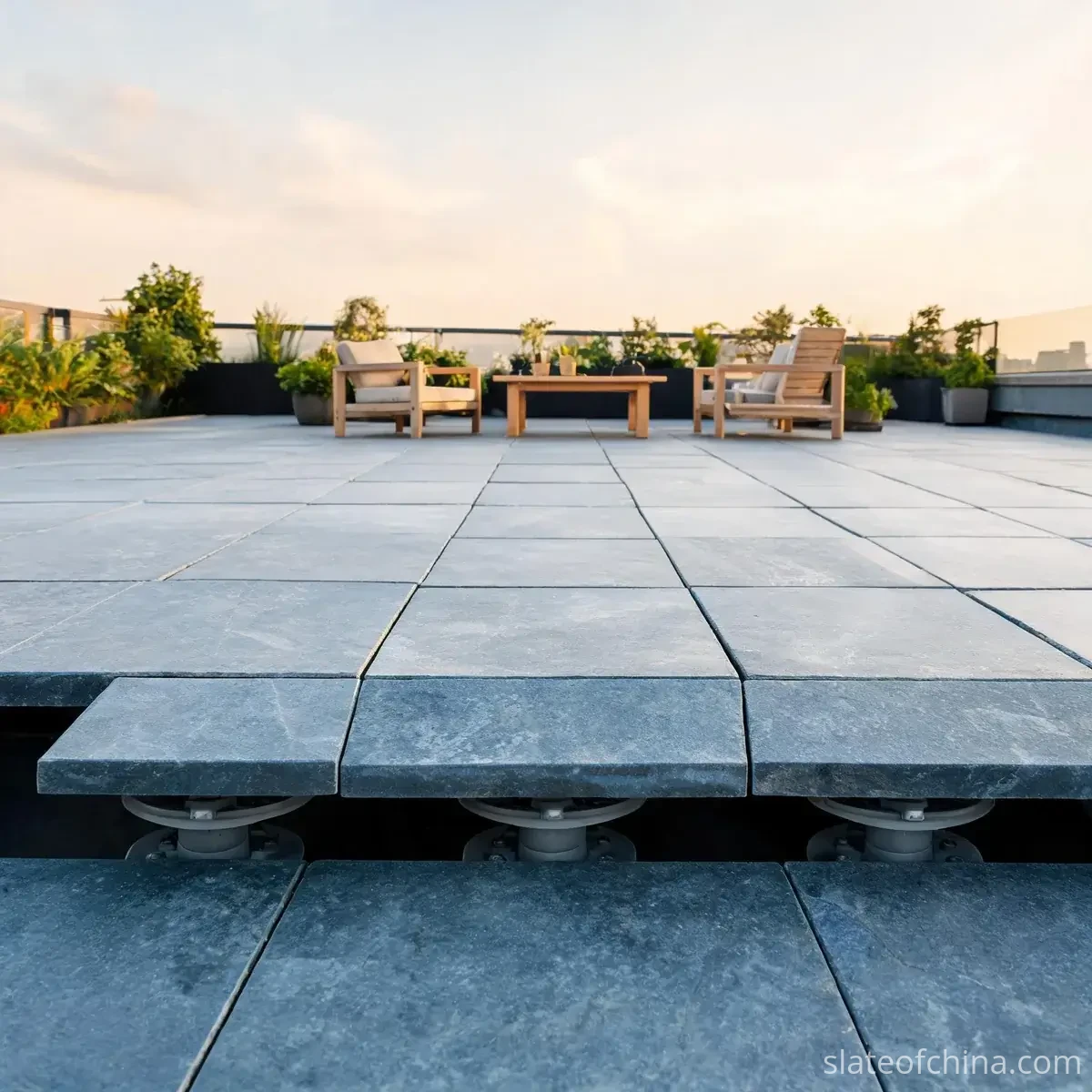
| Pedestal / span | A pedestal raises paving on discrete supports. Span is the distance between supports as defined by the design or test. Confirm stone format, thickness and suitability for the proposed support layout. |
| Fall / drainage | Fall is the slope towards a drainage point or outlet. Drainage is the route water takes away from the surface or assembly. Identify both on the detail. |
| Joint / movement joint | A joint is a gap between units. A movement joint accommodates movement in the assembly. Check the detail before treating every gap as a standard grout joint. |
| Lippage | The height difference between adjacent pieces at a joint. Agree how intentional riven texture is told apart from installation-related steps. |
| Adhered cladding | Stone attached to a compatible substrate with an adhesive or mortar system. Confirm the system, substrate and application limits. |
| Mechanical fixing / kerf / undercut anchor | Mechanical fixings transfer loads through hardware. A kerf is a slot that may receive a clip or support. An undercut anchor engages a shaped hole, typically at the back of a panel. Use the project fixing detail and supporting test evidence. |
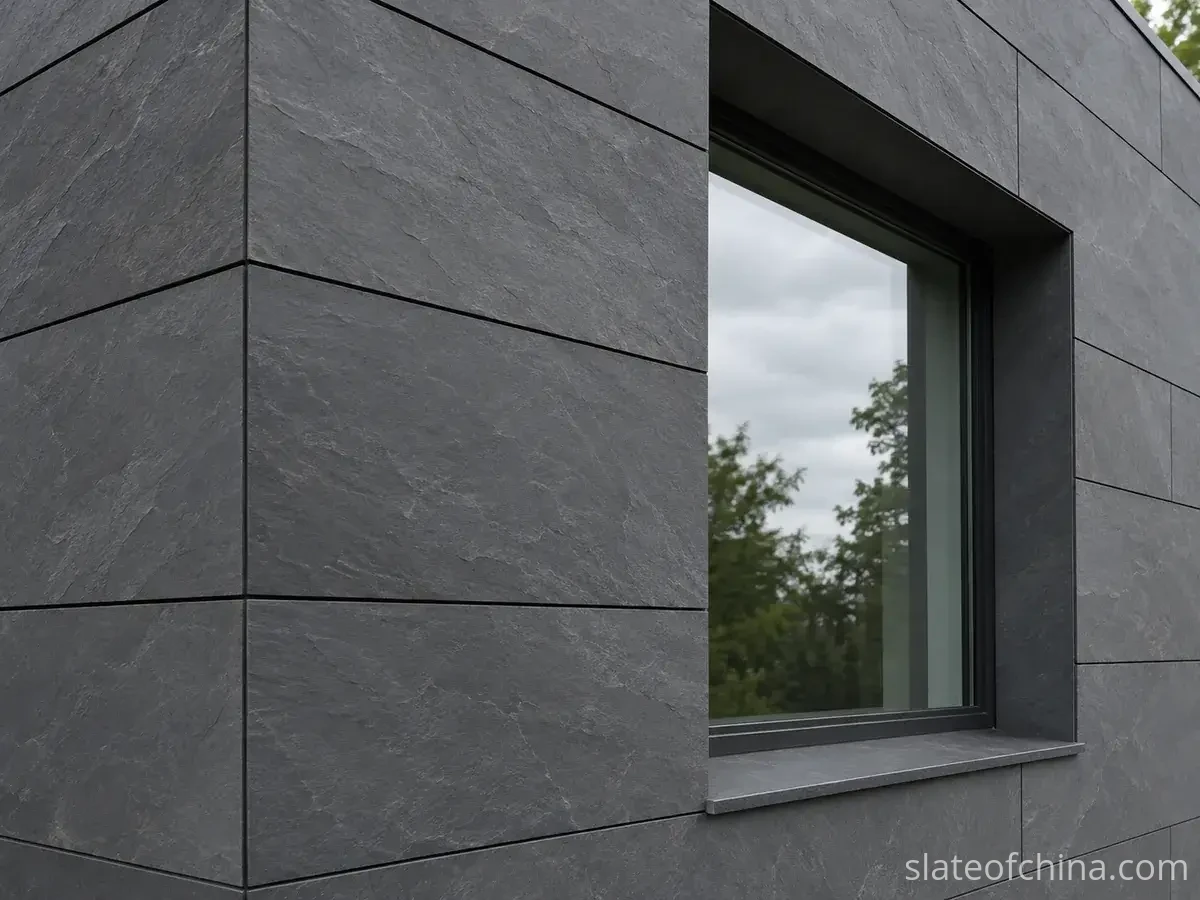
| Rainscreen / cavity | A rainscreen is an exterior cladding assembly that limits rain reaching the inner wall and gives water behind the outer layer a path out. The cavity is the space behind the cladding and may be ventilated depending on the system. Panel appearance alone cannot identify the concealed assembly. |
Test reports and standards
Numbers only mean something with the method and the stone named. A report for one finish or one thickness does not automatically cover another. Keep the test method, specimen, condition and the exact product together in the same line.
| Term | Plain meaning and what to check |
|---|---|
| PTV / Pendulum Test Value | The number recorded by a pendulum slip test. Request the test method, actual finish, wet or dry condition, slider type and test directions, particularly for a profiled surface. See the slate slip resistance guide. |
| R-rating / DCOF | An R-rating comes from a specified shod ramp test. DCOF means dynamic coefficient of friction and depends on the test method and conditions. Request the full report and use the metric the project requires. |
| Water absorption | Water uptake expressed as a percentage of dry mass under the stated test. A low figure alone leaves frost performance and slip resistance to be assessed separately. |
| Apparent density / kg per m² | Density is mass per unit volume. Mass per square metre also depends on thickness. State whether the figure covers bare stone or the installed assembly. |
| Flexural strength / modulus of rupture | Bending stress at failure under the specified method, generally in MPa. Ask about test direction and specimen condition before comparing slate reports. |
| Breaking load | Force that broke the specimen in a defined test. Compare specimen size, thickness and support span along with the force. |
| Freeze–thaw resistance | Performance after defined laboratory freezing and thawing cycles. Check the method, cycle count, specimen condition and what was assessed afterwards. |
| Abrasion resistance | Resistance to wear under a specified test. Compare results from the same method and check how the scale is reported. |
| Test report / DoP | A test report documents specimens, methods and results. A Declaration of Performance (DoP), where required, states declared performance for an identified product and intended use. Check that the document covers the product you are buying. |
What does wet PTV 36 mean? UK HSE guidance places PTV 36 and above in its low slip potential band. Read the number with the test and the intended use: a dry result cannot answer a wet-use question, and the report should name the finish and conditions tested.

Which stone standard is on the quote? EN 1341 addresses natural stone slabs for external paving, EN 12058 natural stone slabs for floors and stairs, and EN 1469 natural stone cladding slabs within its scope. ASTM C629/C629M covers slate dimension stone and excludes roofing slate. Ask for the applicable edition and product scope; for cladding, the panel spec and the fixing design are separate checks. See architectural slate standards for the scope boundaries.
For reference figures and test-report context, see Architectural Slate Technical Data.
Samples and orders
The last group of words decides how the order is counted, packed and shipped. These are where square-metre claims, crate weights and lead times get pinned down before anything leaves the factory.
| Term | Plain meaning and what to check |
|---|---|
| RFQ / MOQ | RFQ means request for quotation. MOQ is minimum order quantity. Ask whether the minimum applies to each format, each finish or the whole order. |
| Batch / lot / range sample | A batch or lot identifies a traceable group under the supplier’s system. A range sample shows accepted variation in colour, texture or another agreed feature. Record sample IDs and keep approval photos with the order. |
| Mock-up / dry lay | A mock-up is a trial assembly to check appearance or details. A dry lay arranges loose pieces before fixing, often to assess colour blend or joint layout. Agree what is being approved. |
| Net stone area / installed coverage | Net stone area generally counts the faces of the pieces. Installed coverage may use a module that includes joints. Ask which basis is used per square metre and list spare pieces separately. |
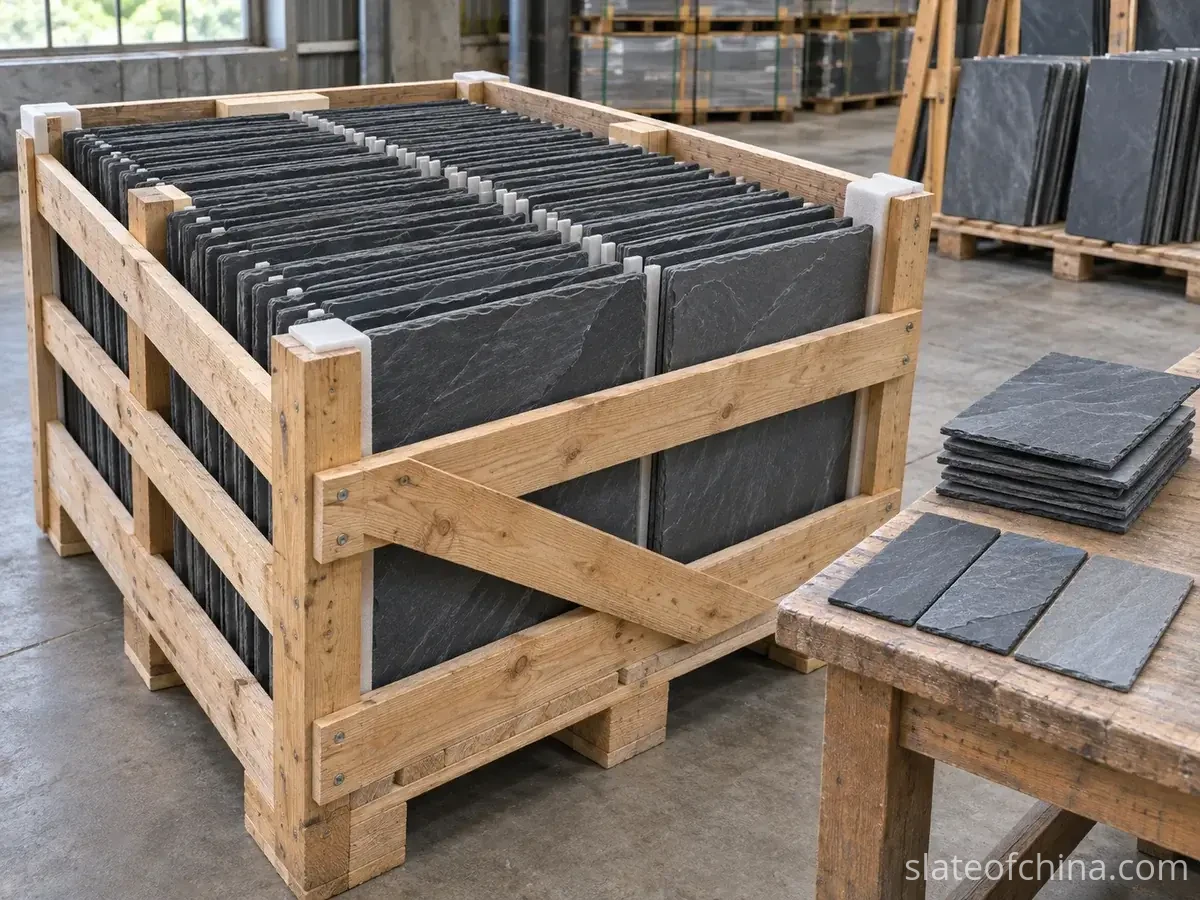
| Net weight / gross weight | Net weight is the stone weight on the stated packing basis. Gross weight includes packaging. Ask for per-crate quantities, weights and dimensions. |
| On-edge packing / blocking | On-edge packing places pieces vertically in a crate or suitable frame. Blocking limits movement during handling. Confirm the agreed arrangement, separators and edge protection for the format. |
| FOB / CIF | Under FOB the seller delivers on board at the named port of shipment. Under CIF the seller also pays carriage and insurance to the named destination port, with risk transferring on board at shipment. Put the named port and agreed Incoterms edition on the quote. |
| Lead time | The time to the milestone stated on the quote. Ask when the clock starts and whether the end point is production complete, ready to load or a scheduled shipment. |
Reading one quote from start to finish
“600 × 400 mm finished size, 20 mm nominal thickness, charcoal slate paving flags, natural riven face, calibrated back, sawn edges, 100 m² net stone area.” Written this way, “nominal” qualifies the thickness alone — the size figures are the finished dimensions to confirm in writing.
You can picture the stone and understand how the quantity is counted. To compare this with another quote, ask the supplier to confirm four things in writing.
- Size and thickness. Are 600 × 400 mm the actual finished dimensions? What are the permitted thickness limits and the measurement points?
- Appearance. Which reference pieces define the acceptable colour and cleft variation?
- Performance. Which report covers the specified finish and intended exposure? If the paving will be used wet, what slip test and conditions does the report identify?
- Order basis. Are cuts and spares separate? What are the per-crate quantities, gross weights and lead-time milestones?

Use the slate specification sheet to send the same requirements to every supplier. For a cut-to-size enquiry, send Slate of China your drawings and piece schedule.
Frequently asked questions
What does calibrated slate mean?
Calibrated slate means slate machined to control thickness, usually on the back so the natural cleft face stays visible. Confirm the allowed thickness band, where it is measured and how high and low points on the face are treated.
What is the difference between natural cleft and riven slate?
Both name the textured face created by splitting slate along its cleavage. Natural cleft is more common in North American listings and riven in UK listings. Approve the face comparison, tone and texture variation on samples before ordering.
What does wet PTV mean?
PTV is the number recorded by a pendulum slip test, and a wet reading is measured on a damped surface. UK HSE guidance places PTV 36 and above in its low slip potential band. Read the number with the test method, finish and conditions the project calls for.
What is a slate ledger panel?
A slate ledger panel is a product format of narrow stone strips or units that create a layered, stacked-stone wall appearance. Confirm the backing, installed depth and available corner pieces with the supplier.
What is a slate rainscreen?
A rainscreen is an exterior cladding assembly that limits rain reaching the inner wall and gives water that gets behind the outer layer a path out. The cavity behind the panels is part of the concealed assembly, which appearance alone cannot identify.
What does 20 mm nominal mean for a slate tile?
Nominal is the stated target or trade thickness, such as 20 mm. It is not a single exact number. Write the permissible minimum and maximum, and the points where they are measured, into the order.
Need a quote in plain terms? Send the application, dimensions, finish and destination port, and we’ll turn it into a spec sheet and a packing estimate you can compare. Ask for an architectural slate quote.