
Slate Density: What 2,700–2,800 kg/m³ Does and Doesn't Mean
Of all the figures on a natural slate data sheet, density is the quietest. No class code hangs from it — EN 12326-1 grades roofing slate on strength, absorption and frost behaviour, ASTM C406/C406M grades its roofing slates S1–S3 on specified breaking-load, absorption and depth-of-softening requirements — and nothing in either system promotes a slate for being heavy. Yet this unglamorous line, usually written 2,700–2,800 kg/m³, sizes the forklift, fills the pallet plan, sets the container booking and prices half the freight quotation. One number does all of that work with nothing but multiplication.
The problem is never the multiplication, which stays honest at every step. The problem is what the multiplication is fed — and what people expect the answer to prove. This guide follows one working figure of 2,750 kg/m³ through the five calculations it genuinely supports: weight per square metre, single-piece weights, order tonnages, packed pallets and container loads. At each stop it marks where the inputs come from and where the drift enters, and it stops, deliberately, where arithmetic ends and testing, declaration and paperwork begin.
THE SHORT VERSION
Density × thickness → stone weight per m². At 2,750 kg/m³ every millimetre of slate adds about 2.75 kg/m²: roughly 27.5 kg/m² at 10 mm and 55 kg/m² at 20 mm, stone only.
Stone weight × installed quantity → the load the structure feels. Overlapping tiles lay more slate per roof square metre than the footprint suggests — double-lap coursing can more than double it.
Net tonnage ÷ density → solid stone volume. Useful for stuffing plans; never equal to a container's legal payload, which belongs to ratings, road rules and the weighbridge.
And one boundary: density is an estimating tool, not a quality certificate. Strength, water absorption and frost resistance come from their own tests — no amount of multiplication produces them.
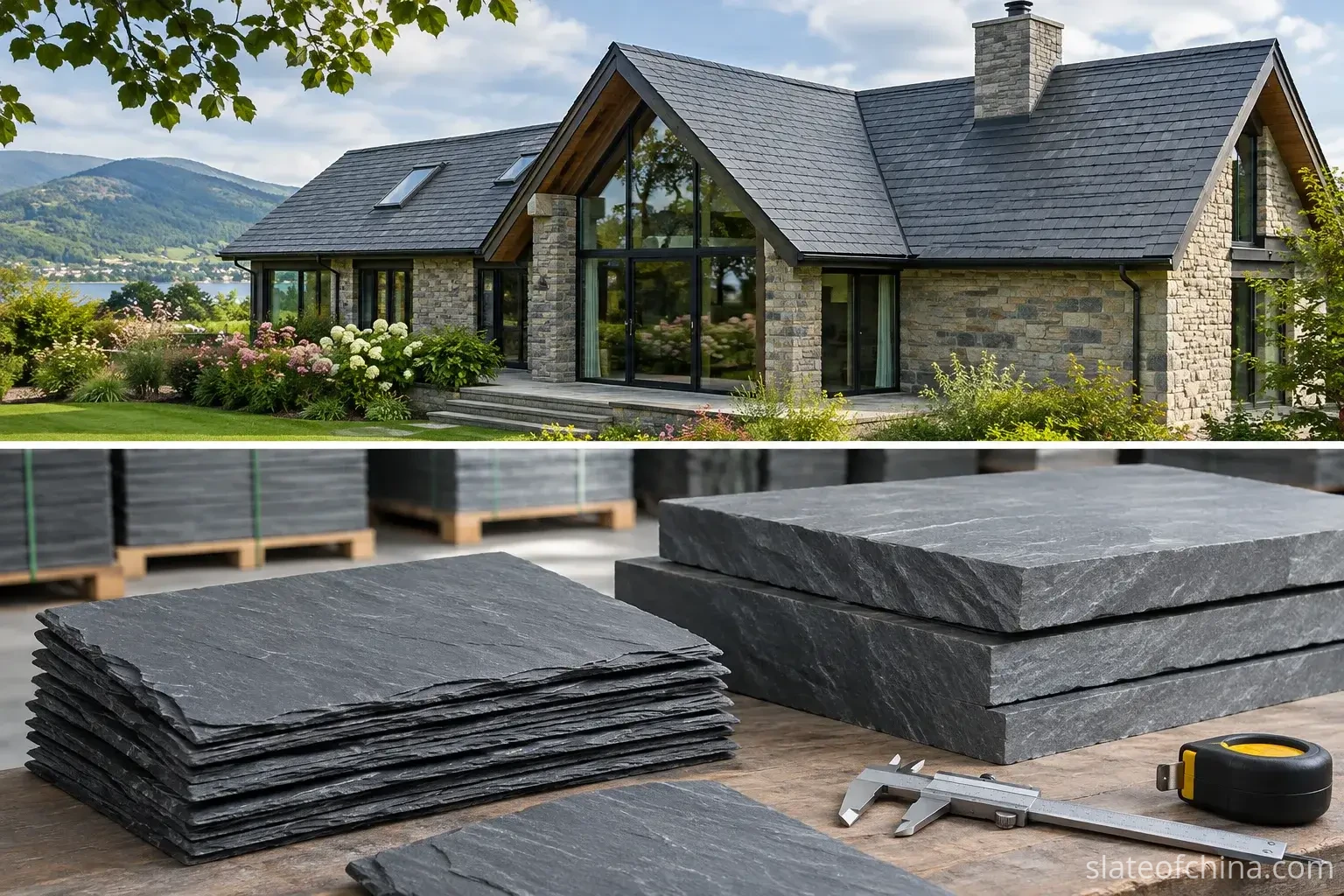
What the slate density number actually measures
Density is mass per unit volume, expressed for stone in kilograms per cubic metre — or, on data sheets that prefer the older unit, grams per cubic centimetre, where the same stone reads 2.70–2.80 g/cm³. The arithmetic behind the figure is disarmingly plain: a specimen with an external volume of 0.001 m³ and a dry mass of 2.75 kg has a density of 2.75 ÷ 0.001 = 2,750 kg/m³. One cubic metre of that same rock has a theoretical mass of 2.75 tonnes. That, and nothing more, is what the data-sheet line says.
What the line does not say is how the number was produced — and for stone, method matters. A dry bulk or apparent density uses the specimen's external volume, internal pores included; this is the number that belongs in shipping and load arithmetic. A real (or particle) density divides pore volume out and lands higher; it describes the solid mineral skeleton, not the tile in your hand. European practice reports both by defined procedure — EN 1936 is the natural-stone test method covering real density, apparent density and open porosity. When a supplier quotes a density, the professional question is short: which density, under which method, measured on which sample?
The US standards system adds an irony worth knowing. ASTM C97/C97M — the general test method for absorption and bulk specific gravity of dimension stone — carries a scope note excluding slate from its coverage: the method is written for all types of dimension stone except slate (ASTM product page). A specific-gravity line on a US-style slate data sheet is therefore worth a follow-up question about procedure, while its European-style counterpart is usually an EN 1936 apparent density. Neither figure is wrong; each simply needs its test method stated.
Structural engineers meet the same number in a different dress. Multiplied by gravitational acceleration, 2,750 kg/m³ becomes a unit weight of about 27 kN/m³ — the form in which slate enters a dead-load calculation. The conversion is trivial; it also explains why a figure that looks like packaging trivia can decide whether a refurbishment keeps its original joists.
How the band looks against a real, tested material
For a concrete reference point: the material we supply from the Jiujiang quarries has measured about 2,819 kg/m³ on representative samples — slightly above the common commercial band, which is exactly why working bands and measured values both need to exist. The figure belongs to those tested samples and stays indicative for planning; where a project's arithmetic depends on it, request the density line with the batch documentation — together with its test method and sample identity, in the same way this section teaches for any supplier's figure. The absorption, frost and flexural results characterising the same material sit on our published slate quality and test results page.
Buyers who would rather check a number than trust a line can do so on a spare sample with a bench scale and a rule — the ten-minute method is described in Jiujiang Slate Density.
Slate weight per square metre, thickness by thickness
The question most buyers actually ask is simpler than it sounds: how much does slate weigh per square metre? The answer is one multiplication:
Applied across the standard architectural thicknesses at the working figure of 2,750 kg/m³, the result is a ladder worth keeping at hand:
| Slate thickness | Stone weight per m² at 2,750 kg/m³ |
|---|---|
| 4 mm | 11.0 kg |
| 5 mm | 13.8 kg |
| 6 mm | 16.5 kg |
| 8 mm | 22.0 kg |
| 10 mm | 27.5 kg |
| 12 mm | 33.0 kg |
| 15 mm | 41.3 kg |
| 20 mm | 55.0 kg |
| 25 mm | 68.8 kg |
| 30 mm | 82.5 kg |
Calculated material mass for solid slate at a working density of 2,750 kg/m³. Values are rounded and indicative — no allowance for thickness variation, surface relief, overlaps, fixings, adhesive or packaging.
Compressed to a trade rule: every millimetre of solid slate adds about 2.75 kg/m² (2.7–2.8 across the common band, 2.82 on our measured representative figure). For interior floors the thickness bands and their weights are worked through in Slate Flooring Thickness: 10, 12 and 20 mm Explained; for slate cladding weight per m² as a full installed assembly — panels, backing, fixings, framing — the arithmetic continues in Slate Cladding Thickness and Weight, including the kN/m² translation for structures.
Area turns kilograms into tonnes, and a project into a number the structure cares about. A terrace calling for 120 m² at a nominal 10 mm is 120 × 0.010 × 2,750 = 3,300 kg, roughly 3.3 tonnes of stone — before adhesive, bedding or grout. Ordering practice usually adds a cutting and breakage allowance on top, commonly a few percent for simple layouts and more where the pattern is complex; that allowance is a purchasing decision, not a physical constant.
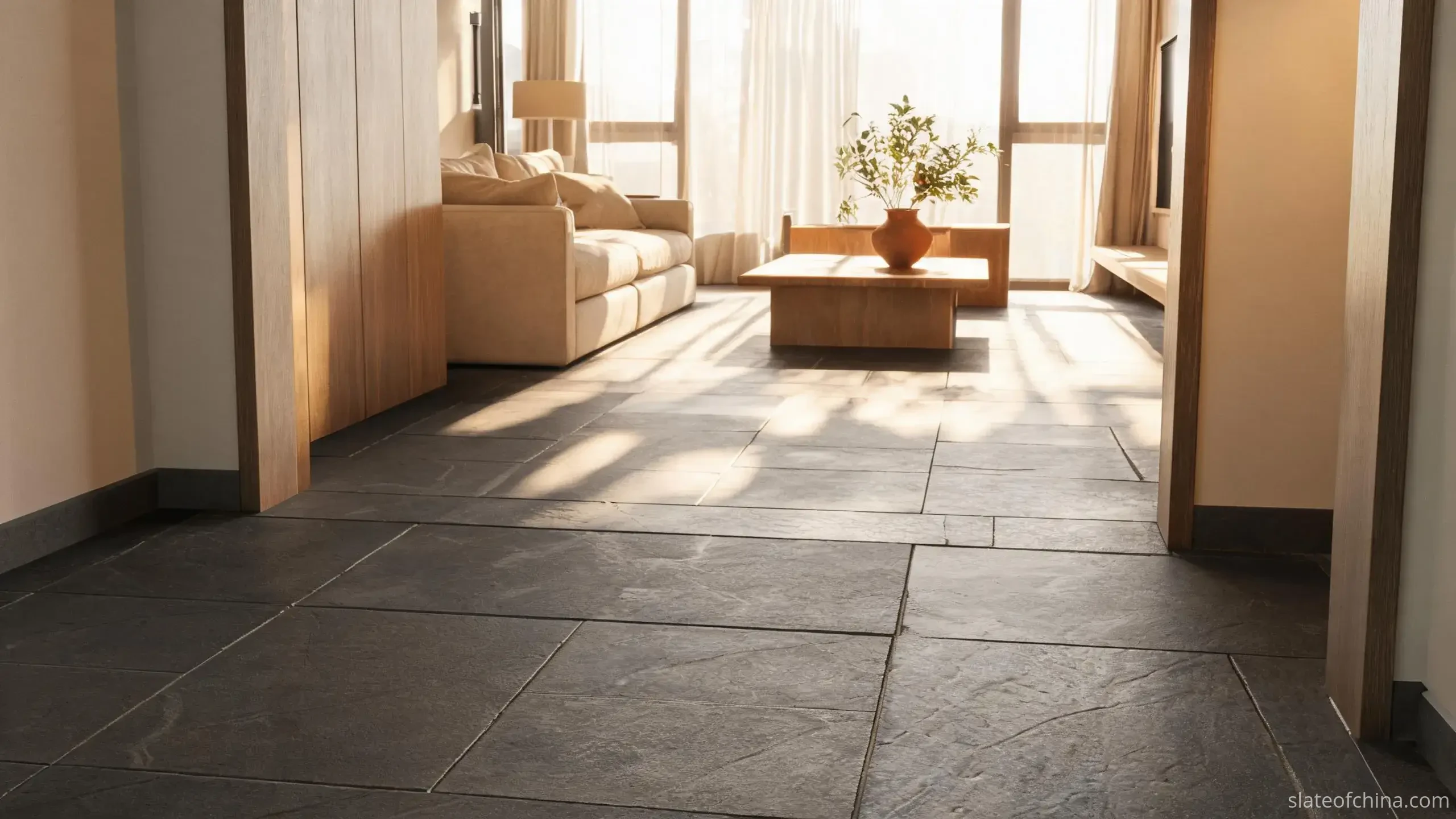
How to calculate the weight of a single slate tile or panel
For pieces rather than areas, the formula a buyer needs is the same physics with new inputs:
Convert dimensions to metres first — 10 mm is 0.010 m, not 0.10 m — because the classic weight-estimate error is a decimal point, not a method. Applied to the three formats that dominate architectural enquiries:
| Worked example at 2,750 kg/m³ | Format | Piece mass (calculated) |
|---|---|---|
| Roofing slate | 500 × 250 × 5 mm | 1.72 kg |
| Wall cladding panel | 600 × 300 × 10 mm | 4.95 kg |
| Paving slab | 600 × 600 × 20 mm | 19.8 kg |
Uniform-thickness stone-only figures for demonstration. A thousand of those roofing slates is about 1.72 tonnes; five hundred panels about 2.48 tonnes — the numbers piece counts and freight quotations are made of.
Piece weights translate directly into handling: a 5 kg panel is one hand and a steady surface; a 20 kg slab is two hands, bent knees and a plan for where it lands. They also feed packaging counts — pieces per crate, slabs per pallet, and the point at which a stack needs a machine rather than a person.
One honesty note travels with these figures. Nominal thickness is a declared intent, not a measured fact: riven and hand-cleft surfaces spread across a thickness band, while calibrated (gauged) backs narrow the spread. A nominal 20 mm product that runs heavy does exactly what the arithmetic predicts — a 10 % heavier average thickness lifts the per-m² weight by the same 10 %. For estimates, use the supplier's declared average or measured piece weights; for cladding assemblies, the tolerance side of that story is worked through in Slate Cladding Thickness and Weight. These three formats map onto the product families in our paving slate and wall cladding categories, where each product's thickness options are listed.
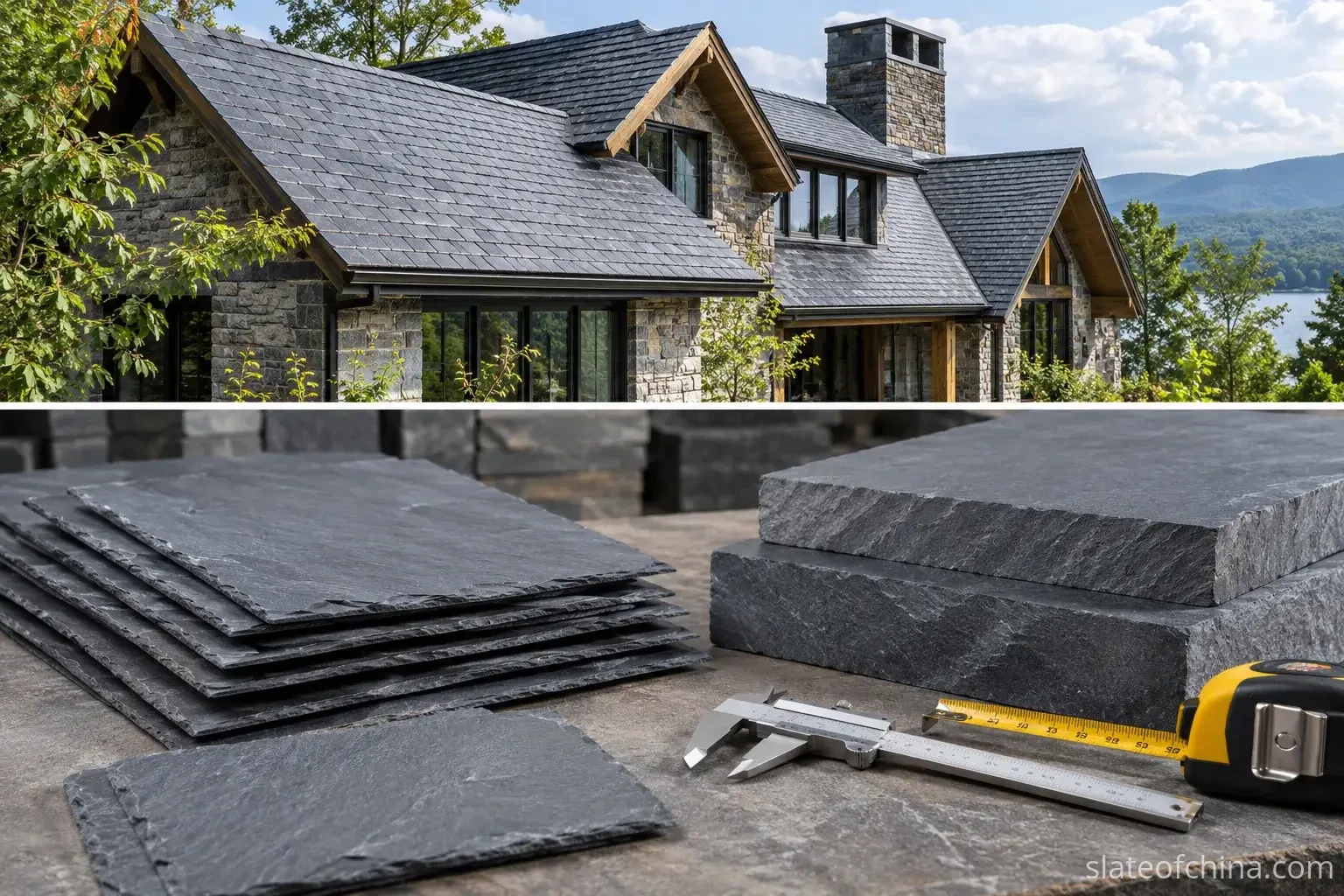
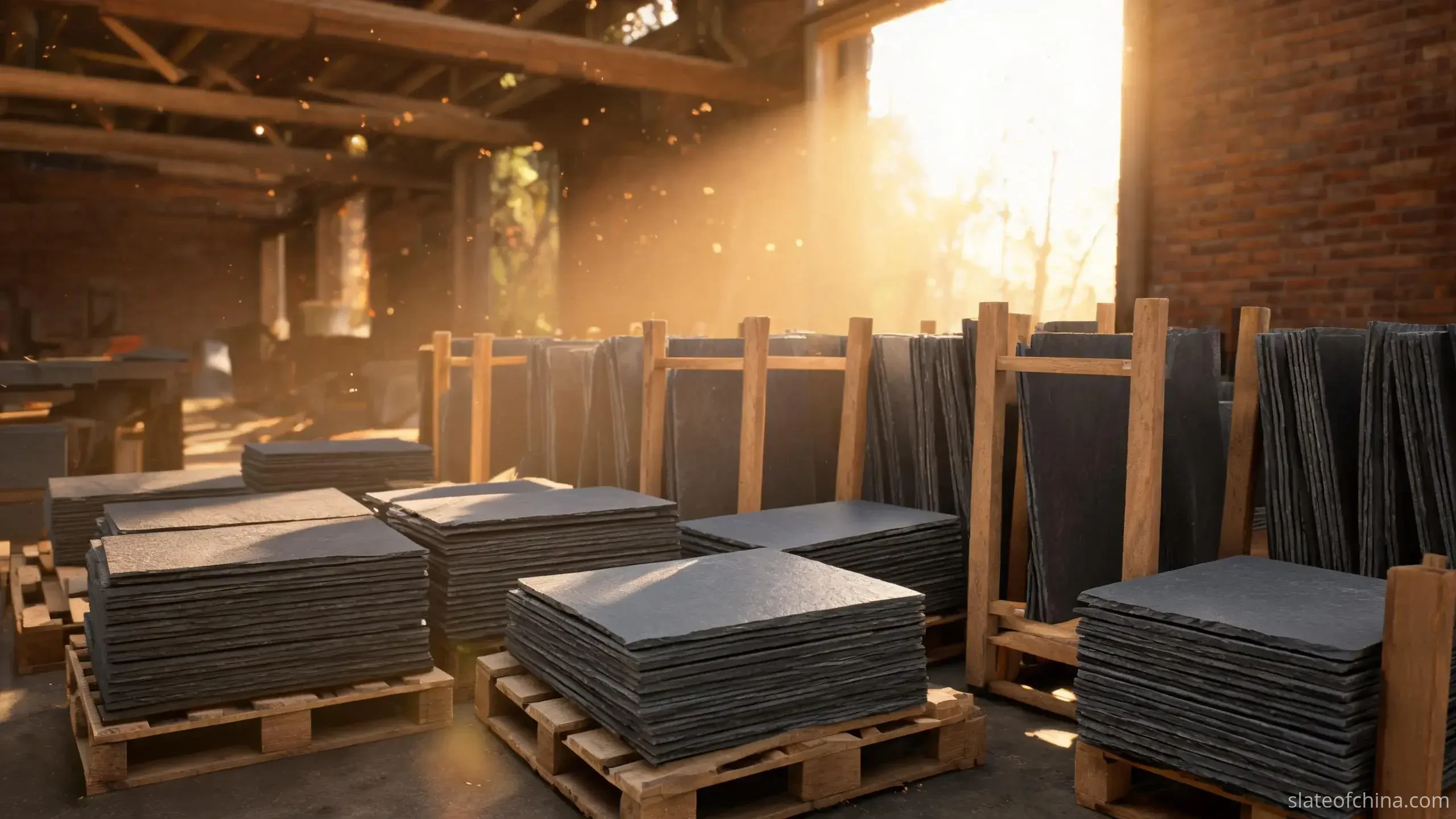
Why an installed slate roof weighs more per square metre than its tiles
A 5 mm slate at 2,750 kg/m³ flat on the bench is 13.75 kg/m². A finished slate roof of the very same material is not — because roofs overlap. In a traditional double-lap roof, two thicknesses of slate sit over most of the surface, and the amount of stone per square metre of roof is set by the layout, not the footprint.
Take a standard worked example: 500 × 250 mm slates at an average 5 mm, headlap 75 mm, conventional double-lap coursing. The gauge — the vertical distance between courses — is (500 − 75) ÷ 2 = 212.5 mm. Roughly 18.8 slates then cover each square metre of roof, ignoring joint widths and edge allowances. At a calculated 1.72 kg per slate that is about 32.4 kg/m² of installed slate — some 2.4 times the flat figure. The datasheet formula was never wrong; it was answering a different question.
The multiplier moves with the design. Deeper headlap for shallow or exposed roofs packs more slates into every square metre; wider slates spread the same mass over fewer joints. Add battens, nails and underlay on top of the stone and the roof load grows again. This is why roof weights belong to a qualified designer's check, and why the input that matters most — tiles per square metre for the chosen layout — is worth requesting from the supplier rather than assuming. The pitch-and-exposure logic behind headlap is set out in How to Calculate Roofing Slate Headlap, and the roof-side weight story continues in the Roofing Slate Guide.

What slate density cannot tell you about quality
The reflex is old and understandable: denser stone feels better, so a higher figure should mean a better slate. The property sheet disagrees. Density is one physical measurement; quality in service is several, and the relationships between them run through tested behaviour, not through arithmetic on a single line.
It cannot certify water behaviour. Slate density vs water absorption is a fair question, but the two are distinct properties: absorption depends on the accessible pore network, and only its own test reports it. Two slates 40 kg/m³ apart can rank either way on absorption — the judgement procedure lives in Water Absorption in Architectural Slate.
It cannot predict strength. Flexural and breaking performance come from mineral fabric, cleavage orientation and specimen geometry — which is why strength figures deserve their own reading, as in Breaking Load and Flexural Strength in Floors and Walls.
It cannot stand in for frost testing. Freeze–thaw behaviour rests on pore structure, saturation and cycles — the domain of Freeze–Thaw Resistance for Outdoor Slate, not of the density line.
Nor does a lower figure condemn a stone — the mistake cuts both ways. The standards systems are unambiguous on where quality rankings come from: EN 12326-1 tests roofing slate for strength, absorption, thermal behaviour and frost; ASTM C406 grades S1–S3 on water absorption; and the product-family standards for architectural slate — paving, flooring, cladding and dimension slate — are mapped in Architectural Slate Standards. None of them ranks a slate by how heavy a cube of it is.
From stone weight to packed slate pallet weight
Pallet weight combines the calculated net stone mass with the weight of the packaging and protective materials. Take 200 of the 600 × 300 × 10 mm panels from the worked example: 200 × 4.95 kg = 990 kg of stone. Add roughly 60 kg of timber, strapping, interleaving and corner protection, and the gross pallet weight is about 1,050 kg — illustrative numbers, but the shape of the maths is universal: packaging rides along with the stone, and freight prices on the total.
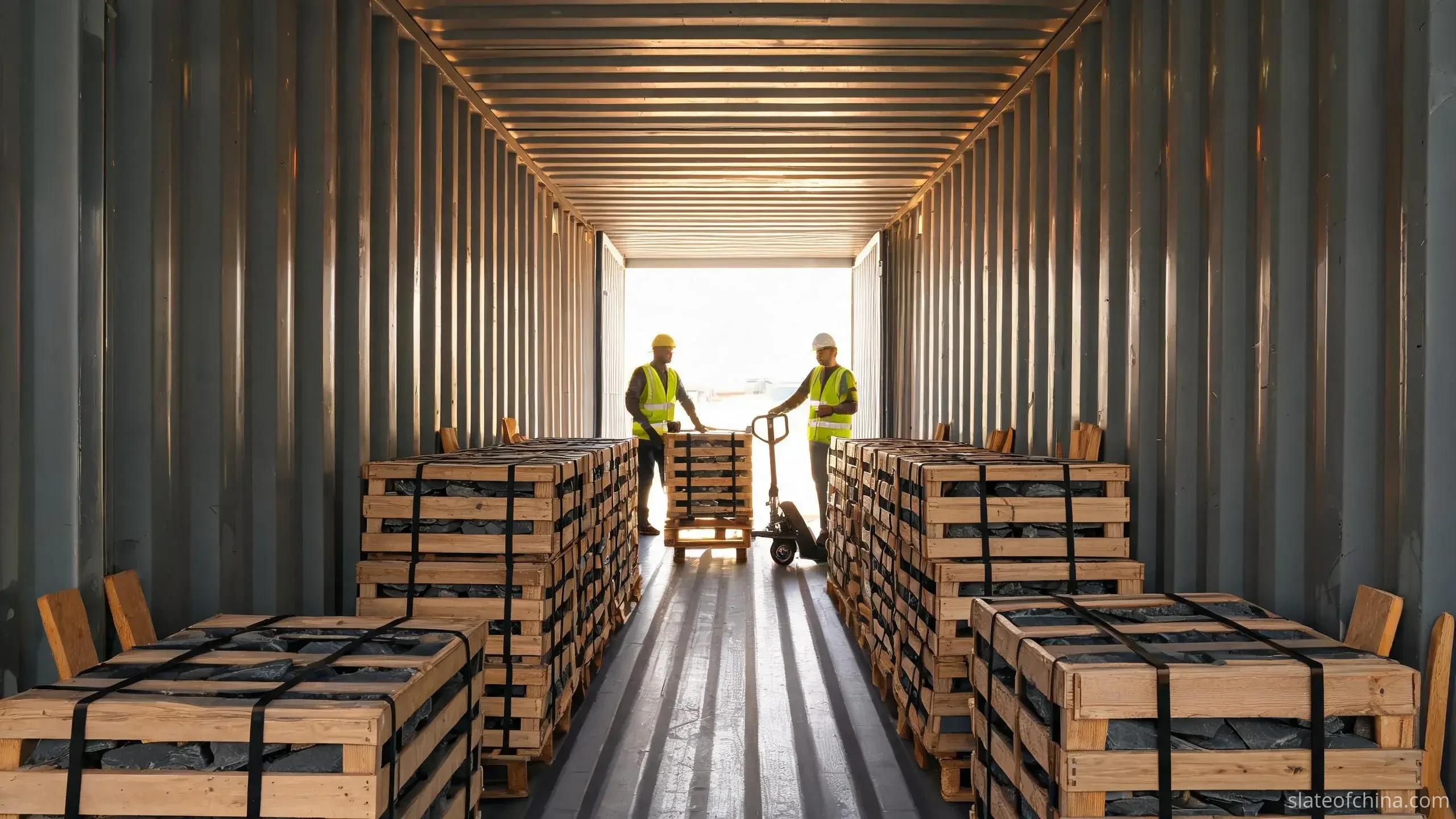
Packing format changes the ratio, not the principle. Tiles and panels typically travel flat-packed in layers with protective interleaf; heavy slabs stand on A-frame or cradle crates so no single layer carries the stack. Export timber is heat-treated under ISPM-15 and stamped accordingly — a compliance detail that belongs on a packing list, not in a brochure.
Between the calculation and the label, several quiet effects accumulate. Riven products tend to run at or above nominal thickness; calibrated products narrower. Pallet timber and wrapping pick up moisture in damp storage — the stone itself barely does, which is one comfort of a low-absorption material — and crate weights vary mill by mill. Individually these are small; together they are the reason the honest workflow is: estimate by arithmetic, order by declared weights, and reconcile against the packing list, where calibrated weighing can close any gap that matters.
Simple arithmetic stays useful at every step of that workflow — it is only ever as good as the thickness and count it was fed. The weights that reach a booking confirmation are the ones somebody wrote down after weighing.

Slate container loading: net tonnage, cube and payload
Flip the formula and density answers a freight question: how much space does a target tonnage occupy? Dividing 25 tonnes by 2,750 kg/m³ gives about 9.1 m³ of solid stone. A 20-foot container offers roughly 33 m³ of internal volume — so a weight-limited slate cargo fills barely a quarter of the box, the remaining volume given over to pallets, crates, bracing and air. Stone famously "weighs out" long before it "cubes out", which is why slate freight is quoted and planned by weight, not by cube.
An illustrative shipment makes the ledger readable:
| Cargo line | Illustrative value | What it is |
|---|---|---|
| Net slate mass | 23,500 kg | Stone alone, calculated or declared |
| Pallets, crates and securing | 900 kg | Timber, strapping, protection, bracing |
| Gross cargo mass | 24,400 kg | What the road, rail and sea legs actually carry |
| Working density | 2,750 kg/m³ | Basis of the volume conversion |
| Solid stone volume | 8.55 m³ | Rock only — under a third of the box's cube |
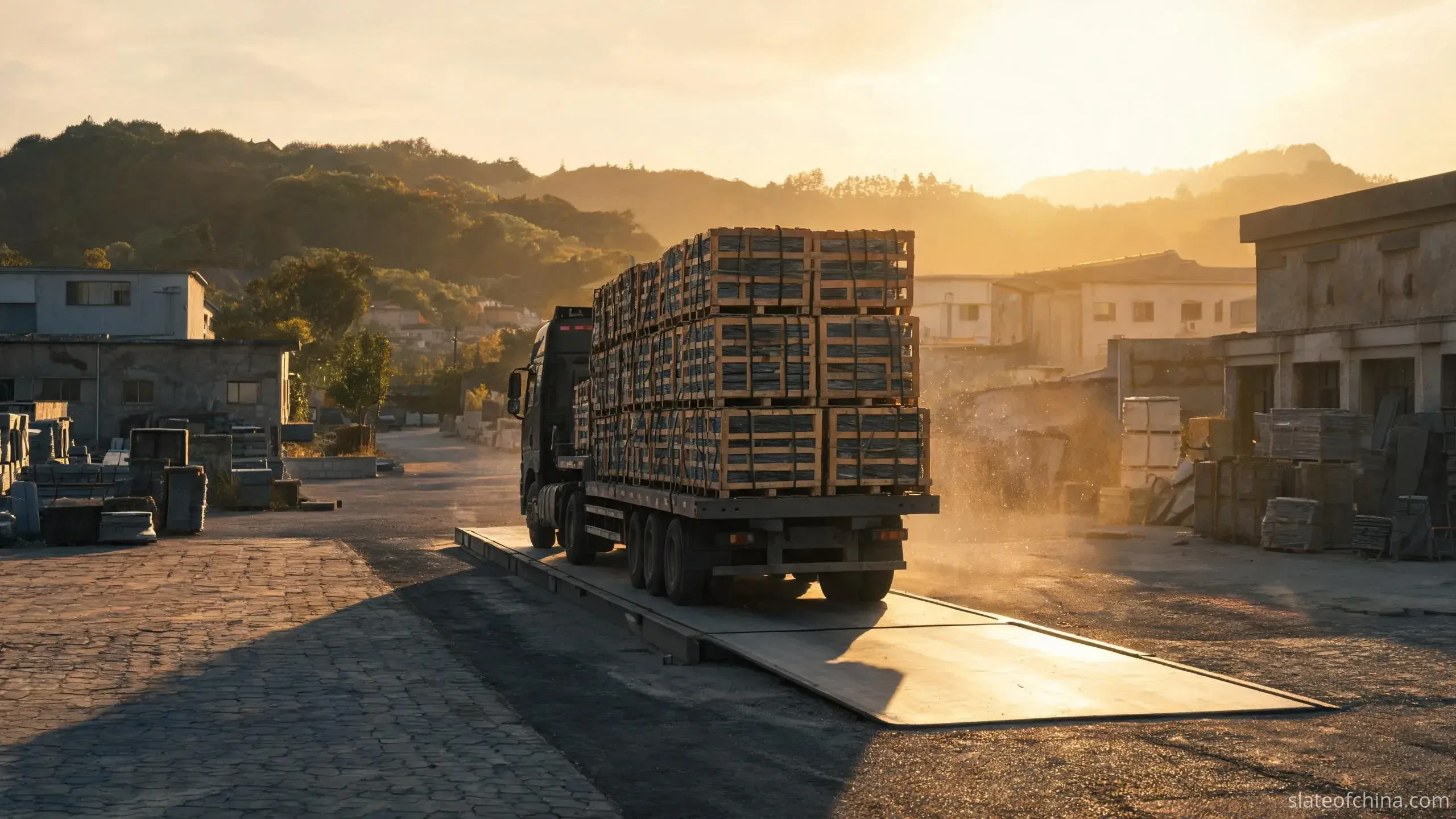
What the table cannot decide is the ceiling. A container's permissible cargo weight is set by the specific box — 20-ft payloads commonly sit between about 21 and 28 tonnes depending on the unit — and then trimmed by road regulations and terminal rules on the route, which often bite below the container's own rating. Dense cargo also concentrates load: a weight-legal container can still be badly stuffed, so heavy slate wants a written plan — floor distribution, strong points, securing, door-row bracing. How that plan is actually built is walked through in the container loading guide, and for roofing slates the square-metre view of the same question is in How Many Square Metres Fit in a Container?
And the argument between paper and reality has a formal settlement. Under SOLAS verified-gross-mass rules, a container's total weight must be established by weighing the loaded container or by an approved calculation method before it sails. In other words, the industry has institutionalised the point this guide keeps making: estimate by density, but the number the vessel takes is measured.
Six common mistakes in slate weight calculations
The same handful of errors surfaces in project estimates and freight disputes year after year:
1. Treating 2,750 kg/m³ as a property of every slate. It is a working figure. Deposits and batches vary on either side of the band; when money or structure depends on the number, use the measured density for the material being supplied.
2. Slipping the decimal point. 10 mm is 0.010 m. One keystroke of 0.10 m turns a floor into a fortress and a quote into an embarrassment — always an order-of-magnitude error, never a subtle one.
3. Forgetting the overlap multiplier. Installed roof coverage — and cladding layouts with laps — contains more stone per square metre than the footprint. Density × thickness alone underestimates installed loads for any overlapping pattern.
4. Trusting nominal thickness as built thickness. Nominal is a promise, not a measurement. Ask for the declared average or measured piece weights, especially on riven products.
5. Mixing net and gross. Net stone mass and gross packed mass both appear on quotations and neither is wrong — but freight, road rules and verified gross mass all price the second one.
6. Citing density as quality evidence. Absorption, strength, frost behaviour and weathering are test results. None of them can be multiplied out of a density figure on a data sheet.
Slate weight formulas on one page
Everything above compresses into six lines. Keep the table, feed it honest inputs, and it will not mislead:
| What you need | Formula | Inputs to confirm first |
|---|---|---|
| Single piece mass | L × W × T × density | Dimensions in metres; measured or nominal thickness |
| Weight per m² | density × thickness (mm) ÷ 1,000 | Declared average thickness, stone only |
| Order tonnage | mass per piece × piece count | Piece count for the pattern, plus waste allowance |
| Solid stone volume | net mass ÷ density | Net mass only — packaging excluded |
| Gross pallet mass | stone mass + packaging mass | Declared packing weights per unit |
| Gross cargo mass | sum of all packed-unit gross masses | Every pallet and crate, none omitted |
Run one final example end to end. A project needs 800 cladding panels at 600 × 300 × 15 mm: 0.6 × 0.3 × 0.015 × 2,750 = 7.425 kg each, and 800 × 7.425 ≈ 5,940 kg — about 5.9 tonnes of stone for early budgeting and a stuffing plan. The figure is indicative until production weighs it; the last multiplication in every chain is always the packing list.
Preliminary slate weight calculator
Stone-only indicative estimate from your own numbers; packaging shares and declared weights still need confirming with the supplier.

What to ask a slate supplier about weight and density
For an order where weight carries consequences — structure, freight, deadlines — six requests put the right numbers on paper:
1. The measured density for the material on offer — with the test method and sample identity, not a typed default line.
2. The thickness basis — nominal or calibrated, and the declared range for riven stock.
3. Whether a quoted tonnage is net stone or gross packed — in writing, on the quotation.
4. Per-pallet gross weights and dimensions — for unloading plans, storage limits and site access checks.
5. The packaging share in each packed unit — timber, strapping, interleaving — so the freight figure does not move later.
6. The container plan basis — target gross mass, packing format, and how verified gross mass will be obtained.
All six fit inside the wider sourcing sequence covered in the Architectural Slate Buying Guide, alongside sampling, specification and inspection.
Density is the quietest figure on the data sheet, and honestly used, one of the hardest working. It converts thickness into loads, areas into tonnages, formats into handling plans and bookings into numbers a freight forwarder can price — provided each multiplication is fed a measured density, a declared thickness and a packed weight rather than an assumption. The arithmetic will always hold up its end. The difference between an estimate and an argument at the weighbridge is entirely in the inputs — which is why the best specification keeps the two conversations, arithmetic and evidence, in separate columns where they belong.
Frequently Asked Questions
Is natural slate always in the 2,700–2,800 kg/m³ range?
No. The band is a working average for many commercial slates, not a specification. Deposit mineralogy moves real values on either side of it — our own tested samples measure about 2,819 kg/m³. For anything that hinges on the number, use the measured density for the material being supplied, together with its test method and sample.
How much does one cubic metre of slate weigh?
At 2,700–2,800 kg/m³, one cubic metre of solid slate weighs roughly 2.7–2.8 tonnes. At our representative tested figure of 2,819 kg/m³ it is about 2.82 tonnes — always the stone alone, before pallets, crates, packaging and air gaps.
How do you calculate the weight of a single slate tile?
Multiply length × width × thickness (all in metres) by the density. A 600 × 300 × 10 mm panel at 2,750 kg/m³ is 0.6 × 0.3 × 0.010 × 2,750 ≈ 4.95 kg. For a whole order, multiply the piece mass by the piece count, then add the packaging share.
How heavy is a packed pallet of slate?
It depends on format and packing, so no universal figure exists. An illustrative pallet of 200 panels at 600 × 300 × 10 mm holds about 990 kg of stone, and roughly 60 kg of timber, strapping and protection takes the gross weight to about 1,050 kg. Always ask for per-pallet gross weights on the packing list.
Why does an installed slate roof weigh more per square metre than its tiles?
Because the tiles overlap. In a double-lap roof the amount of slate covering one square metre is set by the headlap and gauge, not by the roof area: a 500 × 250 mm slate at 75 mm headlap lays about 19 tiles per square metre, lifting a nominal 13.75 kg/m² of 5 mm material to roughly 32.4 kg/m² installed — before battens, fixings and underlay.
Does higher slate density mean better quality?
Not by itself. Water absorption, flexural and breaking strength, freeze–thaw behaviour and weathering come from their own tests, and slates of similar density can differ widely in each. No quality verdict can be multiplied, averaged or inferred out of a density figure.
What is the difference between slate density and specific gravity?
Density is mass per unit volume, expressed in kg/m³ or g/cm³. Specific gravity is dimensionless — the ratio of the material's density to that of water. A slate of specific gravity 2.75 corresponds to about 2,750 kg/m³; the real question on any data sheet is which test method produced the figure.
Can density work out how many tonnes of slate fit in a container?
Only the net stone side. Dividing a target tonnage by density gives the solid stone volume — 24 t at 2,750 kg/m³ is about 8.7 m³ of rock. The loaded container's legal ceiling comes from its rated payload, the packing, the route's road limits and the verified gross mass, not from the density figure.
Technical references
- EN 1936 — Natural stone test methods. Determination of real density and apparent density, and of total and open porosity. The European method behind most density figures on natural-stone data sheets.
- ASTM C97/C97M-26 — Standard Test Methods for Absorption and Bulk Specific Gravity of Dimension Stone. Its scope covers all types of dimension stone except slate (ASTM product page) — the reason a US-style specific-gravity line for slate needs its method confirmed.
- EN 12326-1 — the European roofing slate product standard. Its requirements grade strength, water absorption, thermal behaviour and frost performance — not density.
- ASTM C406/C406M — Standard Specification for Roofing Slate. Assigns roofing slate to grades S1–S3 according to specified breaking-load, water absorption and depth-of-softening requirements — density is not among them.
Related Reading
Request a slate weight and packing estimate
Send us the product dimensions, the thickness, the approximate quantity and the destination port. We will put the measured density for the material on offer beside its test documentation, calculate indicative stone weights for your layout, and confirm the packing details — pallet formats, declared gross weights and a container plan — before anything ships. The material families are browsable in the paving slate, wall cladding and slate slabs categories. Contact us and we will tell you plainly which numbers are measured, which are calculated, and which are still assumptions.