
Interior Slate Flooring: The Buyer's Overview
The word "floor" does most of the work in "slate flooring". Outdoors, a slate surface has to hold up against weather, freezing, drainage and the whole dictionary of traffic. Indoors, the weather stops at the threshold — and an interior slate floor still fails occasionally, almost never because the stone is bad and almost always because it was specified as if it were still an outdoor tile. The moment slate moves inside the building line, the job it has to do changes, and the specification has to change with it.
That contrast is the argument of this whole guide. An interior slate floor is an indoor construction: it is read through floor level, thickness consistency, the substrate it sits on, the finish you walk on barefoot, and the room that lives above it — not through the weather the outdoor stone shrugs off. Read it that way and the choices line up in order; read it as a colour and a tile size and the order goes wrong before the first square metre is laid.
This is the entry guide for slate flooring inside the building line. It walks the decisions a buyer meets first — thickness band, gauged backing, substrate rules, finish choice, and what the room asks of the stone — in the order they arrive, and hands each detail to the deeper guide that owns it.
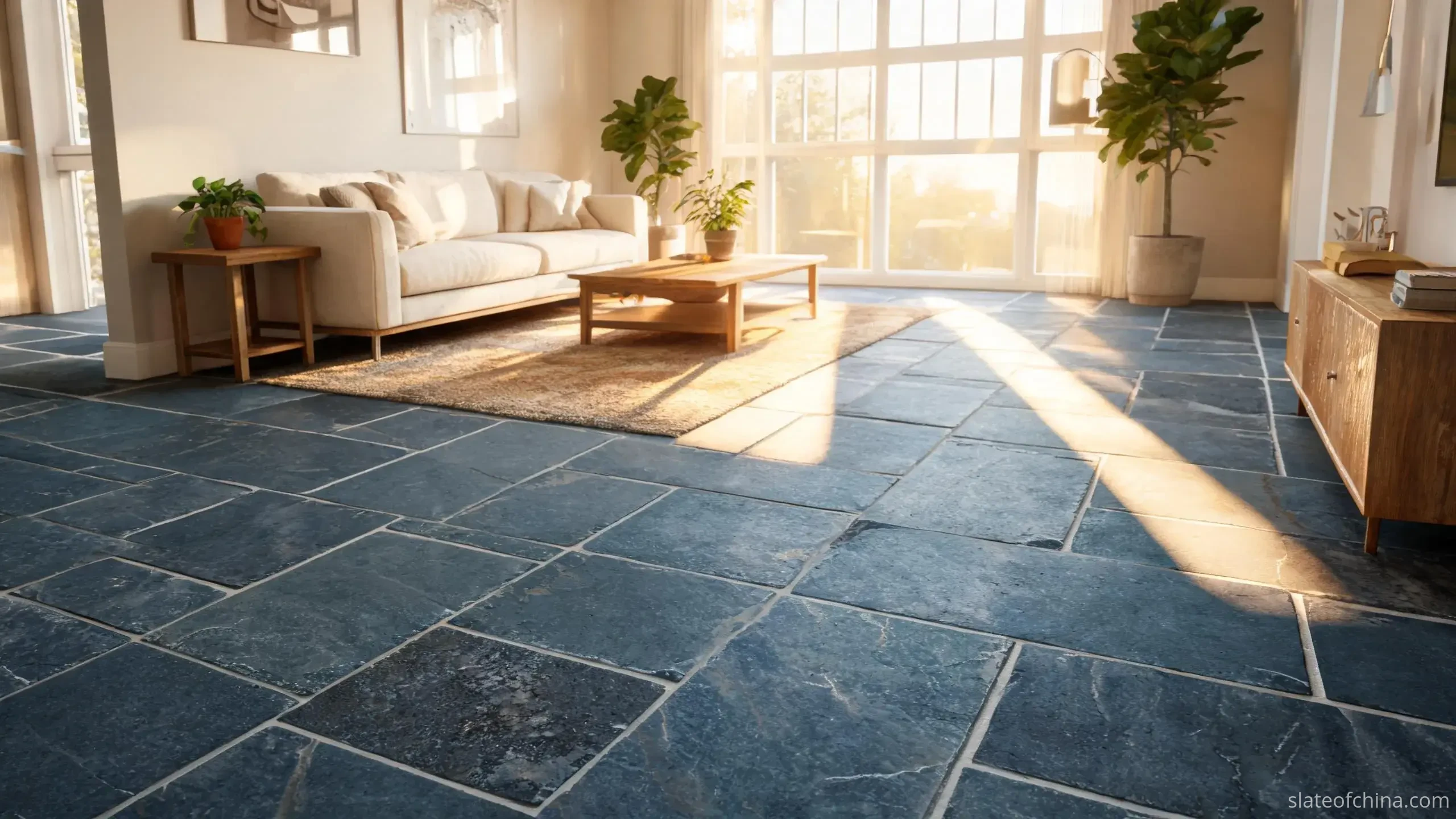
What the threshold changes: the floor is a different job indoors
Step the same piece of slate across the building line and two whole vocabularies drop away. Weather stops being the enemy — there is no rain on the face, no freeze–thaw working the cleavage, no sun fading the colour from above. Load changes its shape — no vehicle arrives, so nothing asks for the pavement-thickness answer of a driveway; the weight is footfall and furniture, spread across the whole floor rather than through four tyre patches.
But indoors, other things start to matter that the outdoor pages never mention. The level becomes a live-in issue: a floor you walk on barefoot, set cutlery on, roll a chair across — a lipped edge or a dipping joint is a trip and a wobble, not a paving quirk. The moisture story flips. Rain is gone, but the substrate can still be wet — a damp concrete slab, a drying screed, a timber floor breathing under the tiles — and that moisture has nowhere to go once the floor is sealed over it. The finish is now under a shoe and a foot and a lamp. What a gravel path tolerates, a living room does not.
So the reading shifts. The outdoor end of this family — formats, finishes, weather, drainage — lives in Slate Paving; the numbers library for sizes and thickness bands is Paving Slate Sizes & Thicknesses; and if the real question is slate against porcelain or marble in a room, the honest comparison is Slate Flooring vs Other Stone Flooring. This page is the indoor side of the same stone.
Thickness indoors: the band, not the rule
The first figure a buyer asks for is usually the thickness, and it deserves an honest answer: there is no single best thickness for an interior slate floor. A usable thickness depends on the tile size, the substrate, the level, and how the room is used. What the trade ships, and what you can reasonably ask for, sits in a handful of bands.
| Thickness band | What it suits | What must come with it |
|---|---|---|
| 8–10 mm | Small-format tiles on a solid, properly supported interior bed | A rigid substrate and careful handling — the thin end is workable, not automatic |
| 10–14 mm | The common residential interior band — living rooms, kitchens, hallways, bedrooms | A level substrate and a consistent, full adhesive bed |
| 14–20 mm | Larger tiles, commercial wear, or a heavier stone look | Stronger substrate; heavier handling; more care at the threshold |
Thickness alone does not determine whether a slate tile is suitable for commercial flooring. A commercial interior asks for more than gauge: project specifications should also consider flexural strength, breaking load, tile dimensions, substrate design and the intended traffic conditions. The suitability of the complete flooring system is verified with the project designer or qualified installer — the millimetres are one input, never the verdict.
Read the table the right way round. A 20 mm tile with an uneven back is harder to bed than a well-made 12 mm tile on a flat substrate. Greater thickness is not automatically a better floor; thickness consistency is often the more useful number, because it decides how evenly the bed fills and how level the finished floor is. Two things travel with thickness — the weight, and the requirement that the thickness is consistent across the lot.
For the weight arithmetic: the paving slate supplied from the Jiujiang quarries measures about 2,819 kg/m³ on representative material — roughly 2.8 kg per square metre for every millimetre, calculated and indicative, and to be confirmed against the test report for the batch actually shipped. At 12 mm that is about 34 kg per square metre; at 15 mm, around 42. These figures are indicative calculations on representative material, and the actual tile weight varies with the specific slate, the thickness and the production batch — use verified, batch-specific technical data for any project calculation. The additional dead load should be included in the overall floor design, particularly for timber structures, suspended floors and renovation projects. The per-gauge reading for each room — which band belongs to a bedroom versus a kitchen, with the fixing implications — is covered in the dedicated slate floor thickness guide.
The gauged decision: read the back of the tile
The single most under-appreciated number in an interior slate order is not the front of the tile; it is the back. Natural slate is split, so left to itself, two tiles in a box can differ in thickness by several millimetres. That is charming on a rustic patio and a problem on an indoor floor, where every millimetre of difference has to be absorbed by the adhesive bed and shows up as a lipped joint.
Gauged slate tiles — the back surface machined to a more consistent thickness — fix this at the source. They make the floor level easier to hold, the adhesive bed more predictable, and the joints more uniform. For a modern residential interior, gauged natural slate floor tiles are usually the sensible call. Ungauged slate keeps more of the natural thickness variation and more of the cleft character; it suits rustic and traditional rooms, and it hands the levelling job to the installer and the bed, which is exactly where you do not want it on a floor you walk on every day.
| Decision | Gauged | Ungauged |
|---|---|---|
| Thickness consistency | High | Variable |
| Floor level | Easier to hold | The bed carries the levelling |
| Installation | More predictable | More adjustment by hand |
| Appearance | Depends on the finish | More natural, more rustic |
| Where it earns its keep | Modern, larger-format interiors | Rustic and traditional rooms |
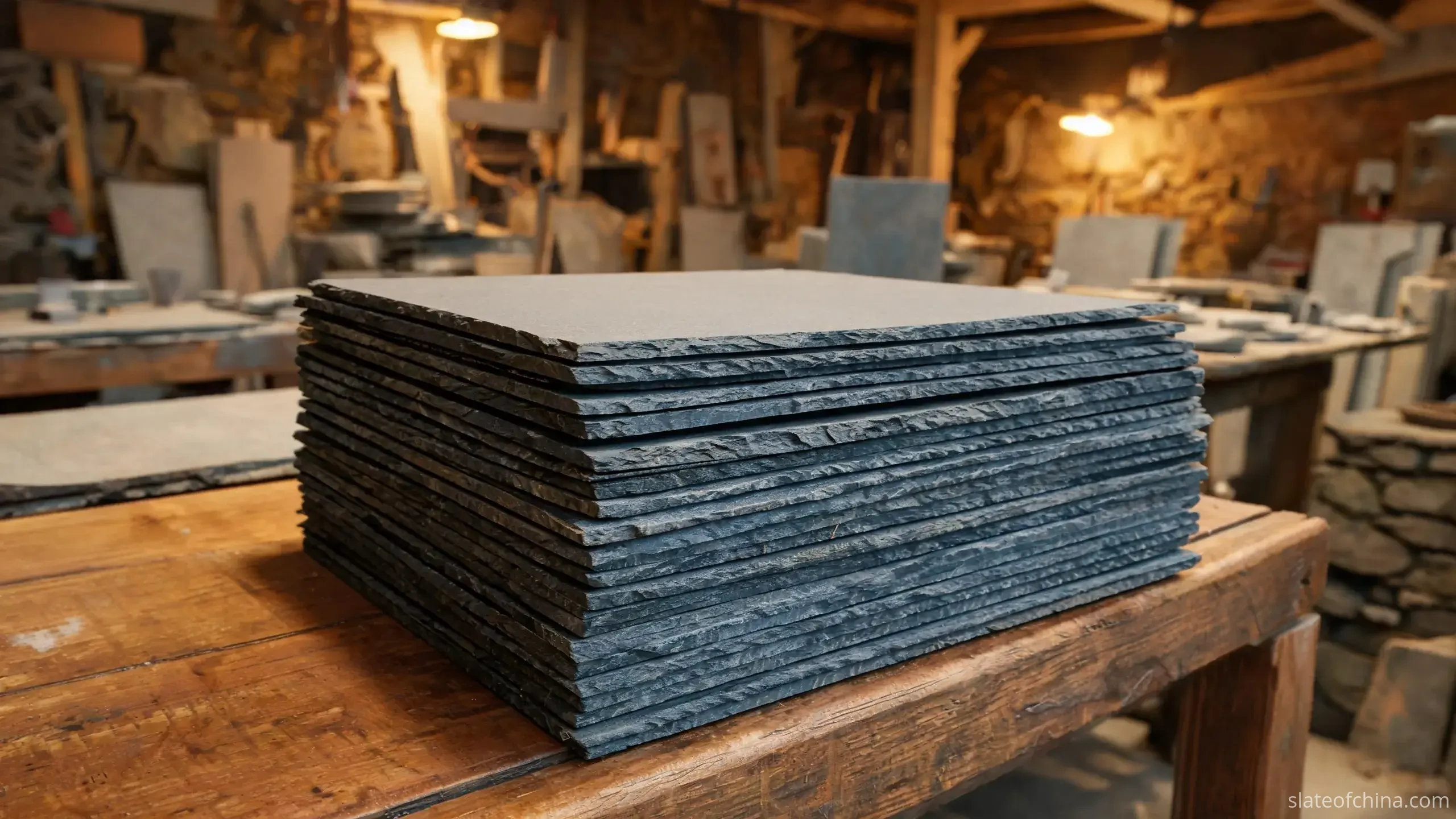
One warning before you turn: gauged refers to thickness, not to flatness or to dimensional accuracy. A tile can be a consistent thickness and still be slightly bowed, and it can be gauged but not rectified. State what you actually want — thickness consistency, flatness, and (for narrow joints) dimensional accuracy — each as its own line in the specification. The full reading of calibrated versus hand-cleft slate, and how the back of the tile decides the bed, is set out in Calibrated vs Hand-Cleft Slate.
Format and joints: how size reads a room
After thickness and backing, the size of the tile is the decision that sets the whole look of the floor. Small formats such as 300×300 mm make more grout lines and read traditional; larger formats such as 600×600 mm make fewer joints and read calm and contemporary. The trade commonly offers interior formats from around 300×300 mm up to 600×900 mm, with custom cut-to-size on request; what is available depends on the block, the quarry and the factory.
Larger tiles are not automatically better. A 600×600 mm tile asks more of the substrate flatness, more of the dimensional consistency and more of the handling on site. Buy a large format for the look, and pay for it with a flatter substrate and careful setting-out. On the joint side, rectified edges — sawn and finished square — allow narrower, more uniform joints; naturally split or sawn edges need a slightly wider joint to breathe. Confirm the tolerance, the flatness and the edge finish in writing before ordering, not after the tiles arrive. The full treatment of large-format floor tiles — handling, substrate flatness, breakage allowance — belongs to the dedicated large-format guide.
What the floor sits on: substrate rules
The substrate is where most interior failures actually begin, and it is the decision the showroom never mentions. No slate can redeem a weak, damp or moving base. The rules, in short form:
| Substrate | What to verify | The indoor note |
|---|---|---|
| Concrete slab | Sound, cured, clean, flat, dry enough | Damp in a slab is the quiet failure; check moisture before sealing a slate over it |
| Cement screed | Strength, stability, dryness, surface soundness | Moisture is the screed’s own question; do not trap it under the tiles |
| Timber subfloor | Movement, stiffness, humidity swing | Needs a designed route — reinforcement, backer board or uncoupling membrane |
| Underfloor heating | Compatibility of stone, adhesive, grout, curing | The whole assembly, not the slate gauge, decides; heating is a system conversation |
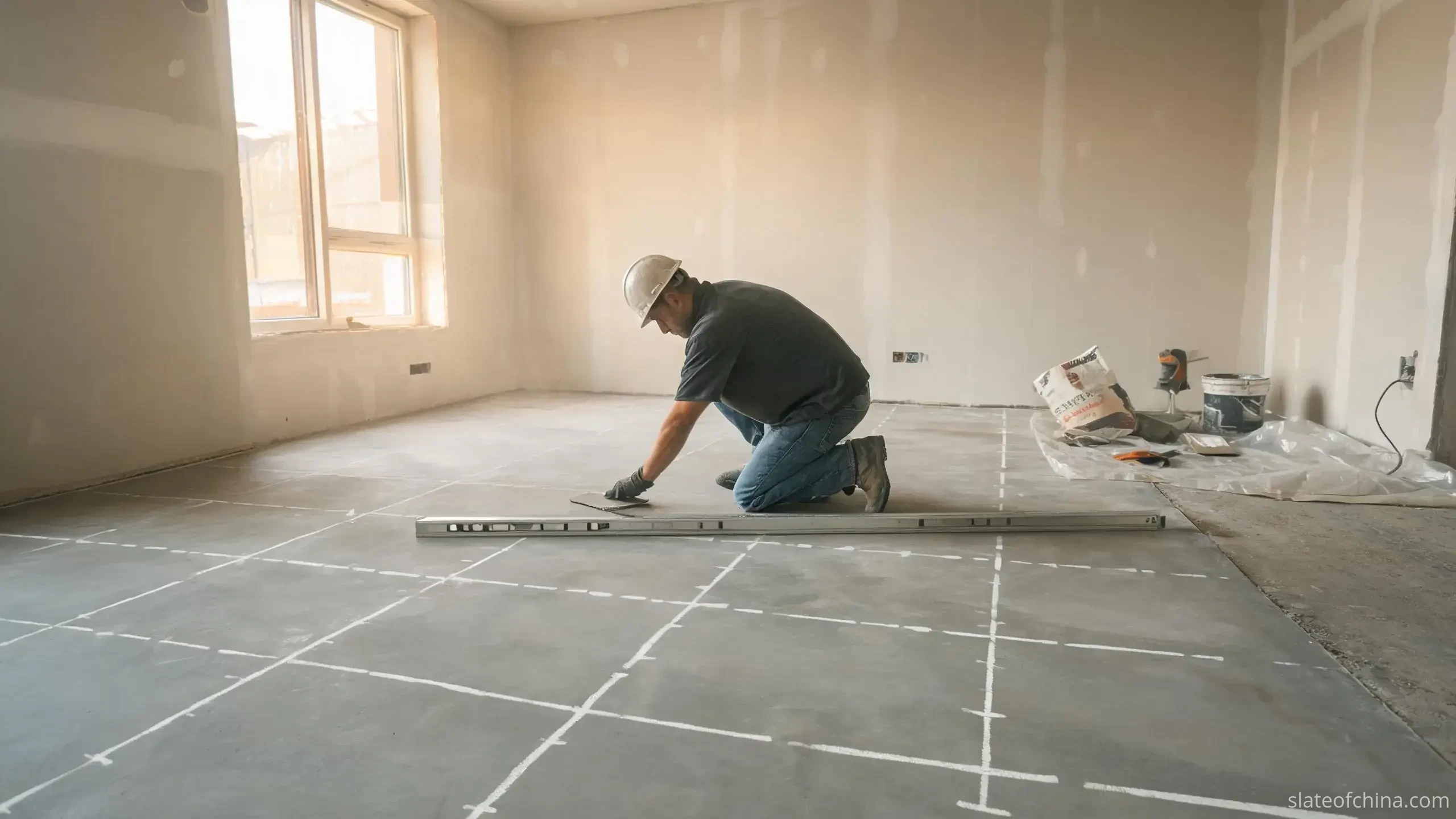
Two indoor-specific notes. Timber needs a design, not a hope: wood moves with temperature and humidity, and the route is usually structural reinforcement plus an approved backer board or an uncoupling membrane, specified by the installer or engineer rather than improvised on site. Heating is a layered product: slate can sit comfortably on a compatible underfloor heating system, but the compatibility is judged on the whole floor — stone, adhesive, grout, curing cycle, movement joints — and the full treatment is covered in its own guide. And wherever water is involved indoors — a wet room, a bathroom — the water management and sealing become a closed package of their own, also with its own guide.
Moisture is assessed before the floor is specified, not after it. Protected from weather is not the same as dry. Concrete slabs and cement screeds must be sufficiently dry before the tiles go down, and ground-floor and basement projects may need an appropriate damp-proofing strategy in the build-up. The stone, the adhesive, the sealer and any moisture-management layer also have to work as one system — residual moisture trapped beneath an impermeable floor finish can end as installation problems, discoloration or adhesive failure. Moisture conditions belong at the specification stage of an interior slate flooring project.
The finish underfoot and in your light
The surface finish is the third face of the decision, after backing and substrate: it decides how the floor looks, how it cleans, how it feels underfoot, and how it reads in the light of the room.
Natural cleft keeps the texture the stone was split with — rustic, traditional, at home with timber furniture. It is not a slip claim by itself. Honed is the calm, matte modern choice: a smooth, even surface that cleans easily and reads minimal; it is the finish most interior floors settle on, but its wet slip value is a tested number, not a texture guess. Brushed sits between them — a soft, textured, more matte surface that holds more of the natural character without the cleft’s rough ridges. Polished gives a glossy, mineral-rich surface, decorative in intent, and indoors it belongs to low-traffic, low-water rooms where you can control the slip risk.
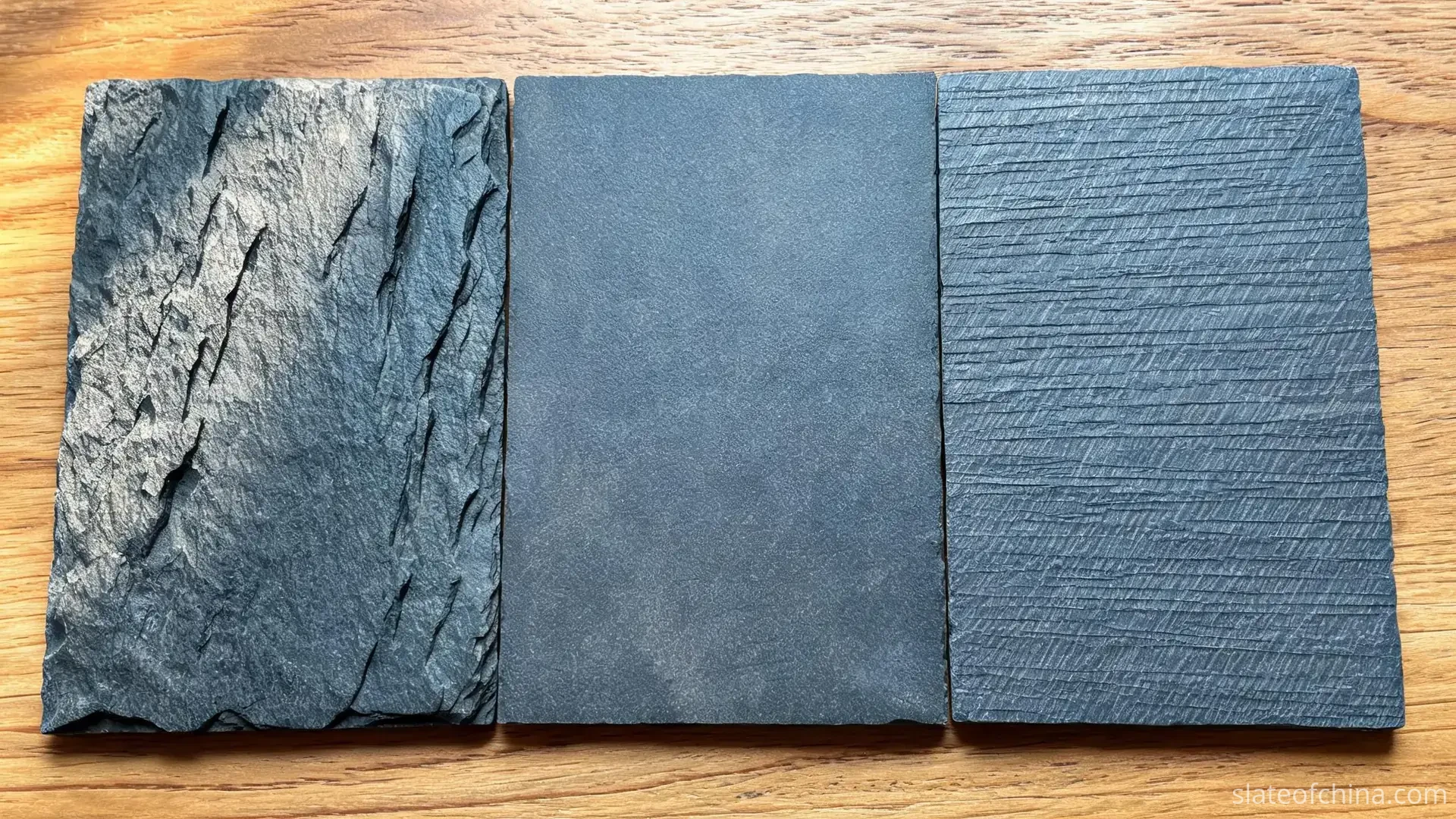
Two habits travel with every finish. First, request the actual finish samples — a photo cannot show you the texture, the sheen, the feel under your shoe. Second, ask for the slip result for that finish and that lot, not for the species: how slip is measured (pendulum, ramp, ANSI) is explained in How Slip Resistance Is Measured, the finish family and its uses are in Slate Surface Finishes, and the pairing of finishes to specific uses in Slate Paving Finishes.
Let the room read the floor
The finish and the gauge follow the room as much as the taste. Three brief reads, in the order a designer meets them:
- Slate flooring for kitchens lives under spills, hot pans, a mop, a foot that has just crossed a lawn. Choose a finish that is easy to clean and acceptably flat, and check its slip behaviour where water and grease meet the floor. Honed slate in a quiet charcoal reads well here and cleans well.
- Slate flooring for living rooms is the freedom end of the family: a calm matte cleft or honed large tile in charcoal, blue-grey or green-grey becomes an architectural base under furniture and rugs. This is where large formats earn their calm.
- Slate flooring for hallways and entrances carries dirt, rain, and the day’s first footstep. A harder-wearing finish with a cleaning rhythm suits it, and darker tones hide the daily dust of a threshold.
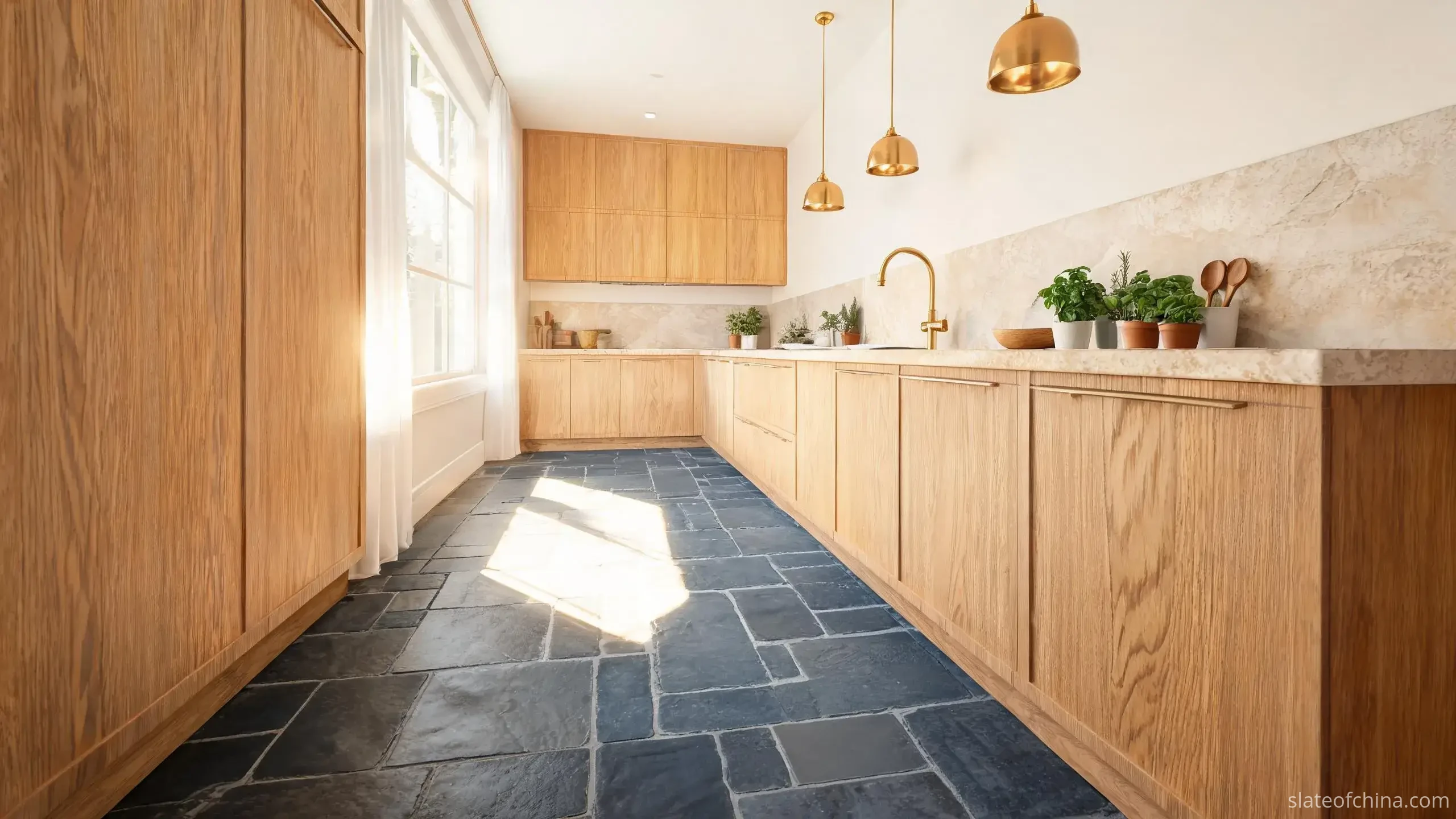
Two rooms get their own full guides because they stress the floor in their own way — the wet room and the maintenance side of an interior floor. For a quick read, the takeaway is this: choose the finish for the room’s daily use, not for the showroom photo, and confirm the wet-slip value for the finish and the lot. The honest comparison of slate against the other floor materials in those rooms — where slate is the wrong answer and where it is the right one — is in Slate Flooring vs Other Stone Flooring.
The one-line spec and the questions that follow
Before you ask for a price, you can write an interior slate floor specification in one line. It carries the room, the size, the thickness, the backing, the finish and the substrate — and that one line is what separates an accurate quotation from a round number.
| Slate flooring specification | Fill in |
|---|---|
| Rooms and traffic | Living room, kitchen, hallway — residential or commercial |
| Tile size | e.g. 600×600 mm |
| Thickness band | e.g. 10–12 mm, with the tolerance stated |
| Backing | Gauged or ungauged |
| Finish | Natural cleft, honed, brushed |
| Substrate and level | Concrete / screed / timber; floor level noted |
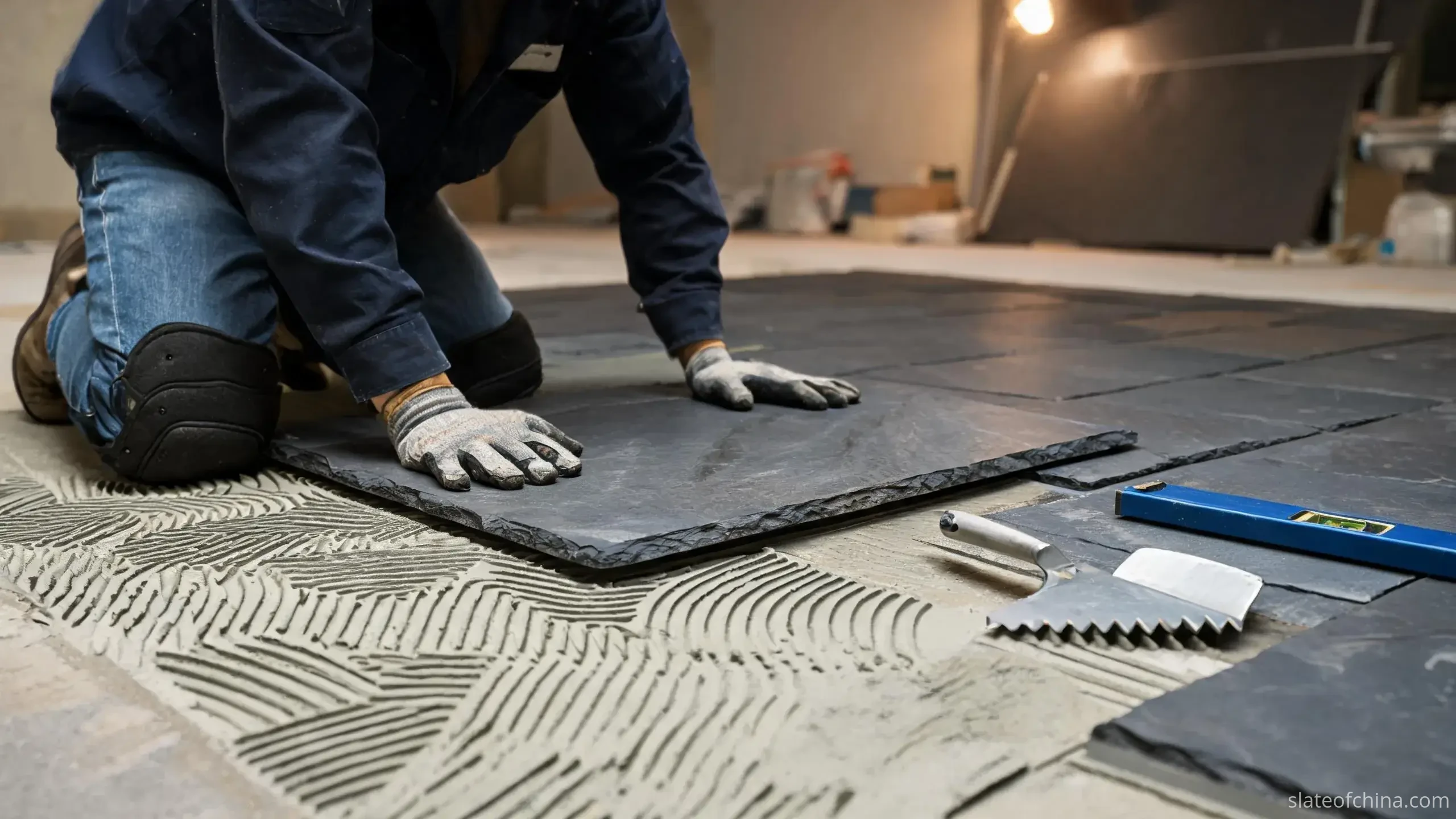
Then send it, and read the questions that come back. The questions to ask a slate supplier for an interior floor are the same discipline as for any architectural slate: is the material gauged or ungauged, what is the actual thickness tolerance, can you sample from the current batch, what is the water absorption, is there a slip value for the finish, and is the packing right for tiles this size. The full step-by-step of the purchase — samples, approval, documents, container math — is in the Architectural Slate Buying Guide.
To bring it home: an interior slate floor is a layered product with four decisions — thickness, backing, substrate, finish — and a room that lives in it. Nail those four and the slate does the thing it has always done: look like stone and last like stone, inside the building line.
Interior slate flooring — common questions
Is natural slate flooring good for interiors?
Yes, where the stone, the thickness band and the finish are specified for an indoor use. Natural slate flooring inside is warm, genuine quarried stone with a real surface, and it lasts; the result depends on the backing, the substrate, the finish and the level of the installation, not on the material alone.
How thick should interior slate floor tiles be?
There is no universal best. Around 10 to 14 mm covers most residential interior tiles; 14 to 20 mm suits larger tiles, heavier looks or commercial wear; 8 to 10 mm is the thin end, workable only on a rigid, properly supported bed. The number follows the tile size, the substrate and the floor level.
Is gauged or ungauged slate better for an interior floor?
Gauged slate is usually the smoother route indoors, because a back machined to a consistent thickness makes the floor level easier to hold and the adhesive bed more predictable. Ungauged keeps more natural variation and suits rustic rooms, and it hands more of the levelling to the installer and the bed.
Can you lay slate floor tiles on a wooden floor?
Yes, as part of a designed assembly. Timber moves with temperature and humidity, so the route is usually structural reinforcement plus an approved tile backerboard or an uncoupling membrane, specified by a qualified installer rather than improvised on site.
Can slate flooring be installed with underfloor heating?
Yes, where the whole system is compatible, the stone, the adhesive, the grout, the curing and the joints all have to work together. Slate thickness on its own does not decide the answer; the complete floor assembly does.
Is a honed slate floor slippery?
Not necessarily, and a honed finish is not a slip claim on its own. Because the surface is smooth, the wet slip value for the finished lot, measured under an appropriate test, should be requested for kitchens, entrances and any room where water and barefoot may meet.
Is slate flooring good for kitchens and bathrooms?
Yes, when the finish, the substrate and the water management are chosen for the room. Kitchens want an easy-to-clean finish and a checked slip value; bathrooms want full waterproofing, drainage and a sealing strategy handled as part of the package, not as an afterthought.
How much maintenance does an interior slate floor need?
Natural slate flooring generally requires regular sweeping or vacuuming and occasional cleaning with a pH-neutral stone cleaner. Depending on the stone's porosity and surface finish, sealing may also be recommended. Periodic inspection of grout joints and damaged tiles helps maintain the floor over time. The actual maintenance schedule depends on traffic, cleaning conditions and the type of sealer used.
Related reading
Specifying slate flooring for an interior?
Factory-direct supply from our own works in Jiujiang. Send the rooms, the tile size, the thickness band, the finish and the substrate — and the reply comes back with matching formats, finishes and technical data: thickness tolerance, gauging, water absorption and the slip value for the finish you choose.
- Available colours and finishes — natural cleft, honed and brushed
- Custom tile dimensions and thickness specifications
- Gauged slate options for level interior floors
- Project samples from the production batch
- Factory-direct quotations with export packing