
Calibrated vs Hand-Cleft Slate: Read the Back of the Tile
Two tiles from one order sit face-up on the sample bench — the same 600 × 300 mm module, the same cool blue-grey, the same quiet cleft catching the light at the same angle. Split in the same week, graded into the same crate. The eye looks for a difference and cannot find one. Then someone turns them over, and they stop being twins: the back of one is flat and fine-textured, an even plane a machine has finished; the back of the other still carries the seam it opened along — ribs, hollows, the record of the split. One tile has been calibrated. The other has been left hand-cleft. The face never told you; the back does.
That flip is the cheapest inspection in natural stone, and the difference it reveals runs deeper than texture. Calibrated slate has had its underside machined to a controlled thickness, so a batch lays at one predictable depth; hand-cleft slate keeps the thickness the split gave it — a freedom a generous bed absorbs and a strict one cannot. Which system a project buys decides the adhesive or mortar it meets, the pace of the crew, the flatness of the finished surface, and on large orders a visible line in the budget. Neither product is the premium option: they are two answers to two different installations, priced accordingly. This page walks that difference from workshop to order line — what each process does, where each product earns its keep, and what to write so the crate that arrives is the crate the drawing meant.
Three neighbours set the boundary before it begins. The visible faces — cleft, sawn, honed, brushed — have their comparison on Slate Surface Finishes; the term architectural slate itself is defined on What Is Architectural Slate?; and where this choice sits in a full specification sequence is walked on How to Choose Architectural Slate. For the material-level question — slate against porcelain, granite and marble — the comparison is already drawn on the flooring comparison page. This page stays underneath all of them: the underside of the tile, the thickness beneath the face, and the words on the order that name them.
Turn the tile over:
Calibrated slate — back ground flat by machine · a nominal thickness with a stated tolerance · beds thin and sets to one depth
Hand-cleft slate — back left as the splitter opened it · thickness holds its natural band · asks for a fuller, more patient bed
A reading of product types, not of any batch — thickness figures, tolerances and back finish are confirmed in writing, per order, with the supplier.
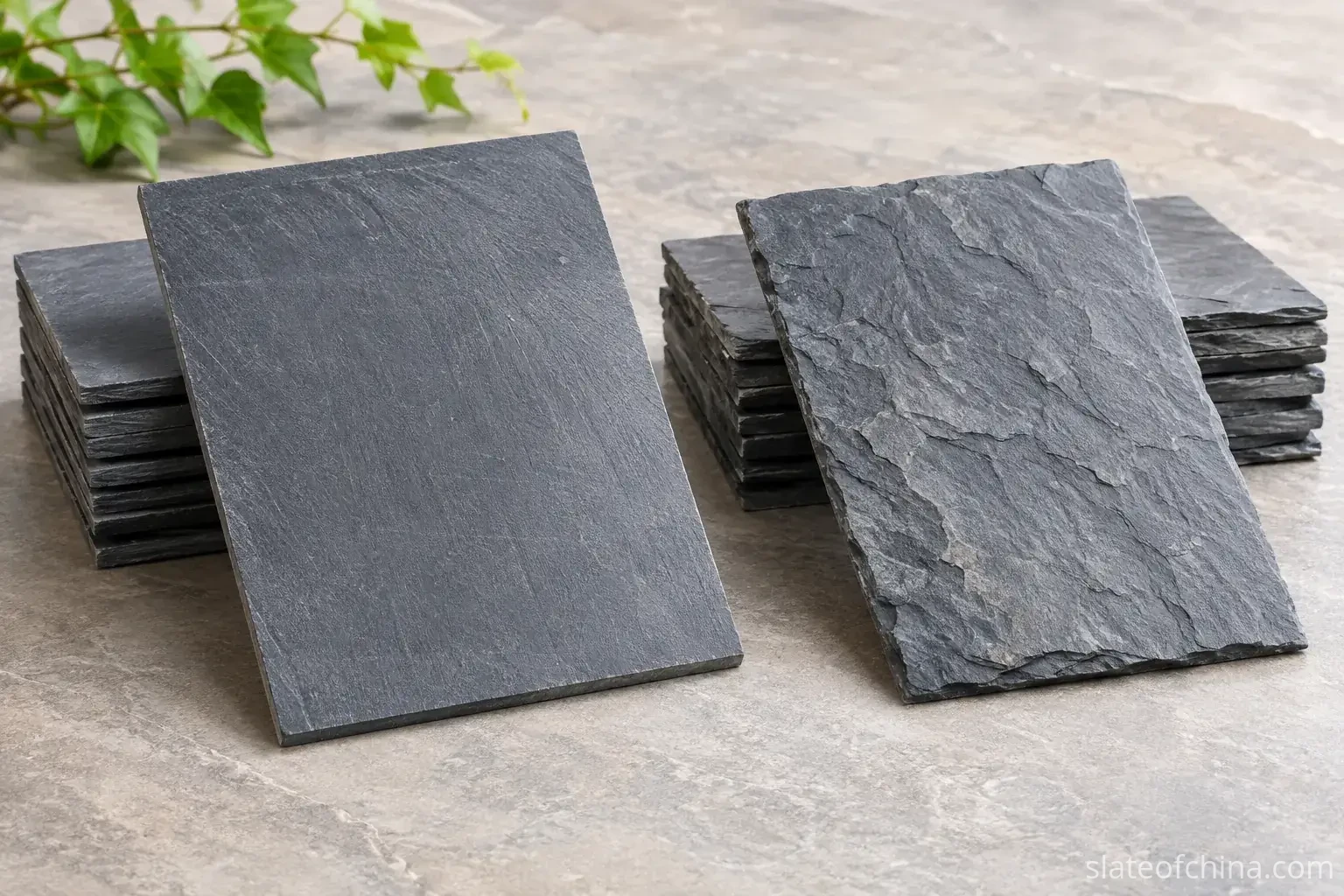
What “Calibrated” Slate Actually Means
Calibrated slate — catalogues also list the product as calibrated natural slate — is slate that has been through one more pass after splitting. The tile is split to a target thickness, then travels face-down across a calibration line, where grinding heads take the unevenness off the underside until the batch reaches one controlled thickness, held within the tolerance the workshop works to. That settled figure — the calibrated slate thickness the batch carries on its documents — is what an incoming inspection reads. The pass works the back only. The face keeps whatever finish was ordered — most calibrated product in the trade is in fact a natural cleft face walking around on a machined footing: the split look above, the engineered plane below.
What the pass can and cannot do is worth saying plainly, because the word carries more promise than the process. The machine can only take stone away; it cannot put rock back. A tile that splits thin stays thin — calibration evens what is there, it never thickens what is missing. It does not touch the face. And it does not touch the rock itself: a soft, absorbent tile from a poor bed is, after calibration, a soft absorbent tile with an even underside.
Run a palm across the slate back surface of a calibrated tile and it reads flat, with a fine regular abrasion in one direction — a machine's texture, not a geology's. The thickness reads the same from corner to corner, and the edge is straight. Buyers will also meet the term gauged slate — several North American catalogues use it for the same machine work, and ungauged slate is its opposite — worth knowing before two quotations that seem to disagree turn out to agree. And ask what “calibrated” covers: the trade also ships semi-calibrated product, a lighter pass with a looser result. Semi-calibrated is an honest answer; calibrated without a number is not.
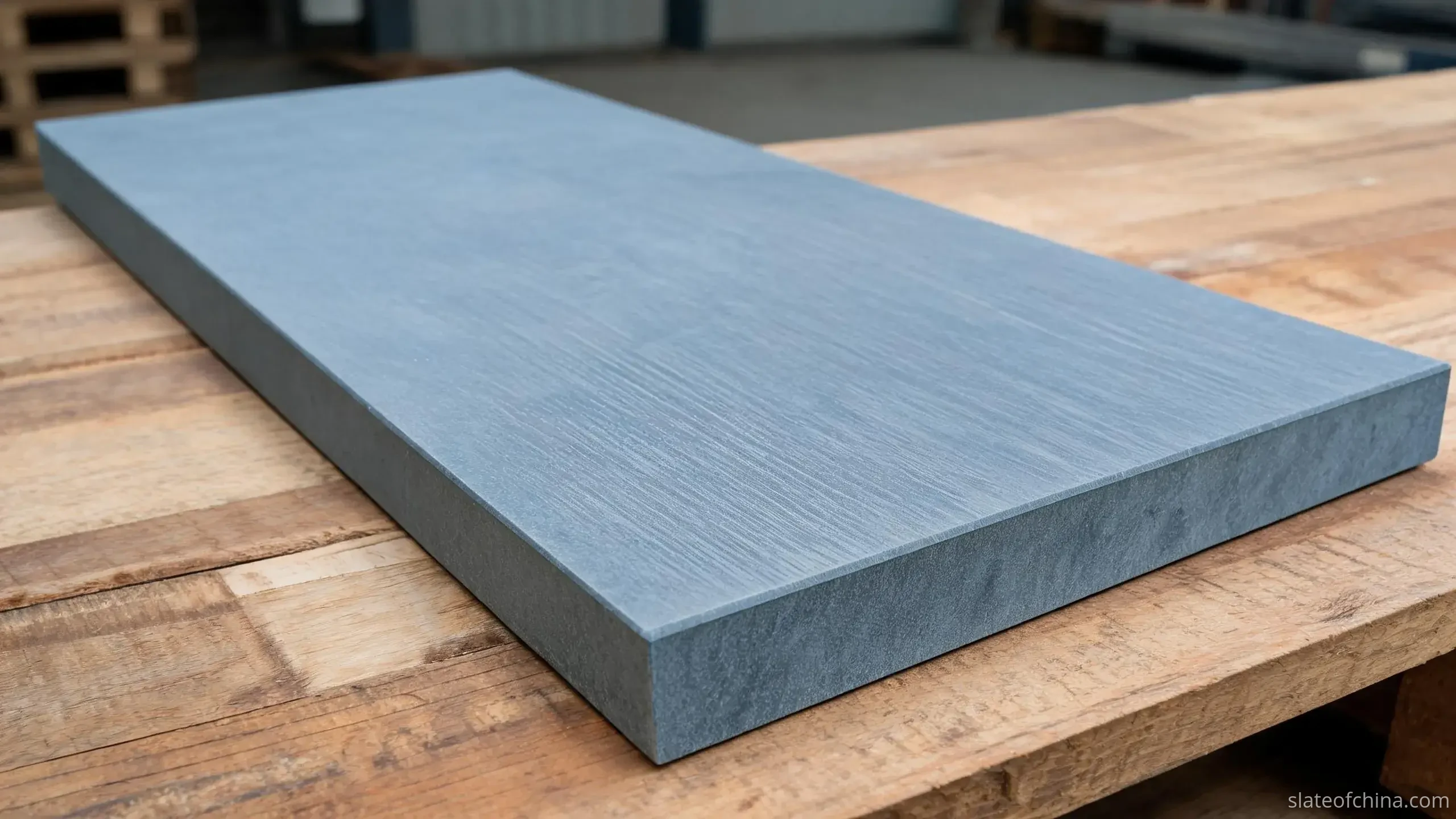
What “Hand-Cleft” Slate Actually Is
Hand-cleft slate — hand-split slate in some catalogues — is the stone as the splitter left it. The block is parted along the cleavage with chisel and mallet; the back of the tile is the natural parting face, and it keeps the seam's own record: gentle ribs, shallow hollows, edges that followed the rock rather than a drawing. Nothing further is done to the underside. What variation the bed gave, selection manages — at the workshop the tiles are hand-graded into a thickness band the order names, which is why honest hand-cleft quotations read like a declared band, never like a single number.
The terminology deserves one paragraph of care, because two words that look interchangeable are not. Hand-cleft names the process — how the underside was made. Ungauged names the state — that the thickness was never calibrated. A hand-cleft tile is very often ungauged, but the two words answer different questions, and a supplier who uses them as synonyms should be asked to pick one and put a number to it. That is also why the honest calibrated vs uncalibrated slate comparison is written in two columns — the pass, and the number — and either one alone can mislead.
It is not the cheaper grade of anything. A well-split tile from a sound bed is a good product; it is simply a different product, with the variation carried honestly on its underside rather than planned out of it. Where that variation is welcome — and the next sections map exactly where it is — hand-cleft is not a compromise. It is the specification.
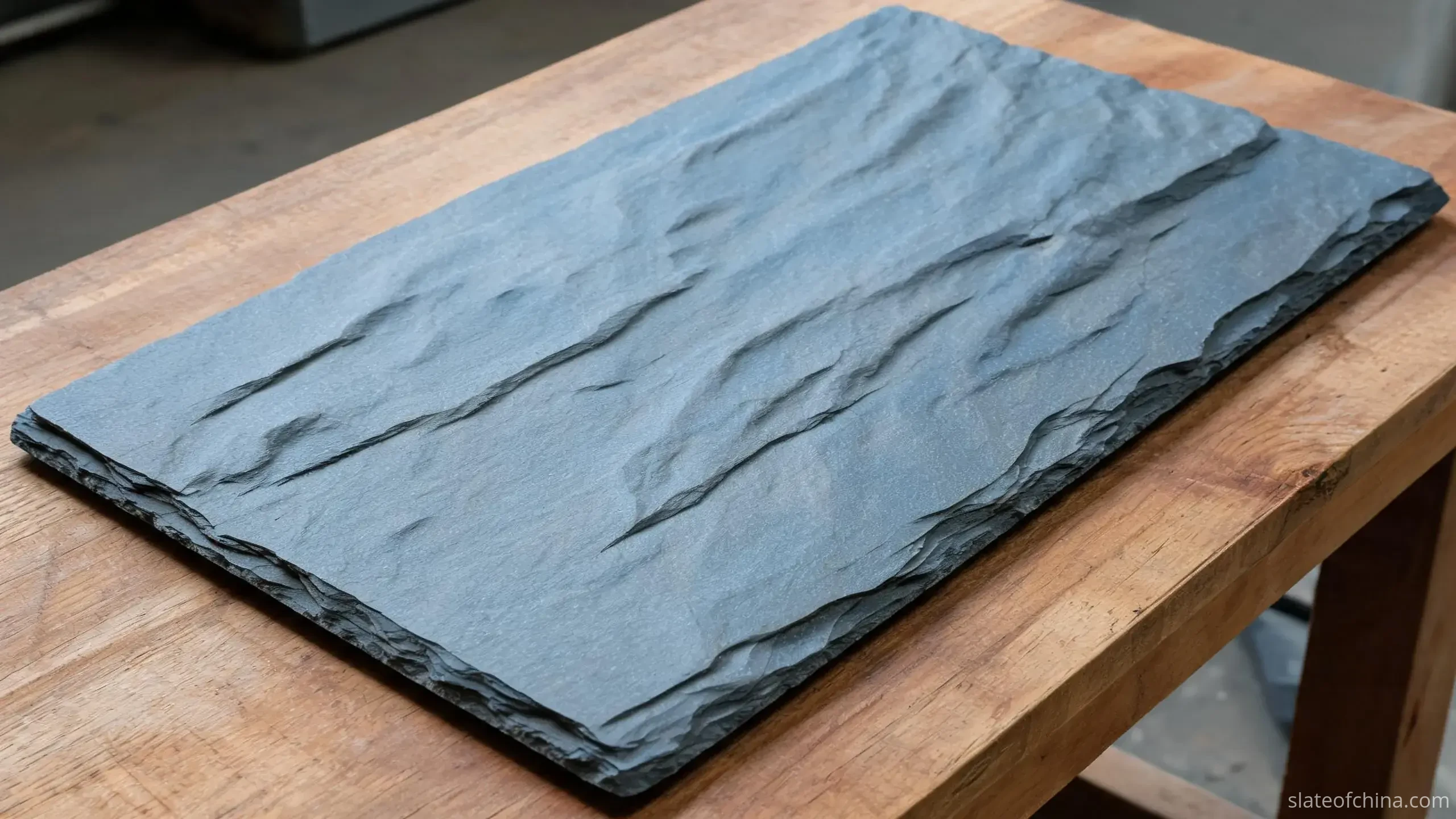
The Difference Shows Up in the Bed, Not on the Face
At the sample table, the difference between the two products is a texture on the underside. On site it becomes geometry, time and money:
| Aspect | Calibrated slate | Hand-cleft / ungauged slate |
|---|---|---|
| Back surface | ground to a flat plane by machine | the natural split face, seam record intact |
| Thickness | one nominal, held to a stated tolerance across the batch | a declared natural band, graded at selection |
| Bedding | thin or medium adhesive bed, laid at one depth | a fuller mortar bed, adjusted tile by tile |
| Lippage at joints | thickness consistent; face and substrate carry the rest | each junction negotiated by the setter's hand and eye |
| Pace and labour | a crew keeps one rhythm across hundreds of tiles | piece by piece — the setter reads each back before it beds |
| Price, buying against laying | more to buy, typically less to lay | less to buy, typically more to lay |
| The visible face | any finish the project names — decided separately | any finish the project names — decided separately |
General behaviour of the two product types — tendencies, not guarantees. The numbers that govern an actual order come from the supplier, in writing, per batch.
Why thickness becomes lippage: a finished floor reads level at its joints, and a joint is two edges meeting at one height. When neighbouring tiles differ in thickness, the setter either floats the shallow one higher in its bed — spending material and minutes — or lets the surface step, and a step is what the shoe finds before the eye does. Through a large floor the differences compound, and on commercial schedules the compounding is priced by the day.
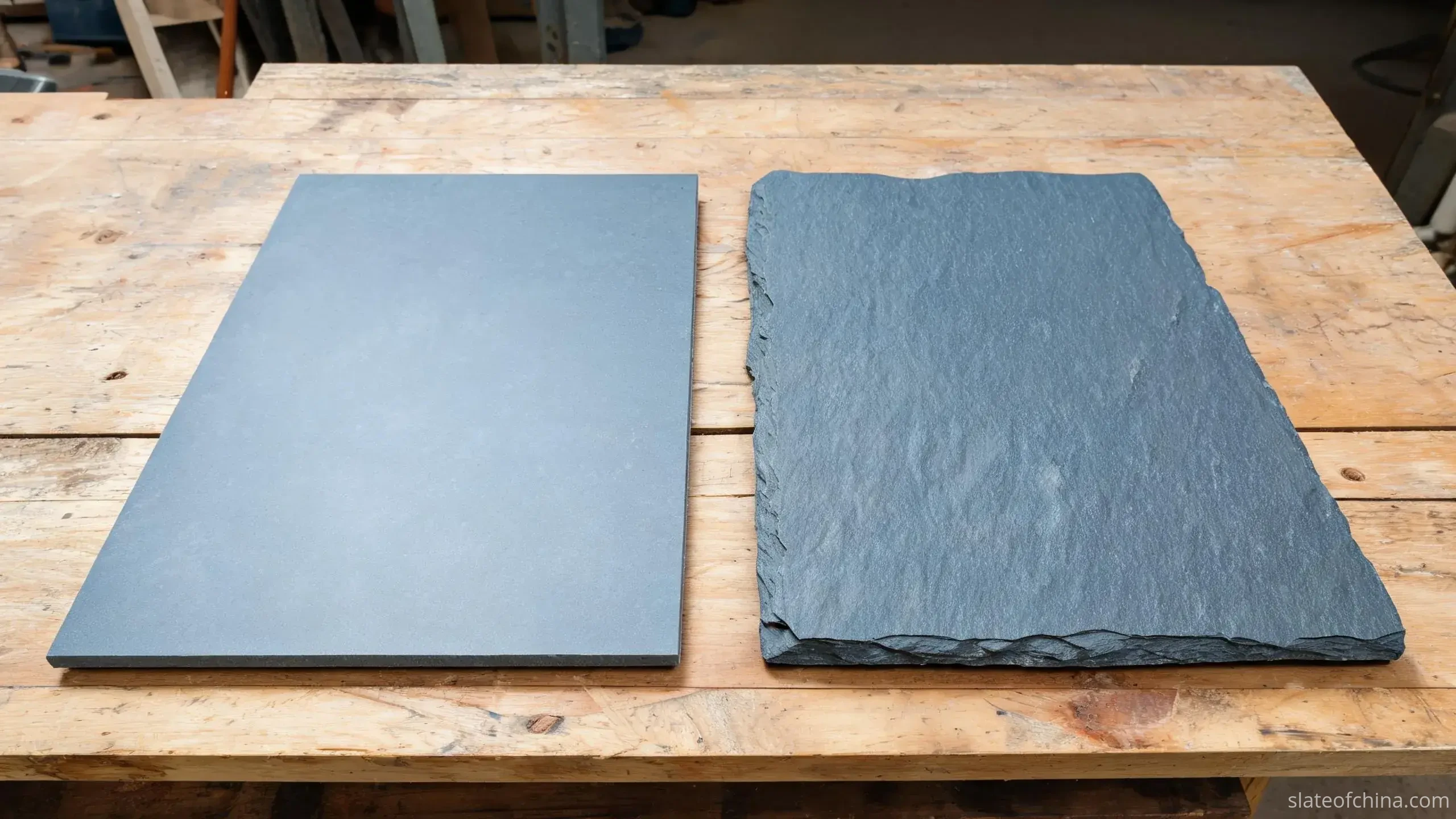
Bedding is where the two products pick their half of the bargain. A calibrated back suits a thin-bed adhesive system over a prepared substrate — a full bed would simply bury work the machine has already done. A split back wants the opposite: a fuller, more patient mortar bed that can take up the natural band, which is why exterior ground on built-up beds has carried hand-cleft flag for centuries. The pairing is the specification. Either way, the substrate under it carries its own half of the bargain: no back, machined or natural, rescues an unlevelled base. A natural band asked to behave like a tolerance produces a floor that argues with the drawing for years — quietly at first, then at every threshold.
What the difference never touches is the face. Calibration says nothing about the look: both products carry whichever finish was ordered — cleft, sawn, honed, brushed — and the same colour band from the same bed. Face and back are two separate decisions made on two separate lines, and the buyer who compares two samples at a showroom is evaluating only one of them.
The arithmetic follows the thickness. On the measured density of the slate — 2,819 kg/m³, indicative arithmetic for planning and never a promise about anyone else's bed — a 600 × 300 mm tile at 12 mm calibrated is about six kilos: a one-hand lift. The same format split to a 25 mm band is in the region of twelve and a half: a two-hand, bent-knees lift, fifty to a pallet, and a forklift conversation rather than a trolley one. Weight at this format is not a footnote; it is part of what the order buys. The thickness bands themselves — the indoor flooring band against the outdoor paving band, product by product — are tabulated on the flooring-thickness page later in this guide.
Where Calibrated Slate Earns Its Keep
Floors that set out from a drawing. Where joints run to fixed widths and the layout sets from a grid, calibrated slate tiles pay their way precisely: one depth across the batch is the assumption the drawing was made on. Grid-set floors, levels carried through doorways, tiles that must behave like components rather than like stones.
Buy calibrated.
Commercial schedules. Hotels, restaurants, lobbies, retail floors — anywhere the fit-out is one line on a programme. On a site where a day's delay costs more than the stone did, the system that keeps a crew in rhythm pays its premium back inside the first week.
Buy calibrated.
Large-format floors. The bigger the module, the less a bed can forgive: a large tile that rocks on a high back cannot be floated quietly, and it surrenders a whole piece wherever a cut falls badly. If the project wants calm through big open surfaces, the underside has to be the quietest thing about the tile. How large formats behave as a product family — handling, substrate tolerance, breakage — belongs to the large-format pages later in this guide; this page carries only the underside of the argument.
Buy calibrated.
Thin-bed and controlled adhesive systems. Cementitious thin-bed over a levelled substrate is fast, clean and strong — and it is built around one premise: tiles of one thickness. Whether a given product suits a given system is confirmed with the adhesive manufacturer per product, never assumed from the word calibrated alone.
Buy calibrated.
Specified tolerances and incoming inspection. A nominal with a tolerance can be measured with a caliper at the door and accepted or rejected on the number — an inspection that takes minutes and ends arguments. For projects specified to drawings with called tolerances, that is the whole point of the pass.
Buy calibrated.
The outdoor branch of the same system — calibrated flags drawing their joints across a terrace — browses in the paving slate category.
Where Hand-Cleft Slate Is the Better Buy
Buildings that already lean old. In a traditional house, a garden room, a courtyard asked to look settled rather than installed, machine-even can read as wrong. The floor should look like it has always been there, and a natural band does that within a season.
Buy hand-cleft.
Exterior ground on full beds. Mortar and sand beds are built to absorb variance — falls are beaten into the bed, thickness rides inside it, and the split back keys into mortar better than any flat plane. For ground laid the old way, the natural back is not a compromise; it is the system the bed was designed for.
Buy hand-cleft.
Budgets that read the whole price. Hand-cleft is typically cheaper at the yard and slower at the trowel. Where labour is the project's own — self-managed sites, phases where pace is free — that trade lands in the buyer's favour. Read the whole price anyway: the cheapest pallet is not always the cheapest floor.
Buy hand-cleft.
Designs that would be fought by flatness. Where evenness would look wrong — rustic settings, character-led interiors, stone asked to be scenery rather than instrument — the machine's discipline is money spent against the design.
Buy hand-cleft.
Is a Calibrated Tile a Better Tile?
No — and the trade's habit of pricing calibration as though it were quality has cost buyers real money. Calibration is a process, not a grade. It buys one thing: consistency of thickness. Stone quality is a separate axis entirely — how the bed formed, what it absorbs, how it weathers, what it holds under load — and no pass on the back changes any of it. The honest formula: calibration is bought from the workshop; quality is inherited from the bed.
So the assessments are kept separate, on purpose. Material: strength, absorption, weathering — questions for test data, not adjectives; the figures behind the slate on this site are published on the test results page. Finish: the visible face, named for its duty. Dimensions: format, flatness of the face, and the thickness tolerance underneath. Processing: edges, back treatment, sorting and packing. A good specification writes the four separately; a good supplier answers them separately too. The commonest mistake on either side of the table is letting one word on an order carry all four.
Reading the Back at Sampling
None of this needs laboratory equipment. Twenty minutes at the sampling stage, four moves in order.
The eye. Turn the tile over in daylight. A ground back reads flat and fine-textured, one machine direction; a split back carries ribs and hollows from the seam. Look for the middle state, too — a back half-flattened, flats appearing between the ribs — and ask which word the supplier attaches to it: semi-calibrated is an honest answer, calibrated without a number is not.
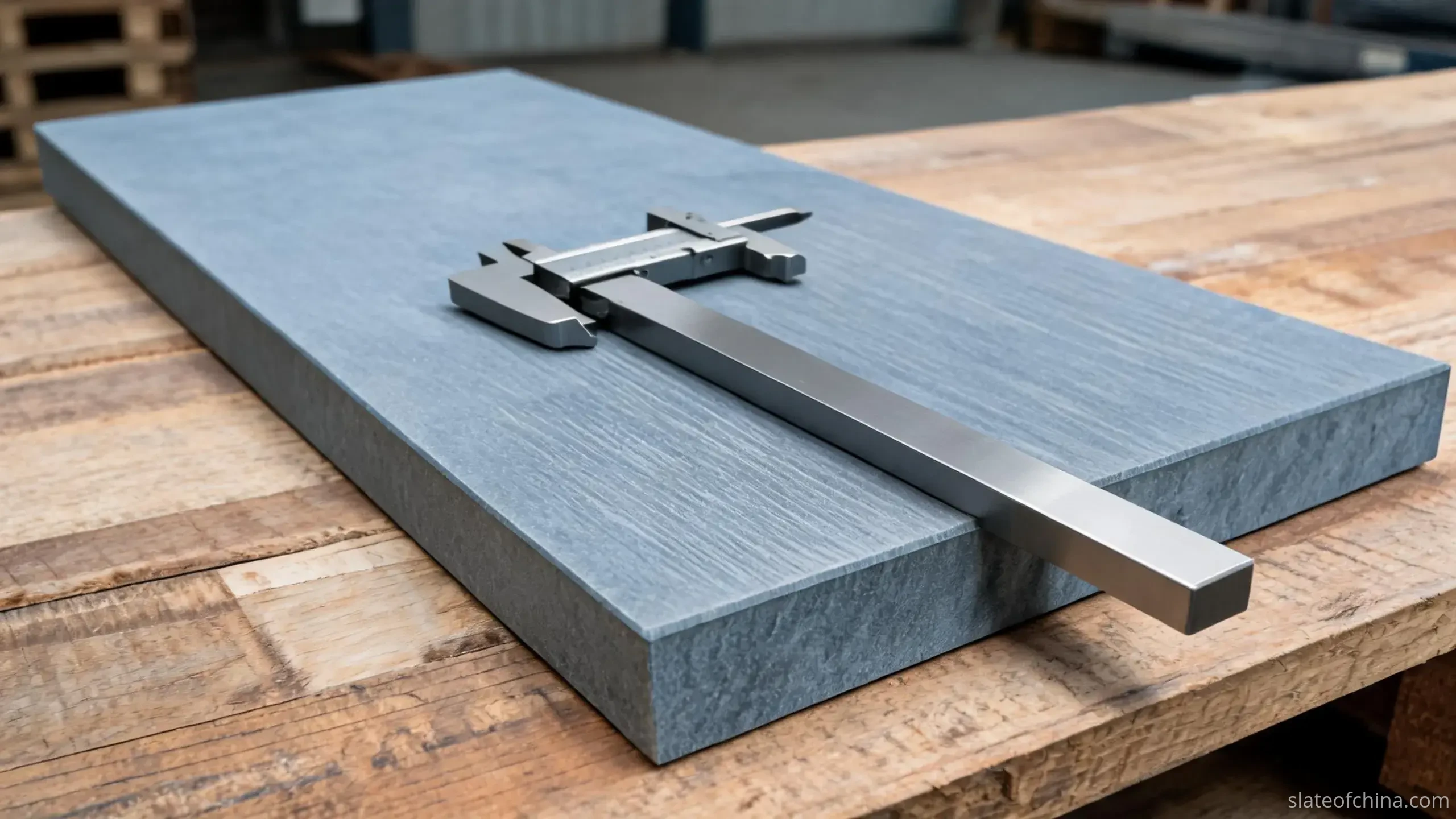
The caliper. Measure the slate tile thickness where it will be argued: along the edge, at least three points per tile — both short ends and the centre — and four or five tiles from the batch. Record two spreads separately: within one tile, and tile to tile. They make two different promises. The first says the tile will bed flat; the second says the batch will lay at one depth. A supplier who controls one but not the other will say which, if asked.
The flat table. Lay four or five tiles face-down on a surface known to be flat. The calibrated ones rest; the split ones rest where their ribs let them, and the ones that rock mark themselves. A coarse read, not an inspection — and it takes ninety seconds.
The paper. Then ask for the photographs and the numbers: front and back photographs of the actual batch; the declared thickness range in writing; confirmation of full, semi or no calibration. Samples answer the face. This paperwork answers the back.
This is a screening read — it decides whether the order is worth writing. What the order itself should say is the last section.
Writing the Difference into the Specification
The commonest purchasing mistake in this trade is one adjective where a paragraph should be. “Calibrated” alone on an order is an instruction every workshop is free to interpret; two suppliers quoting it may be quoting two different passes at two different tolerances. The specification writes the process and the measurable outcome — and in this trade thickness has exactly two honest spellings: a nominal with a tolerance for calibrated stock, or a declared band for split stock. A nominal without a tolerance is a mood, not a number.
Example A — the calibrated line
- Product: natural calibrated slate floor tiles
- Face: natural cleft
- Back: machine-calibrated — pass stated as full or semi
- Nominal thickness: 12 mm, tolerance ± [value agreed with the manufacturer]
- Format: 600 × 300 mm, sawn edges
- Reference sample annexed; thickness inspected at incoming against the tolerance
Example B — the hand-cleft line
- Product: natural hand-cleft slate flags
- Face: natural cleft
- Back: natural split, ungauged
- Declared thickness range: 15–25 mm (example band, agreed with the manufacturer)
- Format: 600 × 300 mm, hand-split edges
- Reference sample annexed; band checked at incoming, both spreads recorded
Illustrative orders, not industry defaults. The slate tile thickness tolerance — or the declared band opposite it — is agreed with the manufacturer per product, never copied from another project, another stone or another catalogue.
The numbers answer to the product's own standard, and the standard is named with the same care: EN 12057 for modular tiles, EN 12058 for slabs for floors and stairs, EN 1469 for cladding panels, ASTM C629 for dimension slate in North America — while roofing slate is a different product family (ASTM C406, EN 12326), and neither set of figures transfers across the boundary. Published tolerance references, such as those of the Natural Stone Institute, describe typical dimension-stone work; they are references, not defaults. The agreed number on the contract is the one that counts — the tolerance you confirm is the argument you never have on site.
Five questions the supplier should answer without hesitating: which word applies — calibrated, semi-calibrated or ungauged; back photographs of the actual batch; the declared range, with control stated separately within-tile and tile-to-tile; samples from the production lot the order will cut; and suitability for the bedding method named in the specification. Suppliers who clear the five on the first email tend to clear the pallet at the first inspection.
When an order names the face finish, the back treatment, the nominal or the declared band — and the tolerance attached to each — the manufacturer can recommend the right product, and the buyer can inspect what actually arrives against the number. At Slate of China, we read every order the way this page reads one tile: face, back, thickness, tolerance, each named and each numbered. We are glad to quote against a written specification — and just as glad to help write it. Send the tile dimensions, thickness, surface finish, back treatment and application with the enquiry; sample tiles showing both backs ship on request, and face-up and face-down photographs of the actual production batch come with every quotation. The fuller walk-through of the order line — terms, sheets, inspection points — is on the architectural buying guide page; and the order-line sheet itself, what to send a supplier line by line, is opened on the spec-sheet page later in this guide. One last habit worth the ten seconds it takes: write the tile's back onto the order with the same care as its face.
Frequently Asked Questions
The questions the two undersides raise most often — definition, quality, price and paperwork. Each answer gives the working rule first; the sections above carry the fuller treatments.
Is calibrated slate better than hand-cleft slate?
Neither better nor worse — differently made. Calibration holds a batch to one thickness so it lays fast and level in a thin or medium bed; hand-cleft keeps its natural band and beds fuller and slower. Choose by installation system and design intent, not by prestige.
What does calibrated slate mean?
Slate that has been through a machining pass on its back after splitting: the underside is ground to a flat plane so the batch reaches one controlled thickness, held within a stated tolerance. The face is untouched by the pass — a calibrated tile can still carry a fully natural cleft face.
What is ungauged slate — is it the same as hand-cleft?
Ungauged means the thickness was never calibrated — ungauged is a state, hand-cleft is a process. A hand-cleft tile is usually ungauged, but the two words answer different questions; ask the supplier to use one and put a number to it.
Can hand-cleft slate be used for flooring?
Yes — on a bed built for it. Hand-cleft slate tiles carry their natural band, which a fuller mortar bed absorbs; interior adhesive floors on strict levels are where the calibrated product does the work instead. The failure comes from pairing the wrong back with the wrong bed, not from either product itself.
Does a calibrated back mean a smooth front face?
No. Calibration works the underside only. The visible face is ordered separately — natural cleft is the default pairing; sawn, honed and brushed answer on their own line.
Is calibrated slate more expensive?
Usually more to buy and less to lay: the machine pass adds cost at the workshop and saves time at the trowel. Hand-cleft is typically the reverse. Compare installed cost, not pallet price — read both sides of the arithmetic.
How can I tell if slate is calibrated?
Turn the tile over: a ground back reads flat with a fine one-directional machine texture; a split back carries the seam's own ribs. Then confirm with measurements and back photographs of the actual batch — adjectives settle nothing a caliper can measure.
Does calibration guarantee a flat tile?
No. Calibration controls thickness — one number per tile, consistent across the batch. Flatness of the face, substrate preparation and installation workmanship carry the surface; those are specified and checked separately.
What thickness tolerance should I write into the order?
The one the manufacturer confirms as achievable for that product — there is no universal default. Write it as a nominal with a tolerance for calibrated stock, or a declared band for hand-cleft, match the numbers to the product's own standard, and treat published tolerance references as references, not numbers to copy.
Related Reading
Specifying slate with the back in mind? The fastest route to a quotation that names both sides of the tile is four written lines:
- The areas and zones — indoors and out, and roughly how many square metres of each
- The face per zone — cleft, sawn, honed or brushed, chosen for duty and cleaning
- The back per zone — calibrated or hand-cleft, with its bedding system: thin-bed adhesive, full mortar bed, or sand
- The thickness line — a nominal with a tolerance for calibrated stock, a declared band for hand-cleft, written the way this page walks it
Not every enquiry arrives decided — a zone list and a rough quantity are a workable start, and sample tiles showing both backs ship on request.