
Slate Surface Finishes: Cleft, Sawn, Honed and Brushed
Walk from one end of a slate workshop to the other and the same stone will pass you twice. Near the splitter it leaves rough along its bedding plane — a face the rock opened by itself, with tooling kept to the edges. Near the grinding line it leaves smooth and quiet, its own surface taken back down to a honed matt. Two tiles, often cut from the same block, and a first-time visitor could be forgiven for reading them as two different stones. They are not. They are one stone choosing how much of its own surface to keep — and that choice, made in the workshop long before the order ships, decides how the stone will behave underfoot, in the rain and under the mop for the next several decades.
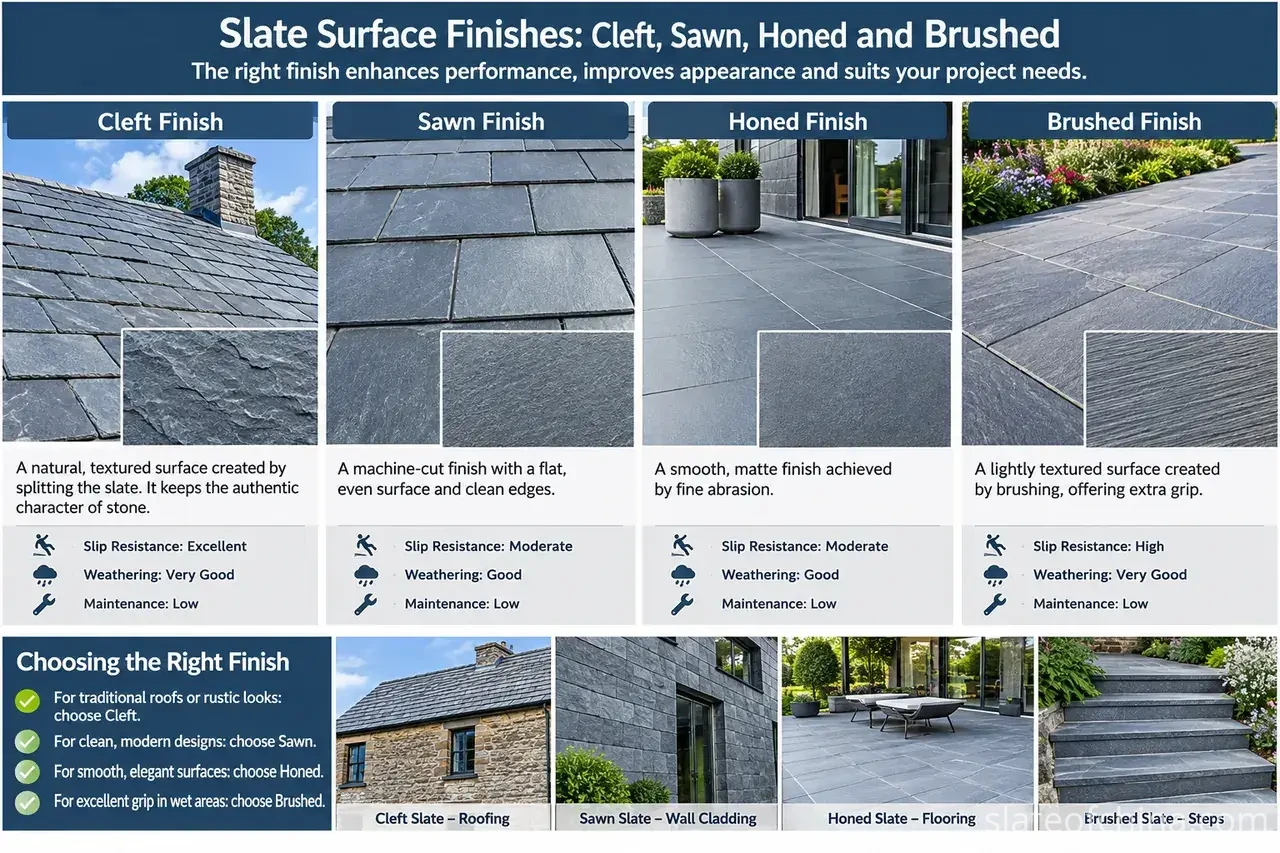
That is the subject of this page. The slate surface finishes a project can order number four — natural cleft, the split face; sawn, the cut face; honed, the ground face; and brushed, the texture-kept-but-softened face — and each one changes the three things a specification ultimately cares about: slip behaviour, weathering and maintenance. None of them is paint; a finish is a decision about how much of the rock survives the workshop.
Two boundaries, briefly. The roof answers to a thinner, stricter two-surface vocabulary of its own, walked through in the Roofing Slate Guide under Smooth Slate vs Textured Slate. And the finish is one stop in a longer specification — Decision Four in How to Choose Architectural Slate, with the term itself defined in What Is Architectural Slate? This page opens that one decision to full width.
Short answer: architectural slate leaves the workshop with one of four faces — and the four of them trade grip against cleaning along one strip. Which stop a project buys decides how the stone behaves wet, and how much work it is to live with.
split along the bed — the rock's own roughness
Grip ●●●● · most cleaning
cut flat — a fine blade texture left behind
Grip ●●○○ · easy cleaning
ground smooth — the quiet matt face
Grip ●○○○ · easiest care, test it wet
kept rough, then softened — texture with the edges taken off
Grip ●●●○ · middle of every trade
Indicative surface texture comparison only — the dots are shorthand, not laboratory grades, and actual slate slip resistance is verified through appropriate wet slip testing, batch by batch, in the project's own test method. The rest of the page walks the strip stop by stop, with the flamed question at the end.
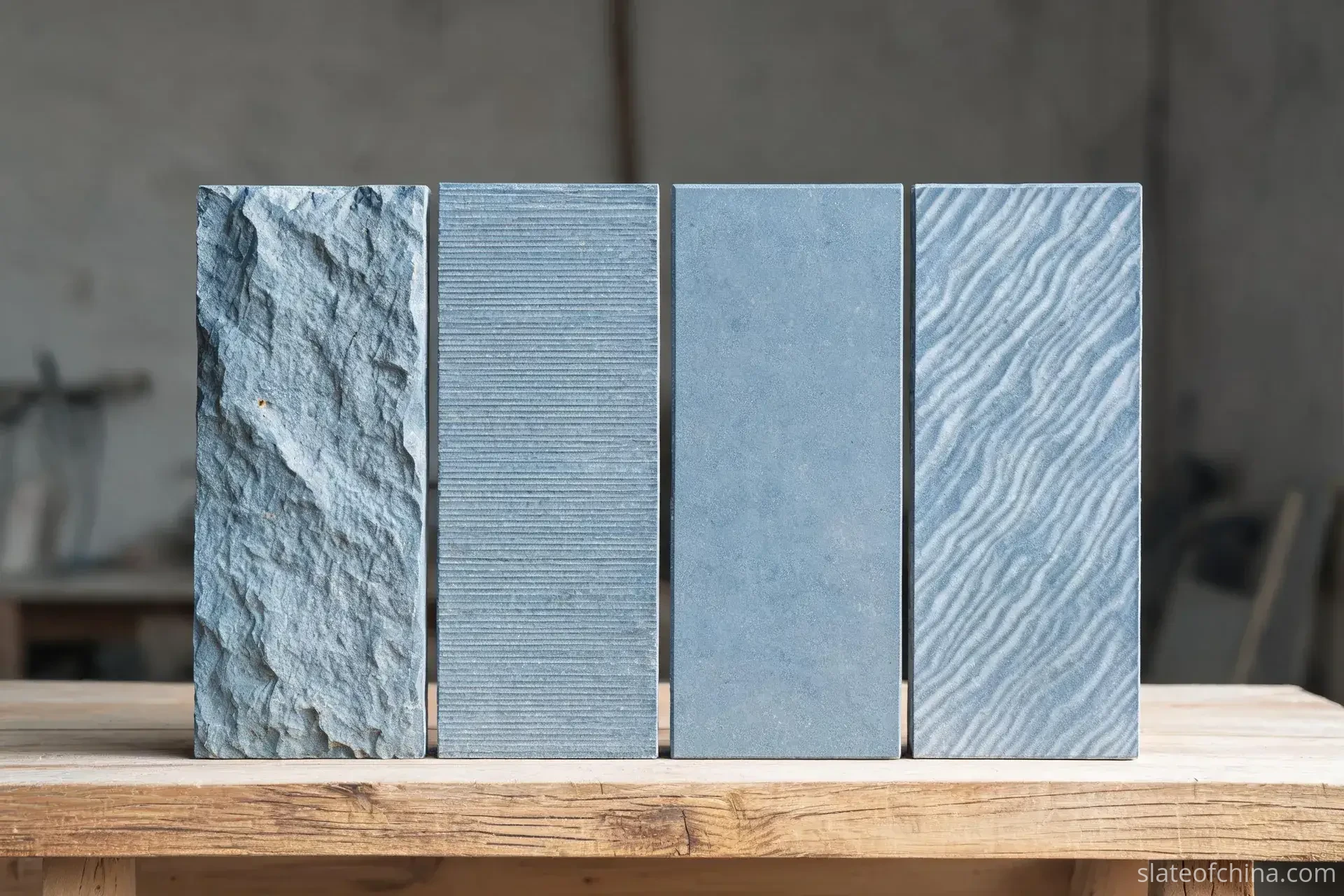
For speed, the slate finishes comparison in three columns — typical gravities, not limits, since every project pairs a face with a duty against exposure and test data:
| Finish | The surface | Typical applications |
|---|---|---|
| Natural cleft | Split along the bed — ridges and hollows the rock gave itself | Garden paths, patios, courtyards; rustic flooring; textured cladding |
| Sawn | Cut flat — a fine, regular blade texture | Modular paving, contemporary layouts, sawn cladding panels |
| Honed | Ground smooth and even — satin matt, no gloss | Interior flooring: halls, kitchens, bathrooms, lobbies |
| Brushed | Texture kept, sharp edges taken off | Steps and transitional floors, covered outdoor rooms |
Face One — Natural Cleft: The Surface the Rock Chose
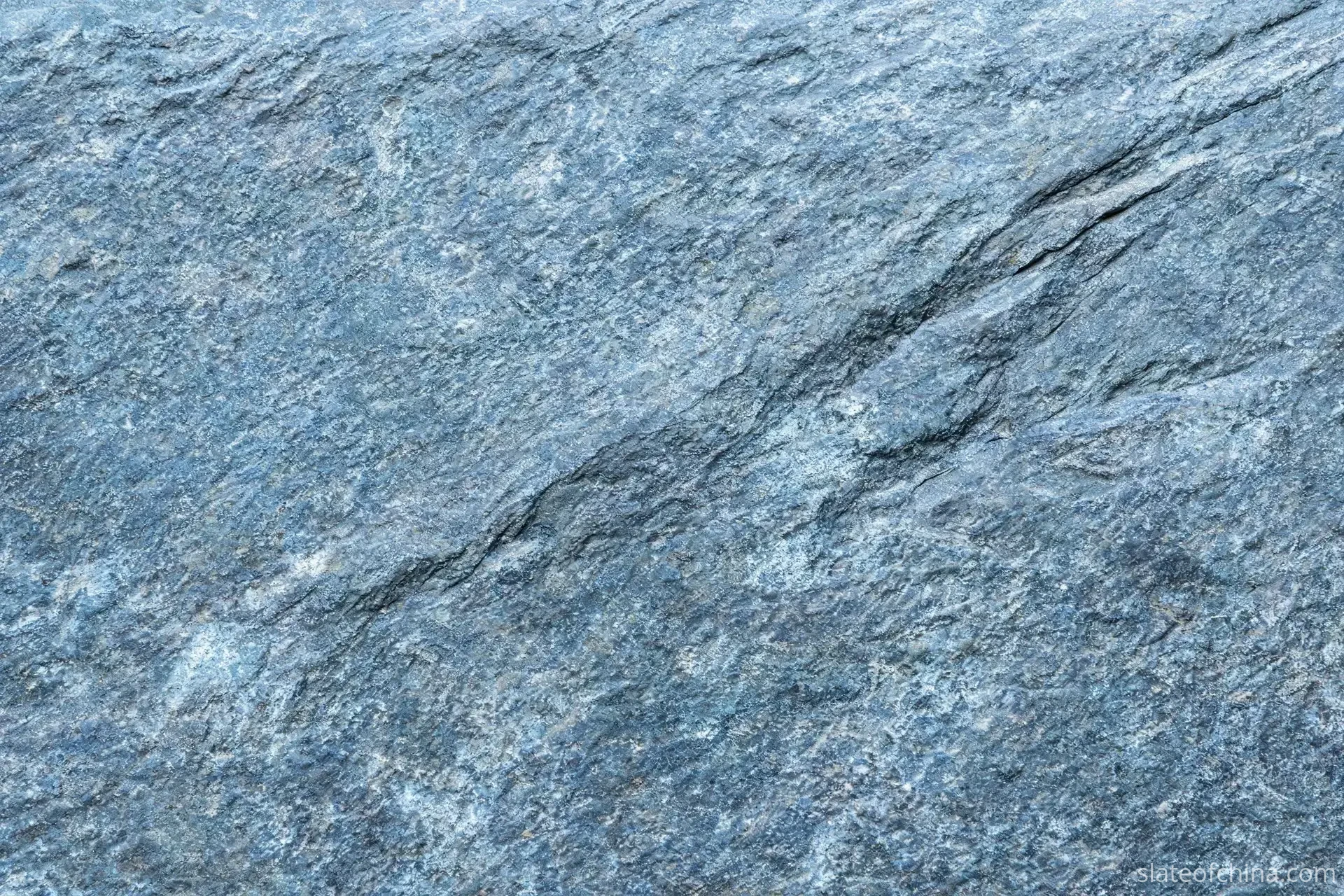
Natural cleft slate is the face the stone gives itself. The splitter sets a chisel line along the bedding plane and opens the block; the two halves part along a surface no machine planned, and that surface ships. Nobody flattens it, nobody evens it — the workshop's work is confined to the edges and the thickness. In the trade the same face answers to riven and split face; three words, one surface, and whichever word a drawing uses, the stone is the same.
Underfoot, the cleft face is the family's structural answer to slip. Its relief is not pattern but topography — ridges and hollows the foot cannot slide across as one plane, the way it can across a smooth face. That is the honest, physics-level case for cleft outdoors, and it is why the face is the default on garden paths, patios, courtyards and stepping stones across the paving range, and a routine choice for textured cladding fields. What the physics does not do is produce a number: wet performance on any finish is lot-specific, surface-specific and test-method-specific, so the honest specification asks the supplier for the tested wet value on the production batch rather than trusting the word riven as a rating. Nor does texture carry a certification — pool surrounds and public wet areas ask for project-specific values whatever the finish, and no face substitutes for the stone's own freeze–thaw reading or for the site's drainage design. The paving-side detail of that testing conversation has its own page later in this guide.
Weathering and cleaning are where the cleft face collects its bill. Texture catches what lands on it — dust, pollen, leaf-fall, the grit a shoe brings in — so a cleft floor asks more of the mop than any smooth face, and needs a cleaning regime chosen with its valleys in mind. Outdoors, that same texture weathers in as character: the face reads settled from the first season, and only improves as it takes the site's light. Indoors the same reading can be exactly the point — the outdoor texture carried inside — in halls and character interiors, where the client has agreed to the maintenance that comes with it. A face that grips also keeps what lands on it; the specification budget for grip should budget the housekeeping too.
On the order: natural cleft (riven) face; nominal sizes; thickness hand-selected to the agreed band. What hand-selection actually does to a tile — and what calibration does to its back — is the next page in this guide's story of the tile itself.
Face Two — Sawn: The Blade's Version of Flat
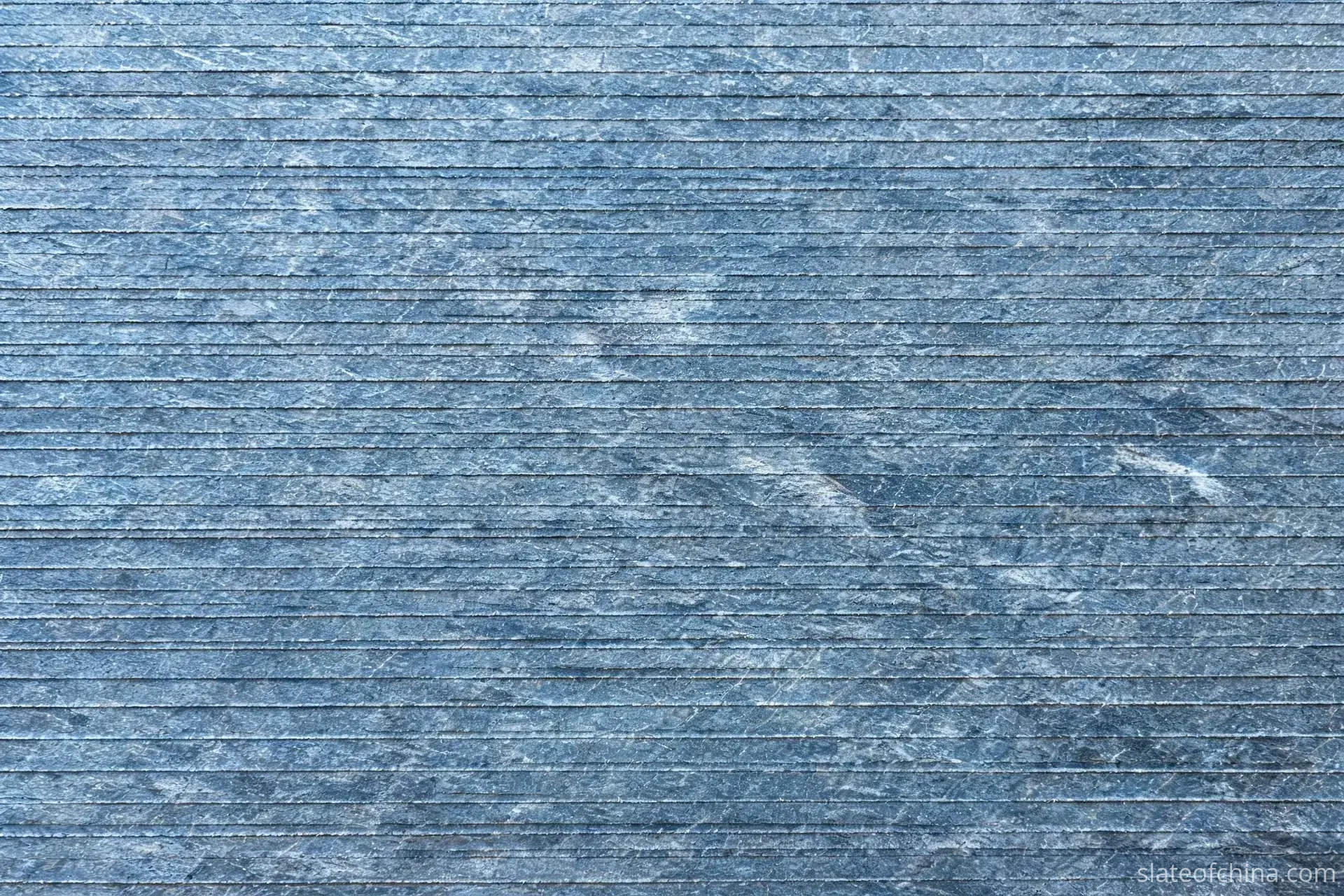
The sawn face is what the blade leaves. Gang saws and circular saws pass through the block, and the resulting surface is flat in a way the cleft face never attempts — but not dead flat: a fine, regular blade texture remains, faint grooves running the length of the cut. To the hand it reads as smooth with a whisper of tooth; to the eye, under raking light, it reads as honest machining. It is the finish of geometry: the face that rectangular modular paving, clean-jointed terraces and sawn cladding panels are built from.
Between cleft and honed, the sawn slate finish occupies the middle ground on almost every axis. It is flatter than cleft — joint lines run cleaner, furniture sits steadier, the laying runs faster — yet it keeps more surface character than honed, and its fine tooth gives it a measured willingness to hold a shoe where a fully ground face may not. The same honest caveat applies: dry behaviour is visible, wet behaviour is tested, and the request to a supplier is the same on every face — the wet figure for the batch, in the test method that governs the project.
Weathering and maintenance sit proportionally in the middle too. The sawn face sheds most of what the cleft face traps, and takes a mop without argument, while its faint grooves hold a little more than a honed surface will — worth knowing in an entrance hall that takes street grit. Outdoors it is the face of contemporary paving programmes and of sawn slate cladding in running layouts, where panels read as panels and joints read as drawn lines rather than as nature's improvisation. Its cut edges and square corners make it the natural partner for the drawing-driven end of the catalogue — the formats that exist because a setting-out demanded them, on the ground or on the wall.
On the order: sawn face, cut to modular or project dimensions; edges sawn; blade texture as the working surface unless honing is ordered on top. The step from sawn-flat to calibrated-back is the tile's own story, one page ahead.
Face Three — Honed: Texture Taken Away
The honed face is the sawn face ground further — abrasive heads pass over the stone until the blade texture is gone and a smooth, even matt remains. It is worth saying plainly what a honed slate finish is and is not: it is smoothing, not polishing. A polished surface is worked to a gloss; a honed surface stops short, flat and satin-quiet, taking light without returning it as shine. On slate, honing is the standard route to a smooth face — the high-gloss look that granite and marble carry belongs to their mineralogy and their polishing lines, and is not the slate catalogue's to promise.
Among slate finishes for flooring, honed slate is the interior face, and its centre of gravity is unmistakably indoors: halls and living spaces, kitchens and bathrooms, lobbies and retail interiors — everywhere the project wants the stone's colour and bed character with a surface that meets furniture, bare feet and cleaning regimes on even terms. Flatness is its gift: a honed field reads as one plane, joint lines stay graphic, and low winter light travels across the floor instead of breaking over ridges. The same flatness is its one honest caution. The smoother any surface, the more its wet behaviour deserves proof rather than assumption: honed tile in a bathroom, an entrance lobby or any wet-duty interior should carry a wet-tested value for the batch, in the test method the project recognises — the figure is asked for, not guessed at. On that tested basis, honed interiors perform in projects across every climate; on no basis at all, any smooth floor is a hypothesis.
Maintenance is where the honed face earns its keep. It is the easiest of the four to clean — nothing traps, nothing resists the mop, and a spill left an hour is still a spill, not an event. Weathering, as an indoor question, mostly reduces to that cleaning regime lightened; the sealing question, where a project asks one, is answered finish by finish and tested on spare pieces before the floor goes down. Two qualifications keep the praise honest: easy to clean is not maintenance-free, and even the quietest face keeps its regime; and honed outdoors is not forbidden, but it moves wear under traffic, staining and wet behaviour back onto the checklist, answered with test data rather than with the finish's indoor reputation. One pairing deserves a mention in the same breath: honed inside with cleft outside the same threshold is a classic combination — the two faces bookending a project with the same stone — and matching the tone band across both is a sampling exercise, not a lucky accident.
On the order: honed face; calibrated tile for adhesive floors; the finish named as a line of its own. For the material-level comparison — honed slate against porcelain, granite and marble, on flatness, grip and keeping — the honest table has already been drawn on its own page.

Face Four — Brushed: Roughness, Tamed
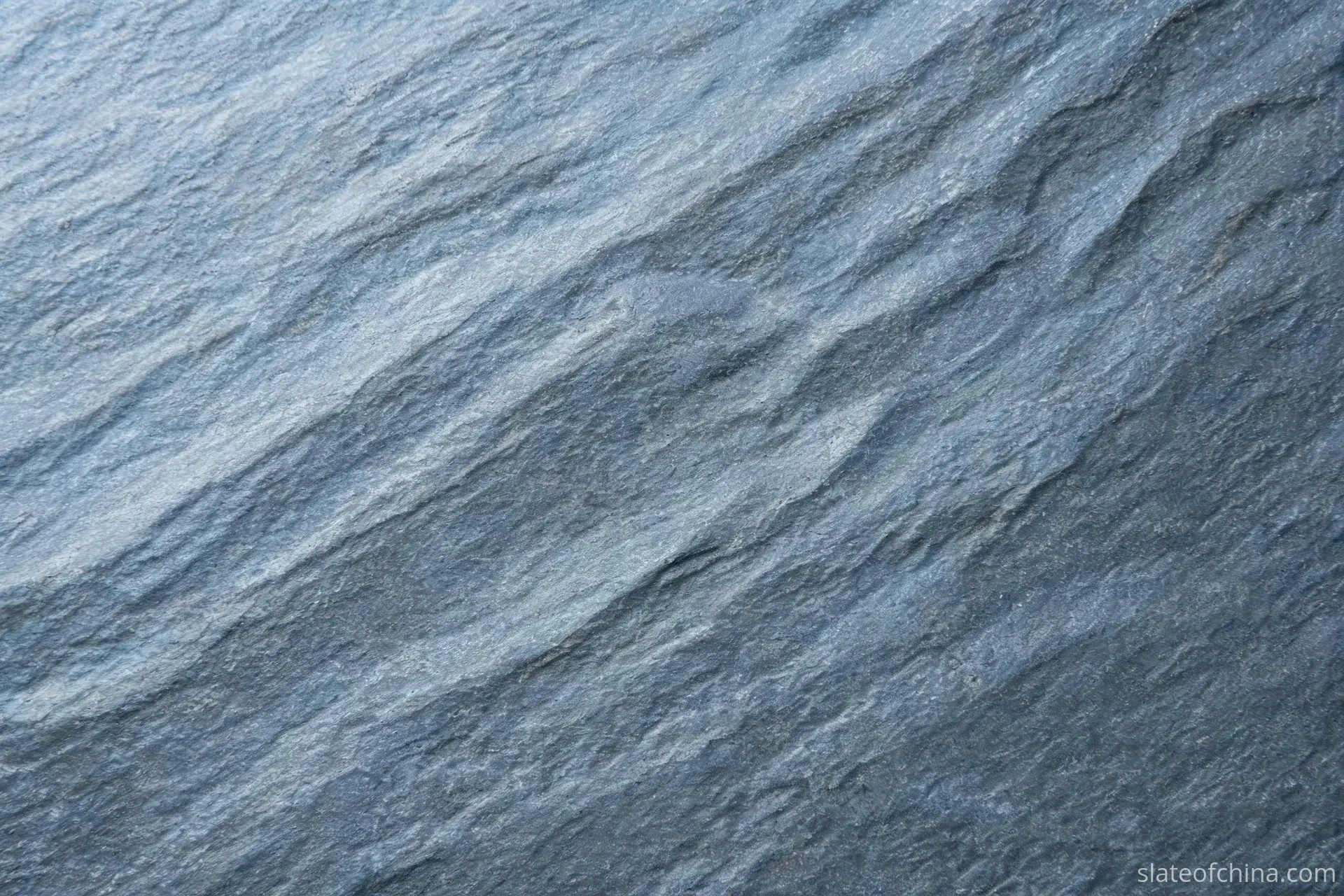
The brushed face is the newest arrival on the strip and the most conditional one: brushing works where the stone's mineralogy suits it, and where it works, it produces something the other three cannot — the cleft face's texture with its sharpest taken off. On the brushing deck, rotating brushes run over the stone and eat the soft edges of the surface relief faster than the hard ones, taking the bite out of the ridge tops while leaving the landscape beneath. The result underfoot is texture with the aggression removed: brushed slate still reads as stone to the sole, but it no longer catches a bare heel or fights a dust mop.
Read against the strip, brushing fills the gap that cleft and honed leave between them. Grip behaviour lands between the two — typically more underfoot character than a sawn face, less topography than cleft — and, as everywhere on this page, the wet number that decides it is a tested one, asked for on the batch and read in the project's own test method. Cleaning lands between them too: the softened relief releases grit that cleft would harbour, while giving the eye more to see than honed would offer. It is the finish for the client who wants a floor that feels like stone without a floor that behaves like weather — transitional spaces, steps, covered outdoor rooms, and interiors that want texture on better-mannered terms.
Two practical notes belong in the same paragraph as the praise. First, brushing is a real process with real limits: how much relief survives is a function of the mineral mix in the specific bed, so sample approval matters more here than on any other face — what the brush leaves is what ships, and the sample is the preview. Second, because the process starts from a textured or shot-worked surface, brushed orders need that base surface agreed along with the brushing itself; a brushed order is a two-line specification, base face and brush pass, not one word. Projects that plan to mix brushed with honed or cleft in one palette gain the usual cross-face benefit — one stone, several readings — and pay the usual cross-face price: tone matched at sampling, product by product, against the production batches.
On the order: brushed face over the agreed base surface; slip and cleaning expectations set against an approved sample from the production lot; tone band matched across any companion faces in the same project.
Can Slate Be Flamed Like Granite?
Some readers arrive here having seen — or been quoted — a fifth finish: flamed. The question deserves a straight answer, with the honest hedge built in. Flame finishing is widely associated with granite — and the association is mineralogical, not accidental.
Flaming works on granite because granite is built from coarse interlocking crystals. A burner passes over the surface, the topmost quartz and feldspar grains expand and pop, and the face spalls into a rough, uniform, grippy texture — a texture fire coaxes out of the grain's own refusal to expand evenly. It is a good process on the right stone: flamed granite is a legitimate, widely used answer for exterior pavement, pool surrounds and heavy wet duty, and nothing on this page takes that answer away from it. Slate, though, is not built that way. It is a fine-grained, layered rock, and direct flame treatment is more complicated on it: heat works on the layering rather than the grain, and depending on the material it can lift, scale or spall thin layers along the very bedding planes the stone is prized for. Whether any particular slate tolerates a thermal pass is a question of that stone's mineralogy — settled by samples and test results, not by articles or assurances. It is not a finish found in the standard slate catalogue.
So when a project asks for "flamed slate", the enquiry usually means one of two things underneath the words. Most often it means grip — a wet-duty surface that cannot be marched across carelessly — and the slate route to that is not fire but faces: natural cleft for maximum relief, brushed for relief with manners, sawn for its fine tooth, each one carrying a tested wet figure for the lot rather than a promise. Occasionally the enquiry means the flamed look — a hot, uniform, roughened grey — and that look, honestly achieved, is granite's to deliver: for that project, flamed granite is the established specification, not slate under a borrowed word. When this site's natural-stone range widens past slate, the flamed question will have its proper granite page.
The practical residue is one sentence: on slate, roughness is chosen from the four faces above and verified by wet test. The comparison between slate and its rival stones, granite included, on flatness, grip and maintenance, is drawn honestly on the flooring comparison page, where flamed granite appears as exactly what it is: granite's answer doing granite's work.
The Grip-and-Cleaning Ledger
Four faces, then, and one continuous trade running through them: grip against cleaning, with weathering reading differently indoors and out. The ledger puts the four architectural slate finishes side by side in the vocabulary a specification actually uses.
| Finish | How it is made | Underfoot | Weathering and cleaning | Where it belongs | Sample approval |
|---|---|---|---|---|---|
| Natural cleft | Split along the bedding plane; face untouched, edges and thickness worked | Strongest relief of the four; structural grip — wet figure still confirmed by test per lot | Weathers in as character outdoors; the most cleaning of the four, valleys included | Paths, patios, courtyards, steppers; textured cladding; character interiors that accept the care | Essential — relief and tone are bed-specific |
| Sawn | Gang-sawn or circular-sawn; flat with a fine regular blade texture | Flat but toothed; middle of the strip — wet value asked for like every face | Sheds most of what cleft traps; grooves hold a little more than honed | Modular paving, sawn cladding panels, drawing-driven layouts on ground and wall | Recommended — confirms blade texture and tone |
| Honed | Sawn face ground to an even matt; smoothing, not polishing | Smoothest of the four; wet duty carries a tested value, never an assumption | Easiest of the four to clean; indoor weathering ≈ the cleaning regime | Halls, kitchens, bathrooms, lobbies and retail interiors; the classic indoor face | Essential — flatness and tone against the reference |
| Brushed | Brushed over an agreed textured base; soft edges removed, relief kept — where mineralogy suits | Texture with manners; typically between sawn and cleft — lot figure settles it | Releases grit cleft would harbour; more character than honed ever offers | Transitional spaces, covered outdoor rooms, interiors wanting texture on better terms | Essential — the brush leaves what the bed allows |
Two things the ledger cannot say. The order of the dots is stable across the catalogue, but the numbers behind them are not — every row should carry its own tested wet value per production batch, in the project's test method, and the specification that proceeds without one is the specification that guesses. Weathering itself is read against exposure, drainage and climate — the same face performs differently on an open northern terrace and under a covered loggia, which is why the ledger speaks in duties rather than guarantees. And the four faces are not rivals but stations on one line; projects that need several of them at once — cleft at the gate, honed in the hall — buy them as one palette exercise, tone-matched at sampling across the families. How the whole-of-site palette and zoning story runs is mapped on Where Slate Is Used in and around Buildings.
Writing the Finish onto the Order
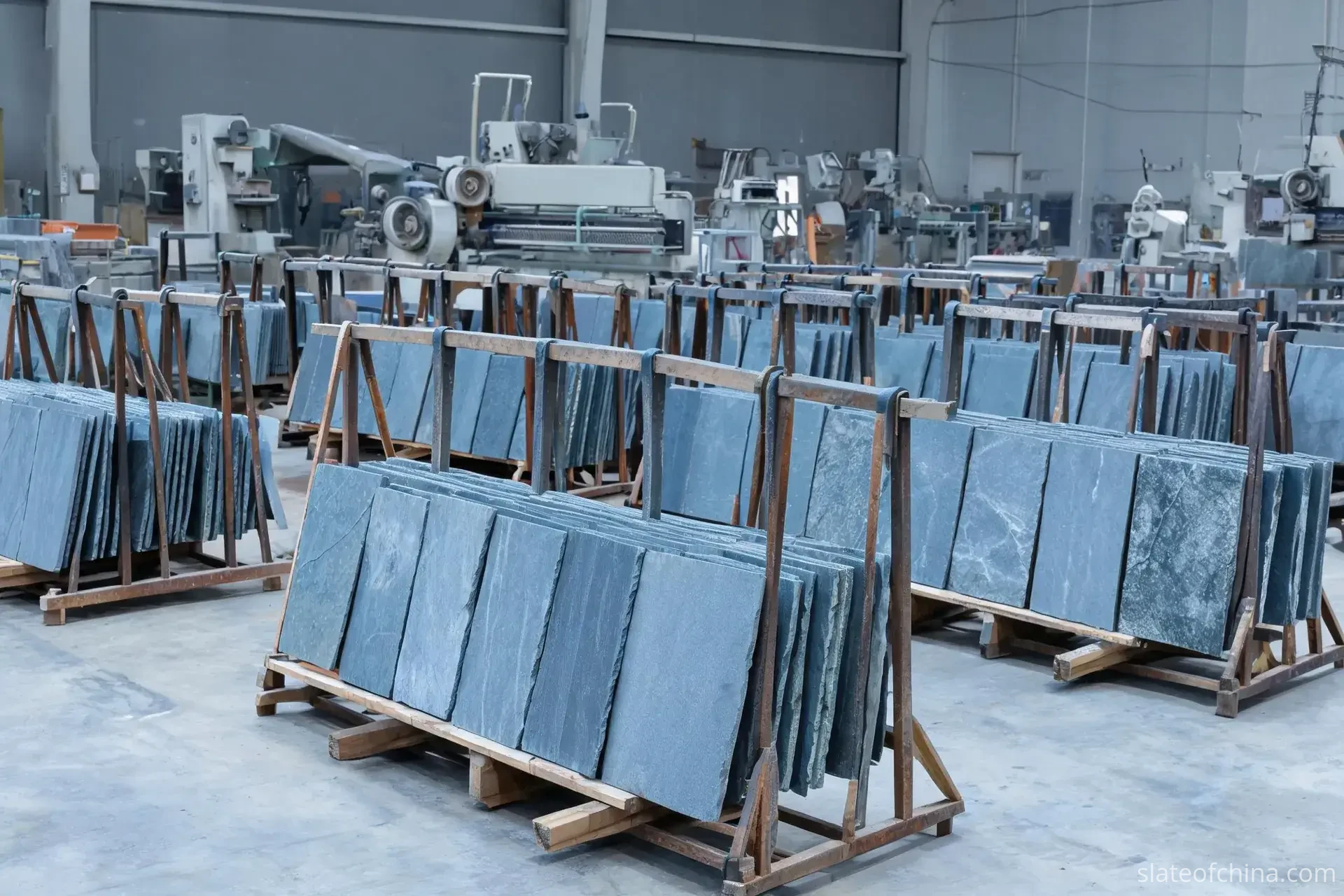
A finish that stays in the conversation is an opinion; a finish that reaches the container is a written line. The purchase order should carry the finish as a noun of its own — natural cleft, sawn, honed, brushed — never as an adjective implied by the product's name or by the photograph the enquiry began with. The invoice that says slate paving and nothing else has left the surface of fifty years to the workshop's default.
Four lines of paperwork make the choice real. The sample set: one reference piece per finish under decision, from the production lot or a batch the supplier commits to match — sealed, numbered and kept, and read for batch tone and texture consistency across the whole order. The base-face line for brushed orders, and the calibration expectation for honed floors, so the two-sided work underneath the visible face is agreed too. The wet-test request: the tested slip value for the batch, in the test method the project recognises — pendulum figures read as pendulum, ramp figures as ramp — asked for at ordering stage, when answering it is still cheap. And the cleaning regime: a short written schedule for the finish as installed, agreed with whoever will operate it, so the mop never meets the valleys for the first time unchaperoned. Sample handling and inspection timing in general belong to the buying sequence, walked step by step in the Architectural Slate Buying Guide; this page only insists that the finish itself rides in writing, on every one of the four lines.
One last habit separates the buyers who get the face they drew from the buyers who discover otherwise. At inspection, finish is checked as its own line — face against the sealed sample, batch against the tone band, and a wet-test figure on file — not absorbed into the general glance at dimensions and packing. The stone that arrives with the wrong face was usually ordered with the wrong line; the ten seconds it takes to write honed, not sawn are the cheapest ten seconds in the whole supply chain. The right finish is, in the end, the one the project can live with on a wet Tuesday — and that is decided here, at the point of ordering, not on the morning after the first rain.
Frequently Asked Questions
The questions below are the ones the four faces raise most often — choice, wet behaviour, words and paperwork. Each answer gives the working rule first; the faces above carry the fuller treatments.
Which slate finish should I choose for outdoors?
Natural cleft is the default outdoors, on structural grip and weathered-in character; sawn serves contemporary paving layouts that want geometry with a fine tooth; brushed suits covered outdoor rooms where texture should mind its manners. Whatever the face, wet behaviour is confirmed by a tested value for the production batch — the finish narrows the odds, the test settles them. Paving-specific routing has its own page later in this guide.
Is honed slate slippery when wet?
Not a question any honest page answers from memory. The honed face is the smoothest of the four, so in wet-duty locations — bathrooms, entrances, lobbies — the specification asks the supplier for the tested wet slip value on the batch, reads it in the project's own test method, and seals or plans around it accordingly. Tested honed floors serve interiors across every climate; the untested smooth floor is simply a guess with a nice colour.
What is riven slate — is it different from cleft?
Same face, different word. Riven, cleft and split face all describe the surface the stone opened by itself along the bedding plane — the splitter's chisel deciding where the parting runs, the face itself untouched. A drawing may use any of the three; a specification should pick one and name it.
What is the difference between sawn and honed slate?
Process and residue. The sawn face is cut flat and keeps a fine, regular blade texture; the honed face is that sawn surface ground further until the texture is gone and an even matt remains. Sawn reads as honest machining with a whisper of tooth; honed reads as one quiet plane. The sawn vs honed slate choice on the order line names which one ships, and honed costs the extra grinding pass that made the difference.
Can slate be flamed like granite?
Not in standard practice. Flaming is a granite process — fire pops the coarse quartz and feldspar crystals into an even rough face — and it belongs to the stone whose mineralogy it suits. Slate is fine-grained and layered, and direct flame treatment is more complicated: heat may lift, scale or spall the layers, and how a specific slate behaves is a question of samples and tests on that material. For flamed-type grip on slate, the route is natural cleft or brushed with tested wet values; for the flamed look, flamed granite is the established answer.
Can a finish be changed after the tiles arrive?
Sometimes, and almost never cheaply. Taking sawn to honed is a grinding pass machines are built for — but only off-site, with the floor lifted and re-shipped. Changing a laid floor's face, or re-working a textured face in place, is specialist work and rarely economical for paving. This is the quiet argument for deciding the finish at specification stage: the cheapest moment to change it is before the stone is cut.
Can one project order several finishes together?
Routinely — the cleft vs honed slate pairing at a threshold, textured outside and smooth inside, is the classic example, and mixed-face orders ship as one palette exercise. The discipline is sampling: each face approved against the production lot, and the tone band matched across products, so the several readings still read as one stone. The zone-by-zone picture of such a project is on the site map page in this guide.
How do slate finishes affect maintenance?
Directly — slate maintenance follows the face, because texture is where dirt lives. Cleft traps most and honed least, with sawn and brushed holding their respective middle positions. Rather than a rule of thumb, a project gives its cleaning regime one written paragraph — methods, frequency, and any sealer — chosen for the finished face and tested on spare pieces before the installation begins.
Is brushed slate suitable for outdoor steps?
Often, yes — steps are one of brushed slate's natural homes: texture with manners underfoot, softened relief that still reads as stone, and edges that take a nosing without drama. The discipline is the same as everywhere on this page: the wet value for the batch is confirmed by test, the nosing and edge details are specified together with the treads, and sample approval settles how much relief the specific bed keeps after brushing. For heavy public stair duty, the tested figures decide — not the finish name.
Related Reading
Choosing a face for a project? The fastest route to a quotation that names the right surface is a sample board and four written lines:
- The zones and areas — which surfaces the project covers, indoors and out, and roughly how many square metres of each
- The face under decision — cleft, sawn, honed or brushed, per zone, or a sample set to compare against
- The wet-duty locations — entrances, bathrooms, pool surrounds — so tested wet values come back with the quotation
- The cleaning expectation — who maintains the surface and how, so the finish is chosen with the mop in the room
Not every enquiry arrives decided — two zones and a rough quantity are a workable start, and sample tiles of all four faces ship on request.