
Paving Slate Sizes & Thicknesses
A paving enquiry usually arrives on this desk as one line — "600 × 600 grey slate, about 400 m², price?" — and it gets measured three times before a number goes back. Once with the designer's ruler, which read the layout drawing and produced the format. Once with the factory's ruler, on the saw line, where "600" means the size the blade was set to, within whatever tolerance the order did or did not specify. And once with a third instrument that is not a ruler at all: the container's scale, which reads no millimetres, only tonnes.
Most of the paving problems we get asked to untangle are stone problems only at the very end. They begin as number problems. A module chosen on a drawing meets a slab cut to nominal dimensions meets a freight quotation that gets compared per square metre but is actually earned per kilogram. When one of the three readings quietly takes precedence over the others, the mismatch surfaces on site — at the joint, at the pallet, or at the wrong moment entirely.
This guide takes the three measurements in order: format as length and width, thickness as the answer to traffic load and the support beneath it, and then the weight-and-container arithmetic that carries a finished drawing across the sea. In between sit the two things that decide whether the stone that arrives still resembles the stone that was drawn — dimensional tolerances and edge finishes. By the last section there is one complete enquiry worked through, and the eleven-line reply that goes back to it. You are welcome to copy that reply. It was built to be copied.
Quick reading — three rulers, four numbers
| The reading | What it decides on site | Where the honest number comes from |
|---|---|---|
| Format — length × width | layout rhythm, joint pattern, cutting waste | the laying plan, not the quarry's stock list |
| Thickness | the traffic the surface can face; handling weight | the load and the bed beneath, not the catalogue |
| Weight per m² | container fill, freight per square metre, size of the crew | density: roughly 2.7–2.8 kg per millimetre of thickness, indicative |
| Edge finish | dimensional regularity, joint widths, the character of the course | the specification — the stone has no preference |
Leave one of the readings unspecified and the decision still gets made — by someone on site, usually with a saw.
The First Ruler: Length and Width — the Formats Buyers Actually Order
There is no master standard for slate paving sizes, and any list that calls itself one is a catalogue, not a constitution. The formats that dominate the trade exist because they are practical at every stage of the chain: they cut cleanly from the block, they pack into pallets and containers without waste, one or two people can carry them, and they set out into tidy courses on site. What follows is a snapshot of that practicality — the slate paving slab sizes most often specified in enquiries, with the inch equivalents North American buyers think in and the modular logic landscape designers lay out by.
| Nominal size (mm) | Approx. (inches) | Where it usually ends up | Module logic |
|---|---|---|---|
| 300 × 300 | 12 × 12 | narrow garden paths, border and corner detailing | a quarter of the 600 module |
| 400 × 400 | 16 × 16 | courtyards, smaller residential terraces | its own 400 grid |
| 400 × 600 | 16 × 24 | patios and walkways — among the most specified paving slate dimensions anywhere | straddles the 400 and 600 grids |
| 500 × 500 | 20 × 20 | squares and formal courtyards | its own 500 grid |
| 600 × 300 | 24 × 12 | linear courses, borders, edging bands, paths | half of the 600 module |
| 600 × 400 | 24 × 16 | mixed-format residential landscapes | 600 grid with an eased width |
| 600 × 600 | 24 × 24 | a common large-patio format in many European projects | the 600 module itself |
| 800 × 400 | 32 × 16 | terraces that want fewer joints | a doubled 400 module |
| 900 × 600 | 36 × 24 | architectural paving, plazas, designed beds | the 600 module stretched |
The module-logic column earns its place. Sizes inside one family — 300, 600, 900 along the same axis — cut from one another: a 600 × 300 border is a 600 × 600 halved; a 300 × 300 corner is the same slab quartered. A layout that stays within a single module family buys most of its cutting allowance back, because offcuts re-enter the design as the next course. Drop a 500 grid into a 600 grid and the arithmetic turns: every interface becomes a cut, and the order may need several percent more stone — sometimes more again — to feed the saw.
Formats longer than these — panel sizes beyond a metre — do exist in the trade for specific projects, but they leave this guide's territory on purpose. Above that line the conversation stops being a paving enquiry and becomes a handling, crating and sub-base engineering conversation. The formats in the table are common precisely because they stay on the right side of it. And as with everything on this page, availability is confirmed per quarry and per order: no belt produces every size in every thickness for every grade, and a format list is the opening of an enquiry, not a promise.
Single Sizes, Modular Sets and Mixed Lots
Once the format family is chosen, the order takes one of three shapes — and each shape asks something different of the paperwork.
Single size. Every slab one nominal format: the most predictable to lay and to quote, with setting-out done by arithmetic rather than negotiation. What this shape demands from the order: the tolerance around the nominal. When a thousand slabs all aim at the same number, even small spread becomes visible in the joints, because there is nothing to hide it behind.
Modular sets. Several coordinated formats — 600 × 600 mains with 600 × 300 and 300 × 300 infills, say — delivered in proportion to a planned pattern. What this shape demands: the piece count per format. "600 × 600 and some smaller pieces" is an invitation for the smaller pieces to arrive in the wrong ratio; a modular pattern only works if the counts match the drawing, and the counts only exist if somebody wrote them down.
Mixed or random lots. Deliberately irregular, usual in cottage and traditional designs. What this shape demands: everything, in numbers. Random is a mood, not a size. If the design needs slabs between 400 and 700 mm long and 20 to 40 mm thick, those ranges belong on the order sheet — otherwise "random" gets filled with whatever the yard has that week, and the laying crew ends up making the design decisions you were supposed to make. In all three shapes the discipline is identical: the order is a list of written numbers, or it is a wish list that someone else will interpret for you.
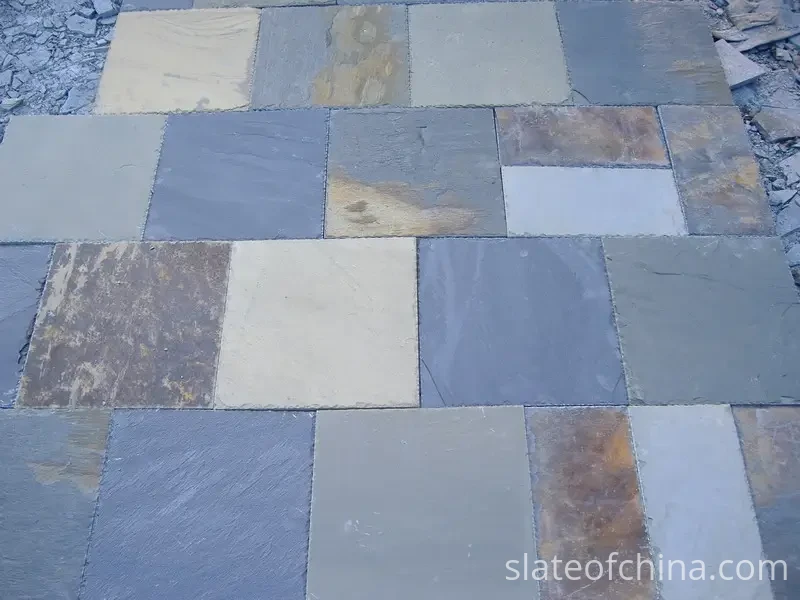
For patios, one honest generalisation is worth writing down: slate paving slabs for patios most often land in the 20–30 mm thickness band, with 600 × 600 or 400 × 600 formats, sawn edge and natural cleft face — not because any regulation decrees it, but because the combination has a long working record across real projects and climates. Custom sizes are a normal part of a paving factory's week; a bespoke border width or an odd square is simply a different sawn programme. What custom work changes is the texture of the order: more format changeovers per batch, and a price that notices them.
The Second Ruler: Slab Thickness by Traffic Load
If format is what the eye checks, thickness is what the ground checks. The honest way to approach natural slate paving thickness is to stop treating it as a number you pick and treat it as the answer to three questions: what will cross this surface, on what bed, and in what format?
Traffic load sets the floor. The table below is where most specification conversations start — the left column is the project, the right column is the actual reason:
| Application | Indicative thickness | What is actually loading the stone |
|---|---|---|
| Footpaths and garden runs | 20–30 mm | people, wheelbarrows, the occasional wheelie bin |
| Patios and residential terraces | 20–30 mm | people, furniture, planters, a grill, visiting children |
| General landscaping, light trade use | 25–35 mm | steady foot traffic, bikes, hand trolleys, yard deliveries |
| Public walks, plazas, commercial entrances | 30–40 mm | constant footfall, cleaning machines, dollies, market stalls |
| Occasional maintenance vehicles | project-specific | a loaded van, a few times a year, over a designed base |
| Any regular vehicle area | engineered specification | cars and vans as rolling point loads, with braking and turning forces attached |
Starting ranges for specification review, not structural limits — the governing figures come from the stone's tested properties and the pavement structure underneath, never from a table on a supplier's website. This one included.
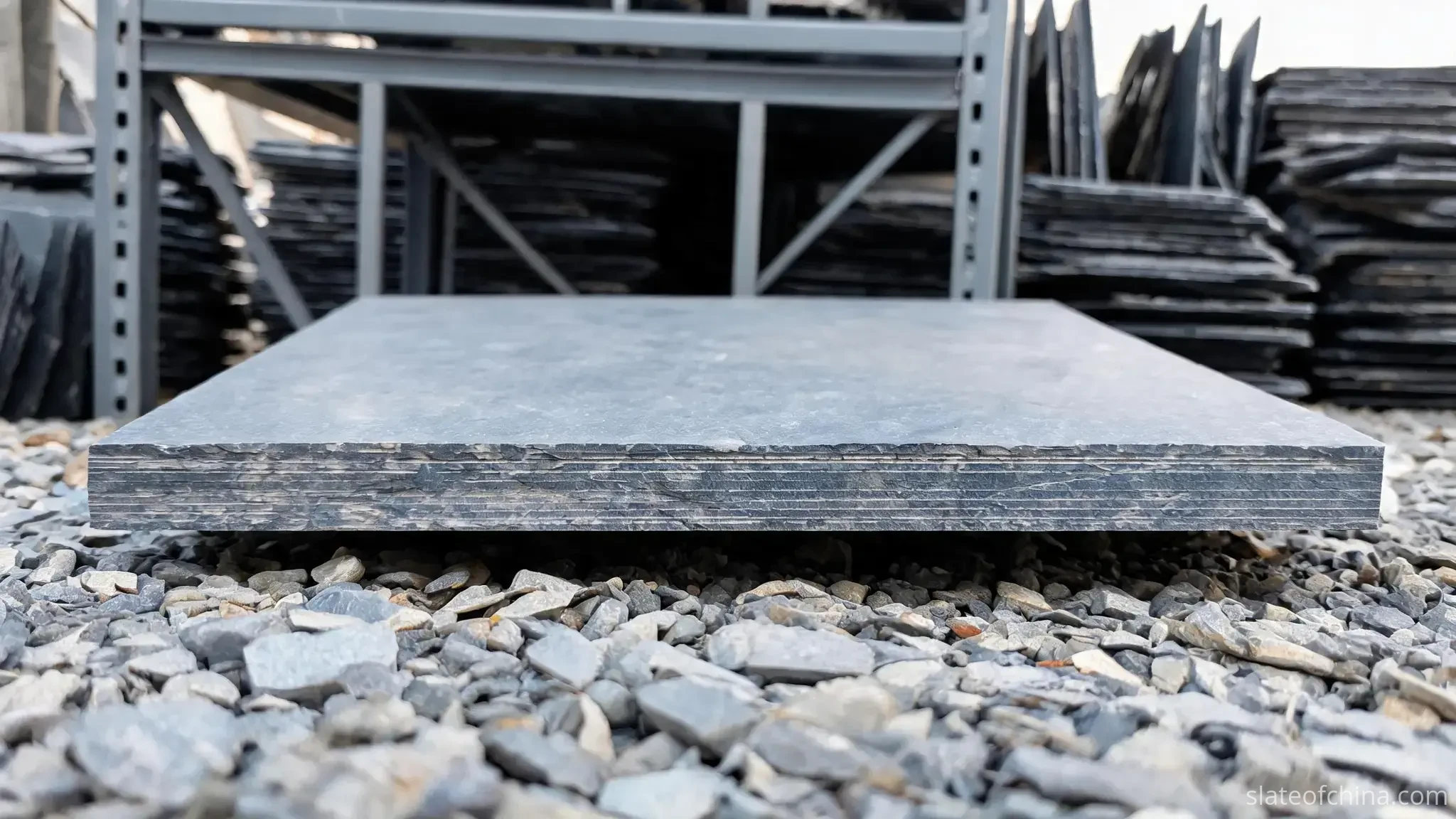
The 20–25 mm end of the band is where cost, weight and handling are kindest, and it performs well on fully supporting beds under honest pedestrian loads. It is also the end where shortfalls show up first: a soft spot under the bed, a pointed load from a planter's foot, a large format asked to bridge more than it should. For many residential enquiries, 25–30 mm is the useful starting range for specification review, for exactly that reason — compared with a 20 mm slab of the same 600 × 600 format, a 25 mm board adds roughly five kilograms per piece at the illustrative density, and that modest premium buys a meaningful amount of extra site reality. The final choice still rests on the stone's verified properties, the format, the support conditions and the intended use. From 30 to 40 mm you are buying resistance: to handling damage before installation, to point abuse afterwards, and to the wear that public landscapes deliver on schedule.
And then the first ruler walks back into the conversation. A 900 × 600 slab at 30 mm and a 600 × 600 at 30 mm are the same gauge of the same stone, but they are not the same product — the large slab bridges more distance between the high spots of the bed, and the same wheelbarrow load asks more bending of it. The rule the trade works by is short enough to carry in one pocket: load sets the floor of your thickness; format can raise it. A big thin slab and a small over-thick one are the two classic ways a paving specification ages badly — one cracks, the other ships air and bills you for it.
Loads, Beds and the Support Beneath the Slab
Load gives thickness a floor; the support system decides how much of that floor you actually need. The same 25 mm slab leads three entirely different lives depending on what lies under it, and a specification that ignores the bed is only half written.
On a full mortar bed over a properly prepared sub-base, the stone works mostly in compression — the job stone is best at — and thickness beyond the load's minimum buys durability and handling margin rather than structural relief. The bed takes the levelling duties, the finished surface runs true from a datum, and each slab is bedded rather than negotiated into position.
On unbound bedding — sharp sand or grit over a compacted sub-base, common in gardens and landscapes — the slab, the bed, the sub-base and the soil all act as one structure, and the weakest layer leads. Thickness is still a player in that system, but it cannot bail out a soft sub-grade. Two weeks after laying, a garden path reports the truth: the finished pavement reflects the weakest layer, not the thickest slab. When a path fails, more often than not the stone was the cheapest component of the failure.
On pedestals — the adjustable raised systems used on roof terraces and balconies — the physics changes sides. Supports arrive as points, the slab spans between them, and bending takes charge of the analysis. Paving slate specified for continuous support should never be quietly re-assigned to pedestal work: the specific format's strength has to be verified for those spans. Pedestal suppliers publish span tables for their hardware; the stone side of that conversation is a test certificate, not a colour swatch.
Driveways get their own paragraph in every serious paving guide, all for the same reason: a car is not a heavy pedestrian. It is a rolling pair of point loads with braking forces and turning scrub attached, riding on a pavement structure that does most of the structural work. Slate can live in that world — with sufficient thickness, verified flexural capacity, and an engineered base — but it lives there by evidence, not by optimism, and "30 mm should be fine" is not a sentence any engineer has ever signed. Where vehicle access is only occasional — a maintenance van, a skip lorry once a year — the honest requirement is a project-specific review of the whole build-up, not a pedestrian specification stretched a few millimetres thicker. That review starts on the evidence side: the test results for the actual grade — flexural strength and water absorption first among them — which a serious supplier can already put on the table.
Outdoor paving floors around pools add wet-barefoot slip resistance to the brief and bring their own test questions; that part of the specification belongs to the surface and the drainage fall, not to the dimensions, and it is treated separately in this guide's paving pages. The border between "dimension" and "performance" is worth keeping visible — dimensions decide what arrives, performance decides what it does.
Between the Readings: Tolerances — Nominal Size and the Actual Stone
Every number in this article so far has been nominal — the figure the saw was set to. The stone that arrives is every piece within an agreed distance of those numbers, and it is that distance, not the nominal, that your laying crew actually works with. A 600 × 400 × 25 mm quotation is an intent; the tolerances around it are the contract.
At least five distances matter in paving — more than in roofing, where the lap quietly absorbs some of the error. None of the numbers belongs in an article; all of them belong on your order. What the article can do is name them, so that the next quotation has nowhere to hide:
- Length and width — decide whether courses close cleanly or the joint widths wander. The figure to ask for is the permitted deviation from nominal, in writing, on the order.
- Thickness — decides bedding depth and the levelling each slab needs. Ask how it distributes across a crate, not just what it averages: a batch averaging exactly 30 mm can still contain a 26 and a 34, and those two slabs ruin the same afternoon for whoever lays them.
- Flatness and squareness — decide whether four slabs meet at one corner or three of them meet and the fourth stands proud. On large formats these two figures work harder than thickness does.
- Edge and corner condition — how much shipping kiss is acceptable before a slab becomes a reject. Clause and claim measure each other: this is the paragraph a breakage dispute will be read against at the dock.
- Colour and texture variation — technically not a tolerance, but it belongs on the same page of the order, because it is the one distance the eye measures unaided.
What protects you is not knowing some "correct" tolerance figure — the right number depends on the grade, the format, the finish and the project, and no honest writer can hand it to you blind. The move that matters is procedural: declining to proceed when the order sheet has a blank where the tolerance should be. A paving quotation without tolerance language is a quotation with a free option on somebody's mistakes, and the somebody is never the supplier.
One habit makes every distance on that list easier to enforce: reference samples with numbers attached. Not a loose tile for colour feel, but a piece — or a set — whose dimensions are marked on it, initialled by both sides, and quoted in the order as what production is checked against. The sample approval routine in this guide walks through that process from the request to the sealed reference; on paving orders it is not a courtesy, it is the cheapest insurance in the transaction.
Edge Finishes: Sawn, Split, Tumbled and Chamfered
Two slabs identical in length, width and thickness can still arrive as different products, because the edge is where the specification becomes visible to everyone who walks past it. Paving slate is offered with four standard edge treatments, and they change more than the silhouette.
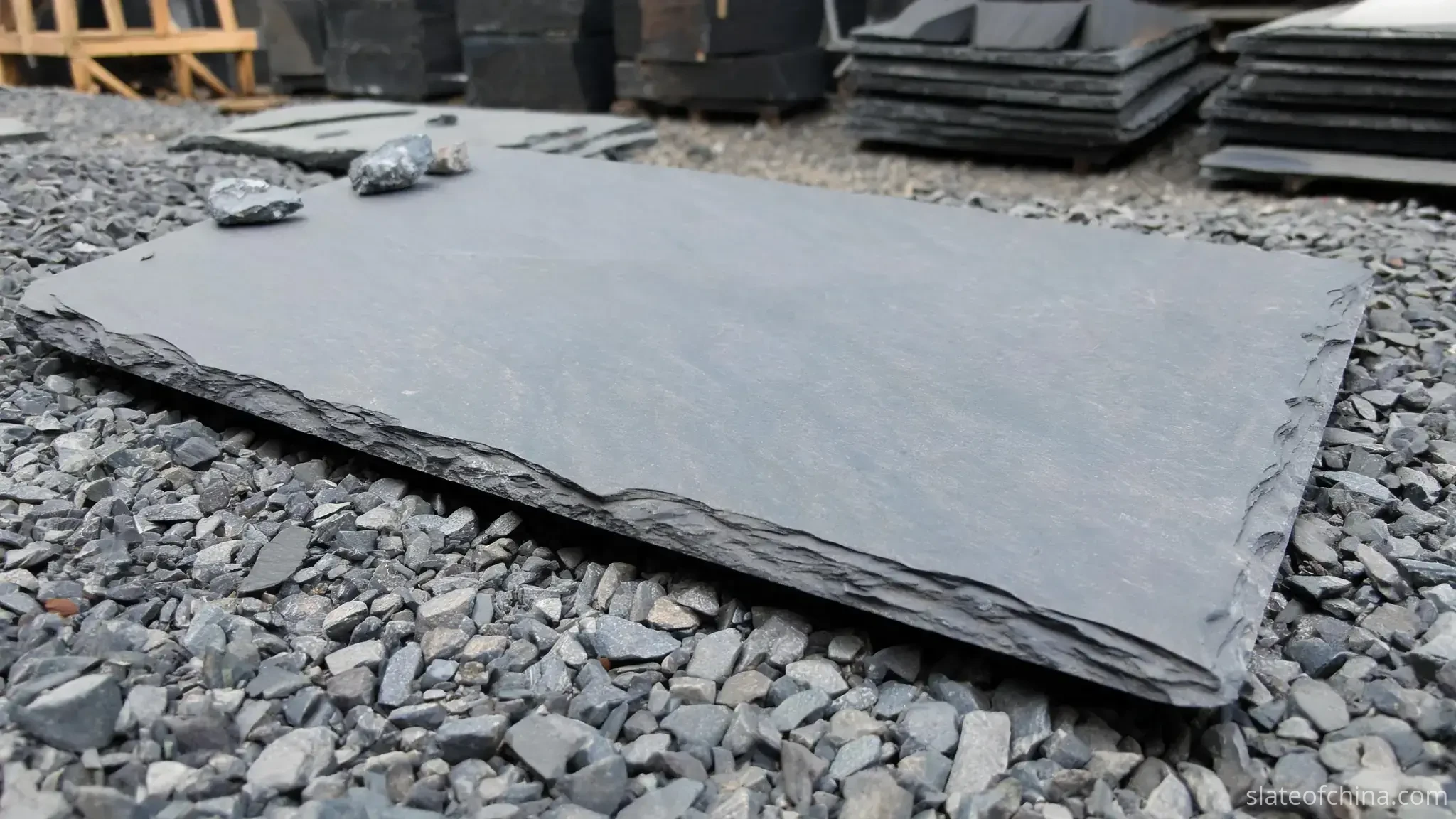
Sawn edges are machine-cut: flat, straight, lightly marked by the blade's path. Four sawn-edge slabs meet at consistent joint widths, and the eye can run a course in a straight line — which is why, for modular and contemporary layouts, sawn edges are less an aesthetic preference than the format's operating requirement.
Split or riven edges are parted along the stone's natural cleavage, so the edge carries the mineral's own texture: a shade irregular, always individual. Joints breathe a few millimetres and get adjusted during laying. In cottage gardens and traditional schemes that irregularity is the entire point; in a geometric terrace it reads as a defect. Same stone, different contract.
Tumbled edges are aged mechanically — slabs run with abrasive until the sharp arrises soften — and the result says "always been here" before anything else on the site does. One caution travels with the word: tumbled is a degree, not a switch. Different machine times give different stones, so the order names the look — lightly softened, heavily aged — or carries a reference photo, or it lets one supplier's "tumbled" stand next to another's with no shared meaning.
Chamfered edges are sawn edges with a small machined bevel — usually a few millimetres — softening the joint line and adding a shadow detail that formal and architectural work draws on deliberately. Of the four, chamfered is the most specification-hungry: the bevel width (and whether the arris stays crisp) belongs on the order, because "chamfered" by itself covers a generous range of outcomes.
| Edge finish | How it reads | Joint behaviour | Natural home |
|---|---|---|---|
| Sawn | clean, straight, faintly blade-marked | even, set by spacer | modular, contemporary, geometric work |
| Split / riven | mineral-textured, individual | breathes a few mm, adjusted in laying | cottage, rustic, traditional settings |
| Tumbled | softened, aged, forgiving | relaxed, slightly irregular by design | heritage and informal gardens |
| Chamfered | sawn, plus a shadow-line bevel | even, with a deliberate detail line | formal and architectural work |
One boundary holds through all four: an edge finish is a dimensional and aesthetic decision, not a safety feature. A rougher edge does nothing for grip under a wet foot — that belongs to the surface finish and the drainage fall. The edge decides what the finished course looks like and how willingly the joints cooperate; it never decides how the surface behaves in the rain.
The Third Ruler Is a Scale: Weight, Handling and the Container
The first two rulers measure the stone; the third one weighs it. Every dimension chosen above converts, through density, into kilograms — and the container reads nothing else. Slate runs at roughly 2,700–2,800 kg per cubic metre (indicative, batch-dependent, worth confirming against the actual grade), which turns into the planning figures an importer actually orders by:
| Thickness | Weight per m² (indicative) | A 600 × 600 slab weighs |
|---|---|---|
| 20 mm | 54–56 kg | 19.4–20.2 kg |
| 25 mm | 67.5–70 kg | 24.3–25.2 kg |
| 30 mm | 81–84 kg | 29.2–30.2 kg |
| 50 mm and up | 135–140 kg | 48.6–50.4 kg |
Theoretical figures at the illustrative density, excluding packaging — the shipping documents' packed weights govern in every real transaction.
Two consequences fall straight out of that table. The first is human: around 25 kg is where a slab remains a one-person lift. At 30 kg it becomes a two-person job, and a crew laying 600 × 600 × 30 all week knows it in their shoulders by Friday. Pallet placement near the laying area, a wheelbarrow route that does not cross the whole garden, and format decisions made with the installer's back in mind — these are planning items, not afterthoughts that only occur to people in photographs.
The second consequence is arithmetic, and it is the point where paving departs from every thin-stone product in the catalogue. A 20-foot container's useful payload sits roughly between 27 and 28 tonnes — a working 27 and a half with the packing inside. Divide that by the table above: a full container of 25 mm paving is on the order of 380–400 square metres of stone; at 30 mm, closer to 330; at 20 mm, a shade under 500. Roofing slate — six to nine millimetres of the same rock — famously packs well over a thousand. The per-square-metre arithmetic of thickness is not a freight detail; it is half of the landed-cost decision, and the same container maths is shown at thin-stone scale in the roofing guide.
And a boundary worth drawing in ink: those container figures are preliminary planning estimates — an illustrative density and a working payload assumption, nothing more. Actual shipment quantities are confirmed each order against the container's permitted payload and any route restrictions, the weight of pallets, crates and strapping, the loading plan, and the conditions at destination. The gross packed weight and final square-metre capacity of every real shipment are verified per order — not assumed from a table like this one.
Increasing thickness can improve resistance to bending and handling damage under suitable conditions — and it always increases freight cost per square metre. What it does not deliver by itself is freeze–thaw durability: that is assessed from test data for the actual stone, read together with the installation and the drainage conditions. Thickness is chosen to meet the project's verified requirements, not increased automatically — "Be safe, make it 40" is not a specification; it is a shipping bill with a clear conscience.
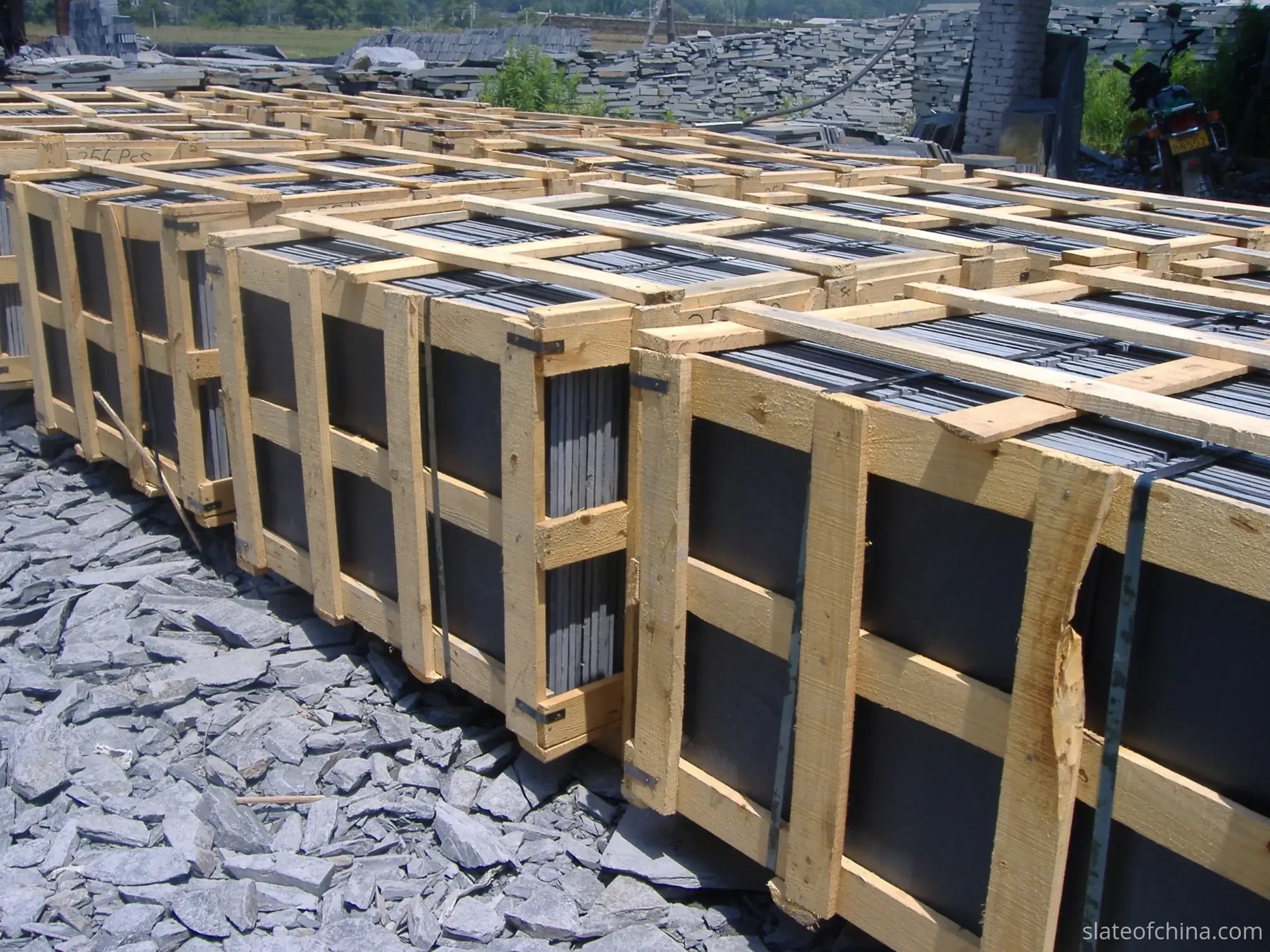
Smaller paving orders routinely share a container with other slate products rather than fill one alone — a 120 m² terrace, as the next section shows, is an awkward standalone container and a perfectly ordinary part-load. Whether a mixed slate load works is confirmed case by case: packing plan, weight distribution and crate counts are agreed per order, because a container's balance is engineered, not assumed. The packing and shipping walkthrough shows how those decisions are made on our side of the desk.
One Enquiry, Worked Through: A 120 m² Terrace
Here is the whole guide in a single email. A landscape designer writes: "Blue-grey slate paving for a private terrace, about 120 m², full mortar bed, domestic use, garden furniture and the occasional delivery trolley. Sawn edges, natural cleft face. What would you quote?" It is already a better enquiry than most — the application, the bed and the finish are all in it — and it still gets measured three times before an answer leaves the desk.
The first ruler settles the format. A 600 × 600 field with a 600 × 300 border band matches the designer's sketch, and both live inside the 600 module — offcuts from one feed the other, so the cutting allowance stays lean. The piece count comes from the approved laying plan, not from the total area: the actual border layout, the cuts, the reusable offcuts, and an agreed allowance for breakage and waste. For a 120 m² terrace, the quantities of 600 × 600 field slabs and 600 × 300 border pieces cannot be settled reliably from the area alone — the border alone can be laid several different ways, and each way moves the count. The count that ships is the count on the order, agreed line by line before production: "about 120 m²" is a conversation, not a packing list.
The second ruler reads the load. Domestic foot traffic, furniture, a delivery trolley, a full bed: the 20–30 mm band covers the brief with room to spare, and 25 mm is the sensible mark — each 600 × 600 slab lands near 25 kg, which the laying crew will quietly thank you for, and the full bed does the structural quiet work. Had the format been 900 × 600, this same paragraph would be pushing thickness upward; had vehicles been in the brief, the paragraph would be an engineering review instead of a millimetre conversation.
The third ruler weighs the answer. 120 m² at roughly 68–70 kg per square metre is about 8.3 tonnes of stone, plus crating, strapping and dunnage — comfortably inside a container's payload, nowhere near filling one. That single fact reshapes the commercial conversation: as a standalone container the order is inefficient; alongside a roofing consignment or another project's pallets, it is routine. Mixed loads are confirmed per order, weight and packing case by case — and for paving quantities of this size, sharing is the normal shape of an honest freight bill.
The reply that goes back is eleven lines long, and every line is one of the readings above:
— 600 × 600 × 25 mm, natural cleft face, calibrated back, sawn edge
— 300 no. field slabs + 58 no. 600 × 300 border slabs — piece counts per the approved laying plan, cuts and waste allowance included
— Weight: ~8.3 t stone basis; packed weights per pallet on the shipping documents
— Tolerances for length, width, thickness, flatness: figures to be stated in the proforma invoice
— Colour: mid blue-grey against approved reference sample, A/B band noted
— Packing: strapped export crates or pallets, piece counts and gross weights on the packing list
— Load: shares a container with another slate consignment, packing plan confirmed at booking
— Incoterm and port: as agreed (FOB to be confirmed)
— Documents: commercial invoice, packing list, batch-linked test data for the delivered stone
— Destination: as advised
— Questions back to you: base construction, preferred joint width, and when the site is ready to unload
Eleven lines is what "price per square metre" looks like after it has been measured three times. Copy the structure freely — the stone trade has answered in roughly this shape for generations, because it is the only version of the answer that survives contact with a container. And if you want to see the formats before composing your own eleven lines, the paving slate range is open on the product pages, formats-and-all.
Frequently Asked Questions
What is the standard size of a slate paving slab?
There is no single universal standard, and any list claiming to be one is a catalogue, not a norm. The formats that recur across suppliers belong to the 300–900 mm family set out in this guide, with 400 × 600 and 600 × 600 the most specified paving slate dimensions worldwide. Availability is always confirmed per quarry and per order — in practice, the "standard" is the size your drawing, your base and your container can all agree on.
Does a larger paving slab need to be thicker?
Often, yes — not because the stone changes, but because the distance between supporting high spots grows with the slab. A 900 × 600 at 30 mm bridges more than a 600 × 600 at the same gauge, so the same load asks more bending of the larger piece. Large formats in pedestrian work are specified either thicker, or with verified strength for the span, or with stricter full-bed requirements — often all three together. Load sets the floor of the thickness; format can raise it.
What is the difference between sawn and split edges on slate paving?
Sawn edges are machine-cut: straight, flat, faintly marked by the blade, and consistent enough for even spacer-set joints in modular layouts. Split or riven edges follow the stone's natural cleavage: irregular, textured, individual — the right choice for cottage and traditional work, where the irregularity is the design. Both edges can come from the same block; the edge is a specification choice, not a quality grade.
What does nominal size mean on a paving quotation?
It is the size production was set to, not a guarantee that every slab measures exactly 600 × 400 × 25 mm. What protects you is the tolerance — the permitted deviation from nominal — stated in writing on the order or proforma invoice. Nominal with agreed tolerances is normal and workable; nominal with silence around it is a risk the buyer is quietly carrying.
Can slate paving be used for a driveway?
Only as a verified engineering decision, never as a thickness guess. Vehicles bring point loads, braking and turning forces that pedestrian specifications do not cover, and the pavement structure beneath does most of the real work. Slate driveways do exist — built with adequate thickness, flexural test data for the actual grade, and a designed base. "Just make it 40 mm" is not that process; it is the sentence that replaces it when nobody has asked the questions.
How many square metres of paving slate fit in a 20-foot container?
For planning, count roughly 380–400 m² at 25 mm thickness, around 330 m² at 30 mm, and a shade under 500 m² at 20 mm — preliminary planning estimates, based on an illustrative density and a working payload of about 27.5 tonnes. Actual quantities are confirmed per order against the container's permitted payload, packaging weight and loading plan, and the shipping documents' packed weights govern. Roofing slate at six to nine millimetres packs well over 1,000 m² in the same box; the difference is thickness, and thickness is weight you pay freight for.
Related Reading
Send the three readings — get numbers back.
Every paving quotation that leaves this desk was measured three times first — yours will be no different. Bring what you already have: the formats under discussion, the traffic the surface will face, the bed it will sit on, the area, and the destination. The desk matches them against the grades the belt actually produces and answers in lines you can hold a sample against:
- Patios and terraces — format, thickness and edge settled against the laying plan and the crew that will lift it.
- Public and architectural paving — formats, tolerances and test evidence quoted to specifications, with export packing planned around the container, not the sketch.
Browse the paving slate range, or send the specification — measured once, twice, three times — straight to the desk. If a number in your enquiry cannot be honestly supplied, you will hear which one, and why, before the pallets are built.