
OEM Billiard Slate for Table Manufacturers
Imagine this: the first 50 sets are perfect. Every pocket cut matches the drawing, every bolt hole lines up, every joint closes without a gap. Then set 51 arrives at the table factory with a 3 mm shift in the pocket opening — small enough to miss in a quick visual check, large enough that the cushion nose would not seat flush against the slate.
That 3 mm is used here only as an illustration — the acceptable tolerance in a real project depends on the table design and the approved drawing. But the scenario shows the difference between buying slate and running an OEM slate program: a single custom set is a project, while reproducing that same set across 100, 500 or 1,000 production runs is a system. And the system is what this guide is about.
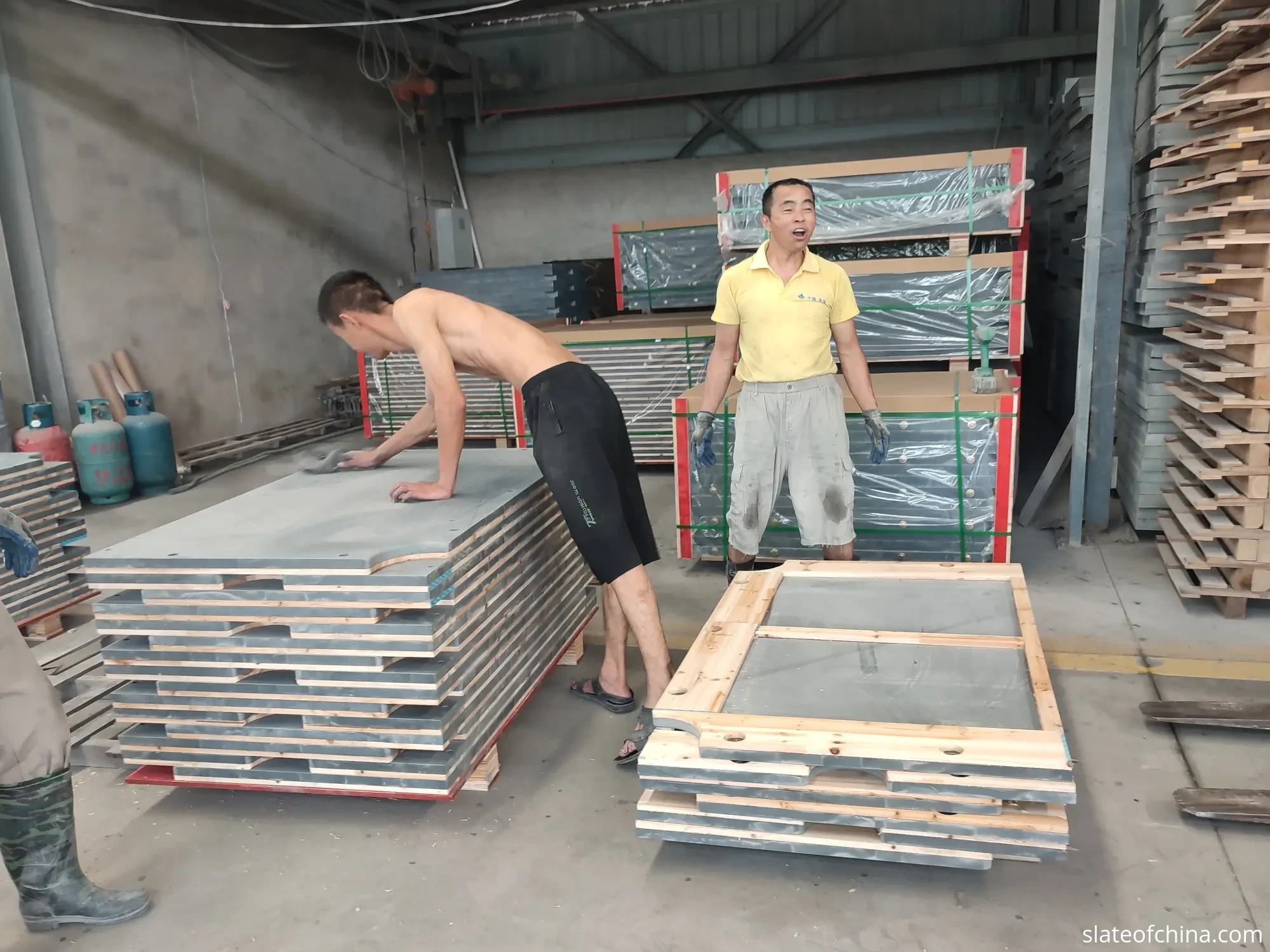
The OEM billiard slate supply chain, in seven milestones:
- Drawing — You provide the production drawing: slate dimensions, thickness, piece count, pocket geometry, hole positions, joint requirements and tolerances.
- Technical review — The slate supplier checks every dimension and machining requirement against what is practical to produce. Anything unclear is resolved before cutting begins.
- Sample — A prototype set is produced and shipped for trial assembly on your actual table frame.
- Approval — The approved sample and finalised drawing become the production reference — the "golden sample" that every future batch is measured against.
- Batch production — Production runs are manufactured to the approved specification, with pre-shipment inspection before packing.
- Export packaging — Wooden crates are built around the actual slate configuration, with brand labels and documentation if required.
- Repeat orders — Future batches reference the same approved drawing and sample, so the specification stays consistent as your production grows.
The purpose of OEM is not to make one custom slate. It is to make the next 100 sets the same way.
What OEM Actually Means in Billiard Slate
OEM billiard slate means the supplier manufactures the slate to the customer's technical specification — not to a standard catalogue size. The customer provides the dimensions, the machining details and the tolerances. The supplier produces the stone to match.
This is different from buying standard slate off the shelf, and it is also different from private-label supply. The distinction matters because the three terms are sometimes used interchangeably in the billiard industry, but they describe different requirements:
OEM billiard slate means the slate is manufactured to the customer's technical specification — the drawing defines the product.
Custom billiard slate is often used the same way, though it can also refer to a one-off non-standard order rather than an ongoing production specification.
Private-label billiard slate adds customer-specific packaging, labels, documentation or branding on top of an agreed specification. A buyer may require OEM, private label, or both.
In practice, most table manufacturers who need OEM slate are not asking for a single non-standard piece. They have a proprietary table design — a specific frame, a defined playing area, a particular rail system, a fixed bolt-hole pattern — and they need the slate produced to fit that design, repeatedly, across production batches.
For a deeper look at the material itself and why natural slate is the standard playing surface, see What Is Billiard Slate? To identify the different slate types at a glance, Types of Billiard Slate covers the differences.
The Specification That Makes OEM Work
An OEM order that goes wrong usually goes wrong at the specification stage, not the machining stage. The most common cause is not a machining error — it is a specification that was never fully defined.
A table name like "9 ft pool table slate" is not a specification. It is a product label. Two manufacturers can use different slate dimensions for the same nominal table size, and both would be correct for their own table design. For a full reference of standard sizes, thicknesses and weights across table types, see Billiard Slate Technical Specifications.
At minimum, an OEM specification should include:
| Specification Item | What to Define |
|---|---|
| Table type | Pool, snooker, Chinese 8-ball, carom, or other |
| Slate pieces | 1-piece, 3-piece, 5-piece or other configuration |
| Thickness | According to table design, not market default |
| Overall slate dimensions | Length and width from the drawing |
| Playing-area dimensions | As specified by the table manufacturer |
| Pocket openings | CNC machined where required — geometry from drawing |
| Bolt holes | Positions, diameter, countersink from drawing |
| Joint requirements | Joint location, edge preparation, matching method |
| Edge machining | Chamfer, square, or per drawing |
| Surface finish | Ground, calibrated, finished |
| Packaging | Export wooden crate, brand labels if required |
| Quantity | Sample, trial order or production batch |
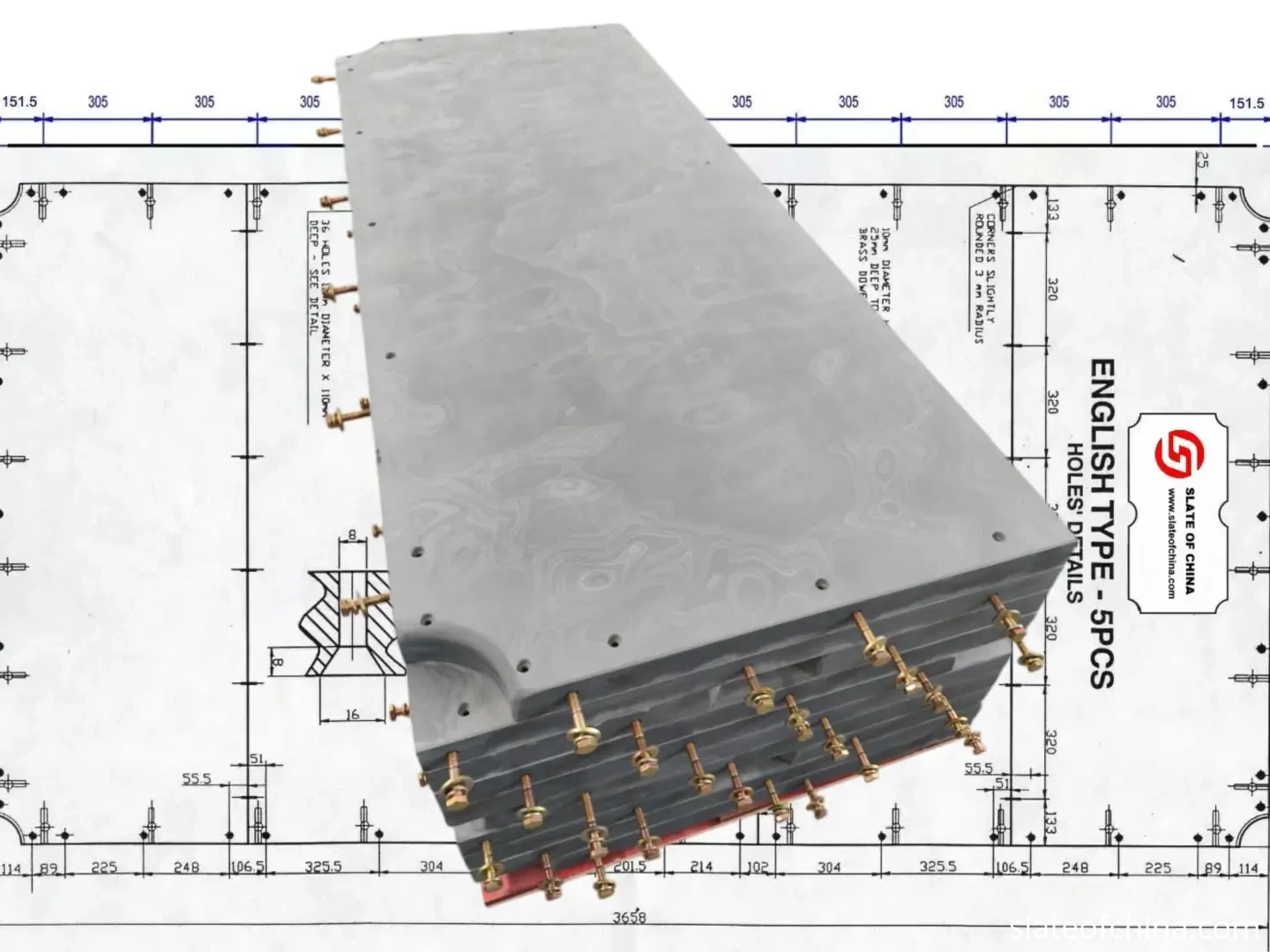
The most important point: a nominal table size does not define the slate. A 7-foot pool table, a 9-foot tournament table, a 12-foot snooker table and a Chinese 8-ball table all have very different slate requirements. The drawing is the single source of truth. If you are sourcing specifically for the U.S. market, the American Pool Table Slate Buying Guide for Manufacturers covers the additional specification details that U.S. table builders need.
From Drawing to First Sample
A reliable OEM order does not jump from quotation to mass production. The process runs through a technical review and a prototype sample before any batch is committed. Each stage has a specific purpose, and skipping one is the most common way OEM projects go wrong.
Technical Drawing Review
Before production begins, the supplier should review the drawing and confirm that every dimension and machining requirement is practical. This is not a formality. For CNC-machined billiard slate, details that look small on a drawing — a pocket radius, a countersink depth, a hole position relative to the slate edge — can be the difference between a set that assembles cleanly and one that does not.
If something is unclear, ambiguous or missing from the drawing, it should be resolved before any stone is cut. Discovering a dimensional problem after a production batch is finished is far more expensive than resolving it on paper. The review should cover:
- Slate thickness and overall dimensions
- Machining depth and pocket geometry
- Hole positions and countersink details
- Edge machining and joint preparation
- Required tolerances and inspection method
Quotation and Specification Confirmation
The quotation should be based on a clearly defined specification — not on a product name. For example, a quotation line should read "9 ft pool table, natural slate, 3-piece, 25 mm thickness, CNC pocket and hole machining per drawing, calibrated surface, export wooden crate, 100 sets" rather than simply "9 ft pool table slate."
The exact specification should be recorded in writing. Different manufacturers can use different dimensions for the same nominal table size, and a quotation that relies only on a product name leaves room for interpretation that neither side intended.
Sample Production
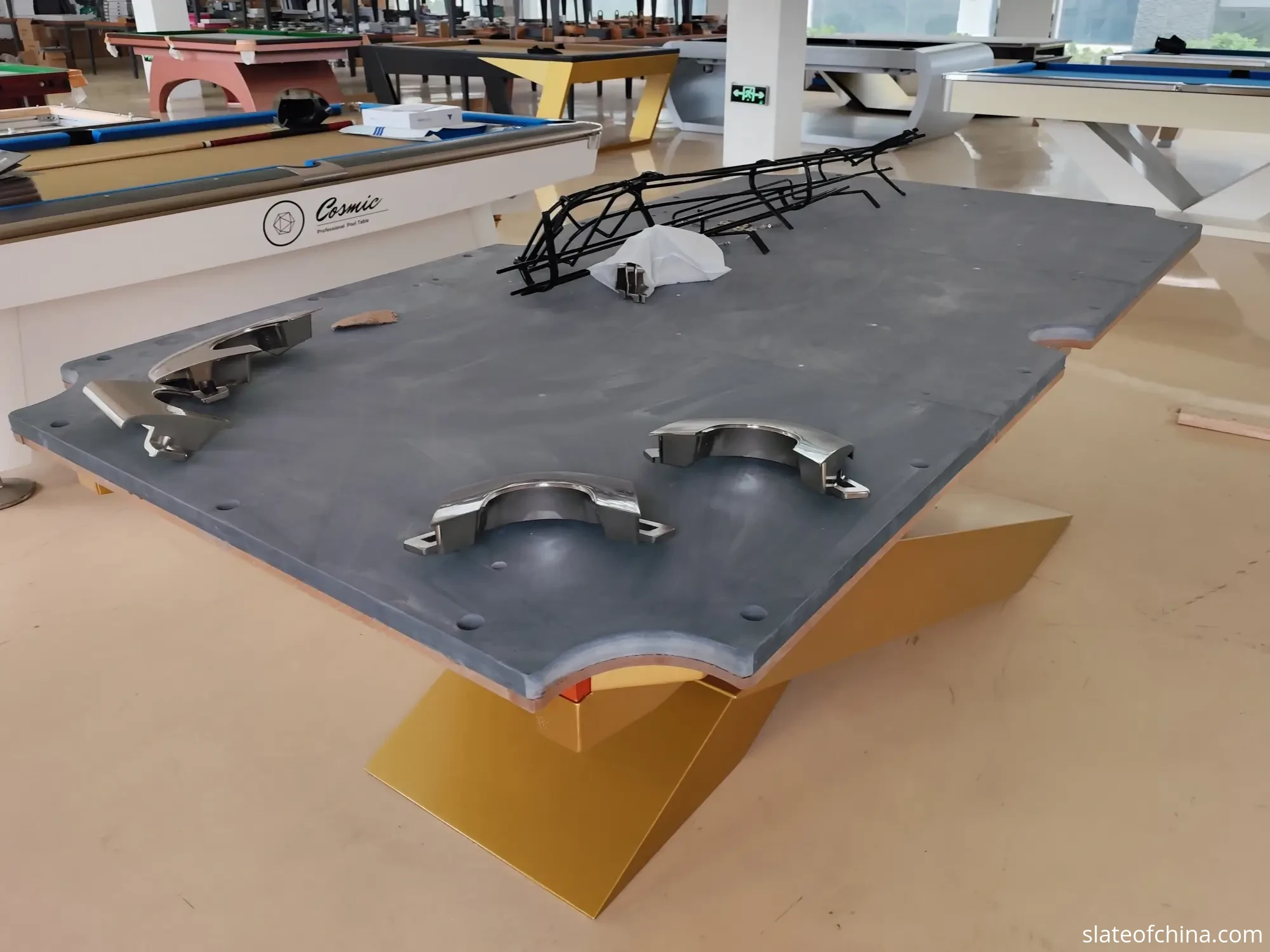
For a new OEM project, a sample is worth more than a long email discussion. A physical sample allows the table manufacturer to test assembly fit, pocket alignment, rail compatibility, hole positions, surface quality and joint performance — all things that are difficult to verify on paper.
You do not necessarily need a perfect engineering drawing to start. A manufacturer can begin with a CAD drawing, a dimensioned PDF, a hand-marked sketch, photos with dimensions, or an existing slate sample. For an established table manufacturer, a CAD drawing is normally the most efficient starting point. But even a rough sketch with clearly marked dimensions is enough to start the technical review.
Sample Approval: The Golden Reference
The sample is not the product. The sample is the reference that defines the product. Once the table manufacturer installs the sample on the actual table frame, verifies the rail fit, checks the pocket alignment and confirms that every dimension matches the drawing, the approved sample becomes what we call the golden sample — the physical reference for every future production batch.
Sample approval should ideally be documented. The customer and supplier confirm the final dimensions, thickness, machining details, surface finish, flatness requirements, hole locations, pocket dimensions and packaging requirements. This creates an agreed production reference that reduces uncertainty between batches.
If adjustments are needed after the trial assembly, the drawing is revised and reconfirmed. A drawing revision is not a casual change — it should be tracked. In practice, we mark revisions as Rev. A, Rev. B, and so on, so that both sides know which version is the current production reference. The golden sample and the latest revision drawing should always match. If they do not, the drawing takes priority and a new sample may be needed.
For repeat OEM orders, this approval process is the single most important document in the relationship. It is what allows the supplier to reproduce the same specification months or years later without re-discussing every detail.
Golden sample = approved drawing + approved physical sample + revision record. These three together answer the question every OEM buyer eventually asks: if people change, months pass and batches repeat, how do we know we are still getting the same product?
Batch Production and Reproducibility
This is where OEM slate supply separates from custom one-off production. A table manufacturer may not need one perfect slate. They may need 100 sets, then 500, then 1,000 — all with the same specification.
The challenge at scale is not making the first set. The challenge is making set 51 identical to set 1. That means the same slab selection criteria, the same CNC programme, the same inspection checkpoints and the same packaging configuration — batch after batch.
Several factors affect batch reproducibility:
Raw material consistency. Natural slate varies by quarry face and block. The supplier should apply the same selection criteria for every batch — density, structure, surface condition — so that the raw material does not introduce variation between batches.
CNC programme stability. The CNC programme that produced the approved sample should be the same programme that produces batch 100. Programme changes between batches — even small adjustments — are one of the most common sources of dimensional drift.
Inspection against the golden sample. Each batch should be inspected against the approved specification, not just against a general quality standard. The golden sample defines what "correct" means for this specific OEM project.
Drawing revision control. If the table manufacturer updates the table design, the drawing revision must be communicated and a new sample may be needed. Producing to an outdated revision is a common cause of batch rejection.
CNC Machining in the OEM Context
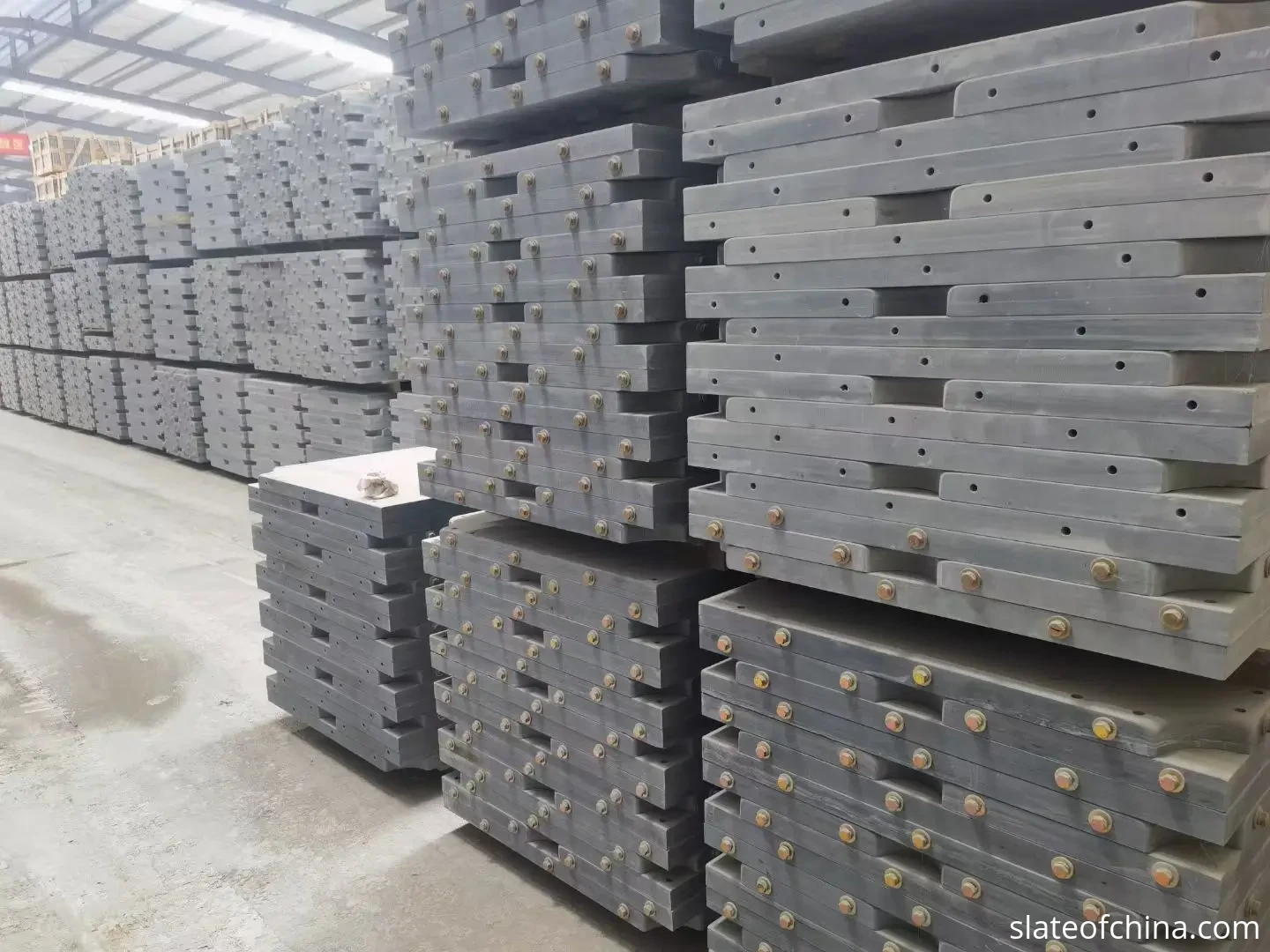
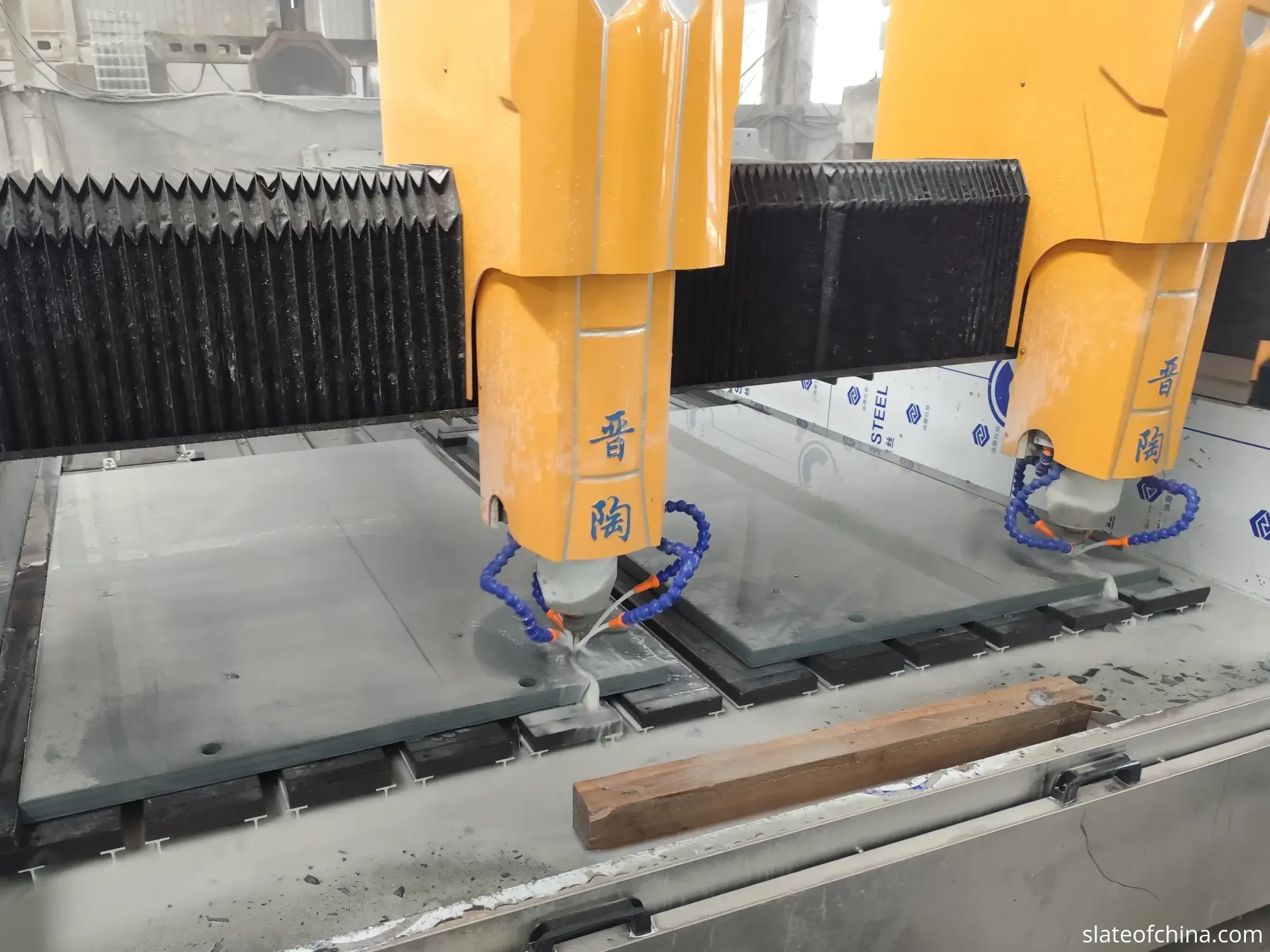
CNC machining is what makes OEM billiard slate practical. Without it, every pocket cut, bolt hole and edge profile would depend on the individual operator's skill — and that is not reproducible across 500 sets.
Depending on the table design, CNC machining may include pocket openings, bolt holes, countersinks, joint preparation, edge machining, mounting features and custom recesses. The exact machining process is determined from the drawing and the approved specification.
For OEM buyers, the important question is not simply "Do you have a CNC machine?" A more useful question is: "Can you machine our approved drawing repeatedly within the required tolerance?"
That distinction matters. A CNC machine is a production tool. The quality of the finished slate also depends on the stone selection, fixturing, machining parameters, inspection process and operator experience. A factory with a CNC machine but no inspection protocol can produce inconsistent parts just as easily as a factory with no CNC at all.
For custom machining from customer drawings — including pocket cuts, hole layouts and non-standard sizes — see our custom pool table slate product page.
Quality Control Across Batches
A useful OEM quality-control process can be divided into several stages, each checking against the approved specification rather than a general standard.
Raw slate selection. The slate is selected for the intended application before machining. The supplier checks thickness, natural structure, surface condition, cracks or defects and overall dimensions to confirm the raw material is suitable.
Dimensional inspection. Finished pieces are checked for length, width, thickness, diagonal dimensions, hole positions, pocket positions and joint dimensions — all against the approved drawing.
Surface and flatness inspection. The playing surface is inspected according to the agreed production specification. The inspection method and tolerance should be defined before production begins, not invented after the shipment is ready. For a deeper look at how flatness, thickness and machining accuracy are measured at our factory, see Billiard Slate Quality & Test Data.
Machining inspection. CNC-machined features — pocket positions, hole diameters, countersinks, edge profiles — are checked against the approved drawing, not against a generic standard.
Final set inspection. For multi-piece slate, it is useful to inspect the pieces as a set rather than treating each piece as an independent product. This helps verify joint alignment, overall dimensions, matching pieces, correct machining and correct labelling. A three-piece set that passes individual piece inspection but fails set inspection — because the joints do not close or the pieces do not match — is not a passed set.
Inspection records for the agreed inspection points can be provided with a shipment when required. What to record and how to document it is best agreed as part of the specification, before production begins.
OEM Packaging and Brand Identity
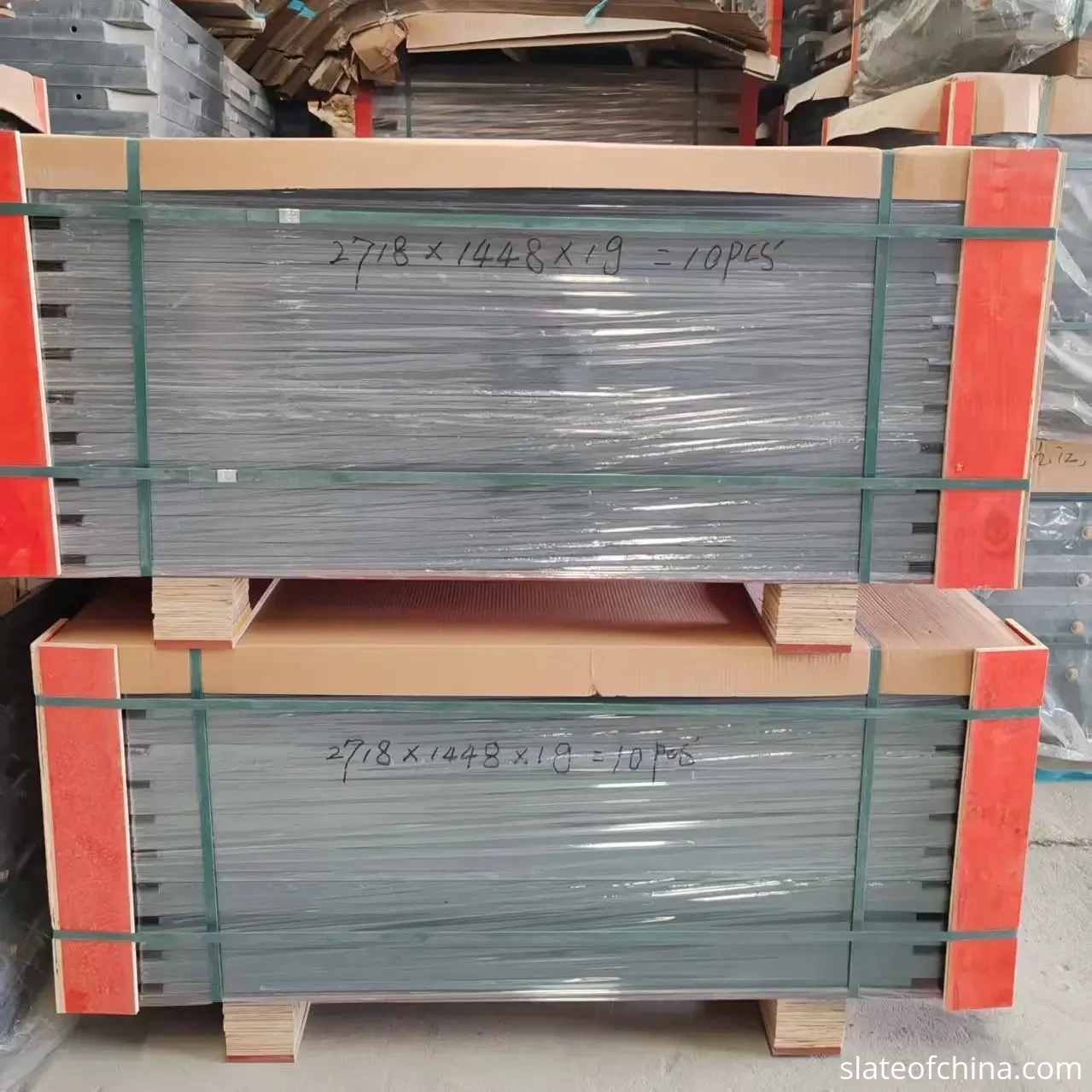
Billiard slate is heavy and brittle. For export orders, packaging should be considered part of the product specification, not an afterthought. A slate set that arrives safely is much more valuable than a cheaper set that requires replacement or repair.
Typical export packaging includes strong wooden crates, internal protection, separation between slate pieces, reinforced corners, moisture protection where appropriate, clear piece identification and secure loading inside the container. For our standard export shipments, billiard slate is packed in wooden crates rather than open pallets, because the crate structure protects the slate edges and surfaces during the full journey from factory to customer's assembly floor.
For OEM and private-label orders, brand identity can be added in three places:
- Crate markings — the customer's shipping marks, product codes and handling instructions on the crate exterior
- Bundle labels — a label identifying the slate set, specification and batch number, attached to the protective wrapping inside the crate
- Packing documentation — a packing list or specification sheet included inside the crate, printed with the customer's branding if required
The slate itself cannot carry a logo — it is the playing surface, and any marking would affect ball roll. Brand identity in billiard slate OEM lives on the packaging, not on the stone.
For more on container loading and shipping, see the Billiard Slate Buying Guide, which covers incoterms, port terms and pre-shipment checks.
OEM vs Standard Slate: What Changes
For a table manufacturer producing a standardised table model, the shift from buying standard slate to OEM supply changes several things at once:
| Factor | Standard Slate | OEM Billiard Slate |
|---|---|---|
| Dimensions | Standard catalogue sizes | Customer-defined per drawing |
| Machining | Limited or standard pocket/hole layouts | Drawing-based, fully customised |
| Thickness | Standard options | According to table design |
| Sample approval | Sometimes skipped | Recommended for every new project |
| Repeat production | Depends on supplier stock | Defined specification, reproducible |
| Packaging | Standard | Can be customised with brand identity |
| Suitable for proprietary table designs | Limited | Yes — the slate fits the table, not the other way around |
The core difference is this: with standard slate, the table manufacturer adapts the table to fit the available slate. With OEM slate, the slate is produced to fit the table. For a manufacturer with a proprietary frame design, a specific playing-area dimension or a particular rail system, OEM production removes the adaptation work at the assembly stage — cutting, drilling and adjustment that would otherwise happen at the table factory.
Common OEM Pitfalls — and How to Avoid Them
Many OEM problems can be avoided before production starts. These are the most common ones I have seen in OEM slate projects:
Specifying only the table size. "9 ft pool table slate" is not enough information for an OEM quotation. The nominal table size does not define the slate dimensions, thickness, piece count, pocket geometry or hole positions. Always provide the drawing.
Sending only a photograph. Photos are useful, but dimensions and drawings are what the factory needs for production. A photo with hand-marked dimensions is better than a photo alone. A CAD drawing is better still.
Changing dimensions after sample approval. Once the sample has been approved, any change should be recorded as a new drawing revision and re-approved. Unrecorded changes between the approved sample and the production batch are a common cause of rejection.
Comparing suppliers only by price. A lower price may not represent the same slate thickness, machining level, tolerance, inspection standard or packaging configuration. Two quotations that look similar on the surface can describe very different products. The How to Choose a Billiard Slate Manufacturer guide covers the evaluation questions that go beyond price.
Ordering a large batch before validating the sample. For a new supplier or a new table design, sample testing reduces production risk. The cost of a sample set is small compared to the cost of a container that does not fit the table frame.
Assuming the first sample guarantees batch consistency. The first sample proves the specification is achievable. It does not prove the supplier can reproduce it 100 times. Batch consistency depends on process control, CNC programme stability and inspection discipline — ask how the supplier maintains these across runs.
What to Send for an OEM Quote
To prepare a useful quotation, send as much of the following information as possible:
- Table type — Pool / Snooker / Chinese 8-Ball / Carom / Other
- Table size — 7 ft / 8 ft / 9 ft / 10 ft / 12 ft / Custom
- Slate thickness — per table design
- Number of pieces — 1-piece / 3-piece / 5-piece / Other
- Overall slate dimensions — from drawing
- Playing-area dimensions — as specified
- CNC drawing or PDF — with pocket geometry, hole positions and tolerances
- Required quantity — sample, trial order or production batch
- Destination port or country — for shipping calculation
- Packaging requirements — standard export crate, or with brand labels
If you have an existing slate sample, photographs and measurements can also help. You do not need a perfect specification before contacting us — if you have only an existing slate, a table drawing or basic dimensions, send them first. We can review the information and identify what additional details are needed before production.
To see how these items come together, here is an example of what a simple OEM specification might look like in practice:
| Item | Example |
|---|---|
| Table | 9 ft Pool |
| Slate | Natural slate |
| Pieces | 3 |
| Thickness | 25 mm |
| Playing area | Per customer drawing |
| CNC machined | |
| Bolt holes | Per drawing |
| Surface | Calibrated |
| Packaging | Export wooden crate |
| Quantity | 100 sets |
This is an example format only. Actual dimensions and tolerances are determined by the customer's approved drawing.
From One Sample to Long-Term Supply
For a table manufacturer, the real value of OEM supply is a specification that stays stable as production grows — from 50 sets to 500 to 1,000, without re-discussing every dimension every time.
A practical OEM workflow looks like this:
Your drawing → technical review → quotation → sample production → trial assembly on your frame → sample approval → batch production → pre-shipment inspection → export packaging → repeat orders against the approved reference.
Once the technical specification is established and the golden sample is approved, future orders become much simpler. The supplier references the same drawing, the same CNC programme and the same inspection checkpoints. The table manufacturer references the same approved specification. The communication shrinks from "let us discuss every dimension again" to "same as approved, batch number so-and-so, quantity X."
That is what OEM billiard slate is designed to deliver: not a single custom piece, but a reproducible component of your table production system — one that stays consistent as your manufacturing grows.
Based in Jiujiang, Jiangxi — one of China's established slate-producing regions — we work with table manufacturers, distributors and importers on custom billiard slate projects, and our slate has been supplied to buyers in more than 30 countries. For more about our factory capabilities, see Professional Billiard Slate Manufacturer in China.
Frequently Asked Questions
What is the difference between OEM and custom billiard slate?
OEM billiard slate means the supplier manufactures to your technical specification on an ongoing basis — the drawing defines the product, and the specification is reproducible across batches. Custom billiard slate can refer to a one-off non-standard order. In practice, most table manufacturers who need OEM supply are looking for repeatable production, not a single custom piece. The two terms overlap, but OEM implies a production relationship, not just a one-time job.
Do I need a CAD drawing to start an OEM order?
No. You can start with a CAD drawing, a dimensioned PDF, a hand-marked sketch, photos with dimensions, or an existing slate sample. A CAD drawing is the most efficient starting point for an established manufacturer, but it is not a requirement. What matters is that enough dimensional information is available for the technical review. If information is missing, we can identify what is needed before production begins.
How many sets should I order for the first OEM batch?
For a new OEM project, we recommend starting with a sample set for trial assembly. Once the sample is approved, the first production batch can be any quantity the table manufacturer needs. There is no strict minimum for OEM orders, but the economics of slate production improve with batch size — a single set requires the same drawing review, CNC setup and inspection process as a batch of 50. The practical minimum depends on the table type and specification.
Can you produce the same specification for future orders?
Yes. Once the sample is approved and the specification is documented, the approved drawing, CNC programme and golden sample become the production reference for subsequent batches. The supplier does not re-interpret the specification for each order — the same drawing, the same programme and the same inspection checkpoints are used. Drawing revision control ensures that any design changes are tracked and communicated.
What information do you need for an OEM billiard slate quote?
At minimum: table type, table size, slate thickness, number of pieces, overall slate dimensions, playing-area dimensions, CNC drawing or PDF with pocket and hole details, required quantity, destination port or country, and packaging requirements. If you have an existing slate sample, photos and measurements also help. You do not need a perfect specification before contacting us — we can review what you have and identify what is missing.
Can you add our brand to the packaging?
Yes. Brand identity in billiard slate OEM appears on the crate markings (shipping marks, product codes, handling instructions), bundle labels inside the crate, and packing documentation. The slate itself cannot carry a logo — it is the playing surface, and any marking would affect ball roll. Private-label packaging is added on top of the agreed technical specification, not instead of it.
What happens if the sample does not fit our table?
If the trial assembly reveals a dimensional issue, the drawing is revised, a new sample is produced if necessary, and the specification is reconfirmed before batch production begins. This is exactly what the sample stage is for — to catch specification problems before they become production-batch problems. The cost of a revised sample is small compared to the cost of a full batch that does not fit the table frame.
Related Reading
Request an OEM Billiard Slate Quote
If you are a pool table manufacturer, snooker table manufacturer, billiard table factory, distributor or importer looking for a custom billiard slate supplier, send us your drawing or current slate specification.
You do not need to prepare a perfect specification before contacting us. Send a CAD or PDF drawing, an existing slate sample, a set of measurements, or even a marked-up photo — we can review whatever you have and identify what additional details are needed before production.
Send us your table type, slate dimensions, thickness, number of pieces, required quantity and destination port. For custom CNC-machined billiard slate, drawings and samples are welcome.