
Jiujiang Roofing Slate: Colour and Weathering
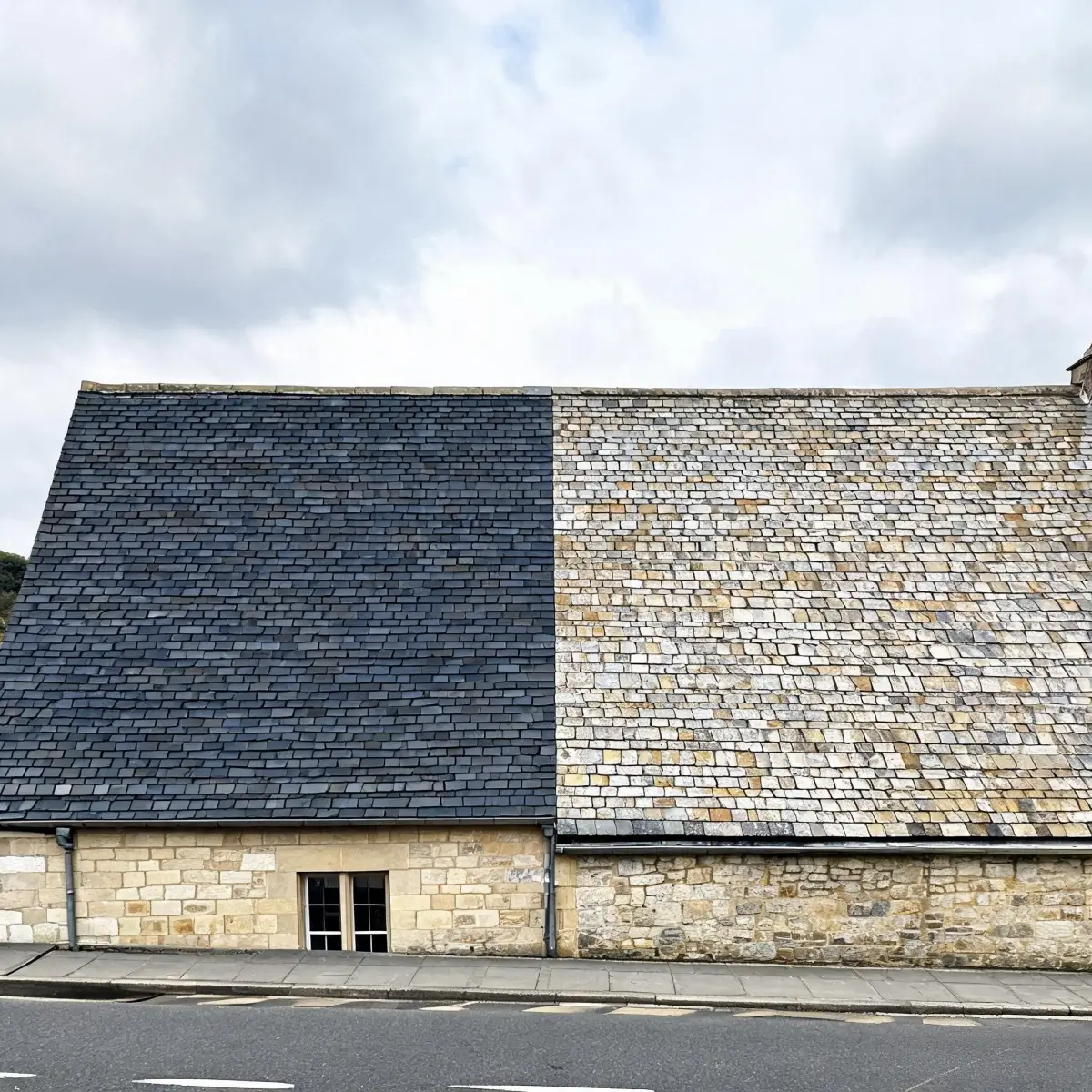
Two roofs on the same street. Both installed the same year, both specified as "grey Chinese slate," both cut to the same dimensions. Twenty-five years later, one has softened to a warm grey with faint buff along the south-facing slopes. The other looks almost exactly as it did the day the last tile was nailed down.
A passer-by might assume they were different materials. They were not. The difference is in the minerals, the quarry layer each batch came from, and how those minerals respond to a quarter-century of rain, frost and ultraviolet light.
That difference — between the colour you see in a sample and the colour your roof will carry in thirty years — is what this article is about.
Quick Answer: Jiujiang slate comes in five natural colour groups — black, dark grey, silver grey, green and warm-toned. The colour comes from minerals in the stone, not from any surface coating. Whether that colour stays the same or softens over decades depends on which minerals are present and how they react to decades of rain, frost and sun. The right question is not "what colour is it?" but "how will this colour behave on the roof?"
| Colour group | Typical tone | Weathering tendency |
|---|---|---|
| Black | Deep black to charcoal | Any change is more visible |
| Dark grey | Charcoal to blue-grey | May soften slightly |
| Silver / light grey | Pale grey to silver | Generally tone-stable |
| Green | Sage to blue-green | Varies by deposit |
| Rusty / warm | Brown, rust, buff | May deepen with oxidation |
Where Slate Gets Its Colour
Natural roofing slate does not get its colour from paint, dye or a surface treatment. The colour is created by the minerals in the stone — and those minerals were locked in place by geological processes that took millions of years.
Carbon-rich minerals contribute to black and dark grey tones. Chlorite and similar minerals produce green colours. Iron-bearing minerals create warmer brown, rusty and reddish tones. The pressure, temperature and chemical environment of the original metamorphic event all influence which minerals formed and in what proportions — which is why two slates from different regions can both be called "grey" while looking quite different when placed side by side.
Our own mineral analysis tells the story in numbers. The chemical composition of Jiujiang slate includes roughly 66.5% silica (SiO₂), 15.8% alumina (Al₂O₃), and about 7.4% total iron oxide (TFe₂O₃). The carbon content gives the darker tones; the chlorite contributes the green-grey character visible in some layers; the iron-bearing minerals are the ones most likely to interact with the environment over time. For a deeper look at the full mineral profile, see Jiujiang Slate Mineral Composition.
There is a practical implication here that buyers sometimes miss. Because colour is geological, even within the same quarry — even within the same geological layer — subtle differences in shade, texture and mineral concentration can occur. Slate is a natural material, not a manufactured colour. The objective for a commercial roofing project is not to eliminate every natural variation, but to control the range so the finished roof has the appearance the project requires.
The Jiujiang Colour Range
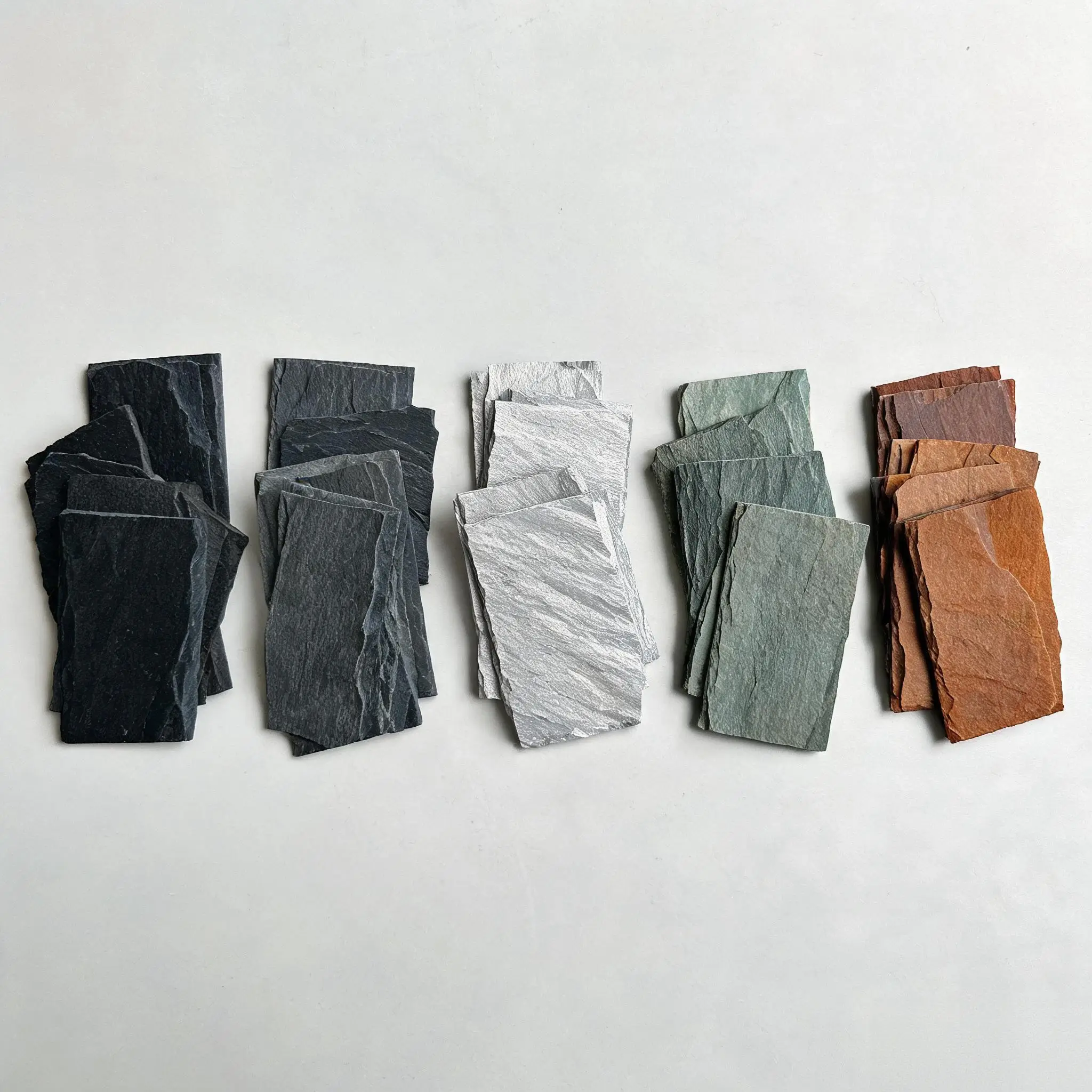
The Jiujiang and surrounding Lushan–Xingzi slate-producing area yields a range of natural colours. Depending on the quarry, the layer being worked and the production requirements, buyers may encounter:
- Black — deep, uniform dark tone; particularly suited to contemporary or restrained architectural styles
- Dark grey — charcoal to blue-grey; the most common roofing colour for traditional European projects
- Silver or light grey — pale grey to silver; softer appearance, often chosen for lighter rooflines
- Green — sage to blue-green; selected when visible natural variation is desired or specified
- Rusty or warm-toned — brown, rust and buff tones; colour associated with iron-bearing minerals in the particular stone
- Mixed or naturally blended — a blend of the above within a commercially controlled range
On the production side, we manage this variation through an A/B/C colour grading system. Each batch is sorted so that the natural colour range stays within a commercially acceptable band. This does not mean every tile looks identical — it means the variation is controlled, not random. For a large project, that distinction matters. A roof with controlled natural variation often looks more authentic than one made from completely uniform manufactured tiles.
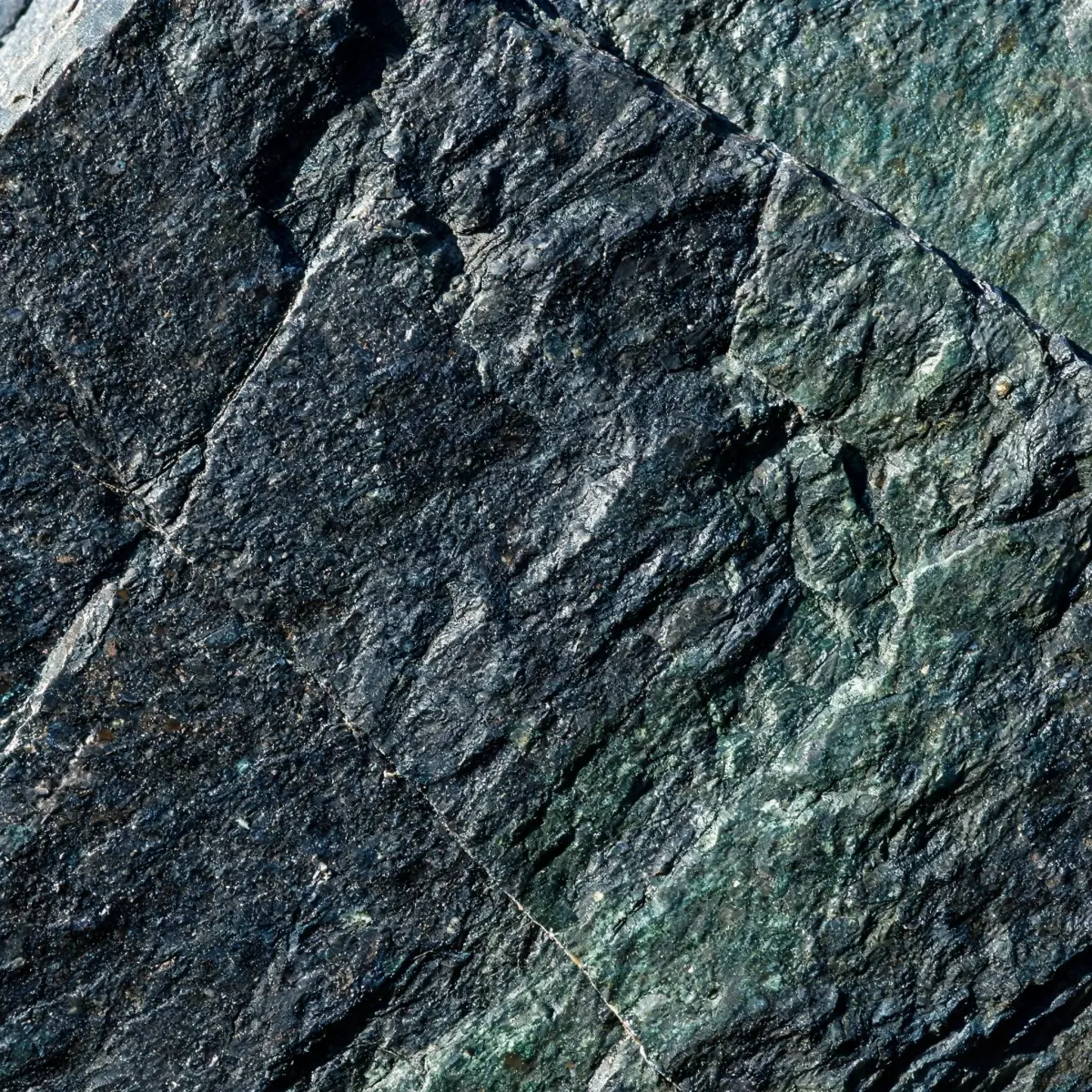
Rusty or warm-toned slates deserve a careful look. Their colour is tied to iron-bearing minerals, and the long-term appearance depends on whether those minerals are stable or reactive. A buyer should specify not only the colour name, but also the expected weathering behaviour. For an overview of how colour fits into the broader sourcing decision, see Why Roofing Buyers Choose Jiujiang Slate.
Unfading, Weathering, Semi-Weathering: Three Words That Decide Your Roof's Future
One of the most important distinctions in roofing slate — and one that too few buyers ask about — is the difference between the original colour of the stone and the way that colour behaves after years of exposure.
The roofing industry has traditionally used a specific vocabulary:
- Unfading (or non-weathering) — the slate maintains its original colour closely over decades
- Weathering — the slate gradually develops warmer buff, tan or brown tones
- Semi-weathering — somewhere between the two, with moderate colour shift
- Fading — implies an undesirable loss of colour intensity
The National Slate Association in the United States draws a clear line between colour weathering and deterioration. Weathering, in this context, is primarily an aesthetic change — the slate may look different, but it can still perform as a roofing material. That said, certain mineral-related reactions can also be associated with reduced durability when undesirable minerals are present in problematic quantities. "The slate changes colour" and "the slate is failing" are not necessarily the same thing — but they are not always unrelated, either.
This distinction matters most for architects, heritage projects and large roofs where colour consistency is part of the design intent. If you specify "grey slate" without asking whether it is expected to weather, you are leaving the appearance of the roof in thirty years to chance.
What Drives Colour Change
Weathering is primarily a mineral story. Certain iron-bearing minerals and other reactive compounds change when exposed to oxygen, moisture and repeated environmental cycles — the daily and seasonal rhythm of rain, frost, sun and drying that a roof experiences for decades.
Depending on the composition of the slate, this can produce:
- A slight softening of the original colour
- Warmer brown or buff tones developing gradually
- Rusty highlights where iron minerals are concentrated
- A more mature, integrated surface appearance
- In less stable materials, more noticeable discoloration
Our test data includes a total iron oxide (TFe₂O₃) value of approximately 7.4%, with Fe-oxide around 6.54% in one chemical analysis. But here is the point that matters: chemical composition alone does not tell you whether a slate will remain visually stable. The form of the iron — whether it is locked in stable mineral structures or present in reactive forms — matters more than the total iron content. A high iron content in stable minerals may contribute attractive green or warm tones without causing problems. A lower iron content in reactive forms can still produce visible oxidation.
Long-term performance needs to be considered together with other properties. Low water absorption, for instance, means less moisture interacting with the minerals inside the stone — and fewer opportunities for oxidation reactions to occur. Our test reports show water absorption values of 0.1–0.2% (depending on the standard and batch), which is well below the EN 12326 A-class threshold of 0.6%. That low absorption is a supporting factor for colour stability, not a guarantee. For the full story on why water absorption matters for longevity, see Water Absorption: Why It Decides Roofing Slate Longevity.
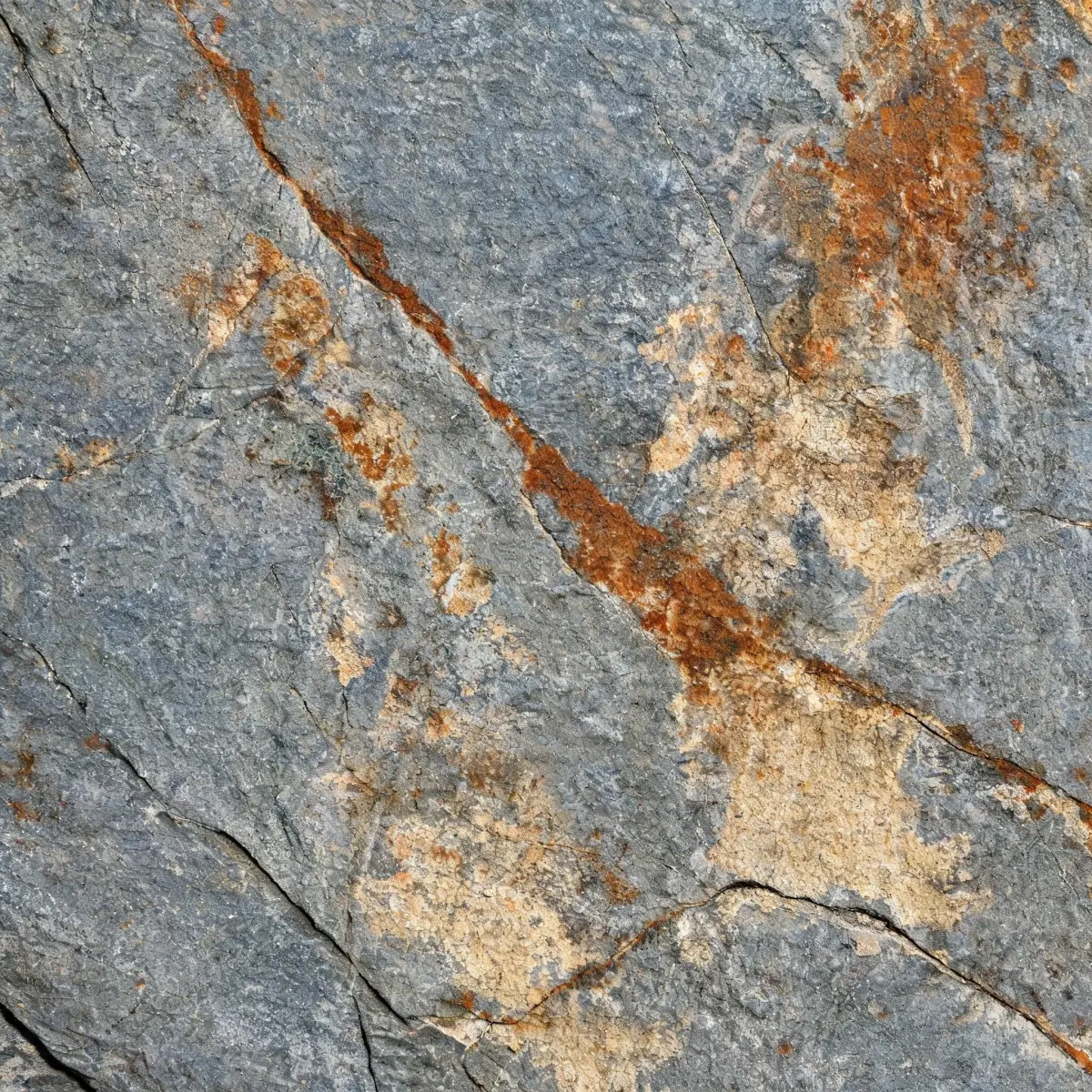
This is also why laboratory testing is more useful than assumptions based on colour or origin. A slate that looks dark and uniform in a showroom can still contain reactive minerals. A slate that looks slightly varied can be entirely stable. The test report — not the photograph — tells you what the stone is likely to do.
Does Jiujiang Slate Fade?
There is no single answer for every slate sold under the name "Jiujiang slate," and any supplier who tells you otherwise is oversimplifying.
Jiujiang is a major slate-producing area, but natural stone varies between quarry sources, geological layers and individual production batches. A responsible supplier should not claim that "all Chinese slate is unfading." Nor should a buyer assume that "Chinese slate always fades." Both statements are equally wrong.
The correct question is: What is the mineral composition of this particular slate, and what does the testing show about its long-term colour stability?
For Jiujiang slate from our production, the available evidence points toward stability. The water absorption is very low (0.1–0.2%), which limits moisture-driven mineral reactions. The calcium oxide content is 0.56% — extremely low compared to marble (CaO above 40%) or limestone (above 50%) — which means there is very little soluble carbonate to be attacked by acid rain. The freeze-thaw retention rate of 92.7% after 120 cycles indicates the stone's structure remains intact under repeated freezing, which in turn preserves the surface that carries the colour. For the full dataset, see Jiujiang Slate Test Results and How to Read a Slate Test Report.
But — and this is important — these numbers describe a specific stone from specific quarries, tested at specific laboratories. They should not be assumed to apply to every slate from every producer in the region. "Jiujiang slate" is a regional name, not a quality certificate. If colour stability matters to your project, ask for the test data that corresponds to the actual material being supplied.
The Two Colours That Demand the Most Attention
Black and green slate both deserve special attention — but for different reasons.
Black and very dark grey are the most demanding colours for colour stability. Small changes are more noticeable because the contrast between a new dark slate and a weathered one is simply greater. A slight warming that would be invisible on a silver-grey roof can be quite apparent on a black one. For a project specifying black roofing slate, we recommend checking the quarry source, requesting a representative physical sample, asking whether the colour is expected to weather, reviewing the relevant chemical and physical test data, and — wherever possible — looking at previous roofs using the same or comparable material. Do not approve a large roofing order solely from a photograph.
Green deserves attention because "green" is a colour family rather than a single geological composition. Green tones are typically associated with chlorite, but the exact mineral combination varies between deposits. Some green slates remain visually stable for decades. Others may develop additional warm or brown tones as iron-bearing minerals within the green matrix react to exposure. This is why green slate should always be evaluated using actual samples from the proposed production source — and why, for projects where colour matching is critical, the buyer should approve both the initial colour and the expected weathered appearance.
For both colours, the sample approval process matters more than the product brochure. If you are at the stage of approving samples, Samples and Sample Approval Process walks through the full procedure. If you are still evaluating suppliers, Slate Testing: What Buyers Should Ask For covers the questions worth asking before you commit.
Weathering Is Not Staining
A roof can look different after decades for reasons that have nothing to do with the slate's mineral colour changing at all. Surface contamination is a separate matter, and confusing it with weathering leads to wrong conclusions.
A roof may become visually darker or appear dirty because of:
- Atmospheric dust and pollution deposits
- Biological growth — algae, moss or lichen
- Nearby vegetation shedding organic matter
- Runoff from metals or other building materials above the slate
- Surface mineral deposits from hard water or spray
None of these are changes in the mineral colour of the slate itself. A roof photographed after decades of exposure may look different from a clean sample in a showroom even when the underlying slate remains structurally sound. This is why photographs of old roofs should be interpreted carefully — and why, if you are assessing an existing roof, it is worth cleaning a small section before drawing conclusions about the stone.
There is also no universal timetable for natural slate weathering. One slate may show little visible change for many years. Another may begin developing warmer tones relatively early. The rate depends on mineral composition, quarry source, environmental exposure, moisture, temperature cycles, roof orientation, local pollution and the individual characteristics of the stone. Claims such as "the colour will change after exactly ten years" should be treated with caution unless they are supported by actual field data from comparable installations.
Here is the honest truth that the slate trade has known for centuries: not every colour change is undesirable. Traditional natural slate roofs often develop a softer, more mature appearance as they age. Rain, sunlight, atmospheric exposure and the gradual accumulation of surface patina can make an old roof look different from newly installed slate — and for many architectural projects, that is exactly what the designer wants. A heritage building, a countryside house or a traditional European-style project may benefit from a slate that develops a controlled natural weathering character rather than one that stays factory-fresh forever.
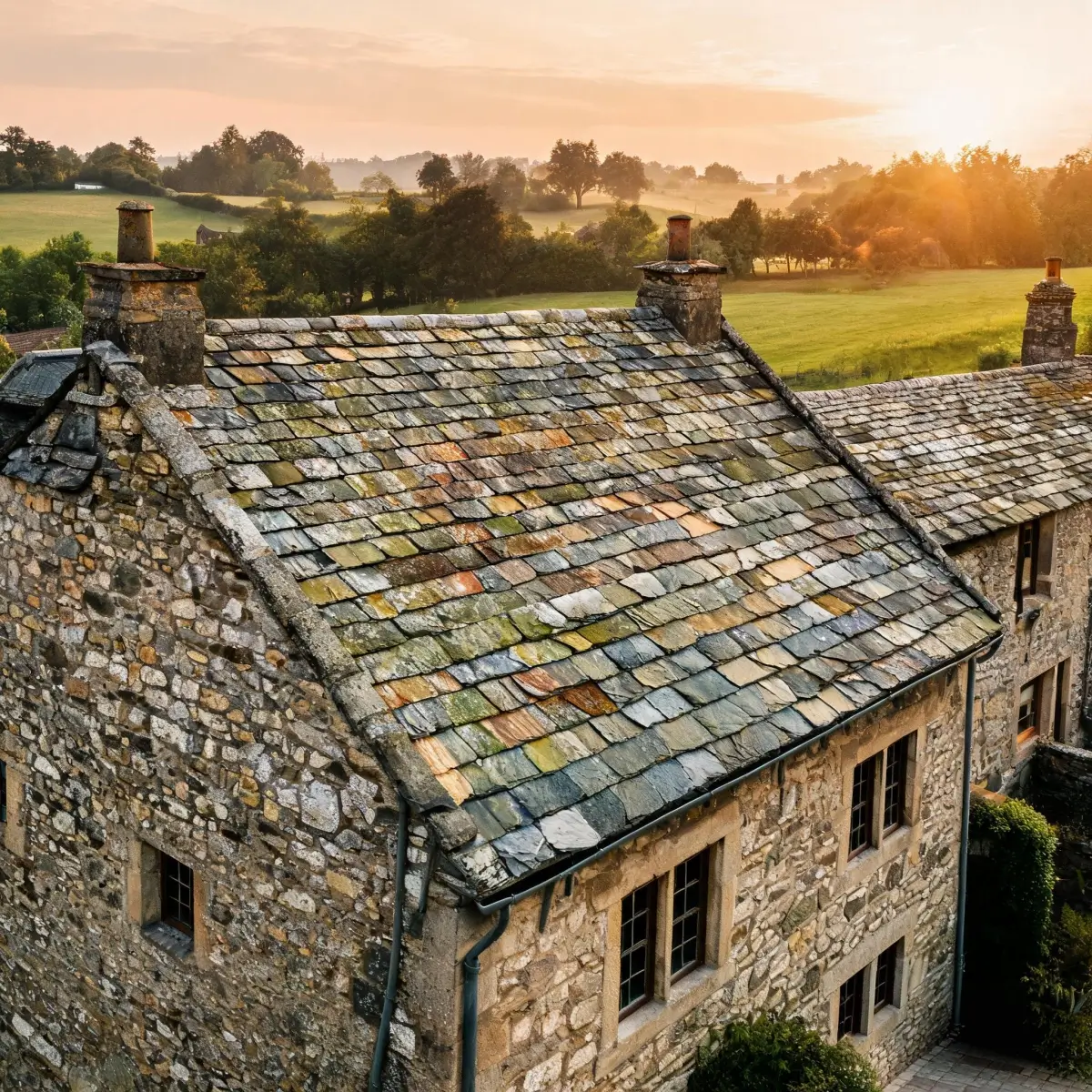
The objective, then, is not always "zero colour change." It is predictable and acceptable colour change — which requires the buyer to know what to expect before the order is placed, not after the roof is installed.
Climate accelerates the process. A roof in a cold, wet climate experiences more freeze-thaw cycles per winter. A coastal roof faces higher humidity and wind-driven rain. These conditions make the quality of the slate — and the compatibility of its minerals with the environment — more critical, not less. Colour stability should not be considered separately from durability. For the climate performance story, see Jiujiang Roofing Slate in Cold and Coastal Climates and Freeze–Thaw Resistance of Jiujiang Slate.
How to Approve Colour for Decades on the Roof
For a serious roofing project, the colour approval process should go beyond picking a shade from a catalogue. Here is what we recommend.
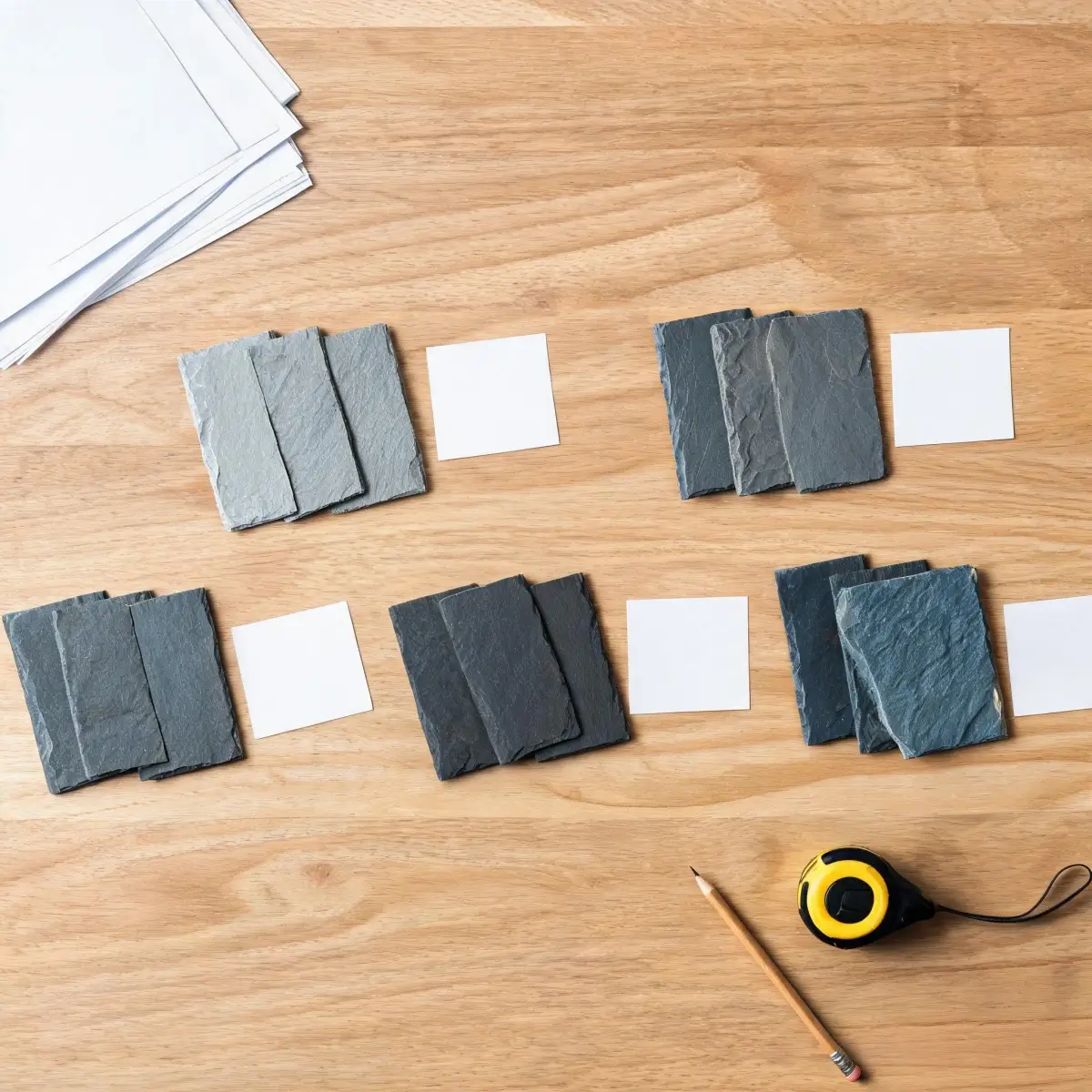
1. Approve a physical sample. Do not rely on digital photographs. Screens, cameras and lighting can significantly change how grey, black and green slate appears. A photograph of dark grey slate under warm interior lighting can look like a different stone entirely from the same slate under overcast skies.
2. Check the back and the natural cleft. The underside and the freshly split face carry information about the natural stone colour that the top surface may not show. If the back and front are consistent, you are looking at the mineral colour. If they differ significantly, the top surface may have been treated or selected.
3. Ask whether the slate is weathering or unfading. Do not assume that "natural colour" means "unchanging colour." A responsible supplier should be able to tell you whether the specific slate you are considering is expected to maintain its colour or develop weathered tones — and on what basis that expectation rests.
4. Ask for test information. Where colour stability is important, request the relevant testing and classification information for the actual slate being supplied. Chemical composition, water absorption and freeze-thaw data all contribute to understanding how the stone will behave. For guidance on interpreting test reports, see How to Read a Slate Test Report.
5. Compare production samples. For a large project, production samples should be checked against the approved sample before the full container shipment is accepted. This is where the A/B/C grading system and the batch numbering become important — they give both sides a reference point.
6. Keep an approved reference sample. The original approved sample should be retained by both buyer and supplier. It gives both sides a physical reference for future production — and, if questions arise years later, something to compare against.
Colour Matching for Restoration Projects
Weathering becomes especially important when replacing slate on an existing building. A new slate may be geologically similar to the original material but still look different because the old roof has already spent decades outdoors — developing a patina, or shifting toward warmer tones that the fresh replacement does not yet have.
The correct replacement is not always the slate that looks closest when both samples are new. Sometimes the better choice is a slate whose expected weathered appearance will become compatible with the existing roof within a few years. This is why restoration projects should compare new sample → existing roof → expected weathered appearance rather than simply asking for "the same colour."
Specification: Colour with Performance
For international roofing buyers, colour is only one part of the specification. A professional specification should ideally identify origin, quarry or production source, colour, colour variation range, thickness, dimensions, surface finish, water absorption, mechanical properties, freeze-thaw performance where relevant, weathering/colour stability requirements, packaging and inspection requirements. The more precise the specification, the less room there is for misunderstanding between buyer and supplier — and the more likely the roof is to look the way you expect it to in thirty years. To start specifying, visit our roofing slate catalogue or contact us for project-specific guidance.
Frequently Asked Questions
Does Jiujiang slate change colour on the roof?
It depends on the specific stone. Jiujiang is a producing region, not a single product. Some slates from the area are expected to maintain their original colour closely; others may develop warmer tones over decades. The determining factors are mineral composition, water absorption and environmental exposure. Ask for the test data that corresponds to the actual material being supplied, not a general claim about the region.
What is the difference between weathering and fading in roofing slate?
The roofing industry uses specific terms. "Unfading" or "non-weathering" means the slate is expected to maintain its original colour. "Weathering" means it gradually develops buff, tan or brown tones. "Semi-weathering" falls between the two. "Fading" implies an undesirable loss of colour intensity. Weathering can be an aesthetic change that does not affect the slate's performance as a roofing material; fading is generally considered a defect. The distinction matters because a weathering slate can be a deliberate design choice, while a fading one is a quality issue.
How can I tell if a slate will stay the same colour?
You cannot tell from a photograph or a colour name alone. The most reliable approach is to request the chemical composition (particularly iron content and form), water absorption data and any available weathering or thermal-cycle classification for the specific slate being supplied. Low water absorption (our test values are 0.1–0.2%) and low carbonate content (CaO 0.56%) are supporting factors for colour stability, but the form of the iron minerals matters more than the total iron number. Physical samples approved under real lighting remain the most practical test.
Is colour change a sign that the slate is failing?
Not necessarily. The National Slate Association distinguishes colour weathering from deterioration. Weathering can be primarily an aesthetic change — the slate looks different but continues to perform as a roofing material. However, certain mineral-related reactions can also be associated with reduced durability when undesirable minerals are present in problematic quantities. The key is to distinguish controlled natural weathering (which can be part of the material's character) from unexpected discoloration or surface breakdown (which requires investigation). If the slate is also cracking, delaminating or losing structural integrity alongside colour change, that is a different matter from gradual tonal shift.
Should I approve slate colour from photographs alone?
No. Screens, cameras and lighting can significantly change how grey, black and green slate appears. A dark grey slate photographed under warm interior lighting can look like a different stone from the same slate under overcast skies. For any serious project, approve physical samples — and for large projects, compare production samples against the approved reference before accepting the full shipment. Keep a sealed reference sample on both sides.
What should I specify for a restoration project where the existing roof has already weathered?
Do not simply ask for "the same colour." The existing roof has already spent decades outdoors and may have developed a patina or shifted toward warmer tones. The correct approach is to compare three things: the new sample, the existing roof, and the expected weathered appearance of the new slate. Sometimes the better choice is a slate whose expected weathered appearance will become compatible with the existing roof within a few years — not the slate that looks closest when both are new. Consider specifying a weathering or semi-weathering slate if the existing roof shows mature patina.
Related Reading
Specify colour with performance — not just by name
Ask for the mineral composition, the water absorption data and the expected weathering behaviour of the actual slate being supplied. A roof is a thirty-year decision; the colour you specify today should be the colour you can live with for decades.