
How to Read a Slate Test Report
The thirty-second version: a slate test report is not a certificate — it is a fingerprint. Six groups of numbers, each one telling you something different about where the stone came from, how it was made, and what it will do on a roof or a billiard table. Read them together and you have a photograph of the stone's origin. Read them in isolation and you have a sales sheet. This guide decodes each group — density, absorption, strength, freeze-thaw, chemistry and thickness — using Jiujiang slate's real lab data as the reference point, and shows you the three ways a report can look right and still be wrong.
Part of the Jiujiang Slate Guide's Quality, Testing & Standards section. The companion piece on the Roofing Slate Guide — How to Read a Roofing Slate Test Report — walks through the document row by row; this page decodes what the numbers say about the stone behind them.
A three-page PDF arrives in your inbox with the subject line "Test Report — EN 12326-1" and no cover note. It came from a supplier you are evaluating, or from a lab your architect recommended, or from a trade show contact whose slate samples are sitting on your desk. You open it. The first page is a header block with a laboratory logo. The second page is a table of numbers. The third page is a conclusion that says "Pass" in a green box.
Most buyers stop at the green box. That is roughly equivalent to buying a house after reading the estate agent's summary without stepping inside. The numbers on the second page are the house — and they are not difficult to read once you know what each group is doing. Every figure on a slate test report belongs to one of six categories. Each category answers one question about the stone. Together, they form a fingerprint that no marketing brochure can fake — because the arithmetic has to be internally consistent, or the report is lying.
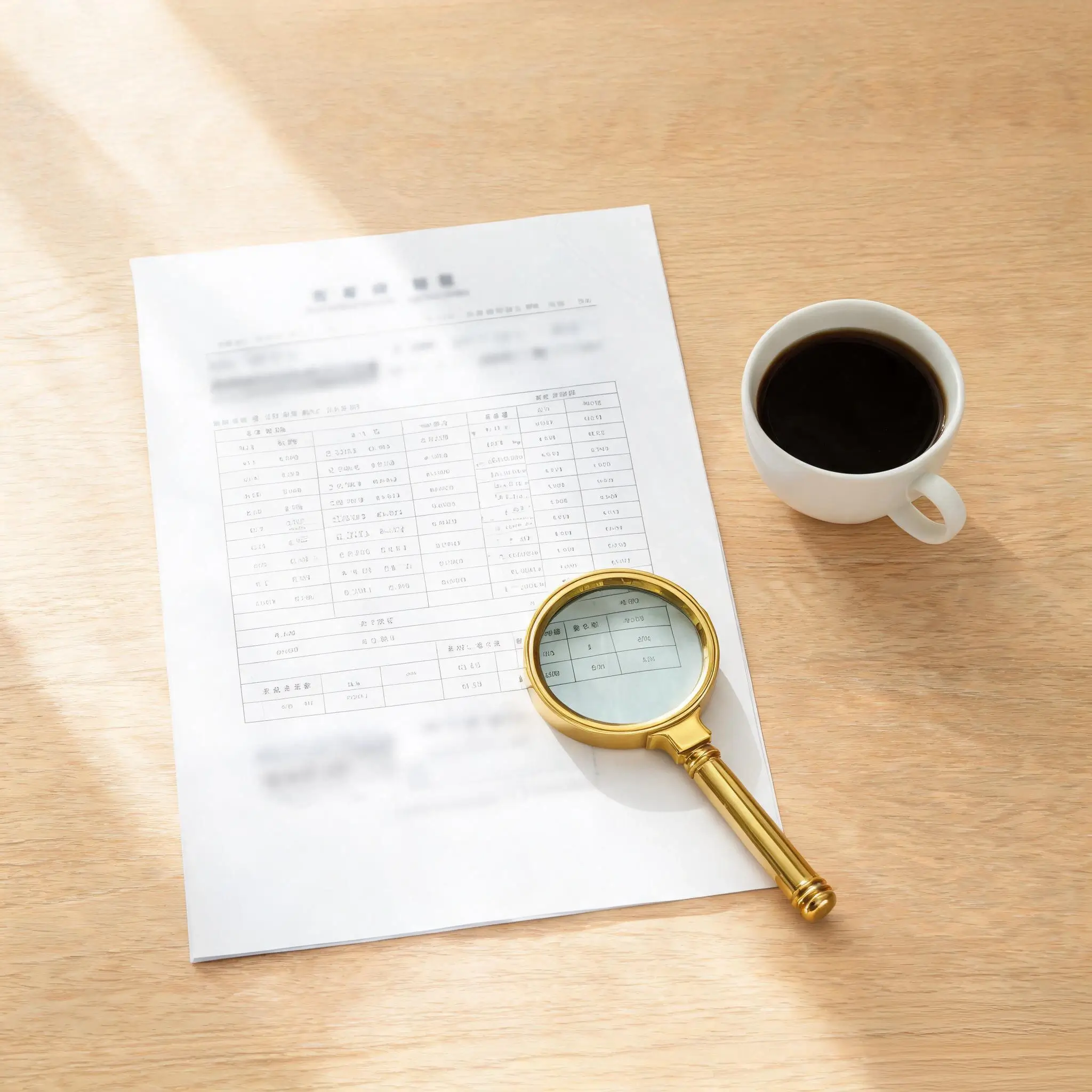
Code 01: The Identity Block — whose stone is this, anyway?
Before any test data, every report carries an identity block: the laboratory name, the testing standard (EN 12326-1, ASTM C406, or both), the sample description, the test date, and — the line that separates a document from a decoration — the batch or lot number. A report without a batch number is a statement about a slate. A report with your batch number is a statement about your slate.
This sounds obvious, and it is the single most common failure in the trade. A supplier sends a beautiful certificate from a respected lab, the numbers are excellent, the green box says "Pass" — and the batch number on the report does not match the batch number on the packing list, because the certificate describes a batch from a different season, a different quarry face, or a different producer entirely. The report is real. The stone in your container is real. They are simply not the same stone.
The rule: if the report cannot be traced to your order, it is a brochure. Ask for the batch number before you ask for the price. A producer who tests properly — who links each certificate to a numbered batch, whose 100% inspection process means every piece is traceable — has nothing to hide behind a generic certificate.
Code 02: The Absorption Print — the number that outranks everything
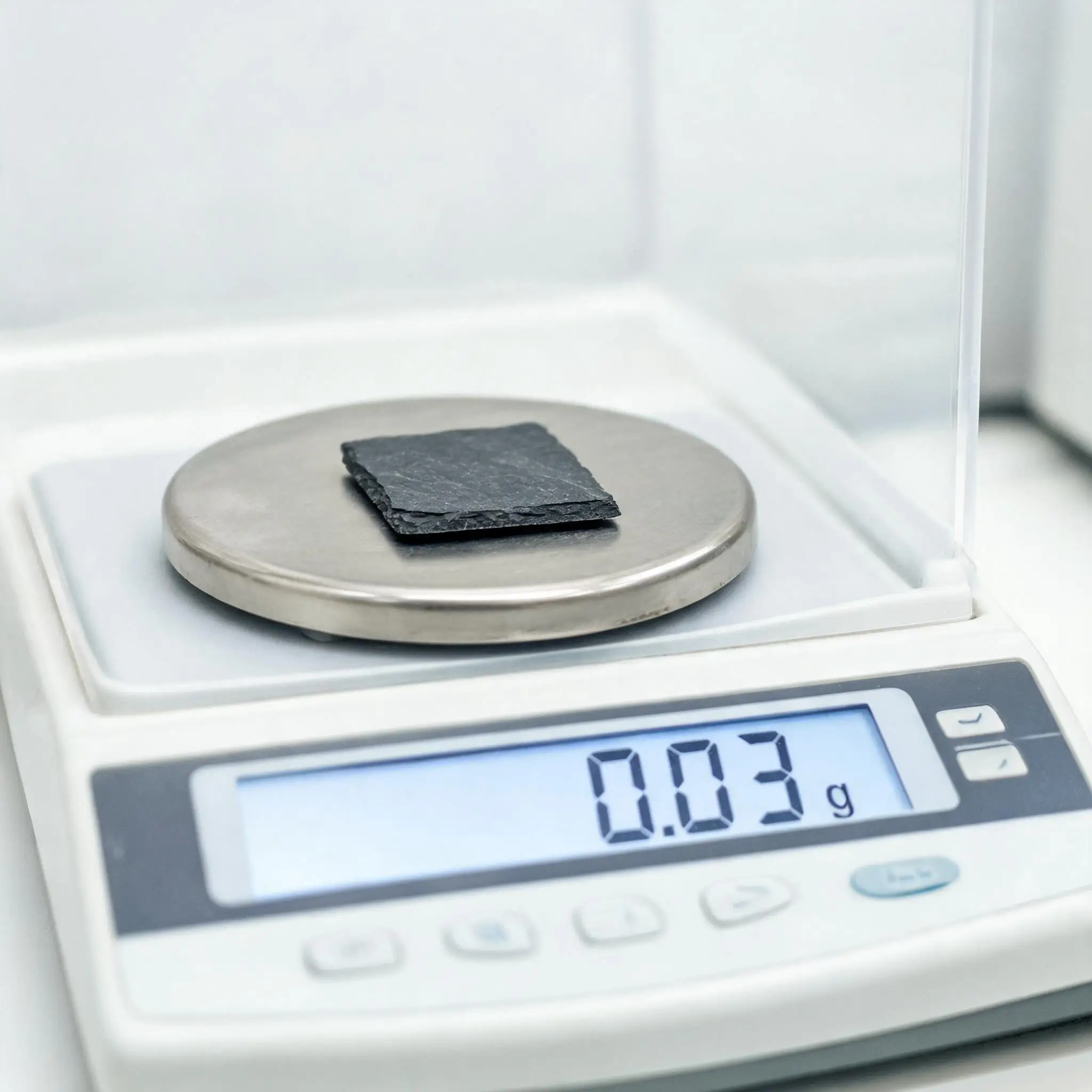
Water absorption is the single most consequential number on the report. It tells you how much water a dry slate drinks after a timed soak, expressed as a percentage of its own dry weight. The reason it outranks everything else is mechanical: frost damage in slate is not the stone freezing — it is the water inside the stone freezing, expanding, and wedging the structure apart. Less water inside means less frost ammunition. The full explainer on Jiujiang slate's absorption covers the test method in detail; on the report, you are looking for one line: the apparent absorption value in percent.
Three different labs have tested Jiujiang slate on three different occasions, and the numbers are not identical: 0.1% in one report, 0.13% in another, 0.2% in a third. This is not a contradiction — it is the nature of natural stone. The EN method (48-hour soak) and the ASTM method measure slightly differently, and natural variation between quarry faces means no two batches will produce a single identical decimal. What matters is the range: all three sit well below 0.6%, which is the EN A1 threshold, and well below 0.25%, which is the ASTM S1 gate. The honest way to present this is the range, not the prettiest single number.
What the absorption print tells you about origin: a slate that drinks below 0.2% is a slate whose pore structure is tight — which means the metamorphic process that created it was thorough, the minerals are well-interlocked, and the rock spent enough time under heat and pressure to close its gaps. A slate that drinks above 1% is a slate that was under-cooked geologically, or whose mineral composition includes too many soluble components. The number is a photograph of the stone's geological childhood.
Code 03: The Strength Print — and the thickness that changes everything
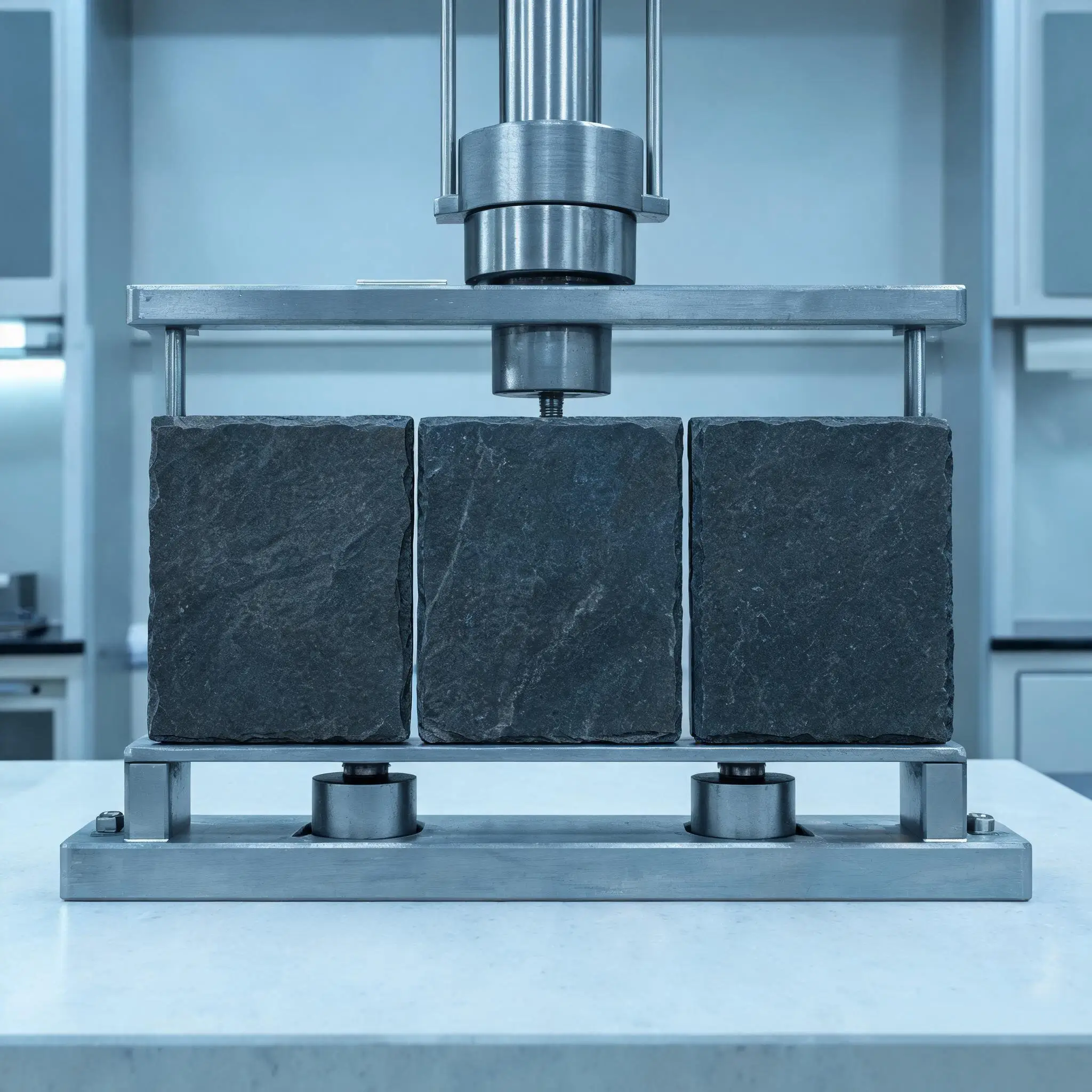
Strength appears on a slate report under several names: breaking load (the raw force in newtons or pounds that snaps the sample), flexural strength or modulus of rupture (that same force normalised by the sample's dimensions). They are the same event sliced by different standards. The flexural strength guide treats them in engineering depth; on the report, what matters is the number and the thickness of the sample that produced it.
Here is why thickness matters more than any other context: the modulus formula squares the thickness. A 6 mm slate and a 4 mm slate of the identical stone will test at dramatically different strengths, because the thicker sample resists bending with the square of its dimension. A report that gives a strength number without stating the sample thickness is a report that cannot be interpreted — the number is floating without a reference frame. Jiujiang slate tests at roughly 60 MPa dry and above 45 MPa after full water saturation — but that number only means something because the report also says the sample was 8 mm thick.
What the strength print tells you about origin: there is a less obvious number on this block that most buyers ignore — the ratio between dry strength and wet strength. A stone that loses 50% of its strength when saturated is a stone whose internal structure is partly held together by dry friction rather than mineral bonding. Jiujiang slate retains about 75% of its dry strength when wet (60 MPa dropping to 45 MPa). That ratio is a fingerprint of how thoroughly the rock was metamorphosed: a well-cemented slate holds its structure wet or dry; an under-cooked one comes apart when water enters the pores.
A note on a number that catches attention: compressive strength. The same Jiujiang stone has been reported at values ranging from 86 MPa to 280 MPa across different labs — a threefold spread that looks alarming until you understand that compressive strength varies enormously with sample geometry, loading direction, and the angle between the load and the cleavage plane. The hardness guide explains why this number fluctuates while Mohs 3-4 stays rock-steady: hardness is a property of the minerals; compressive strength is a function of how you break the rock. On the report, do not anchor your judgement to the compressive row — anchor it to flexural strength and absorption, which are the numbers that govern roof and table performance.
Code 04: The Freeze-Thaw Print — the test that simulates decades in weeks
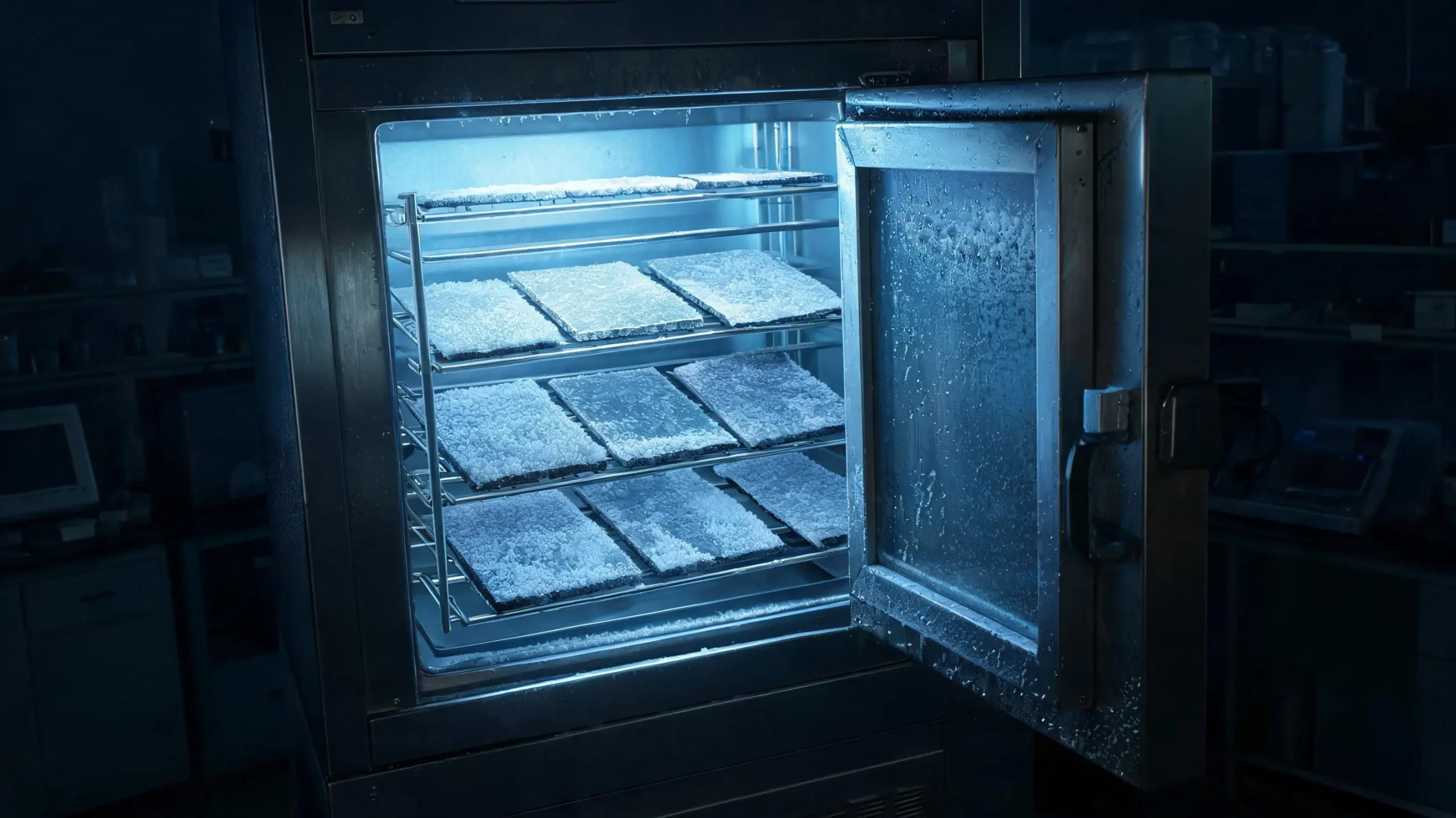
The freeze-thaw test is the closest a laboratory comes to time travel. Saturated slate samples are cycled between deep freeze (around -20°C) and thaw (around +20°C), typically for 50 cycles on the European side and similar on the American side. After cycling, the samples are weighed: weight loss means fragments have broken off, and the percentage tells you how the stone will survive decades of winter.
Two figures matter on this row: the weight loss (you want zero, or near it) and the cycle count (a report that says "freeze-thaw tested" without stating how many cycles has not finished its sentence). Jiujiang slate has been cycled to 120 cycles with no measurable weight loss — a margin more than double the standard ask. More tellingly, the strength retention after freeze-thaw is 92.7%: a pre-cycle compressive load of 156 MPa dropping to 144.7 MPa after cycling, a loss of less than 8%. That is the number that tells you the stone's internal structure survived the winter intact, not just the surface.
What the freeze-thaw print tells you about origin: a slate that passes 120 cycles without loss is a slate whose absorption is low enough that frost has almost no water to work with. The freeze-thaw number is not independent — it is a downstream consequence of the absorption number. A high freeze-thaw loss with a low absorption number would be internally inconsistent, which is exactly the kind of contradiction that exposes a report that does not describe the stone it claims to.
Code 05: The Chemistry Print — the quiet arithmetic of longevity
Some reports include a chemical composition block, often near the back. The rows that matter most are calcium oxide (CaO), sulphur trioxide (SO₃), and iron oxide (Fe₂O₃). These numbers are uninteresting until the day they are not — which is the day acid rain starts working on the roof.
Carbonate content is the mineral that acid rain dissolves first. A stone with high CaO will lose its surface edges over decades as the carbonate dissolves, leaving the slate rougher, more porous, and closer to failure. The European practical threshold is below 5% CaO. Jiujiang slate reports CaO at 0.56% — not just below the threshold, but two orders of magnitude below it. For context, marble sits above 40% CaO and limestone above 50%. The mineral composition guide unpacks the full chemistry; on the report, the CaO row is the one that tells you whether the stone's chemistry is working for the roof or against it.
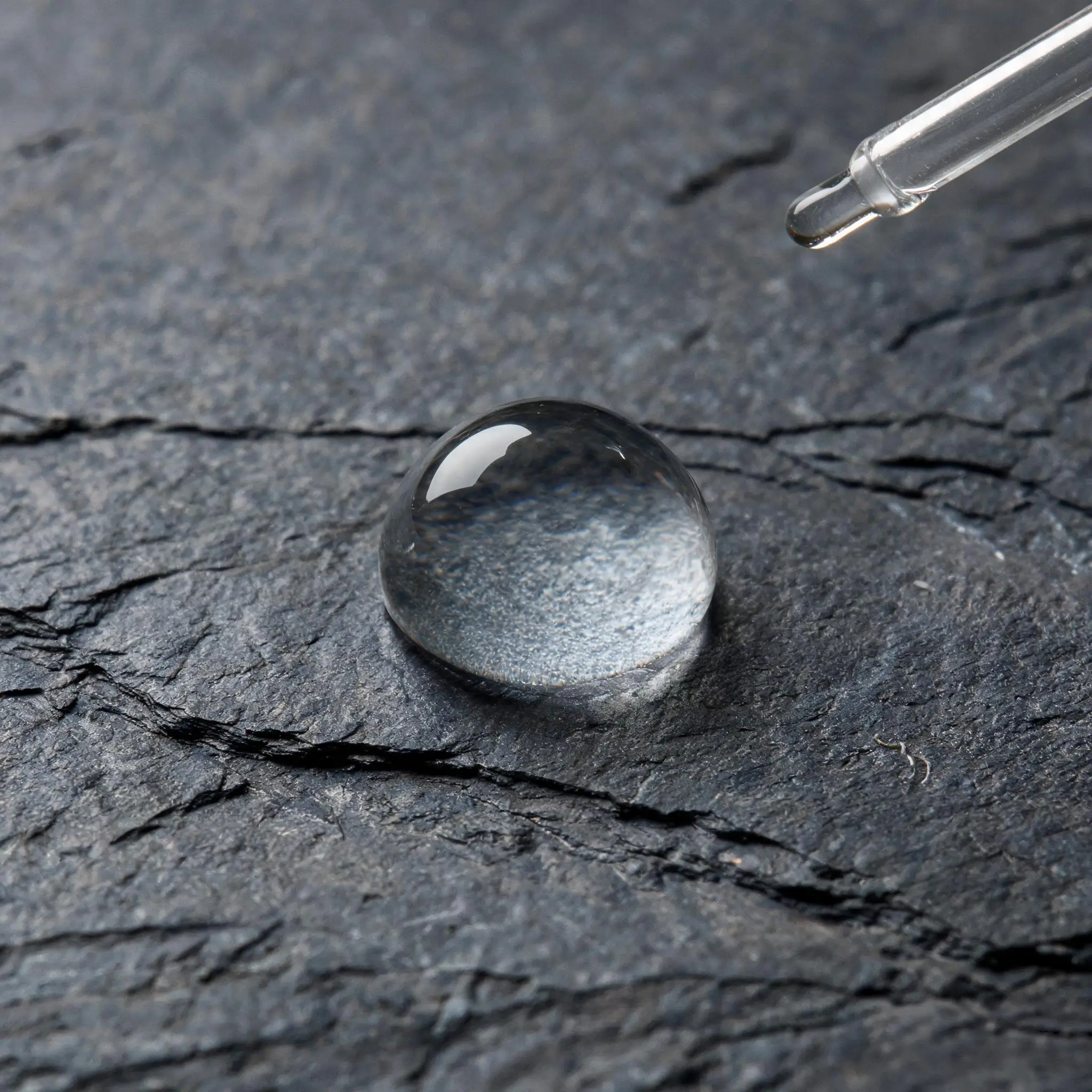
The simplest verification does not require a laboratory. Place a drop of dilute hydrochloric acid on a slate surface. If it fizzes, there is carbonate. If it sits perfectly round and does nothing, there is almost none. The chemistry row on the report is the formal version of that drop — but the drop is something you can do yourself, in a yard, in thirty seconds.
Code 06: The Thickness Print — the fingerprint of the factory
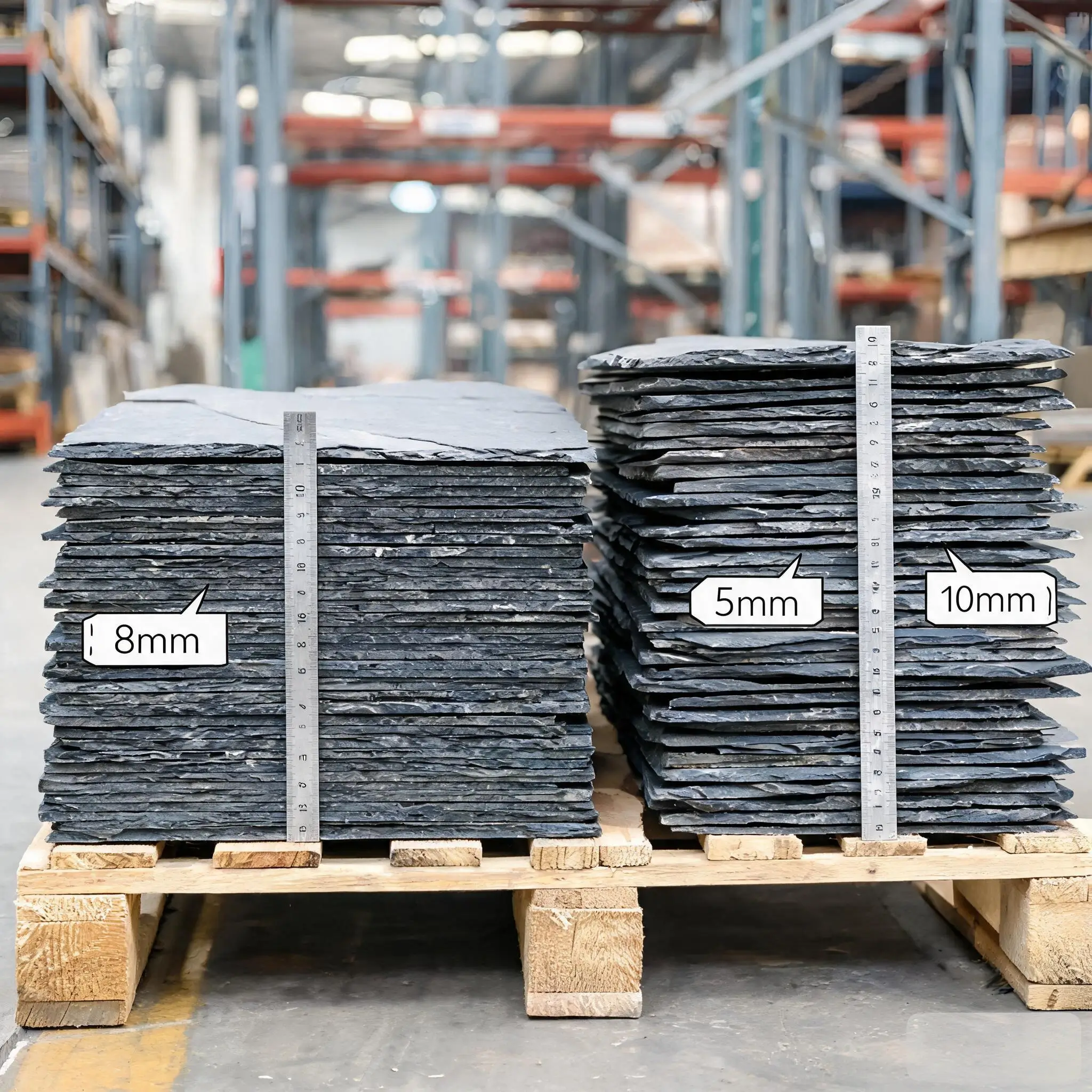
Most buyers never look at the thickness tolerance block, and it is the single most revealing line on the report. It gives the nominal thickness and the measured range — the variation across the samples tested. A tight range means a controlled production process: CNC-dressed slate holds around ±0.5 mm; hand-split material drifts by a millimetre or more. A wide range means the factory measures what it splits but does not correct what it finds.
The flatness and dimensional stability guide covers the measurement methods in depth. On the report, the thickness row is the fingerprint of the factory behind the stone — because every other number on the report describes the rock, but the thickness row describes the maker. A producer who holds ±0.1 mm on billiard slate and ±0.5 mm on roofing slate is a producer who measures. A producer whose thickness row reads "nominal 7 mm, measured 5.2-9.1 mm" is a producer who splits and ships.
The six codes together: a camera, not a checklist
Read individually, each code tells you one thing about the stone. Read together, they form something more powerful: a photograph of the stone's origin. A slate with absorption below 0.2%, strength retention of 75% wet, freeze-thaw survival of 120 cycles, CaO at 0.56%, and a thickness tolerance of ±0.5 mm is not six random facts — it is a consistent picture of a well-metamorphosed rock from a quarry that processes with precision. Change any one number and the picture changes. Push absorption to 1% and the freeze-thaw number would have to climb to match; if it does not, the report is describing two different stones.
This is what a properties guide cannot do and a test report can: it cross-checks itself. The six codes are not independent — they are linked by the physics of the stone. Absorption drives freeze-thaw. Mineral composition drives acid resistance. Density drives both. Thickness tolerance drives installation quality. A report where all six codes tell the same story is a report you can build a purchase on. A report where one number stands apart from the rest is a report with a question mark.
Three ways a report can look right and still be wrong
After the six codes, the last skill is recognising when the numbers are individually plausible but collectively suspicious. Three patterns catch more bad reports than any single out-of-range value:
- 1. The floating strength. The flexural number looks healthy — 50 MPa, say — but nowhere on the report does it state the sample thickness. Without thickness, a modulus number is not a measurement; it is a fact that refuses to be checked. Always match the strength row to the thickness row. If the thickness is missing, the strength is a guess.
- 2. The absorption that does not match the freeze-thaw. The absorption row shows 0.8% — above the S1 gate, but not catastrophic — and the freeze-thaw row shows zero loss after 50 cycles. These two numbers are physically linked: a stone that drinks 0.8% of its weight in water should show some frost damage over 50 cycles. If it does not, either the freeze-thaw test was not run at full saturation, or the two rows describe different samples. Either way, the report is internally inconsistent.
- 3. The date that makes the paper irrelevant. The report is perfect — every code checks out, the batch number is present, the green box is green — but the test date is three years old, or the batch number does not match the packing list. A report describes a stone on the day it was tested, not for eternity. Stone does not change, but batches do: a certificate from a 2023 batch tells you nothing about a 2026 container unless the batch numbers match.
The pattern across all three is the same: a good report is not a collection of good numbers — it is a collection of numbers that are consistent with each other. When the six codes tell the same story, the stone is telling the truth. When one code breaks the pattern, the report is either describing a different stone or describing no stone at all.
Questions buyers ask about reading slate test reports
What is the most important number on a slate test report?
Water absorption. It is the upstream cause of freeze-thaw performance, which is the upstream cause of roof longevity. A slate with absorption below 0.2% — like Jiujiang slate's range of 0.1-0.2% across three labs — has almost no water for frost to work with, which means the freeze-thaw number, the strength retention, and the longevity are all downstream consequences of that one percentage. If you only check one row, check absorption — but always check it against the freeze-thaw row to confirm they tell the same story.
Why do different labs report different numbers for the same stone?
Three reasons: the testing standard differs (EN 12326-1 uses a 48-hour soak; ASTM uses a different protocol), the sample comes from a different quarry face or production batch, and natural stone varies within the same geological formation. Jiujiang slate has been reported at 0.1%, 0.13%, and 0.2% water absorption — all from the same geological belt, all from legitimate labs. The variation is within a narrow range, well below every standard threshold. A supplier who presents a single number as eternal is oversimplifying; one who presents the range honestly understands the material.
How can I tell if a test report actually describes the slate in my container?
Check the batch number on the report against the batch number on the packing list and on the crate labels. It should be the same number in three places. Then check the test date: a report from a batch tested six months ago is plausible; a report from three years ago describes a different production run. Finally, check the sample description — the thickness and size on the report should match what you ordered. If any of these three do not line up, the report is describing someone else's stone.
Should I trust a report that says "Pass" but does not show the individual numbers?
No. A green "Pass" box without the underlying data is a verdict without evidence. A real report shows every test value — absorption percentage, strength in MPa, freeze-thaw cycle count and weight loss, chemistry in percent, thickness range — and the pass/fail classification is derived from those values. If the supplier sends a certificate with a verdict but no data table, ask for the full report. A serious laboratory always issues the full document; a supplier who only sends the summary page is asking you to trust the green box without seeing the arithmetic behind it.
What does CaO 0.56% mean in practical terms?
It means the stone has almost no carbonate content — the mineral that acid rain dissolves first. For context, marble contains over 40% CaO and limestone over 50%. At 0.56%, there is essentially nothing for acid rain to attack, which means the slate's surface edges will not erode over decades in polluted or coastal environments. The European threshold is below 5%; Jiujiang slate sits two orders of magnitude below it. You can verify this yourself with a drop of dilute acid on any slate surface — if it does not fizz, the carbonate is negligible.
If the compressive strength number varies so much, should I ignore it?
Treat it as secondary information, not as a primary judgement criterion. Compressive strength in slate varies with sample geometry, loading direction, and the angle between the load and the cleavage plane — the same Jiujiang stone has been reported from 86 MPa to 280 MPa depending on the test setup. Flexural strength (modulus of rupture) is the number that governs roof and table performance, because it tests the stone in the direction it actually fails in service. Mohs hardness, which stays at 3-4 regardless of test method, is the more reliable indicator of the stone's fundamental abrasion resistance.
Ask for the report — before you discuss the price.
We test every batch to EN 12326 and ASTM C406, name the batch on the certificate, and send the full data table before we quote.
Request the Full Test Report