
100% Inspection: How We Check Every Piece
Every slate panel and tile that leaves our Jiujiang factory passes through six checks on the inspection bench — dimensions, thickness, flatness, surface, edges, and sound. Not a random sample. Not every tenth piece. Every single one. If it fails any check, it goes back. Here is what each check looks like, what we reject, and why a single bad piece never makes it into your crate.
Last month we ran 3,840 roofing tiles through the inspection bench. 341 came back. That is a reject rate of just under 9%. Some months it is lower, when the stone from a particular quarry face splits clean and the weather has been dry. Some months — after heavy rain loosens the face, or when we shift to a harder band deeper in the mountain — it climbs to 12 or 13%. The number moves with the rock. What does not move is the rule: 100% piece-by-piece inspection, not batch sampling.
I run the inspection line. I have been at this bench for over a decade. The procedure I am about to describe is not something we wrote in a quality manual for auditors to read — it is what my team does, every working day, with every piece of slate that comes off the splitting floor or the CNC machine.

There are six checks. They happen in order. A piece has to clear all six before it goes into a crate. Miss one, and it goes back — re-cut, re-split, or in the worst case, set aside for the seconds pile.
Check 01 · Dimensions
The first thing we do is lay the tile flat on the bench and check length and width against the order drawing. A steel tape measure does the job for roofing tiles. For billiard panels, where the tolerance is tighter, we use a calibrated steel rule on a granite plate.

The tolerance for roofing slate is ±2 mm on length and width. That sounds loose, but on a hand-split tile it is the difference between a roofer fitting the slate cleanly and having to trim every piece on the roof. For CNC-cut billiard panels, we hold ±0.5 mm — tighter than most workshops in this industry bother with.
What gets rejected: tiles that are undersized (the splitter took too much off one edge), tiles that are oversized (they will not fit the gauge pattern on the roof), and tiles that are not square — where the two diagonal measurements differ by more than 1 mm. A non-square tile is usually a splitting problem: the wedge angle was off, and the cleavage plane ran slightly diagonal.
We check the diagonal here, every time. Measure corner to corner, both ways. If the two diagonals match, the piece is square. If they do not, back it goes.
Check 02 · Thickness
Thickness is where most rejects happen. We measure five points on every piece: the centre, and four corners. Not just one spot — because slate does not split to a perfectly uniform thickness. The edges can run thinner than the middle. One corner can be thick if the cleavage plane dipped.
A digital caliper reads to 0.01 mm. We do not need that resolution for roofing slate, where the tolerance is ±0.5 mm, but we use the same caliper on the billiard bench, where ±0.1 mm is standard and ±0.05 mm is the high-precision spec for competitive table panels.
What gets rejected: a roofing tile that varies more than 1 mm across its five measurement points — even if each individual point is within tolerance, too much variation means the roof will look wavy. A billiard panel that is out by more than 0.1 mm at any point. And anything with a taper: thicker at one end than the other. A tapered tile rocks on a flat surface. A tapered panel will not sit flush on a table bed.
We log the five readings on the batch record. Not for every single tile — that would be thousands of numbers a day — but for the first tile of every batch and every tenth tile after that. If the sample shows drift, we stop the line and check the splitting wedge or the CNC tool offset.
Check 03 · Flatness
Flatness is a separate check from thickness. A tile can be perfectly uniform in thickness and still not be flat — it can have a gentle cup or twist across its face. You will not catch that with a caliper.
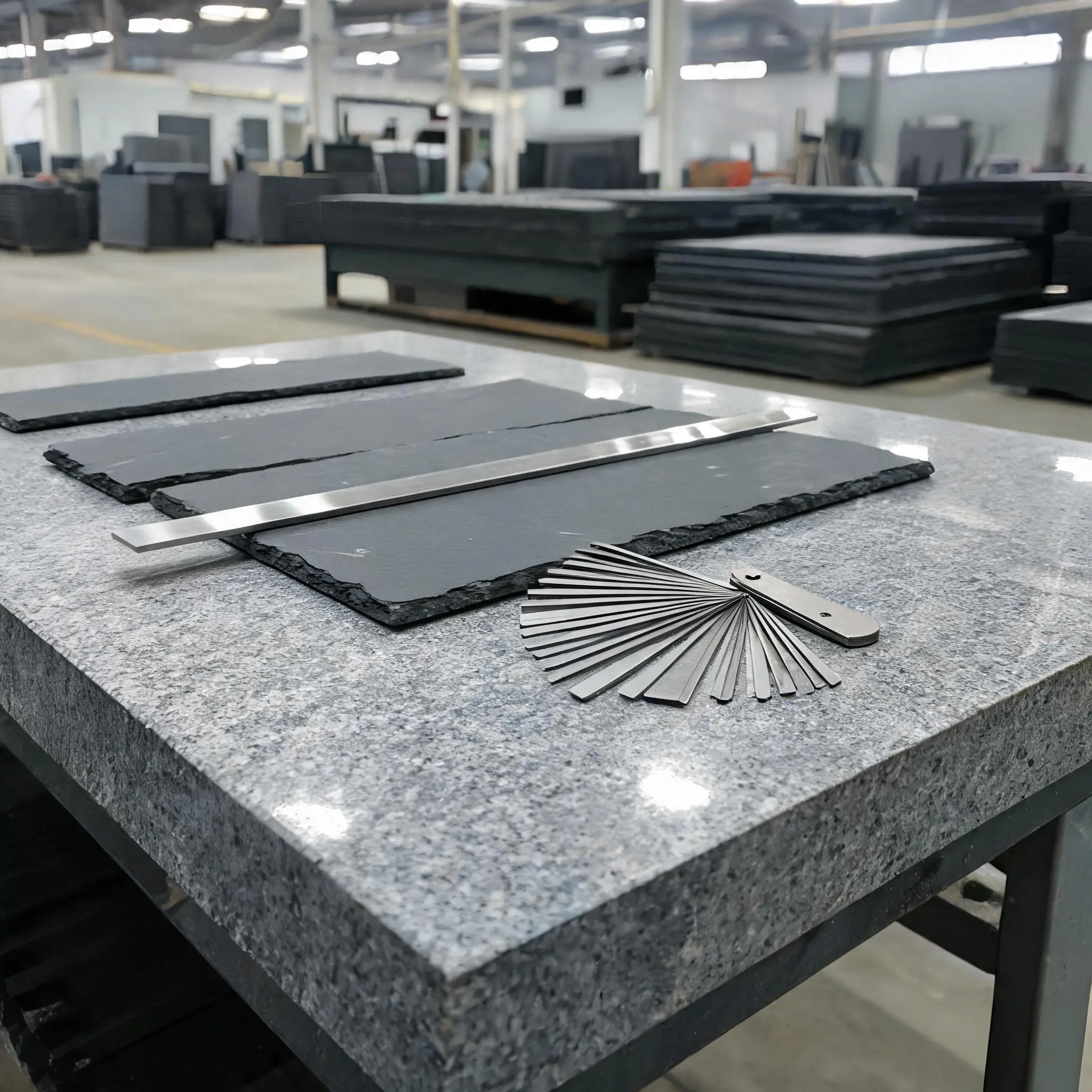
We use a steel straightedge — a 1-metre precision rule — laid across the face of the tile in three directions: lengthwise, crosswise, and diagonal. Then we slip a feeler gauge under the straightedge at any point where light leaks through. If the gauge slides in, the gap is too wide.
For roofing slate, the threshold is 0.3 mm. If a 0.3 mm feeler blade goes under the straightedge anywhere along its length, the tile is rejected. For billiard panels, the threshold is 0.1 mm — and we check with a 0.1 mm blade. A panel that cups by more than a tenth of a millimetre will cause a ball to deviate on a championship table. The players would feel it. We cannot let that happen.
What gets rejected: cupped tiles (concave or convex across the face), twisted tiles (one diagonal high, the opposite diagonal low), and tiles with a local dip — usually where a soft spot in the stone was ground or split away, leaving a shallow depression. Local dips are the hardest to catch, because the straightedge bridges right over them. That is why we also run a fingertip across the surface. A trained finger can feel a 0.05 mm step that the straightedge misses.
Check 04 · Surface
Surface inspection is still done by eye and by hand. No machine has replaced it — and I have seen the camera systems that tried. A line-scan camera can flag a colour difference, but it cannot tell you whether a dark line is a harmless mineral streak or a structural crack that will open up after one winter on a roof in Wales.
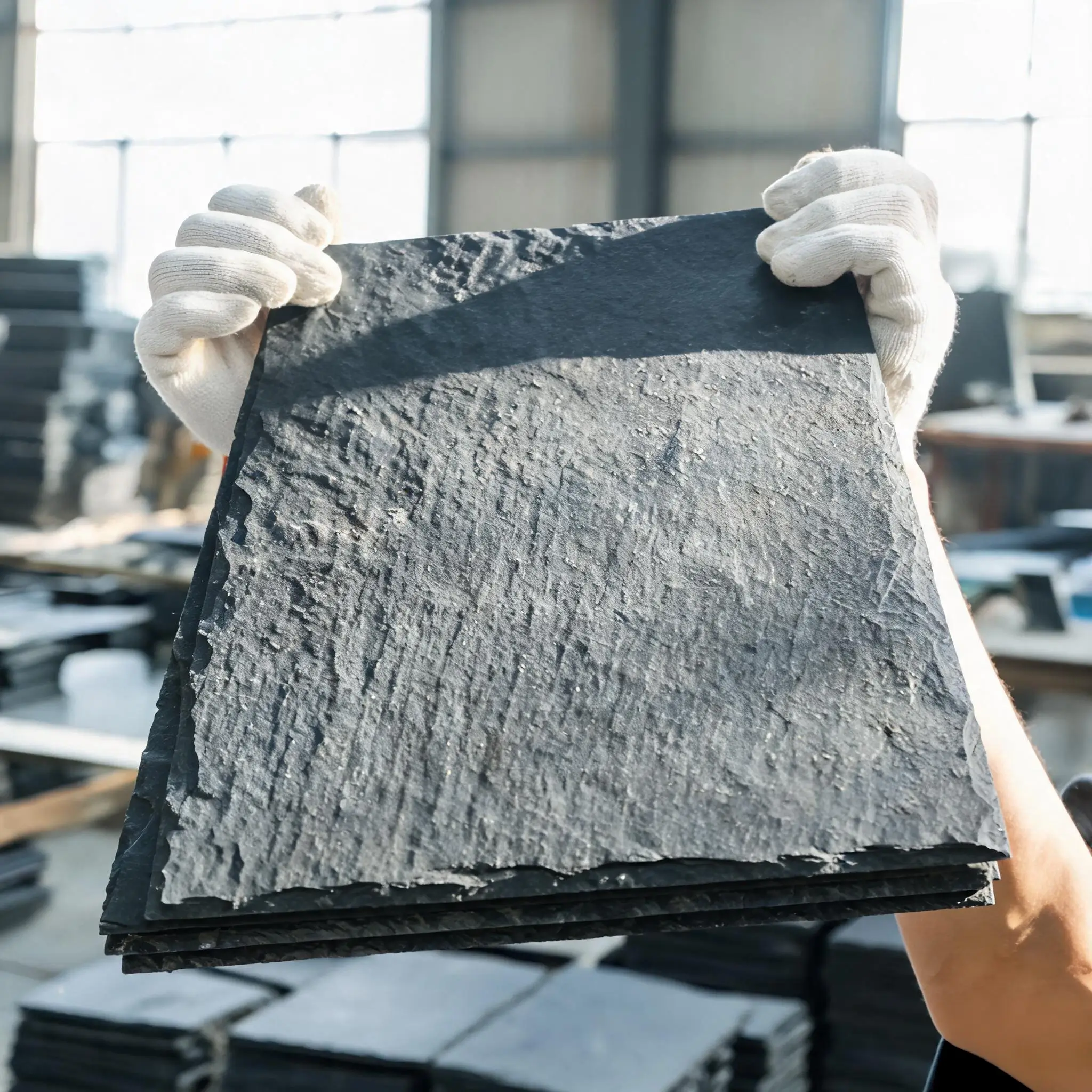
We inspect under raking light — light that hits the surface at a low angle, about 15 to 20 degrees. Overhead fluorescent light fills in shadows and makes everything look flat and uniform. Raking light does the opposite: it turns every ripple, every crack, every pyrite crystal into a visible shadow. It is the same principle a jeweller uses to check a cut facet.
What gets rejected:
- Cracks. Surface cracks are obvious. Hairline cracks — the ones visible only under raking light, that you can catch with a fingernail — are the dangerous ones. They will open under freeze-thaw. We reject every piece with a hairline crack, no exceptions.
- Pyrite clusters. A few isolated pyrite crystals are normal in Jiujiang slate — they are part of the natural mineral composition and do not affect performance. But a cluster of pyrite in one spot, especially if it is raised or surrounded by a lighter halo, can rust and pop out after years of weather exposure. We reject tiles with pyrite clusters larger than 5 mm.
- Colour variation within a batch. We sort by colour tone. If one tile is visibly darker or lighter than the rest of its batch, it gets moved to a different batch where it matches — not to the reject pile, but to a batch where it blends in. Your roof should look uniform, not patchy.
- Delamination patches. These look like small areas where the surface has started to flake or peel. They mean the cleavage plane was not clean — the stone split along two planes at once. The tile may be structurally sound, but the surface will shed flakes for years. Reject.
One more rule on surface: if we find a defect on one tile in 50 from the same batch, we re-inspect the entire batch. A 1-in-50 rate usually means the splitting wedge is wearing out or the stone quality in that section of the quarry face is dropping. Better to catch it at the bench than after the tiles are on a roof in Scotland.
Check 05 · Edges
Edges tell you more about a slate tile than any other feature. A clean, straight edge means the stone split cleanly and the cut was true. A chipped, ragged edge means something went wrong — the stone was brittle, or the tool was dull, or the operator rushed.
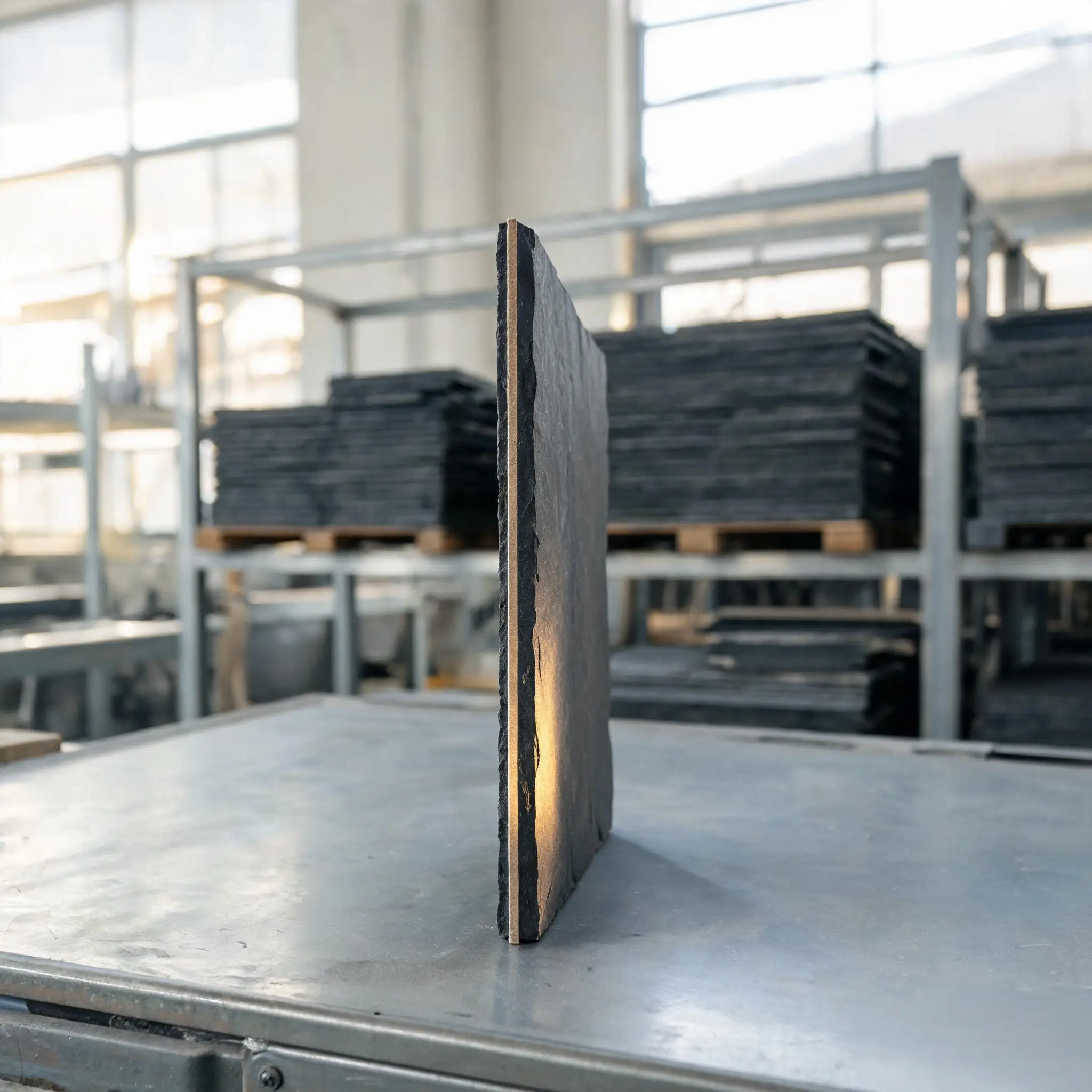
We check edge squareness with a 90-degree steel square. The edge should sit flush against the square, with no gap at the top or bottom. For roofing slate, the tolerance is ±0.5 mm — we check with a feeler gauge, the same approach as flatness. For billiard panels, the edges are CNC-machined to ±0.1 mm, and the joint between two panels is checked with a 0.05 mm feeler gauge. If the gauge slips into the joint, the panels do not match.
Then we run a finger along the edge. Not for squareness — for chips. A fingertip can feel a chip that the eye misses, especially on a dark slate surface. Any chip deeper than 2 mm on a roofing tile is a reject. On a billiard panel, any visible chip is a reject, full stop.
What gets rejected: edges with saw marks (the cutting blade was not dressed properly), edges with spalling (the stone fractured along the cut line instead of shearing cleanly), edges that are not square (the panel will not butt up against its neighbour), and edges with chips larger than the tolerance allows.
Check 06 · Sound
This is the oldest test in the book, and still the one I trust most. Pick up the tile, hold it loosely by one corner — do not grip it, let it hang free — and tap it near the centre with a small wooden mallet. A good slate rings: a clear, bright note that sustains for a second or two. A bad slate goes thud. Dull. Dead. Short.
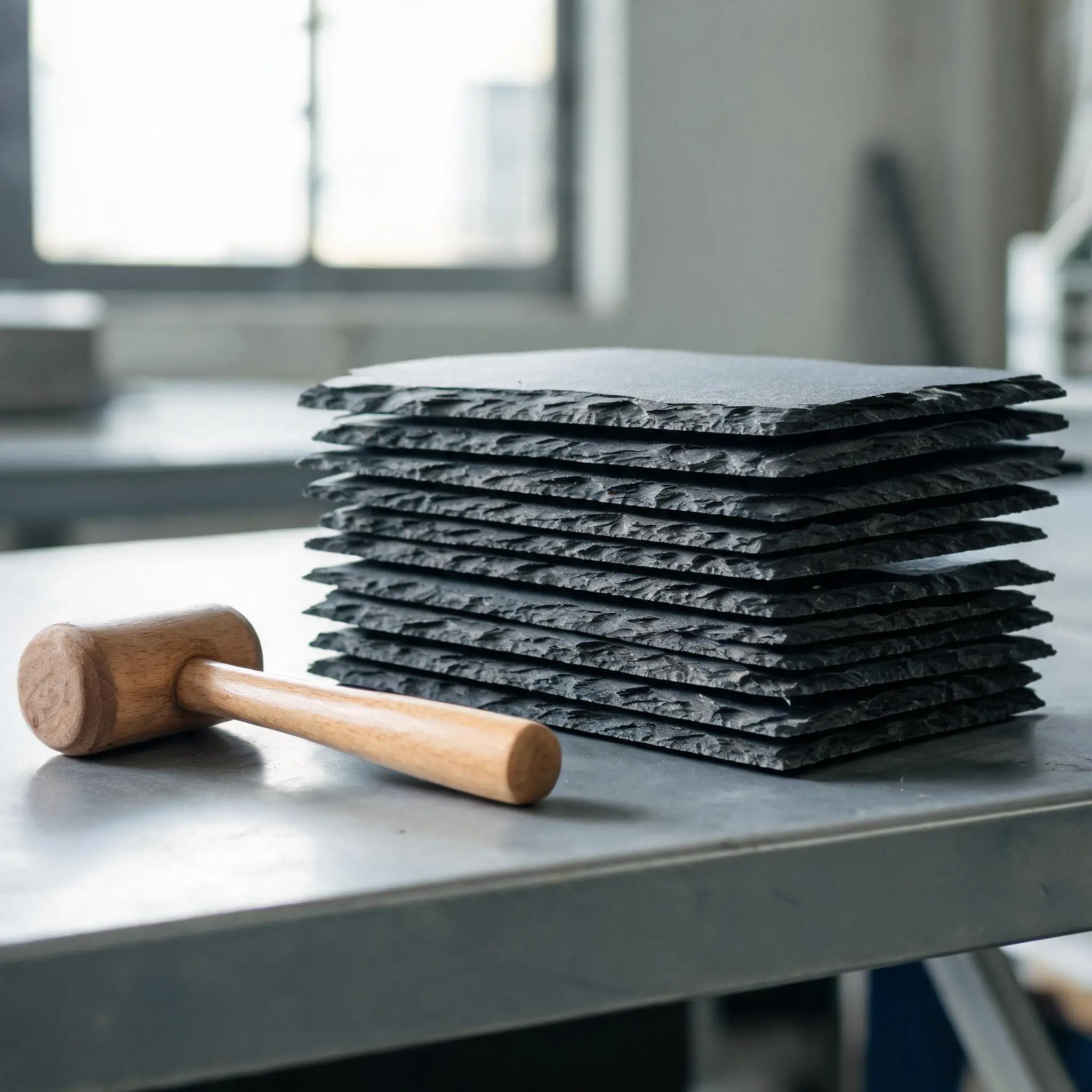
The ring test catches what no other check can: hidden internal cracks. A hairline crack that is invisible on the surface, a cleavage plane that almost separated but did not quite — these defects do not show up under raking light or a straightedge. But they kill the resonance. The slate cannot ring because the crack absorbs the vibration.
Every piece gets tapped. Not every tenth piece — every piece. On a busy day that is 300 to 400 taps. You develop an ear for it. My team can sort a pallet of tiles in 20 minutes by sound alone, pulling out the dead ones before they even reach the visual checks.
What gets rejected: any tile that does not ring clear. There is no tolerance here, no "mostly rings." It either rings or it does not. A tile with a dead sound goes to the reject pile, and we break it with a hammer to confirm the internal crack. Ninety-nine times out of a hundred, there it is — a dark line inside the stone that never reached the surface.
What Happens to the Rejects
Rejected pieces do not go in the bin. They go back to the floor, sorted by reason.
Tiles that are oversized go back to the splitter to be trimmed down. Tiles that are undersized are cut to the next smaller standard size — a 500×250 mm tile that came out too small becomes a 400×200 mm tile. Tiles with surface defects but sound structure go to the seconds pile: sold locally at a discount for garden walls, pathways, and non-structural uses where appearance matters less.
Only tiles with structural problems — hidden cracks, severe pyrite clusters, delamination — are broken and discarded. The stone dust and fragments go to a local brick factory as aggregate. Nothing is wasted.
The reject rate is tracked daily and weekly. If the rate spikes, we trace it back: which quarry face, which splitter, which machine. The batch number on every tile tells us where it came from and when it was made. That brings us to the last step.
Batch Numbers and the Paper Trail
Every tile that passes all six checks gets a batch number. Not a label stuck on the surface — a number written on the packing slip and stamped on the end of the crate.
The batch number encodes three things: the quarry face the block came from, the date it was split or machined, and the inspector who passed it. If a customer finds a problem with a tile six months after it ships — a pyrite cluster that started rusting, a crack that opened after a hard freeze — we can trace that tile back to the exact block, the exact day, and the exact person who inspected it.
Before the crate is sealed, one final visual check: are the tiles packed the right way up? Are the cardboard dividers in place? Is the batch number on the crate end legible? This is not a measurement — it is a confirmation that the tiles that passed all six checks are the tiles going into the crate, not a mix-up from the seconds pile.
This is not a marketing claim. It is a working system. We have used it to recall two batches in the last five years: one where a section of the quarry face had a carbonate vein we did not catch at the splitting stage, and one where a CNC tool wore out mid-shift and the thickness drift crept just over tolerance. In both cases, we contacted the customer before they noticed the problem, because the batch tracking told us exactly which crate was affected.
That is what 100% inspection buys you. Not perfection — no factory is perfect. But the ability to know exactly what went wrong, when, and where, and to catch it before the customer does.
Why 100%, Not Batch Sampling
I have been asked, more than once, by visiting buyers why we do not switch to batch sampling. The argument is always the same: "If your process is under control, you do not need to check every piece. Sample 10%, run the statistics, trust the process."
It sounds reasonable. It works for stamped metal parts or injection-moulded plastic, where every piece is identical because the machine makes them identical. Slate is not stamped. Slate is split from a natural block, and every block is different. The cleavage plane is not perfectly parallel. The mineral distribution varies within a single block. A block can look perfect on the outside and have a soft vein running through the middle that only shows up on the 20th tile.
Batch sampling assumes defects are randomly distributed. In slate, they are not. They cluster. A bad section of quarry face produces a run of 30 or 40 tiles with the same hairline crack pattern. If those 40 tiles happen to fall between your sample points, they all ship — and the customer finds them on the roof, one by one, over the next two winters.
Checking every piece is slower. It costs us 2 to 3 minutes per tile across all six checks, which means a four-person inspection team clears about 600 to 800 tiles in a working day. We could double that with batch sampling. But the cost of a recall — the freight, the replacement, the damaged reputation — is always higher than the cost of the inspection team. Every time.
Our laboratory test results tell you what the stone is capable of: density, water absorption, flexural strength, freeze-thaw resistance. Those numbers come from a sample, tested in a lab. They tell you the material is sound. The 100% inspection tells you that the specific tile in your hand is sound. You need both — the lab data to know the stone, and the piece-by-piece check to know the tile.
If you want to see the inspection process from the buyer's side — what to check when you visit a factory or when a container arrives at your port — read our guide to evaluating roofing slate quality and our inspection checklist for container opening. This article is the story from our side of the bench.
Frequently Asked Questions
What does "100% inspection" actually mean in a slate factory?
It means every single piece — not a sample, not every tenth tile — is checked against all six criteria before it goes into a crate. Dimensions, thickness (five points), flatness, surface, edges, and ring test. If a piece fails any one of those checks, it does not ship. The reject rate in our factory runs between 8 and 13%, depending on the quarry face and the season.
How long does it take to inspect one slate tile?
About 2 to 3 minutes per piece across all six checks. A four-person team clears 600 to 800 tiles per day. The ring test is the fastest — a few seconds per tile. The flatness check with a straightedge and feeler gauge is the slowest, because we measure in three directions.
What is the most common reason a slate tile gets rejected?
Thickness variation. Slate splits along a natural cleavage plane, and that plane is not perfectly parallel. If a tile varies by more than 1 mm across its five measurement points, it goes back — even if each point is individually within tolerance. A roof laid with tiles of varying thickness looks wavy and uneven.
How is 100% inspection different from laboratory testing?
Laboratory testing (EN 12326 or ASTM C406) analyses a small sample of tiles for density, water absorption, flexural strength, freeze-thaw resistance, and mineral composition. It tells you the material is sound. 100% inspection checks every individual tile for manufacturing defects — cracks, chips, thickness drift, flatness deviation. You need both: the lab report to characterise the stone, and the bench inspection to guarantee the tile.
Do you inspect billiard slate the same way as roofing slate?
The same six checks, but with tighter tolerances. Roofing slate thickness is held to ±0.5 mm; billiard panels to ±0.1 mm (or ±0.05 mm for high-precision competition tables). Roofing flatness allows a 0.3 mm gap under a straightedge; billiard panels allow 0.1 mm. The edge joint between two billiard panels is checked with a 0.05 mm feeler gauge. The ring test is the same for both.
Can I trace a slate tile back to its quarry origin?
Yes. Every tile that passes inspection carries a batch number that encodes the quarry face, the production date, and the inspector's ID. If a problem surfaces months or years after shipping, we can identify the affected batch and trace it to the specific block and day. We have used this system to proactively recall two batches in five years — both times before the customer noticed the issue.
Want to See the Inspection Bench Yourself?
Every tile we ship has passed six checks and carries a traceable batch number. If you are ordering roofing slate or billiard panels, ask us for the inspection record of your batch — we will send it with the shipping documents.