
Jiujiang Slate Flatness & Dimensional Stability
Surface flatness (CNC-machined): ±0.1 mm standard / ±0.05 mm precision ground
Thermal expansion: 0.0075 mm/m·°C — a 600 mm tile grows 0.045 mm per 10 °C change
Inspection: 100% — every panel, straightedge + feeler gauge, no sampling
Open my tool roll and the first thing you see is a set of feeler gauges — twelve steel blades, each thinner than the last. The thinnest is fifty microns: 0.05 mm. About half the thickness of a human hair.
If I can slide that blade under a straightedge resting on a slate surface, the panel fails.
I run flatness inspection in our Jiujiang factory. I've been doing this for fifteen years — every billiard panel, every roofing tile, every custom slab that leaves this building comes across my bench. And the question I get asked most by buyers is not how flat is it? but does it stay flat?
Two different questions. The first is about machining. The second is about the stone itself — its density, its thermal expansion, its refusal to warp. Both matter. A perfectly machined panel cut from stone that warps in five years is worse than a roughly machined panel cut from stone that doesn't move.
This is my logbook — what I measure, what the numbers mean, and why Jiujiang slate stays flat long after it leaves my bench.
Log 01 — What "Flat" Actually Means
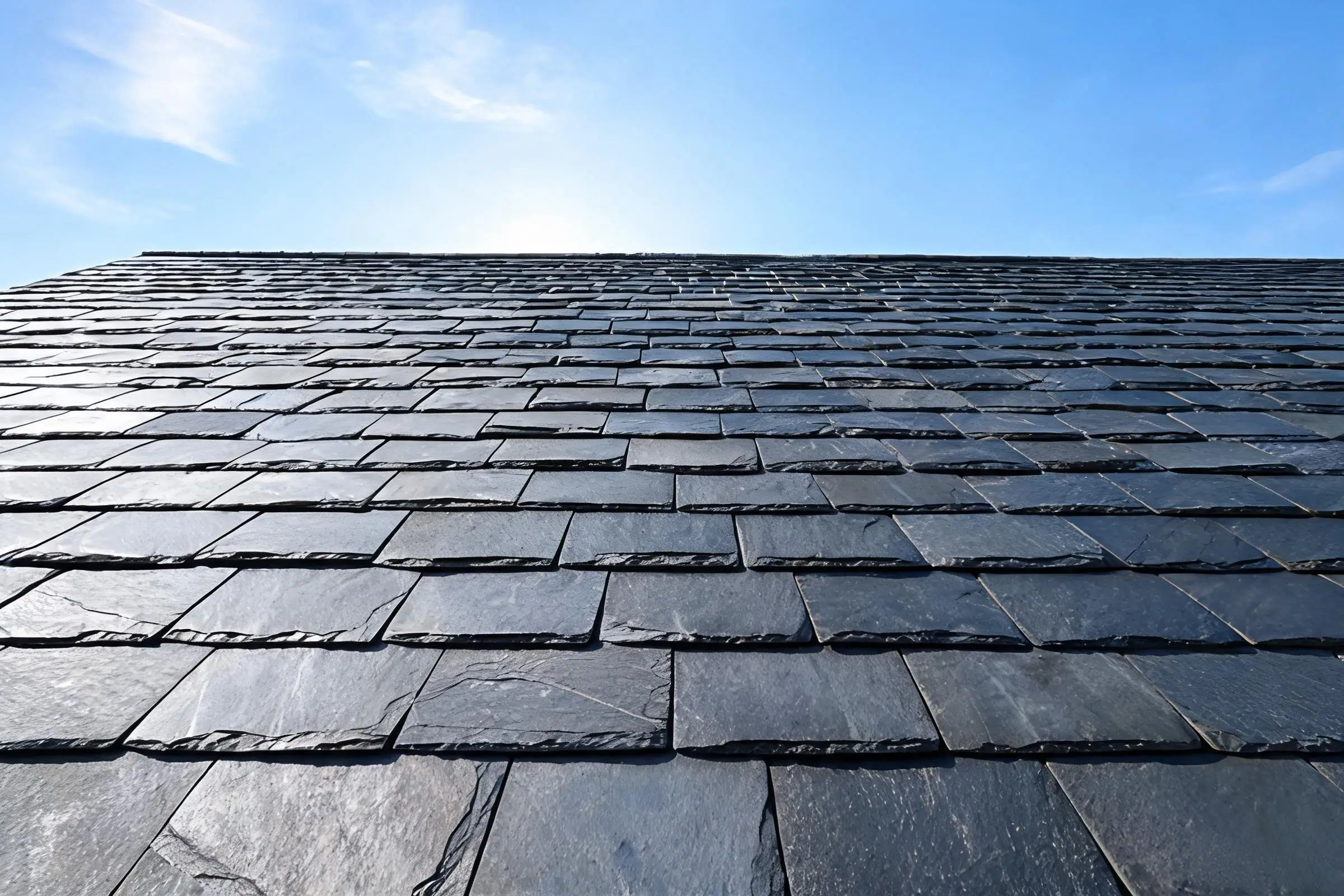
A roofing tile can have a rough, natural cleft surface — the texture of split stone, ridges you can feel with your fingertips — and still be perfectly flat. Flat doesn't mean smooth. Flat means the surface sits in a single plane. Put a precision straightedge across it and the contact is uniform.
A billiard bed needs both. The surface must be flat (single plane) and smooth (low surface roughness) because a ball rolls on it. That's why billiard panels go through CNC grinding after splitting — the cleft face is flat enough for a roof but not smooth enough for a table.
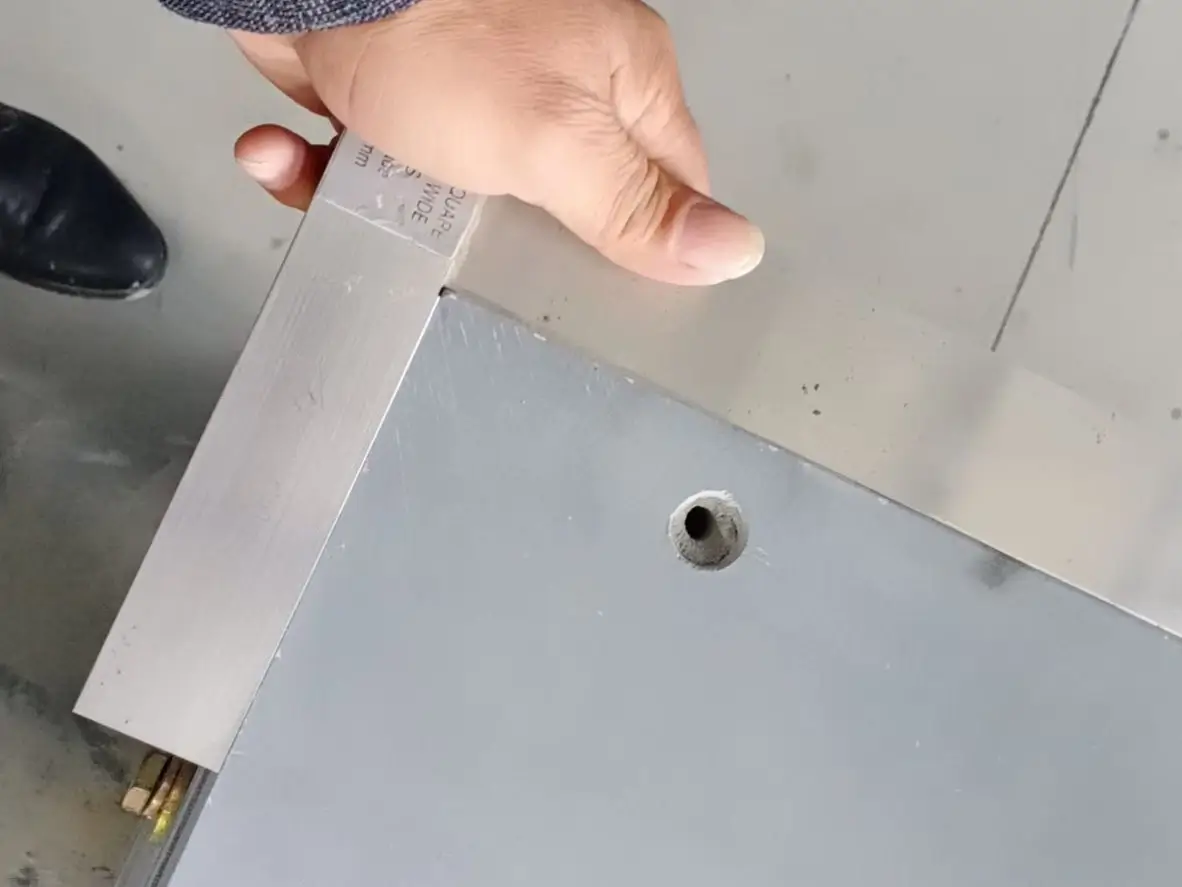
I mention this because I've seen buyers confuse the two. They run a hand across a roofing tile, feel the natural texture, and conclude the tile isn't flat. It is. What they're feeling is surface roughness — about 0.3–0.5 mm of micro-relief on a natural cleft face. The plane underneath is flat to within ±0.5 mm across a 600 mm tile, which is the roofing standard.
For billiard beds, we hold ±0.1 mm. For precision-grade tournament beds, ±0.05 mm. That's the thickness of a sheet of paper.
Your fingertip can detect a surface deviation of about 0.02 mm — thinner than a sheet of paper. So ±0.1 mm is "feels flat" to anyone who runs a hand across it. But a billiard ball rolling at 2 m/s can feel the difference. A 0.1 mm dip over a 100 mm span changes the ball's trajectory by about 0.06° — invisible to the eye, but enough to miss a long pot.
Log 02 — The ±0.1 mm Number and Where It Comes From
A billiard panel arrives at my bench as a rough-sawn slab — straight off the block saw, ±1 mm at best. From there it goes through three stages:
Surface grinding. A diamond-faced wheel removes material from both faces, bringing the slab to near-final thickness and flatness of about ±0.3 mm.
CNC precision grinding. A computer-controlled head with a finer-grit diamond tool passes across the surface, tightening flatness to ±0.1 mm.
Precision finish (optional). Additional grinding passes with progressively finer grit, bringing flatness to ±0.05 mm for tournament-grade tables.
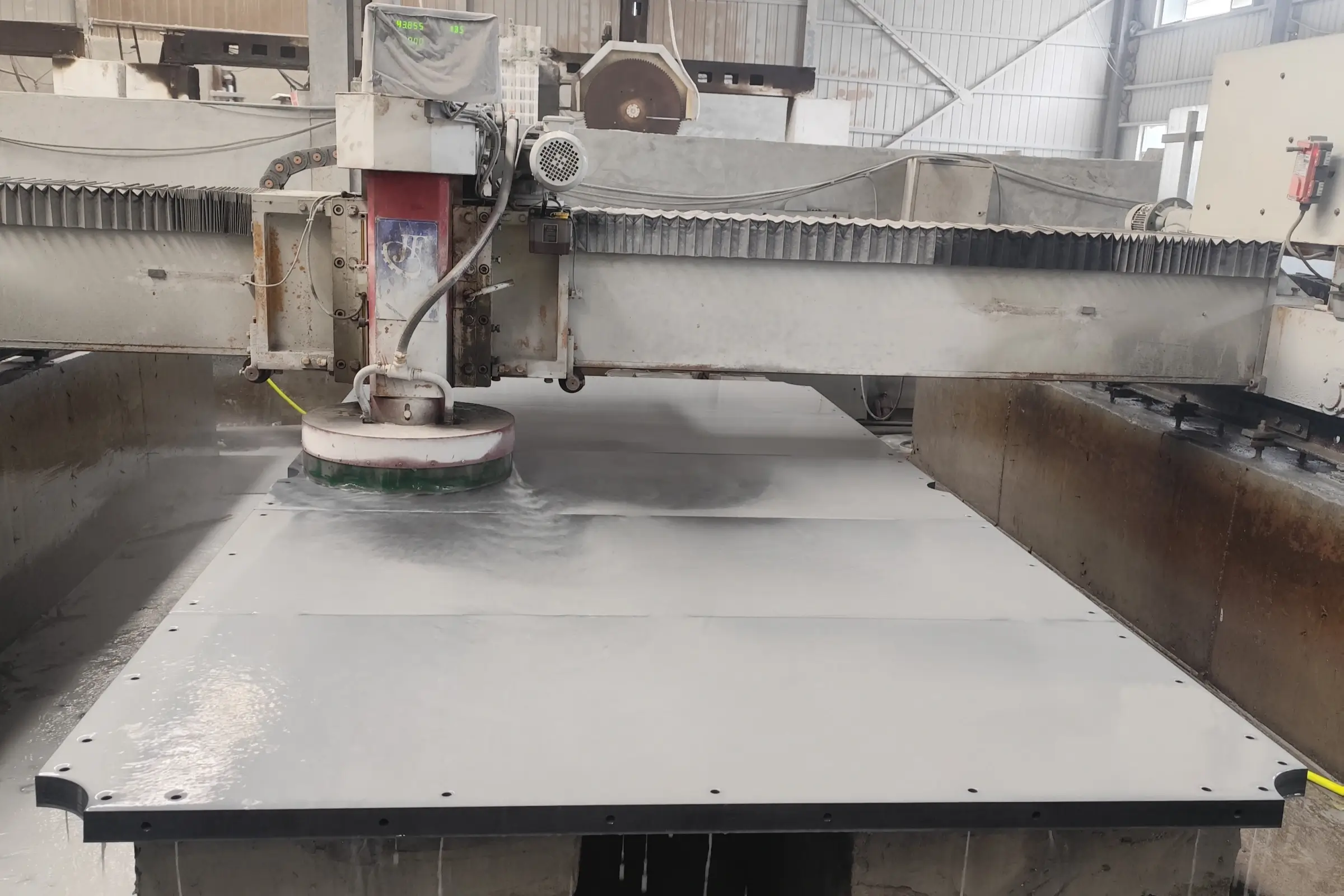
Why ±0.1 mm and not ±0.01 mm? Because slate is a natural material, not a machined metal. The mineral grain — interlocked muscovite and quartz — creates micro-variations in hardness across the surface. The diamond tool cuts slightly deeper where the stone is slightly softer. At ±0.1 mm, those variations average out. Below that, you're fighting the stone's own mineral fabric.
Why Jiujiang slate specifically holds this tolerance comes down to two things we've measured in other articles: density and hardness. The density is uniform — 2.7–2.8 g/cm³ with minimal variation across a block — so the CNC tool encounters consistent material resistance and cuts evenly. The hardness sits at Mohs 3–4, which is the sweet spot: hard enough that the diamond tool cuts cleanly, soft enough that the tool doesn't deflect or overheat. Granite at Mohs 6–7 needs more cutting force, which generates heat, which causes thermal expansion in the workpiece, which drifts the tolerance to ±0.3 mm.
| Application | Dimension | Standard tolerance | Precision tolerance |
|---|---|---|---|
| Billiard bed flatness | Surface plane | ±0.1 mm | ±0.05 mm |
| Billiard bed thickness | Panel thickness | ±0.15 mm | ±0.1 mm |
| Roofing tile thickness | 4–8 mm tiles | ±0.5 mm | ±0.3 mm |
| Roofing tile length / width | 500×300 mm typical | ±2 mm | ±1 mm |
A billiard bed needs ±0.1 mm because a ball rolls on it. A roofing tile needs ±0.5 mm because water sheds off it. Different jobs, different numbers.
Log 03 — Dimensional Stability: The Stone That Doesn't Move
Machining a panel to ±0.1 mm is one thing. Keeping it there for twenty years is another. That's the dimensional stability question — does the stone move?
The number on our 2001 building-grade certification reads: linear thermal expansion coefficient 0.0075 mm/m·°C. What that means physically: take a one-metre slate tile, heat it by one degree Celsius, and it grows 0.0075 mm. Cool it by one degree and it shrinks by the same amount.
Let me make that real. A 600×300 mm roofing tile on an English roof goes from −5 °C on a January night to +35 °C on a July afternoon — a 40 °C swing. The expansion: 0.0075 × 0.6 × 40 = 0.18 mm. Less than two sheets of paper.
For a 2.4-metre billiard bed panel in a room that shifts from 15 °C overnight to 25 °C during the day: 0.0075 × 2.4 × 10 = 0.18 mm. The same number, coincidentally — and it's absorbed entirely by the joint gap between the three panels.
Now compare that to other materials:
| Material | Expansion (mm/m·°C) | 600 mm tile, 50 °C swing |
|---|---|---|
| Jiujiang slate | 0.0075 | 0.225 mm |
| Glass | 0.009 | 0.270 mm |
| Concrete | 0.010 | 0.300 mm |
| Steel | 0.012 | 0.360 mm |
| Aluminium | 0.024 | 0.720 mm |
Slate moves less than any of them. That's not marketing — that's the mineral composition. High silica (SiO₂ 66.46%), low calcium (CaO 0.56%), fully recrystallised metamorphic fabric. The mineral grains are locked together — mica and quartz interlocked at a microscopic scale — and there's no free water in the pores to freeze, expand, and distort the stone.
Moisture stability matters too. A stone that absorbs water swells. Our water absorption rate is 0.1% — one of the lowest in the industry. A 4 kg roofing tile soaked for 48 hours gains less than 4 grams. That amount of water causes no measurable dimensional change.
And here's what I see in practice: panels I measured five years ago, stored in unheated factory space through Jiangxi's humid summers and cold winters, measure the same today. The stone doesn't creep. It doesn't cup. It doesn't twist. The metamorphic fabric that took hundreds of millions of years to form doesn't relax in a warehouse.
Log 04 — The Billiard Bed: Where Flatness Decides Everything
A 9-foot billiard table uses three slate panels — each about 1.5 m × 0.85 m × 25 mm — that must align into a single flat plane 2.4 m × 1.27 m. The joints between them are the critical point. If the panels aren't flat, the joints step — one panel sits 0.2 mm higher than the next, and every ball crossing that joint deflects.
Here's how we make sure they align.
Each panel is CNC-ground to ±0.1 mm independently. The mating edges — the short edges where two panels meet — are machined to the same tolerance. When the three panels are placed on the table frame and pulled together with the frame's connecting bolts, the joint surfaces meet at the same height.
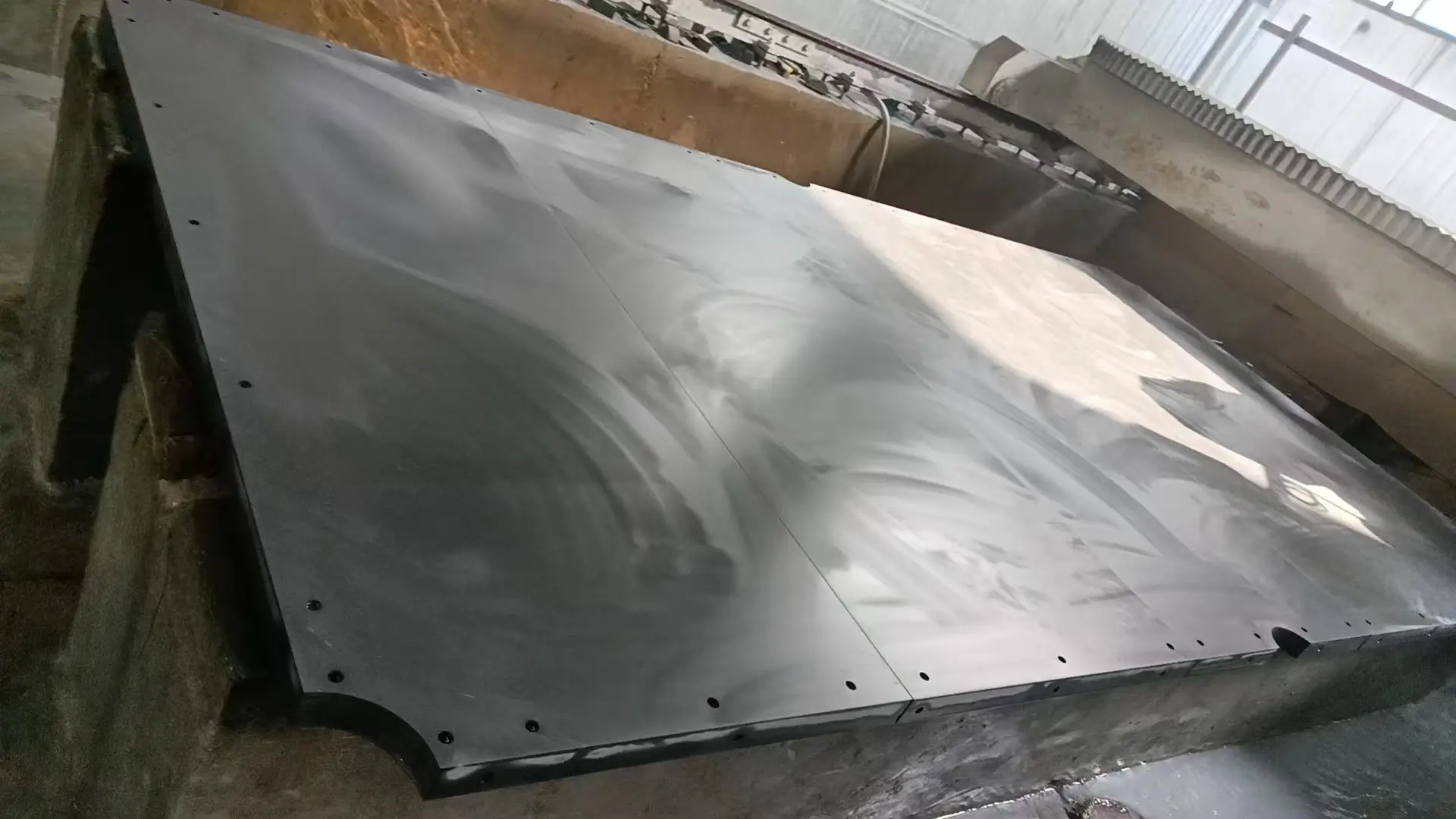
The test is simple. I place a coin at the joint — across the seam, straddling both panels. If the coin rocks, the joint is off. If it sits flat, the joint is level. A billiard ball rolled slowly across the joint should not veer. If it does, there's a step — and the panel goes back to grinding.
A professional tournament table has a flatness specification of about 0.5 mm across the entire 2.4 m playing surface. Our three panels, each at ±0.1 mm, aligned — the worst case is about 0.3 mm total deviation. Well within spec.
But here's the part most people miss: a table that's flat today must stay flat tomorrow. The room heats up during a tournament — lights, spectators, doors opening and closing — and the temperature can rise 10 °C in an hour. The 2.4 m panel expands 0.18 mm. Where does it go?
Into the joint gap. We machine a deliberate 0.2–0.3 mm gap between panels — not visible to the eye, but wide enough to absorb thermal expansion without the panels pressing against each other and lifting. The felt cloth covers the gap. The balls never know it's there.
This is why dimensional stability matters on a billiard table as much as flatness. A stone that expands 0.024 mm/m·°C — like aluminium — would grow 0.58 mm over a 2.4 m panel with a 10 °C change, more than the joint gap can absorb. The panels would press together, lift at the joint, and the table would go out of level. Jiujiang slate's 0.0075 keeps the expansion inside the gap.
Log 05 — The Roofing Tile: Where Flatness Keeps Water Out
Nobody runs a billiard ball across a roof. So why does flatness matter for roofing tiles?
Because water finds every gap. A roofing tile that cups — edges lifting, centre dropping — opens a channel between itself and the tile below. Wind-driven rain doesn't need much of a channel. A 1 mm gap is an open door.
A flat tile laps correctly. The upper tile overlaps the lower tile by the headlap distance (typically 70–75 mm), and the two flat surfaces sit in full contact. Water runs down the upper face, hits the overlap, and continues down the lower face. No sideways travel, no infiltration.
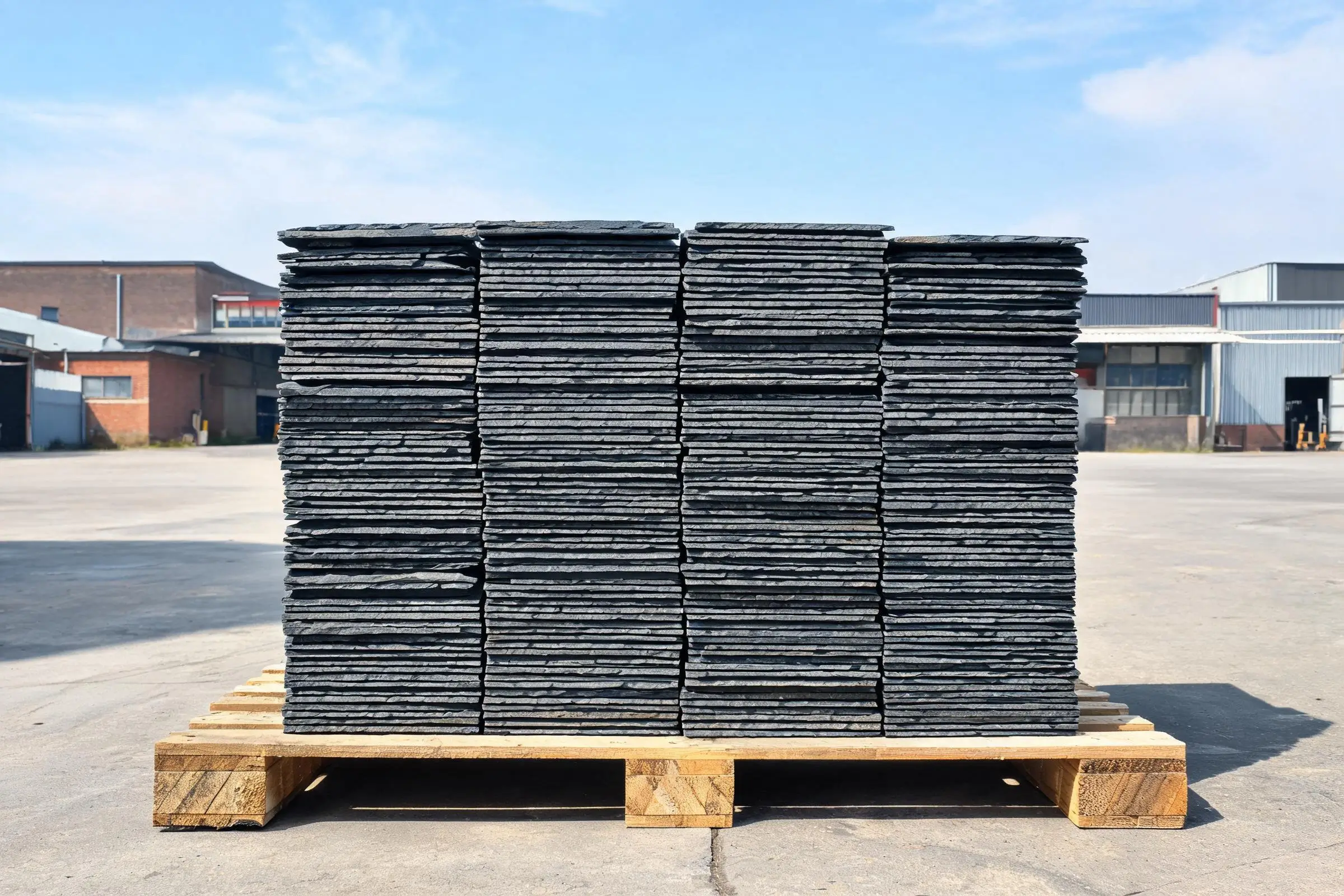
Dimensional stability is what keeps a tile flat for a century. Consider what a roof goes through: −10 °C on a February night, +40 °C under direct summer sun — a 50 °C swing. Rain, snow, frost, UV. A 600 mm tile expanding 0.225 mm across that range is nothing — the overlap absorbs it. But a tile that cups by 2 mm at the corners because the stone warped? That's a leak waiting to happen.
The data backs this up. Our 2001 certification includes a softening depth test — an accelerated weathering test that simulates decades of natural exposure. The result: 0.025 mm of surface softening under accelerated conditions. Translated to natural exposure, that's roughly 0.1–0.3 mm of surface change over 50 years. The flatness of the tile barely moves.
Compare that to concrete tiles, which can continue to hydrate and shrink over years, or some clay tiles that cup from residual firing stresses. Natural slate from a stable deposit doesn't have those mechanisms. The stone was finished changing a long time ago. See our roofing slate specifications.
Log 06 — Inside the 100% Inspection Protocol
I mentioned that every panel comes across my bench. Let me walk you through what happens.
Surface flatness. I use a calibrated steel straightedge — 1.5 m long, straight to ±0.01 mm — and a set of feeler gauges. I place the straightedge across the panel surface in five positions:
- Full length, along the long axis
- Full width, along the short axis
- First diagonal
- Second diagonal
- Centre cross
At each position, I try to slide feeler gauges under the straightedge. For standard billiard panels, a 0.1 mm blade must not pass. For precision-grade panels, a 0.05 mm blade must not pass. If either blade slides under, the panel goes back to grinding.
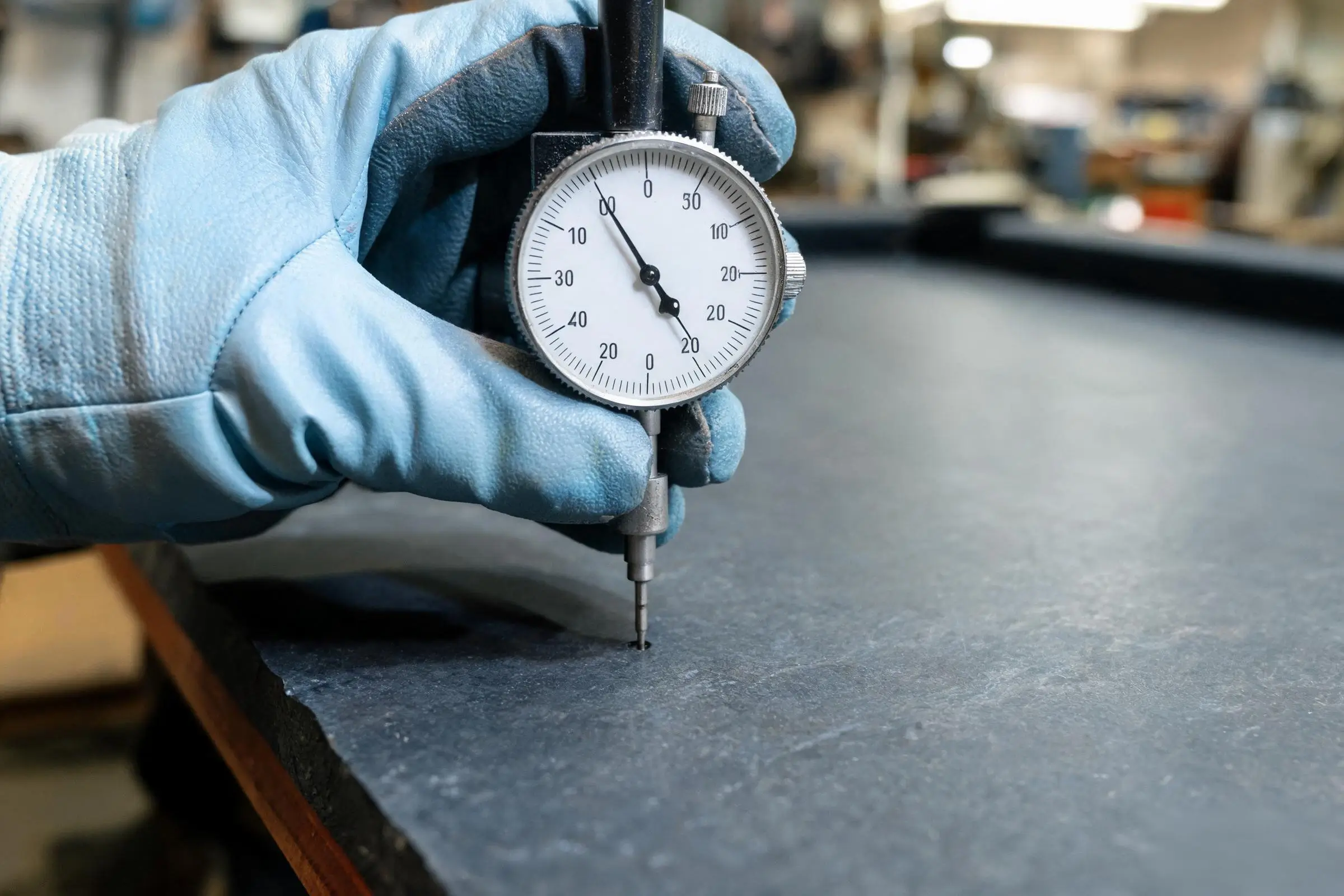
Thickness. Digital caliper at six points: four corners and the centre of each long edge. For billiard panels, the spread must be within ±0.15 mm. For roofing tiles, ±0.5 mm.
Dimensions. Length and width verified against the order specification. Tolerance: ±1 mm for billiard, ±2 mm for roofing.
Surface. Visual inspection for scratches, chips, mineral veins, or any defect that would affect play (billiard) or water shedding (roofing).
Every panel gets a card — a small paper tag with the measured flatness deviation, thickness range, and inspector's stamp. That card goes in the crate with the panel. If a customer ever questions a panel's flatness, we can pull the card and tell them exactly what we measured on the day it left the factory.
This is 100% inspection — not statistical sampling. We don't check one panel in ten and assume the rest are the same. We check every single one. That's the only way to guarantee ±0.1 mm on every piece, not "typical" or "average."
Log 07 — Three Tests a Buyer Can Run Today
You don't need my bench to check flatness. Here are three tests you can run on a sample tile or panel with tools you probably already have.
Test 1: The Straightedge Test. Get the longest precision straightedge you can — a good-quality spirit level works, at least 1 m long. Lay it across the slate surface in different directions. Look for light leaking under the edge. A flat surface shows uniform contact or tiny, even gaps. An uneven surface shows bright gaps on one side and dark contact on the other.
Test 2: The Paper Test. A standard sheet of A4 paper is about 0.1 mm thick. Slide it under the straightedge — if it passes, the panel is at the tolerance boundary. If it slides freely, the deviation is over 0.1 mm. For a quick check on a roofing tile, this tells you whether the tile is within the roofing flatness spec.
Test 3: The Ball Roll Test (billiard only). Place a clean billiard ball on the bare slate surface — no cloth — and give it a slow, gentle push. It should roll straight for at least 30 cm without curving. Any curve means a flatness issue. For a three-piece bed, roll the ball slowly across each joint. It should cross without bouncing or deflecting.
Bonus: The Coin Test. For three-piece billiard beds, place a coin across the joint, straddling both panels. Tap it lightly. If it rocks or clicks, the joint has a step. If it sits firm, the joint is level.
Frequently Asked Questions
What does ±0.1 mm flatness tolerance mean in everyday terms?
About the thickness of a sheet of A4 paper. If you lay a precision straightedge across a slate surface machined to ±0.1 mm, you should not be able to slide a standard sheet of paper under the edge. For precision-ground billiard panels at ±0.05 mm, even half a sheet of paper won't pass.
Can natural slate warp or lose flatness over time?
Not under normal conditions. Slate's thermal expansion coefficient is 0.0075 mm/m·°C — one of the lowest among building stones. A 600 mm tile on a roof experiencing a 50 °C temperature swing moves less than a quarter of a millimetre. The metamorphic fabric — interlocked mica and quartz formed over hundreds of millions of years — doesn't relax or creep. Panels stored in unheated factory space for five years measure the same as the day they were ground.
How does temperature affect a billiard slate bed?
A 2.4-metre panel experiencing a 10 °C room temperature change expands 0.18 mm — well within the 0.2–0.3 mm joint gap designed to absorb it. The table stays flat. A stone with a higher expansion coefficient would press the panels together, lift the joint, and put the surface out of level. This is why dimensional stability matters as much as initial flatness on a billiard table.
What's the difference between surface smoothness and flatness?
Smoothness is about texture — how the surface feels to the touch. Flatness is about the plane — whether the surface deviates from a perfect flat reference. A natural cleft roofing tile can be rough to the touch (0.3–0.5 mm surface micro-relief) yet perfectly flat in plane (±0.5 mm across 600 mm). A billiard bed needs both: flat for true ball roll, smooth for consistent speed.
I don't have professional measuring tools — can I still check flatness?
Yes. A good-quality spirit level at least 1 m long works as a straightedge. Lay it across the surface and look for light gaps underneath. For a rough numeric check, try sliding a standard sheet of A4 paper (about 0.1 mm thick) under the edge — if it passes, the panel is at the tolerance boundary. For billiard panels, roll a ball slowly across the bare surface — any curve means a flatness issue.
Does flatness matter as much for roofing tiles as for billiard beds?
The tolerance is different — roofing tiles aren't CNC-machined to ±0.1 mm. But flatness still matters: a tile that cups or twists creates gaps where wind-driven rain enters, and freeze-thaw cracks it from there. Dimensional stability — the stone not moving over decades — is what keeps a roof flat and weatherproof for a century. A stone with low thermal expansion and low water absorption stays flat because it has no mechanism to warp.
Need slate that stays flat — on a table or a roof?
Every panel leaves our Jiujiang factory with a measured flatness card — the actual numbers, not a promise. If you need slate that holds its tolerance and doesn't move, send us your specification.