
4 Things That Make Jiujiang Slate Different (And How to Verify Each One)
Quick answer: Jiujiang slate stands apart on four measurable properties — not marketing claims:
- Density — 2.7–2.8 g/cm³, at the top of the natural slate range
- Water absorption — 0.2%, well below the 0.6% "excellent" threshold
- Machining tolerance — ±0.1 mm CNC standard, ±0.05 mm precision-ground
- Consistency — same formation, verified by 100% individual inspection
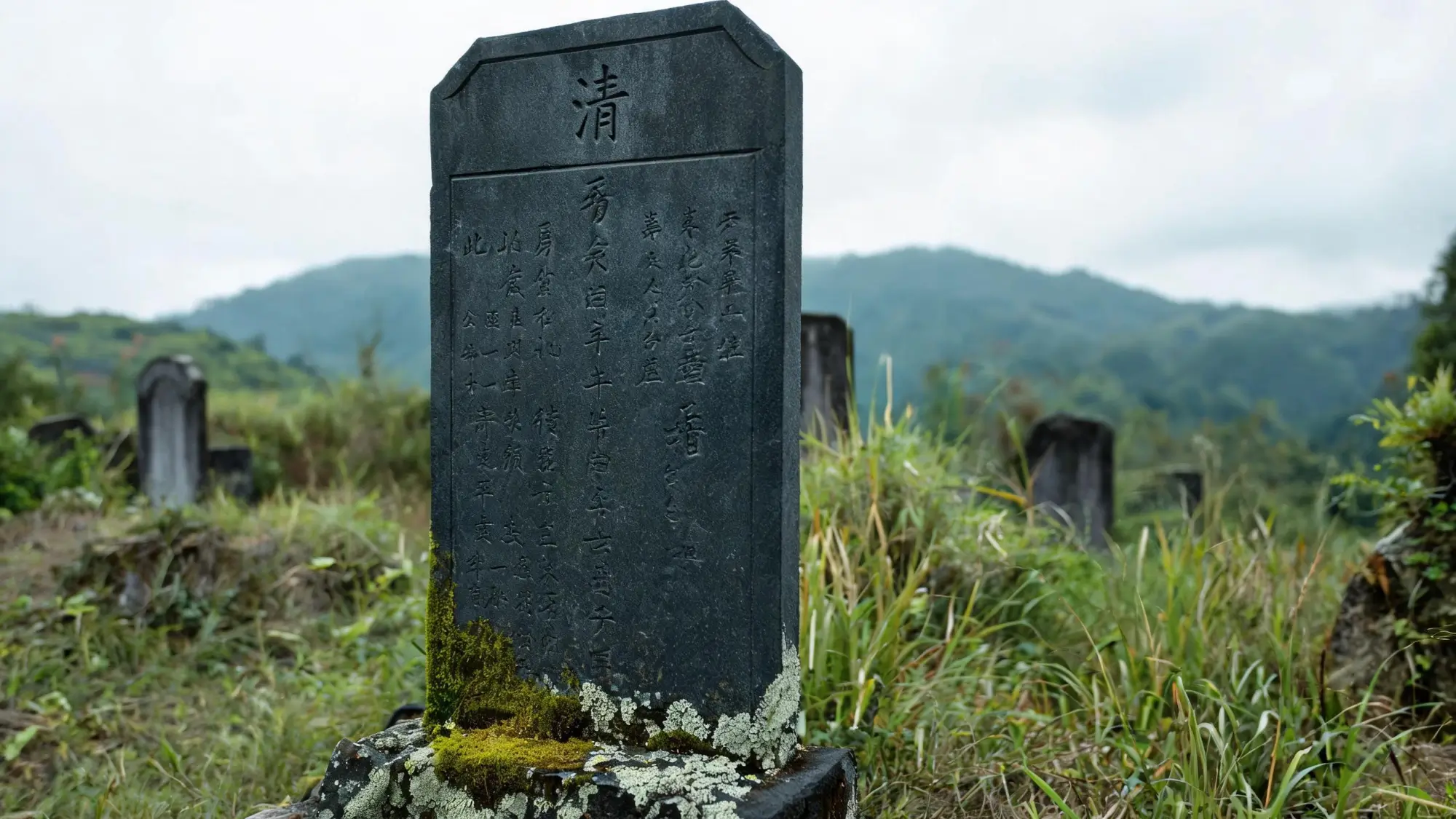
Plus one piece of evidence no competitor can produce: a 200-year-old tombstone, still intact, cut from the same rock.
The Difference Is Measurable, Not Marketed
Every slate supplier says their stone is "dense," "durable," "consistent." Those words mean nothing without numbers behind them. The difference with Jiujiang slate isn't a better story — it's a set of figures you can hold against a test certificate and verify with your own hands.
The same rock feeds two industries with completely different demands. Roofing buyers need thin, dense, frost-proof tiles. Billiard table builders need perfectly flat, dimensionally stable panels. One stone does both — not because of marketing, but because the geology of the Lushan–Xingzi belt produces a metamorphic rock with an unusual combination of density, cleavage quality, and mineral stability. You can read the full geological backstory in The Geology of Jiujiang Slate; here, we're focused on what you can measure.
Four properties separate this stone from the alternatives. One piece of field evidence backs them all up. Each one is something you can check — not just take our word for.
1. Density: 2.7–2.8 g/cm³ — Heavy Means Tight
Density is the foundation. A dense slate has less pore space, which means less water ingress, better frost resistance, and more stable dimensions under temperature change. Jiujiang slate consistently tests at 2.7–2.8 g/cm³ — at the upper end of the natural slate range.
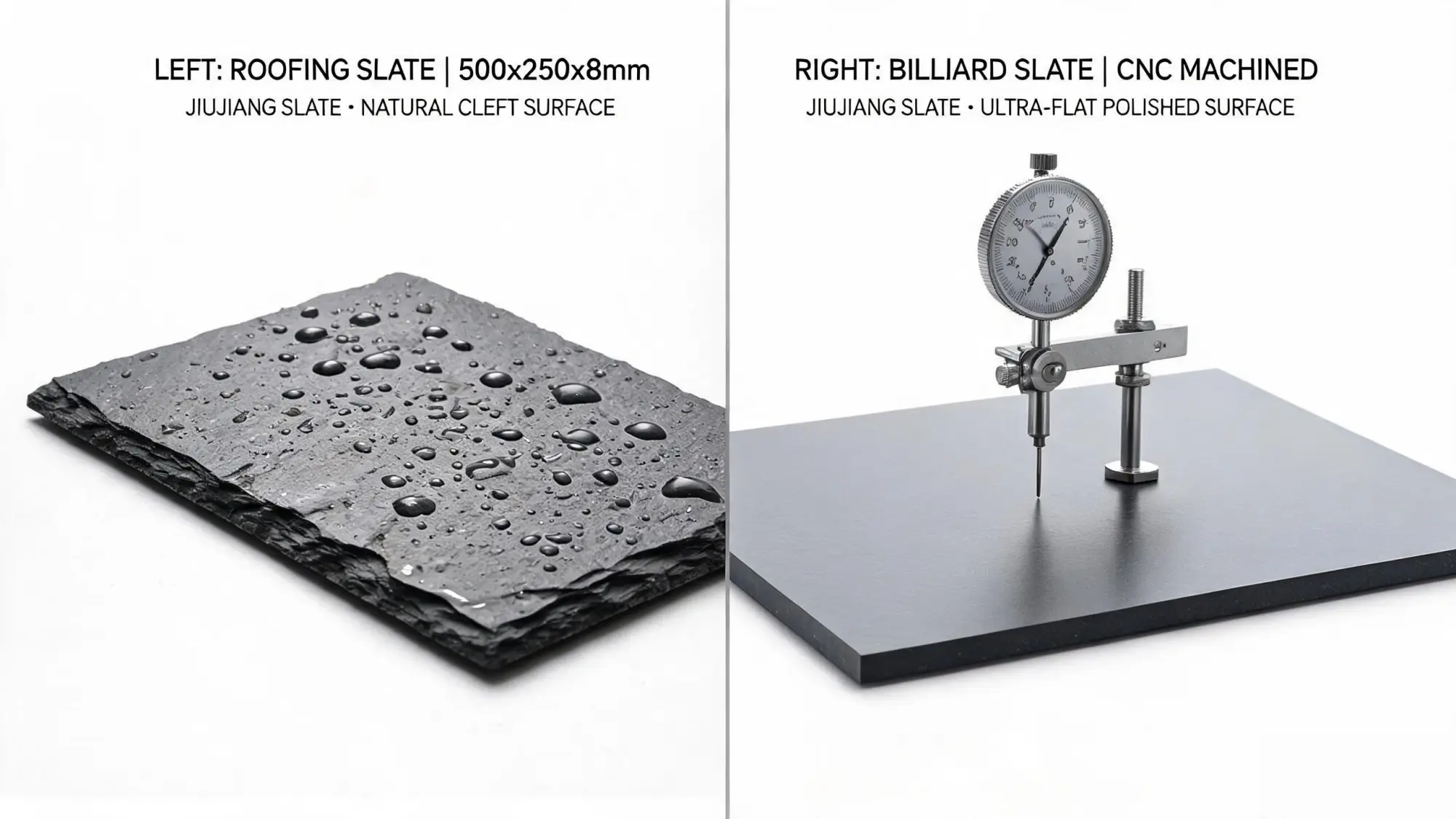
What does that feel like? A standard 500 × 250 × 8 mm roofing tile weighs about 2.4 kg. Pick one up and the first thing you notice is the heft. It doesn't feel like shale or a soft sedimentary stone. It feels like a brick.
On a roof, density translates directly to winter performance. Water can't easily penetrate a tight matrix. Freeze–thaw cycles — the single biggest killer of roofing slate in cold climates — depend on water getting in, freezing, and expanding. Less water in, less frost damage. It's that simple.
On a billiard table, density means the stone won't warp or absorb humidity from the air. A panel that stays flat for decades is a panel that started dense.
How to verify: Ask for the test report. Density is one of the easiest properties to measure and should appear on any EN 12326 or ASTM C406 certificate. If a supplier can't produce a number, that's the number that matters. For a deeper look at why density drives both frost resistance and flatness, see Jiujiang Slate Density.
2. Water Absorption: 0.2% — The Number That Decides Winter
If density is the foundation, water absorption is the figure that decides whether your roof survives January.
Jiujiang slate tests at 0.2% water absorption by weight. To put that in perspective: the EN 12326 standard classifies anything under 0.6% as excellent. Welsh Penrhyn slate — the gold standard for heritage roofs — sits around 0.3–0.4%. Jiujiang slate is in the same neighbourhood, and in some batches, lower.
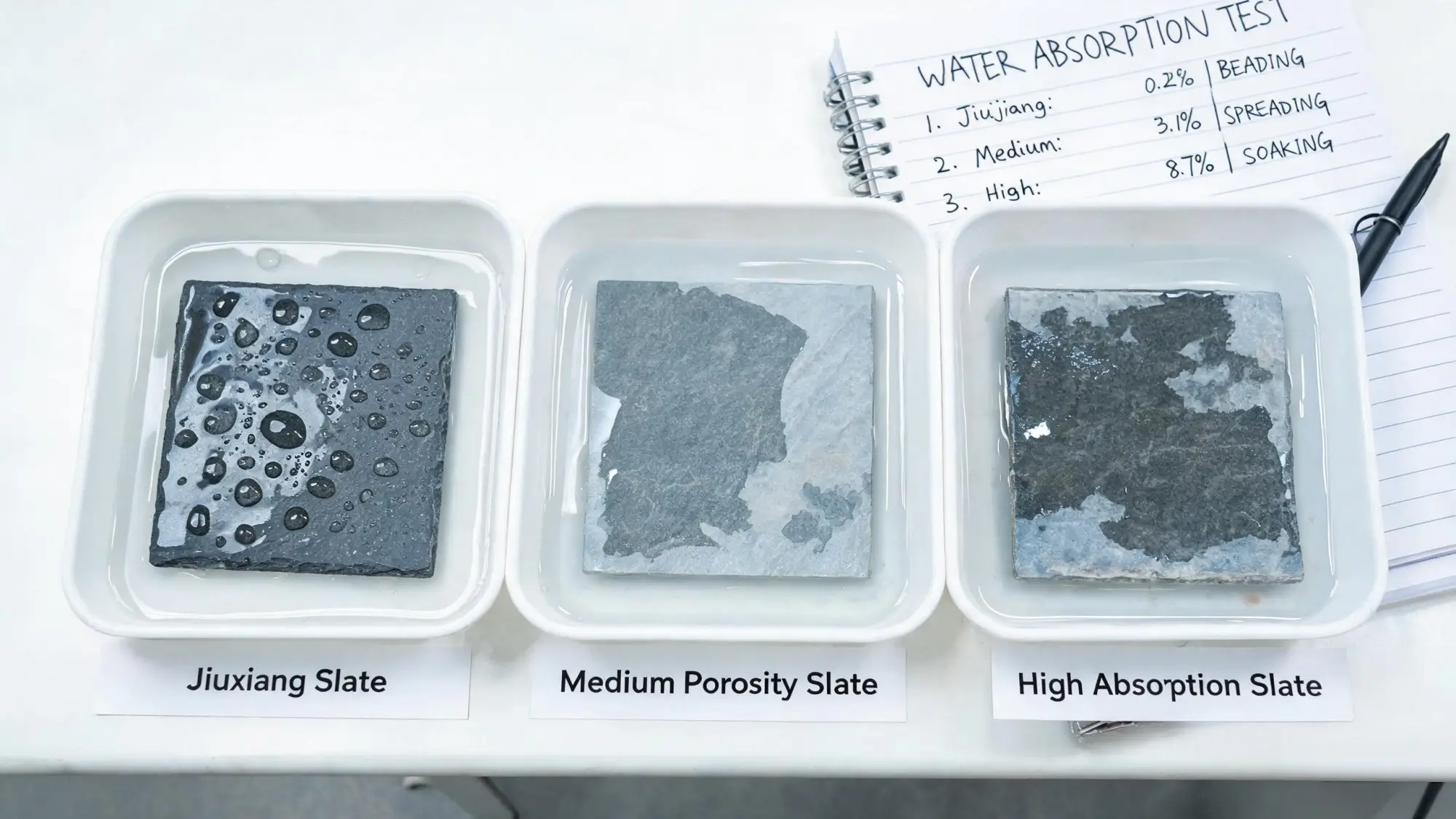
What 0.2% means in practice: take a 500 × 250 × 8 mm tile (about 2.4 kg) and soak it in water for 48 hours. It absorbs roughly 5 grams — a teaspoon of water spread across the entire tile. Compare that to a higher-absorption slate at 3%: the same tile would drink 72 grams, fourteen times more.
More water inside means more expansion when it freezes. More expansion means more internal stress. More stress means cracks, delamination, and eventually a roof that sheds tiles in March.
Our slate has been tested through 120 freeze–thaw cycles in the lab — zero weight loss, zero structural change. But the lab test runs for 120 days. For the real proof, keep reading.
How to verify: The water absorption test is cheap and standard. Any EN 12326 or ASTM C406 report includes it. You can also do a rough version yourself: weigh a dry sample, soak it for 24 hours, weigh it again. The percentage difference tells you everything. For the full picture on why this number matters more than any other, see Jiujiang Slate Water Absorption and Water Absorption: Why It Decides Longevity.
3. Machining Performance: ±0.1 mm — The Tolerance You Can See
Not all dense slate machines well. Some stone is hard but brittle — it chips under the cutter. Some splits cleanly but won't hold a machined edge. Jiujiang slate does both: it's hard enough to grind to a precision surface, and stable enough to hold that surface over time.
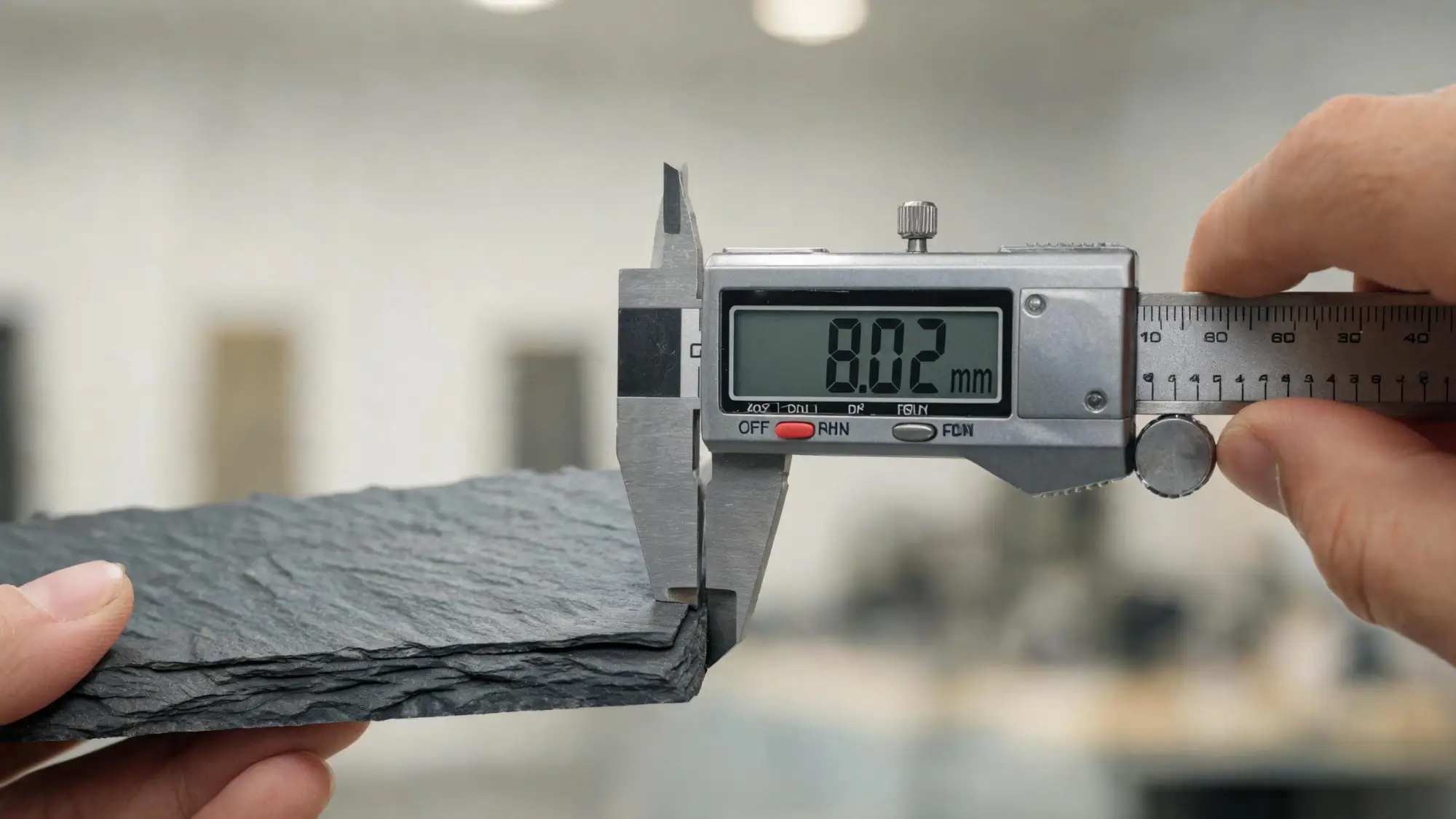
The standard CNC tolerance in our factory is ±0.1 mm. For precision billiard bed panels, we grind to ±0.05 mm. To visualise: 0.1 mm is roughly the thickness of a sheet of printer paper. That's the maximum deviation allowed across an entire panel surface.
Why does this matter for roofing buyers who aren't ordering billiard panels? Because the same machining capability produces roofing tiles with consistent dimensions. A tile that's supposed to be 500 × 250 × 8 mm is 500 × 250 × 8 mm — not 8.3 on one edge and 7.7 on the other. Consistent dimensions mean even headlap, even courses, and no gaps that water can exploit on a rainy night.
For the billiard trade, this tolerance is the entire game. A three-piece table bed that isn't flat to within a fraction of a millimetre will produce a table where balls roll off-line. Jiujiang slate is the reference source for table builders worldwide precisely because the stone machines flat and stays flat. Roughly 80% of our output goes to roofing; 20% goes to billiard. The same rock, different finishing — and the machining tolerance is what makes the 20% possible.
How to verify: Bring a digital caliper to your sample. Measure thickness at five points — four corners and centre. The spread tells you the tolerance. A roofing tile should be within ±0.5 mm; a billiard panel within ±0.1 mm. For the full technical breakdown, see Jiujiang Slate Flatness & Dimensional Stability.
4. Consistency: Same Rock, Same Batch, Same Result
The first three properties are about the stone. The fourth is about the supply.
A single quarry can produce excellent stone — once. The question buyers should ask is: will the next container be the same rock? Will the colour hold? Will the density hold? Will the splitting behave the same way?
Jiujiang's advantage here is geological scale. The Lushan–Xingzi slate belt isn't one narrow vein — it's a broad formation of the same metamorphic rock running across the region. Quarries tap different parts of the same formation. The mineral composition stays within a narrow range: SiO₂ around 66.5%, CaO under 0.6%, dominated by muscovite, quartz, and chlorite. That consistency is what allows us to guarantee specifications batch after batch, container after container.
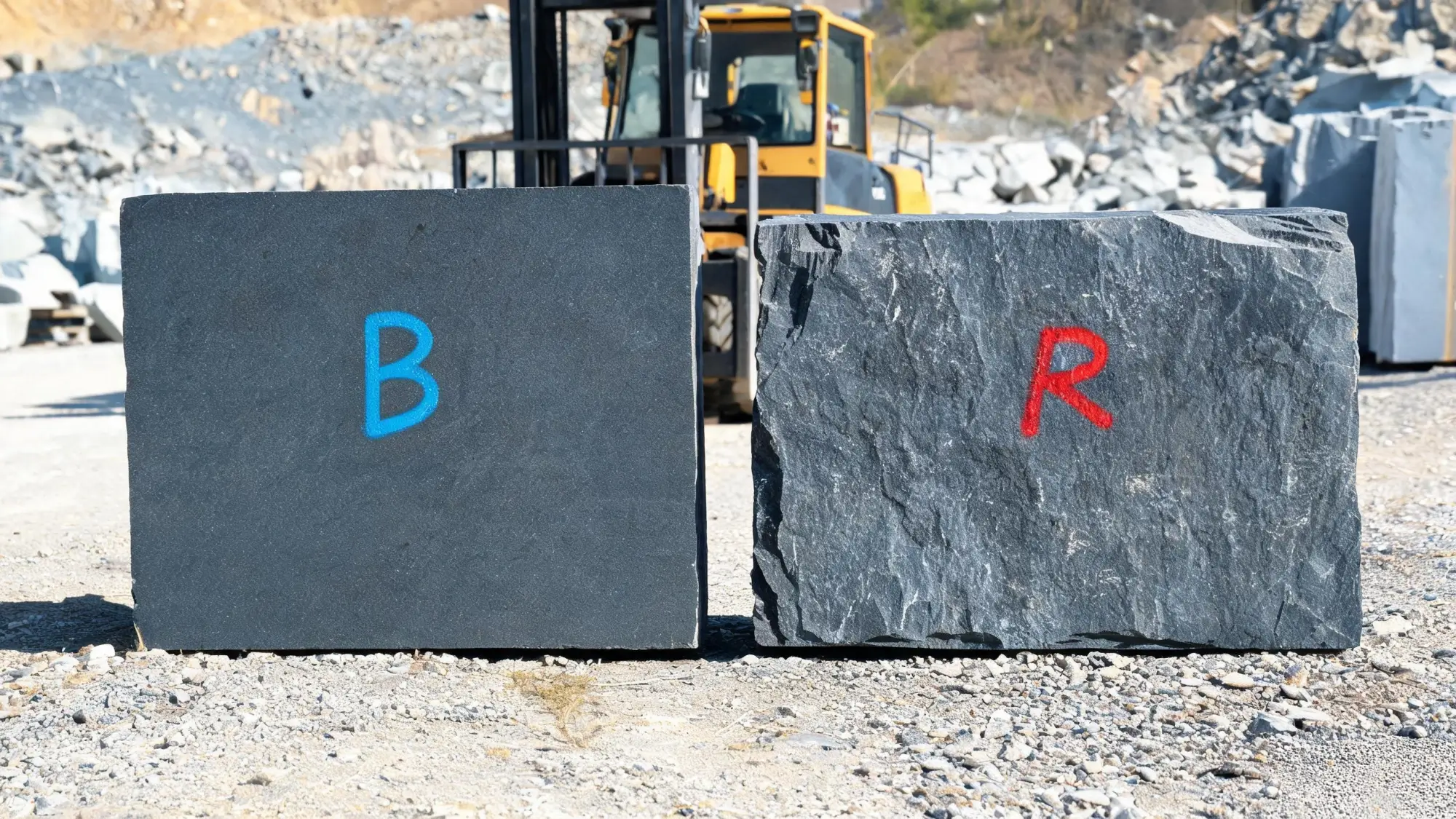
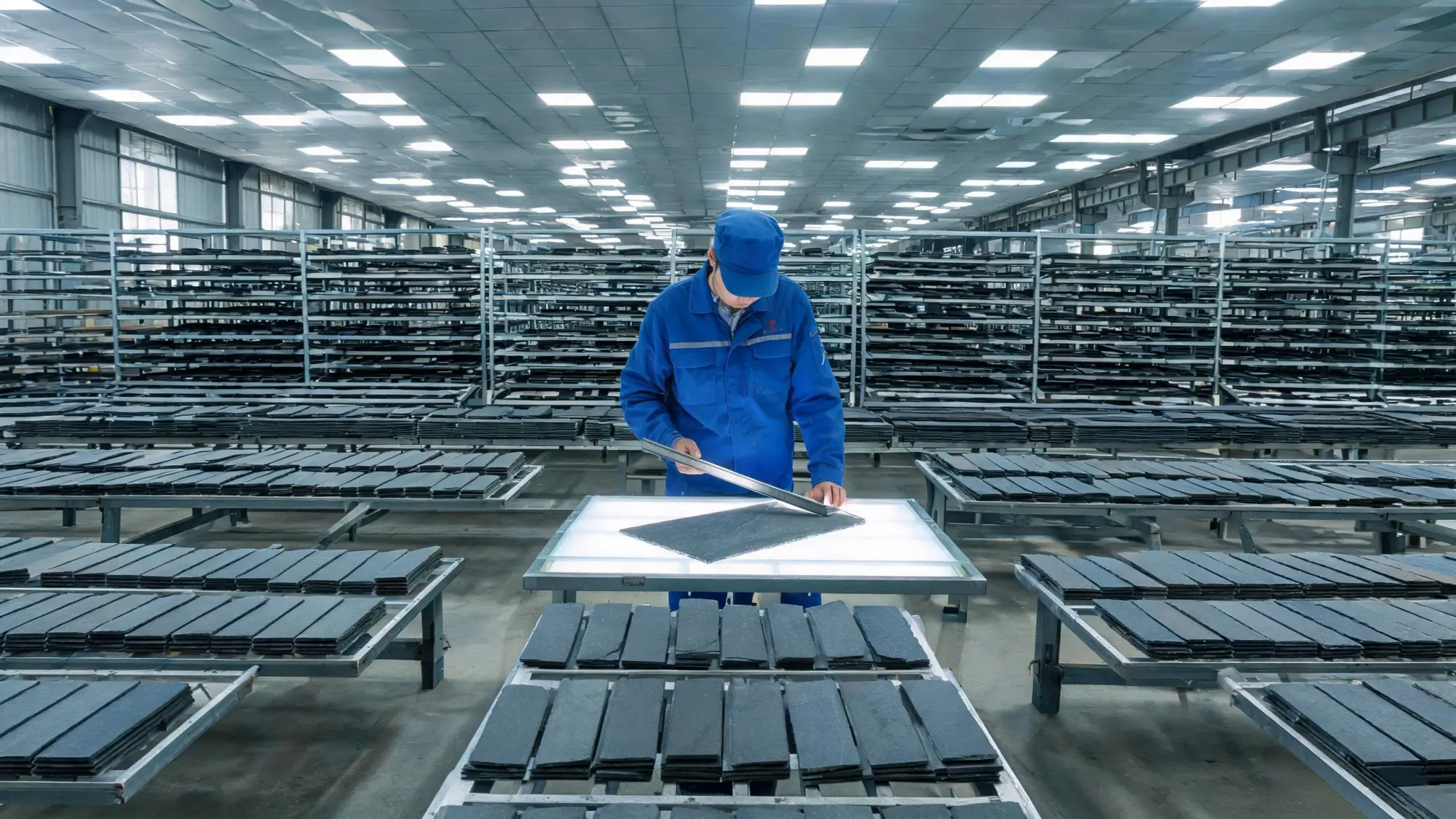
In the factory, we enforce consistency with 100% individual inspection. Not batch sampling — every single tile and panel is checked for flatness, thickness, dimensions, and surface quality before it goes into a crate. If a tile fails, it doesn't ship. That's not a quality policy printed on a brochure; it's the reason we can put a batch number on every crate and trace it back to the quarry face.
The practical result for you: the sample you approve is the stone you receive. The first container and the tenth container have the same colour range, the same density, the same splitting behaviour. You're not rolling the dice on a new mountain each time you order.
How to verify: Ask for a batch number on the test report and on the packing list. If the report says "representative sample" with no batch reference, you have no way to confirm that the certificate matches the stone in your container. A batch number ties the data to the delivery. For the full inspection process, see 100% Inspection: How We Check Every Piece.
The 200-Year Field Test Nobody Else Can Show
Here's what no competitor can put on their page.
In the hills around Lushan and Xingzi, there are slate tombstones that have been standing in the open for close to 200 years. Rain, snow, freeze–thaw, sun, acid rain — everything a roof endures, these stones have endured, without the protection of being under a roof. They're still intact. The engraved characters are still legible. The surfaces show no delamination.
Our lab tests run 120 freeze–thaw cycles — about four months of accelerated winter. A 200-year-old tombstone has been through roughly 73,000 freeze–thaw cycles, depending on how many sub-zero nights per winter in the region. And it's still standing.
This is the difference between a lab certificate and field evidence. A test report tells you the stone passed a standardised procedure. A tombstone tells you the stone will still be there when your grandchildren inherit the house.
We don't sell tombstones. But the rock in those graveyard stones is the same rock we quarry — the same formation, the same mineralogy, the same density, the same cleavage. When you read "0.2% water absorption" on our test results, that number is the lab version of what the tombstone has been proving for two centuries.
How to Verify These Four Claims Yourself
You don't need to take our word for any of this. Here's a five-step checklist you can run before you commit to an order:
- Read the test report. Ask for EN 12326 or ASTM C406 data with a batch number. Check density (look for 2.7+ g/cm³), water absorption (under 0.6%), flexural strength (50+ MPa), and freeze–thaw result. Our public data is at Jiujiang Slate Test Results.
- Order a physical sample. Not a photo — a piece you can hold. Weigh it, measure it, soak it. A 500 × 250 × 8 mm tile should weigh about 2.4 kg. After 24 hours in water, it should gain no more than 1% of its dry weight.
- Bring a caliper. Measure thickness at five points — four corners and centre. The spread tells you the dimensional tolerance. Consistent tiles mean consistent installation.
- Ask for the batch number on the packing list. If the test report, the packing list, and the crate stencil all show the same batch number, you can trace the data to the delivery. If any one is missing, ask why.
- Visit the factory — or ask for a real-time video. If the supplier is a factory, they can walk you through the inspection line on a phone. If they can't, you're probably talking to a trading desk.
Frequently Asked Questions
What makes Jiujiang slate different from other Chinese slate?
Jiujiang slate comes from a single geological formation in the Lushan–Xingzi belt, so the mineral composition and density are consistent across quarries. Other Chinese slate regions produce different rock types with varying properties. The key differences are density (2.7–2.8 g/cm³), water absorption (0.2%), and machining tolerance (±0.1 mm CNC) — all verifiable on a test report with a batch number.
Is Jiujiang slate as good as Welsh or Spanish slate?
On the numbers, yes. Jiujiang slate's water absorption (0.2%) is comparable to or lower than Welsh Penrhyn slate (around 0.3–0.4%). Density is in the same range. The main difference is price and supply — Jiujiang offers consistent volume at a lower cost. For a full property-by-property comparison, see our Jiujiang Slate vs Spanish, Welsh and Indian Slate guide.
What is the most important number to check when buying Jiujiang slate?
Water absorption. If the stone absorbs less than 0.6% water by weight, it will resist freeze–thaw damage in cold climates. Jiujiang slate tests at 0.2%, which is well below the threshold. Always ask for a test report with a batch number — the number is only useful if you can tie it to the stone in your container.
How can I verify Jiujiang slate quality without visiting the factory?
Order a physical sample and run three checks: weigh it dry, soak it for 24 hours, weigh it again (water absorption); measure thickness at five points with a caliper (dimensional tolerance); and compare the colour to the sample you approved. Ask for a real-time video walkthrough of the inspection line — a factory can do this; a trading desk cannot.
Does Jiujiang slate come in different grades?
Yes. The same formation produces blocks of varying quality. The best blocks — denser, cleaner cleavage, fewer inclusions — go to billiard slate. Standard blocks go to roofing tiles. Within roofing slate, tiles are sorted by thickness band (e.g., 7–9 mm) and colour range (A/B/C grades). The grading happens at the factory, not the quarry.
Can I get a test report before ordering?
Yes. Our published EN 12326 and ASTM C406 test data is available on our Jiujiang Slate Test Results page. For a specific order, ask for a report that carries the batch number of your production run — not a generic certificate. A batch-specific report ties the data to the stone you'll actually receive.
Related Reading
Want to verify these numbers with your own sample?
Order a physical sample from our Jiujiang factory. Weigh it, soak it, measure it — then compare it to the test report. If the numbers don't match, don't buy. That's the standard we hold ourselves to.