
Where Is Jiujiang Slate From?
Every crate of slate that leaves our factory carries an export invoice, and every invoice carries the same five-line address:
Xiong Village, Hengtang Town, Lushan City, Jiujiang, Jiangxi Province, China 332808
If you have ever ordered anything from China — or tried to compare slate suppliers — you have seen addresses like this. Five names, nested inside each other like measuring spoons. Most buyers skim past them. But those five lines are the most honest map of Jiujiang slate you will ever get, because each line is one zoom level, and each zoom level answers a different question about the stone you are buying.
This page walks you down through all five. By the end, "Jiujiang slate" will not be a label on a quotation any more. It will be a place you could find on a map, a place you could fly to, a place whose geography explains why the stone is dense, why it is affordable, and why it has been shipped out of this river city for so long.
The zoom chain, in six lines:
China — the country; most slate sold today, from any origin, starts somewhere in Asia
Jiangxi Province — south-eastern China, the slate heartland of the south
Jiujiang — the prefecture-level city on the middle Yangtze River, a major river port
Lushan — the World Heritage mountain; since 2016 also the county-level city that was once Xingzi County
Hengtang — the town in the slate belt, where the processing yards sit
Xiong Village — our factory's gate, where your container gets loaded
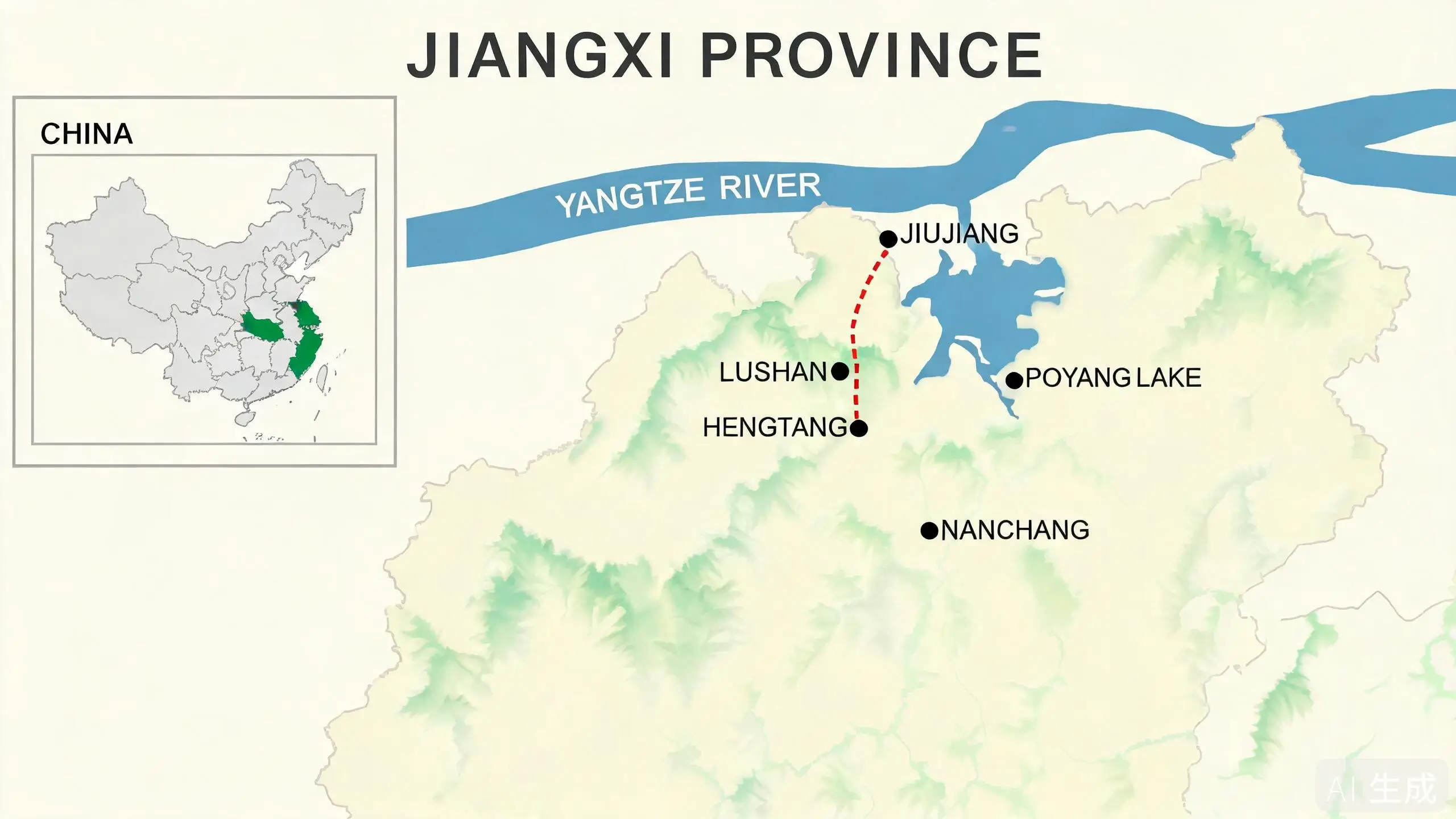
Zoom Level: China
Start at the top of the address, because the top of the address is where most of the world's slate now comes from. China is the largest slate-producing country on the market today, in the way Spain was a century ago and Wales was two centuries ago. When a quarrier in Europe counts his costs — energy, labour, land, permits — and a buyer counts his budget, the arithmetic keeps pointing east.
But "Chinese slate" is not one thing, and this is the first place where a vague answer costs you money. China produces slate in several provinces, from the northern hills of Hebei to beds in Shaanxi and beyond, and the rocks are not interchangeable. Density, splitting behaviour, weathering, even the way the quarry face is worked — all of it varies from province to province. Two tiles can both say "China" on the customs paper and behave completely differently on a roof in Bergen.
So the country name is only the first filter. What you actually need is the second line.
Zoom Level: Jiangxi Province
Jiangxi is the province that matters for this stone. It sits in south-eastern China, inland from the coast, wrapped around China's largest freshwater lake and drained by rivers that have carried trade for as long as there has been trade here. Slate is not Jiangxi's only stone, but along its northern edge — the part of the province that faces the Yangtze — runs the belt that the trade calls the Chinese slate region.
Two geographic facts do most of the work in this province. The first is the lake: Poyang Lake sits in the middle of Jiangxi like a hub, and every important city in the province is within reach of its water system. The second is the river: the Yangtze runs along Jiangxi's entire northern border, and the city of Jiujiang sits directly on it, which means the province's slate region has had deepwater shipping at its doorstep for as long as it has been quarrying.
That combination — stone belt in the hills, navigable water at the boundary — is rare. Most slate regions in the world are mountain-and-mule stories: beautiful geology, expensive logistics. Jiangxi got both halves of the bargain. If you have ever wondered how a heavy, low-margin building stone crosses an ocean and still lands at a competitive price, the answer usually starts with a map, not a quarry.
Zoom Level: Jiujiang, the River Port City
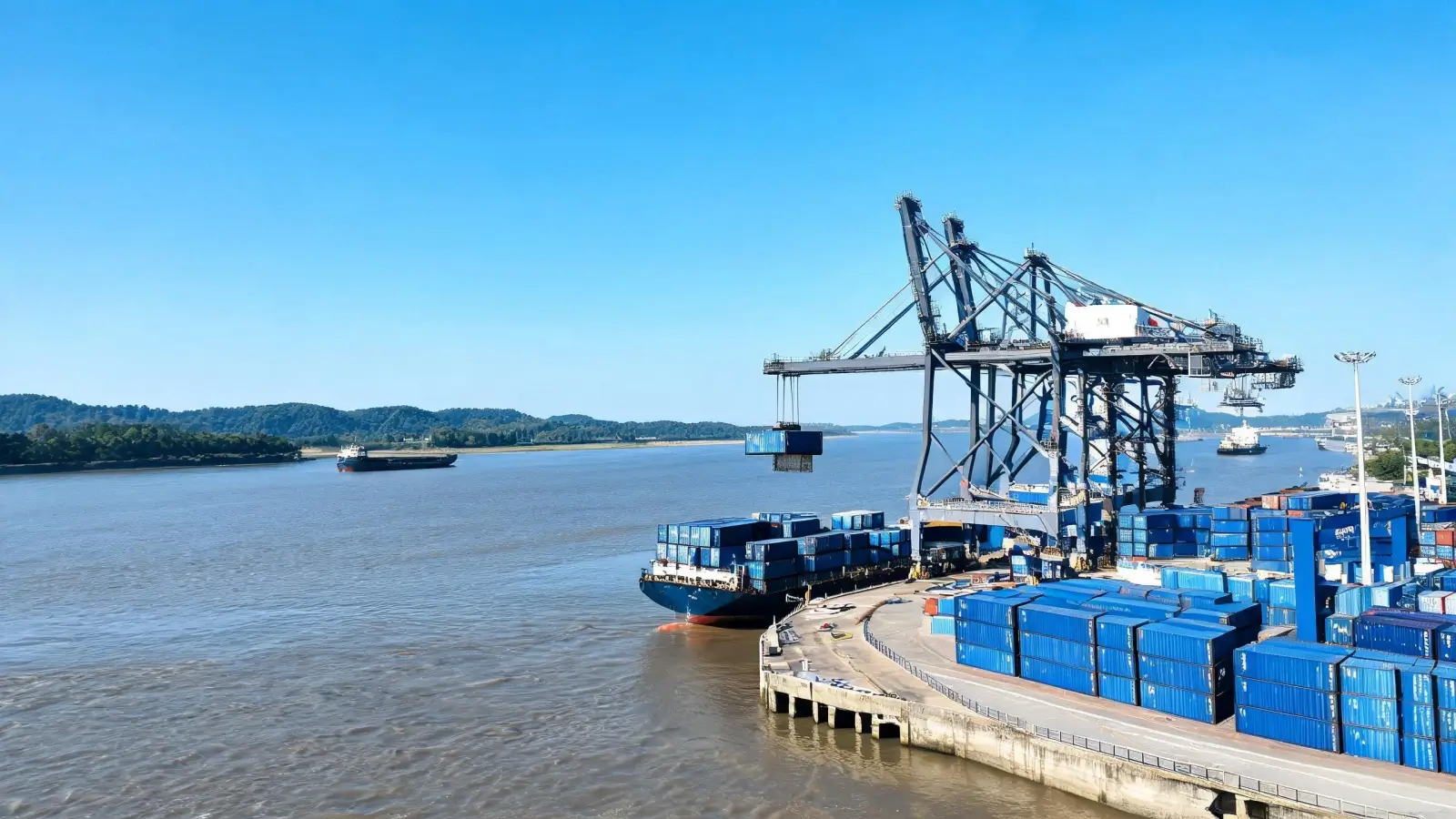
Now the address resolves to a city. Jiujiang is a prefecture-level city of a few million people on the south bank of the Yangtze, roughly at the point where China's greatest river stops being an upper river and starts behaving like the broad, barge-carrying waterway of the lowlands. The city is one of the recognised major hub ports along the Yangtze's middle-lower reaches — the kind of place where container ships call, where customs lives, where your slate's paperwork actually clears.
For a slate buyer, Jiujiang is the working end of the region. Two things happen here that matter to your landed cost. First, the stone moves on water: a container of slate is a heavy thing to push over roads, and every hundred kilometres of highway you can replace with river is money you keep. Second, the port connects onward. A container leaving Jiujiang rides the current down to Shanghai — roughly eight hundred kilometres of navigable river — and from Shanghai the ocean leg begins. One river, one ocean, no re-handling of the stone in between.
When a supplier tells you his slate ships "from Shanghai", it is worth remembering that Shanghai is only the ocean gateway. The stone was born eight hundred river-kilometres upstream, in the hills you are about to zoom into.
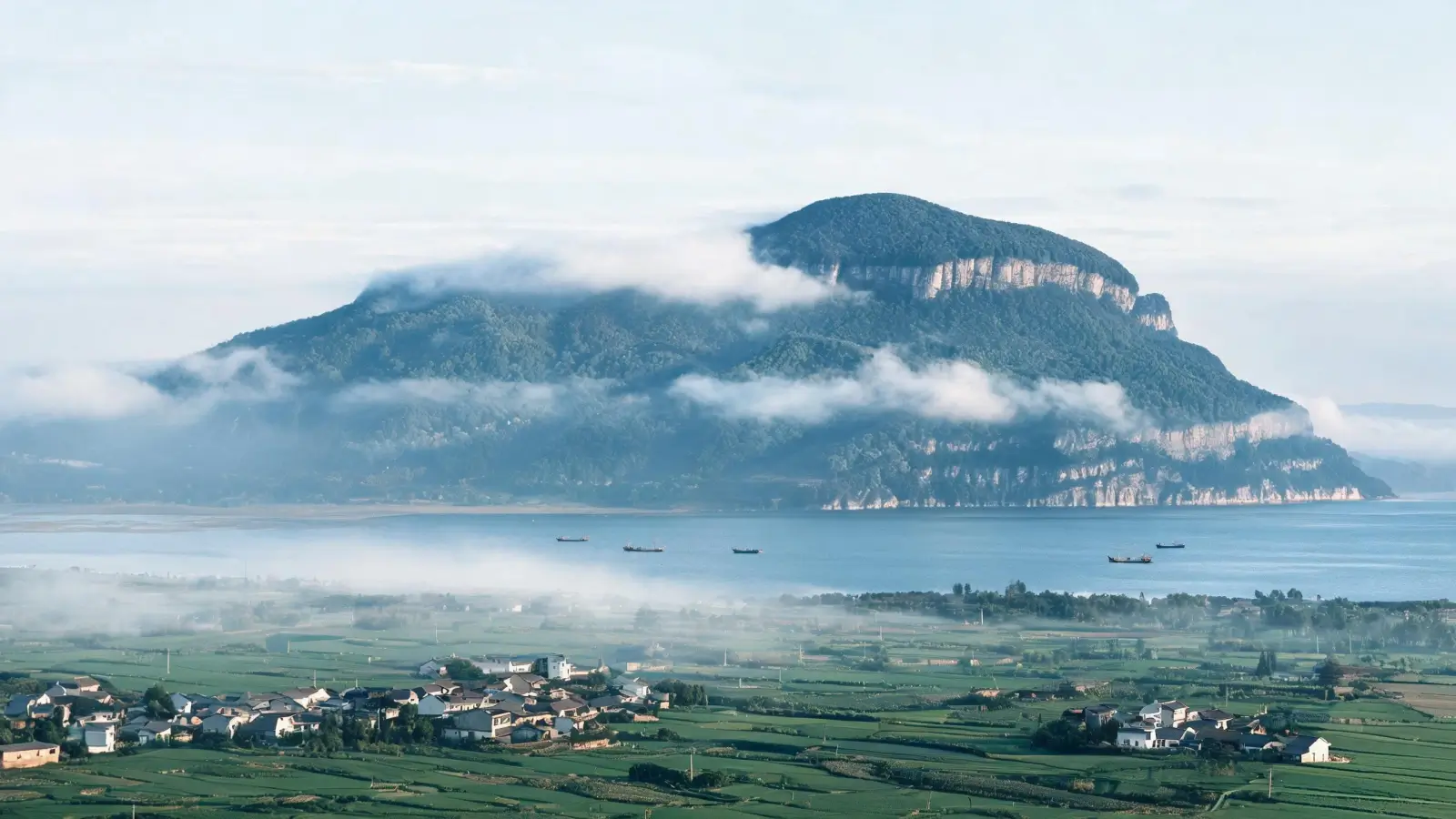
Zoom Level: Lushan and the Lake
The next line of the address is the one that gives this slate region its identity. Lushan — Mount Lu — is one of China's most famous mountains: a UNESCO World Cultural Landscape and a Global Geopark, a broad, cliff-banded fault-block mountain that rises straight out of the plains to catch the clouds. On its eastern flank, close enough to see on a clear day, lies the western shore of Poyang Lake, China's largest freshwater lake.
The slate belt lives in the low hills between the mountain and the lake — foothill country, close enough to the mountain that the region's slate has carried its name for centuries. This is the geography that gives the stone its name-recognition abroad, because "Lushan" is a place name that international buyers can actually verify: it is on maps, in atlases, in a hundred years of travellers' accounts. A stone with a verifiable address is not the same product as a stone with a shipping label.
There is a second reason the mountain belongs in this article, and it is not scenery. Lushan's slopes and the land around them have been built in local stone for well over a thousand years — temple foundations, bridge piers, village walls, the grey-tiled roofs you still see on older farmhouses. The slate region did not have to invent its credibility; it inherited it. We keep that story — inkstones, village roofs, the long local use of this rock — for the history page, because here the point is simpler: this is not a place that discovered slate recently. It is a place defined by it.
Zoom Level: Lushan City, Once Xingzi County
Here the address does something that confuses buyers, so let us slow down at this zoom level longer than the others. The line reads "Lushan City", and if you have been in the slate trade a while you may know the same place by an older name: Xingzi.
Both are correct. Xingzi was a county on the western shore of Poyang Lake, and the slate trade knew the region by that name for decades. In 2016 the county was redesignated as a county-level city and took the mountain's name — it became Lushan City. Nothing about the rock changed that year. The quarries, the belt, the splitting yards — all stayed where they were. Only the letterhead changed.
So when you see "Xingzi slate" in an old specification and "Lushan slate" in a new one, you are looking at the same stone with two dates on it. Our own factory sits inside this line of the address, in Lushan City — the county-level city, not the mountain itself, although on a clear evening from the yard you would not need much persuading. The full story of the region's names — Jiujiang, Lushan, Xingzi, and how to make sure you are comparing the same rock — has its own page: Jiujiang, Lushan or Xingzi Slate: What's in a Name?
Zoom Level: Hengtang, the Slate Town
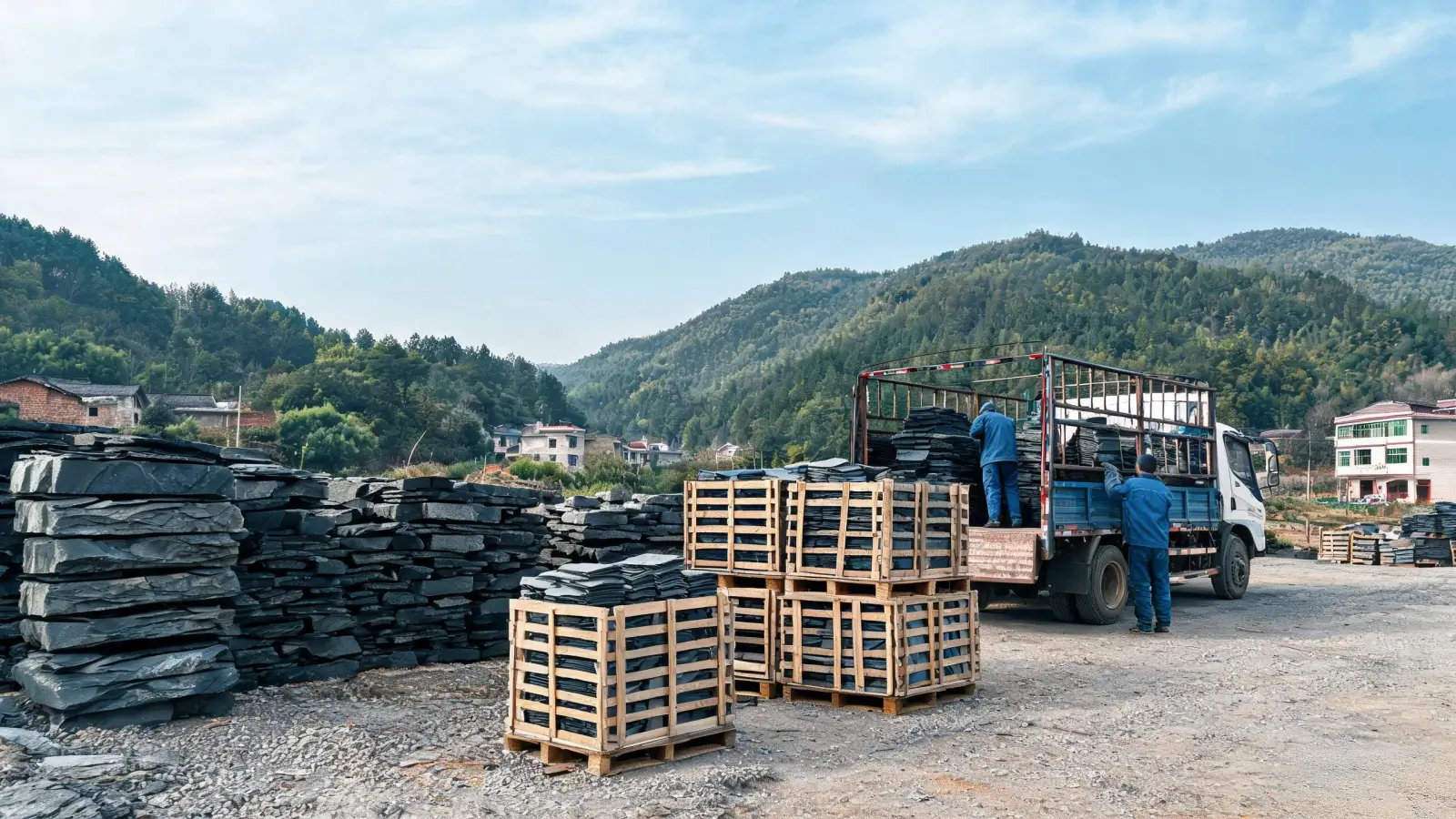
Now the address is nearly a street. Hengtang is a town in the slate belt — ordinary by most measures, a single-industry town of the kind that used to be common in stone regions everywhere: streets that smell of rock dust after rain, trucks stacked with blocks at the first light, and yards where families who have worked the same beds for generations split and dress and crate the stone.
This is the level where geography stops being a map and becomes a process. Blocks come down from the nearby quarry faces to the yards around Hengtang, where they are sorted by what they can become. The straightest, cleanest, densest material is graded upward; the rest still finds honest work as thicker tiles or other products — slate is one of the few industries where almost nothing good is wasted, a story the production page tells in full.
If you zoom all the way to the bottom line — Xiong Village — you reach the last thing worth knowing about this map: the factory gate. This is where the two halves of the journey meet. Everything above Hengtang in this article — the lake, the river port, the province — is the reason the stone can leave. The yards below it are the reason the stone is worth sending.
Why the Geography Follows the Container
It is fair to ask why a page about where spends its last section on logistics. The answer is that with a heavy stone, geography and price are the same subject. Slate is dense — that density is half the reason it survives a century on a roof — and dense cargo punishes every unnecessary kilometre of road. The Jiujiang region's economics work because the three fixed points of its address sit so close together: the quarry faces in the hills, the processing yards of the belt, and a Yangtze River hub port within a short trucking distance of both.
An empty container comes up from the port to the factory, is loaded at our gate, and goes back down to the wharf the same day. From there the river takes over. No intermediate warehouses, no extra hands on your stone, no third-party yard where tiles wait for their next truck. The container you seal at the factory in Hengtang is the container that clears customs in Jiujiang and sails from Shanghai. When buyers ask how a fully tested, certified natural slate can price the way Jiujiang slate does, that short, sealed chain is most of the answer.
The full freight picture — container types, the packing standards that survive an ocean crossing, and how lead times are built — is covered in the sourcing section of this guide. The point of this page is only that the map itself is a commercial document. The five lines of the address are also the five reasons the price works.
Frequently Asked Questions
How far is the slate region from Shanghai?
By river, roughly 800 kilometres. Jiujiang port sits on the middle Yangtze, and a loaded container barge or vessel rides the current down to Shanghai in a few days, where the ocean leg begins. The river distance is one of the region's quiet advantages: heavy cargo moves on water for most of the domestic journey, which keeps the domestic freight share of your landed cost small.
Do slate containers from Jiujiang ship directly, or via Shanghai?
Via Shanghai, in practice. Jiujiang is a genuine Yangtze hub port where containers clear and load, but the deep-sea ocean services — to Europe, the Americas, most of Asia — sail from the coastal gateways, chiefly Shanghai. For you this is invisible: one container, one seal number, one bill of lading. The stone does not leave the box between our factory gate and the ocean vessel.
What is the best way to visit the region?
Fly to Nanchang Changbei International Airport, the nearest major international gateway to the slate belt, and the drive from the airport to the factory area is under an hour on expressway. If you are combining a visit with other stops in China, the region is also reachable by high-speed rail via Jiujiang station. Overseas buyers have been visiting us over the years — to walk the quarry faces, watch the splitting and CNC machining, and see their own order loaded — and we host visits by arrangement.
Why does the slate not ship straight from the quarry?
Because a quarry face is not a logistics site — it has no cranes, no container handling, no customs. The pattern here is the short-truck pattern: blocks move a short distance from the quarry faces to the processing yards, the finished tiles and panels are containerised at the factory, and the container is trucked to the Yangtze port and barged to Shanghai. Consolidating everything at one loading point also means the whole order travels under one seal, inspected and packed by one team.
Is the region easy to find on a map before I visit?
Very. Start with the two fixed points: Lushan (Mount Lu), the UNESCO-listed mountain just south of the Yangtze, and Poyang Lake, China's largest freshwater lake, immediately east of it. The slate belt runs through the hills between them; Hengtang, the processing town, sits inside that belt, and Jiujiang is the port city where the region meets the river. Any online map will find all of these names — the region's own article, the Jiujiang Slate Map, puts them together in one view.
Related Reading
Put the Address to the Test
Now you can read all five lines of our address. If you want to see what the place produces, we will send you a hand sample of the slate itself — cut from the belt you have just mapped, with the test data that belongs to it.