
Roofing Slate Technical Data: The Spec Sheet Every Buyer Needs
A roof is only as good as the numbers you left behind before it went up. Colour you can see, texture you can feel, but absorption, strength, weight and coverage — those live on paper, and the paper is where a roof is won or lost. This page is that paper: the key figures for natural roofing slate, gathered in one place, each tied to the detailed guide that explains it properly.
Quick answer — the master reference table. If you remember nothing else from this page, remember these six numbers:
| Property | Typical value | Why it matters |
|---|---|---|
| Water absorption | ≤ 0.5% (EN A1 ≤ 0.6%; ASTM S1 ≤ 0.25%) | Frost survival. Below 0.3% the stone doesn't drink, so it can't be cracked from inside. |
| Density | 2.7–2.8 t/m³ (2.7 g/cm³) | Tells you weight per m², container loads and roof load all at once. |
| Weight per m² | 7–9mm slate ≈ 19–24 kg/m² | Lighter than concrete tiles (35–70 kg/m²) — most structures accept it. |
| Flexural strength | Dry ≥ 40 MPa; good slate ≈ 60 MPa | How much bending a tile survives. ASTM S1: ≥ 575 lbs modulus of rupture. |
| Freeze–thaw | ≥ 200 cycles, no visible damage | The real proof for cold climates — the absorption number predicts it, the cycle test proves it. |
| Coverage | 500×250 @ 75mm headlap ≈ 19/m² | Count depends on exposure, not tile area. 300×200 ≈ 44/m²; 600×300 ≈ 13/m². |
The six numbers above are the load-bearing ones. Everything below is the same story with the doors open — what each figure measures, where it comes from, and what to do when a supplier's number doesn't match.
Why a technical data file beats a sales pitch
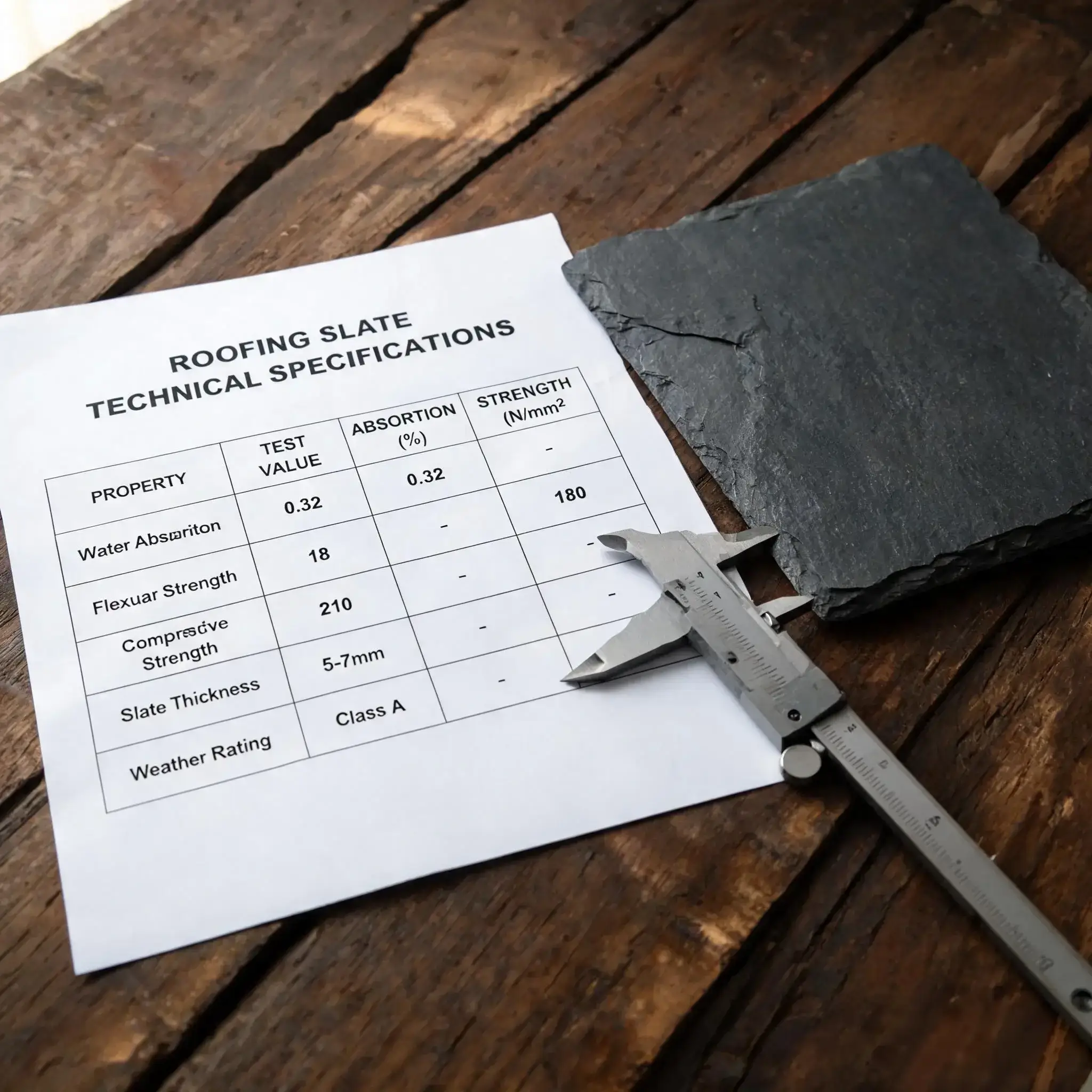
Slate is sold in a lot of ways — by colour, by region, by brand. But once it's on a roof, the only thing between you and a hundred-year covering is a set of numbers: how much water it drinks, how hard it can be bent, how much it weighs, how many pieces cover a square metre. Two slates can look identical across a yard and behave completely differently across a winter.
That is why every serious specification — architect, importer, contractor — runs through the same checklist. And it's why this page exists as a single place to find the key figures, with the deeper guide linked beside each one.
Water absorption: the number frost reads first
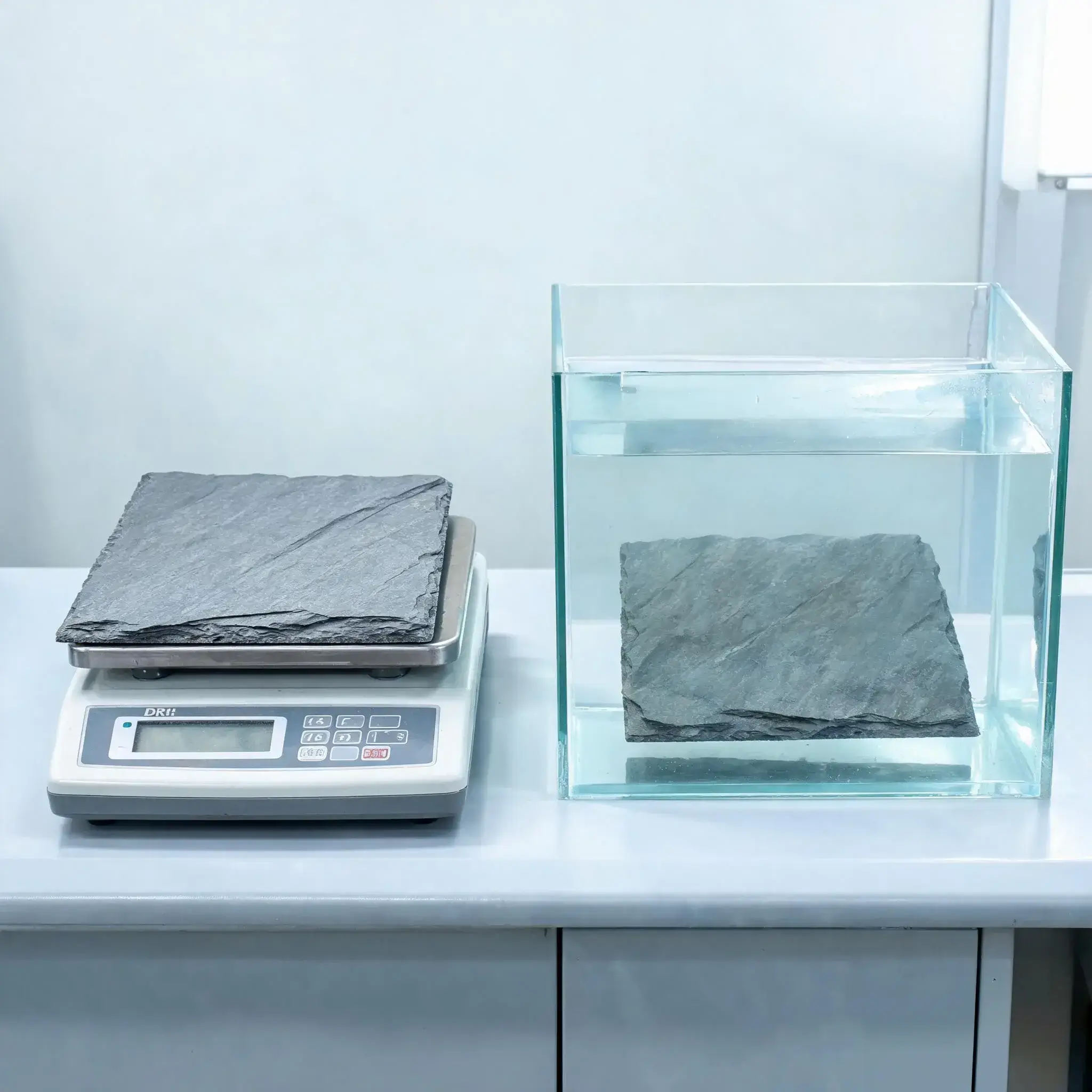
What it is: the percentage of its own weight a dry slate absorbs when soaked. Test: dry at 110°C, weigh, soak 48 hours, wipe, weigh again — gain ÷ dry weight × 100.
- Good: ≤ 0.5%
- EN 12326 Code A1 (top): ≤ 0.6%
- ASTM C406 S1 (top US grade): ≤ 0.25%
- Excellent (our Lushan slate): ~0.2%
Water absorption predicts frost survival. Water that gets into the pores expands by about 9% when it freezes, and that expansion flakes the tile apart from inside. A slate at 0.2–0.3% has almost nothing inside to freeze — which is why the good stuff sails through freeze–thaw tests while the thirsty stuff delaminates. The full mechanism, and the field test you can do without a lab, is in our water absorption guide.
Flexural strength and breaking load: the bending test
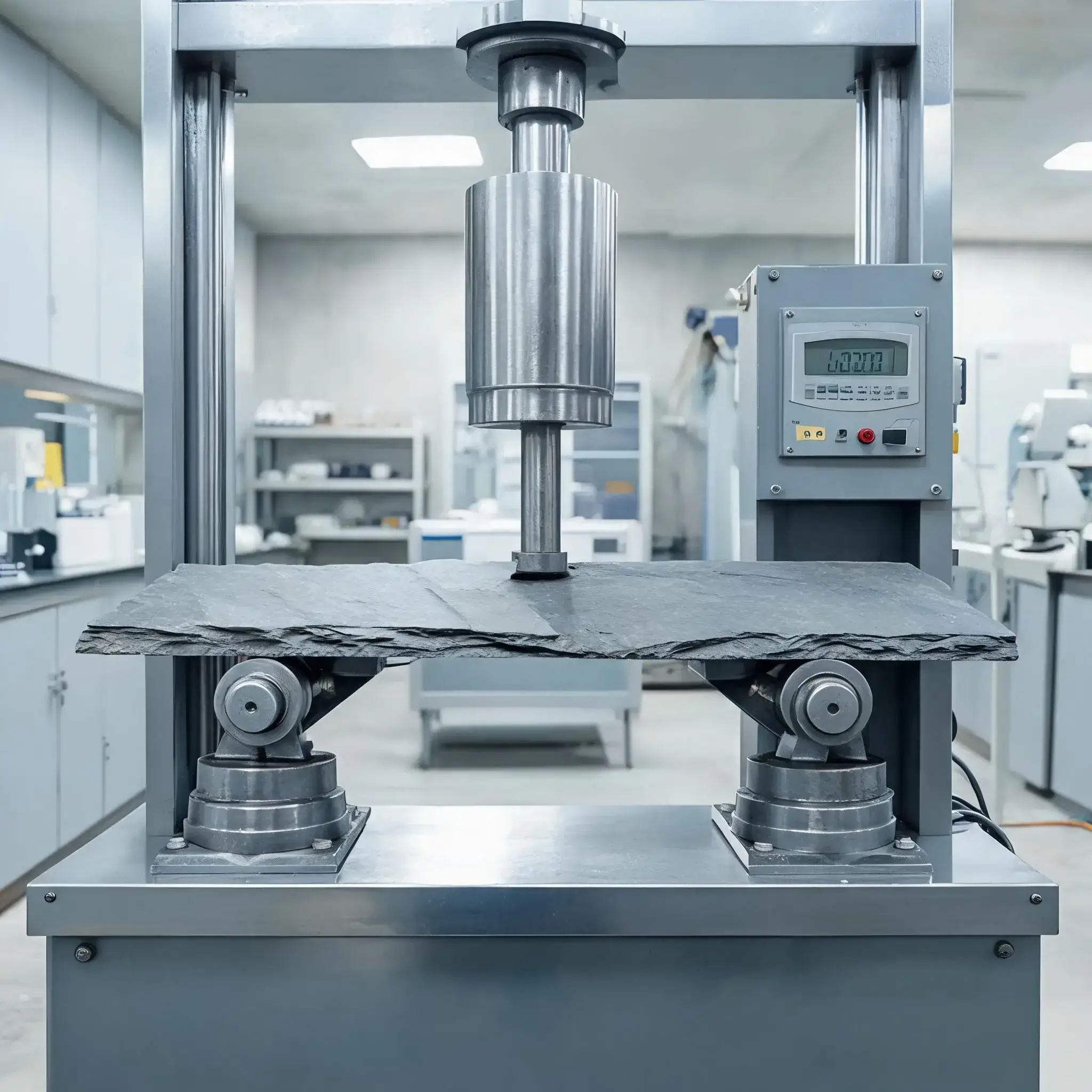
Two phrases appear on every report. They answer the same question with two different yardsticks:
- Breaking load — the force (N or kN) that snaps a specific slate in the machine. Think "how heavy a weight can I put on it".
- Flexural strength (modulus of rupture) — the stone's own resistance to bending, size-independent, in MPa (or lbs in the US).
What's good: ASTM C406 S1 needs a minimum modulus of rupture of 575 lbs. EN 12326 sets minimum breaking loads by size and thickness class. In practice, good slate tests 40–60 MPa dry, and stays above 40 MPa even after 48 hours in water — a wet slate is a weaker slate. Our Lushan board tests at ~60 MPa dry and ~45 MPa wet, with a test report to back it. The flexural strength guide digs into the machine, the numbers and the margin you should demand.
Density and weight: the rule that unlocks everything
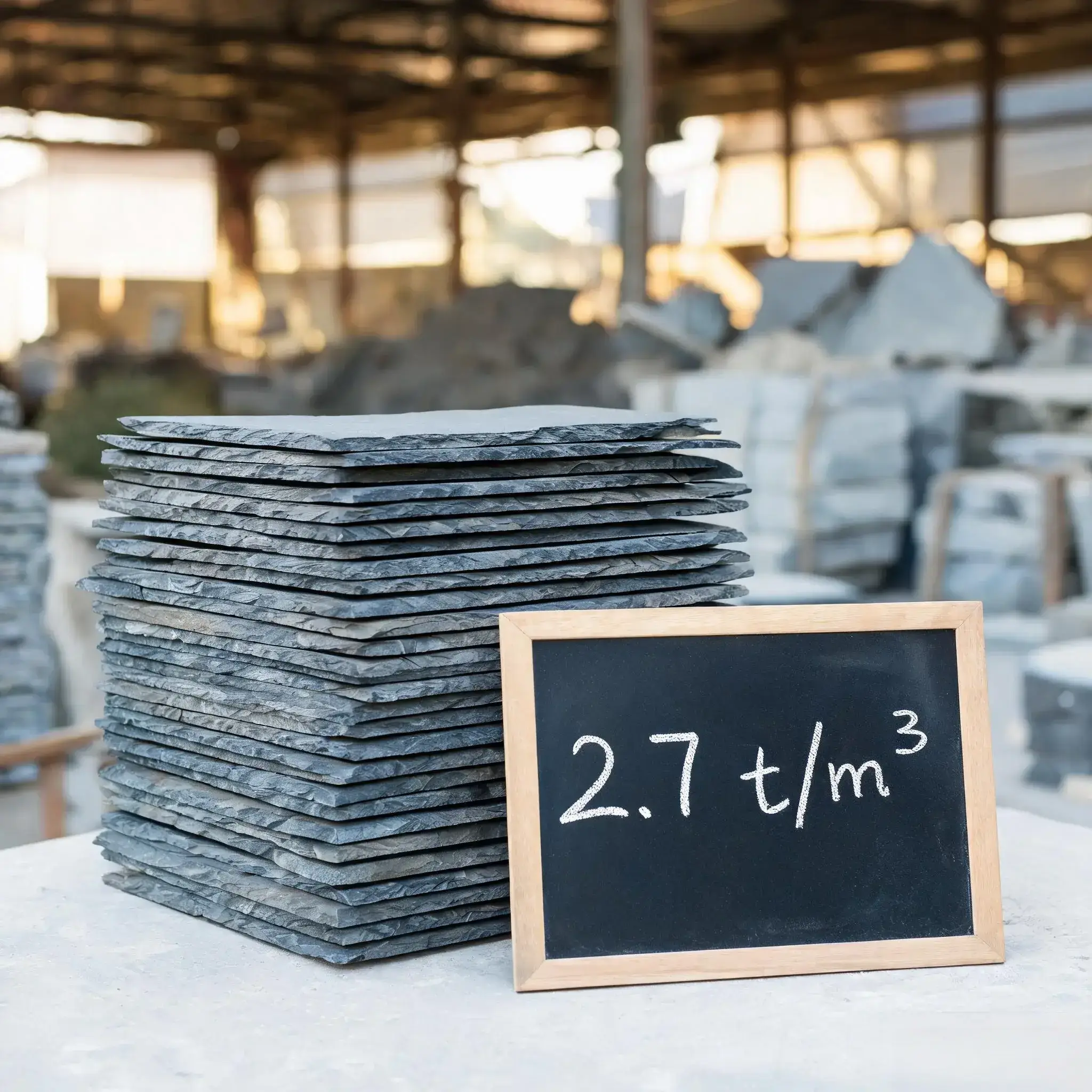
Here is the most useful rule in the whole slate trade:
Slate weighs about 2.7 tonnes per cubic metre. So every millimetre of thickness is 2.7 kg per square metre. A 6 mm slate ≈ 16.2 kg/m²; an 8 mm ≈ 21.6 kg/m²; a 10 mm ≈ 27 kg/m².
The same rule gives you the roof load: 7–9mm slate comes in at 19–24 kg/m² — lighter than concrete tiles (35–70 kg/m²), which is why most structures built for concrete will take slate without reinforcement. And it gives you the container: a 20ft box has a working payload of about 27.5 t, so 27,500 kg ÷ your slate's kg/m² = the m² that will load. Thickness range 7–9mm ≈ 1,130–1,450 m² per 20ft. Full tables in the weight guide and the container capacity page.
Coverage: slates per square metre
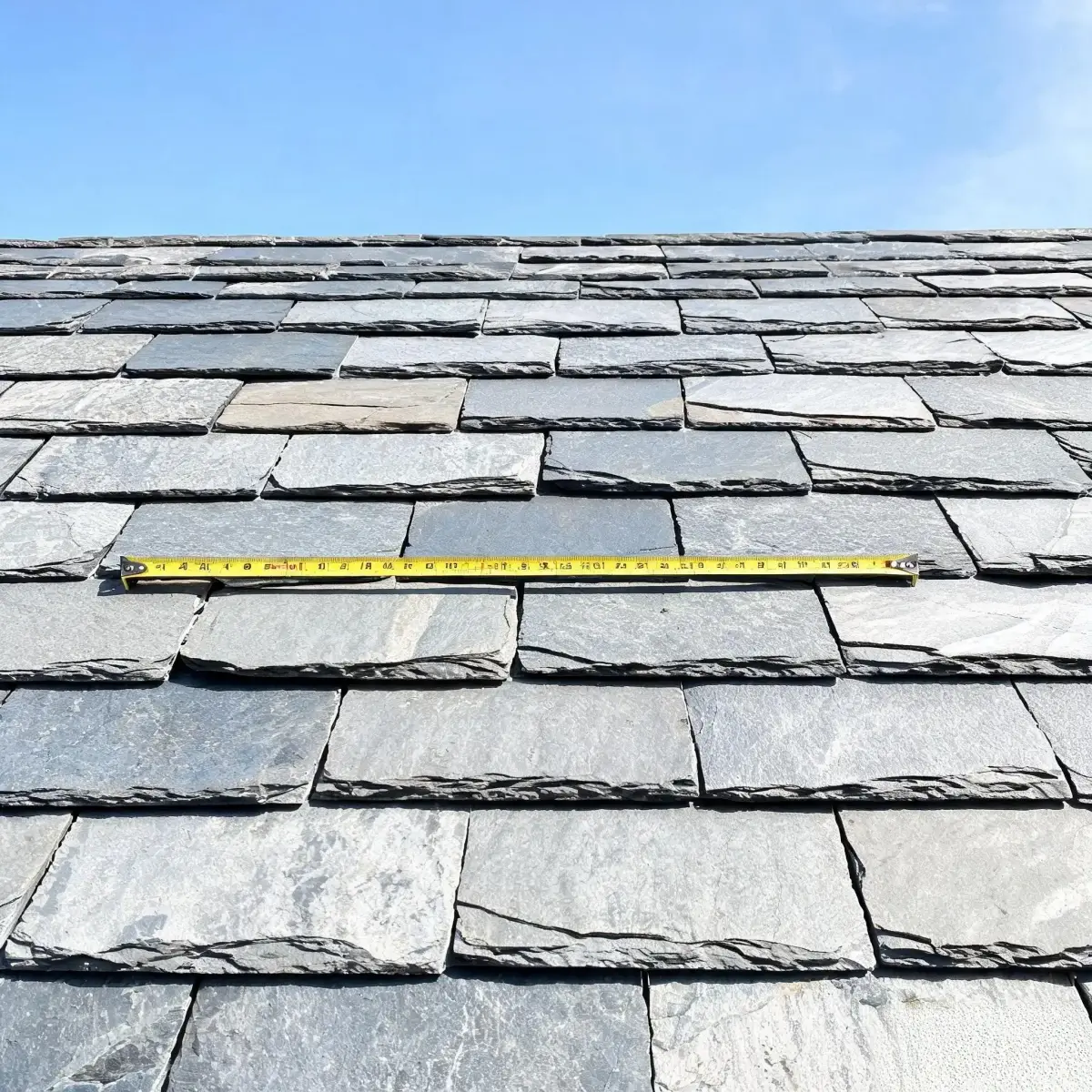
How many slates cover a square metre? That's the question that fills every enquiry inbox — and the answer is "it depends", in the most scientific sense of the phrase.
| Slate size | Approx. pieces per m² (75mm headlap) |
|---|---|
| 300 × 200 mm | ≈ 44 |
| 400 × 250 mm | ≈ 26 |
| 500 × 250 mm | ≈ 19 |
| 600 × 300 mm | ≈ 13 |
| 600 × 400 mm | ≈ 4 |
Because the number is set by exposure (the visible part after the headlap overlap), the same 500×250 runs 18.8 pieces/m² at 75mm headlap on a 30° roof, and about 20 pieces/m² if the headlap climbs to 100mm on a shallower slope. Headlap is the variable that changes the count — the headlap, gauge and exposure guide explains the geometry, and the pieces-per-m² reference is the table our sales team quotes from. Always add 5–10% waste on top of the count.
Thickness: what the band really means
Slate thickness is quoted as a band — 6–8mm, 7–9mm, 9–11mm — not a single number. The band tells you the range the delivery will sit in, and it matters three times over: weight goes up with thickness (the 2.7 t/m³ rule), flexural strength climbs with the square of thickness, and cost climbs with both. For cold climates and heavy snow, 9–11mm or even 13–15mm thick board; for most UK/European roofs, 7–9mm is the standard. The thickness guide matches bands to pitches, climates and structures.
Grade: EN 12326 and ASTM C406
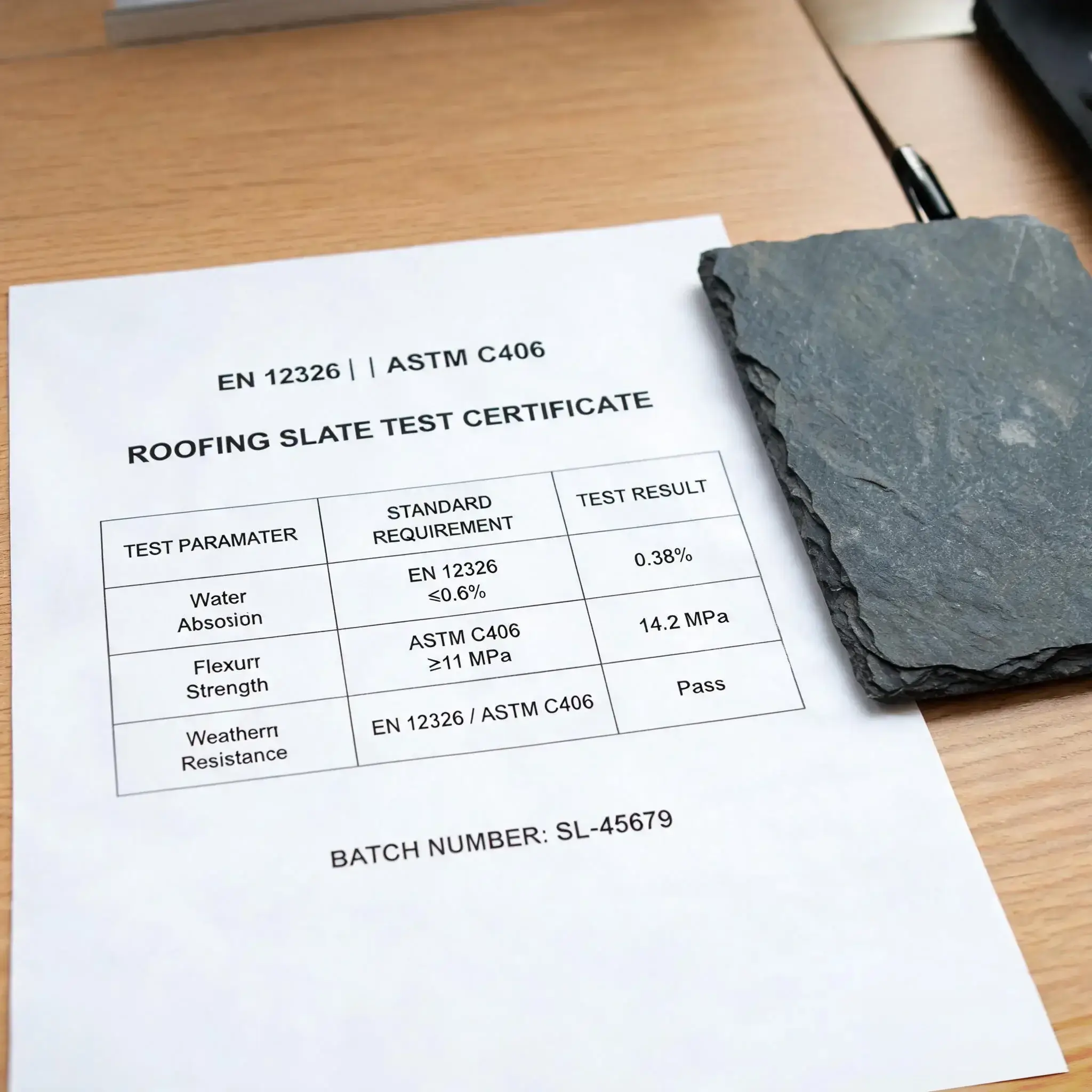
Two standards set the language of slate quality:
- EN 12326-1 (Europe) — tests water absorption (Code A1 ≤ 0.6%), breaking load, freeze–thaw and chemical composition, and classifies the result.
- ASTM C406 (US) — grades slate into S1 (top), S2, S3. S1 demands ≤ 0.25% absorption and ≥ 575 lbs modulus of rupture (ASTM C120 test).
Reading a certificate is a skill of its own — a certificate without a batch number is a decoration, not a specification. The EN guide, the ASTM guide and the report-reading guide each walk through it in detail. Our own Lushan slate carries EN 12326 and ASTM C406 documentation — the full report is on the test results page.
Other numbers specifiers should not skip
- Carbonate content (CaO): the lower the better — high carbonate is a weathering risk under acid rain. Our Lushan board: 0.56% CaO.
- Silica (SiO₂): high quartz = hard and dense. Ours: 66.5%.
- Freeze–thaw cycles: the real proof — our test ran 120 cycles with zero weight loss.
- Fixings: copper or stainless nails, size matched to the slate — a slate is only as strong as the nail holding it.
The minimum specification I'd send any supplier
If you are a specifier, copy this into the next enquiry:
| Item | What to demand |
|---|---|
| Water absorption | ≤ 0.3% target, EN A1 ≤ 0.6%, ASTM S1 ≤ 0.25% |
| Flexural strength | ≥ 40 MPa dry, S1 ≥ 575 psi (ASTM C120) |
| Thickness band | Exact range, not "from X" — e.g. 7–9mm |
| Freeze–thaw | ≥ 100 cycles, no visible delamination |
| Chemical | CaO low; SiO₂ high (report attached) |
| Certificate | With batch number matching the packing list |
Roofing Slate Technical Data — FAQ
What is the technical data for roofing slate?
The core figures are: water absorption (≤ 0.5%, top grades ≤ 0.25–0.6%), density (2.7–2.8 t/m³), flexural strength (40–60 MPa), weight per m² (19–24 kg for 7–9mm), and coverage (13–44 pieces per m² depending on size). Chemical values like CaO and SiO₂ add the weathering picture. Every supplier's report should list these with a batch number.
What is the standard thickness of roofing slate?
Roofing slate is sold in thickness bands — 5–6mm, 6–8mm, 7–9mm, 9–11mm, 13–15mm. The 7–9mm band is the UK/Europe standard for houses; 9–11mm and thicker suit heavy-snow or high-wind sites; 5–6mm suits weight-sensitive retrofit projects.
How many slates are there per square metre?
Depends on size and headlap: 500×250 at 75mm headlap is about 19 per m²; 400×250 is about 26; 300×200 about 44; 600×300 about 13; 600×400 about 4. The figure is set by exposure, not tile area, and rises if headlap climbs. Add 5–10% waste to the count.
What does EN 12326 Code A1 mean?
A1 is the top water-absorption code in EN 12326-1 (Europe), allowing ≤ 0.6%. It's the safety net of the standard, not a target — good slate runs at 0.2–0.3%. ASTM C406's top grade S1 is stricter at ≤ 0.25%.
Is slate heavy enough to need roof reinforcement?
Usually not. A 7–9mm slate roof weighs 19–24 kg/m² — lighter than concrete tiles (35–70). Most buildings framed for concrete or clay take slate without structural work. For frames built for lightweight asphalt, get a structural surveyor to check the joists.
What is the density of roofing slate?
About 2.7–2.8 tonnes per cubic metre (2.7 g/cm³). The rule that follows: every millimetre of thickness is 2.7 kg per m². That one figure drives the roof weight and the container load — a 20ft box works on about 27.5 t of payload, which is why 7–9mm loads to roughly 1,130–1,450 m².
Related Reading
Want the numbers before you compare quotes?
We publish our EN 12326 and ASTM C406 test results — water absorption, flexural strength, chemical composition and freeze-thaw data — and every batch ships with a certificate tied to the packing list.