
Roofing Slate Flexural Strength & Breaking Load: How Strong Must a Slate Actually Be?
Quick Answer: Flexural strength (also called modulus of rupture) is the maximum bending stress a slate survives before it snaps; breaking load is the raw force — in newtons or pounds — that breaks that specific slate in the test. Under ASTM C406/C406M, roofing slate is graded S1–S3, and all three grades share a minimum breaking-load requirement of 575 lbf (≈2,560 N) — that figure is a load, not a strength, and it does not by itself certify an ASTM grade. Our Lushan slate tests at roughly 60 MPa dry and still above 45 MPa after 48 hours of full water saturation; grade compliance has to be verified under the relevant standard's own test conditions.
Part of the Quality, Testing & Standards section of the Roofing Slate Guide — if you haven't yet, read the previous article on water absorption.
Walk into any slate warehouse and every sheet looks the same: grey, hard, thin. Flick it with a knuckle and it rings. But the one thing nobody can judge by eye is how much bending it will take before it snaps.
That's what flexural strength measures. It's the number that separates a slate carrying a roofer's boot for 40 years from one that cracks on the pallet. And unlike colour or texture, you can't negotiate with it.
So let's read the numbers the way a test lab does.
Two numbers, one question
Every test report lists two phrases: flexural strength and breaking load. Same question, different yardsticks.
- Breaking load — the force applied to a slate until it breaks, measured in newtons (N) or kilonewtons (kN). Think of it as "how heavy a weight can I put on it".
- Flexural strength (modulus of rupture) — the inherent bending stress the stone itself can take, measured in megapascals (MPa) (or psi in the US system). It's the breaking load recalculated for the slate's size and thickness.
That difference is where the confusion starts. A thick 600×400×8 mm slate breaks under a much higher load than a thin 300×200×4 mm one — yet their strength can be identical. Load belongs to the geometry; strength belongs to the stone.
Why this matters before you buy: a cheap slate often feels fine in your hand. Then the lab report comes back with a breaking load a third of what a decent slate carries — and suddenly the "good value" isn't good at all. No amount of colour or thickness dressing changes that number.
So when a supplier says "our slate is strong", the honest follow-up is: strong under which test, at which size, compared to what?
What the numbers actually mean
Let's convert both into something you can feel.
| Test term | Unit | What it really measures | Rough everyday equivalent |
|---|---|---|---|
| Breaking load | N / kN | The force that snaps a specific slate in a test jig | 1 kN ≈ the weight of a 100 kg adult |
| Flexural strength | MPa | The stone's own resistance to bending, size-independent | 1 MPa ≈ 145 psi; a strong slate tests at 60 MPa |
For a roof, the practical point is simple: whatever unit it's reported in, you want a slate whose breaking load sits several times above the worst load it will ever feel. A man working on a roof puts roughly 1 kN of point load through the slate under his foot. A slate that breaks at barely more than that fails the test with no margin at all.
How the test is actually run
Don't picture a man stamping on tiles in a quarry. The test is a machine, and it follows a fixed routine.
A slate is laid flat on two supports a standard span apart, and a round steel bar presses down in the middle — bending it like a branch until it splits. The force at the moment of fracture is the breaking load. The flexural strength is then computed from that force, the slate's width, and the square of its thickness.
Because thickness is squared in the formula, a half-millimetre difference changes the result disproportionately. That's why a 6 mm slate and a 5 mm slate of the same stone can report noticeably different numbers — and why the test sheet always states the tested size.
The methods are standardised: ASTM C120 for the US bending test, and EN 12372 (the concentrated-load flexural-strength test for natural stone) for the European equivalent. The product specification that grades your roofing slate sits under ASTM C406 (North America) and EN 12326-1 (Europe); EN 12326-2 covers the related test methods for roofing slate.
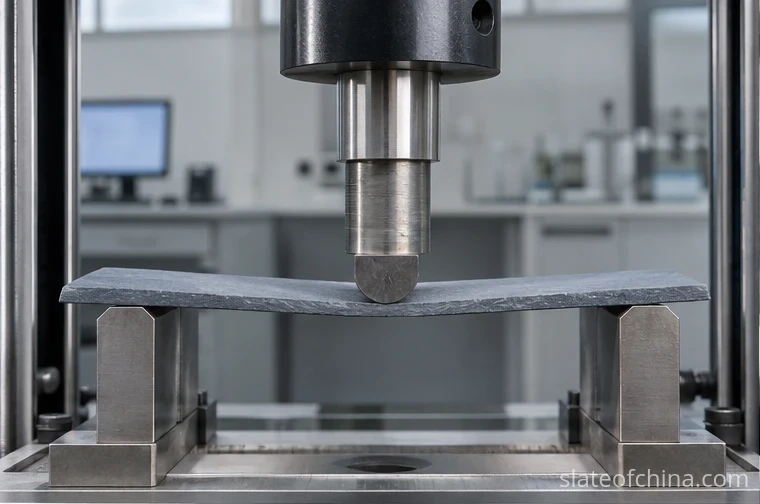
How thickness affects breaking load
Under ideal conditions — the same material, the same specimen width, the same support span — breaking load scales roughly with the square of thickness. Double the thickness and you don't get twice the load; you get about four times it. Halve it and most of the margin disappears in a single step.
The practical impact: when you compare two quotes that report different loads, check the tested size and thickness first. Two numbers tested at different sizes are not competing on the same terms.
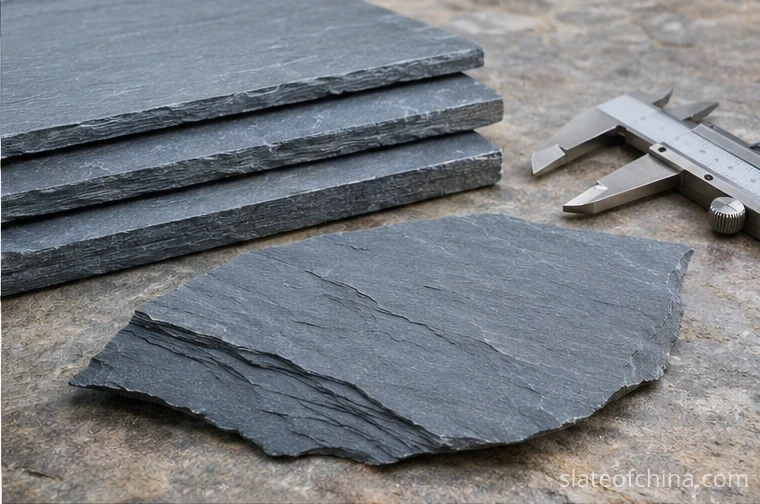
How strong is strong enough?
Now the number people actually want — read in the right frame.
ASTM C406/C406M (North America): roofing slate is classified into Grades S1, S2 and S3. All three share the same minimum breaking load of 575 lbf (≈2,560 N) in the ASTM C120 test; what separates the grades is water absorption and weather resistance, with S1 carrying the most stringent durability requirements.
| ASTM grade | Minimum breaking load | Maximum water absorption |
|---|---|---|
| S1 | 575 lbf | 0.25% |
| S2 | 575 lbf | 0.36% |
| S3 | 575 lbf | 0.45% |
Based on ASTM C406/C406M; each grade also has to meet its weathering (softening-depth) requirement. Confirm the applicable standard edition before you rely on the numbers.
EN 12326-1 (Europe): the product specification for natural roofing slate. It expresses requirements by slate size and thickness class, so there is no single universal value — the requirement rises with tile size. A slate that only scrapes its class minimum is a gamble; a quality slate clears it several times over.
Our own numbers (Lushan, Jiangxi — the quarry behind our roofing slate): dry flexural strength around 60 MPa; after 48 hours of full water saturation it still holds above 45 MPa. Water absorption ~0.2%, and CaO at only 0.56%. These are our own lab figures on a named batch — treat them as a data point, not as a certificate: 60 MPa does not by itself prove an ASTM grade, and grade compliance has to be verified against the relevant standard and test conditions. The full test documentation goes to serious buyers on request.
In other words: scraping past the minimum is not "passing", it's surviving. A slate worth nailing down passes by multiples, not by margins.
What the number does NOT tell you
Flexural strength is a snapshot. Three things it doesn't cover:
- Water absorption — a strong-looking dry slate can weaken noticeably when soaked. Ours sits at ~0.2% absorption, and our dry-to-wet gap (about 60 to 45 MPa) is roughly 25% — which is why we report both states rather than only the dry figure. A 0.6–0.8% slate tends to show a larger drop in a wet climate. That's exactly why we wrote a separate guide on water absorption.
- Freeze–thaw history — strength after repeated frost cycles is the real test of a roof. After 120 freeze–thaw cycles our reported strength held with no loss; we report it as the measured result on that batch, not as a claim that frost makes slate stronger — batch scatter and test conditions matter. EN and ASTM both score this; the grades guide explains what the letters actually guarantee.
- Installation reality — a strong slate nailed wrongly onto sagging battens still fails. The test assumes perfect support; your roof rarely is. Fixing, batten and pitch matter as much as the stone.
So flexural strength is the floor, not the building. Necessary, but never sufficient on its own.
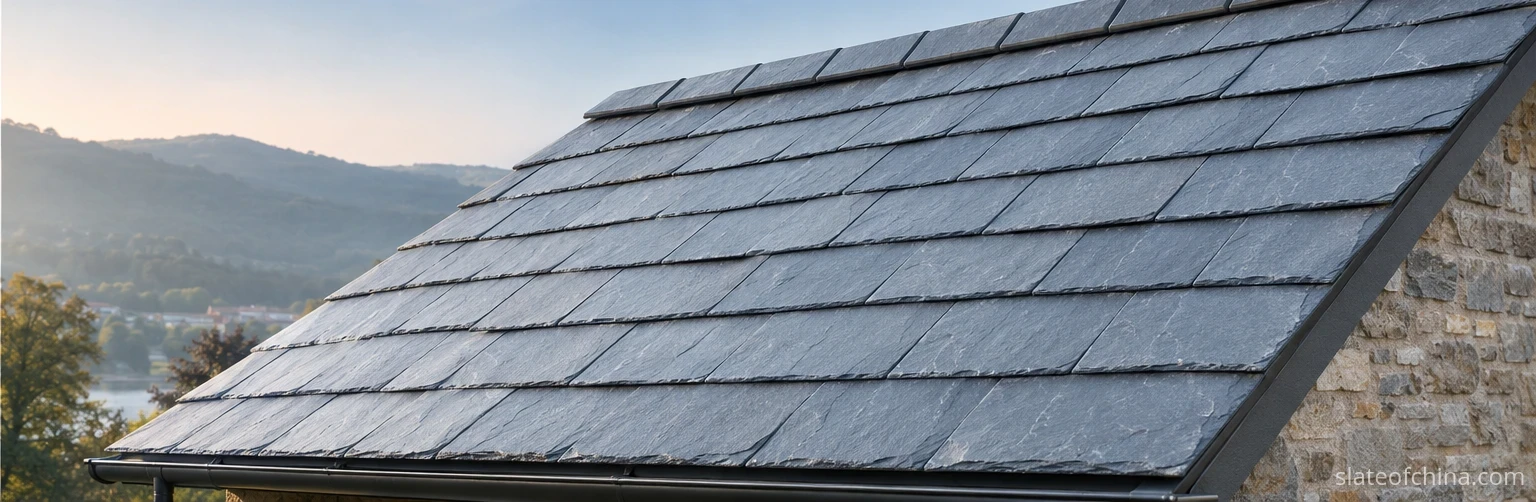
How to read a lab report without getting lost
When a supplier emails you a test PDF, look for these three lines first:
- Tested size and thickness — without them, the numbers mean nothing.
- Breaking load (N) or flexural strength (MPa) — and the margin by which they beat the cited standard's minimum.
- Water absorption % and carbonate content (CaO) — the two numbers that predict how strength behaves over decades.
Then read the margin. Scraping past the 575 lbf minimum at 585 is a warning sign — and remember that 575 lbf is a load figure, so read it together with the tested size and the standard's own conditions. Clearing it by several times is a different class of stone.
The only number that matters on site
On a roof, a person standing on one tile puts a point load into it, and the tile transfers the weight to the row below. That tile doesn't care about the lab report — it feels the load, and it either holds or it doesn't. But strength is only one input: a high flexural value does not mean you can safely walk straight on a single slate, because support, lap, fixing, existing cracks and where the load sits all change the outcome.
A slater's practical habit: if a tile snaps under light hand pressure at the bench, it's bad before it's even installed; one that rings clear and high when struck is worth a second look. Treat this as a quick screen, not a certification — and use proper roof walkways and safety equipment instead of standing on exposed slates.
When comparing quotes for a roof, ask for the test report before you talk price, and compare the margin on the modulus of rupture. If a supplier can't show a number that clears the minimum by a wide gap, they're selling you a gamble, not a roof. And if they offer samples, run them through the two 10-minute yard checks in the choosing guide — a good slate survives both.
Quick answers to the questions that never quite get answered
What is flexural strength of roofing slate in simple words?
It's how much bending a slate can take before it breaks, measured in MPa. In everyday terms, a person on a roof loads one tile with roughly 1 kN; a good slate carries several times that. Our Lushan slate tests at ~60 MPa dry.
What is the difference between flexural strength and breaking load?
Breaking load is the raw force in N or kN that snaps a given slate in the machine. Flexural strength is that force re-stated per unit of width and thickness (in MPa, or as the ASTM lbs figure), so slates of different sizes can be compared fairly. Same idea, two yardsticks.
What breaking load does EN 12326 require?
EN 12326-1 sets minimum breaking loads by slate size and thickness class. There is no single magic number — the requirement rises with tile size. What matters is the margin: a quality slate clears its class by a wide gap, and that's what you should look for in the certificate.
How strong does a slate need to be for a roof?
At minimum it should clear the ASTM breaking-load requirement — 575 lbf for all grades S1–S3 in the ASTM C120 test — with S1 adding the tightest water absorption and weathering limits, or its EN class. In practice, good slate tests in the 40–60 MPa dry range and stays above 40 MPa wet. Our Jiujiang slate tests around 60 MPa dry and above 45 MPa wet.
Why does thickness change the strength result?
Because flexural strength is computed with thickness squared — a 6 mm slate takes far more bending than a 4 mm one of the same stone. That's why strength figures only compare meaningfully within one size and thickness. See our thickness guide for the practical effect on roof loading.
Is Chinese roofing slate strong enough?
Good slate from the Lushan (Jiangxi) region tests 40–60 MPa — comfortably above the international minimums. Strength follows the quarry and the quality control, not the country. That's exactly why you verify with a real test report rather than a label.
Keep Reading
Spec a roof on numbers, not on promises.
Request our independent test documentation — flexural strength, water absorption and chemical composition — before you compare quotes.
Get the Test Documentation