
Can Roofing Slate Be Reused or Recycled?
Quick answer: Yes — and the numbers are better than almost any other roofing material. When a slate roof is stripped carefully, 65–80% of the tiles are sound enough to go straight back onto another roof. Another 10–15% are intact but cosmetically imperfect, and those get repurposed as paving, wall cladding, or crafts. The broken remainder — 5–10% — is crushed into aggregate for drainage, paths, and landscaping. Less than 5% ends up in landfill, and that fraction is mostly the timber battens and felt, not the stone. A natural slate tile can serve three roofs over 200 years before it becomes anything other than a roof tile. The synthetic alternatives? Nearly 100% landfill, every time.
What happens to 100 tiles stripped from a slate roof:
65–80 tiles → Re-roof (sold as reclaimed slate, reinstalled on another building)
10–15 tiles → Repurpose (paving, cladding, hearths, crafts, garden features)
5–10 tiles → Recycle / Aggregate (crushed for drainage, paths, mulch)
< 5 tiles → Landfill (mostly battens and felt, not the slate itself)
I have been buying and selling reclaimed building materials for eighteen years, and if there is one thing I have learned about natural slate, it is this: slate never dies, it just moves. A Welsh slate tile taken off a roof in Bangor in 1930 can end up on a garden wall in Surrey in 2026, still waterproof, still ringing true when you tap it. The question on this page — can roofing slate be reused or recycled? — is one I answer every week at the yard, usually while standing in front of a customer holding a weathered grey tile and wondering whether to believe me. So let me walk you through it the way I walk them through it: question by question.
Can You Take Slate Off One Roof and Put It on Another?
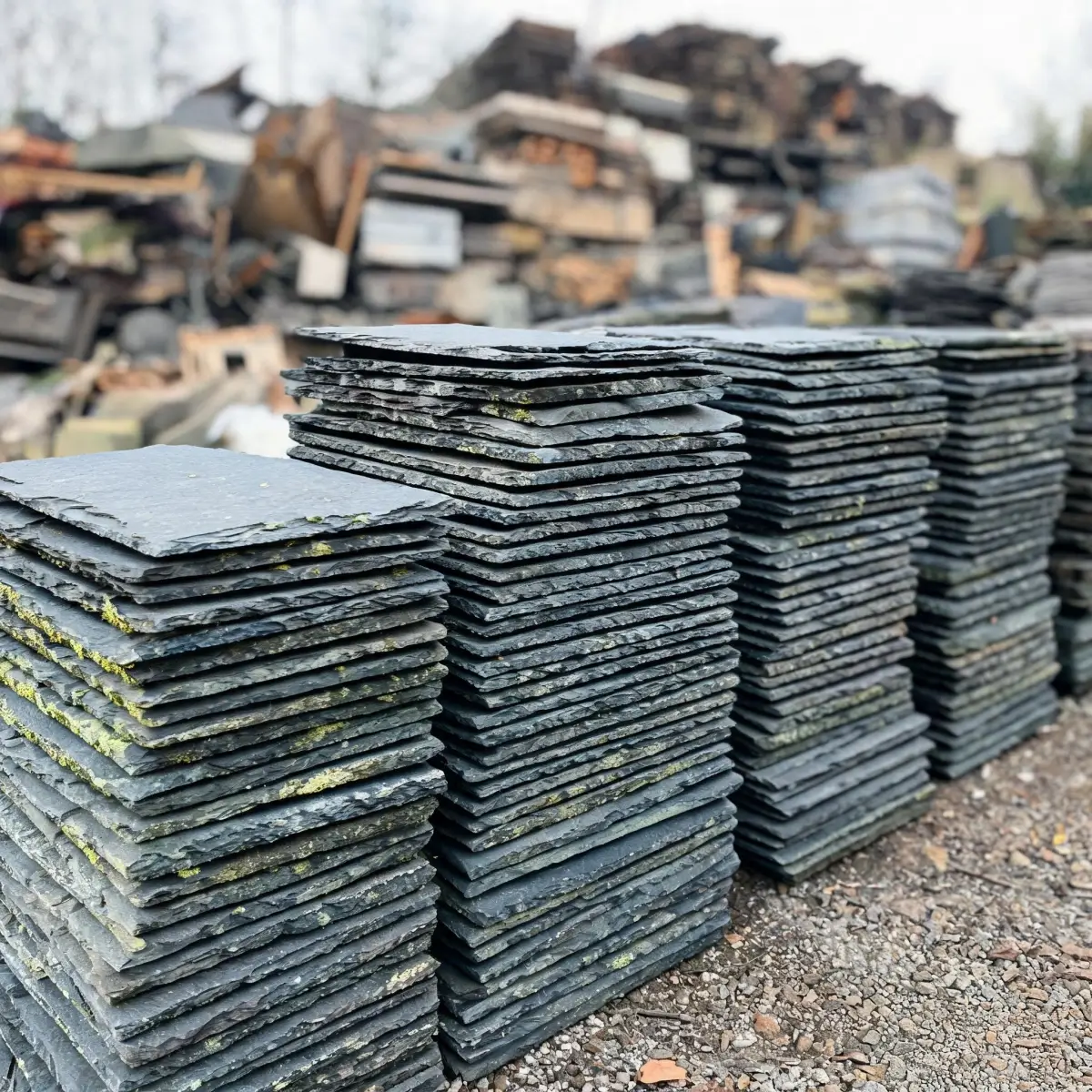
Yes, and this is what happens to most sound slate that comes off a roof. The process is called hand stripping, and it is the difference between salvage and rubble. A demolition contractor who runs an excavator across a slate roof produces a skip full of fragments. A roofer who lifts each tile, removes the nails, and stacks it face-to-face produces a pallet of second-hand slate that I will pay good money for.
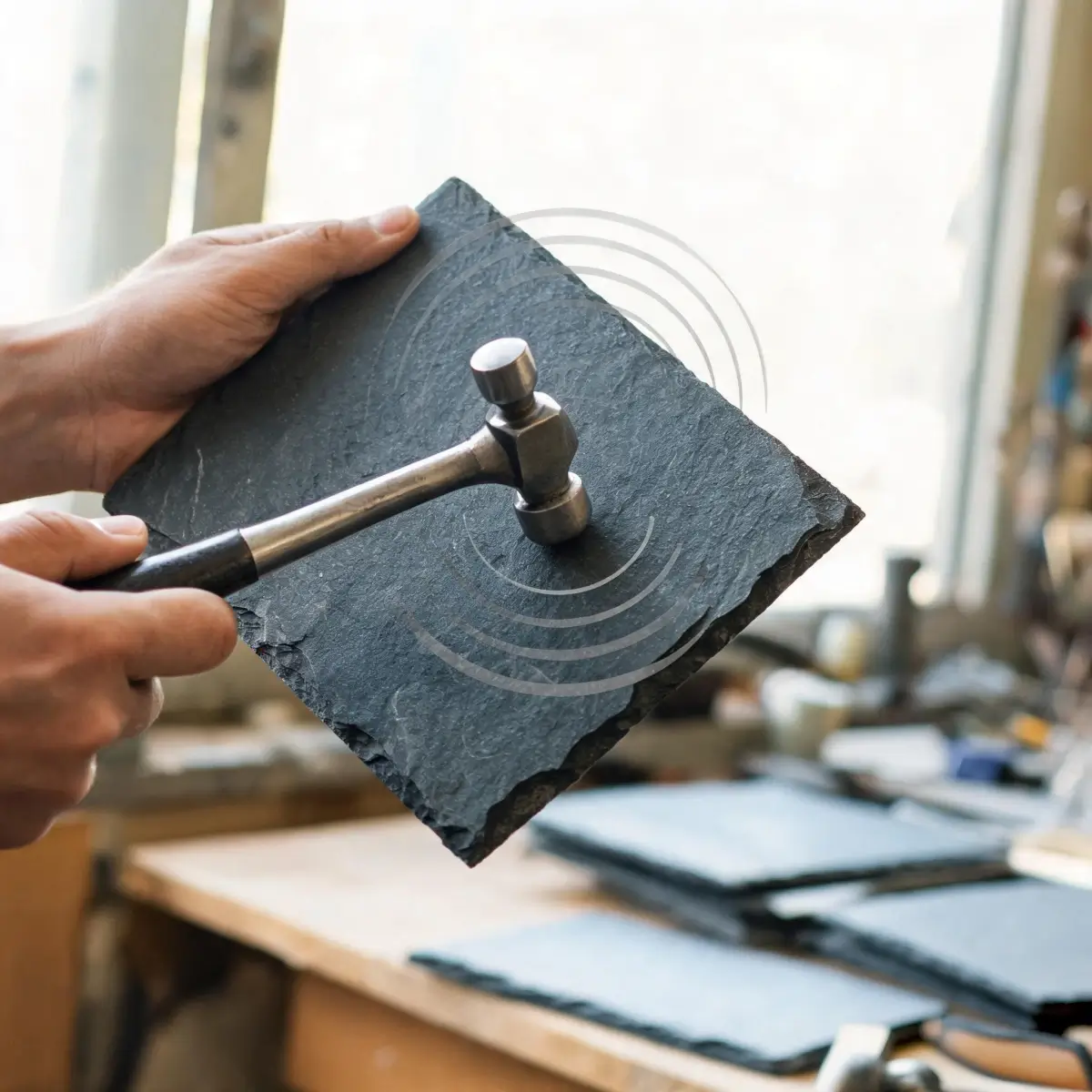
The tiles come to my yard, and they go through three checks before they are sold on. First, the ring test: I hold each tile by one corner and tap it with a small hammer. A clear, bell-like ring means the stone is intact — no internal cracks, no hidden delamination. A dull thud means the slate has a fault line I cannot see, and it goes to the breakage pile. Second, I check the edges and surface for chips, old nail holes, and weathering. Third, I measure the tiles and sort them by size, because a roofer buying reclaimed slate needs a consistent batch, not a lucky dip.
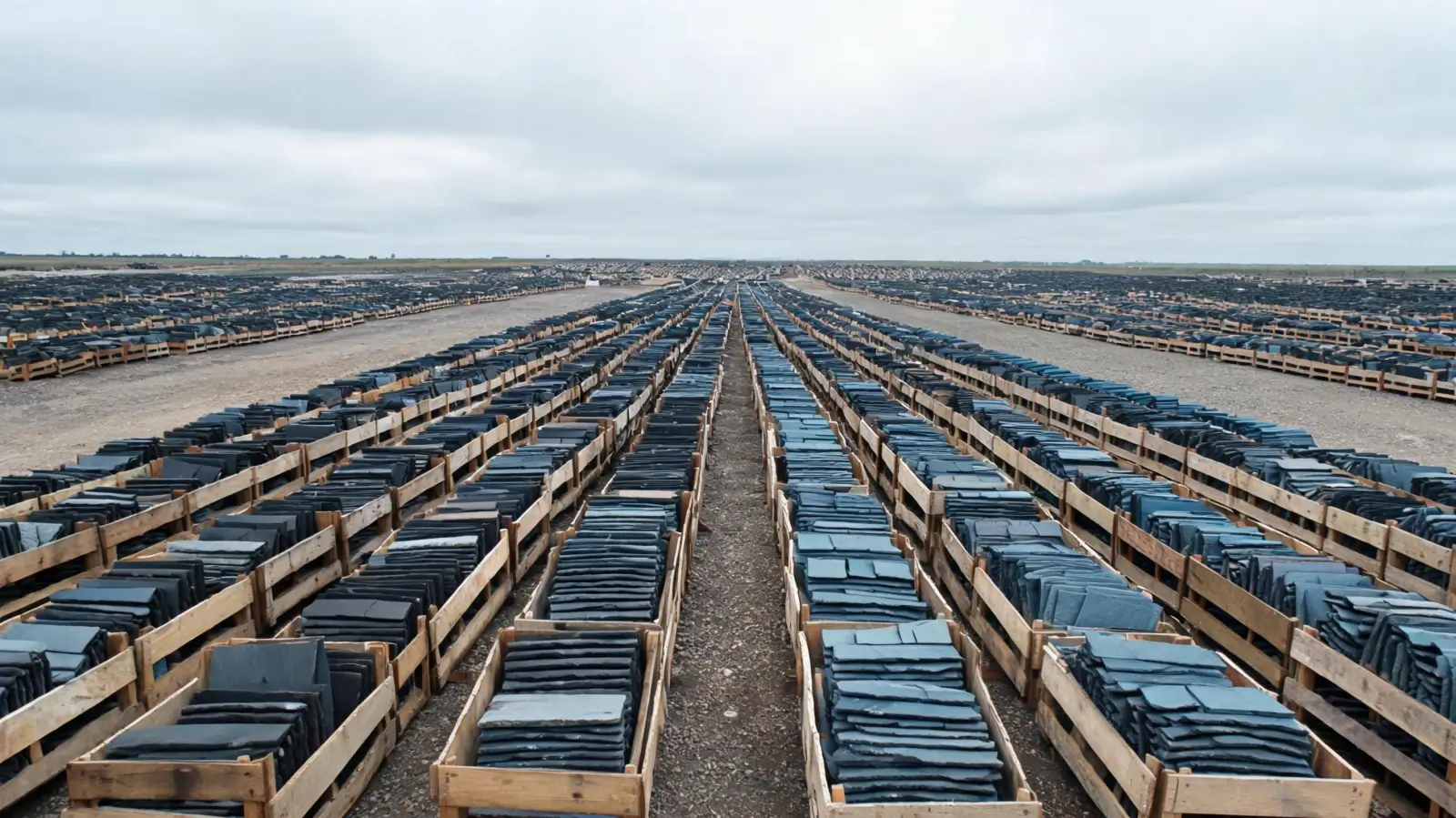
How much survives this process? On a well-maintained roof of, say, 3,000 tiles, I typically see 65–80% come through as sellable. The number depends on three things: how carefully the roof was stripped, how old the slate is, and whether the building sat under trees for decades (moss and damp accelerate edge decay on even the best stone). The worst case I have seen was a 1960s roof stripped by machine — barely 20% survived. The best was a pre-1900 Welsh slate roof hand-stripped by a craftsman who knew what the tiles were worth: 92% went back on another roof.
What does reclaimed slate cost compared to new? At my yard, sound reclaimed tiles sell for roughly £0.15–£0.30 per tile depending on size and origin. New slate from a good quarry runs £0.40–£0.80 per tile at wholesale. The reclaimed market is not a discount bin — it is a separate supply chain serving restoration projects, heritage buildings, and homeowners who want weathered character from day one. Some reclaimed Welsh slate commands more than new Chinese slate, because the colour and texture are no longer available from any quarry.
If you are planning to strip a slate roof and want the tiles to have a second life, the most important thing you can do is tell your contractor before the scaffold goes up. Hand-stripping costs more in labour — expect £1–£2 per tile — but the recovered slate often sells for more than the stripping cost, and the alternative is a skip fee and a landfill. Our guide to reusing existing roofing slate covers the stripping, grading, and reinstallation process in more detail.
How Do You Know If Old Slate Is Still Sound?
The ring test is the first thing, but it is not the only thing. Here is what I check, in the order I check it:
Tap it. Hold the tile by one corner, dangling free. Tap the centre with a small hammer or the back of a chisel. A clear, sustained ring — think of a bell, not a plank — means the stone is structurally intact. A short, dead sound means there is a crack running through it that you may not be able to see. This test works because slate's natural cleavage gives it a crystalline resonance when it is whole, and that resonance dies the moment a fracture breaks the continuity of the stone.
Look at the edges. A slate tile that has been on a roof for eighty years should have crisp, clean edges. If the edges are rounded, soft, or powdery, the stone is delaminating — the layers are separating, and the tile will not last another decade on a roof. This is the same carbonate-decay problem that our carbonate content guide explains in detail, and it is the single most common reason old slate fails the ring test.
Check the nail holes. Old nail holes are not a problem if they are clean and the tile will be re-nailed in a different position. But if the holes are enlarged, rusted, or surrounded by a white halo, the fixing area has been compromised. A good slater will re-punch new holes at least 25 mm from the old ones — the cutting and punching guide shows how this is done on new slate, and the principle is the same on reclaimed.
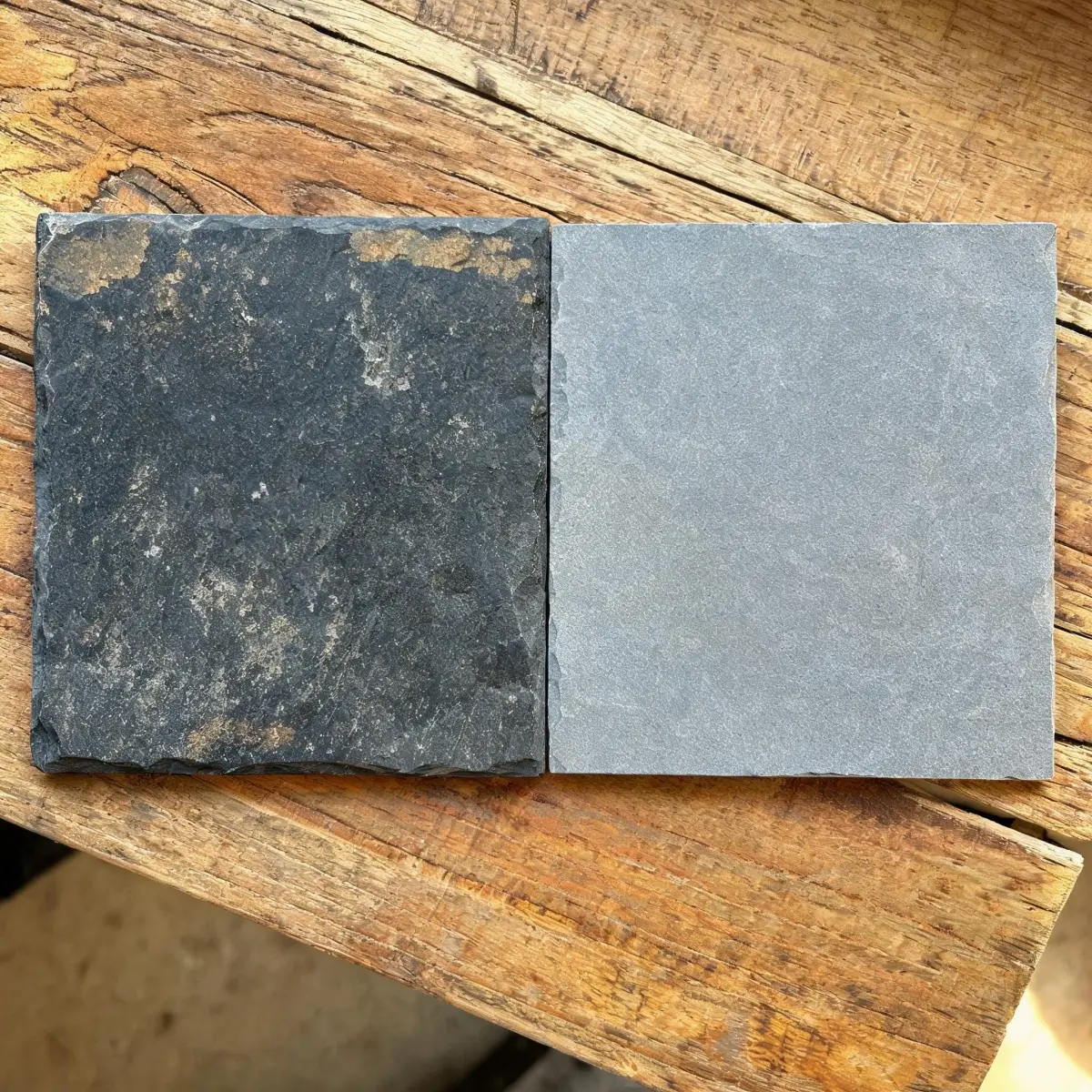
Look at the surface. Some weathering is normal and attractive — a slightly uneven colour, a soft sheen where rain has polished the surface. But if the surface is flaking, if you can peel a layer off with your thumbnail, or if there are rust-coloured spots that crumble when pressed, the slate has either high carbonate content or pyrite inclusions, and it is not going back on a roof.
What Happens to Slate That Can't Go Back on a Roof?
Not every tile that comes off a roof is sound enough to re-roof with, and this is where the story gets more interesting, not less. A tile that fails the ring test or has edges too soft for roofing still has value — just a different kind of value, in a different market.
Paving and flooring. Slate tiles that are structurally intact but too weathered or inconsistent for roofing make excellent paving slabs. The same properties that make slate a good roof tile — low water absorption, natural cleft surface, frost resistance — make it a superb paving material. I sell sound-but-not-pretty slate to landscapers at roughly £15–£25 per m², which is less than new paving slate but performs identically. Laid on a proper sub-base, a slate paving path will outlast the house it came from.
Wall cladding and veneer. Thin, weathered slate tiles are increasingly popular as wall cladding for feature walls, fireplaces, and external facades. The irregular surface that disqualifies them from roofing becomes a selling point for cladding — clients want texture, not uniformity. I cut weathered tiles down to cladding thickness and sell them by the square metre.
Hearths and window sills. A single sound slate tile, cut to size and edge-dressed, makes a fireplace hearth that costs a fraction of a new slab. Slate's heat resistance is genuine — it does not crack under thermal shock the way some manufactured stone does — and reclaimed slate brings a depth of colour that new slate takes decades to develop.
Crafts and homewares. The smaller offcuts and broken pieces go to craft workshops that make coasters, placemats, cheese boards, and sign blanks. This is a small market in tonnage terms but it absorbs the material that is too small for anything else and would otherwise be the first to go to landfill. Our slate crafts range shows what the end products look like.
Can Broken Slate Be Recycled as Aggregate?
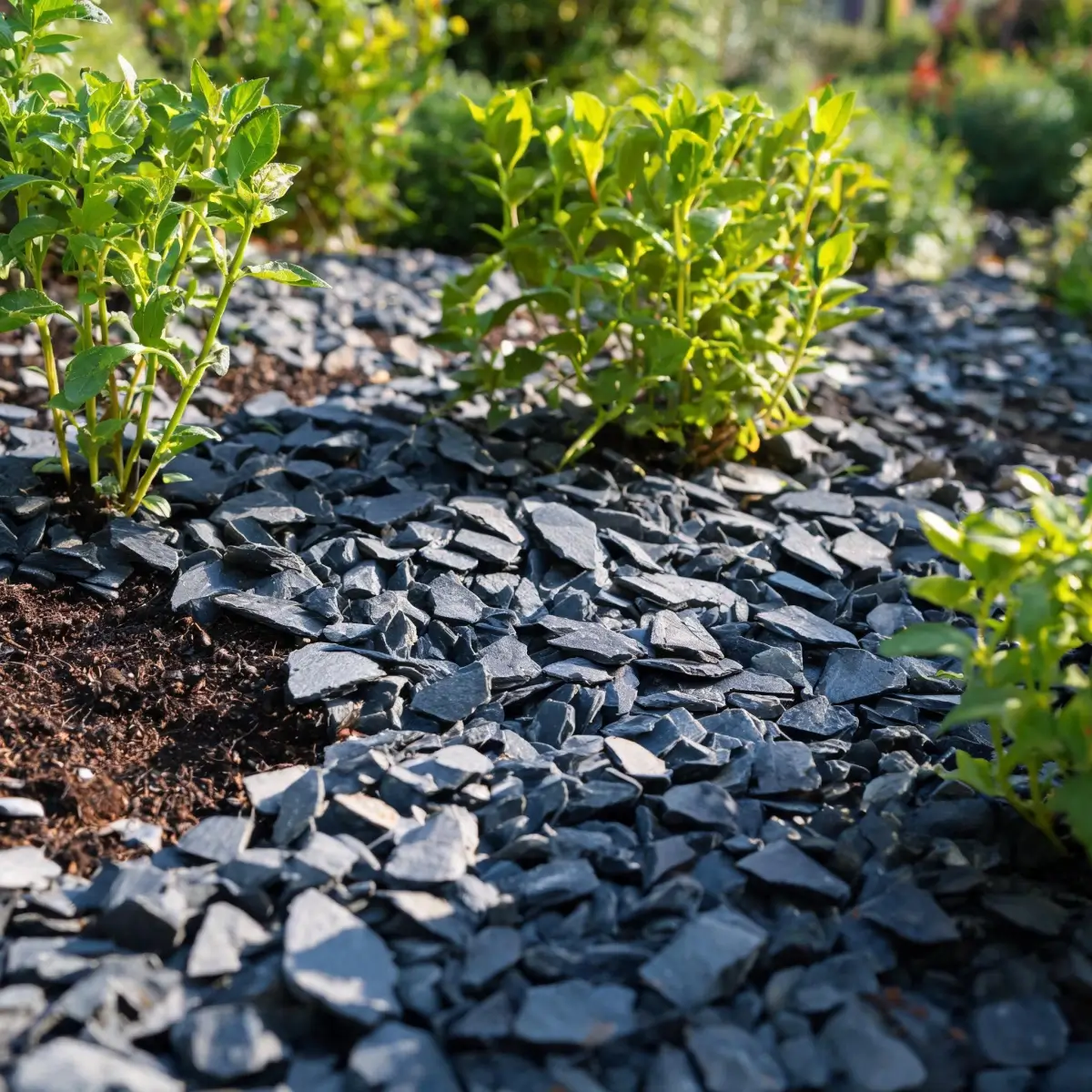
Yes, and this is the third life — the one that surprises people most. When slate is too broken or too small for paving or crafts, it goes through a crusher and becomes aggregate. Crushed slate has properties that make it genuinely useful, not just a convenient way to avoid a skip fee.
It is pH-neutral. This matters more than it sounds. Crushed concrete aggregate is alkaline — it leaches lime into the surrounding soil and changes the pH of anything it touches. That is fine under a driveway but disastrous in a garden or a watercourse. Crushed slate is chemically inert, the same stone it was on the roof, so it can be used as drainage backfill, path surface, or mulch without affecting the soil chemistry around it. For gardeners and landscapers, this is the difference between a material that works and one that kills their plants.
It drains freely. Slate's natural cleavage means crushed fragments are flat and angular, not rounded. That shape locks together underfoot but leaves enough void space for water to pass through. I sell crushed slate as a drainage medium for French drains and soakaways, and as a permeable surface for paths and patios. It compacts better than pea gravel and does not migrate the way rounded aggregates do.
It looks good. Dark grey crushed slate is a premium landscaping material — garden centres sell small bags at a price per kilo that would make a quarry owner weep. The same colour that made it a handsome roof tile makes it a handsome mulch: it does not fade, does not float in heavy rain, and suppresses weeds better than bark because it sits flat and tight.
How much broken slate actually gets crushed versus landfilled? At my yard, I would estimate 5–10% of what comes in goes to the crusher, and less than 5% goes to landfill — and the landfill fraction is almost entirely the timber battens, roofing felt, and the occasional tile that is so badly decayed it crumbles in the hand. The stone itself, if it came off a roof as a tile, almost always finds a use.
How Does Slate Compare to Synthetic Roofing for Recyclability?
This is the question I wish more people asked before they chose a roof, because the answer is the clearest environmental argument for natural slate that exists — and it does not require a lifecycle assessment or a carbon calculator to understand.
Natural slate is a single material: rock, split and cut, nothing added. When it comes off a roof, every piece has a use, and the only processing it needs is sorting and maybe cutting. There is no coating to strip, no polymer to separate, no adhesive to break down. The material you put on the roof is the material that comes off, and the material that comes off is the same material that goes into the next roof, or the next path, or the next cheese board.
Synthetic slate — fibre cement, bituminous-felt tiles, polymer-composite slates — is a different story entirely. These products are composites: fibres bound in cement, polymers mixed with fillers, bitumen reinforced with glass. When a synthetic slate roof reaches the end of its life, typically after 25–40 years, the tiles cannot be separated back into their raw materials. There is no reclaimed market for fibre-cement tiles because they cannot be reused — they are brittle, they have degraded, and nobody wants them. There is no recycling stream because the composite cannot be economically separated. So they go to landfill. All of them. Every tile, every time.
I do not sell synthetic roofing, and I do not buy it when it comes off a roof, because there is nothing to buy. When a fibre-cement roof is stripped, the skip goes to the tip and that is the end of the story. When a natural slate roof is stripped, the skip is the last resort, and it is mostly empty. If you want the full material comparison — lifespan, appearance, cost — our natural vs synthetic guide covers it in detail. But on the single question of what happens at the end, the answer is stark: natural slate has four doors out of the building, and synthetic has one.
| End-of-life path | Natural slate | Synthetic / fibre-cement |
|---|---|---|
| Reused as roofing tiles | 65–80% | ~0% |
| Repurposed (paving, cladding, crafts) | 10–15% | ~0% |
| Recycled as aggregate | 5–10% | ~0% |
| Landfill | <5% (mostly timber/felt, not slate) | ~100% |
Figures are indicative, based on eighteen years of salvage yard operations. Individual roofs vary. The key point is the direction of travel, not the precise percentage: natural slate has four outlets, synthetic has one.
What About the Environmental Benefit of Reusing Slate?
People ask this in two ways. The first is: "Is it better for the planet to reuse old slate than to buy new?" The second is: "Does slate actually get recycled, or does it just sit in a pile somewhere?" Let me answer both honestly.
On the first question: reusing slate avoids the energy and extraction cost of producing a new tile. A new slate tile requires quarrying, cutting, and shipping — low energy compared to fired clay or manufactured concrete, but not zero. A reclaimed slate tile requires transport and sorting, and that is all. The embodied energy in a reclaimed tile is roughly a quarter of a new one, simply because the quarrying and processing have already been paid for by the first roof. Our environmental impact guide puts the quarrying and production figures in context if you want the numbers.
On the second question: slate does not "sit in a pile." I cannot keep enough good reclaimed slate in stock. The demand comes from three directions: restoration contractors who need matching tile for heritage work, homeowners who want character at a lower price than premium new slate, and an growing market of architects specifying reclaimed materials for BREEAM and LEED credits. If a slate tile is sound, it sells. If it is not sound, it gets crushed. The only slate that sits is the stuff that arrived already crumbling — and that goes to the crusher within the week.
There is one environmental angle that is less obvious but worth mentioning. When you reuse slate, you are not just saving the energy of a new tile — you are also avoiding the disposal cost of the old one. In the UK, landfill tax on construction waste is over £100 per tonne. A typical slate roof weighs 4–7 tonnes. That is £400–£700 of landfill tax that does not get paid if the slate goes to salvage instead of the tip. The economics of salvage are not charity — they are simply better than the economics of dumping, and they get better every year the tax rises.
How Long Can a Slate Tile Keep Being Reused?
This is my favourite question, because the answer sounds like I am making it up.
I have handled Welsh slate from the 1890s that came off a roof in Cardiff, was sold as reclaimed in the 1960s, went onto a second roof in Herefordshire, came back off in 2020, and is now sitting in my yard waiting for its third roof. That stone is roughly 130 years old. It passed the ring test. It will sell within the month.
The oldest slate I have personally seen in active reuse was a Welsh tile dated to around 1904 — we could trace it through a quarry stamp on the back. It came off a church roof in 2024 after 120 years of service, was sorted, and went straight onto a private home extension. The roofer told me it cut and nailed exactly like new slate. No special treatment, no softening, no degradation that mattered.
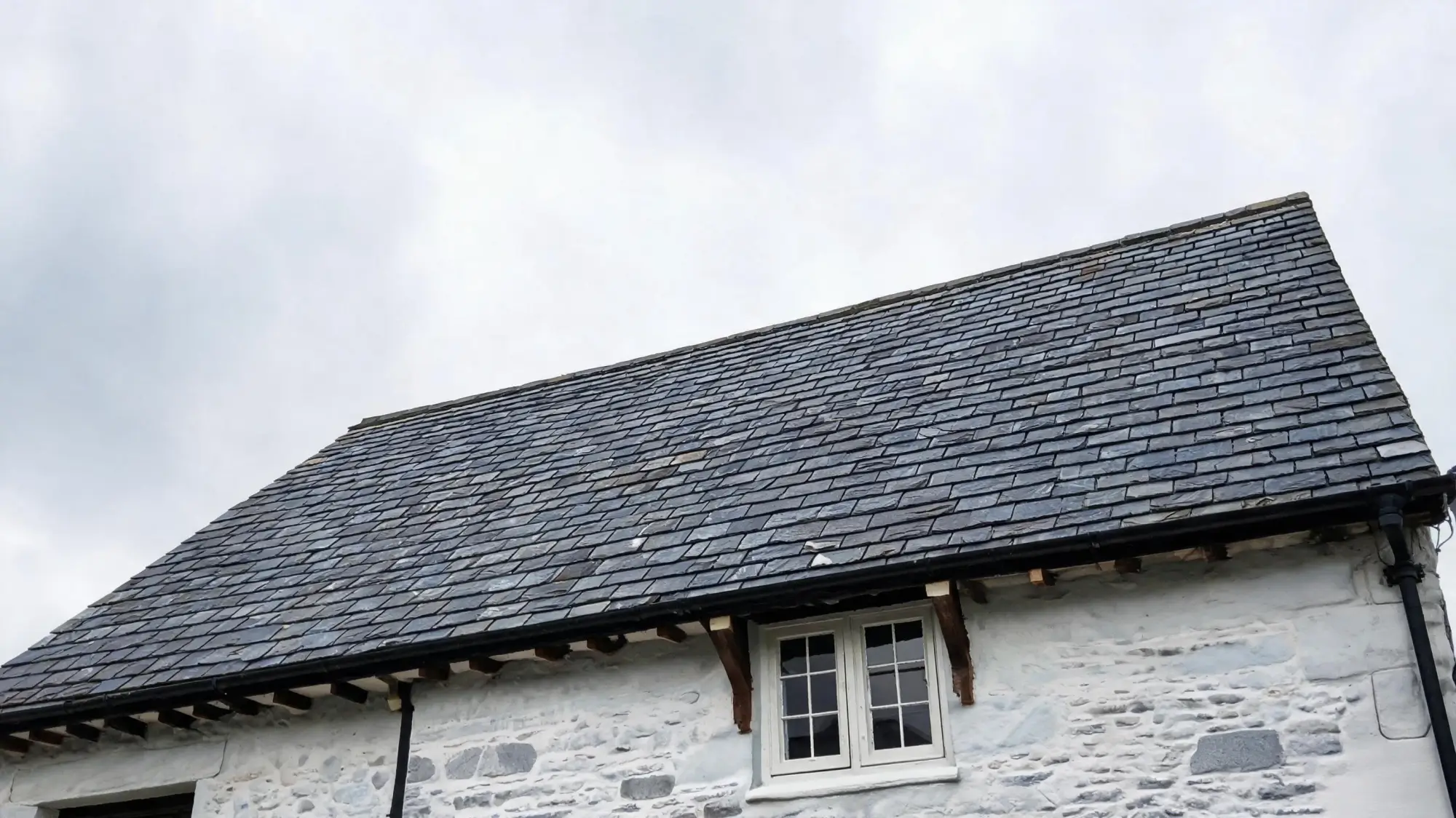
The theoretical limit on slate reuse is not the stone — it is the fixing method. Old nail holes can be re-punched if they are in good condition, and hooks can be re-used indefinitely because they do not damage the tile. A slate tile fixed with copper nails or hooks could, in principle, serve four or five roofs over 200–300 years before the stone itself finally weathers to the point where it becomes aggregate. That is not a marketing claim — it is simple geology. Slate is a metamorphic rock formed over hundreds of millions of years under heat and pressure. A century on a roof does not materially age it, because the conditions on a roof (rain, frost, sun) are gentle compared to the conditions that created it.
What Should I Do If I'm Removing a Slate Roof?
If you are a homeowner, a contractor, or a developer about to strip a slate roof, here is the practical advice I give every customer who calls my yard. It is not complicated, and it will make the difference between a roof that has a second life and one that becomes rubble.
1. Tell the contractor before they start. The single biggest factor in how much slate survives stripping is whether the roofer knows the tiles are being saved. If they know, they hand-strip. If they do not know, they run an excavator across it and it is all over. Say it in the contract: "All natural slate to be hand-stripped and stockpiled for salvage." Those eight words are worth thousands of pounds and several tonnes of landfill.
2. Sort as you strip. Stack tiles face-to-face in pallets, not thrown into a skip. If the roofer can sort by size as they go, even better — it saves me a day of work and makes the tiles worth more. Nail holes do not matter at this stage; I will re-punch or re-hole at the yard.
3. Photograph the roof before stripping. This is for two reasons. First, it helps me estimate how much is likely to be sound before the tiles arrive. Second, if the roof is a heritage building, the photos may be needed for listed building consent or for matching replacement tile. Matching replacement slate explains why a photo from before stripping is worth more than a phone call after.
4. Call a salvage yard before you call a skip company. I will come and assess the roof, give you a price for the tiles, and arrange collection. If the slate is good, the value of the reclaimed tile often exceeds the stripping cost — meaning you save money by not throwing it away. If the slate is bad, I will tell you honestly and you have lost nothing but a phone call.
5. Do not mix slate with other waste. The most common reason good slate ends up in landfill is that it gets thrown into a mixed-waste skip with felt, timber, and broken tiles. Once it is in there, it is contaminated and I cannot take it. Keep slate separate, and it stays valuable.
Quick Questions Answered
Is reclaimed slate as good as new slate?
For roofing, sound reclaimed slate performs identically to new slate — it is the same material, formed the same way, with the same water absorption and frost resistance. The differences are cosmetic: reclaimed slate has a weathered surface, slightly uneven colour, and may have old nail holes that need re-punching. For heritage projects and restoration work, reclaimed slate is often preferred over new because it matches the existing roof in colour and texture. For a new build where uniformity matters, new slate is the better choice. Both will outlive the building.
Can I reuse slate tiles from my own roof?
Yes, and it is one of the most cost-effective ways to reroof. If your existing slate is sound — passing the ring test with crisp edges and no delamination — you can hand-strip it, re-grade it, and relay it on the same roof or a different building. This is called "strip and relay," and it typically costs 60–70% of a full new-slate roof because you are only paying for labour, not material. Our guide to reusing existing roofing slate covers the full process.
What is crushed slate used for?
Crushed slate aggregate is used as a drainage medium for French drains and soakaways, as a permeable surface for garden paths and patios, as a weed-suppressing mulch in landscaping, and as a sub-base material. It is pH-neutral (unlike crushed concrete, which is alkaline), drains freely due to its angular flat particle shape, and does not fade or float. It is a premium landscaping material sold in garden centres at a far higher price per kilo than it costs at a salvage yard.
Can synthetic slate be recycled?
Effectively, no. Fibre-cement tiles, polymer-composite slates, and bituminous-felt tiles are composite materials that cannot be economically separated into their raw ingredients. There is no reclaimed market for them because they degrade and become brittle with age. When a synthetic slate roof is replaced, the old tiles go to landfill — nearly 100% of them, every time. This is the single biggest environmental difference between natural and synthetic roofing at end of life.
How much is old roofing slate worth?
Sound reclaimed roofing slate typically sells for £0.15–£0.30 per tile at a salvage yard, depending on size, origin, and condition. Premium reclaimed Welsh slate can command more. For a typical roof of 2,000–3,000 tiles, the reclaimed value can range from £300 to £900 — often more than the cost of hand-stripping. Broken or unsound slate has no resale value as tile but can be sold as aggregate at roughly £20–£40 per tonne. The value is in the sorting: mixed waste has none.
Where can I find reclaimed slate near me?
Reclaimed slate is available from architectural salvage yards, reclamation merchants, and some roofing suppliers. In the UK, the Salvo and LBM directories list salvage yards by region. If you are buying reclaimed slate for a roofing project, always ask to visit the yard, inspect the tiles in person, and run the ring test on a sample batch before committing. If you are selling slate from a roof being stripped, contact local salvage yards before the strip begins — they will assess the roof and may collect directly.
Slate That's Built to Be Reused
The best recycling story starts with material that is worth recycling. We produce S1/T1 roofing slate to EN 12326 and ASTM C406 in our Jiujiang factory — CNC-cut to ±0.2 mm and individually inspected, every tile. Slate with tight tolerances and proven test results is slate that will pass the ring test in 100 years, because the stone underneath the standard is genuinely sound. The test results are public, and the current material range is here. Buy slate that is built to outlive the building — and the next one.