
Roofing Slate Packaging and Crate Standards
The short version: a good crate is not a box of tiles; it is a device for protecting tiles through weeks of handling, stacking and ocean motion. The twelve lines that matter: ① bundle count, ② interleaving, ③ corner protection, ④ straps and re-tensioning, ⑤ crate construction, ⑥ weight and stacking height, ⑦ moisture — load dry, ⑧ moisture — vent or seal, ⑨ labels and batch numbers, ⑩ ISPM 15 timber marks, ⑪ container loading, and ⑫ the packing list that ties it all together. Each line is cheap to specify in the office and expensive to correct after the seal.
Roofing slate can pass every laboratory test and still arrive as a claim. Between the last inspection bench and the buyer's roof sits a chain of packing decisions — bundling, interleaving, strapping, crate construction, moisture control, labelling, loading — and a failure at any one of them is not a quality problem. It is a specification problem, and specification problems are settled on paper before the deposit, not at the port after the surveyor arrives.
Most buyers treat packing the way they treat the label inside a shirt — present, vaguely useful, rarely read. Then a container arrives with a corner missing on one crate and a handful of tiles that ring dull, and the phrase "shipping damage" enters the conversation, though nobody can point to the line in the contract that said how the slate would be packed. A slate roof has three ways to fail — bad stone, bad fixing, bad arrival — and the standards documents cover the first two in detail. The third one is decided by the twelve lines in this guide.
What follows is the packing specification in the order the crate is actually built: what each line does, what it costs when it is skipped, and the questions that tell you whether your supplier works to a standard or to a habit.
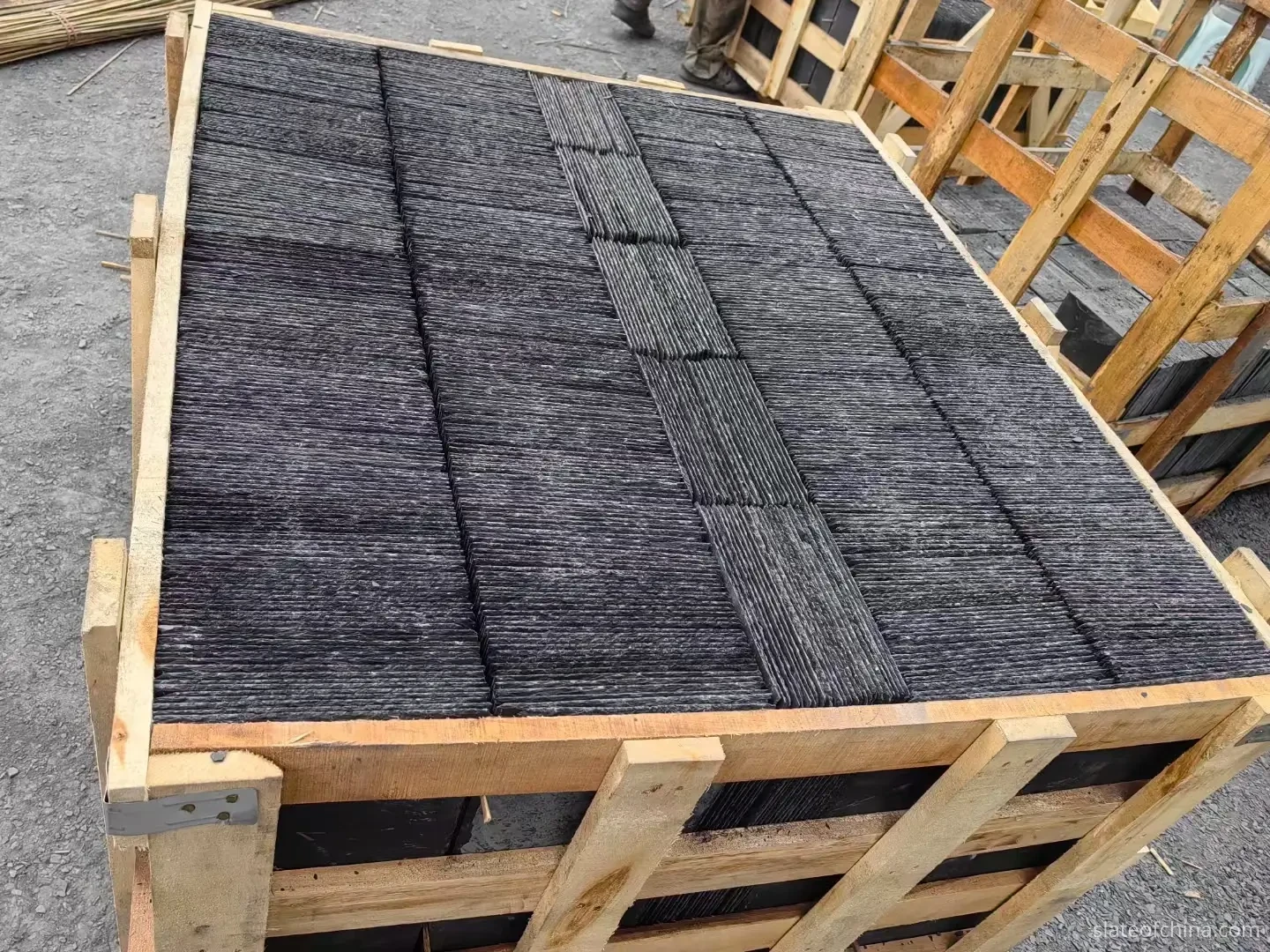
Line 1 — Bundling: The Small Pack Within the Pack
Before the crate, there is the bundle. Export packing generally starts with tiles tied into bundles of ten to twenty pieces — a cardboard sheet between every second or third tile, a strap around each bundle, and the bundles laid into the crate course by course, staggered so the corners of one bundle do not sit directly above the corners of the next.
The reason is pressure distribution. Slate breaks at corners first, and a loose pile of tiles in a crate leaves the top face of every tile carrying the entire stack through a few small contact points. Bundle the tiles and the cardboard spreads the load across the face; stagger the bundles and no two corner stacks line up in the same column. Every layer of bundling is a layer of pressure spreading, and pressure — not impact — is what quietly breaks most packaged slate.
Two questions to put in writing: the bundle count per crate, and the packing plan that shows how the bundles are laid. A plan that bundles in tens and crates in round numbers is a plan that was calculated. A supplier who answers "around a thousand pieces, more or less" is asking the buyer to do arithmetic the factory did not do.
Line 2 — The Interleaving: Cardboard, Foam, or Nothing at All
Between one bundle and the next goes an interlayer. The trade name is interleaving, and the material decides much of the friction and moisture story of the shipment:
| Material | What it does | Watch-out |
|---|---|---|
| Corrugated cardboard (3–5 mm) | Economical, compresses slightly, spreads the load, keeps tile faces from rubbing | Will flatten if the crate is overfilled; must be stored dry |
| Foam / EVA sheet (5–10 mm) | Best cushioning, resists vibration on long voyages | More expensive, and foam can hold moisture against the stone |
| Nothing ("tile on tile") | Saves cost per m² | Vibration polish — two faces rubbing for weeks in the same spot — plus corner chipping that begins before the crate is even opened |
Cardboard interleaving is the practical default for most export slate. Foam is a justified upgrade for long voyages, transhipments or aggressive climates. What is never acceptable is "nothing": crates that arrive with tile faces polished at the contact points have not been damaged in transit — they were packed to abrade. That damage is invisible on the dock and shows up on the roof, which is exactly what makes it expensive.
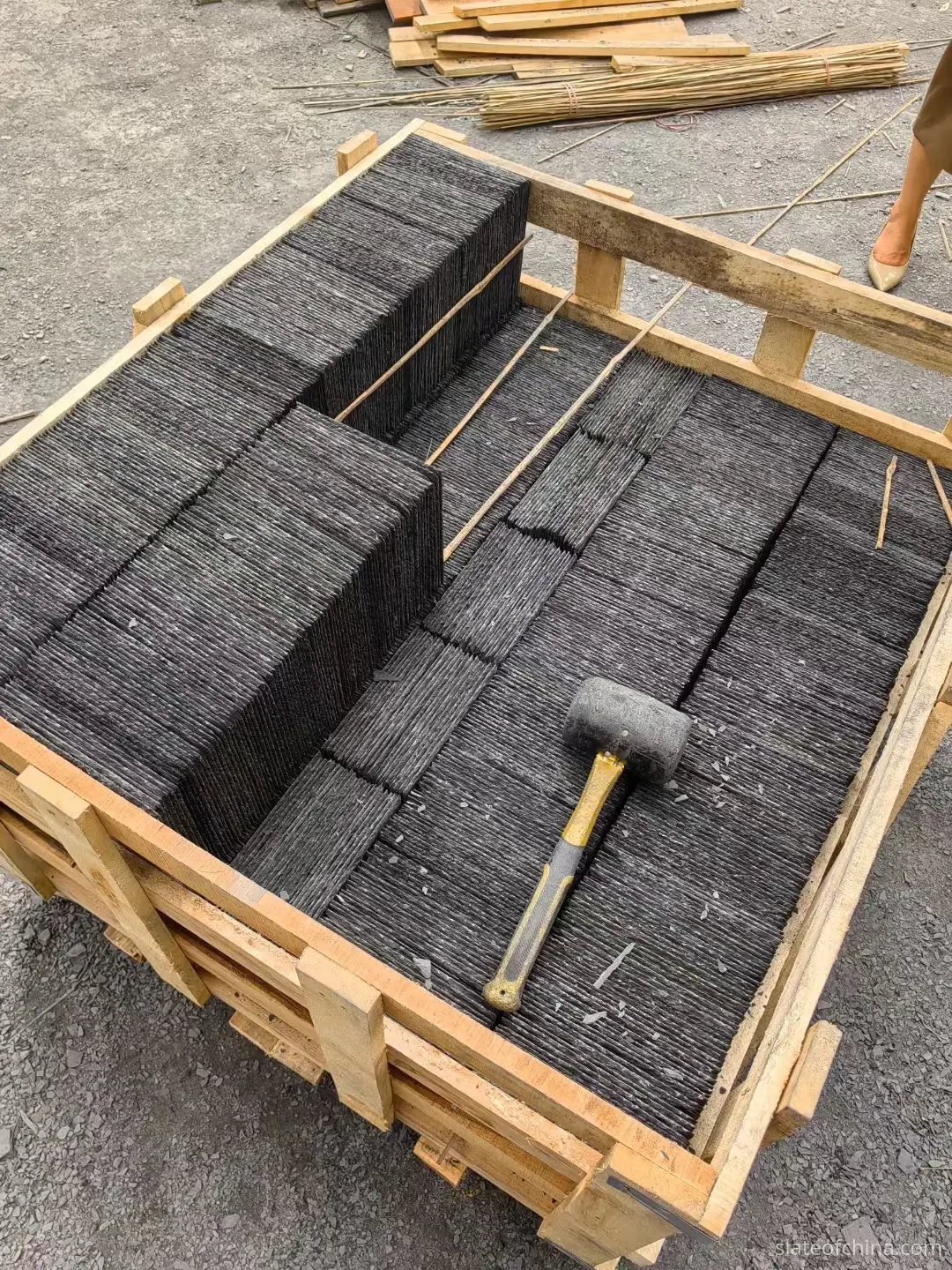
Line 3 — Corners: Where Most Slate Breaks
Corner damage is the most common form of transit breakage in roofing slate. The corner of a tile is the thinnest edge, the least supported, and the point that meets the crate wall when the load shifts. Packing protects corners at three levels:
- On the bundle: corner protectors — cardboard or foam angles — at the corners of each bundle or crate load, standing the stack away from the timber.
- On the crate: the timber structure itself. Crates with full-height corner posts carry an impact on the frame instead of the panels, and the panels instead of the tiles.
- In the container: the gap between the crates and the container wall is the last line of defence — packed tight, or padded with the cardboard from the bundles, so the container wall becomes part of the plan rather than a hazard (see Line 11).
Treat "corner protection" in a quotation as an incomplete sentence until it carries a dimension. Protection by what — 3 mm cardboard, 10 mm foam, bare timber? Write the material and thickness into the packing specification, and confirm it in the loading photographs. The difference between the brochure and the crate is measurable, and it is measured in broken corners.
Line 4 — Straps and Re-tensioning
Steel or polyester strapping holds the crate together, and every export packing includes some. The detail that separates a specification from a habit: strapping relaxes. Polyester strap in particular loses a measurable amount of tension in the first 24 hours after the crate is closed, and a crate is often strapped, stacked and sealed faster than that.
A disciplined packing line straps twice — once at the packing station, and again after the crate has stood overnight and the load has settled — or uses tensioning tools that hold better than a basic seal. The question that reveals the standard is simple: "strapped once, or re-tensioned the next morning?" It costs one sentence in an email and tells you whether the invisible labour is being done.
Strap selection is not a rule of thumb. The strap type, width and count follow the crate weight and the packaging design, and polyesters differ in rated strength as much as steels do. Rather than accepting a generic claim, ask for the strap specification in the packing plan — material, width, number of straps and their position — the same way the tile specification is requested. A supplier who cannot state it is packing to a habit, not to a calculation.
Line 5 — The Crate Itself: Timber, Walls, and What They Do
A close wooden crate — base, four sides, lid, internal bracing — is the export standard for roofing slate in ocean freight. Proper construction protects the tiles against impact, vibration, compression and movement, and it does four specific jobs:
A well-built export crate has four structural elements: full-height corner posts that carry the stacking weight down through timber, not through tiles; a timber frame that holds the walls off the bundle edges; internal bracing — cross-pieces that lock the bundles in position when the load works; and a lid that bears on the frame, not on the tiles. A crate that lets the tiles hold the walls apart is a crate that arrives with a bowed side and a cracked tile where the wall's job was being done by stone.
Timber choice is the other half: solid timber for the frame and corner posts, plywood or oriented strand board for the wall panels. Solid timber carries the load; panels keep the neighbouring crate off the bundles. A crate built entirely from thin screwed panels — no structural posts — is lighter and cheaper and may serve a local delivery; it is not an ocean-freight crate. Ask for the crate specification as for the tile specification: timber sections, panel thickness, and whether the corner posts run the full height of the crate.
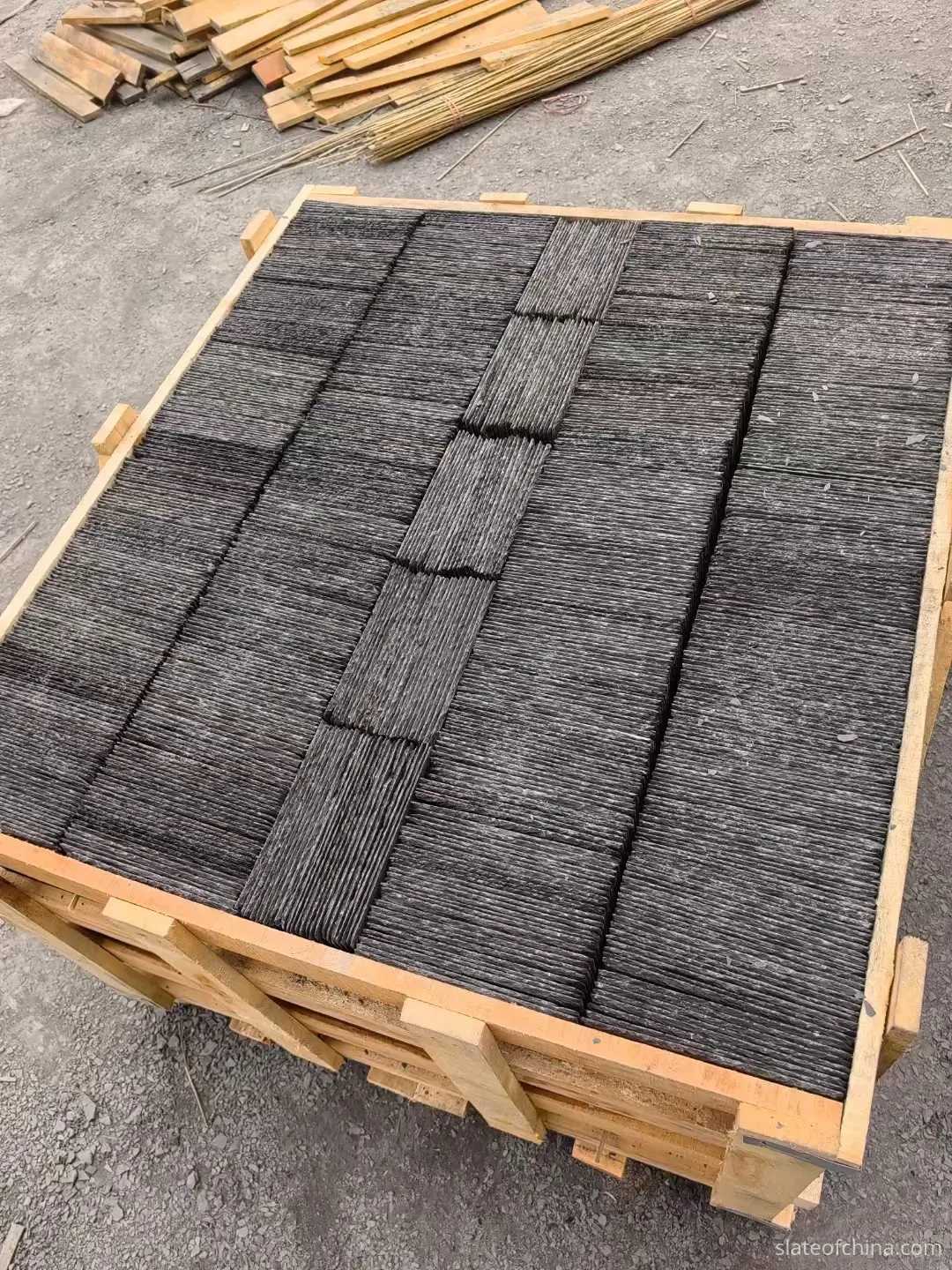
Line 6 — Sizes, Weight, and the Arithmetic of a Crate
The crate has to fit the container in footprint and in loading height, and the numbers only work when they are worked as one arithmetic. The figures below are an illustrative example for one common specification — 500 × 250 mm tiles at 7–9 mm — using the density rule that slate runs about 2.7 t per cubic metre, so every millimetre of thickness adds about 2.7 kg per m²:
| Figure (illustrative) | 500 × 250 mm, 7–9 mm slate | How it is derived |
|---|---|---|
| Weight per tile | About 2.4–3.0 kg | 0.125 m² per tile × (7–9 mm × 2.7 kg/m²) |
| Stone per crate | About 60 m² — roughly 480 tiles | A common export crate size; 60 m² ÷ 0.125 m² per tile |
| Stone weight per crate | About 1.1–1.4 t, before the timber | 60 m² × 19–24 kg/m² for 7–9 mm slate |
| 20ft container load | About 1,130–1,450 m² — typically 21–28 crates | 27,500 kg payload ÷ 19–24 kg/m², checked against volume |
Read the table as an example, not a standard. The exact figures move with the size, the thickness band and the crate design — thicker slate (9–11 mm) stops nearer 920–1,130 m², thinner slate (5–6 mm) can pass 1,700 m² before weight stops it — and the full calculation, including the formula to check any supplier's number, is set out in how many square metres fit in a container. What the packing specification must deliver is agreement: the crate count, the m² and the piece count have to reconcile to the same arithmetic, on one line of the packing list, before the container is booked. The MOQ guide explains why that line is also the boundary between one production batch and two.
Stacking height has a mechanical ceiling that is easy to overlook. In a two-high stack the bottom crate's frame carries one full crate above it — within the design of a normal export crate. Three-high moves beyond that design: the bottom tiles take the weight of two crates through the timber, and the plan now needs engineered bracing, a timber sled under the base, or a different loading plan entirely. State the stacking height in the packing list. If a claim ever depends on whose load plan broke the tiles, that line is the evidence.
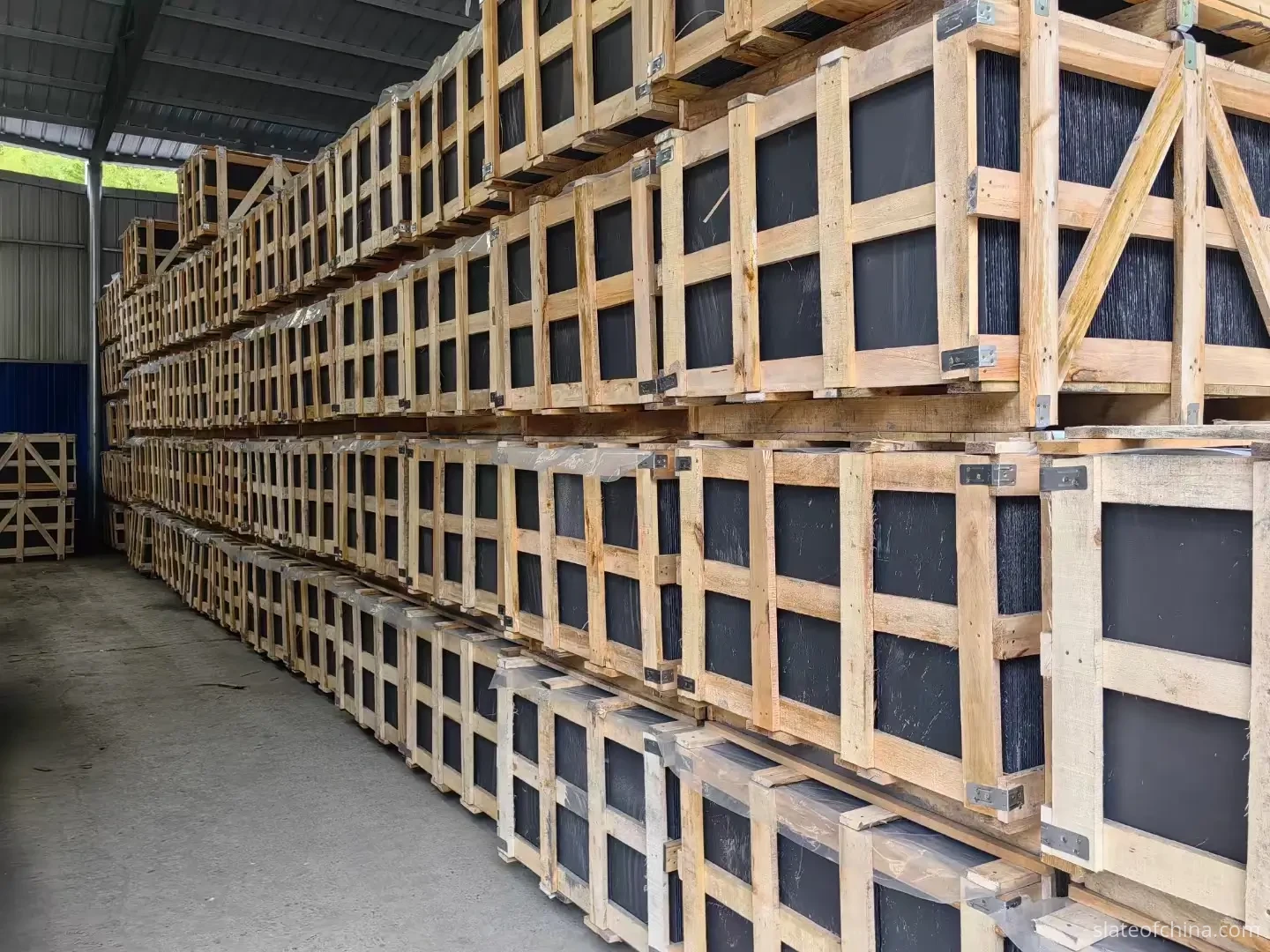
Line 7 — Moisture, Part One: Load It Dry
Shipping containers are not dry environments. A steel box builds its own micro-climate: deck-level containers cycle between hot days and cold nights, the air inside cools against the steel, and condensation runs down the walls onto the floor and the cargo. For a cargo of stone, the practical enemy is not salt — it is water, arriving from inside the box.
That is why the first moisture line is not a treatment but a state: the slate and the packing go into the crate dry. The checkable version of "dry" is a set of conditions, not a laboratory number:
- Stone surfaces dry and at ambient temperature — no visible dampness, no standing water on tiles or crate base.
- Slate not sealed within a day of washing or wet cutting — water held in surface micro-texture and micro-cracks comes out during the temperature cycles of the voyage and does not go back in.
- Packing materials stored dry — cardboard interleaving and liners that have sat in a wet yard carry their own moisture into the closed crate.
- How dryness is verified — ask what the factory checks before packing, and when. The drying beds and pre-packing checks are described in the factory quality control guide.
Then the physical defences: a PE film or liner between the crate base and the first course keeps floor-level condensation off the tiles that sit lowest, and desiccant placed against the cold spots — typically the door end of the container — buys margin at low cost. None of these rescue a crate that was sealed damp. They protect a crate that was packed dry.
Line 8 — Moisture, Part Two: Vent or Seal
The second moisture decision is whether the crate breathes or closes, and the honest answer is that both are correct in the right conditions:
- Vented construction suits long ocean voyages with big day–night temperature swings, where condensation forms inside a closed box faster than desiccant can absorb it. A vented floor and a raised top course let air move and water drain.
- Sealed construction suits short hauls, door-to-door containers and routes where the main risk is rain during handling — provided the slate and the packing materials went in dry, and desiccant is placed.
The failure mode is matching the wrong choice to the route. A sealed crate that was packed damp manufactures its own condensation every night of the voyage. A vented crate that spends a week on an open dock in the rain can take on more than it sheds. Ask the supplier which one they build, and why, for your route — a supplier who answers in terms of your voyage, not their brochure, has thought about the sea. The tell at destination is the underside of the lid and the top course of tiles: water beading on the lid and damp staining on the top course is the signature of a box that should have breathed. The inspection checklist covers that check on arrival.
Line 9 — Labels, Batch Numbers, and the Packing List Number
Every crate should carry, stencilled or on a weatherproof label: the crate number, the tile size and thickness, the bundle or piece count, the batch number, the gross and net weight, and the packing list number that ties the crate to the bill of lading. The label is the crate's identity, and identity is what makes a claim possible. When a crate's batch number does not match the packing list's batch line, that mismatch — not the broken tile — is the first conversation, and the label is the document that wins it. Batch control begins earlier, on the sorting floor, as described in how roofing slate is graded and sorted.
Line 10 — ISPM 15: The Stamp Customs Asks About
The second stamp is phytosanitary. ISPM 15 is the international standard for solid wood packaging: solid timber crossing a border generally must be heat-treated or fumigated and carry the IPPC mark, and a container without compliant marks can be held, re-shipped or de-wooded at destination.
The scope rule matters. Processed wood products — plywood, OSB and other engineered panels made from heat-treated, bonded material — are generally outside the treatment requirement, which is why plywood-sided crates are common in stone exports. But a mixed crate matters for the exemption: plywood panels on a solid-timber frame still contain solid-wood components, and it is those components — the posts, the frames, the bracing — that the mark has to cover. Ask which parts of the crate are solid wood, and check that those parts carry the stamp. "It's plywood, it's exempt" is only true of a crate with no solid timber in it, and most slate crates have plenty.
Line 11 — Loading: The Plan Inside the Box
From the moment the crate reaches the container door, the loading plan is the packing. The normal pattern in a 20ft box is two rows of crates, one row against each side wall, with the middle aisle braced so nothing moves laterally. Everything that is not held by the container structure is held by dunnage — boards, foam, the flattened cardboard from the bundles — jammed into the gaps. At sea the load settles and works; a plan that leaves free space undealt with is a plan that delivers the free space to the tiles.
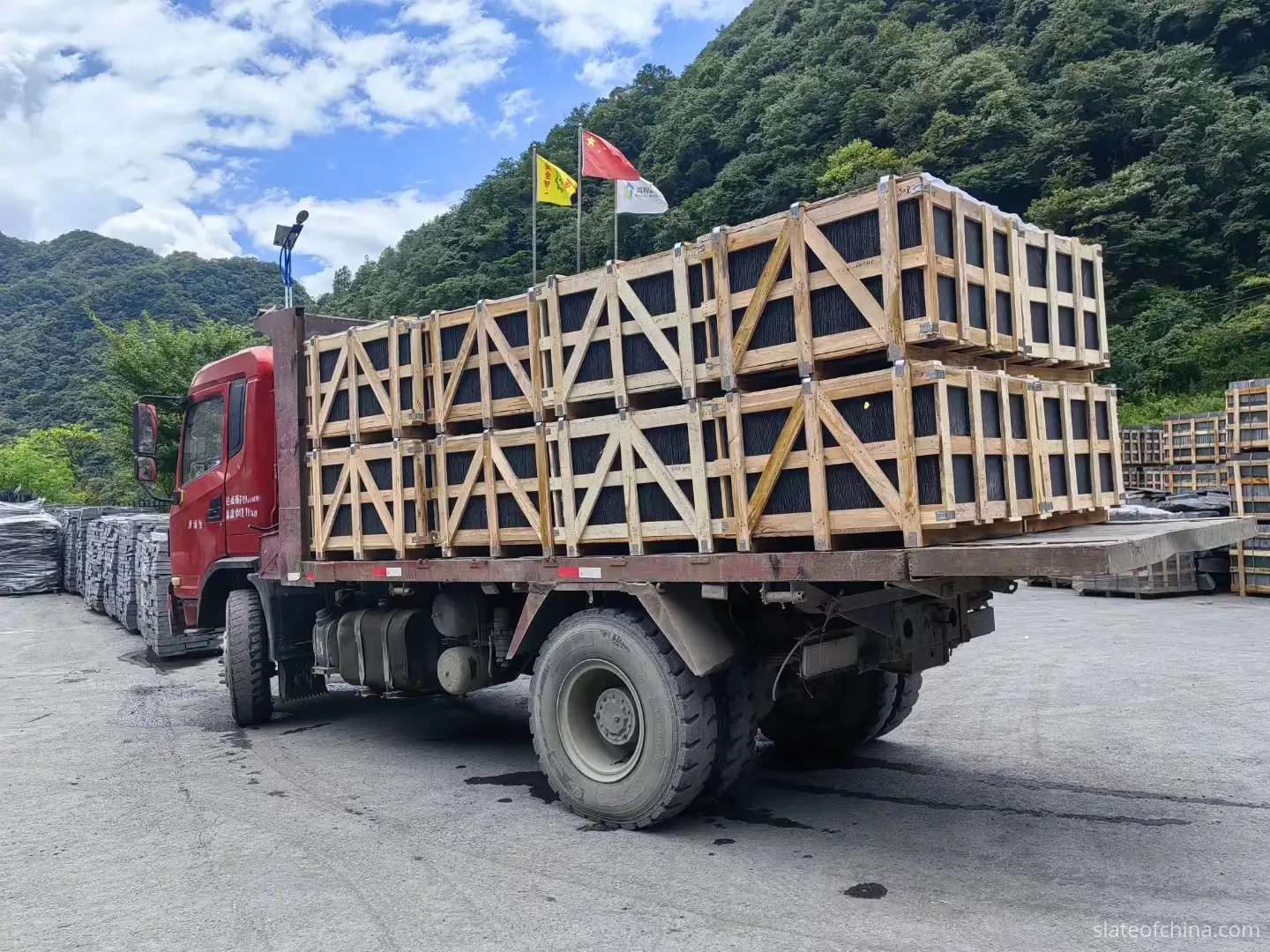
Three things to ask of the loading plan:
- Heaviest at the bottom, distributed across the floor. If the shipment mixes crate sizes or cargo types, the plan should place the heavy slate low and evenly, with lighter cargo and bracing above.
- Bracing against the rear and the door. The last metres of the container are where motion is least restrained; crates there go in with bracing against the door frame.
- The three photographs. A reliable exporter photographs the empty container, the first row, and the finished load, and keeps the set with the packing list. A supplier who can produce last month's set works to a repeatable standard; a supplier who cannot produce any set works to whatever happened that morning.
Line 12 — The Weight List and the Paper Trail
The packing list is the document that makes all eleven lines enforceable: gross weight, net weight, piece count, m², crate numbers and the container number, matching the bill of lading and the manifest. Disagreement between those papers is one of the most common reasons a slate container is held at a port — the manifest says one figure, the packing list says another, and the port has a scale. Crates weighed on the factory weighbridge, with the list printed from the scale's record, close that gap before it opens.
And when the container lands, the claim clock starts on delivery, not on discovery. The survey, the photographs and the count all have to exist inside the carrier's deadline — typically days. The sourcing guide's final checkpoint covers the arrival sequence. The working rule is simpler: the day the container opens is the day the paperwork starts.
The Export Packaging Inspection Checklist
Twelve lines compress into one page. The checklist below is the version a buyer can hold at the factory, at the port or at the container door — tick what is present, photograph what is not, and attach the result to the packing list before the seal goes on.
| Check | What good looks like | Where it is decided |
|---|---|---|
| Crate structure | Full-height corner posts, framed walls, internal bracing, lid bearing on the frame | Line 5 |
| Bundles and count | Bundles of stated count, laid staggered; count reconciles with the packing list | Line 1 |
| Interleaving | Cardboard or foam between bundles at the stated spacing, dry | Line 2 |
| Corner protection | Protectors of stated material and thickness at bundle and crate corners | Line 3 |
| Strapping | Strap material, width and count as specified; tensioned after settling | Line 4 |
| Stacking height | Two-high as standard; anything higher braced by design and stated on the list | Line 6 |
| Dryness | Dry stone surfaces, dry packing materials, base liner where specified | Line 7 |
| Vent or seal | Construction matched to the route; desiccant at the cold end of sealed crates | Line 8 |
| Timber treatment mark | IPPC mark on every solid-timber component, or all-plywood construction | Line 10 |
| Labels and batch | Crate number, size, thickness, count, batch, weights, list number — all legible | Line 9 |
| Container loading | Two rows, gaps braced, rear crates chocked; empty/first-row/loaded photographs taken | Line 11 |
| Packing list | Weighbridge figures, matching bill of lading and manifest, attached photo set | Line 12 |
So What Actually Breaks, and What "Normal" Means
Every buyer asks the same two questions: how much breakage is normal, and what happens when there is more. The precise answer is that there is no universal acceptable breakage rate for roofing slate shipments. What arrives whole depends on the packing specification, the route and the handling — which means the honest place to settle the question is the contract, before the deposit: an agreed damage tolerance, an agreed inspection procedure at unloading, and an agreed claim window and responsibility for costs. A tolerance written in advance is a working tool; a tolerance argued after the container opens is a dispute.
What can be said in general is where to look first, because the pattern is consistent. When breakage runs above what was agreed, the cause is found in the packing plan more often than in the stone or the sea. Three questions locate it:
- Was the crate built to the specification — bundle count, interleaving, corner boards, strap count and tension?
- Was the stacking and loading plan as described — height within the stated limit, heaviest crates low, rear and mid-aisle gaps braced?
- Was the cargo dry and correctly vented or sealed? — because moisture damage is a delayed failure: it rarely shows on the dock, and it arrives on the roof as the tile that cracks in the first hard frost.
The third question is the one that misleads. A claim that "the stone is bad" is often a moisture and packing story wearing a geology costume, and the evidence sits in the lid stain, the top course and the packing list — in that order. The roofing slate range pages carry the stone specifications; the test results describe the material. This guide covers the part no report describes: what the voyage does to packed slate, and what the packing does about it.
FAQ
What kind of wooden crate is used for shipping roofing slate?
A proper export crate for roofing slate has a base, four sides and a lid, built on a timber frame with full-height corner posts that carry the stacking weight through the wood, not the tiles. Internal bracing locks the bundles in position, and the wall panels — solid timber or plywood — keep the neighbouring crate off the bundle edges. Bare pallets and shrink-wrap-only packing are not export packing for ocean freight, whatever the price advantage.
How many square metres of roofing slate fit in a 20ft container?
A 20ft container works on about 27.5 tonnes of payload, and slate weighs about 2.7 tonnes per cubic metre. For 7–9 mm slate that works out to roughly 1,130–1,450 m², typically 21–28 crates of about 60 m² each. Thinner slate (5–6 mm) can pass 1,700 m² before weight stops it; thicker slate (9–11 mm) stops nearer 920–1,130 m². The arithmetic is portable: thickness in mm × 2.7 gives kg per m², and 27,500 divided by that number gives the m² — then checked against volume.
What is the ISPM 15 stamp on slate crates?
It is the international phytosanitary mark for solid wood packaging. Solid timber crossing a border generally requires heat treatment or fumigation and the IPPC mark; without it, customs can hold or refuse the shipment. Plywood and other processed wood panels are generally outside the treatment requirement — but a crate with plywood panels on a solid-timber frame still has solid-wood posts and bracing, and those parts are what need the mark.
How much breakage is normal when roofing slate arrives?
There is no universal acceptable breakage rate. What counts as acceptable depends on the packing specification, the route and the handling, and it should be agreed in writing before shipment: a damage tolerance, an inspection procedure at unloading, and a claim window with clear responsibility for costs. When breakage exceeds what was agreed, the packing plan is the first place to look — bundle interleaving, corner protection, strap tension, stacking height and dryness, in that order.
Why do tiles crack a year after installation if they looked fine on arrival?
Because some damage is invisible on the dock. Micro-cracks from vibration or compression, and moisture sealed into the crate, can stay dormant until the first freeze–thaw cycle expands them. Packing the slate dry, interleaving properly, and matching the vented or sealed construction to the route decide whether a shipment arrives whole or merely whole-looking — and the difference shows up on the roof, not at the port.
What should the packing list say for a roofing slate shipment?
It should match the crate labels exactly: batch number, size, thickness, piece count, m², bundle count, gross and net weight per crate and in total, and the container number. The figure that carries the most weight is the one printed from the weighbridge — a packing list that matches the bill of lading and the manifest keeps the container moving through the port and gives you a clean paper path for any claim.
How do I check the packing of a crate without opening it?
Weigh the crate against the packing list — a discrepancy beyond tolerance is the first red flag. Read the label's batch number and compare it with the test report and the packing list. Check the timber for dampness and for the ISPM 15 mark on solid-wood parts. Photograph the crate's condition before the straps come off, then open the top layer first with the interleaving still visible: the inside of the crate shows whether the outside of the promise was real. The inspection checklist puts the full sequence in order.
Related Reading
Send the Size — Get the Packing Plan in Writing
Every roofing slate quotation we write carries a line-by-line packing specification — crate construction, bundle count, interleaving, strapping, moisture measures, timber treatment and the loading plan — and the loading photographs that go with your batch. Ask for a packing plan · see the roofing slate range · view our test results