
Large-Format Slate Floor Tiles
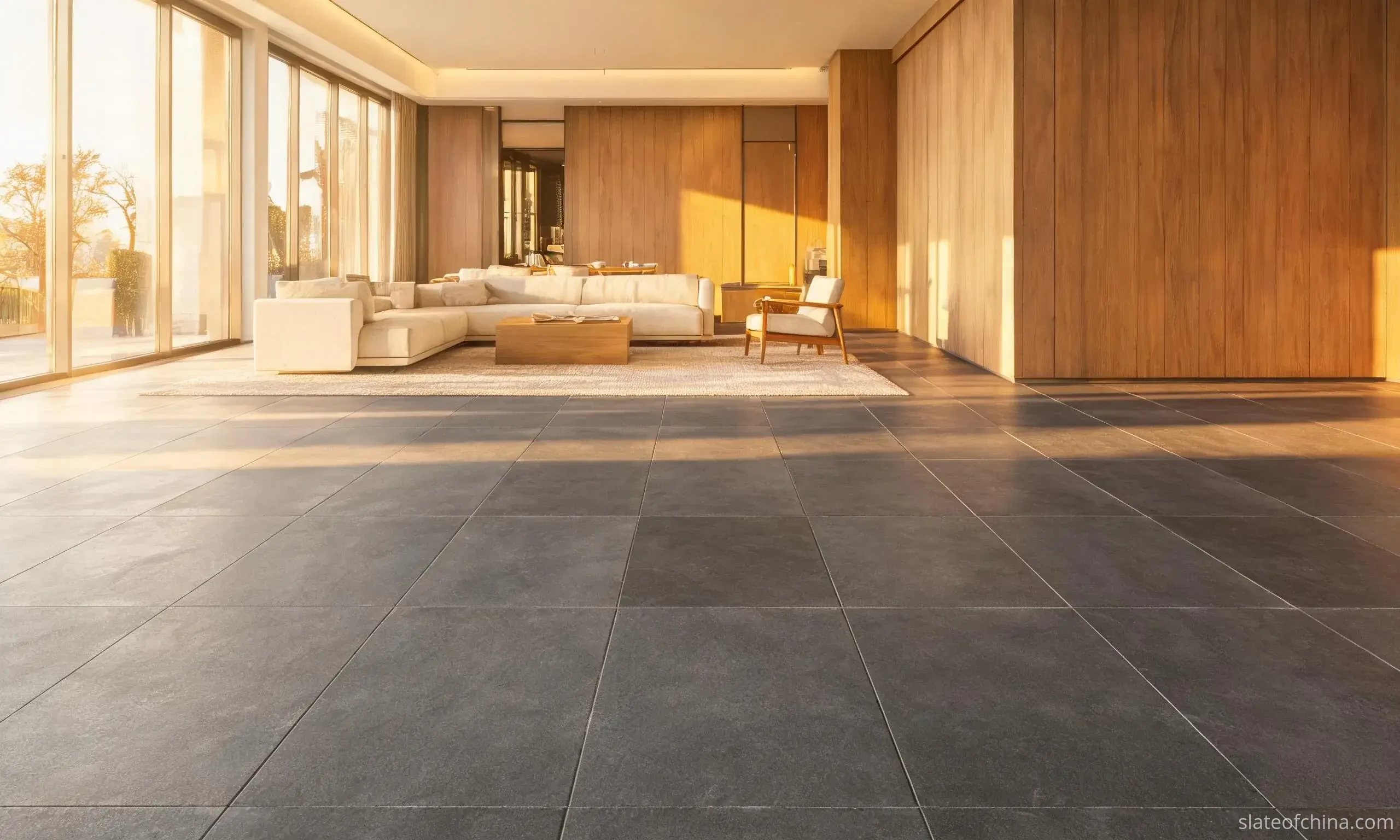
A wide slab of slate reads beautifully from the doorway: a calm, continuous sheet, few joints, the surface running the same way across the whole room. It reads that way because it was laid once, and the laying is where the format starts to talk. Larger tiles are not a scaled-up version of small ones. They are a different object to carry, to bed, and to keep flat, and the difference shows up in the places you do not photograph.
Hold on to one rule of thumb for the whole guide: the bill grows faster than the tile. Double the side of a tile and its area goes up by four, but it asks for more than four times the care — in the flatness of the base, the way the piece is lifted, the way the bed is filled, and the allowance you set aside for the ones that break before they reach the floor. The big format is the look you buy; the handling, the tolerance and the allowance are the bill you carry. This guide walks that bill line by line.
1. The size you buy: what counts as large format
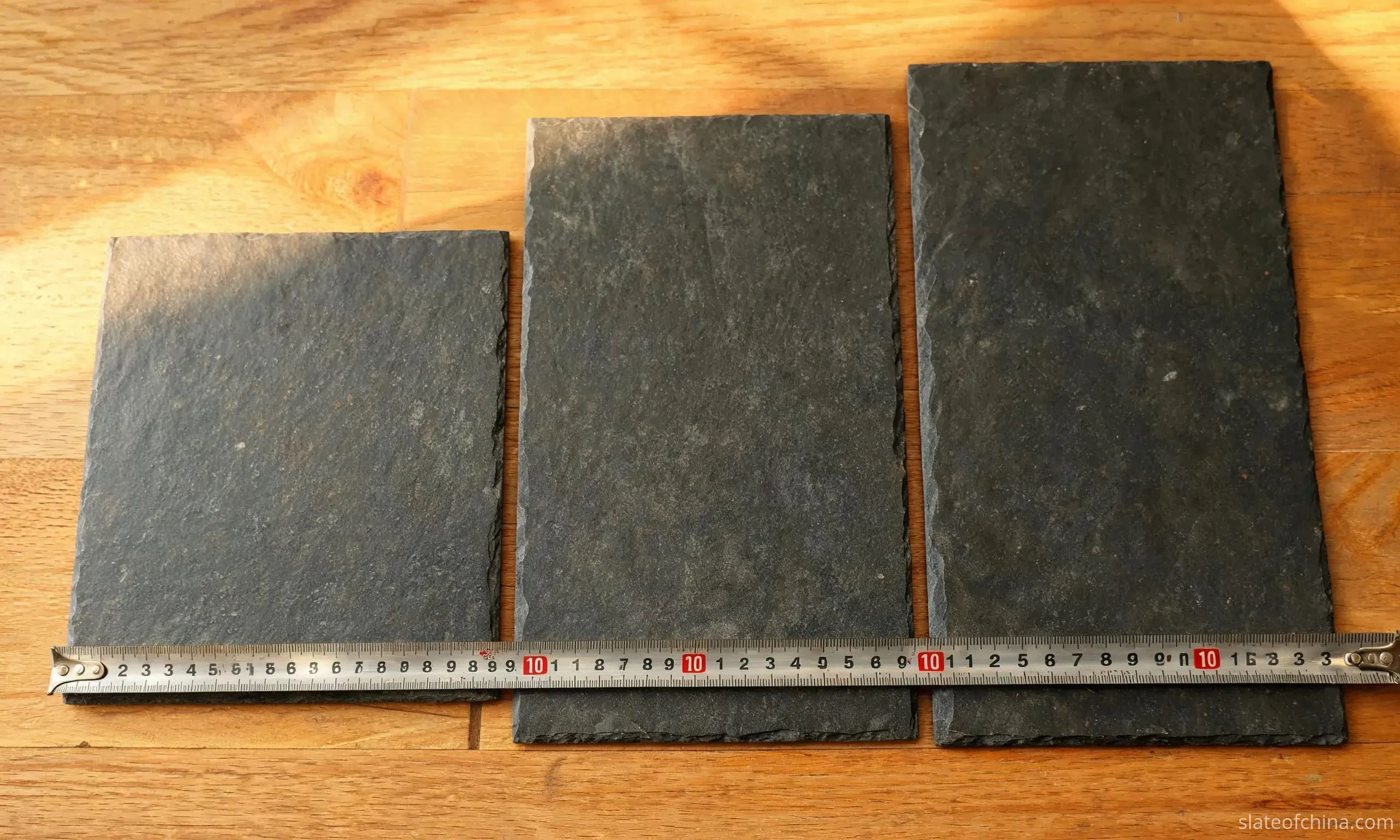
There is no official line at which a slate tile becomes large format. In the interior trade the phrase usually means anything at or above the classic 600×600 modular tile — 600×900, 600×1200, 800×800, 900×900 and beyond. What a given quarry can actually ship depends on the block, the cleavage of the stone and the capacity of the saw, and that is the first thing to confirm rather than assume.
| Format | Typical interior use | The note |
|---|---|---|
| 600×600 mm | Standard residential and commercial rooms | The modular baseline |
| 600×900 mm | Living rooms, halls, open plan | A more directional room |
| 600×1200 mm | Contemporary, linear layouts | Longer and heavier |
| 800×800 mm | Larger residential and commercial spaces | Needs a flatter base |
| 900×900 mm | Open-plan interiors | Fewer joints, a bigger unit |
| 1000×1000 mm | Feature floors and spacious rooms | Needs a lifting plan |
Modular planning still matters. Formats such as 600×600, 600×900 and 600×1200 share a 600 mm dimension, which helps a designer coordinate different tile sizes within one layout. But efficient offcut reuse depends on the actual floor plan, the cutting sequence, the joint arrangement and the tile orientation — a modular relationship does not automatically guarantee less waste. Plan the layout and count the pieces before the order is confirmed; a 500 grid dropped into a 600 family turns every interface into a cut. The full modular logic — and the numbers it comes from — is the argument of our paving slab sizes and thicknesses guide.
2. The look you're paying for
The visual case for large format is real, and it is worth stating plainly rather than dismissing it as a fad. Fewer joints across the same area make a more continuous surface; the grout lines that break a small-tile floor into a grid recede, and the natural colour and texture of the slate are read across a wider, quieter plane. Big tiles sit naturally beside wood, steel, concrete and long glazed openings — the pairings that define a contemporary room.
That is the product you are buying, and large-format natural slate floor tiles have a genuine place in modern residential and commercial interiors. The point of this guide is not to talk you out of them. It is to make sure the look you buy arrives intact, and that the bill you carry for it — the flatness, the weight, the handling, the packing — is one you planned for instead of one that surprises you.
3. The first line on the bill: weight
The first number a large-tile order meets is the weight, and it grows fast because weight follows area. A 1200×1200 mm tile is four times the area of a 600×600 mm one, and at the same thickness it weighs four times as much. On a 20 mm tile the arithmetic, at an indicative density of 2,800 kg/m³, is roughly:
| Tile size (20 mm) | Approx. weight per tile | What it tells you |
|---|---|---|
| 600×600 mm | about 20 kg | A normal two-hand tile |
| 600×900 mm | about 30 kg | A two-person carry |
| 600×1200 mm | about 40 kg | A supported lift |
| 900×900 mm | about 45 kg | A planned lift |
| 1000×1000 mm | about 56 kg | Lifting equipment |
| 1200×1200 mm | about 80 kg | A handled unit, not a tile |
These are stone-only figures at 20 mm thickness — no adhesive, no bedding, no grout. Density moves a little from block to block: the representative figure we use for Jiujiang material is about 2,819 kg/m³, tied to a tested batch rather than every block shipped, and the number you plan with should come from the product test report for the batch. At 80 kg, a 1200×1200 mm tile is not a floor tile in the ordinary sense of the word; it is a unit that needs a plan to move.

4. The line that grows with the tile: substrate flatness
The flatness line is the one that tightens with size. A larger tile spans a wider area of the substrate, so uneven support becomes harder to accommodate: where high spots and depressions leave parts of the tile inadequately supported, a concentrated load can create bending stress in the stone. How much risk actually follows depends on the slate's thickness, its mechanical strength, the tile dimensions and the installation conditions — which is why substrate flatness and continuous bedding support matter more and more as the format grows. A substrate tolerance that passes a small-tile job can quietly sink a big-tile one.
Flatness here means the base under the tile. High points and low spots the tile sits across produce a lever: walk on a big tile that is not evenly supported and the stone bends instead of pressing into the bed — and slate does not want to be bent. The substrate rules for each interior — concrete, screed, timber — are set out in the interior flooring overview; the extra a big tile adds is that the tolerance tightens. Measure the base flat with a straightedge and level, correct high and low areas before laying, and do not try to buy flatness with a thicker tile or more adhesive. The stone and the adhesive fill the bed; they do not bridge a hill.

And moisture is part of the base. A slab that is still wet under the stone does not get drier under a big, sealed tile — the water has nowhere to go once the floor is closed over it. Check moisture at specification stage, and let the substrate be assessed on its own before the tiles arrive. Handled the same way, the base is where a large floor earns its keep or tells the story of its cracks.
5. The line you carry: handling and breakage
Carry. That is the word bigger tiles whisper first. Handling requirements follow from weight and dimensions together, never from weight alone — a relatively light but thin, oversized slate tile can still be awkward or unsafe to move by hand, because its long unsupported span flexes in the arms. Before the tiles arrive, assess the size, the thickness, the surface finish, the lifting points and the access route, use lifting equipment where it is sensible, and follow the manual-handling rules that apply on the site. The reason is the same lever that ran through the substrate: the bigger the piece, the longer the arm, and the more force a bad lift puts through the stone.
The three habits that break big tiles:
- Lifting from a corner. The unsupported end becomes a cantilever and snaps under its own weight.
- Carrying on a single edge. The rest of the piece sags and flexes as you move.
- Swinging a big slab unsupported. The far end overhangs while you shift the near end.
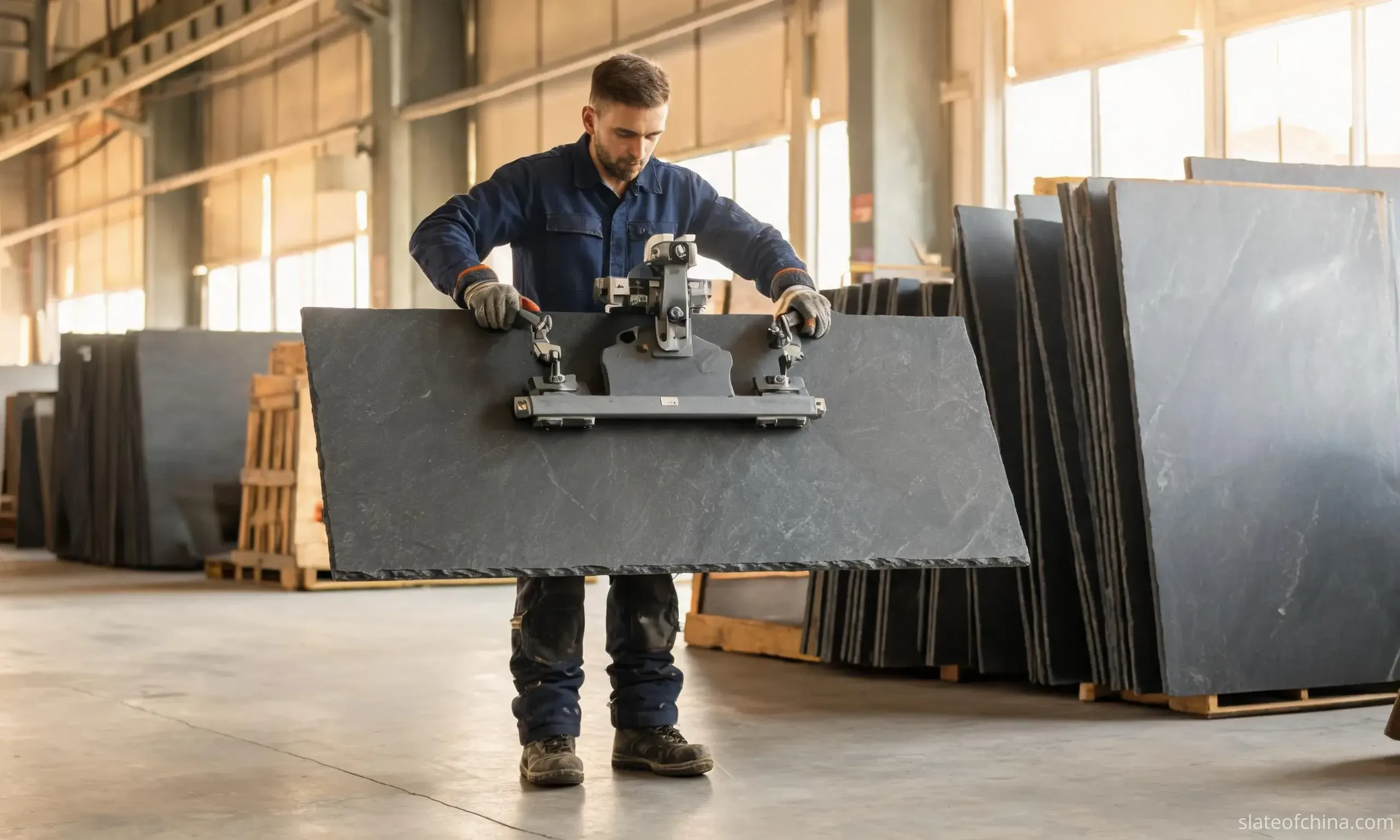
For anything over roughly the 600×900 mm size, plan the lift on paper: a lifting frame or clamps, two or more people, a clear route, and a surface big enough to set the piece down flat. Vacuum equipment is a real option, but only where it suits the surface — a rough natural riven face may not hold a vacuum seal. And on the order side, build the breakage and condition-on-arrival line into the contract, and agree how a broken tile is replaced before the crate leaves the factory, not when a claim turns up at the door.
6. The line the installer writes: the bed and the coverage
The installer's part of the bill is the bed. A big tile is only as good as the contact it has with the base: if the bed has voids, the tile bends between them, and that is a crack looking for a place. For large format the practice is a full bed — spread, then back-butter, so the stone is seated on the adhesive or mortar across the whole face, not just at the edges. The installer checks coverage on the first few tiles, pulls one back to look, and adjusts the trowel and method until the contact is even. That is a test you watch, not a habit you assume.
A common wrong turn is to reach for more adhesive to fix a low spot. Adhesive is formulated to bed and bond the tile, not to span a gap, and heaping it on to compensate for an uneven base is not what the manufacturer's technical instructions describe. If the base is not flat, fix the base first. Large-format slate generally calls for an adhesive system specifically suitable for large natural-stone tiles, applied at the appropriate thickness and coverage; the thickness itself follows the tile size, the stone's strength and the base, and it is worked out in the slate flooring thickness guide rather than assumed here. And the backing matters for the same reason: a calibrated (gauged) tile with a consistent thickness beds evenly, where a naturally split back hands the levelling to the bed and the installer.

7. The finish and the edge: what changes when the tile is big
Large format changes how a finish reads. A riven or cleft face that looks gentle on a 300×300 mm tile reads as a bigger texture on a 600×1200 mm surface, because the same relief is spread across a wider plane. A honed matte face reads calm and minimal on a big tile, which is often exactly what the format is chosen for. The full family — cleft, sawn, honed, brushed — is covered in our slate surface finishes guide; for a large floor the point is that the finish is now a big surface you walk on and clean, so choose it for the room, not for the showroom.
And the size does not change the slip answer. Slip is a test result for the finish and the lot, not a texture you can read by eye — how it is measured is explained in the slip-resistance guide. If the floor is commercial, request the value for the finished material in the document that travels with the order. Edges matter too: sawn, square edges let you set a narrower, more even joint; naturally split edges want a little more room to breathe. State the edge in the spec.

8. The line that ships: packing
A big slate tile rarely breaks on its own. It breaks in the crate, in the container, in the swing from the forklift. The packing is the last line of the bill that nobody budgets for until a crate arrives with a line of cracks through two good tiles. For large format the export packing should be built around the tile, not borrowed from small-tile habits.
The essentials: a strong wooden crate, corner and edge protection, separation and cushioning between the faces, the tile held so it does not shift in transit, and a package weight the receiving side is ready to unload. Agree the pallet or crate dimensions, the loading method and the unloading equipment before the crate is built — not when it lands. This is where a well-run supplier separates from a quote-and-forget one.

9. Common mistakes on big-tile orders
Most big-tile problems are a handful of avoidable habits. Check yourself against them before you commit:
- Ordering the largest size a saw can cut without proof the slate itself holds it — confirm against a production sample, not a catalogue.
- Picking a thinness on price and forgetting the flatness and handling price that travels with a thin, large piece.
- Taking a nominal thickness as an actual measure — ask the tolerance, and whether the back is gauged.
- Laying on a base you have not measured.
- Lifting big tiles from a corner and letting them hang unsupported.
- Ordering without a packing and unloading plan agreed in advance.
- Ordering without an approved sample, when colour and texture vary block to block.
10. The specification line and the questions to ask
Before you ask for a price, write the specification in one line. It carries the room, the format, the thickness, the backing, the finish, the edge and the base — and that line is what separates an accurate quote from a round number.
| Slate floor specification | Fill in |
|---|---|
| Room and traffic | Living room, open plan, commercial — residential or public |
| Tile format | e.g. 600×1200 mm |
| Thickness and tolerance | e.g. 20 mm, with the declared range |
| Backing | Calibrated (gauged) or natural |
| Finish and edge | Riven, honed or sawn; edge type |
| Base and level | Concrete, screed, timber; floor level noted |
| Allowance and packing | Breakage %, crate dimensions, unloading plan |
Then send it, and read the questions that come back. The full step-by-step of the purchase — samples, approval, documents, container maths — is in the Architectural Slate Buying Guide. For a big format, add these to your supplier:
- Can you actually produce this size consistently from the block?
- What is the thickness tolerance, and is the back gauged?
- What flatness and dimensional tolerances can you hold?
- Can you show production photos and a sample from the current batch?
- What is the actual weight per tile and per crate?
- How is it packed, and how do we handle breakage on arrival?
- Can you supply matching replacements from the same material and finish?
Bring the bill home: a large-format slate floor is a good decision when the look is chosen deliberately and the engineering is carried with it. The size is the statement; the flatness, the lift, the bed, the crate and the allowance are the bill you carry. Nail those and the big tile does what big tiles are for — reads calm, runs long, and lasts — with the cost sitting exactly where you planned it.
Large-format slate floor tiles — common questions
What size counts as a large-format slate tile?
There is no official line. In the interior trade most suppliers treat 600×600 as the threshold: 600×600, 600×900, 600×1200, 800×800, 900×900 and 1000×1000 are all commonly called large format. What a given quarry can cut reliably is set by the block, the cleavage and the processing.
How heavy is a large-format slate tile?
At an indicative density of 2,800 kg per cubic metre and 20 mm thickness, a 600×600 tile is about 20 kg, a 600×1200 about 40 kg, and a 1200×1200 about 80 kg — stone only. The real weight depends on density and finished dimensions, so confirm the batch figure before planning the lift.
Are large-format slate tiles more likely to crack?
They are more sensitive to handling, to an uneven substrate and to a bed with voids, because the bigger surface has more unsupported span for the same fault. With a sound tile, a flatter base, a full bed and careful handling, the risk falls to a normal level. The cracks on big-tile jobs usually come from the process, not the stone.
What thickness do large-format slate tiles need?
There is no universal number. Bigger tiles generally want more than the thinnest band, and 20 mm is a common interior discussion, but the right figure follows the tile size, the stone strength, the base and the installation. The thickness logic is the work of the dedicated thickness guide.
Can large-format slate tiles be supplied in different thicknesses and finishes?
Yes, within the limits of the raw slate and the processing. Large-format slate floor tiles can be supplied in different thicknesses, surface finishes and edge treatments, including gauged (calibrated) options for level floors. Before placing a bulk order, confirm the available dimensions, the thickness tolerance, the calibration requirement and a production sample from the current material, so the specification you write is one the manufacturer can hold.
Do large-format tiles need a flatter substrate?
Yes. The larger the tile, the more of the base it spans, and the more an out-of-tolerance high or low spot becomes an unsupported span. Measure the flatness before ordering and level the base before laying — a big tile will not bridge the faults you leave under it.
Do large-format slate tiles need special handling?
Often. A lifting frame, clamps or a vacuum to suit the surface may be needed on the bigger sizes, with two people on the larger pieces and a route long enough to set the tile down flat. Lifting from a corner is how big tiles snap.
Are large-format slate tiles more expensive to install and ship?
Generally, yes. There is more weight to move, a tighter flatness requirement, more skilled handling and usually a dedicated crate. The extra shows up as labour, equipment, packing and a breakage allowance — which is exactly the bill this guide is about.
Can Chinese suppliers make custom large-format slate tiles?
Some can, within the limits of the block, the cleavage and the processing. A custom dimension should be confirmed against actual production with a sample rather than a catalogue, and the packing designed for that size before you commit.
Related reading
Specifying a large-format slate floor?
Tell us the room, the format, the thickness and the finish, and the reply comes back with the numbers that keep the bill honest: actual weight per tile, flatness and dimensional tolerance, gauged options, test data and export packing for the size you choose.
- Custom large-format dimensions to production capability
- Calibrated (gauged) options for level big-tile floors
- Weight and thickness data per tile from the batch
- Approved project samples before you commit
- Export crating designed around the tile size