
Slate Paving Finishes: Which Surface for Which Use
At seven in the morning, a pool surround is the most honest test a paving specification will ever face. The water is still, the air is cool, and the first person across the stone is barefoot, carrying a towel, half awake. A surface that looked composed in a showroom photograph now has to do three things at once: stay comfortable under a bare heel, keep its grip when the splash-out arrives, and dry without leaving a pale ring of sunscreen in every hollow.
Walk thirty metres to the covered terrace and the same stone is under a roof, in shoes, beside a glass door, with a coffee cup and a chair leg working on it. The conditions have changed, and with them the sensible answer. This is why a paving finish cannot be chosen from a swatch. A finish is a duty decision before it is a taste decision.
Quick answer: four duties decide the finish, and none of them is appearance
A. Water. Where it arrives, how long it stays, and what it carries with it — rain, run-off, splash-out, condensation, or a hose.
B. Traffic. Bare feet, heels, dog claws, prams, wheelchairs, furniture legs, bins — each one loads the surface differently.
C. Cleaning. The method the site will really use, not the one in the maintenance folder.
D. Age. How the surface is repaired, matched and lived with in year fifteen.
Cleft for exposed ground where leaves and soil will land. Honed where a roof genuinely intervenes, and not at the open edge. Brushed for the long middle. And a wet sample with a test result wherever people will walk barefoot.
Natural slate paving surface finishes are usually sold under four names: cleft (the split face), sawn (the blade face), honed (ground flat and matt) and brushed (texture kept, edges softened). Sandblasted and other mechanical textures exist on some stones. What each face is, and how the workshop produces it, belongs to a separate page: Slate Surface Finishes. This page asks the paving question instead. Which surface belongs to which place, what has to be written down so the place actually receives it, and where the decision is usually lost between the drawing and the crate.
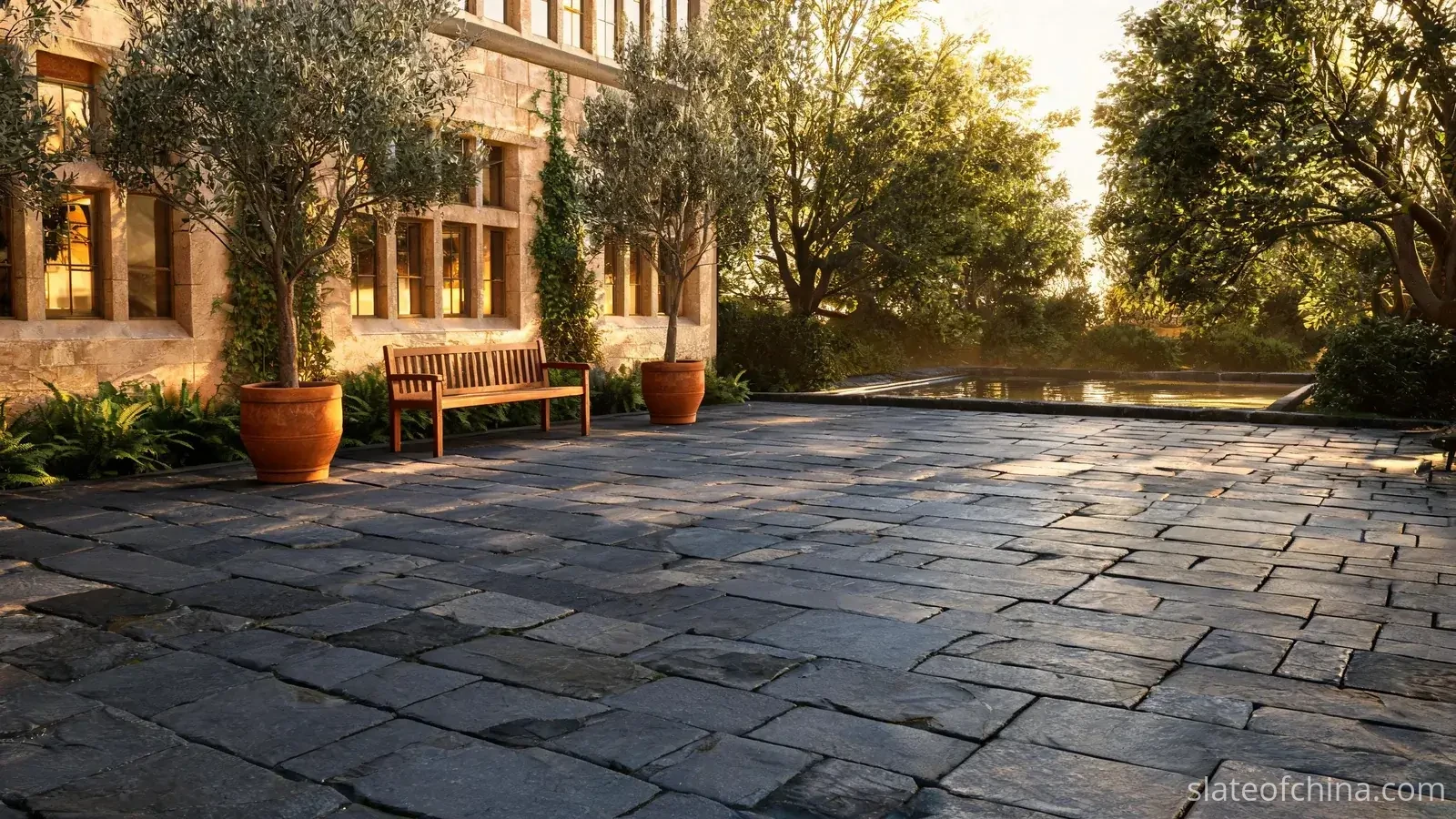
A paving slab has four surfaces. The finish names one.
In a quotation, a paving slab is one line. In service it is four surfaces, and only one of them is the finish.
The top face is the one the brochure photographs. It takes the sun, the rain, the shoe and the mop.
The arris is the edge where the top turns down. On a step, it is the part that takes the first and hardest contact of every footfall. On a field slab it is the part most likely to chip during laying, and the part that shows a chip for the next twenty years.
The back is the surface nobody specifies until the first slab rocks. A honed top can sit on a rough, uncalibrated back; the bed has to accommodate what the back actually is. The relationship between the face and the back is a paving decision, and it is covered properly in Calibrated vs Hand-Cleft Slate.
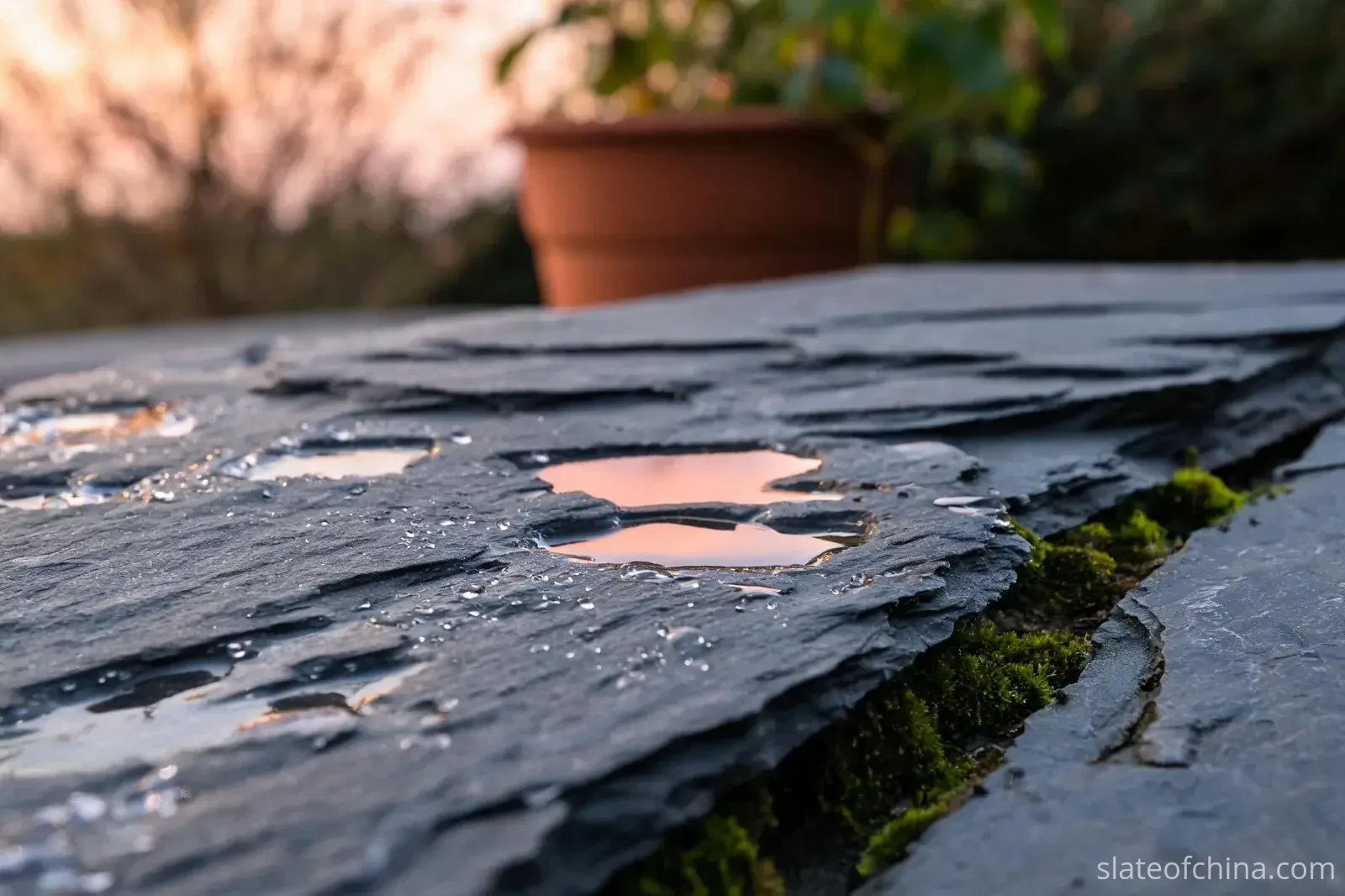
The joint is the fourth surface, and in wet weather it is the busiest. Water crosses a pavement mainly at the joints and edges, not through the middle of a sound slab. A wide joint over a loose bed holds a film of water and a line of grit; a tight joint in a moving pavement crushes and spalls. The finish on top has almost no influence on either.
This matters because finish conversations tend to become the whole conversation. A client approves a honed sample, the contractor lays it on a rough back with a 6 mm joint and no fall, and the first rain produces a complaint that is blamed on the stone's slip resistance. The stone has done nothing wrong. The specification named one surface and left three to chance.
So the useful order is: place, then four surfaces, then the finish. A finish without an edge and joint decision is not yet a specification; it is a preference with a sample attached.
Read the site before the sample
The most common specification error in slate paving is not choosing the wrong finish. It is choosing the right finish for the wrong description of the site. Four readings do most of the work, and all four can be taken from a site visit or a decent set of drawings.
How the water arrives. There is a large difference between rain falling on an open patio, rain driven against a wall and running off it, splash-out from a pool, a hose left running by a planter, and condensation under a roof. Each wets the stone differently. Sheet flow over a whole field is one condition; a repeated wet patch at the foot of a downpipe is another. The second is where algae starts, and it is usually the patch nobody shows the supplier.
How long the water stays. A fall of 1:80 and a fall of 1:40 produce different pavements from the same slabs. So does a shaded north-facing corner, a tree that drops leaves into a joint line, and a detail that creates a lip at the threshold. The finish decides how much water the surface holds on to; the pavement decides whether the water ever leaves. Neither can be judged alone.
Who crosses it, and with what. Bare feet and stiletto heels want opposite things from a surface. Dog claws polish a path over years, a pram wheel finds every proud edge between slabs, and a steel chair leg dragged twice a week leaves a track that no sealer hides. A domestic patio and a public walkway may both be “pedestrian”, but they are not the same duty.
How it will be cleaned. This is the duty most often left out of the brief, and the one that most often decides whether the client is happy in year three. A leaf blower and a stiff brush suit a cleft face. A rotary machine and a mild neutral detergent suit a honed floor. An acidic descaler that is fine on a glazed ceramic will attack the carbonate fraction of some slates, and a high-pressure jet held too close will open the surface of almost any stone. The finish should be chosen with the cleaning method the site can actually sustain — not the other way round.
There is a fifth reading that belongs to the climate rather than the site: freeze–thaw cycling, salt air, and the length of the shaded wet season. Those belong to the stone's test data more than to its finish, but they change how much texture is worth having and how much dirt a texture will collect. A slate that performs well in a damp maritime garden may still need a different maintenance rhythm from the same slate under a Mediterranean pergola.
A practical habit before approving anything: look at the sample wet, in the light of the place, at the angle a person sees it. Dry samples flatter every finish. Wet samples tell the truth about colour, about how water sits, and about how much of the surface is actually bearing on a shoe. The rest of the buying process around the stone — documents, packing, batch approval — is set out in Slate Paving: The Buyer's Overview and in How to Choose Architectural Slate.
Exposed patios and paths: texture earns its keep, then sends the bill
Duty reading: direct rain, leaf fall, soil, furniture, and a client who will notice the cleaning.
Natural cleft is the default for a reason that is partly physical and partly social. Physically, the split face presents a topography of shallow ridges and hollows rather than a single plane, so a wet foot finds more edges to work against than a ground-flat face offers. Socially, it is the face people recognise as stone; a garden path in cleft slate looks as though it belongs to the garden rather than to a catalogue.
The physical argument has a limit that is worth stating plainly. A cleft face is not automatically non-slip, and the word “riven” is not a test result. Texture depth varies between quarries and between beds in the same quarry; a tight, shallow cleft can behave quite differently from a deep, open one. Where a patio will be used by older visitors, by children running, or beside water, the finish needs a wet test result for the actual production stone, not an assurance based on how rough it looks. How that test is carried out is a subject of its own, and it is not something a photograph can settle.
The bill for texture arrives in the cleaning. Cleft holds what lands on it: pollen in spring, leaf fragments in autumn, the grit that comes off a path, and the fine soil that splashes up during rain. None of this is a defect. It is the same relief that gives the surface its character, doing what relief does. A client who wants a cleft patio should also want a stiff brush, a broom and a willingness to use them after the leaf season. If that is not the household, a brushed or lightly textured face will produce fewer conversations.
Sawn deserves a place in the conversation too. A sawn face is flat enough for tight joints, stable furniture and a clean setting-out, and its fine blade texture keeps a little tooth underfoot. It is the face of modular paving and contemporary layouts, and it needs the same wet test as any other finish: flat is not the same as safe.
Two site conditions deserve a second look before cleft is confirmed. The first is furniture: a table with slender legs on a lively cleft face will rock, and a chair dragged across it will wear the high points first. The second is accessibility. A route used by a wheelchair, a walking frame or a pram wants a surface with limited relief and consistent joints; a strongly cleft field can be beautiful and still be the wrong choice for that route. The answer is often a change of finish for the route and cleft for the field, rather than one face everywhere.
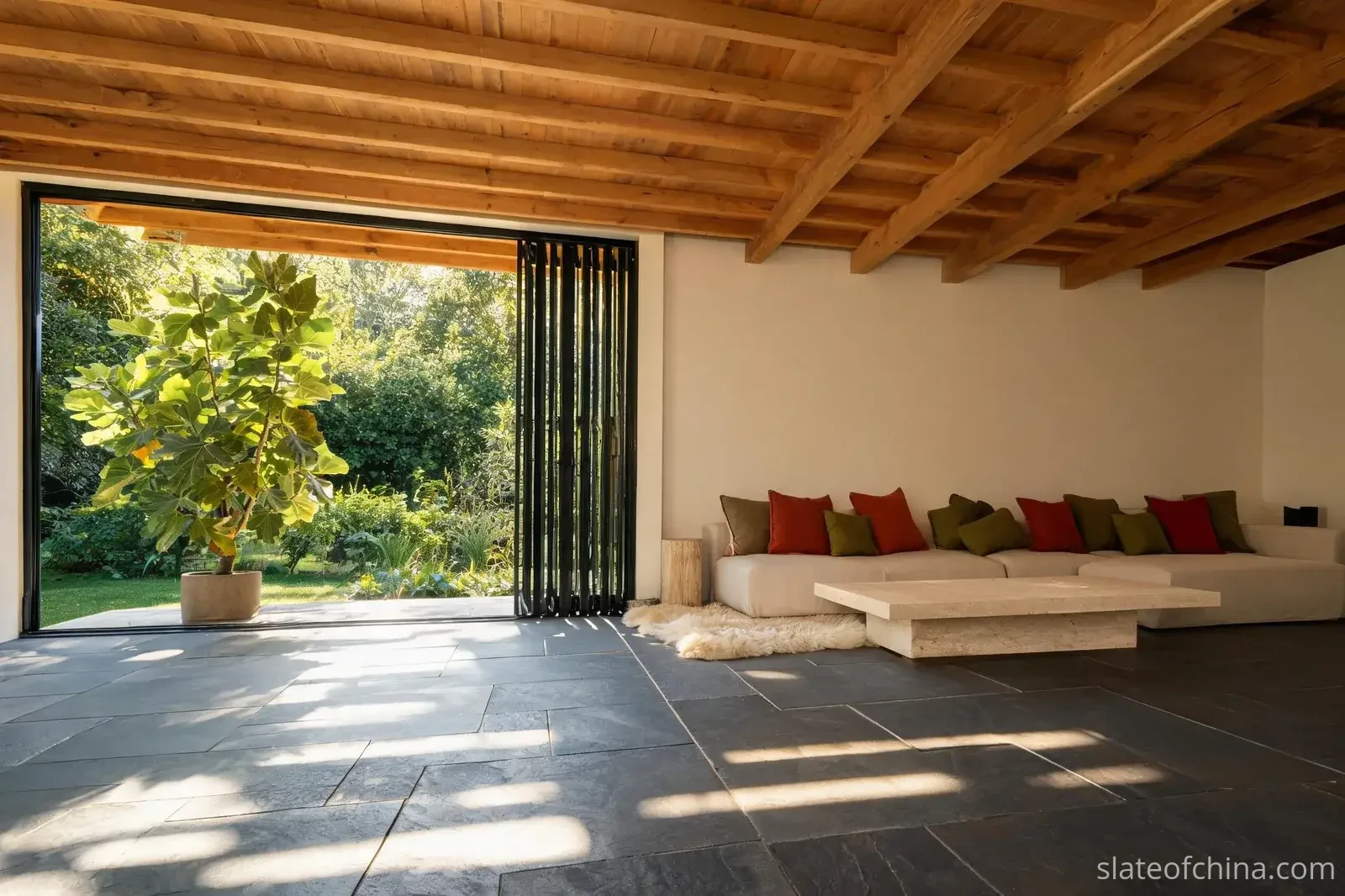
Covered terraces: shelter is a condition, not a promise
Duty reading: little direct rain, but wind-driven wet, condensation, plant water and a threshold that connects to the garden.
Under a roof, honed slate becomes a reasonable proposition. The smooth matte face is comfortable underfoot, easy to sweep, and quiet in the way that contemporary terraces usually want. The mistake is to treat “covered” as a guarantee of dryness. A roof with an open side and a prevailing wind will wet the first metre of floor in almost every storm. A pot watered weekly will keep a patch damp. A cool night after a humid day can leave condensation on stone that never saw rain. And the threshold itself is a wet zone by design, because that is where wet shoes arrive from the garden.
The practical response is zoning rather than a single answer. A honed field is defensible in the sheltered middle of a terrace; the threshold band, the open edge and the strip beside the planting are better served by a brushed or lightly cleft finish. If one face must run throughout, brushed is usually the more forgiving compromise: it reads as refined at a distance, keeps a little texture underfoot, and does not show every footprint the way a dark honed surface can.
Colour changes how a finish reads in use. A blue-black honed surface shows water marks, dust and the bloom of a damp mop most clearly; a grey-green slate keeps more visible tonal movement, so a brushed face can look busier but also more forgiving; rusty slate brings its own iron-derived variation, which no finish will hide. Dark charcoal also absorbs more solar heat, and the difference is felt barefoot at a pool edge — measure it on site rather than assume it. That is not a reason to avoid dark stone, but it is a reason to see a wet sample of the actual colour in the actual light, and to ask what the maintenance regime will be. The behaviour of colour and variation is treated in Architectural Slate Colour and Texture; the point here is narrower: the finish and the colour together decide how visible the cleaning is.
One more detail belongs to the terrace rather than the stone. A honed floor that meets a lawn or gravel without a mat, a grate or a defined threshold will carry grit indoors and will be judged by the scratches that follow. The finish is not responsible for that, but it will be blamed for it.
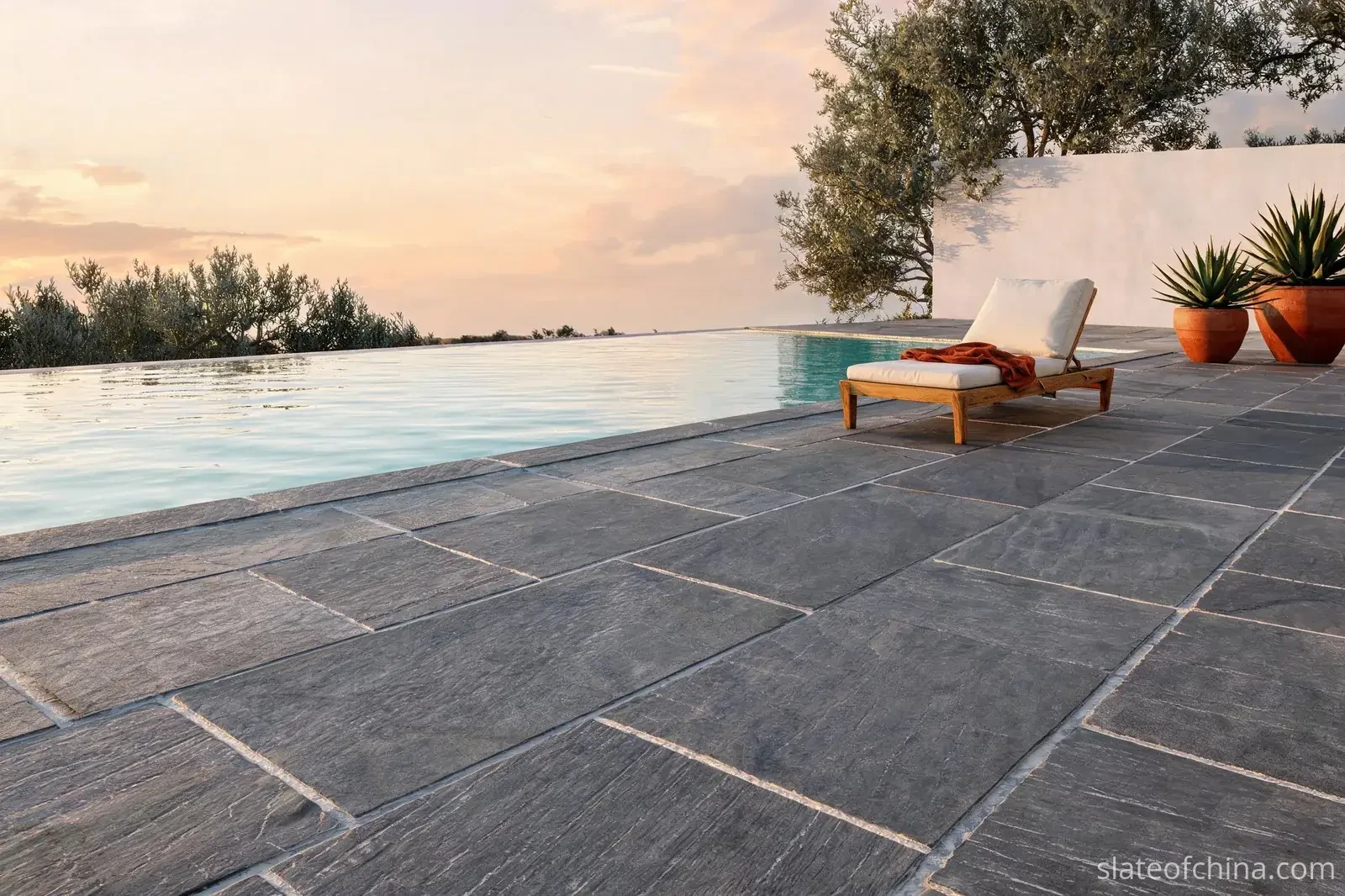
Pool surrounds: barefoot rewrites the brief
Duty reading: continuous splash-out, bare feet, sun cream, chlorine, and stone that may be hot by mid-afternoon.
A pool surround is the paving job where comfort and grip pull in opposite directions. A deeply cleft or heavily textured stone gives the foot plenty to grip, and also gives a bare sole something to complain about on the walk from the lounger to the water. A honed surface is kind to the foot and, when wet, may offer very little to stop a running child. Brushed slate occupies the useful middle: enough texture to feel alive underfoot, not so much that it becomes abrasive.
Grip here has to be judged for the bare foot, not for a shoe. That is a different test condition and often a different test method from the one used on a public footway, and a supplier who sends a single slip figure without saying how it was obtained has not answered the pool question. The relevant method and its limits deserve a proper explanation; what matters at specification stage is that the tested surface is the finish being supplied, tested wet, for the use the pool will actually see.
What a wet slip report should tell you
A figure on its own is not evidence. Before a report is accepted, five things should be legible on the page:
- The method by name, and the standard it follows. Pendulum, ramp and DCOF results are not interchangeable, and a number moved from one method to another means nothing.
- The condition tested: wet, and with which slider or sole. A shoe test and a barefoot slip-resistance test answer different questions, and a pool edge belongs to the second.
- The exact finish, stone and any sealer, named as they will be supplied — not a generic “slate” or a photograph.
- The sample: production batch, test date and the laboratory.
- The result in the method’s own units, with the report attached. A brochure line without a method is marketing.
Heat is the duty nobody writes down. Dark slate in full sun can become uncomfortable within a few steps, and the difference between a charcoal and a mid-grey surface is felt by a bare foot long before it is noticed by an eye. In hot climates, a lighter tone or a lighter stone is a practical decision, not a decorative one. Shade, planting and the time of day change the reading too, which is why a sample board left in the sun for an afternoon is more useful than a colour chip viewed indoors.
Then there is the residue. Sun cream, body oil, chlorine and the minerals in pool water leave a film that collects in texture. A brushed face holds less of it than a deep cleft; a honed face holds less again but shows every mark. The cleaning method has to match the finish, and the finish has to be chosen with the cleaning in mind. The wrong product, used weekly, does its damage quietly: the surface goes before the appearance does.
Finally, the edge. Coping, waterline detail and the joint at the pool shell are where water sits longest and where a chip is most visible. A crisp arris looks superb in a photograph and is the first thing to suffer from a vacuum head or a cleaning trolley. A small chamfer or a slightly softened edge costs little and survives better. That is an edge decision, but it belongs in the same conversation as the finish, because the two are seen together.
Steps and ramps: the finish stops being a floor
Duty reading: concentrated footfall on a narrow tread, water arriving from above, and an edge that carries the consequence of a mistake.
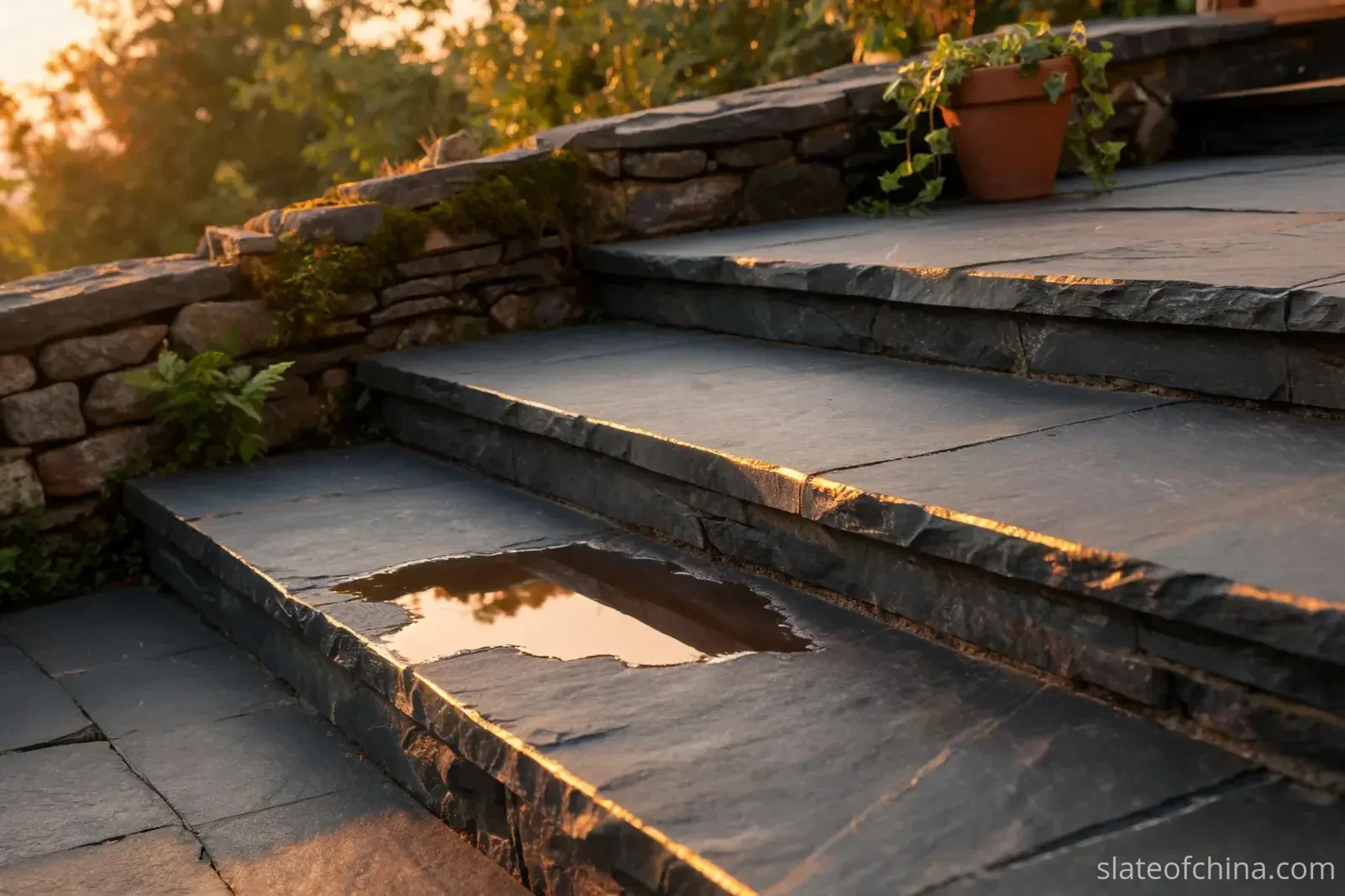
On a flight of steps, the top face is only half the surface. The arris — the front edge of the tread — is where a foot lands first and where the eye reads the step in low light. A crisp, square edge is beautiful and vulnerable; a small chamfer or a deliberately softened arris is kinder to shoes and survives trolleys, grit and the occasional dropped object. On exterior steps, the nosing detail also decides whether water drips cleanly off the front or tracks back under the tread.
The finish on a tread should be chosen for a foot arriving wet and slightly committed. In an exposed garden, brushed or lightly cleft treads are the usual answer; a fully honed tread on an outdoor flight is asking a lot of a wet shoe. Indoors, where the steps are dry and shoes are soft, honed is comfortable and quiet. The transition between the two — an indoor flight leading to a garden door — is the place to change finish, not to compromise on one face for both.
Ramps are stricter than steps. A ramp concentrates the risk over its whole length rather than at one edge, and water on a slope behaves differently from water on a flat: it runs, it films, and it arrives at the bottom with whatever it has picked up. Texture helps, but texture alone does not make a ramp safe. The slope, the cross-fall, the joint layout and the drainage have to work with the finish. A rough surface on a badly drained ramp is still a wet ramp.
There is a detail that catches out otherwise careful specifications: the contrast between tread and landing. A change of finish between tread and landing can be useful visually, and it becomes risky if it introduces a lip or a different grip level exactly where people hesitate. If the finish must change, do it on a landing, keep the levels flush, and keep the same finish across the part where a foot is in motion. The dimensions that make the flight work — thickness, going, rise — belong to the numbers library in Paving Slate Sizes & Thicknesses.
Commercial paving: consistency, cleaning cost and the replacement slab
Duty reading: many feet, machine cleaning, a maintenance budget, and a specification that will be audited.
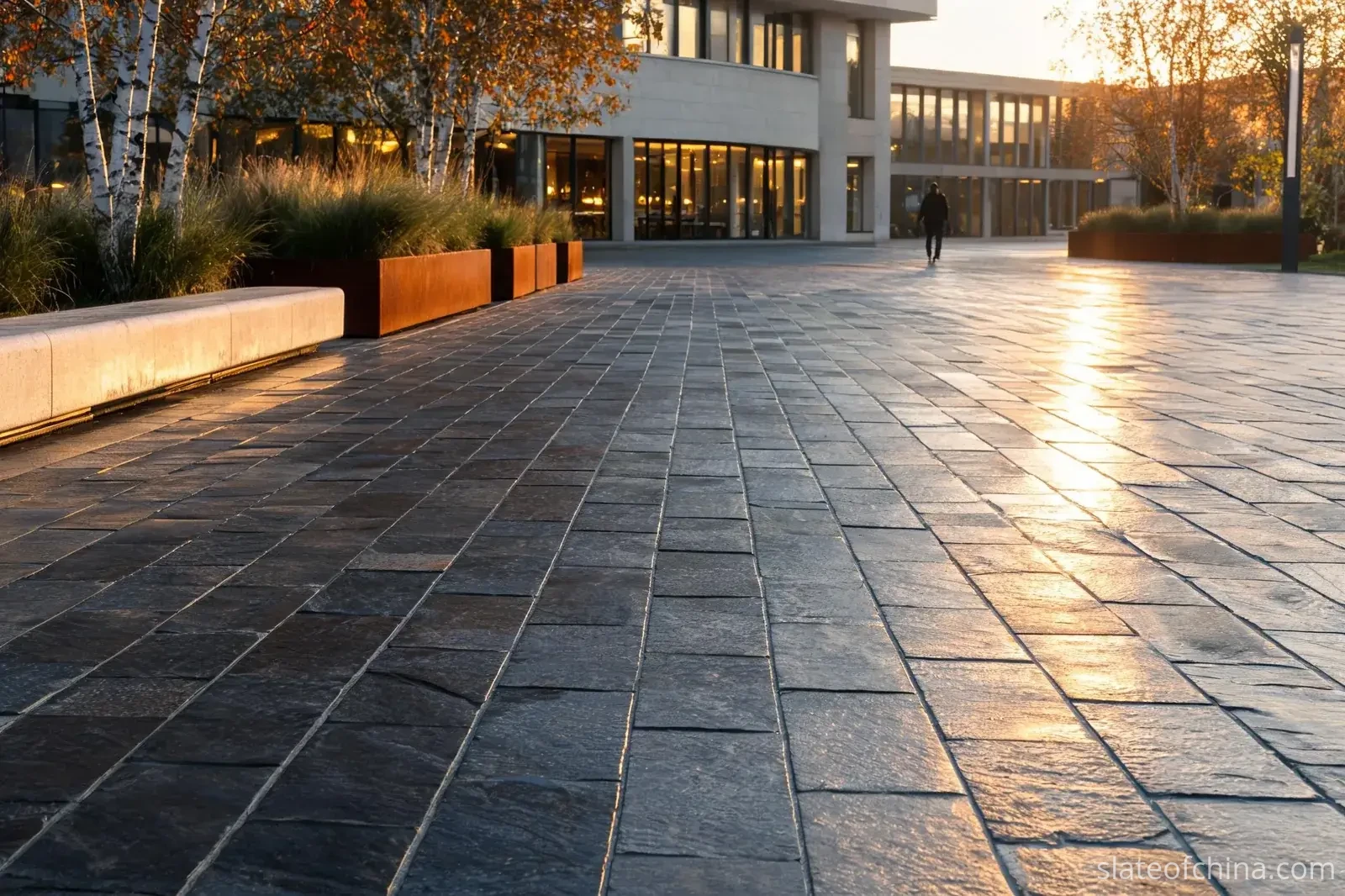
Commercial work changes the weighting of the four duties rather than the duties themselves. Appearance consistency moves up, because a public plaza is read as one surface and a patchwork of tones reads as a mistake. Cleaning cost moves up, because the client pays for it every week for twenty years. Replacement moves up, because a single cracked slab in a busy entrance will be replaced, and the replacement has to match.
That points towards finishes that are uniform and reproducible. A lightly brushed or sandblasted face gives a more even field than a strong cleft, and it is easier to specify across a large area where several production batches will be used. A relatively uniform, fine texture makes routine cleaning more predictable, although a deeper texture will still hold dirt and demand more of the machine. The trade-off is honest: a uniform texture shows a stain more clearly than a lively cleft, because there is no variation for the eye to read it against. In a station forecourt, that matters; in a garden, it does not.
Two specification habits pay for themselves. The first is to state the acceptable surface variation in writing, with a reference sample that represents the production range rather than the best slab in the yard. The second is to keep a set of approved samples and a record of the batch after completion. A finish is not just a surface; it is a reference that someone will need in five years when a drain cover is lifted and four slabs are broken. Without the sample, “brushed, charcoal” becomes a negotiation.
The public-realm requirements around the stone — duty cycle, accessibility, testing, maintenance planning — are set out in Commercial Slate Paving. What matters for the finish decision is simpler: in a commercial setting, the cheapest surface to buy is rarely the cheapest surface to own. Texture that holds dirt costs cleaning hours; a smooth face that shows every mark costs cleaning hours of a different kind. The right answer is the one the maintenance team can deliver on a wet Tuesday in February.
Three treatments that are not catalogue items
Beyond the four working faces, three treatments turn up regularly in specifications and rarely deserve to be treated as standard options.
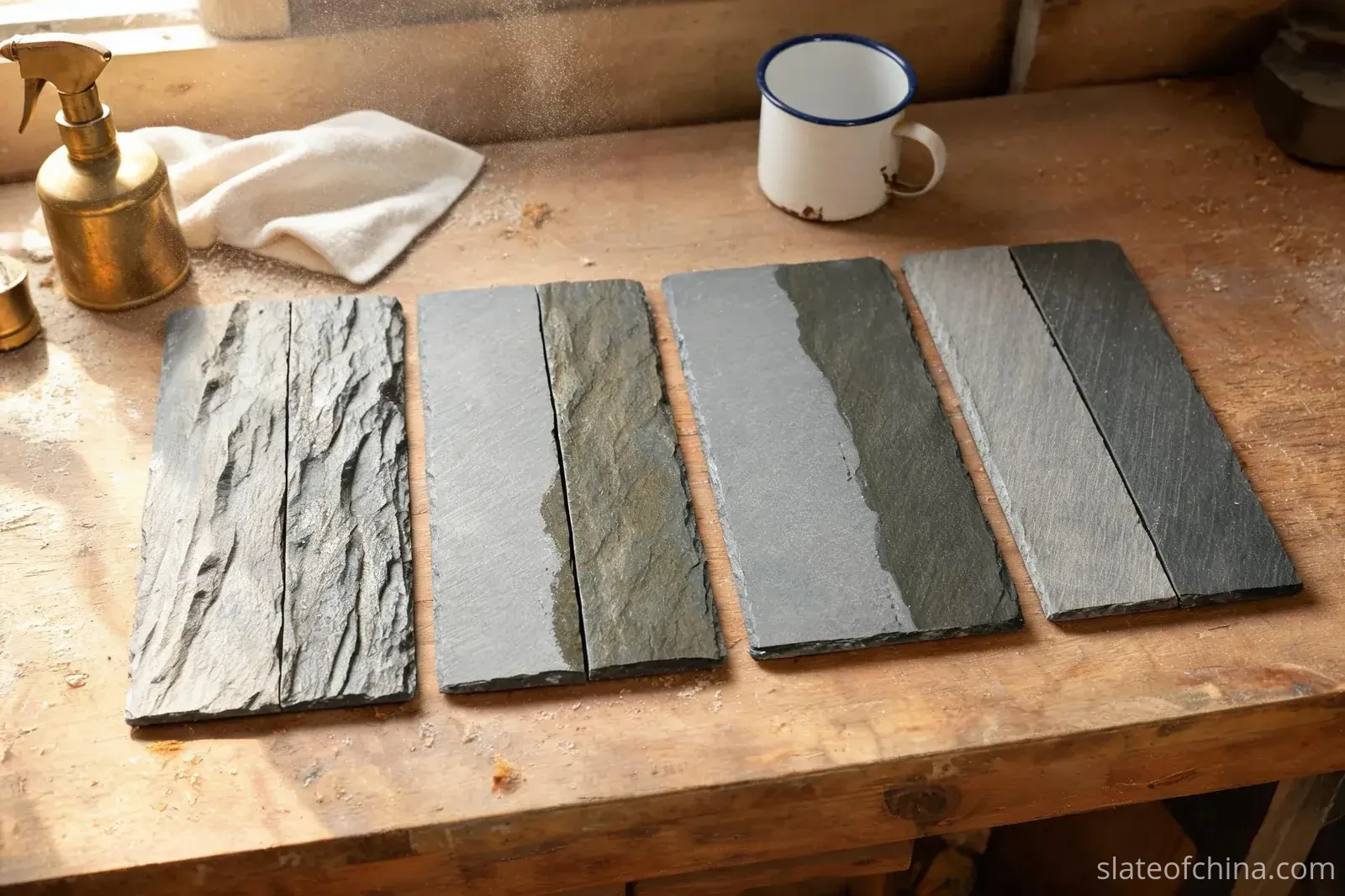
Sandblasted. A fine, uniform matte texture produced by projecting abrasive at the surface. On slate it can work well, particularly where a consistent field is wanted across a large area, but the depth and evenness depend on the stone and the process. A deep blast holds dirt; a light blast may barely change the wet behaviour. Ask for a production sample and judge it wet, not a photograph of a sample.
Bush-hammered. A strongly textured surface produced by repeated impact. On a layered stone, impact is not a neutral operation: it can open the cleavage, loosen flakes and leave a surface that looks robust and can behave badly after a winter. It is used on some stones and in some markets, but it is not a finish to order by name without testing the actual slate.
Flamed. Thermal texturing belongs to granite and other crystalline stones, where the heat fractures individual mineral grains. Slate is a different material with a strong directional cleavage, and the same treatment does not produce the same result predictably. A flamed finish is not a standard slate paving product, and a supplier who offers one should be able to show what happened to the stone, not just the surface. The reasoning behind that boundary is set out in Slate Surface Finishes.
The common thread: none of these treatments is a way to rescue a stone that was the wrong choice for the place. Texture applied after the fact changes the surface, not the drainage, the traffic or the maintenance regime.
Where a finish is lost after it is chosen
Most finish failures are not manufacturing failures. They are translation failures. The drawing says “honed”; the order says “honed”; the crate arrives with a face that is smooth but not flat, or flat but from a different bed, or correct but sealed with a product that changed its colour and its grip. Nobody lied. The word simply carried less information than the project needed.
There are three places where the meaning leaks out.
The adjective travels, the sample does not. “Brushed” describes a process, not a depth. Two factories can both brush a slate and produce surfaces that feel different underfoot and collect different amounts of dirt. A written finish name plus a retained, wet-approved sample is a specification. A finish name alone is an adjective.
Substitution at procurement. When a project is value-engineered, the stone may change while the finish word stays. A honed surface from a different quarry can be a different colour, a different hardness and a different wet behaviour. If the finish matters — and at a pool edge it does — the approval has to be tied to the stone and the batch, not to the word.
Sealing after installation. A sealer can deepen the colour, reduce water absorption and change the surface friction, sometimes in ways the client did not expect. Not every slate paving needs sealing, and the same product is not right for a cleft face and a honed one. Test the proposed sealer on a spare slab from the same batch, wet it, and compare it with the unsealed sample before anything is applied to the pavement. Maintenance products are part of the finish decision, not an afterthought to it.
The protective routine is unglamorous and effective: approve a sample wet, keep it, write the finish and the acceptable surface variation into the order, record the batch, and photograph the approved face in raking light. That short routine will settle more arguments than any brochure.
An example specification, line by line
A finish survives procurement when it is written as requirements rather than an adjective. The example below is deliberately ordinary — a brushed blue-black slate for a residential terrace — and the figures are illustrative, not recommendations. The right-hand column is the part that makes the order enforceable.
| Line in the order | Example entry | What it controls |
|---|---|---|
| Material | Natural slate, stone and source named | “Slate” alone does not define strength, absorption or frost behaviour. |
| Surface | Brushed | Names the process, not the depth; the approved sample supplies the depth. |
| Colour | Blue-black, within the approved range | A colour name is a range, not a single slab. |
| Thickness | 30 mm (example only) | Thickness follows the structure and the load, not the finish. |
| Top surface | Consistent brushed texture, no gloss, no visible saw marks | The face the client actually approved. |
| Back | Calibrated, or an agreed back profile | Controls bedding, rocking and point loading. |
| Edge | Sawn, arris lightly softened | The edge is part of the finished surface, not a by-product. |
| Sample | Approved wet and dry, retained by both parties | The reference for every later question about match. |
| Testing | Wet slip and durability reports for the supplied finish | Ties the number to the stone that will arrive in the crate. |
The 30 mm figure is there to show how the line is written, not to recommend a thickness for a terrace. Thickness belongs to the pavement design; the finish lines belong to the surface. Written this way, the order can be checked against the sample, and the sample can be checked against the crate.
The decision table
The table below is a starting position, not a rating. It assumes a sound pavement, a proper fall and a stone that suits the climate. Any row can be overturned by a test result, a site condition or a client requirement that the table cannot see.
| Place | Primary duty | Finish that usually fits | What changes the answer |
|---|---|---|---|
| Open patio or garden path | Rain, leaves, soil, furniture | Natural cleft; brushed where a calmer surface is wanted | Accessible route, table stability, leaf load, wet test result |
| Covered terrace | Wind-driven wet, condensation, grit from the garden | Honed in the sheltered middle; brushed at edges and thresholds | Open sides, prevailing wind, planting, dark colours and dust |
| Pool surround | Splash-out, bare feet, sun cream, heat | Brushed; light-toned stone in strong sun | Barefoot test evidence, comfort, cleaning products, coping detail |
| Steps and ramps | Concentrated footfall, water from above, edge risk | Brushed or lightly cleft treads; softened arris | Slope and cross-fall, nosing detail, indoor/outdoor transition |
| Commercial plaza or walkway | Volume, machine cleaning, replacement | Brushed or sandblasted for a uniform field | Batch consistency, dirt load, maintenance plan, retained samples |
| Interior floor at a garden door | Wet shoes, grit, indoor comfort | Honed inside; brushed in the transition band | Mat well, threshold detail, cleaning frequency |
Read the right-hand column first. It is the column that decides most real projects, because it contains the conditions the table cannot see. A pool surround with a barefoot test result that does not support the intended finish is not a brushed project; it is a project that needs a different stone or a different detail. A covered terrace with an open west side is not fully covered, whatever the roof plan says.
And the finish is only one line in a longer specification. Thickness belongs to the structure, format belongs to the layout, colour belongs to the batch, and the base belongs to the engineer. What the finish can do is make the surface honest about the place it serves. That is a modest ambition, and it is the one that lasts.
Slate paving finishes — common questions
Which finish is best for an outdoor slate patio?
Natural cleft is the usual starting point, because its relief gives a wet foot more to work against and its appearance suits a garden. Brushed is the practical alternative where furniture, bare feet or a calmer look matter. In both cases the finish should be confirmed by a wet slip test on the actual stone, not by the word on the quotation.
Is honed slate too slippery for outdoor use?
It can be, and it should not be assumed safe because the surface looks matte. Honed slate is most defensible under a roof, on a sheltered terrace or indoors. On an exposed, regularly wet surface it needs test evidence for the supplied finish and a drainage design that removes water quickly; without both, it is a risk rather than a refinement.
Is cleft slate difficult to clean?
It asks more of the cleaning routine than a smooth face, because its hollows hold pollen, leaf fragments and grit. A stiff brush, a broom and regular removal of leaf litter keep it in good order. The difficulty is predictable rather than surprising, and it is worth agreeing with the client before the stone is ordered.
Brushed or honed for a covered terrace?
Honed works in the sheltered middle of a terrace and gives the quietest surface underfoot. Brushed is more forgiving at open edges, thresholds and anywhere wind-driven rain or plant watering reaches. Many terraces are best served by both, zoned rather than forced into one face.
Can slate paving be sandblasted?
On some slates, yes, and the result can be a useful uniform matte field for commercial work. The depth and evenness depend on the stone and the process, so the specification should be based on a production sample judged wet, with the cleaning implications accepted. It is not a finish to order from a name alone.
Why is flamed slate not common?
Thermal texturing is a granite technique: it relies on heat fracturing mineral grains in a crystalline stone. Slate has a strong directional cleavage, and the same treatment does not give a predictable surface. A flamed finish should be treated as a question to put to a specialist processor, not as a standard slate paving option.
Does sealing change the finish?
It can change colour, sheen and surface friction, and the effect differs between a cleft and a honed face. Not every slate paving needs sealing. Test the proposed product on a spare slab from the same batch, compare it wet against the unsealed sample, and only then decide whether the pavement will be treated.
Can a finish be matched years later?
Only if something was kept. Retain an approved sample, record the finish and the batch, and photograph the face in raking light. Without that record, a replacement slab is matched by memory and description, and “brushed charcoal” can arrive in a different depth, colour and texture.
Related reading
Choosing a surface for a patio, a pool edge or a public walkway?
Send the place, the water it will see and the traffic it will carry. The reply comes back with the finishes that suit the duty, samples from the production batch, and the technical data behind them — water absorption, frost resistance and the wet slip result for the exact surface supplied. If samples are needed for an upcoming project, ask for the colours and finishes under consideration and wet them before deciding.