
Slate Patio Paving: Choosing Stone for Outdoor Living Areas
A patio is one of the few places in a house you walk on with bare feet in summer and with rain-sodden boots in winter. That double life is why choosing natural slate for a patio is not quite the same as choosing it for a floor or a wall. Slate brings a colour range and a natural surface that manufactured paving struggles to imitate, but the stone only stays worth the money when the format, the finish and the edge detail are matched to the way you actually use the space.
Three decisions come first. Format — larger slabs make a compact patio read clean, while smaller units cope with awkward corners, steps and beds. Surface — a natural cleft or a textured finish copes with wet weather better than a smooth honed surface, though a rough look alone is not the same as a tested slip result. Edge — a straight sawn edge or a matching border course gives the patio a finished perimeter and keeps the outer slabs from becoming the weak point. Thickness, falls, joints and installation follow those three, and most of them belong to the installer, not to you.
Why slate, and why a patio is a bigger job than a floor
An interior floor sees traffic that is mostly clean, dry and shod. A patio is outdoors in a literal way: it takes the weather full-on, collects leaves and grit, dries out then soaks again, and gets walked on when it is wet. Those are different demands, and they are the reason a patio slab should be judged on weathering, surface behaviour and installation, not only on how the colour looks in a sample tray.
The argument for slate in a home patio is partly visual and partly practical. It sits comfortably next to timber decking, gravel, brick, concrete and planting, and it works across a wide range of house styles — a cool grey-green reads quietly next to a rendered modern wall, while a cleft dark grey holds its own against brick and stonework. Slate is also relatively low-maintenance once the surface and the setting are right.
The honest caveat is that quality varies with source. The same trade name can arrive with very different water absorption, consistency of thickness or surface character, depending on the quarry and the batch. So the practical question is never “is slate good for patios?” but “is this slate suitable for this patio, in this climate?” The rest of this guide is built around that question.
Format: the slab that fits your life
Format is the first decision because it drives everything downstream — the visible joint pattern, the handling weight, the waste at the edges, and how the paving relates to doors, steps and planting. There is no single best format; there is a format that suits the scale of the space and the way you want it to read.
Larger slabs, such as 600 × 600, 800 × 400, 900 × 600 or 1000 × 500 mm, give a clean, spacious look with fewer joints. They make a small courtyard feel less fragmented and they flatter a long dining terrace. The catch is weight and the base: a big slab needs a level, stable bed and stronger hands to set. Smaller units — 300 × 300, 400 × 400 or 450 × 450 mm — turn corners, curve around planting and steps, and are easier for a two-person crew to lay. They bring more joints, which means joint width and alignment deserve real care, not a habit.
Random-length and mixed-size patterns fall between the two: one consistent width with varied lengths creates a relaxed, less formal terrace that suits cottage gardens and older houses. Plan the pattern before you order so you do not end up with repeated joint lines or a corner full of tiny offcuts.
These are market formats, not a universal standard. Confirm the exact slab dimensions and the thickness with the supplier in writing, and check how the format behaves at the specific areas of your patio — door thresholds, steps, and where the paving meets a lawn or a path.
The surface your feet and the rain both meet
Finish decides how the patio feels barefoot, how it handles rain, and how easy it is to clean. For a domestic patio, the honest rule is to choose a textured or natural surface before a polished one.
Natural cleft retains the texture created when slate separates along its natural cleavage planes. It gives each slab an individual character and is widely used in traditional outdoor paving. However, the suitability of natural cleft slate for exterior applications still depends on the stone’s weather resistance, surface condition and technical performance.
Sawn slate is cut on the machine, giving a cleaner, more controlled surface and more consistent dimensions. It suits a modern, architectural terrace and it makes the laying out easier. Depending on the processing it may be further finished to a texture you want.
Brushed and honed sit further toward the smooth side of the range. A honed patio can look very refined, but it should only be chosen for a wet outdoor area when there is a tested slip result to justify it, and it is usually better confined to a covered terrace than an open rain-washed slab. A light brush is often a practical middle ground for a modern terrace that still needs to cope with weather.
For the full family of finishes — cleft, sawn, honed, brushed — see Slate Surface Finishes, which sets out the complete range and when each one earns its place. If a wet, barefoot, poolside edge is involved, read how slip resistance is actually measured before you pick a finish by appearance alone.
Colour and the house behind the patio
Colour is where most buyers start, and it is worth doing in context rather than from a single name. A dark charcoal or blue-black slate gives a crisp, contemporary edge and flatters light render, aluminium windows and green planting, but it soaks up heat in full sun — relevant if you will walk barefoot or leave the patio sun-struck. A lighter or medium grey stays cooler, hides light dust better, and pairs with timber, brick and stonework. Green-grey and mixed rustic tones carry more natural variation and suit country gardens and cottages.
The realistic part: one slab is not the colour. A production batch carries a natural range, and what you approve on a sample needs to be the range you can live with. When the patio covers a large area, ask to see several slabs together, and treat the written colour range as part of the order, not an aside. The deeper reading of slate colour — how to judge the variation, the reference pair, and what to write into the order — is covered in Natural Slate Colours.
Edge details: where the patio becomes a finished room
The edge is the part almost everyone chooses last and regrets first. A patio that stops in a ragged line at the lawn looks unfinished, and a slab that has nothing supporting it is the one most likely to crack or rock. Edge detailing is cheap in the budget and does most of the work in the finished look.
Straight sawn edges give clean, regular joints and a contemporary look. They suit geometric layouts, large formats and formal terraces, and they read cleanest at the house, doors and steps.
Natural or irregular edges keep more of the stone’s original character and can ease a relaxed transition into planting and gravel in a cottage garden. They need a planned restraint so a slab is not sitting on an unstable point or in an over-wide joint.
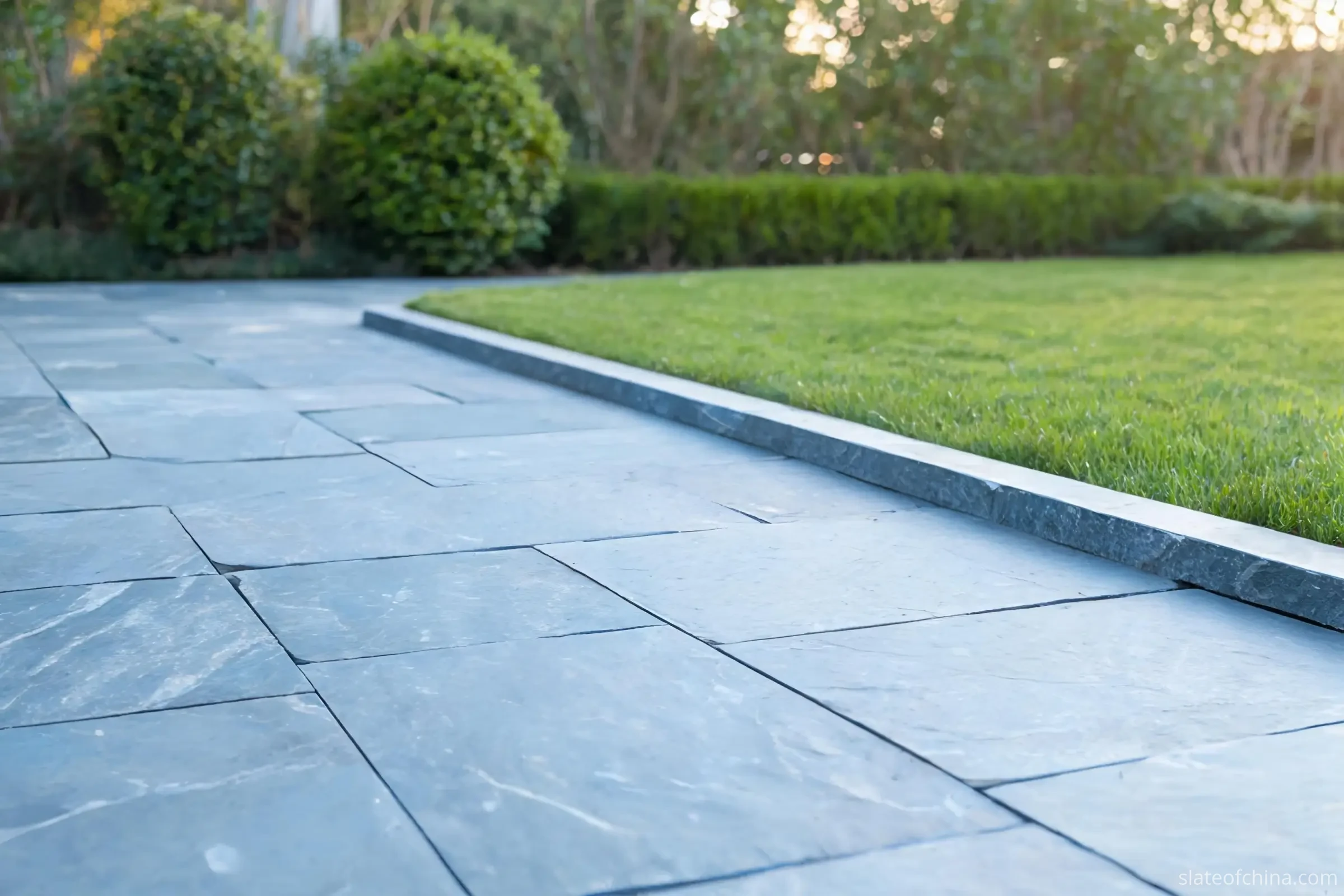
Border course and perimeter detailing are the most reliable way to make the patio feel intentional. A darker course along the edge of lighter paving, a contrasting edging, or a raised planter with a matching slate cap all define the perimeter and tie the patio into the garden. Where the paving meets the lawn, a thin stone border prevents the edge from being nibbled at by grass and movement. The outer row also needs physical restraint: paving should not rely on loose soil to hold its position.
Thickness: who carries the load
Slate thickness should follow the installation system, the expected load, the slab size and the ground, not a habit. A slab fully bedded on mortar, a unit raised on pedestals, and a dry-laid aggregate base carry the load differently, and they ask different things of the stone.
For a residential patio, thicknesses around 20 mm to 30 mm are commonly encountered in natural stone paving, with thicker units specified where the base, the slab size or the loading asks for them. These are market figures, not a universal rule — the correct number is the one your support system requires, and that is usually something to confirm with the supplier and the installer together. If a vehicle or a heavy load ever lands on the patio, that decides the thickness band, and that is the case for the driveway guide rather than this one.
One processing choice runs through the thickness conversation: calibrated slate has been machined to a consistent thickness, which makes paving heights and joint lines easier to control; uncalibrated slate keeps a natural band of thickness variation and suits traditional, rustic layouts, but it asks the installer to adjust the bed slab by slab. Whichever route you take, write the thickness tolerance into the specification rather than a nominal thickness alone. The full reading of calibrated versus hand-cleft slate — what the back of the tile tells you — is covered in Calibrated vs Hand-Cleft Slate.
Keep the two plans apart: the slab format and finish are a stone decision; the thickness, the bed and the base are a system decision. The slab dimensions that belong in your order — including thickness tolerance — are set out in the slate paving sizes and thicknesses numbers sheet.
Falls, water and joints: leave the engineering to the installer
Water is the great equaliser. A beautifully cut slab will fail if the water is standing on it, running back to the wall, or freezing in a bad joint. Falls, joints and pointing are the job of the ground, and they belong in the installer’s scope, not guessed from the yard.
For a ground-supported patio the build-up, in general, runs: strip the vegetation and unsuitable soil, excavate, prepare and compact a sub-base, set the levels and the falls, bed the slabs, then complete the joints with a compatible pointing. A fall in the region of 1:60 to 1:80 is a common starting point for paved surfaces; the final gradient comes from the project, the paving size and the drainage layout. The point to fix up front is that rain drains away from the house and finds an outlet, and that thresholds, steps, drainage channels and low points are dealt with deliberately.
Joint width is part of the same conversation. A very tight joint is not automatically correct; a joint has to allow for the slab tolerance and the pointing system. The pointing material should suit natural stone and the local freeze-and-thaw — a cement or resin that is right for the product and the region, applied following its instructions.
Drainage design and joint construction across larger paved areas deserve a more detailed discussion in their own right. For a residential patio, the essential principles are straightforward: provide adequate falls, ensure effective drainage and use a compatible jointing system. A patio installed on a prepared base with effective falls will hold up far longer than a prettier patio on a flat, wet base.
Patio rooms: matching the stone to each part of the garden life
The same slate can read very differently according to the room around it. It helps to think of the garden as a set of rooms and choose the format and finish per room rather than one slab for everything.
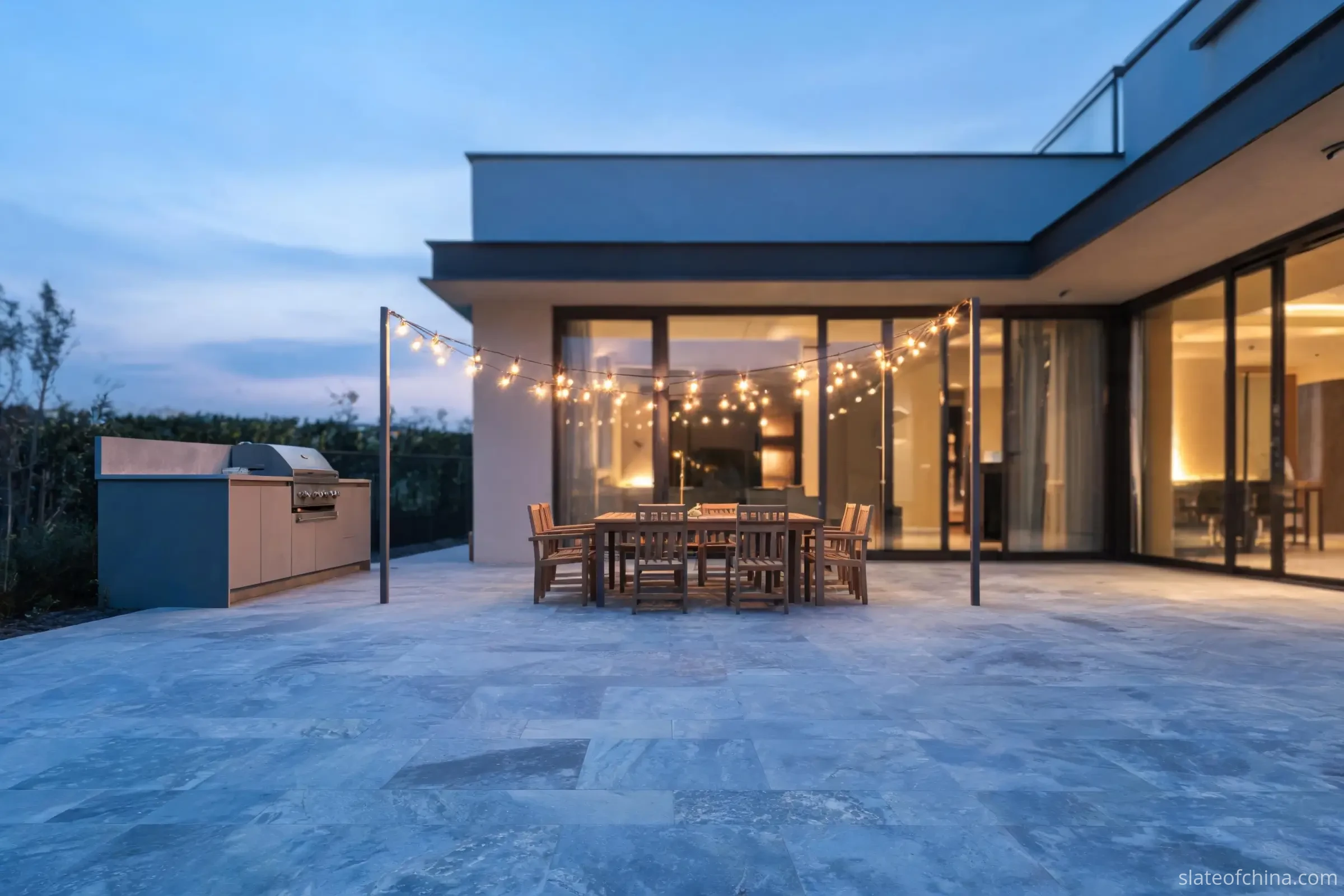
| Outdoor room | Format and finish to consider | What to watch |
|---|---|---|
| Garden patio | Cleft grey or mixed colour; small to medium format | Give the furniture room; leave access to the beds and the lawn |
| Dining terrace | Regular rectangular slabs; an even, textured surface | Chair legs and table feet settle better off the joints |
| Small courtyard | Fewer, larger slabs to keep it calm; or smaller units to turn the corners | A tight colour palette keeps a compact space from looking busy |
| Outdoor kitchen | A practical, cleanable surface near the cooking area | Cleaning, grease and drainage come first here |
| Poolside | A finish with a wet slip result fit for the barefoot, wet edge | Do not assume natural stone is slip-proof; check the tested wet result |
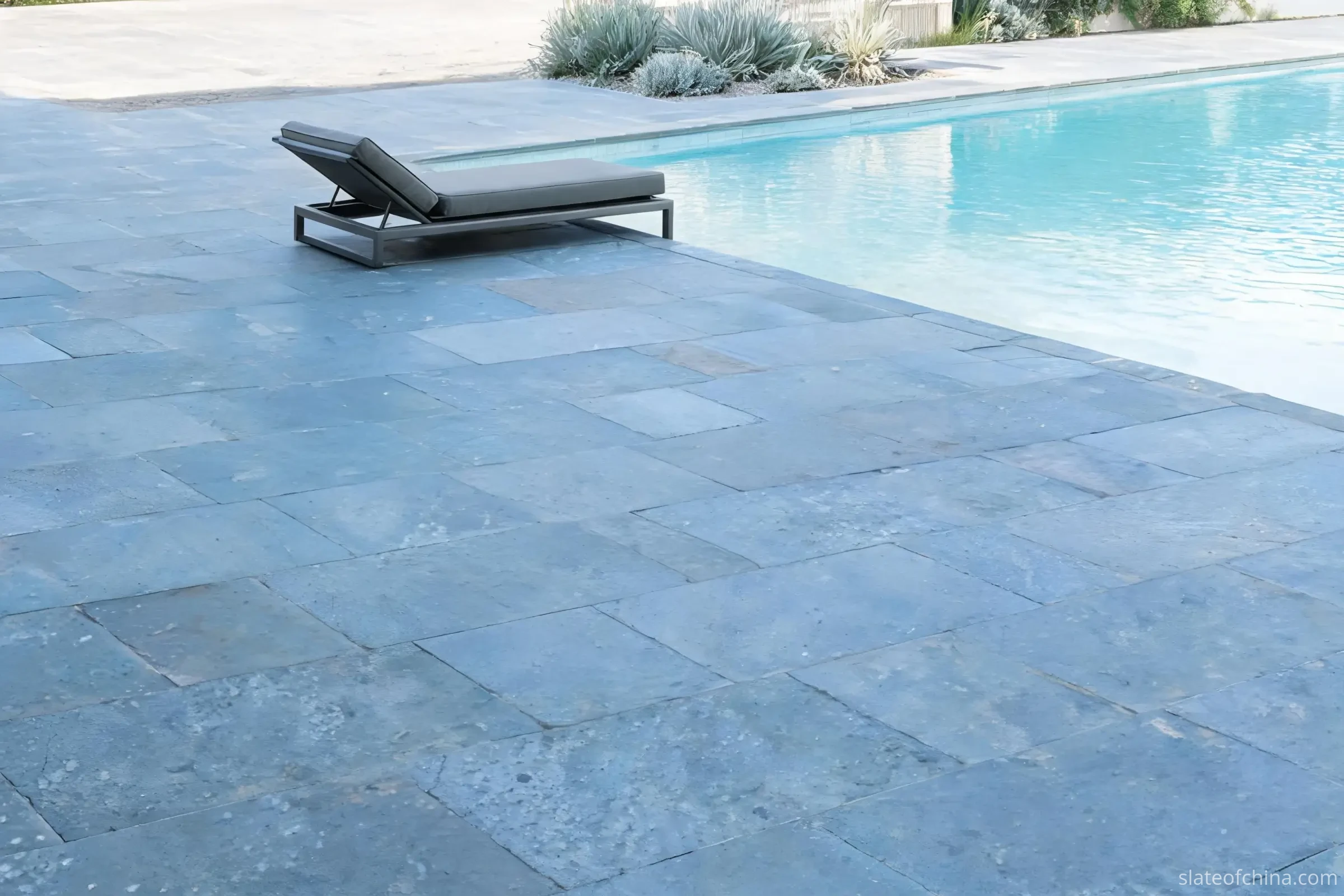
Keeping a slate patio: less is usually more
Maintenance is straightforward when the methods match the stone. Sweep the leaves and grit, wash with clean water, and use a pH-neutral cleaner meant for natural stone. Avoid harsh acids and be cautious with a pressure washer — too much pressure can damage the weaker surface, the joints or a sealer.
Moss and algae appear mainly in shade and damp corners; improving drainage and sunlight and removing organic debris usually cuts it back before it establishes. If you seal, remember that sealing is not automatic and not a fix: an impregnating sealer may reduce staining or water uptake in some stone, but test it on a small area first, confirm it does not change the colour, and follow its instructions. A sealer cannot rescue poor drainage or the wrong stone.
When slate is the answer — and when it is not
Slate is not the right choice for every patio, and the honest answer is useful at exactly the point where the colour has won you over. Compare it on the terms that matter outside.
| Material | Holds its own | Where to look twice |
|---|---|---|
| Natural slate | Natural character, a wide palette, a calm low maintenance surface when set right | Quality and weathering vary with source — check the batch, not the name |
| Porcelain paving | Very consistent, low water uptake, many printed designs | A manufactured look; it does not read as natural stone |
| Sandstone | Warm tones, gentle texture | Porosity and staining depend on the stone and the exposure |
| Limestone | Refined, pale palette | Some grades need careful choosing for a wet outdoor patio |
| Concrete slabs | Readily available, familiar formats | Look and surface depend on the product — often no match for natural stone |
None of these is better absolutely. The right choice is the one that meets your design, the technical demands, the budget and how long you plan to stay. Slate tends to be the answer when natural texture and a quiet architectural character are worth more than the uniformity of a product. If you want to live on the surface with your feet and the light, natural slate is hard to beat; if you need a guaranteed, repeatable printed look, a good porcelain has its place.
What to ask before you buy slate for a patio
Buying a patio is a quantity of decisions, and a good supplier will treat the order as a specification, not a colour conversation. The short checklist, in order of importance:
- Formats and thickness — the slab dimensions, the thickness, and the tolerance you can rely on in the batch.
- Finish and edge — cleft, sawn, brushed or honed, and whether the edge is sawn straight or natural.
- Water and frost — the water absorption number and the freeze-thaw suitability for your climate (relevant in a country with a real winter).
- The slip question — for a wet or barefoot area, ask for the tested wet result rather than a rough appearance.
- The batch — colour range and thickness consistency across the delivery, plus photographs of the actual material, not the sample tray.
- The practical math — what per pallet, a packing detail that protects edges, and a margin for cutting, waste and a future replacement.
Then sit for the whole-patio question: can the same batch be supplied later for an extension or a repair? A patio that grows in stages depends on that match more than a floor does. For a fuller run at the selection and the purchase, the sister guides are Slate Paving, which owns the full buyer’s overview, and How to Choose Architectural Slate, which runs the decision in order. If the project is public and busy rather than the family end, Commercial Slate Paving sets the written requirements a commercial job asks of the stone.
Slate Patio Paving — common questions
Is natural slate good for outdoor patios?
Yes, when the stone is the right one for the exposure. A patio calls for slate with suitable weather resistance, a suitable surface and the correct installation — check the water absorption, the freeze-thaw suitability, the finish and the tested slip result rather than trusting the name alone.
What is the best slate finish for a patio?
Natural cleft and lightly textured finishes are the usual choice for a rain-washed patio because they cope with the wet better than a smooth honed surface. The best finish balances appearance, cleaning and the tested wet slip performance for your actual space.
Are slate patio slabs slippery when wet?
They can be. It depends on the stone, the finish, surface contamination and water. A rough-looking surface is not by itself a slip guarantee — ask for the tested wet result for the intended use, and for a poolside or barefoot edge that matters double.
How thick should slate patio slabs be?
Thickness follows the base, the slab size, the load and the stone. Around 20–30 mm is common in residential paving products, but the correct figure belongs to the specific support system and specification, so confirm it with the supplier rather than applying a single number.
Can slate paving be used around a swimming pool?
Some slate can, provided the wet slip performance, barefoot comfort, drainage and resistance to the poolside conditions meet the project. Do not assume natural stone is safe at the wet edge; a tested result carries the decision.
Does slate patio paving need sealing?
Not always. Some slate benefits from a suitable impregnating sealer; other batches do not need one. Test on an inconspicuous spot first, confirm it does not shift the colour, and follow the instructions. A sealer cannot fix poor drainage or the wrong stone.
Is dark slate too hot for a sunny patio?
Dark slate absorbs heat, so in full sun it can get noticeably warm underfoot. If the patio is sunny and walked barefoot, compare a lighter tone or plan the way it is used, rather than surprising the family with a hot floor.
Can the same slate be used for the patio and the garden path?
Yes. Using matching slate for patios and garden paths creates visual continuity throughout the garden. Both applications can use similar construction systems for pedestrian traffic, but the sub-base, drainage, slab thickness and installation details should be selected according to the ground conditions and intended use of each area.
Related reading
Choosing a natural slate patio?
Tell a slate supplier the format, the finish and the edge you have in mind, and they can match the batch to the patio. Sizes, colours and cut-to-size options are all on the table.