
Commercial Slate Paving: Specifying for Public Projects
Put the same stone on a house patio and on a public square, and you are asking two different jobs of the same material. On the patio it carries a few people and a coffee table. On the square it carries thousands of steps a day, a cleaning trolley twice a week, a delivery van at the back edge, de-icing salt in January and rainwater that has nowhere to go because there is no roof. The stone is identical. The specification is not allowed to be.
That is the argument of this guide. Selecting slate paving for a public project is not a material choice plus a set of tolerances. It is a written system that tells every party what will be delivered, how it will be checked, and what will be rejected if it does not comply. The people who matter here are the ones who write and receive that requirement: landscape architects, specifiers, contractors, developers, material distributors and the municipal teams who inherit the finished area.
The guide follows the order of a real public project. It starts with the duty cycle, works through thickness, slip resistance and durability evidence, then covers drainage, installation, accessibility, appearance and maintenance. At the end of most sections there is a short clause you can lift into your own specification. Nothing in it is a substitute for the test reports and local regulations that apply to your site — that point is repeated where it matters.
Quick answer: a public paving specification should not begin with colour and thickness. It should begin with the duty cycle, then lock down four things in writing — the loading basis, the slip and durability evidence with its test methods named, the thickness and tolerances the delivered slab will be checked against, and a maintenance plan with a named owner. If it cannot be written on a page and verified against a delivered slab, it is not a specification yet.
Where Commercial Slate Paving Is Used
Commercial slate is not a single product category; it is a family of formats and finishes assessed against project-specific performance requirements and the applicable national standards — not interchangeable products. The same quarry stone can appear as a wide sawn slab in a civic plaza, a cleaved tile in a hotel courtyard and a small-format unit around a landscape bed. What makes each one a commercial product is that someone has put its performance into the contract.
Typical public applications include:
- Public squares and civic plazas — large paved areas where a consistent architectural surface has to keep looking even while hundreds of people cross it daily.
- Commercial building entrances and hotel forecourts — high footfall, frequent rainwater and the detail problems of thresholds, ramps and doorways.
- Pedestrian walkways and shopping precincts — repeated foot traffic, cleaning machinery and the need to replace an individual slab when it is damaged.
- Hospitality terraces and courtyards — places that balance a premium appearance with paving that will get wet from rain, cleaning or nearby water features.
- Landscaped public spaces — around water features, seating and planted areas where texture and colour are used to define zones.
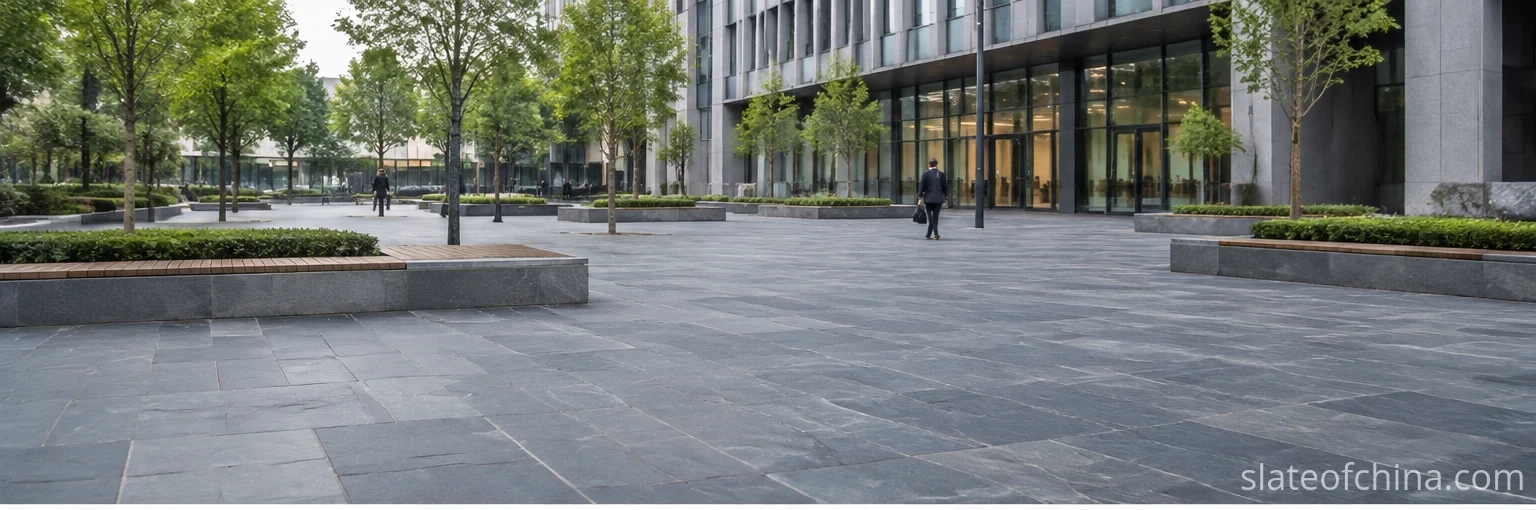
The mistake is to start from colour and apply one thickness across the whole project. Different zones take different duty cycles, and the specification should say so.
Start from the Duty Cycle, Not the Looks
The first question is not "which slate?" but "what will the surface do every day?" Two projects can both be called commercial yet demand entirely different engineering — a pedestrian plaza and a service access road are not the same load.
| Traffic zone | What the surface has to absorb |
|---|---|
| Pedestrian plaza | Continuous foot traffic; occasional maintenance equipment and event structures |
| Shopping walkway | Heavy pedestrian use plus cleaning machinery |
| Hotel forecourt | Pedestrians, luggage trolleys, occasional service vehicles |
| Public walkway | Pedestrians, bicycles, maintenance vehicles |
| Service access | Delivery vehicles and intermittent heavier loads |
| Vehicular plaza | Repeated vehicle loading and turning forces |
For pedestrian-only areas the control points are surface wear, slip resistance, dimensional consistency and the stability of the base beneath. Where vehicles can enter, the question changes completely: vehicle type, axle loads, frequency, turning and braking forces, slab format and thickness, bedding, jointing and the sub-base all become a single structural problem.
Two warnings belong here. A thicker slab does not by itself make a paving system suitable for vehicles — a wide thin-ish slab on a soft base can fail where a smaller thicker unit on a proper base will not. And never copy a thickness from another project. Ground conditions, support, slab dimensions and installation all change the answer.
Thickness and Dimensions: What the Drawing Should Say
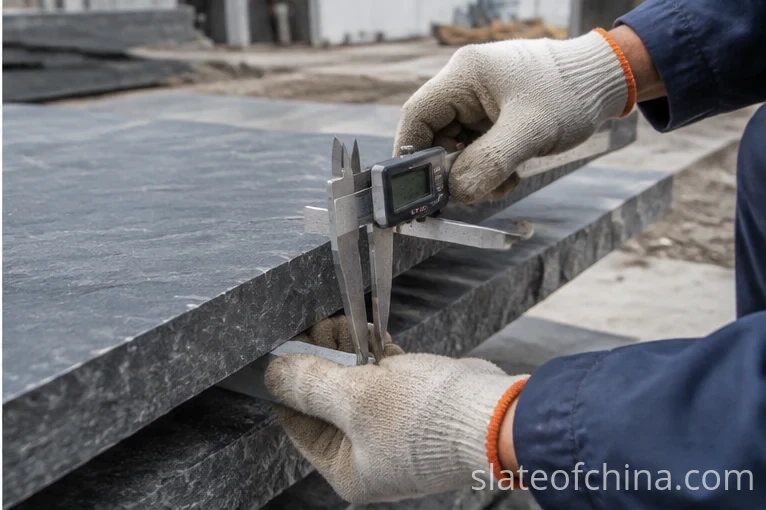
Thickness is the detail people get right last and fight over first. There is no single thickness that suits every public project, and no reputable supplier will give you one. The figure follows from the duty cycle, the slab length and width, the flexural strength of the stone, the bedding and the base it sits on.
What a specification should lock down instead is how thickness is controlled. State the nominal thickness and the permitted deviation. Then state whether the slabs are calibrated to a consistent gauge, sawn to exact dimensions, or naturally cleft with variable thickness. Calibrated slate simplifies levelling across a large area; cleft stone keeps a traditional appearance but the installer has to manage its variation.
Slab format changes the engineering too. Large-format slabs read as calm and contemporary, but a bigger stone increases the bending stress on every unsupported span. The drawing should state length, width, thickness, flatness, edge treatment and finish — and on random-format work, the acceptable range should be agreed before production, because on a public area small differences become obvious over hundreds of metres.
Write your spec: slabs shall be cut to size, calibrated to a consistent thickness, with permitted thickness tolerance of ±X mm and dimensional tolerance of ±Y mm as agreed on the drawings. No slab outside the approved tolerance shall be delivered without written acceptance.
Wet Slip Resistance Needs Proof, Not a Look
Slip resistance is the requirement most often judged by eye and most often disputed in the first rain. Rainwater, wet leaves, algae, cleaning residue and surface contamination all change the traction a pedestrian actually gets. A stone that is confident in the dry can be a different proposition wet.
Finish matters. Natural cleft and suitably textured surfaces generally keep a useful texture, while sawn, honed and brushed finishes differ and must each be considered for exposed external work. That is a family question covered properly in our slate surface finishes guide. But appearance alone settles nothing: a rough-looking surface is not automatically safe, and a smooth-looking one is not automatically a problem — the number is what counts.
For European external natural stone paving, EN 1341 is the product standard and EN 14231 defines the pendulum method for wet slip resistance. A specification should name the test method, say whether it was run wet, give the measured value and the required acceptance criterion, and confirm the result applies to the exact surface finish being supplied. A slip value with no method attached has no meaning.
Remember, too, that a number taken on day one is not the number after three seasons of foot traffic. Polish, biological growth and the wrong cleaner all move the real-world figure. On safety-critical sites, plan a re-check during the maintenance life of the project.
Write your spec: the supplier shall provide a wet slip-resistance result (pendulum method per EN 14231, or the applicable national method) for the actual finish to be supplied, meeting the project's stated acceptance level. No paving is accepted without the report.
The Durability Data to Ask For
Public paving gets its service life tested in public. "High strength" and "weather resistant" are not data. Ask for the numbers, and for the method that produced them. The useful set for external paving under European practice is below — always confirm the current editions and the national requirements for your site.
| Property | European test method |
|---|---|
| Product requirements (external paving) | EN 1341 |
| Flexural strength | EN 12372 |
| Abrasion resistance | EN 14157 |
| Water absorption | EN 13755 |
| Freeze–thaw resistance | EN 12371 |
| Wet slip resistance | EN 14231 |
| Geometric characteristics | EN 13373 |
| Petrographic examination | EN 12407 |
Flexural strength (EN 12372) matters because slabs sit on a support that is rarely perfectly even — a stone takes a concentrated load over the voids in its bedding. Abrasion resistance (EN 14157) reflects a surface walked on, cleaned and wheeled over for years. Water absorption (EN 13755) feeds into freeze–thaw behaviour (EN 12371), and where de-icing salts are used the project requirements for that exposure should be stated. Low water absorption helps, but it is not a certificate of frost safety on its own.
Write your spec: all physical and mechanical values shall be backed by independent laboratory reports identifying the test methods, the tested material and its surface finish. Unsupported statements of "high strength" or "suitable for outdoor use" are not acceptable.
Drainage Is Designed In, Not Improvised
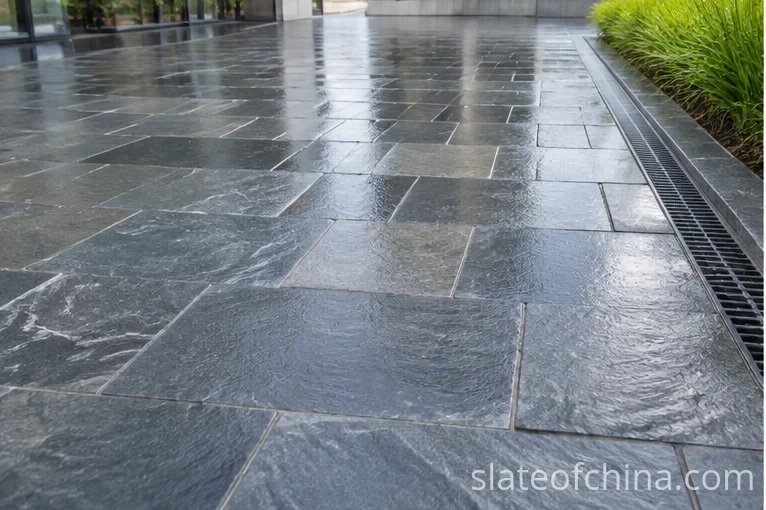
Water is the quiet saboteur of public paving. Standing water raises the slip hazard, feeds staining and algae, and in freezing weather becomes a real problem underfoot. So drainage is designed before the stone is ordered, not added at the end of the works.
The paved surface needs falls that direct water to defined drainage points, with the gradient set by local rainfall, surface texture, slab layout and accessibility. Low points where water collects should be designed out. Linear channels need to be coordinated with the paving module so the grates do not force awkward cuts; drainage should never be pointed at entrances, foundations or threshold details.
Be clear about the system type too. Natural slate is used as an impermeable surface; a permeable system has to be designed as one, through the joints and the construction below. Impermeable paving with surface drainage, open-jointed permeable paving and paving over a drainage layer each demand different bedding, jointing and sub-base.
Write your spec: the paved surface shall fall to the drainage points shown on the drawings. Falls, channel positions and threshold coordination shall be dimensioned in the layout and verified on site before bedding begins.
The Base and the Bedding Carry the Load
A strong slate slab on a poor base is a strong slab on a poor base. Most early paving failures — rocking units, edge lift, hairline cracks — are failures of the system, not of the stone.
Depending on the project the slate sits on a full mortar bed, a compacted sub-base with a bedding layer, or a concrete base. Each comes with its own rules: mortar beds must be continuous and fully supported because hollow areas create unsupported zones; flexible bedding needs the right aggregate and edge restraint; and concrete bases raise the questions of movement, cracking, bonding and expansion joints. In every case the installation detail is written by a qualified designer or engineer, not improvised on site.
For a commercial area the joints and edges take lateral load from pedestrians, wheeled equipment and vehicles. Edge restraints, a stable joint and a jointing material compatible with the stone and the bedding are part of the engineering, not an afterthought.
Write your spec: bedding, jointing, edge restraints and any movement joints shall be designed for the stated duty category and certified by the engineer. Hollow areas, edge lift or rocking slabs are grounds for rejection and corrective action.
Accessibility Is Part of the Specification
A public surface serves people who walk, people in wheelchairs, people using sticks and people pulling luggage. Accessibility is therefore designed in from the start, not applied as a layer.
That usually means consistent finished levels, controlled joint widths, limited lippage between adjacent slabs, suitable gradients and safe transitions at thresholds and drainage grates. Texture is the tension point: a strongly cleft slate can be a delight to look at but a difficult surface to walk on, push a trolley across or roll a chair over. For accessible routes the natural character of the stone is balanced against the surface regularity the local public-realm guidance requires, and that local regulation takes precedence.
Colour and Consistency Across a Large Area
Slate is a geological material, and variation in colour, texture and mineral marking is part of its character. The difficulty on a public project is scale: what is charming in a courtyard becomes a coordination problem over a five-hundred-metre plaza when one batch does not match the next.
So the specification should name an approved colour range, the surface texture, the edge profile and the acceptable natural variation. Then — because a single small sample is a weak control — the architect should approve a reference set that shows the acceptable range and is kept for the production and delivery inspection. Remember the stone also reads differently wet and dry; colours deepen after rain, so approve the sample under realistic lighting and moisture, not only in the showroom. Our guide to natural slate colours covers reading that variation.
A Maintenance Plan Written Into the Contract
Nobody markets natural slate as maintenance-free, and a public one certainly is not. The difference between a well-kept plaza and a stained, slippery one is rarely the stone — it is that someone is named to maintain it and given a method.
A practical plan covers:
- Routine cleaning — removing loose grit and organic debris, sweeping leaves, washing with compatible methods, and keeping drainage channels clear.
- Biological growth — algae and moss in shaded, damp spots affect appearance and slip; scheduled inspection and treatment around trees and water features.
- Joint and surface inspection — loose or rocking slabs, cracked joints, settlement and surface damage caught before they become a safety issue.
- Winter practice — snow and ice removal with de-icing products that suit the stone and the jointing, following the approved project guidance.
- Future matching — agreeing that the supplier retains reference samples and production records so replacement stone can be matched years later.
Cleaning products matter: aggressive acids and the wrong de-icer can attack the stone and the joint material. The maintenance contractor should follow the approved method, not a generic procedure.
Write your spec: the paving is supplied with a documented maintenance plan covering cleaning, joint inspection, drainage clearing, winter treatment and the retention of reference samples for future matching. Responsibility and inspection intervals are named in the contract.
A Commercial Slate Spec in One Checklist
A complete section pulls the points above into a single block a buyer can hand to a contractor and a contractor can hand to a supplier. A short form of that block is:
| Group | What the spec should state |
|---|---|
| Material | Stone type, geological origin, approved colour range, surface finish, edge treatment |
| Dimensions | Nominal size, nominal thickness, permitted tolerances, flatness, calibrated or cleft |
| Technical | Flexural strength, abrasion, water absorption, freeze–thaw, wet slip, density |
| Installation | Traffic category, bedding system, sub-base, joint width and material, drainage, edge restraint, movement joints, accessibility |
| Quality & delivery | Approved reference samples, factory inspection, batch identity, packaging, delivery schedule, acceptance and rejection procedures |
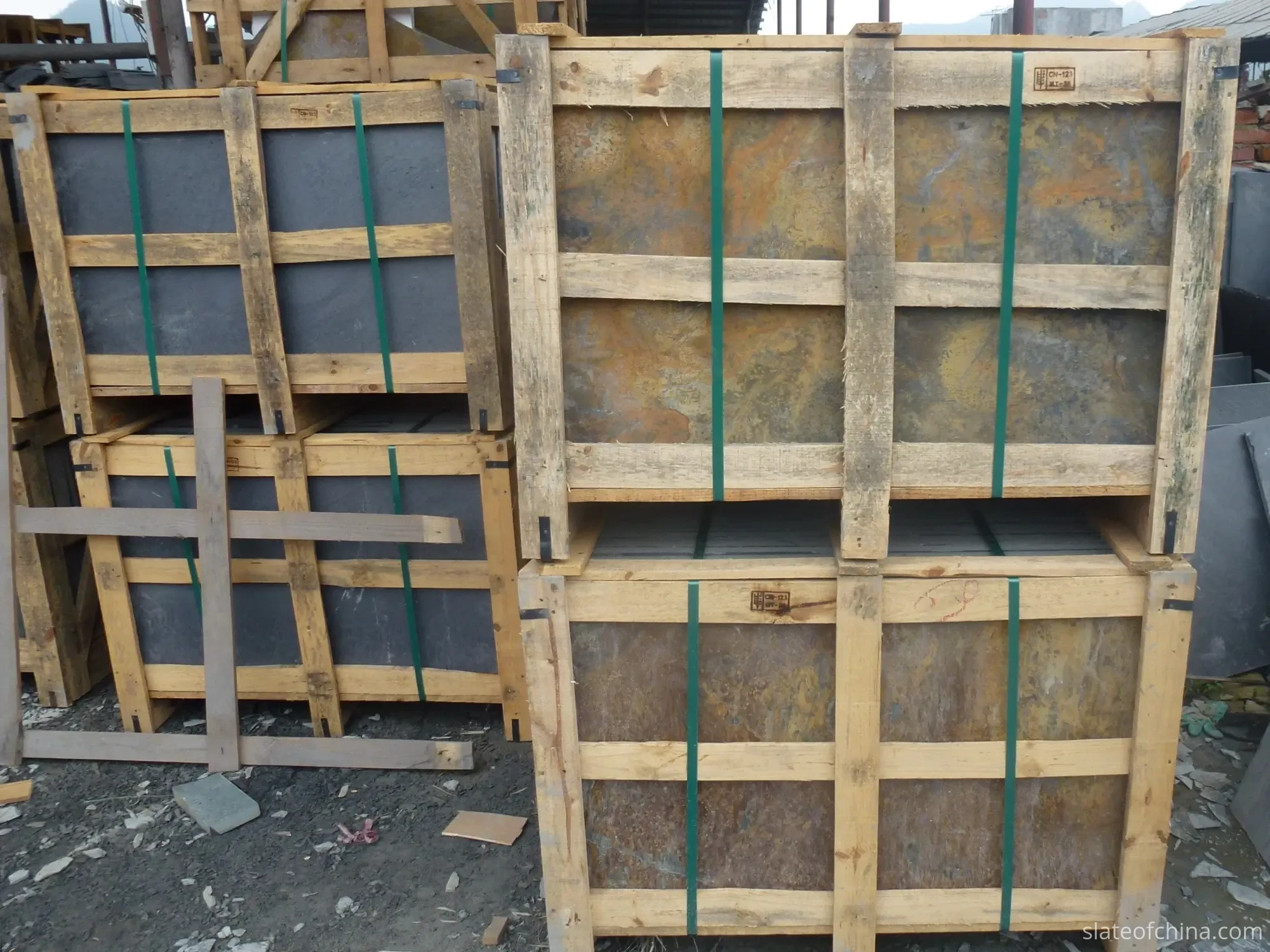
On large projects the client should also hold the right to independent laboratory testing and to inspect delivered materials against the approved samples. For a more detailed guide to common paving formats, thickness options, dimensional tolerances and shipping considerations, see our guide to paving slate sizes and thicknesses.
The most useful thing any of this does is to move the argument forward. When the requirement is written, the test method is named, the sample is approved and the acceptance is agreed, the conversation between the designer, the contractor and the supplier is about the evidence, not about opinions.
Frequently Asked Questions
Is natural slate suitable for commercial paving?
Yes, when its physical properties, surface finish, dimensions and installation system are matched to the actual duty cycle and environment of the area. Suitability is established by test evidence, not by assertion.
What thickness of slate suits a commercial project?
There is no single thickness. It follows from the duty cycle, slab dimensions, flexural strength, bedding and sub-base. Write the nominal thickness and the tolerance, and ask the supplier to substantiate the figure for your application.
Is slate paving slippery when wet?
It depends on the stone, the surface finish, the wear and the maintenance. Cleft and textured finishes often help, but the real answer comes from a wet slip test on the exact finish to be supplied.
What finish is best for a public walkway?
Cleft and suitably textured finishes are commonly chosen for external walkways. The final pick balances wet-slip performance, accessibility, ease of cleaning and appearance, and should be confirmed by testing.
Which standards apply to slate paving in Europe?
EN 1341 is the product standard for natural stone slabs in external paving. Related test methods include EN 12372 (flexural), EN 14157 (abrasion), EN 12371 (freeze–thaw) and EN 14231 (slip). Confirm the edition and national adoption for your project.
Can slate paving take vehicle traffic?
Potentially — but not automatically. Vehicle type, axle loads, slab format and thickness, bedding and base design must be assessed together, and the design documented. A thicker slab alone does not guarantee it.
Does commercial slate need regular maintenance?
Yes. Cleaning, drainage clearing, joint and surface inspection, and checks for loose or damaged slabs keep a public surface safe and presentable over the long term.
Can slate be made to custom dimensions for a project?
Yes. Suppliers can cut to size against your drawings, subject to material characteristics, production capability, agreed tolerances and the project schedule.
Related Reading
Need a slate package that can be put into a specification?
Slate of China supplies natural slate and project-specific cut, calibrated and surface-finish options for architectural paving. Send us your project requirements and drawings. We can help review the required dimensions, thicknesses, surface finishes and available technical documentation, and prepare a material proposal for your project specification.