
Billiard Slate Surface Quality Inspection: Holes, Chips, Veins & Polish
Late in the day, when an order is close to packing, the ceiling lights above our final bench go off. That is not the workshop closing — it is the opposite. A work lamp is pulled over, tipped low and switched on, and its beam rakes across the slate panel lying on the bench. The flat grey surface that looked perfectly quiet an hour ago starts to talk.
Every shallow pit throws a small shadow. Every chip along an edge catches a bright line. An open crack holds a thread of darkness that follows it along its whole length. A surface that looks flawless under even light will confess under a raking lamp. That lamp remains one of the cheapest instruments at the final inspection bench — and one of the hardest to fool.
By the time a panel reaches this point, its thickness and dimensions have already been measured against the drawing, and its flatness has been measured with instruments, not assumed. What happens under the lamp is a different kind of check. This page is that check written down — billiard slate surface quality inspection, the read of the surface itself, organised around the four words of its subtitle: holes, chips, veins and polish.
One of those four words needs explaining before it misleads anyone. On this page, polish refers to the finished surface condition of the bed — never to a glossy polished finish. Billiard slate is normally ground to a fine, matte surface rather than polished to a gloss; the polish section below explains what that correct finish looks like, and what it is checked for.
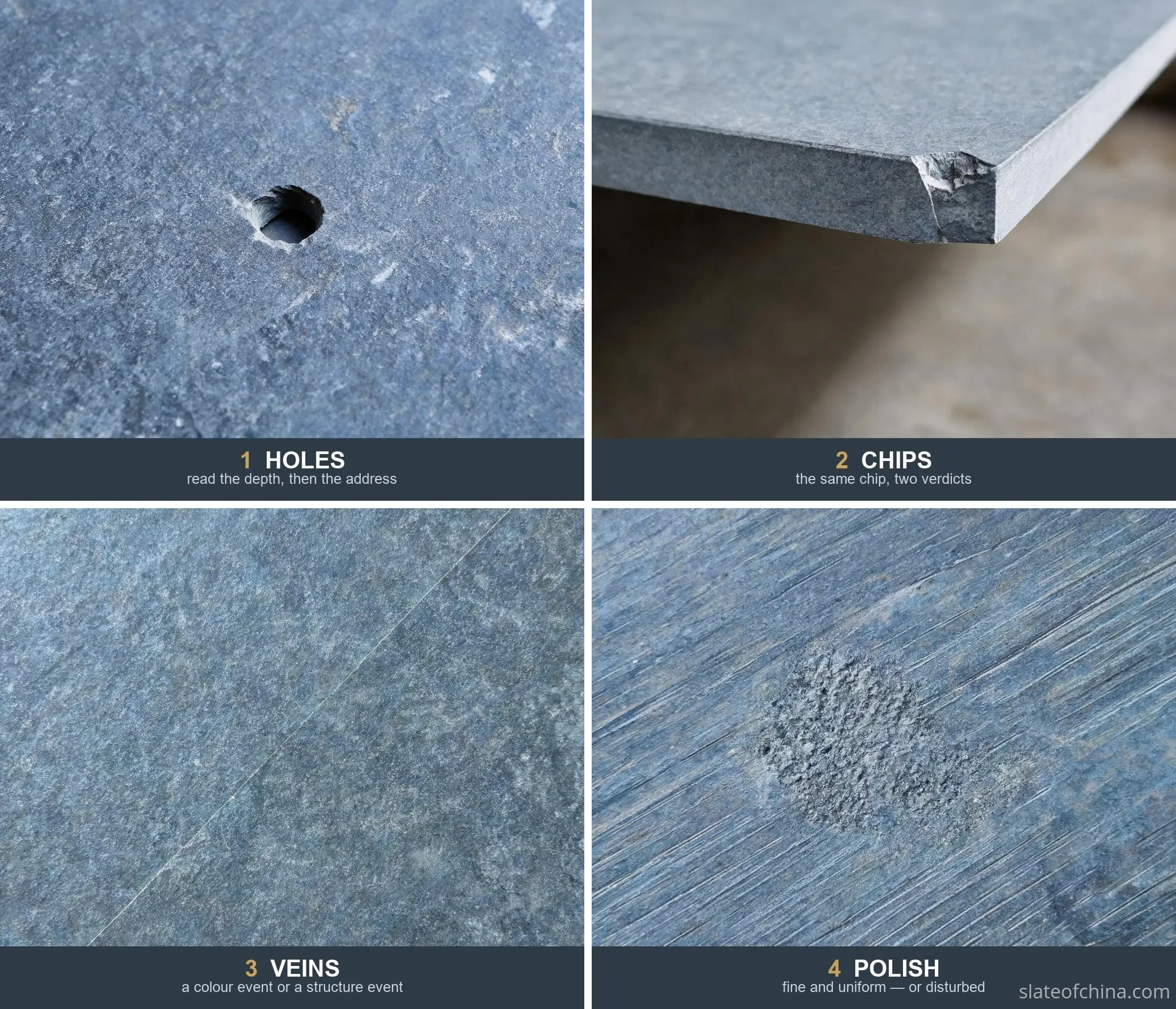
Holes: read the depth first, then the address. A shallow closed pit and an open hole are two different findings.
Chips: the same chip can be a rejection on a joint edge and a non-event under the frame. Location decides.
Veins: a line is a colour event or a structure event. Only the second one is a defect.
Polish: the target is a ground, honed matte surface with a fine uniform pattern — not gloss. Fine grinding marks are normal; disturbed patches are not.
The Last Bench Before Packing
In our production process, surface inspection sits between machining and packing — the last bench a panel visits while it is still naked and every finding can still be acted on. It is a visual and tactile check: eyes and fingertips, helped by light. The measuring stations upstream have already answered their questions; this one answers a question none of the instruments can: is this surface ready for cloth, and ready for the handling and jointing that happen between here and the table?
How closely each panel is read follows the inspection scope agreed in the order — full or sampling, with photographs where the order includes them. Whatever the scope, the method is the one described on this page, and the findings land in the same record format as every other quality item in our wider inspection framework.
Slate is a natural stone, and we have no interest in pretending otherwise. A panel that carries a faint mineral seam, a whisper of tonal banding or the fine matte texture of a ground surface is not hiding a fault — that is simply what the material is. The purpose of this bench is not to make every panel look identical. It is to hold the line between natural character that does not affect cloth installation or play, and a surface defect that can.
Why the Overhead Lights Go Off
The reason is geometry. Overhead light is the most flattering light in a workshop: it falls evenly, fills every shallow depression and softens every arris, so a surface can look better under it than it actually is. Raking light does the opposite. Because the beam travels almost parallel to the surface, anything that stands slightly proud catches a highlight, and anything that sits even slightly low holds a shadow. The micro-relief of the surface — every pit, groove, bruise and open seam — gets translated into light and dark that the eye reads in a second.
That translation is the point of the exercise. Under the lamp, an open crack holds a thin continuous shadow, because light falls into it. A mineral line, which is only a difference in colour, holds no shadow at all. A shallow dish that was invisible at noon becomes a small dark lake. A chip on the top arris of an edge becomes a bright wedge with a shadow behind it.
You do not need our lamp to do this. Any hard light at a low angle works — a phone torch held almost flat against the surface, or low sun through a doorway. When your container arrives, that is exactly how we suggest you look at the panels, and the short routine is at the end of this page.
Holes: Read the Depth, Then the Address
Natural slate can carry small surface openings: shallow pits where a soft mineral grain once sat and later weathered out, pinholes from the rock's long history. A tiny, closed, shallow mark is a natural characteristic, and under the agreed appearance criteria it is not a rejection. What stops a panel is different in kind, not only in size.
On this bench a hole is read twice. The first read is the opening itself: how deep, how open, and — every bit as important as the pit — the condition of the rim. Sound, smooth stone around a small opening behaves like stone. Crumbled or loose material around it is what turns a small feature into a working problem, because loose stone does not stay put under a stretched cloth and years of play.
The second read is the address. The same shallow pit that is a quiet note in the record where a cushion will cover it is a different conversation when it sits beside a pocket cut, close to a bolt hole, or near the mating line of a joint. A finding in those zones is read more strictly, for the plain reason that there the surface has neighbours that matter.
There is no universal depth figure that separates an acceptable pit from a rejectable hole, and we do not invent one at the bench. The acceptance line is written before production, in the agreed specification. For OEM orders, that agreement should be in writing before production — acceptable size and depth, the locations that matter, and whether the stone around the hole must be sound. What this bench adds is the finding, named plainly: what it is, how open, and exactly where.
Chips: The Same Chip, Two Verdicts
Chips are the most common finding on any slate that has been cut, ground, drilled and moved — which is all of them. They happen at the saw, at the grinder and at the drill, and most of all they happen after machining is finished: the crisp edge of a finished panel is the most vulnerable thing in the workshop, and the trip from bench to packing is where it earns its bruises. That is why handling after machining gets the same attention here as the stone itself.
What a chip means depends almost entirely on where it sits. On the playing surface, a chip is read for what it leaves behind: a sharp edge or a local depression can affect surface preparation, and may become noticeable through the cloth after installation. On a joint edge, even a small chip matters more: the joint is where two panels have to meet and take filler, and a chip in the mating line is a gap the compound was never meant to fill. The full geometry of joints belongs to the joint alignment guide; from this bench's point of view the edge is simply inspected twice, once as a surface and once as a joint member. And on a non-functional edge — one that will live under the frame, in shadow, holding the panel but never seen — the same chip may be an accepted characteristic under the agreed specification. It is recorded either way.
The habit we teach new inspectors is to say the address out loud before saying the verdict. A chip is not a judgment; it is a finding with a location, and the location is most of the judgment.
Veins: A Line Is Not Always a Crack
This is the call that takes longest to learn on this bench, and it is the one that worries buyers most — a photo of a suspected crack in the stone is one of the most common messages we are asked to explain.
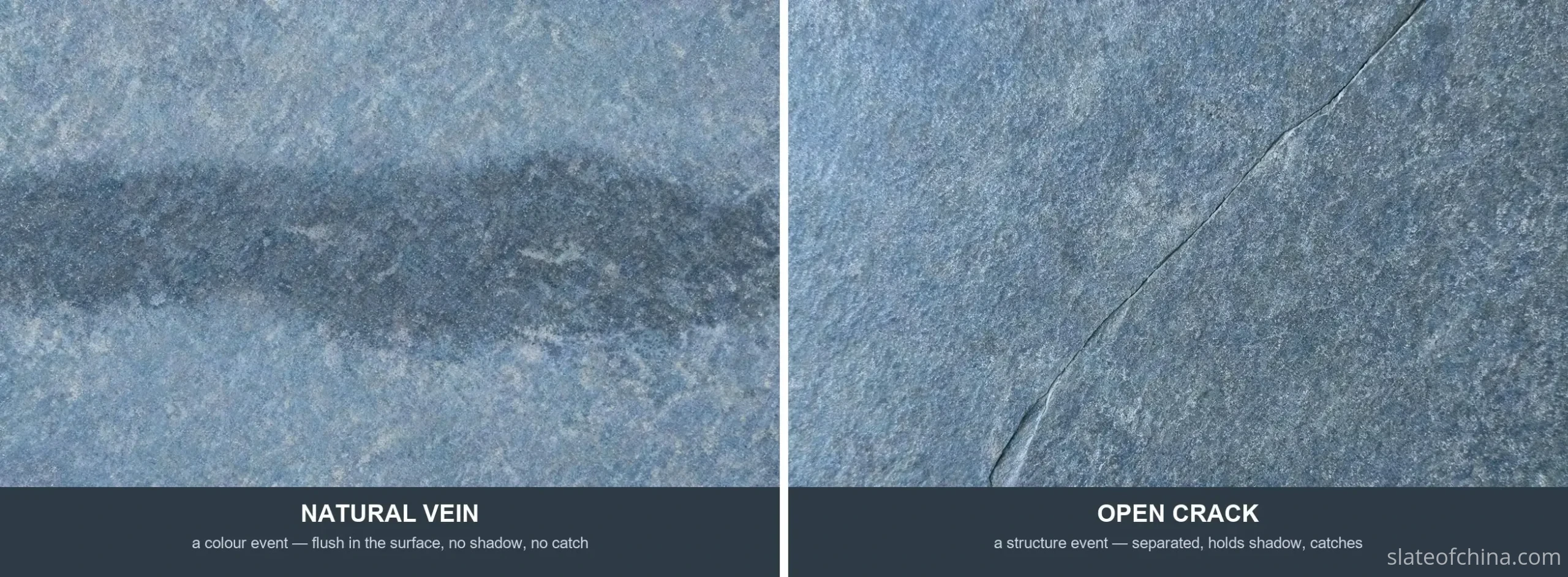
Most lines in slate are harmless. Slate is metamorphic rock: it grew minerals and got squeezed, and a seam of slightly different mineralogy can show in the finished surface as a faint line of colour. That line is part of the stone's biography. It is a colour event, not a structure event, and separating the two is a short list of physical questions. The lamp plus a fingernail answers most of them:
- The catch test. A fingernail, or the corner of a thin steel blade, drawn across the line at right angles. A colour line offers no resistance. An open fissure catches — even slightly.
- The shadow test. Under raking light, an open crack holds a continuous thread of shadow along its length, because it is genuinely open. A mineral line holds none.
- The edge test. Where the line meets the cut side edge of the panel: does the cut profile show solid, unbroken stone, or does the line continue through the thickness as a visible gap?
- The destination. A line that runs toward a bolt hole, a pocket cut or a panel edge gets a harder second read than one that fades out in the middle of the field.
- The company it keeps. A line with crumbling or chipped material along it, or a step in the surface across it, has stopped being a colour event.
Read together, the five tests collapse into a quick judgment table:
| What you see | Likely condition | Action |
|---|---|---|
| Colour line, flush with the surface | Natural mineral vein | Usually acceptable |
| Line catches a fingernail | Open fissure | Inspect / reject |
| Continuous dark shadow along the line | Open crack | Reject |
| Line continues through the cut edge | Possible structural feature | Inspect carefully |
| Crumbling material along the line | Damaged area | Reject / rework |
A tight, closed mineral line in the playing field is, in our production process, a note in the record — and subject to the appearance criteria agreed for the order, usually a panel that ships. An open crack does not ship. The record names the two differently for a reason: vein, closed, no catch and fissure, open, holds shadow are different sentences, because one is the stone being a stone and the other is a defect. Natural appearance is not the same thing as structural damage.
Polish: What the Surface Is Supposed to Look Like
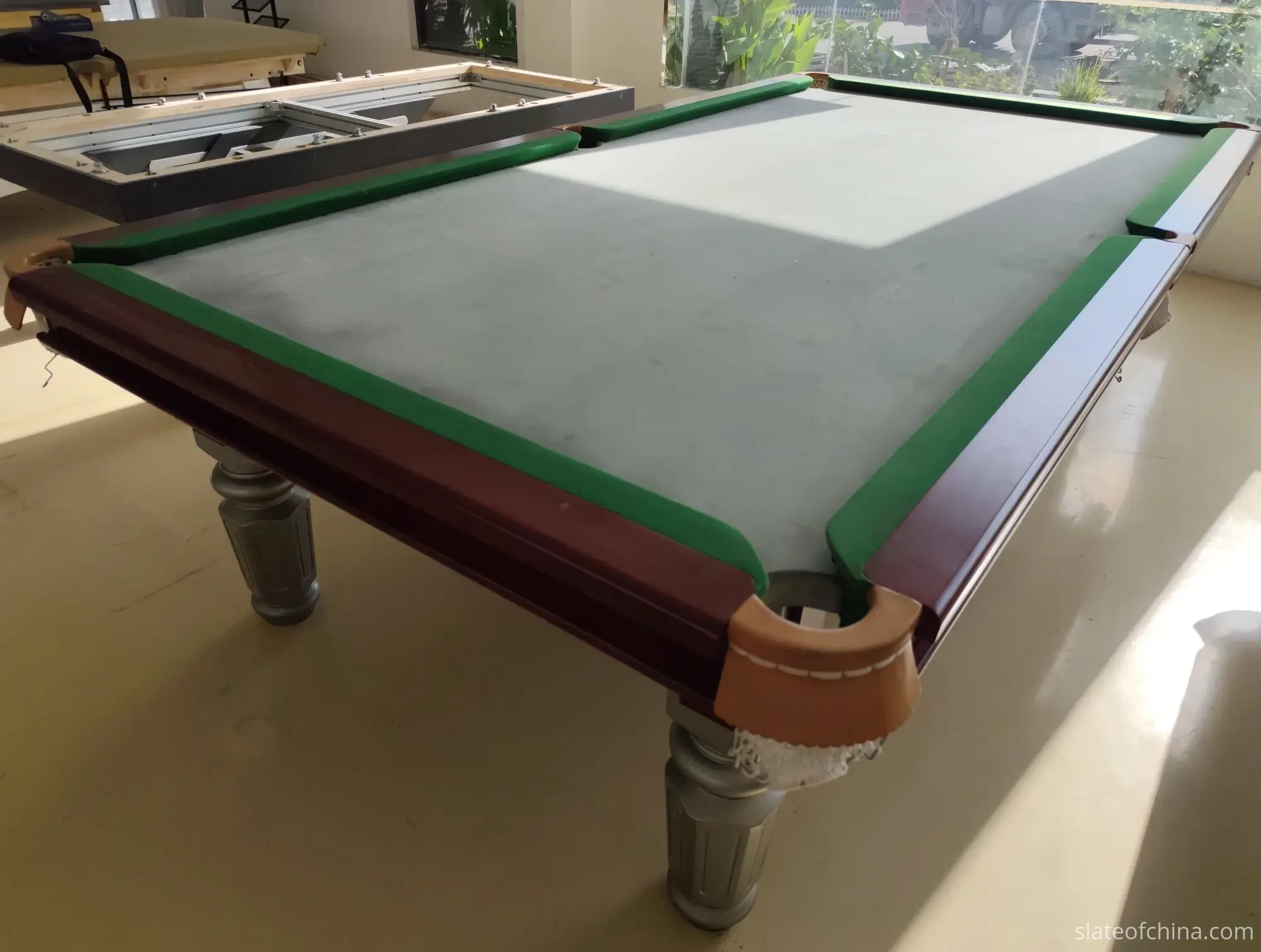
Buyers ask for polished slate more often than you would think — it is the natural word when you want a nice surface. But a billiard bed is not polished, and should not be. The surface finish we ship is ground: flat, smooth to the touch, honed matte. The cloth provides the finish the player actually touches; a gloss underneath it would buy nothing at all. How that surface is produced — the grinding passes that create it — is covered in our surface grinding guide.
On this bench, the finish is read two ways. The normal way: fine, uniform grinding marks across the whole panel — faint parallel traces where the wheel passed are the honest signature of the process, what a ground stone is supposed to look like, and not a defect. The wrong way: a surface that says the process lost control somewhere. Deep single grooves. Waves in a regular rhythm. Rough patches that feel different under the hand from the rest of the panel. Islands the wheel never reached.
Should billiard slate be polished?
No. Billiard slate is normally precision-ground rather than gloss-polished. The target surface finish is flat, fine, uniform and matte — the condition billiard cloth installation actually needs. Gloss underneath the cloth would add nothing to the table.
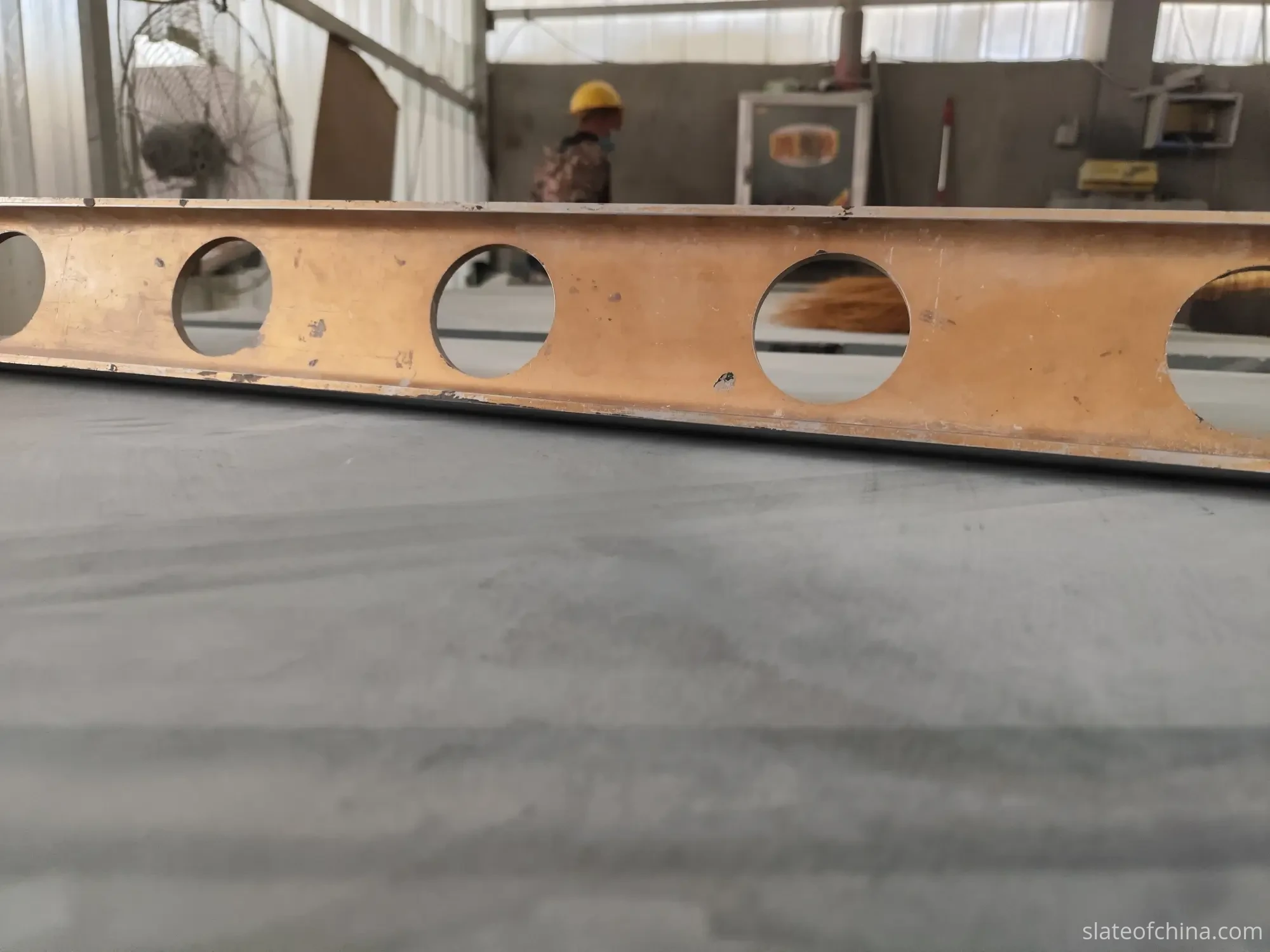
One more thing this bench is not: a flatness check. A surface can feel smooth and still not be flat, and a properly flat panel still carries its fine grinding marks. Smoothness is read here with hand and eye; flatness is measured on the measuring benches, with instruments, and recorded as numbers on our quality and test data page. The two checks support each other, and neither one substitutes for the other.
Where It Sits Decides What It Means
A surface defect is judged by both what it is and where it is. Every finding on this bench — hole, chip, vein or finish — goes into the record with three fields: what it is, where it sits, and what we did about it. The middle field does most of the work, and it is the one a photograph alone cannot give you.
| Zone on the panel | What that zone has to do | How a finding here is read |
|---|---|---|
| Playing surface | Carries the cloth and the ball path | Strictest read: sharp edges, depressions and open features count |
| Joint edges | Meet the neighbouring panel and take filler | Read as surface and as joint geometry — a chip here is a gap later |
| Machined areas (bolt holes, pocket cuts) | Locate and hold the table hardware | Read for chips radiating from holes and damage bridging into the field |
| Hidden zones (under frame or cushions) | Support and centre the panel, never seen | Small closed findings may be accepted per the agreed spec — recorded either way |
| Cut side edges | Show the thickness; handled constantly | Read for fresh handling damage between machining and packing |
That table is why the question “Is this chip acceptable?” cannot be answered from a photo alone, and why our records are worth more than our adjectives. "Good quality" is an opinion; a record that names the feature, the zone and the verdict can be checked, argued with in a useful way, and improved on the next order. The wider checklist those records feed into is described in our quality control guide for buyers.
The Second Pass: Around Every Machined Hole
After the general surface read, the machined areas get a pass of their own, because drilling and cutting stone have failure modes of their own and they concentrate at the hole rims. What we look for around every opening:
- chips radiating from a drilled hole, like small bite marks in the rim;
- a torn or rough countersink ring where the bit exited;
- a pale, bruised halo around a pocket cut — micro-fracturing the eye catches before the hand does;
- damage that bridges from a hole into the playing surface.
The positions of the holes are the drawing's business — how CNC holds them is covered in the CNC machining guide — but the condition of the stone around them is this bench's business. A panel can be flat, on-size and well ground, and still need attention because the rim of one bolt hole came out ragged.
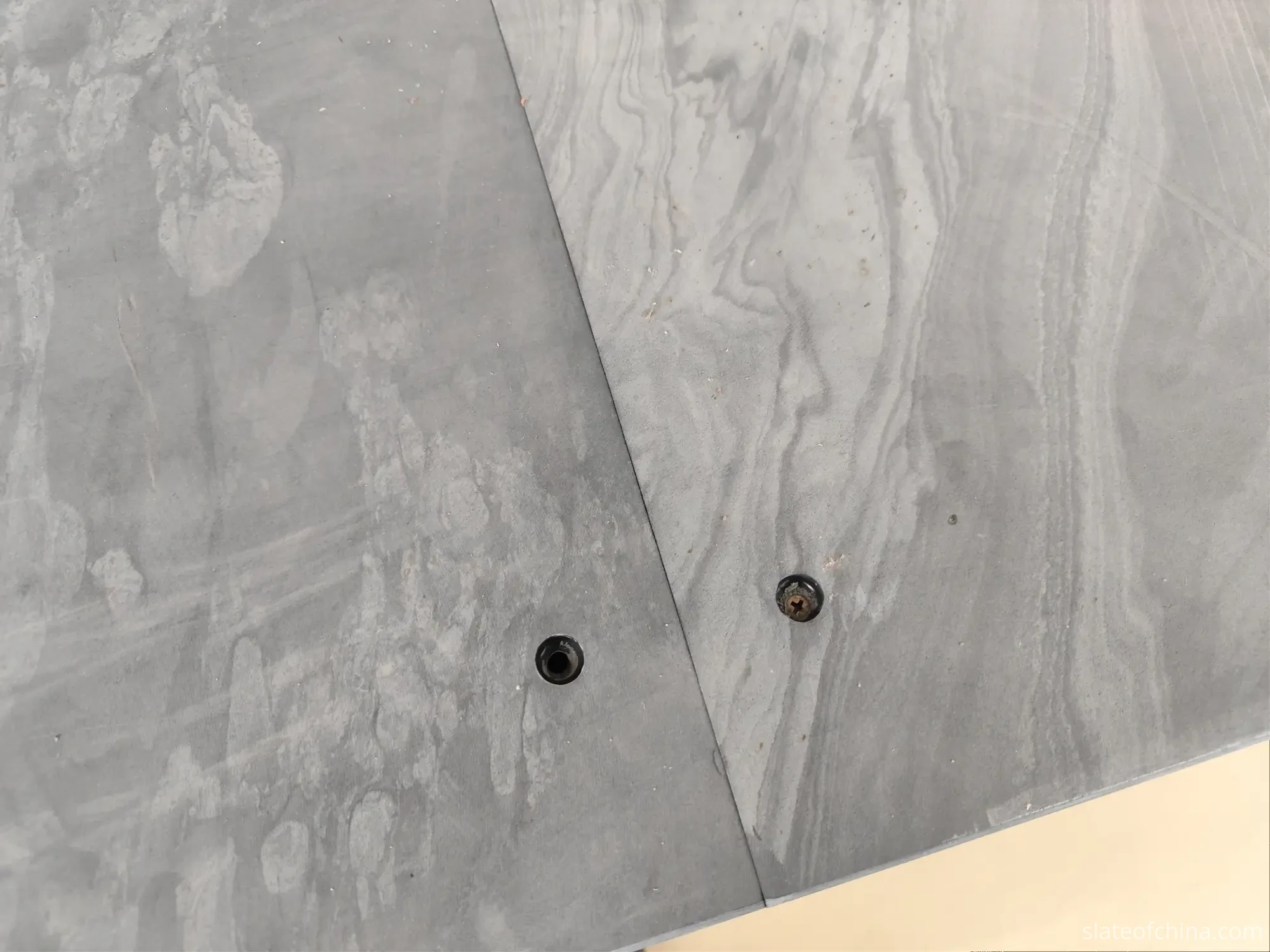
Across the Joints, as a Set
Multi-piece beds get one more look that no single panel can offer: with the set laid in its final positions, the lamp passes across the seams. What this read covers is strictly surface — debris caught in a joint, a bruise sitting right on the mating line, a chip that only becomes visible when two edges finally meet. The relationships between the panels — steps across a seam, uneven gaps, the fit itself — are the deeper chapter on joint alignment. This bench only confirms that what meets at the seam is clean, sound stone.
What Happens to a Panel That Fails
Three outcomes exist, and the record shows which one a finding received. A defect that can be machined out — a localized rough patch, for instance — sends the panel back through the process and back across this bench. A finding that cannot be corrected takes the panel out of the order. And because a bed is a matched set rather than a pile of loose spares, a panel that leaves is replaced through its own set's record, not by reaching for a convenient stranger from another batch. And a rejected panel does not simply disappear from the file: the finding, the verdict and the replacement stay in the QC record, traceable to the same order and the same specification.
Where the order includes photo documentation, findings and the final condition are photographed before packing; after this bench, the next hands on the panel are the packing crew's. And none of it rests on taste. The acceptance line for each of the four words on this page — which holes, which chips, which lines, what finish — was agreed before production began. The bench answers to that sheet, not to the mood of whoever is holding the lamp.
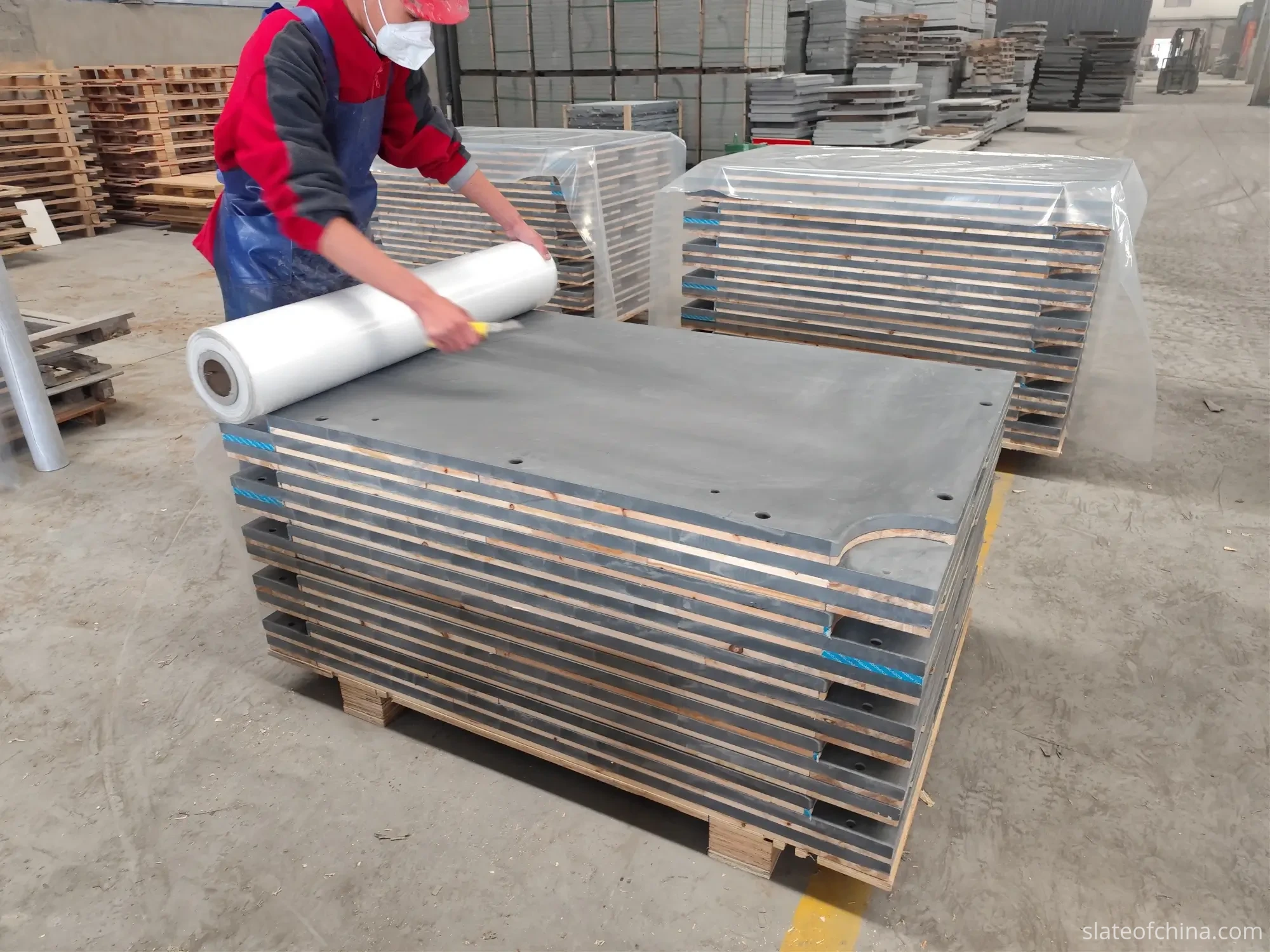
How to Inspect Billiard Slate When Your Container Arrives
The whole method travels. When your container is unloaded and the panels come out, before anything is installed:
- Give every face a low-angle light sweep — a phone torch held almost flat is enough. You are looking for the same four billiard slate surface defects: open holes, fresh chips, lines that hold shadow, and any patch of finish that looks different from the rest.
- Run a fingertip around every machined hole and along every joint edge. The finger finds what the camera misses.
- If the order included inspection photographs, compare what you see against the record — not against memory.
- Photograph anything questionable on day one, before installation. A photo with an address attached — this hole, this panel — can be answered; the surface looks odd often cannot.
For the measuring side of an arrival check — straightedge work, feeler gauges, the numbers — the incoming flatness guide has the full routine, and the wider quality-control checklist shows how surface findings sit among all the other items worth checking. The beds themselves — from pool table slate to full-size snooker beds, Chinese 8-ball and carom sets — are listed across our billiard slate range.
Questions Buyers Ask About Slate Surfaces
Are veins in billiard slate a defect?
Not automatically. Slate carries natural mineral lines that are colour events rather than structural ones — a tight, closed line with no catch under a fingernail and no shadow under raking light is a natural characteristic, and subject to the appearance criteria agreed for the order it usually ships. An open fissure — one that catches, holds shadow and shows as a gap in the cut edge profile — is a different finding and does not ship. The distinction is physical, not decorative.
Is a chipped slate edge always a reason to reject?
No — location decides. A chip on a joint edge or the playing surface is read strictly, because it sits where the table works. The same small chip on an edge that will live hidden under the frame may be an accepted characteristic under the agreed specification. That is why findings are recorded with a location, and why this question cannot be answered from a photo alone.
Should billiard slate be polished?
No. A billiard bed is finished by precision grinding, which leaves a flat, fine, uniform matte surface — the finish cloth installation needs. A gloss polish is not part of the specification. What this inspection checks instead is the condition of the ground finish: deep grooves, waves and rough patches are the findings that count.
Are small holes or pits in slate acceptable?
It depends on the finding, not on a single number. We read how deep and open the hole is, the condition of the stone around its rim, and above all where it sits — a shallow closed pit under where a cushion will be mounted and the same pit beside a pocket cut are two different findings. There is no universal depth figure that separates acceptable from rejectable; that line belongs to the specification agreed before production.
Can we see surface inspection photos before packing?
When the order includes photo documentation, yes — findings and the final surface condition are photographed before the panels are packed, so the record travels with the shipment. The scope of documentation follows what was agreed for the order, so if pre-packing photos matter to you, the time to ask is at specification stage, before the stone is cut.
Who decides whether a surface feature is acceptable?
The specification agreed before production decides, and the bench reports against it. That is the point of writing surface acceptance into the order: a finding can be measured, located and compared with a written line instead of argued about from memory. Where a buyer works to a different standard from our working defaults, the drawing and the order record are where that is settled — before the stone crosses an ocean, not after.
Related Reading
Write the surface into the order. Holes, chips, veins and finish stay vague until someone writes down what is accepted where. Send your table drawing and we will agree the surface acceptance criteria with the rest of the specification — before production, not at the bench.