
Billiard Slate Quality Control: What Buyers Should Check
Billiard slate quality control is not one inspection — it is two. The first runs on paper, before the order is placed. The second runs on stone, before the container leaves the factory. Miss the first, and the second stops being an inspection and becomes an argument.
This page is the inspection checklist behind that idea — the same list our export desk walks through with table manufacturers, importers, distributors and replacement-slate buyers before an order is confirmed, and again before a container is sealed. It covers what to put in writing before ordering, what to measure and photograph before shipment, and what to keep in the file so that any disagreement can be settled with paper rather than patience.
Before you approve a billiard slate shipment, run this buyer inspection checklist.
| Check | What to verify |
|---|---|
| Dimensions | length, width, both diagonals and thickness |
| Flatness | deviation within the agreed tolerance, over the agreed measuring length |
| Thickness | multiple-point readings across each panel |
| Machining | bolt holes, pockets and edges against the drawing |
| Surface | no unacceptable cracks or defects affecting machining, assembly or use |
| Panel matching | joint fit, set marks and thickness consistency across the set |
| Packaging | pallet, separators, corner protection and strapping as specified |
| Documentation | inspection records, measurement photos and loading evidence in your file |
Two Desks, One Order
Almost every slate dispute we have been close to began the same way. Not with bad stone — with a number that lived in someone’s head and never made it onto paper. The bed arrived a shade thinner than the frame was built for. The bolt holes sat where the drawing said they should not. And when the emails started, both sides discovered, usually within the same afternoon, that they had never agreed what “good” meant in the first place.
Quality control exists to prevent that discovery. For billiard slate it happens at two desks. The first desk is yours — the writing desk where the order is specified, weeks before any stone is cut. The second is the factory’s inspection bench, days before loading, where the specification finally meets the panels. There is a third desk as well, the one nobody wants to visit: the claims desk. You only meet it if the first two were skipped.
A word on neighbours, so this page keeps to its own job. The Billiard Slate Buying Guide walks the whole sourcing journey — samples, quotations, documents, shipping. Our Quality & Test Data page shows what a factory’s own inspection records look like, format by format. This page stays on one subject: the checks a buyer runs, and the evidence those checks should leave behind.
THE 3-STAGE BILLIARD SLATE INSPECTION
- Before production: freeze the specification and acceptance criteria in writing.
- Before shipment: inspect the finished slate against that specification.
- On arrival: check for transportation damage before installation.
At the First Desk: Write the Slate Before You Buy It
“Please quote 9 ft pool table slate, 25 mm.” A quote built on that sentence is a quote built on a label. Labels describe products; specifications describe orders. Two suppliers can both accept that email and ship different beds, because “9 ft” is three numbers wearing one name — playing area, slate outline, cabinet size — and the label does not say which one you mean. The identification keys are in Types of Billiard Slate; the standard dimension tables for each table type are collected in Billiard Slate Technical Specifications.
Everything not written into the purchase order gets decided later — by production planning, by the CNC operator, by whoever is under time pressure that week. None of them is you. The purpose of the first desk is to decide, while the decision is still free, what “acceptable” will mean at the moment it can be measured.
| What the order must state | What the line earns its place by preventing |
|---|---|
| Bed outline and playing area | one rectangle in stone per piece, so “9 ft” becomes a drawing instead of a label |
| Thickness, with tolerance | a band you will accept, not a single number you hope to see |
| Flatness tolerance, with measuring length | a figure that states how it was measured, and over what span |
| Piece count and seam layout | agreement on which bed is arriving, and where the joints will run |
| Pocket and bolt-hole geometry | positions taken from drawing datums, not from “the usual pattern” |
| Surface finish level | the preparation level the cloth installer is expecting |
| Packing method | pallet, separators, corner protection, strapping — agreed, not improvised |
| Inspection scope and evidence | full or sampling, and what the factory owes you in records and photographs |
Then run the five-question test over every line, the way a QC desk writes its own procedures. Can it be measured? With what tool? By whom? Against what number? Recorded where? A line that cannot answer all five is not a specification — it is a hope with a unit attached.
One of those lines deserves its own paragraph: the inspection scope. “We check everything” is a sentence, not a scope. A scope is something a supplier can be held to — every set measured before packing, or a first article plus an agreed sample of sets from the run. Full inspection and sampling are both honest ways to run an order; they simply suit different orders, and a two-set replacement does not want the plan a recurring supply programme does. What matters is that the choice is written down before production starts.
For machined beds, add one more item to the desk: an approved reference. Drawing, physical sample where practical, revision record — the method table builders know as the golden sample, described in OEM Billiard Slate for Table Manufacturers. The short version: every check on the second desk needs something to be checked against, and that something should not be memory.
You do not need twenty questions at the first desk. Four do most of the work, because each one turns an adjective into a number:
- What thickness tolerance can you hold — and where on the panel do you measure it?
- What flatness tolerance can you guarantee, over what measuring length, measured how?
- What does a completed inspection record for one set look like — may I see a filled-in example from a past order?
- What inspection scope do you propose for this order, and what evidence comes with it?
A supplier who has genuinely measured the product answers in numbers and methods. A supplier who has not answers in adjectives — “very flat”, “top quality” — and you have learned what you needed to know before the deposit rather than after the shipment. The wider evaluation of a billiard slate supplier — factory or trading desk, equipment, capability, track record — runs to ten questions in How to Choose a Billiard Slate Manufacturer, and the test-report and document requests worth making before a deposit are collected in Slate Testing: What Buyers Should Ask For.
At the Second Desk: Walk the Floor in This Order
The second desk is the inspection bench, and inspection day has a natural order: identity first, then measurement, then surface, then packing. Work it in that order and little gets missed. Count the sets before you count the panels. Photograph while you measure, not afterwards. And whether you attend in person, send a third-party inspector, or review the factory’s record and photographs from your own office, the sequence stays the same.
Count Sets Before You Count Panels
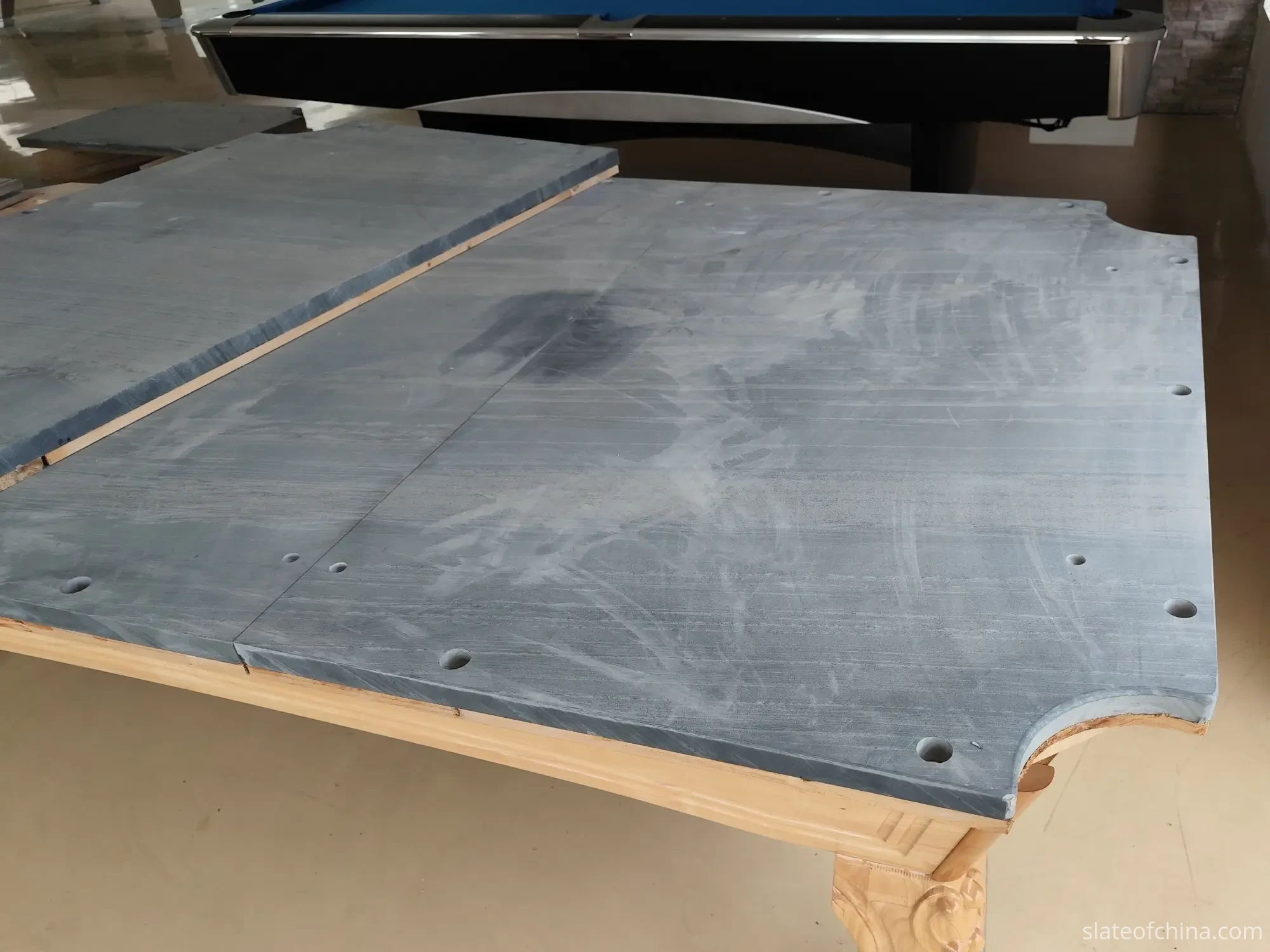
Billiard beds may ship as one-piece, three-piece or five-piece sets depending on the table design — for example, a common 9 ft pool bed may use three pieces, while a 12 ft snooker bed commonly uses five. Either way, a set is a matched unit, not several stones that happened to be cut the same week. So the count runs in sets: every set complete, every piece carrying its identification mark in the correct sequence. A–B–C or 1–2–3 on the joint ends tells the installer which piece goes where; the marks look trivial until the first time they are absent, and a matched set turns into a puzzle on the customer’s floor. Why a three-piece bed is one playing surface rather than three convenient stones is laid out in One-Piece vs Three-Piece Slate.
While counting, look at the joint faces on the sampled sets. They should be machined, clean and free of chips along the mating edges. A chip on a joint face is a chip in the middle of the playing surface the day the cloth goes tight — which is why joint edges get checked at the factory rather than discovered on the floor.
Measure Against the Drawing, Not the Brochure
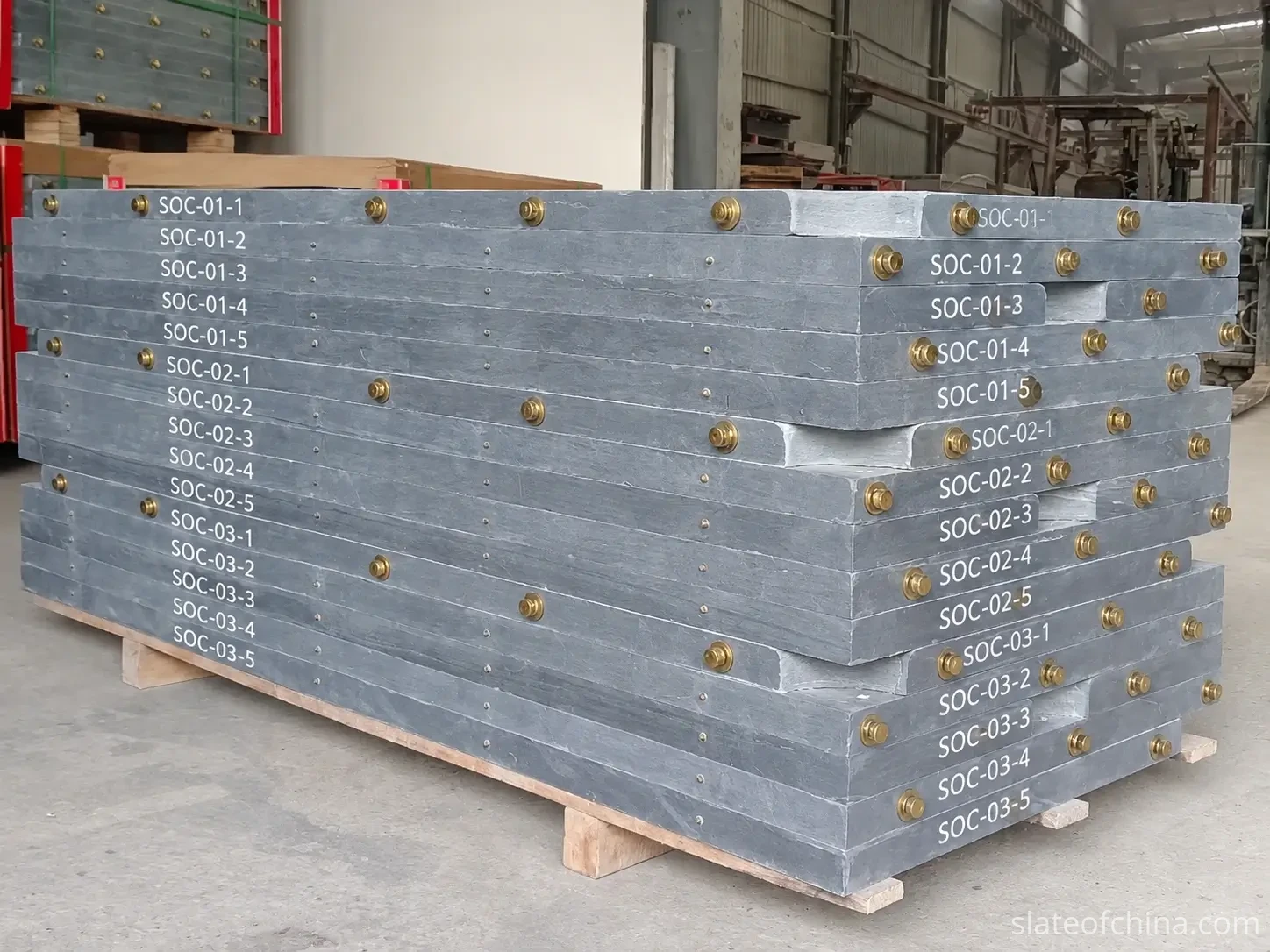
Dimensions first: length, width and both diagonals, taken on the sampled sets and compared with the approved drawing. The diagonals earn their place because a panel can hold all four of its sides and still arrive as a parallelogram. Then thickness — and not once per panel. For example, the working pattern on our own QC desk is five points per panel, four corners and the centre, because a panel can read perfectly at its middle and taper towards an edge. The method, and example records showing how the numbers are written down, are on the Quality & Test Data page.
Nobody hand-measures every point of every panel twice, and nobody should have to: the factory measures as part of production, and your inspection verifies rather than duplicates. Verify to the scope the order names — the first article, a mid-run set, the final sets, or whatever was agreed. The acceptance line is the simplest sentence in quality control: every measured point falls inside the band on the drawing. A point that lands outside is not an argument. It is a re-measurement, a written note, and a decision made while the stone is still in the factory.
Flatness: Ask to See the Gauge
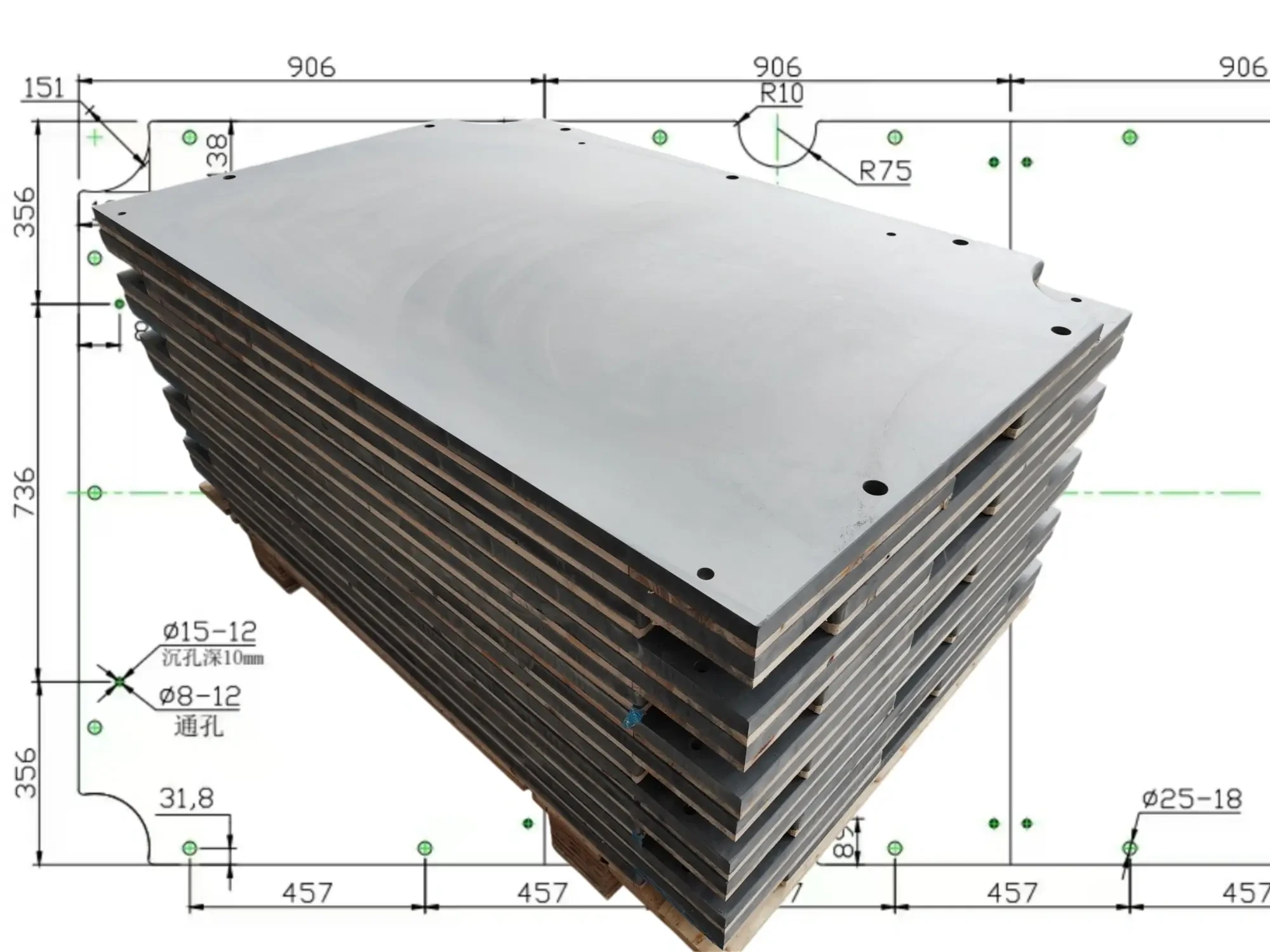
Flatness is the item buyers ask about most and pin down least. “Is your slate flat?” is a question about feelings. “What flatness tolerance can you hold, over what measuring length, measured how?” is a question about a product. A flatness number without its measuring length is not really a specification — it is an adjective — and the reasoning behind that is worth a page of its own in How Slate Flatness Affects Ball Roll.
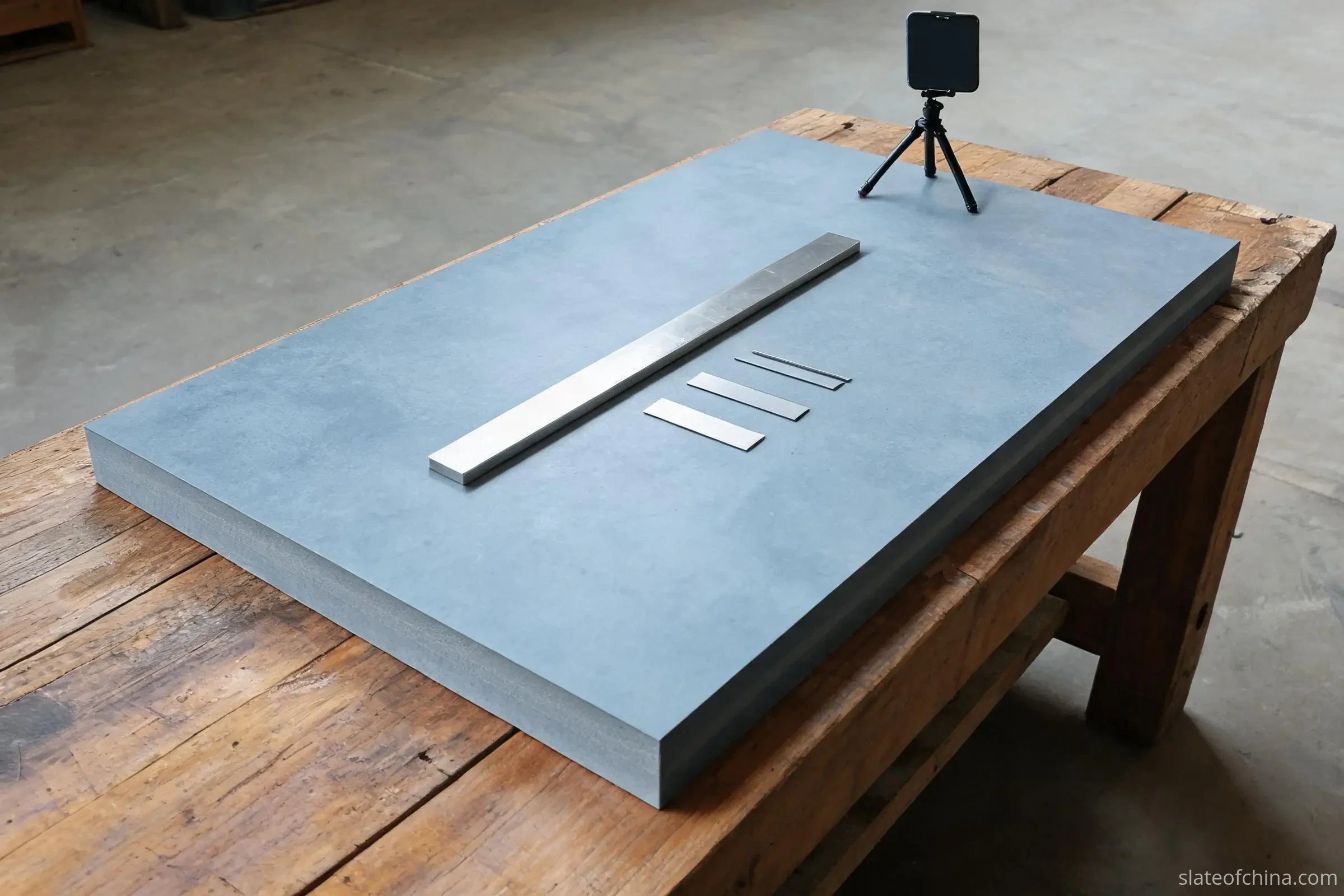
On the floor, flatness is demonstrated, not asserted. The classic demonstration is also the most honest tool in the factory: a straightedge laid across the surface with feeler gauges probing the gap — slow, visual, and difficult to fake. Ask to see it over the measuring length your specification names. The acceptance criterion is the same simple sentence as thickness: within the agreed band, at the positions the method calls for, with the result written down. If you are shown a beautiful finished panel and no gauge, you have been shown furniture, not a measurement.
Read the Surface With the Light Low
Surface inspection is mostly a lighting decision. Light the panel from a low angle instead of from above, and the marks that flat lighting hides — shallow depressions, grinding scratches, faint unevenness — stand up and introduce themselves. Walk the sampled panels under raking light before you look at anything else.
Then the triage, because slate is a geological material and no two panels are identical. Mineral banding, a slight tone shift between pieces, a barely-there cleavage trace on a cut edge — these are features of the stone, not failures of the factory. Four questions separate a feature from a defect: does it affect the strength of the panel? The machining? The installation? The cloth or the ball roll? Four no’s, and it is a natural characteristic. Any yes, and it goes into the record with a photograph, to be decided — replace, repair or accept — while the stone is still in the factory, where the decision costs a forklift trip, not a container.
Holes and Pockets: Position Beats Diameter
Machined features are checked against the drawing, feature by feature. Bolt holes first: diameter and countersink, then position — measured from the two datums the drawing names, not from the nearest convenient edge. A hole a few millimetres out reads as nothing on a loose panel and as everything on a rail: the bolt sits crooked in its countersink, or the rail refuses to pull down evenly, and the cause stays invisible because nobody measured position, only diameter.
Pocket mouths next, where the bed carries them: the width where each mouth opens, the shape of the cut, the distance of each opening from the slate edges — against the drawing, and photographed from above before packing. Where an order runs on a custom pattern, the drawing carries the geometry the whole way through production; that is the working method described on our custom pool table slate page. On multi-piece beds, symmetry between the pieces of a set earns one extra glance: matched panels should mirror, not merely resemble each other.
The Finish You Ordered
Finish is a specification line, not a mood. “Ground for cloth” is a defined level of surface preparation, and a bed arriving a grade rougher or glossier than ordered simply moves work to the next pair of hands — the cloth installer — who is not consulted until the moment it is expensive. At the bench, the finish check is one pass under the low light and one comparison against the approved sample, where one exists.
Frequently Asked Questions
What should I check before ordering billiard slate?
Put the quality into writing before anything is cut: the bed dimensions taken from a drawing rather than a table label, thickness with a tolerance, a flatness tolerance with its measuring length, hole and pocket positions, the finish level, the packing method, and an inspection scope — full or sampling — together with the evidence the factory will provide. A line that cannot say how it will be measured is not yet a specification.
What does a pre-shipment inspection of billiard slate include?
In order: confirm the sets and their identification marks; check dimensions and five-point thickness on the sampled sets; have flatness demonstrated with a straightedge and feeler gauges over the agreed measuring length; inspect surface, edges and joints; verify bolt-hole and pocket positions against the drawing; check packing against the written specification; and record loading photographs with the seal number.
What flatness tolerance should pool table slate have?
The one your table design carries, agreed in writing with the supplier. There is no single universal number worth chasing, because a tolerance only means something together with its measuring method and measuring length — the same number can be demanding over one length and meaningless over another. What a factory’s own inspection records look like, including example figures for flatness and thickness, can be seen on our Billiard Slate Quality & Test Data page.
Should I hire a third-party inspector for a slate order?
It can make sense for large orders, or when you cannot attend yourself — but the inspector needs a specification to inspect against, so the writing desk comes first. Send the approved drawing, the agreed tolerances and the checklist from this page; without them an inspector can only describe what the panels look like, not whether they pass.
How do I inspect billiard slate when the container arrives?
Photograph the container and the seal before the doors are fully open, check the numbers against your loading photos, and look at the stacks before anything is moved: upright, unshifted, no visible edge damage. Count the sets. After unpacking, measure a sampled set against the same standards as at the factory and compare with the inspection records in your file. Report any mismatch with photographs before the stock is put away.
What photos should I ask the slate factory to send?
Photos that show the measurement, not just the stone: a straightedge across the surface with feeler gauges at the gap and the set mark visible, a thickness reading taken at the panel edge, joint faces close up, packing before loading, the stacks secured inside the container, and the closed doors with the seal number legible. A photo of a finished panel shows the panel; a photo with a gauge in frame shows the panel passing.
Packing: The Last Check Before the Stone Becomes Freight
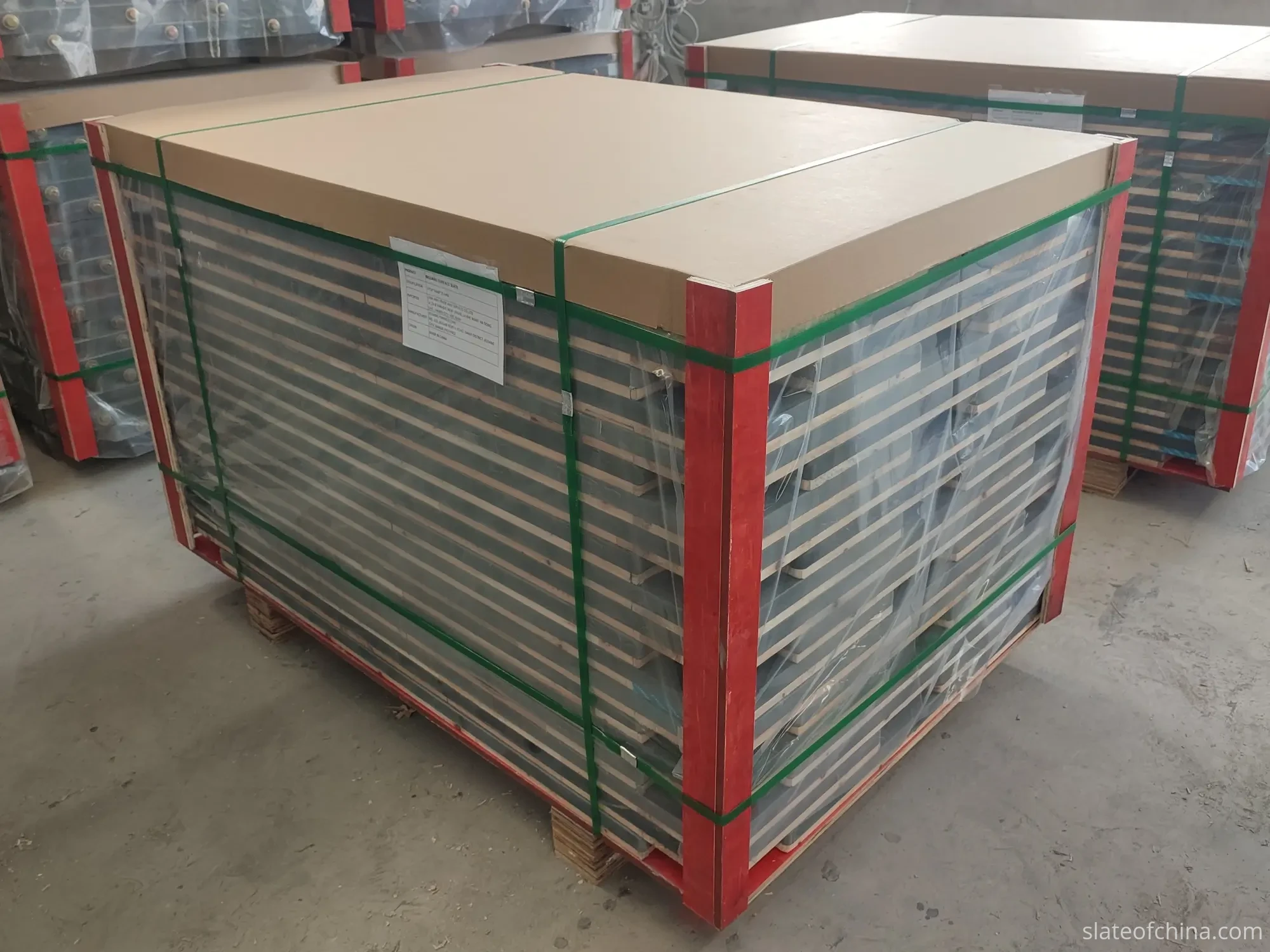
A bed can pass every measurement and still arrive broken, which is why packing sits on the quality checklist rather than the logistics one. Billiard slate travels stacked on heat-treated, ISPM 15-stamped wood-framed pallets — thin separators between the panels, protective corners, strapping holding the stack to the skid. None of it is exotic. All of it is specified, because improvised packing is how measured, inspected, approved stone turns into a claim.
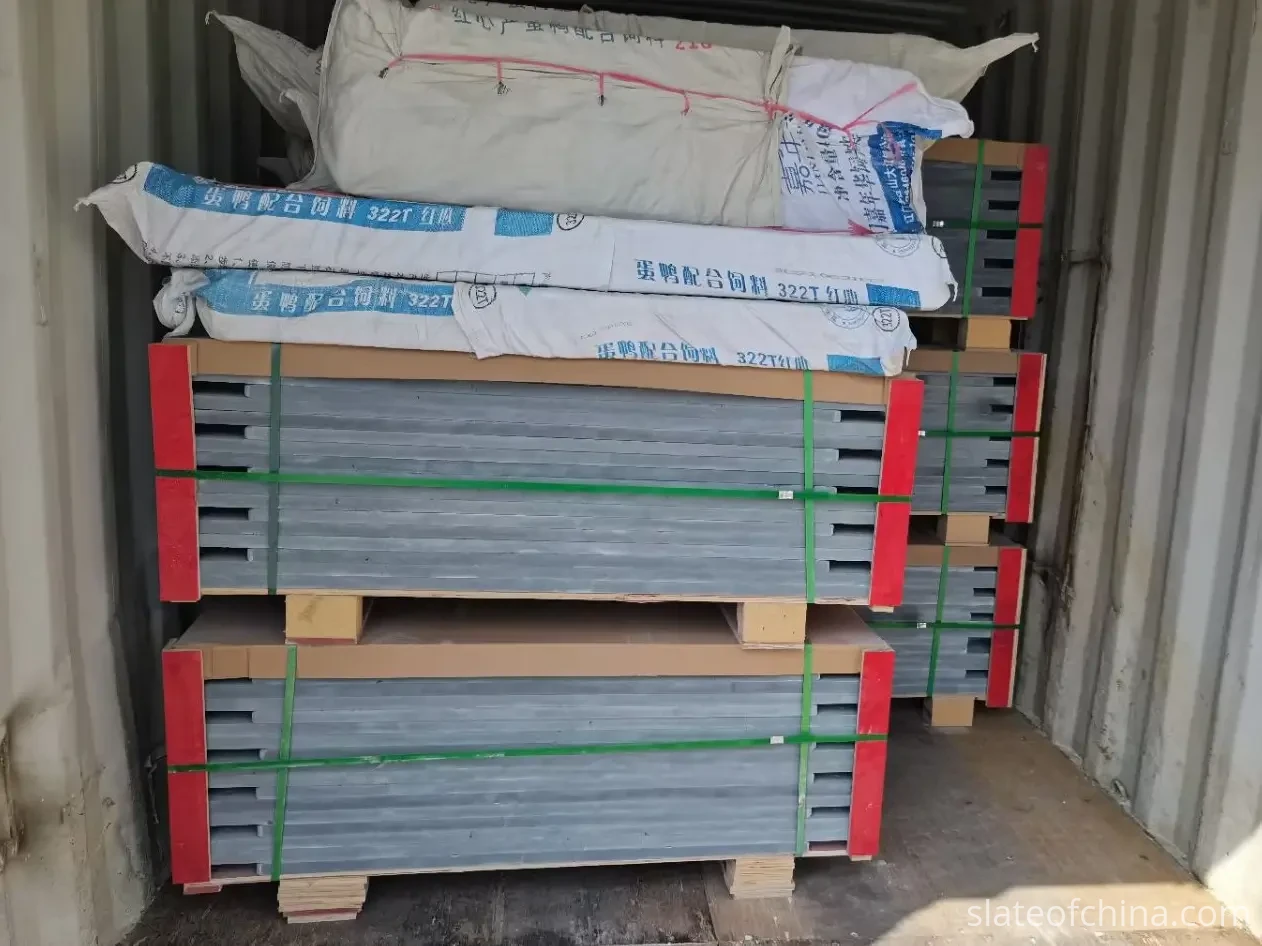
At the second desk, check packing the way you checked stone: against the written line. Separators actually between the panels, not merely visible at the sides of the stack. Corners protected. Strapping tight and intact. Panels dry and clean — grit left on a surface ends up glued under the cloth, and it is the installer who finds it. Deviations get photographed before loading, because the cheapest day to fix packing is the day before the container arrives. How the pallets are stacked and secured inside the container is its own discipline, covered in Billiard Slate Container Loading.
Photograph the Gauge, Not the Stone
If this page had room for one piece of advice, it would be this one. A photograph of a finished panel is a photograph of a claim. A photograph of the same panel with a straightedge across it, feeler gauges at the gap, and the set mark in frame is evidence — it shows the tool, the reading and the identity at the same time. When you ask a factory for inspection photos, ask for the second photograph.
The same discipline covers the rest of loading day. Video the loading: walk the rows, read the set marks into the camera, film the last pallet going in. Photograph the closed doors with the seal number legible, then write the number into your file. Keep the specification, the drawing, the inspection records and the photographs together in one folder per order — if incoming inspection ever finds a problem, that folder is the meeting.
One Table for the Whole Inspection
Print the table below and mark it as you go. It works identically standing on the factory floor and reviewing the factory’s photographs from your office. If you have an hour rather than a day, spend it on the first four rows — identity, dimensions, thickness, flatness — because those are the four that no photograph can repair once the container is sealed.
| What you are checking | What “pass” looks like | Evidence to keep |
|---|---|---|
| 1. Set identity | every set complete; each piece marked in the correct sequence; joint faces clean | photo of each set with marks readable |
| 2. Dimensions | length, width and both diagonals inside the drawing band on sampled sets | measurement photos with the reading visible |
| 3. Thickness | five points per sampled panel, every point inside the agreed tolerance | thickness record per set |
| 4. Flatness | deviation inside the agreed band over the agreed measuring length, shown with the gauge | straightedge-and-feeler photos |
| 5. Surface | no feature that answers “yes” to any of the four triage questions | close-ups of any questionable area |
| 6. Edges and joints | no chips along joint faces; edges machined and clean | joint close-ups |
| 7. Bolt holes | diameter, countersink and position from the drawing datums | hole-position photos |
| 8. Pocket mouths | opening, shape and edge distances per drawing | photos from above |
| 9. Finish | surface at the specified preparation level | low-angle light photo |
| 10. Quantity | sets loaded match the packing list and the order | loading tally photo |
| 11. Packing | pallet, separators, corner protection and strapping as written | packing photos before loading |
| 12. Container | floor clean, dry and undamaged | photo of the empty container |
| 13. Loading | stacks placed and secured per the loading plan | loading video or photo set |
| 14. Seal and documents | seal number recorded; packing list matches what was loaded | doors-closed photo with seal legible |
Incoming Inspection: The Day the Container Arrives
Pre-shipment inspection does not abolish the arrival inspection; it makes it fast. You are no longer inspecting a mystery — you are comparing a delivery against a file. For importers and table manufacturers, incoming inspection should not stop at counting the pallets, especially after long-distance sea transportation. Photograph the container before the doors are fully open. Check the container and seal numbers against your loading photos. Then work through the panels before anything goes into production.
| What to check | What you are looking for |
|---|---|
| Pallet condition | no broken pallets, impact marks or shifted stacks |
| Corners and edges | chips and cracks photographed before the stone is moved |
| Visible cracks | no structural cracks or damage beyond what the loading photos show |
| Moisture | panels dry, no signs of water ingress during the voyage |
| Panel identification | set marks matching the loading photos and packing list |
| Dimensions and thickness | a sampled set measured against the same standards as at the factory |
| Flatness | straightedge check on sampled panels — the flatness-specific method has its own guide |
| Machining | hole positions and pocket geometry against the approved drawing |
| Joint fit | mating edges clean, panels matching as a set |
A delivery that matches its file goes into production the same week. One that does not gets reported with the folder attached — photograph before moving the stone, keep the packing as found, and report promptly; the documents that travel with the shipment are listed in How to Import Billiard Slate from China. A discrepancy reported with evidence is a claim. Reported without evidence, it is a negotiation — and negotiations are slower.
What the Checklist Actually Buys You
Buyers occasionally ask what all of this ceremony adds to the cost of a bed. The honest answer: very little, and it is not really ceremony. The specification costs an email. The inspection scope costs a sentence in the order. The evidence costs a camera that is already in everyone’s pocket. What the three of them buy is the ability to settle a disagreement in an afternoon, with both sides reading the same piece of paper — and more often, they prevent the disagreement from existing at all.
The stone was always going to be what it was going to be; slate does not read purchase orders. What separates a smooth order from a painful one is whether anybody wrote down, in advance, what “good” meant — and then checked. Order slate you can prove, and you will usually receive the slate you ordered.
Related Reading
Bring your own checklist. We like being measured.
Before you place a billiard slate order, send your supplier the required dimensions, thickness, tolerances and machining drawing — and ask for the inspection method and actual QC evidence before loading. If your company runs a QC checklist or works from an approved drawing, send it with your inquiry and we will build the production and inspection plan around it. Send us your table drawing, dimensions or existing slate sample requirements, and we can confirm the inspection points before production — or browse the billiard slate range.