
How Slate Thickness Affects Table Performance
A common mistake in billiard-table construction is to treat slate thickness as an isolated specification. A thicker slate placed on an under-designed frame does not automatically produce a better-playing table. A 25 mm slate in a table engineered for it can play truer than a 50 mm slate sitting on a frame that was never built to carry it.
The question I hear most from table builders and importers is simple: is thicker slate better? The honest answer is the one nobody wants to hear: it depends on what sits under it, how it is supported, and whether the frame was engineered for the weight it now carries.
The 60-second answer
Slate thickness flows through a chain of five structural links before it reaches the ball:
- Thickness sets the bending stiffness of the slate section
- Rigidity determines how much the slate resists deflection between support points
- Support demand — stiffer slate tolerates wider support spacing; thinner slate needs more supports
- Deflection under load — the actual movement of the surface when balls strike cushions, when players lean, when the table settles
- Playing surface geometry — what the ball experiences: flat, stable, consistent — or not
Thicker slate changes the structural system. Whether that change improves the table depends on whether the frame, supports and leveling keep up.
A properly supported 25 mm slate in a table designed for it can perform very well. A poorly supported 50 mm slate can still produce problems — deflection between undersized supports, frame flex under the extra weight, joints that open because the frame cannot hold the load. Thickness matters, but it does not act alone. For the full selection decision across table types, see our thickness comparison guide. This article stays on one question: what does thickness actually do to how the table plays?
Thickness is not the same as flatness. A 50 mm slate that is poorly supported or incorrectly installed can perform worse than a properly supported 25 mm slate. Thickness sets the bending stiffness; flatness, leveling and support set the playing surface.
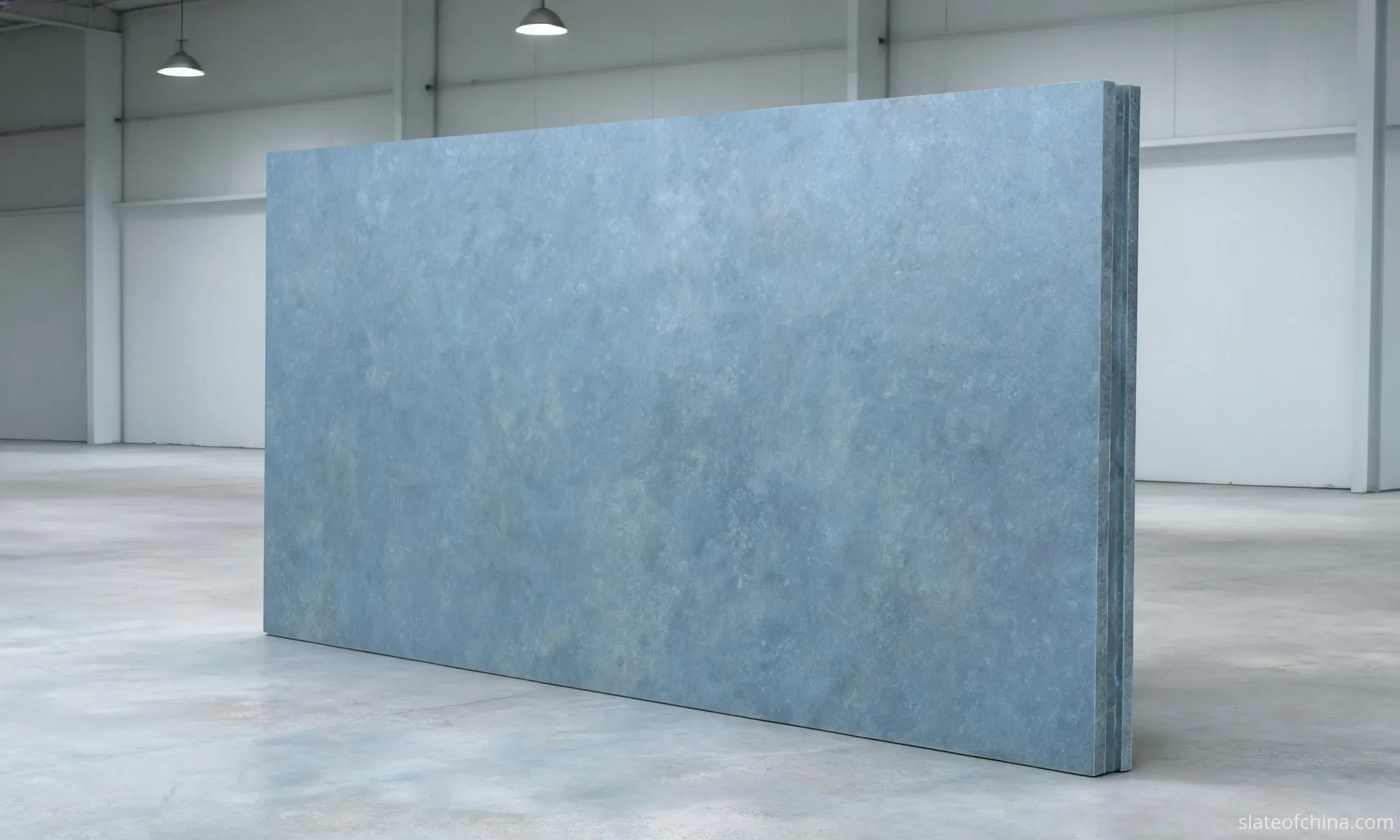
Why Slate Never Works Alone
A billiard table playing surface is not a slab of stone. It is a system. The slate is one component in a chain that includes the frame, the cross-supports or beams, the leveling mechanism, the joints between slate pieces, the cloth, and the cushion assembly. Every one of these parts has to work together. When they do, the table plays well. When they do not, no thickness of slate fixes it on its own.
This is why comparing slate thickness in isolation — "25 mm vs 50 mm, which is better?" — can produce a misleading answer. The 25 mm slate in a pool table whose frame, supports and leveling were all designed for 25 mm is a complete system. The 50 mm slate dropped onto a frame designed for a lighter bed is a component in the wrong system.
When I diagnose a table that "doesn't play right," I look at the system before I look at the slate. I check the frame for flex, the support spacing under the slate, the leveling points, the joint condition. In many cases, the problem is not the slate itself but the structure underneath it — the frame, the supports, the leveling, or the joints. Slate is the standard material for billiard beds because it is rigid, dimensionally stable and machinable to tight flatness. But those properties only translate into a true playing surface when the rest of the table holds up its end.
The Physics: Why Thicker Resists Bending
If you take a slate slab of a given length and width and double its thickness, you do not double its resistance to bending. You increase it by roughly the cube of the thickness ratio. In simplified beam theory, bending stiffness is proportional to thickness cubed.
What does this mean in practice? Under otherwise comparable conditions, a 50 mm slate section has about eight times the theoretical bending stiffness of a comparable 25 mm section — not two times, but eight. That is a dramatic difference, and it is the physics behind why thicker slate is specified for larger, heavier-duty tables. The full span arithmetic for pool versus snooker is covered in its own article; here, the point is simpler: thicker slate resists bending much more than you might intuitively expect.
But a billiard table is not a single freestanding beam. The slate rests on a frame, spans between support points, is held by leveling screws, and is jointed between pieces. The actual deflection you see in service depends on the support spacing, the frame rigidity, the joint construction and the installation quality — not just the thickness. The cube law tells you the theoretical stiffness advantage. The real-world improvement depends on the system.
I have seen 25 mm slate with closely spaced cross-supports show less deflection under a straightedge than 50 mm slate sitting on widely spaced beams. The cube law gives thicker slate a head start. It does not give it a free pass.
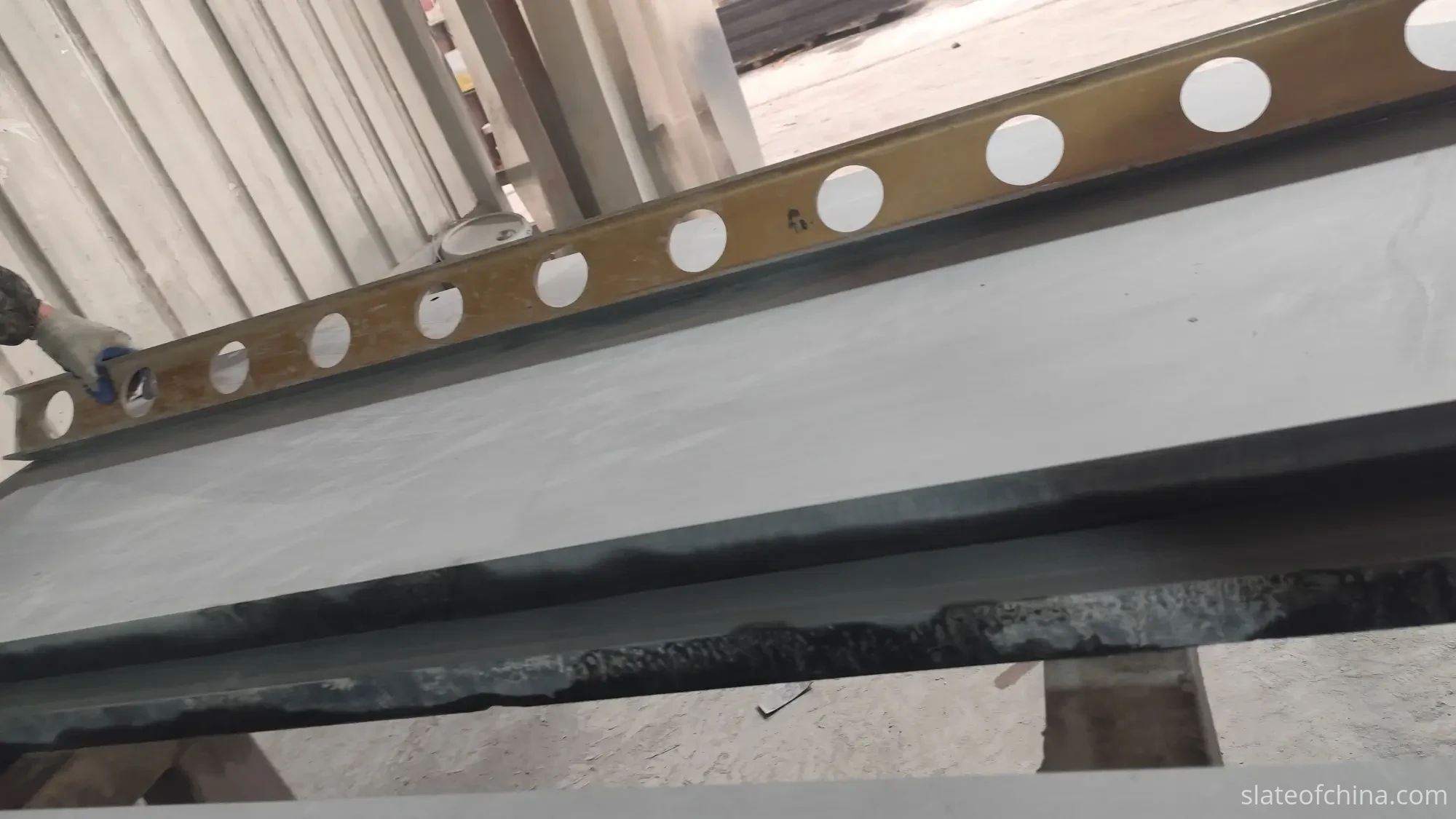
25 mm and 50 mm: What Actually Changes
The table below sets out the practical differences. It is not a verdict — it is a description of what changes when you move from one thickness to another.
| Factor | 25 mm Slate | 50 mm Slate |
|---|---|---|
| Bending stiffness | Baseline (1×) | ~8× (cube of thickness ratio) |
| Weight (9 ft example) | 250–270 kg per set (typical example; varies with dimensions and machining) | Approaching 500 kg per set (same caveat) |
| Support tolerance | Less margin — needs closer supports | More forgiving of wider spacing |
| Frame demand | Standard frame adequate | Requires a heavy-duty frame |
| Installation handling | Two-person lift per panel | May need lifting equipment |
| Transport cost | Lower | Higher — weight drives freight |
| Typical application | Pool tables, lighter designs | Heavy-duty and large-surface tables |
The important point — the one that gets lost in most thickness discussions — is that 25 mm is not automatically inadequate, and 50 mm is not automatically necessary. A 25 mm slate in a pool table designed around it is a sensible specification, not a cost-cutting compromise. A 50 mm slate on a table whose frame cannot carry it is an expensive problem. For a side-by-side comparison of 25 mm, 45 mm and 50 mm by table type, see the thickness verdict guide.
This does not mean that a 50 mm slate automatically produces twice the playing performance of a 25 mm slate. The cube law gives the thicker section a dramatic stiffness advantage in theory, but real-world table performance depends on the support structure, frame rigidity, leveling and installation — not on thickness alone.
Ball Roll: Stability, Not Speed
Many buyers ask: does thicker slate make the balls roll faster? The direct answer is no. Ball speed is primarily a function of cloth type and condition, humidity, ball condition, table geometry and leveling. Slate thickness itself does not inject speed into the ball.
What thickness does is more subtle, and it is the reason the question feels right even though the answer is counterintuitive. A thicker, properly supported slate maintains its playing geometry under load — when balls strike cushions, when a player leans on the rail, when the table is used hard over time. If the surface deflects, even fractionally, the ball sees a slightly different path than it should. On a large table or under demanding conditions, that small deviation becomes visible.
So the real relationship between thickness and ball roll is this: thicker slate, well supported, helps the surface stay flat. It does not make the ball go faster. It makes the ball go where it should. Ball roll is a stability question, not a speed question.
This is one reason professional and tournament table designs pay close attention to slate thickness, support structure and leveling as a package — not as independent decisions.
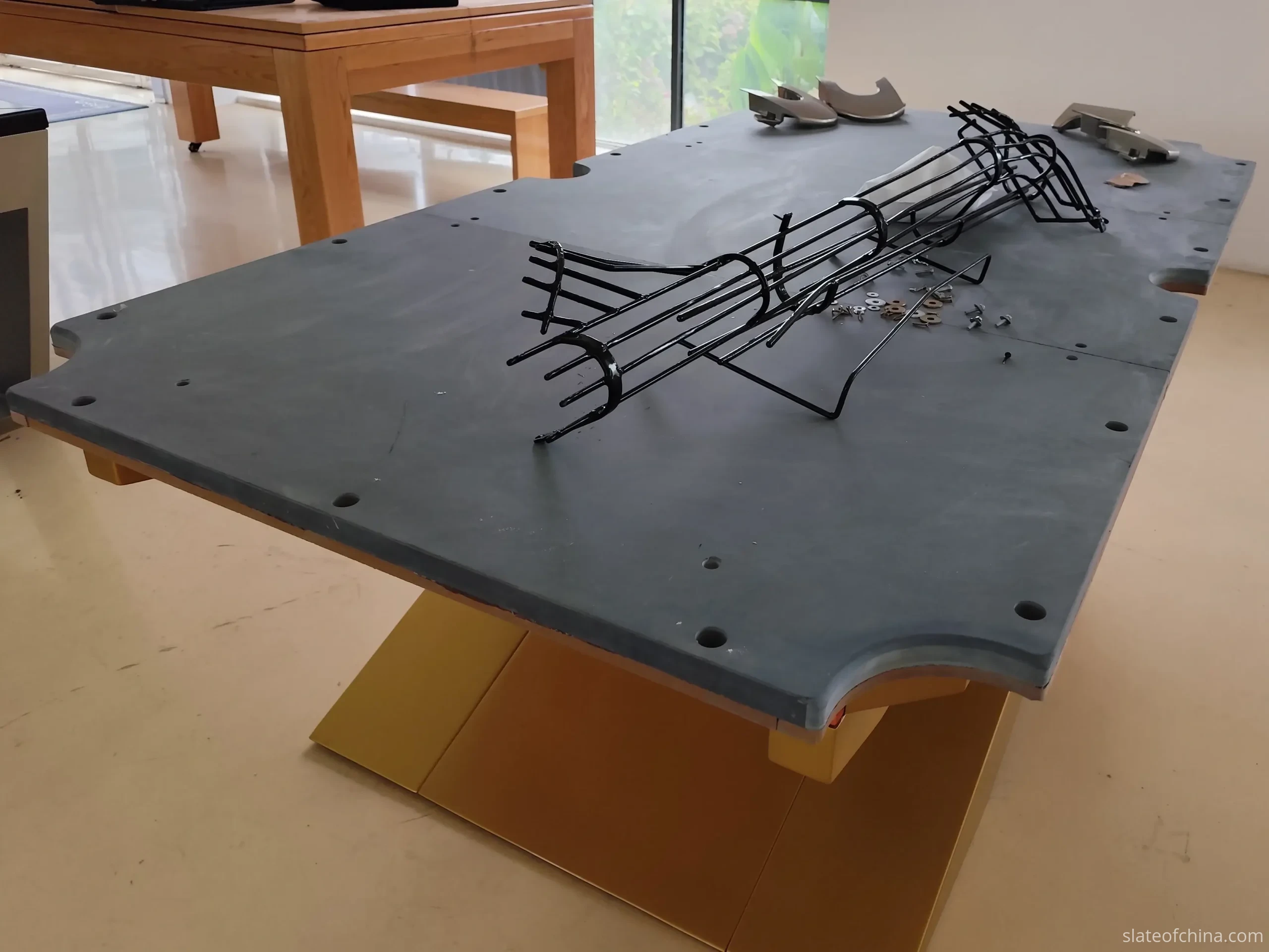
Bounce Consistency: The Foundation Under the Cushion
Does thicker slate give you better rebound? It can contribute to more consistent bounce — but this needs to be said carefully, because the claim gets oversold.
The rebound of a billiard ball is affected by many variables: cushion rubber compound, cushion profile, cushion mounting, ball condition, cloth, table geometry, temperature and humidity. Slate thickness is one factor in that chain, and it is not the loudest one. The cushion system is usually much more directly responsible for rebound characteristics than the slate thickness alone.
What a thicker, properly supported slate does is provide a more rigid foundation for the cushion system. When balls repeatedly strike the cushions, the slate underneath absorbs and distributes the load. If the slate flexes, the cushion moves, and the rebound changes slightly from one strike to the next. If the slate holds firm, the cushion does its job the same way every time.
So it would be inaccurate to say "50 mm slate automatically produces better bounce." A better statement: a thicker, properly supported slate can provide a more rigid foundation for a precision cushion system, helping the table maintain consistent rebound geometry over time. Slate thickness influences the foundation of the table; it does not independently determine rebound characteristics. Bounce is a cushion system property first, and a slate thickness property second.
The Support Equation
This is the section I spend the most time on when I talk to table manufacturers, because it is where the "thicker is better" assumption breaks down most clearly.
Imagine two tables. Table A has 25 mm slate, a rigid frame, adequately spaced cross-supports, a properly designed leveling system and correctly installed joints. Table B has 50 mm slate, a weak frame, inadequate support spacing, poor leveling and joints installed without alignment. The second table does not automatically play better because its slate is twice as thick. In my experience, it usually plays worse.
Slate must be supported correctly. For thinner slate, support design becomes more critical, not less — the structure has less resistance to bending between support points, so the supports have to pick up more of the load. A 25 mm slate with closely spaced beams and a rigid frame can hold a playing surface flatter than a 50 mm slate on a frame that flexes under its own weight.
When a table manufacturer specifies "25 mm slate," that is the beginning of a specification, not the end. The complete spec should include the slate dimensions, the support arrangement, the frame construction, the number of pieces, the leveling method and the joint configuration. Without those, "25 mm" is a number on a page — it tells you nothing about how the table will play. The technical specifications reference collects those numbers in one place.
A useful way to think about billiard slate
Slate thickness + support spacing + frame rigidity + leveling system = playing-surface stability
Increasing thickness can increase rigidity, but reducing unsupported span or improving the support structure can also have a major effect on slate behaviour. Thickness is one variable in a structural equation, not a standalone answer.
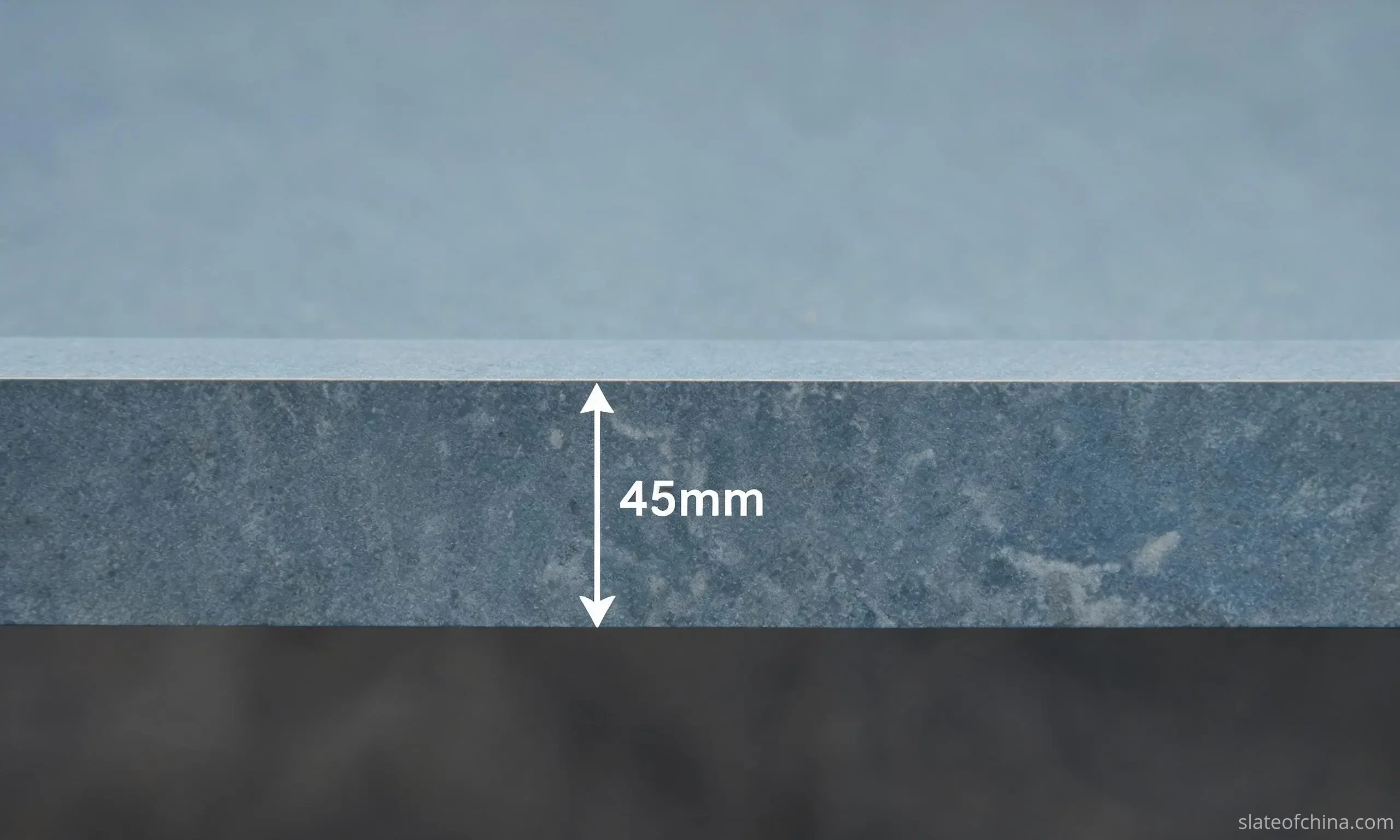
The Hidden Cost of Going Thicker
Slate density is relatively consistent — about 2.7 tonnes per cubic metre. If you keep the length and width the same and double the thickness, you approximately double the weight. The math is simple. The logistics are not.
A 9 ft pool table at 25 mm carries roughly 250–270 kg of slate. The same table at 50 mm approaches 500 kg. A 12 ft snooker table at 45 mm carries close to 800 kg across five pieces; at 50 mm, that number rises by about ten percent. Every additional kilogram shows up somewhere — in the frame, in the floor, in the handling, in the freight.
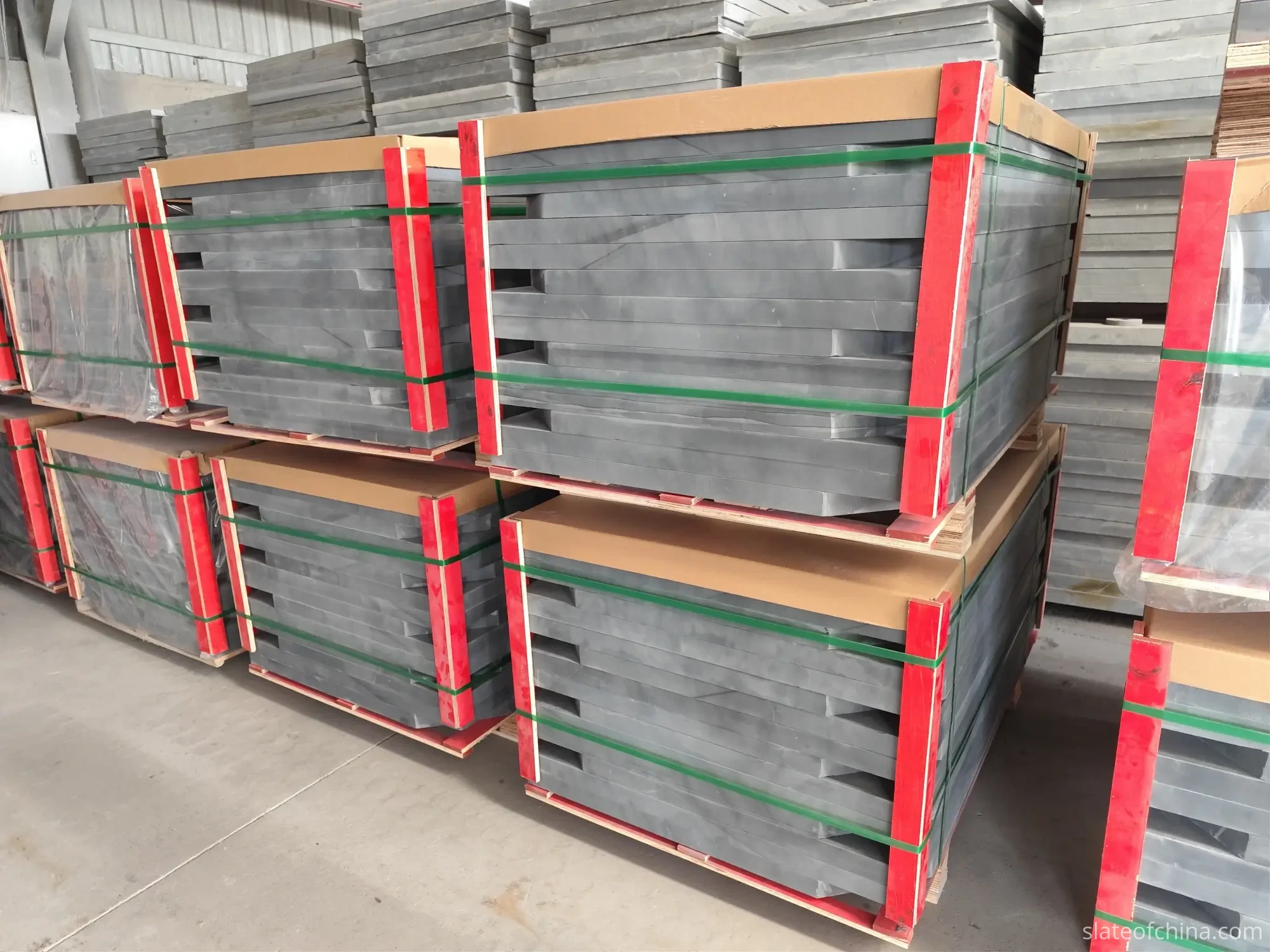
For manufacturers, thicker slate means heavier panels that need more workers or lifting equipment during installation, stronger frames to carry the weight, higher freight costs because the container fills by weight before it fills by volume, and more demanding installation procedures. A container of billiard slate fills by weight long before it fills by space — and thicker slate fills it faster. For the full sourcing implications, the buying guide walks through the logistics chain.
Maximum thickness is not the same as optimal specification. The objective is to use enough thickness for the intended table design and performance level — no more, no less.
Three Things Buyers Confuse: Thickness, Flatness and Leveling
These three terms come up in almost every specification discussion, and they are often used as if they mean the same thing. They do not.
Thickness is the section dimension — how deep the slate is from the playing surface to the underside. It is a manufacturing specification.
Flatness is the geometry of the playing surface — how much it deviates from a true plane. It is measured with straightedges, dial indicators or laser equipment, and it is controlled by surface grinding and inspection. How we measure it is documented on the quality and test data page.
Leveling is the installation adjustment — using shims, leveling screws and frame adjustment to make the playing surface level in the room. It is a field procedure, performed during installation.
A thick slate can be installed unlevel. A thin slate can be perfectly flat and level. A perfectly flat slate can develop a dip if the frame settles. These three properties are related — they all contribute to the final playing surface — but they are not interchangeable. When you source slate, ask for all three, not just the first.
A professional specification should address: slate thickness (for example, "45 mm, within agreed tolerance" rather than simply "45 mm"); slate dimensions (length and width matching the table design); flatness tolerance (with a stated measurement method); thickness tolerance (particularly important for precision machining); surface condition (checking for cracks, unacceptable laminations, edge damage, machining defects); and machining features (pocket openings, cushion cuts, screw holes, edge machining, joint configuration). For the full parameter list, see the selection guide.
What to Put on Your RFQ
If you are an importer, table manufacturer or distributor, the worst RFQ you can send is: "Please quote billiard slate 25 mm." That tells the supplier almost nothing useful. A better request includes:
- Table type — pool, snooker, carom, Chinese 8-ball, Russian pyramid
- Playing area — length × width
- Slate size — overall dimensions of each piece
- Thickness — 25 / 38 / 45 / 50 mm, or per drawing
- Number of pieces — 1, 3, 5, etc.
- Machining — pocket openings, cushion cuts, holes, edge machining
- Flatness requirement — as specified by the table design
- Thickness tolerance — as specified
- Packing — export packing requirements
- Quantity — sets per order or per container
If you have a technical drawing, send it with the RFQ. For a slate manufacturer, the drawing is more useful than any general description. "Standard 9 ft pool slate" means different things to different factories. A drawing with dimensions, thickness, piece count, hole positions and pocket geometry means the same thing everywhere. More answers to common sourcing questions are on the FAQ page.
Thicker slate increases rigidity, but table performance comes from the entire playing-surface system — not thickness alone.
Frequently Asked Questions
Is 25 mm slate thick enough for a pool table?
It can be. Many pool-table designs use approximately 25 mm slate, provided the slate is properly supported and the frame is designed for it. The question is whether the thickness matches the table's structural design, not whether 25 mm is "enough" in isolation.
Does thicker slate make billiard balls roll faster?
Not directly. Slate thickness mainly contributes to structural rigidity and surface stability. Ball speed depends more on cloth, humidity, ball condition, table geometry and leveling. What thicker slate does is help the surface stay flat under load — which keeps ball paths predictable, not faster.
Does thicker slate improve cushion rebound?
It can provide a more rigid foundation for the cushion system, which helps maintain consistent rebound geometry over time. But rebound characteristics depend primarily on cushion rubber, profile, installation and table geometry. "50 mm slate automatically produces better bounce" is not an accurate claim.
Why is 50 mm slate so heavy?
Slate density is about 2.7 tonnes per cubic metre. If the length and width stay the same, doubling the thickness approximately doubles the volume and therefore the weight. A 9 ft set at 25 mm weighs roughly 250–270 kg; the same table at 50 mm approaches 500 kg. This has a significant effect on freight, handling and frame requirements.
Should I choose the thickest billiard slate available?
Not necessarily. The correct thickness is the one engineered for the table. Excess thickness adds weight, cost, handling difficulty and frame demand without a proportional performance benefit. The objective is enough thickness for the intended design and performance level — not maximum thickness.
What thickness is common for a 12 ft snooker table?
Around 45 mm is commonly encountered in full-size snooker slate specifications, with 50 mm also produced for certain designs. The exact requirement should come from the table manufacturer's engineering specification, not from a generic "thicker is better" rule.
Related Reading
Send us your table drawing and thickness specification
Tell us your table type, finished slate dimensions, thickness, piece count, machining requirements and destination port. We will review the specification and confirm whether the thickness is matched to your table design — before production begins.