
Russian Pyramid Table Slate: Why You Can't Just Scale Up a Pool Table Slab
Russian Pyramid tables are unusually large billiard tables, with full-size playing areas commonly around 12 ft × 6 ft, and their slate requirements shift in ways that a simple dimensional scale-up will never capture. Thickness, piece count, pocket machining, joint alignment and shipping weight all change at this scale. This guide walks through what table manufacturers, importers and OEM buyers need to specify before anyone cuts stone — and why a "12 ft Russian Pyramid slate" inquiry is not enough information to start production.
| Specification | Russian Pyramid Slate |
|---|---|
| Full-size playing area | Approx. 12 ft × 6 ft |
| Slate thickness | Table-design dependent |
| Slate construction | Multi-piece |
| Pockets | 6 |
| Pocket layout | 4 corner + 2 side |
| Machining | CNC recommended |
| Final dimensions | Based on OEM/table drawing |
The 12 ft × 6 ft dimension refers to the playing area, not necessarily the finished outside dimensions of the slate. This distinction matters more on a Russian Pyramid table than on any other billiard table we supply, because the stone is so large that a small misunderstanding becomes an expensive one.
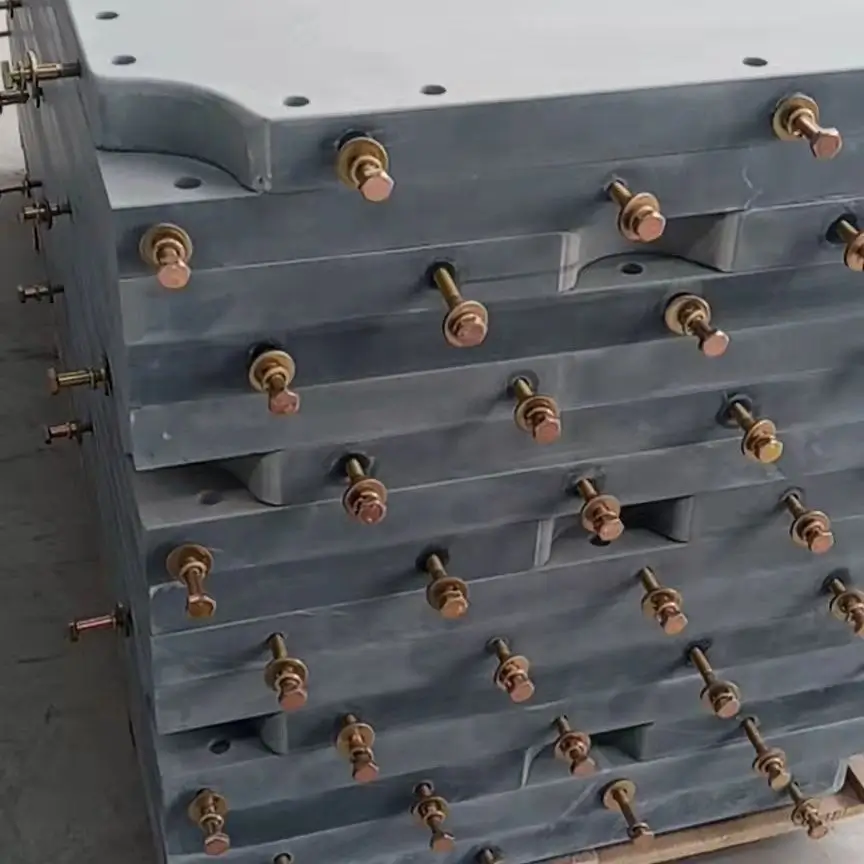
What Makes Russian Pyramid Different
I have been machining billiard slate for over a decade, and Russian Pyramid orders still get my attention. Not because the stone is different — it is the same Jiujiang slate we use for pool tables and snooker tables. What changes is everything the stone has to become.
Russian Pyramid, also called Russian billiards, is a cue sport played on a very large table with balls noticeably bigger than standard pool balls and pockets that are tight relative to those balls. That combination — large playing surface, heavy balls, demanding pocket geometry — is what makes the slate specification a separate engineering problem, not a bigger version of a pool-table spec.
Compared with a conventional pool table, a Russian Pyramid table typically has a larger playing surface, larger and heavier balls, smaller and tighter pockets relative to the ball diameter, a substantially thicker slate bed, and very high requirements for playing-surface flatness. You can see how these differences stack up across table types in our guide to the types of billiard slate.
Playing Area ≠ Slate Size: The First Mistake
In practice, the first problem in a Russian Pyramid slate inquiry is usually the size. A buyer sends a message asking for "12 ft × 6 ft Russian Pyramid slate," and expects a quote. The problem is that 12 ft × 6 ft is the playing area — the surface the balls roll on — not the slate outline.
The slate itself extends beyond the playing area to accommodate cushions, pocket cut-outs, mounting structure and the table frame. So the actual stone dimensions are larger, sometimes significantly, and they depend on the specific table design. You cannot arrive at the slate dimensions by converting 12 ft × 6 ft into millimetres and adding a margin. The final slate drawing has to come from the table manufacturer or OEM.
Before slate production can begin, a manufacturer should normally provide the following:
| Specification | Why It Matters |
|---|---|
| Playing-area dimensions | Defines the actual surface the balls use |
| Overall slate dimensions | Determines raw-stone block requirements |
| Number of slate pieces | Determines joints, assembly and shipping |
| Slate thickness | Affects weight, rigidity and frame design |
| Pocket positions and dimensions | Required for CNC machining — cannot be guessed |
| Corner and side-pocket geometry | Must match the cushion and pocket system |
| Cushion mounting dimensions | Important for table-frame compatibility |
| Mounting-hole positions | Determines how the slate fixes to the frame |
Four separate measurements get confused in this conversation, and each one means something different:
| Dimension | Meaning |
|---|---|
| Playing area | The actual ball-playing surface |
| Cushion-to-cushion dimension | The playing-area reference used for table sizing |
| Slate outline | The finished physical stone dimensions |
| Overall table size | Includes frame, rails and cabinet |
You should never order a Russian Pyramid slate from "12 ft × 6 ft" alone. A specification such as this tells a supplier almost nothing they can cut stone to. The drawing tells them everything.
How Thick Should Russian Pyramid Slate Be?
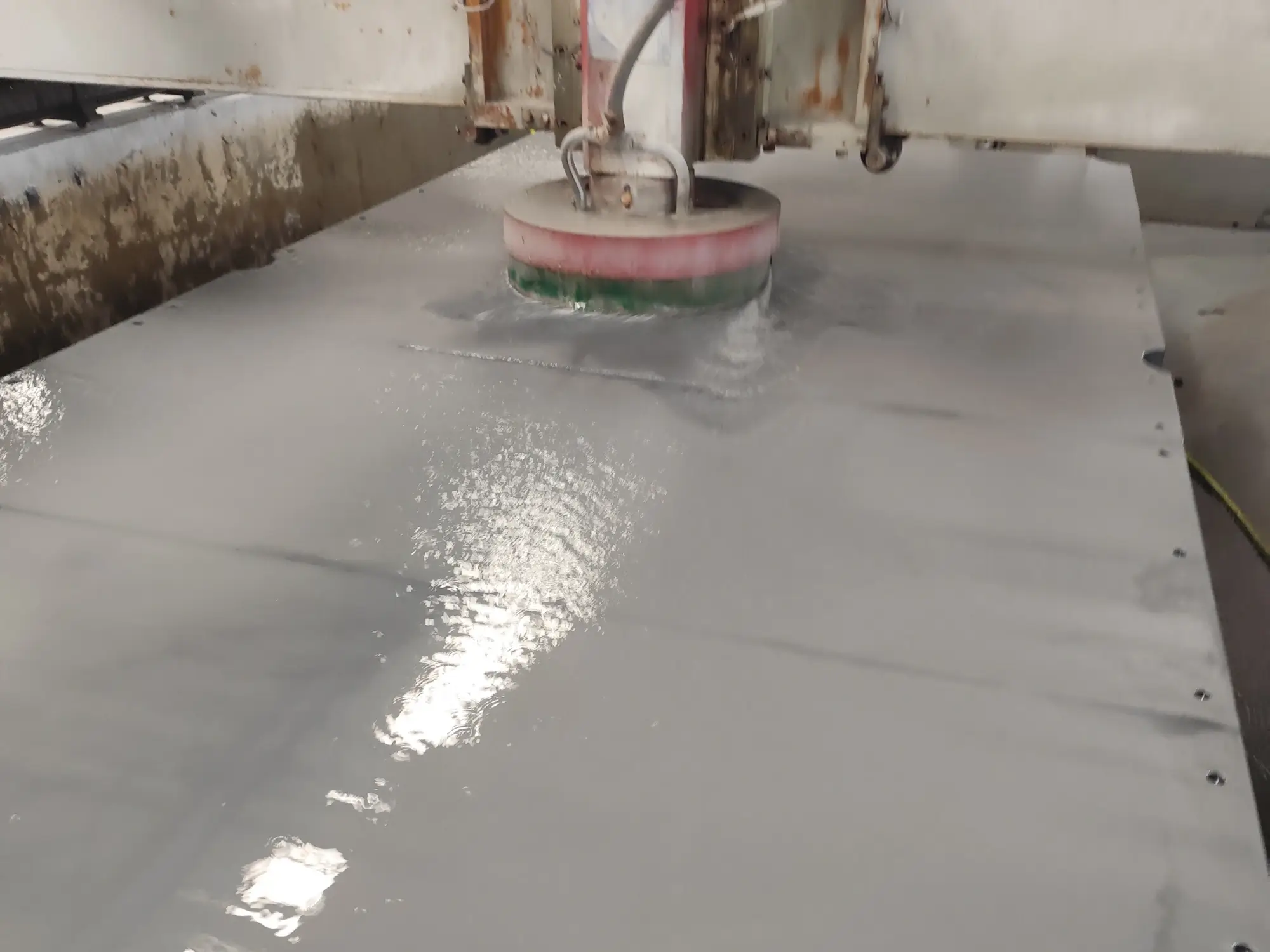
People ask me for a thickness number, and I have to push back. There is no single universal thickness that fits every Russian Pyramid table, and giving one would be irresponsible.
Russian Pyramid slate thickness is a table-design specification, not a universal Russian Pyramid standard. Treat any supplier that quotes a single "standard thickness" for Russian Pyramid tables with caution — the number has to come from the table frame's engineering design, not from a generic spec sheet.
What I can say is that Russian Pyramid tables, because of their large playing surface, generally need a thicker slate bed than a standard pool table. The slate has to resist bending under its own weight, survive transport and installation, and stay flat once assembled. But the correct thickness depends on the table size, the number of slate sections, the slate material density, the support structure underneath, the span between supports, the frame design, the target table weight and the manufacturer's engineering requirements.
What I can also say is that thickness consistency matters more than the nominal thickness itself. In a multi-piece set, if one piece is 45 mm and the next is 43 mm, you will feel that 2 mm step through the cloth. Our process controls thickness through raw slab selection, cutting, calibration, surface grinding and a final dimensional check on every piece — not a batch sample, but 100% individual inspection. The goal is not just a thick piece of stone. It is a matched set where every piece is the same thickness to within a tight tolerance.
So when a buyer specifies "thick slate," the right response is to ask for the drawing instead. The drawing already contains the thickness the table was engineered for.
Multi-Piece Construction: Why Joints Decide Everything
You cannot ship a single piece of slate the size of a Russian Pyramid table. Even if you could quarry it, cut it and grind it, you could not get it through a doorway, into a container or onto a fork lift without unacceptable risk. So large billiard tables use multi-piece slate construction — commonly three pieces, sometimes four or more, depending on the table manufacturer.
For a slate supplier, the number of pieces is not the only question. The real question is how those pieces join. A billiard table does not become accurate just because each individual piece is flat. When you assemble three or four pieces into one playing surface, the joints between them have to align to the same flatness standard as the rest of the surface. A poorly matched joint can create a small ridge or low spot that affects slow ball roll and becomes noticeable after the cloth is installed.
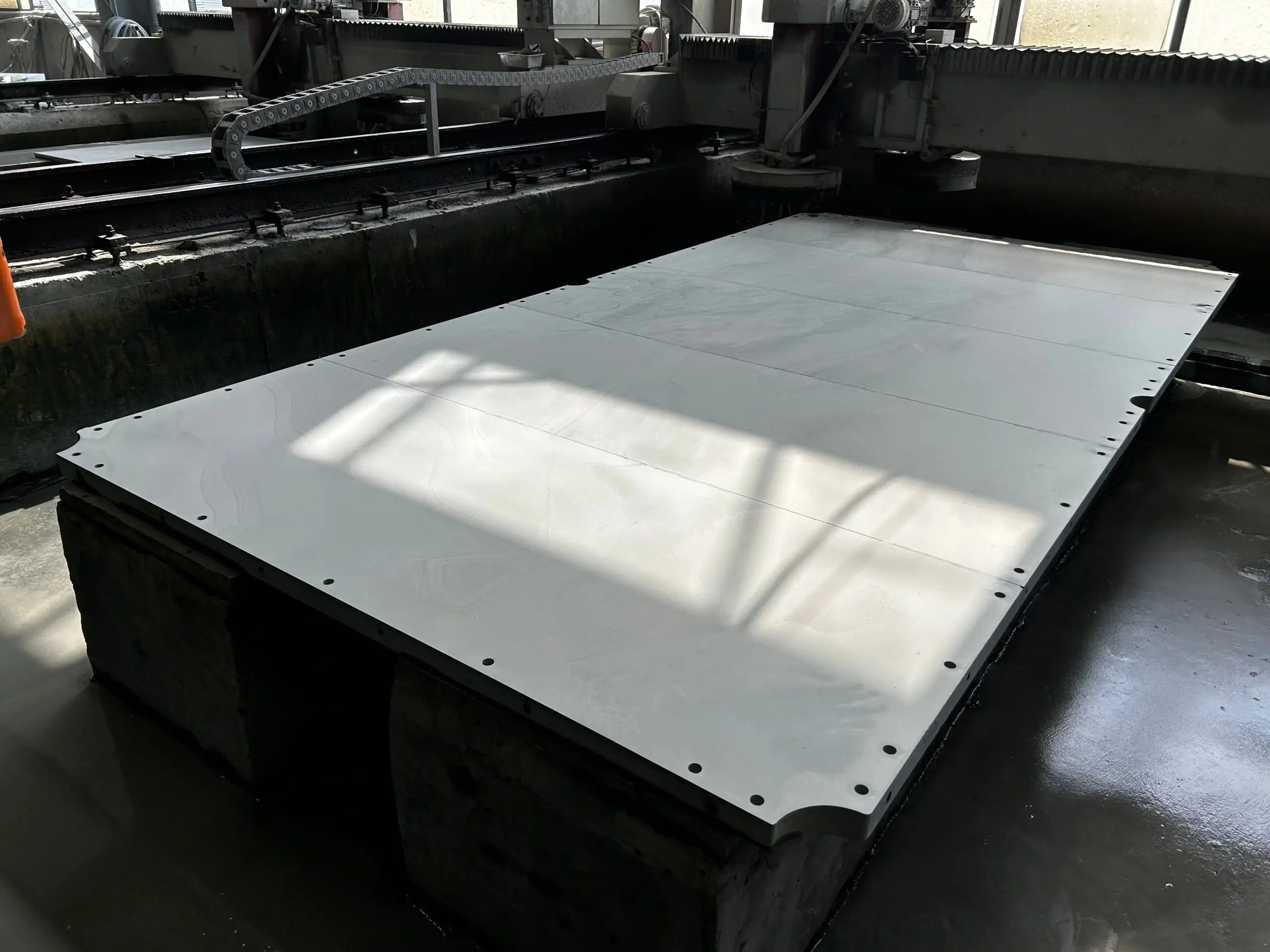
Poor joint matching can produce a visible ridge, a low spot, a change in ball roll at the seam, difficulty during cloth installation and uneven cushion response near the joint. This is why professional billiard-slate production includes matched-set inspection — checking the pieces together as a set, not only individually. We grind the joint edges on the same CNC setup, then place the set on a flat reference table and check the seam with a straightedge and feeler gauge before the set is approved for packing.
The supplier should confirm individual piece dimensions, joint locations, joint-edge straightness, thickness consistency, surface flatness, reference points and screw or fixing locations. All of these come from the table drawing, not from a general Russian Pyramid specification.
Pocket Layout: The Hardest Machining Job in Billiard Slate
If there is one part of a Russian Pyramid slate order where mistakes are most expensive, it is the pocket layout. Russian Pyramid is played with large balls on a table with comparatively tight pockets. The gap between the ball and the pocket opening is measured in millimetres, not centimetres. That makes the pocket geometry critical to the game, and it makes the slate machining critical to the pocket geometry.
A standard Russian Pyramid table has 6 pockets: four corner and two side. The count is easy. Everything else about the pockets is not.
The key point to understand is that the pocket centre position is not the pocket opening. A production drawing has to define both — pocket centre coordinates and opening dimensions — plus the pocket shape, cushion nose position, facing geometry and the slate edge dimensions around each pocket. Change any one of these and the effective pocket size changes with it.
- Pocket centre coordinates
- Opening dimensions
- Pocket shape (corner vs. side)
- Cushion nose position
- Facing geometry
- Slate edge geometry around each pocket
The effective playing pocket is determined by the relationship between these components, not by the slate opening alone.
The pocket cannot be treated as a simple circular hole drilled into the stone. The complete pocket system involves the slate opening, the cushion geometry, the pocket liner, the pocket facing and the playing-surface dimensions. A slate supplier who independently adjusts pocket dimensions based on a general "Russian Pyramid" spec, without the OEM drawing, is guessing at something that cannot be guessed.
Do not machine the pocket openings from the nominal table size alone. Use the manufacturer's CAD drawing or an approved template. Small dimensional differences — a millimetre or two in the wrong direction — can significantly affect how balls enter the pockets. The safest approach is to manufacture the slate according to the OEM table drawing or an approved sample.
CNC Machining: Why It Matters at This Scale
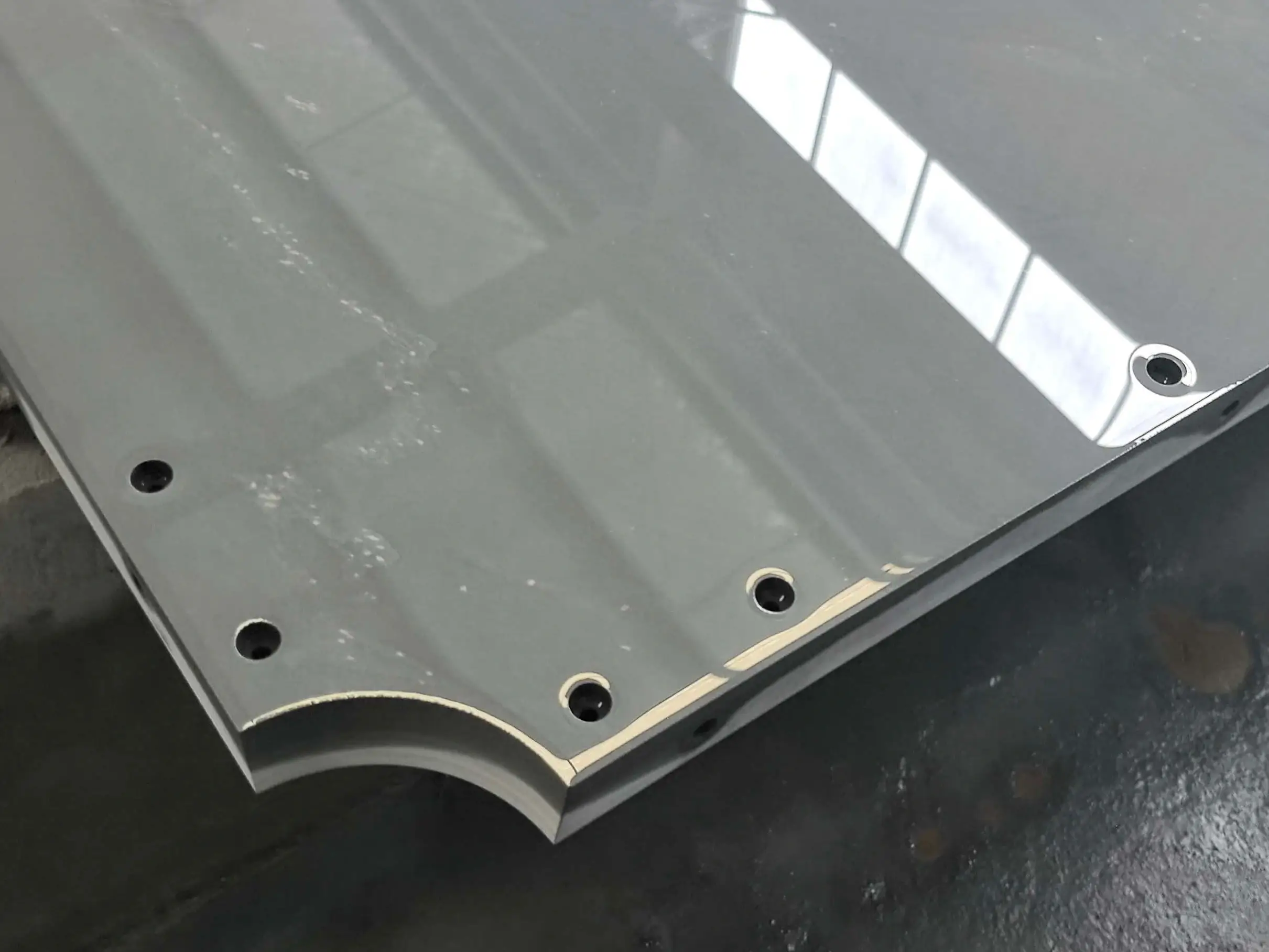
At Russian Pyramid scale, CNC machining provides a highly reliable way to control pocket positions, mounting holes, edge geometry and dimensional repeatability for OEM production.
Once the correct CAD drawing has been confirmed, the same machining programme can be used to maintain consistency between production batches. This matters enormously for OEM customers ordering multiple slate sets. If a table manufacturer is producing 50 Russian Pyramid tables under their brand, every slate set has to be identical — not similar, but dimensionally interchangeable. For repeated OEM production, CNC provides much better repeatability than manual layout and marking.
We recommend confirming a technical drawing before cutting the final material. The drawing should include overall dimensions, playing-area dimensions, slate thickness, piece layout, pocket coordinates, pocket dimensions, edge dimensions, mounting holes and required tolerances. This prevents what is arguably the most expensive mistake in custom billiard-slate production: machining the correct stone to the wrong table specification.
What Kind of Slate Actually Works for Russian Pyramid?
Not every slate is suitable for billiard-table production, and Russian Pyramid tables are especially demanding because of their size. Billiard slate needs a combination of properties: flatness that holds after installation, consistent thickness across the set, dimensional integrity for large pieces, machinability for accurate cutting and CNC work, a surface that takes a fine ground finish, and consistent density across the set.
For OEM production, dimensional repeatability can be as important as the properties of a single set. A factory may need dozens or hundreds of slate sets with the same dimensions and machining pattern, so the supplier has to evaluate the stone as a manufactured precision component, not simply as a natural slab. The specific QC figures — flatness tolerances, thickness consistency, density readings — are on our billiard slate quality and test data page.
Russian Pyramid vs. Pool Table Slate: What Actually Changes
Russian Pyramid slate and pool-table slate share the same raw material and the same basic production principles. But their final specifications can be quite different, and the differences are not just dimensional.
| Feature | Russian Pyramid | Standard Pool |
|---|---|---|
| Table scale | Usually very large | Varies (7–9 ft typical) |
| Playing surface | Large (~12 ft × 6 ft) | Smaller |
| Ball size | Typically ~68 mm | Typically ~57 mm |
| Pocket design | Tight relative to ball | More generous |
| Slate thickness | Design-dependent, often substantial | Design-dependent, typically thinner |
| Slate configuration | Multi-piece (3 or more) | Commonly 3-piece |
| CNC pocket machining | Critical — tight tolerances | Important |
| Flatness requirement | Critical at large span | Critical |
| Joint alignment | Critical — long seams | Important |
| OEM drawing | Strongly recommended | Strongly recommended |
The biggest mistake is assuming that a standard pool-table slate specification can simply be scaled up. The table geometry has to be considered as a complete system — slate, frame, cushions, pockets and cloth — not just as a bigger piece of stone.
Russian Pyramid Slate Weight and Shipping
Large natural slate pieces are heavy, and Russian Pyramid slate is heavier than most. The final weight depends on the dimensions, thickness, density, number of pieces and how much material is removed by machining. But a rough calculation is useful for planning.
The formula is straightforward: Weight = Length × Width × Thickness × Density, with all dimensions in compatible units. For example, a slate set measuring roughly 3.6 m × 1.8 m × 0.045 m with a density of about 2,800 kg/m³ gives a theoretical weight of approximately 816 kg. That is a simplified calculation — the actual finished weight depends on final dimensions, pocket cut-outs and material density — but it is close enough for logistics planning.
For a set of this size, planning starts with the individual pieces, not the total. A buyer needs to think through:
- Individual piece weight — how each piece is handled on site
- Total set weight — floor and truck capacity
- Crate weight — the wooden crate adds to the shipped mass
- Fork-lift and lifting capacity at both ends
- Loading method and container space per piece
Logistics should be considered during the design stage, not after production. A crate that suits a factory fork-lift may not suit the installation conditions at the customer's workshop. We pack billiard slate in reinforced wooden crates — not on pallets — because crates provide better edge protection and allow internal bracing for pieces of this weight. For international OEM orders, discuss packing, lifting points and container loading before finalising the slate dimensions — the full transport sequence is covered in the billiard slate buying guide.
What to Send Your Slate Supplier
If you are a Russian Pyramid table manufacturer looking for a custom slate supplier, the most useful thing you can send is a technical drawing, not a table size. Ideally, provide:
- Playing-area dimensions
- Overall slate dimensions
- Slate thickness
- Number of slate pieces
- Pocket coordinates and opening dimensions
- Pocket shape (corner and side)
- Cushion mounting dimensions
- Mounting-hole positions
- Required tolerances
- Surface-finish requirements
- Packing and shipping requirements
If the table is already in production, an existing slate sample or an approved CAD file is even better. A sample gives the supplier the exact dimensions, pocket geometry and edge details to replicate. A CAD file gives them the programme to run on the CNC. Either one is more useful than a conversation that starts and ends with "12 ft Russian Pyramid."
For OEM and private-label table production, repeatability is the issue. A factory may need dozens or hundreds of slate sets with the same dimensions and machining pattern. The supplier should be able to maintain a controlled production process from raw slate through cutting, calibration, surface grinding, CNC machining, inspection, matched-set verification and packing — so that every production batch remains compatible with the same table design. That is particularly important for manufacturers selling Russian Pyramid tables under their own brands.
Frequently Asked Questions
What size is a Russian Pyramid table?
A full-size Russian Pyramid table is commonly associated with a playing area of approximately 12 ft × 6 ft, although actual dimensions vary by manufacturer and table model. The slate itself is larger than the playing area.
How thick is Russian Pyramid slate?
There is no single universal thickness. Slate thickness should be determined by the table manufacturer's engineering design, the slate-piece configuration and the support structure. Russian Pyramid tables generally use a thicker slate bed than standard pool tables, but the exact figure must come from the table drawing.
How many pieces of slate does a Russian Pyramid table use?
Large Russian Pyramid tables generally use multiple slate sections — commonly three, sometimes four or more — because a single piece of that size cannot be practically transported or installed. The exact number depends on the table manufacturer's design.
Are Russian Pyramid pockets smaller than pool-table pockets?
Russian Pyramid tables are known for relatively tight pockets relative to the ball size. The exact opening should be confirmed from the table manufacturer's specifications, because pocket geometry involves both the slate opening and the cushion construction — not just the hole in the stone.
Can standard pool-table slate be used for a Russian Pyramid table?
Not necessarily. The slate thickness, dimensions, pocket machining, piece configuration and mounting details may all be different. Custom production according to the OEM table drawing is normally the safer approach than trying to adapt a pool-table specification.
How heavy is a Russian Pyramid slate set?
The weight depends on the dimensions, thickness, density and piece configuration of the slate. A full set can weigh several hundred kilograms, depending on its exact specification — so handling, export packing and container loading must be planned carefully during the design stage.
Need a Custom Russian Pyramid Slate Specification?
Send us your table drawing, slate dimensions or an existing slate sample. We can review the required size, thickness, pocket layout, CNC machining and multi-piece configuration for production — and ship to 30+ countries in reinforced wooden crates.
Contact us with your Russian Pyramid table spec → | View billiard slate products