
Why Billiard Table Builders Source from Jiujiang
Before a billiard table manufacturer places a first order, the conversation rarely starts with price. It starts with three questions that sound like this:
“Can you repeat this drawing next year — same dimensions, same machining positions, same batch behaviour?”
“What is your thickness tolerance across a full container, not on your best sample?”
“How do you match a three-piece set so the pieces behave as one surface?”
We have supplied billiard slate from Jiujiang to table manufacturers for years, and those three questions explain the article better than any marketing sentence could. A table builder is not shopping for stone. A table builder is qualifying a component that has to fit a cabinet, accept a cloth, hold a tolerance, and then do it all again in the next order.
This guide walks through what the trade actually evaluates — and why an established slate region in Jiangxi Province has become a sourcing base for manufacturers who think in drawings, tolerances and repeat orders rather than in quarry prices.
Quick Answer: Billiard table builders source from Jiujiang because the region can supply slate as a repeatable precision component, not just as stone: suitable natural rock, processing that holds thickness and flatness, CNC machining from the buyer’s own drawings, matched multi-piece sets, inspection discipline, and container-scale export supply that stays consistent between orders.
| What the trade evaluates | Why it decides sourcing | How to verify |
|---|---|---|
| Rock stability | Sets survive machining and handling | Block selection before cutting |
| Thickness control | Panels fit the cabinet design | Tolerance on drawings + inspection |
| CNC capability | Geometry repeats across orders | Same drawing, second order, same result |
| Set matching | Multi-piece tables play as one surface | Seam check on assembled sets |
| Repeat supply | OEM production does not restart from zero | Second container matches the first |
Slate as a Precision Component, Not a Piece of Stone
For most stone products, the buyer judges what arrives. For billiard slate, the buyer judges what arrives and what happens next: how the panel sits in the frame, how the cloth reads across the surface, how the joints line up, how the pockets accept the rubber, and how the next fifty tables compare with the first one.
That is why the production sequence for billiard slate is closer to component manufacturing than to quarrying:
block selection → cutting → thickness calibration → surface grinding → CNC machining → drilling and profiling → inspection → packing → table assembly
A stone that looks excellent at the quarry can still create problems if thickness drifts, if machining produces breakage, or if batches behave differently in production. Experienced table builders therefore evaluate slate as an engineered natural material — and they evaluate suppliers the way manufacturers evaluate any component source.
Stable Rock Is the Entry Requirement
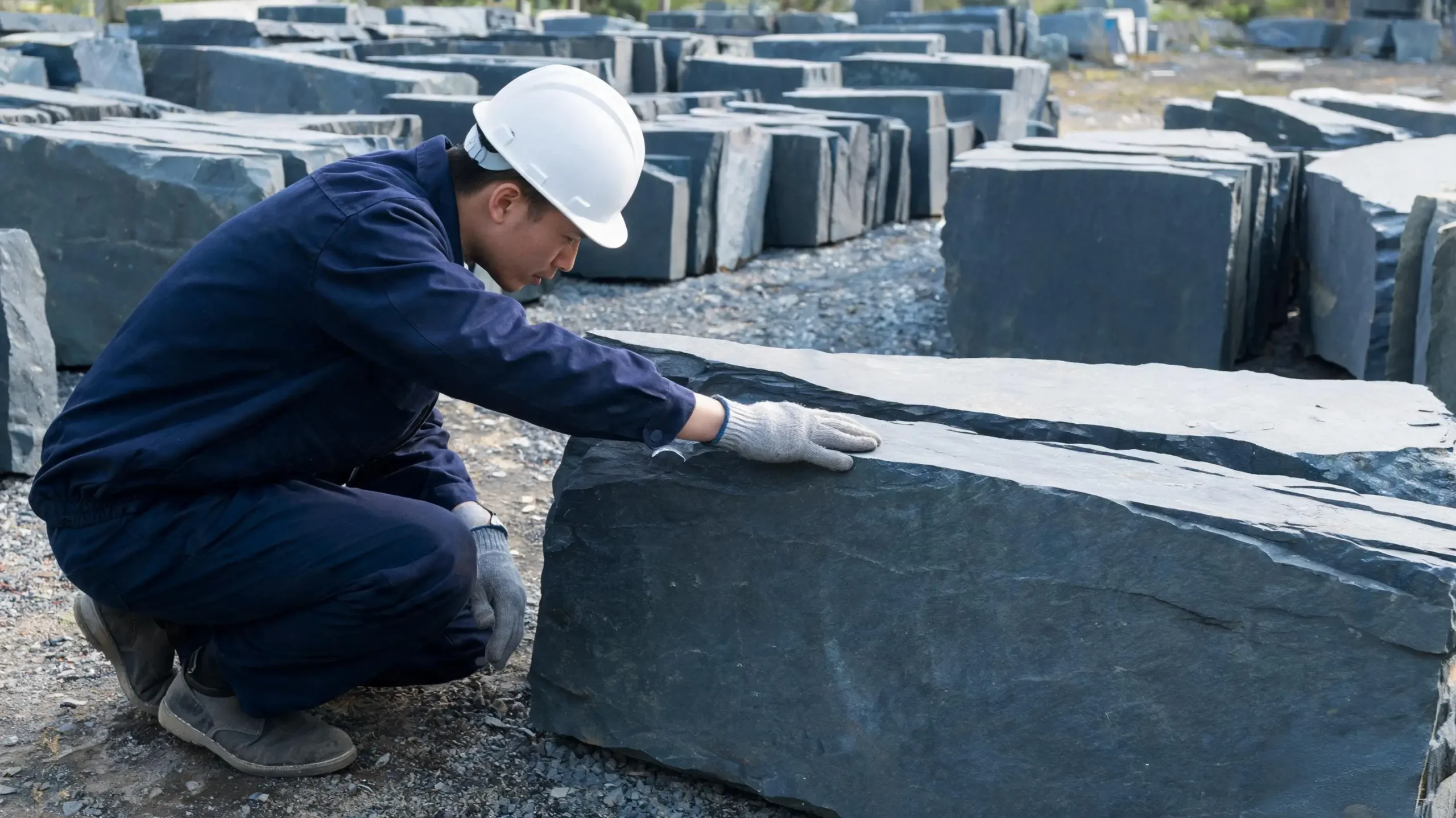
Everything starts with the block. The Lushan–Xingzi formations around Jiujiang yield slate that splits into large, dense pieces — and billiard tables demand size. A 12-foot snooker table typically needs a three-piece set in the region of 3658 × 1867 mm at 45 mm thickness. Pieces that large cannot be swapped cheaply once machining has started, so raw material selection happens before the saw, not after it.
Not every block qualifies. In our yard, only a minority of extracted material — roughly one block in five — passes the selection criteria for billiard-grade use: no hidden cleavage planes, no soft mineral bands, no risk of delamination under the grinding head. The rest moves to less demanding applications. That pre-selection discipline is the first thing a table manufacturer is really buying.
If you want the full journey — how a qualified block becomes a finished panel — see From Quarry to Billiard Slate: The Panel Journey.
Density Consistency and Thickness Control
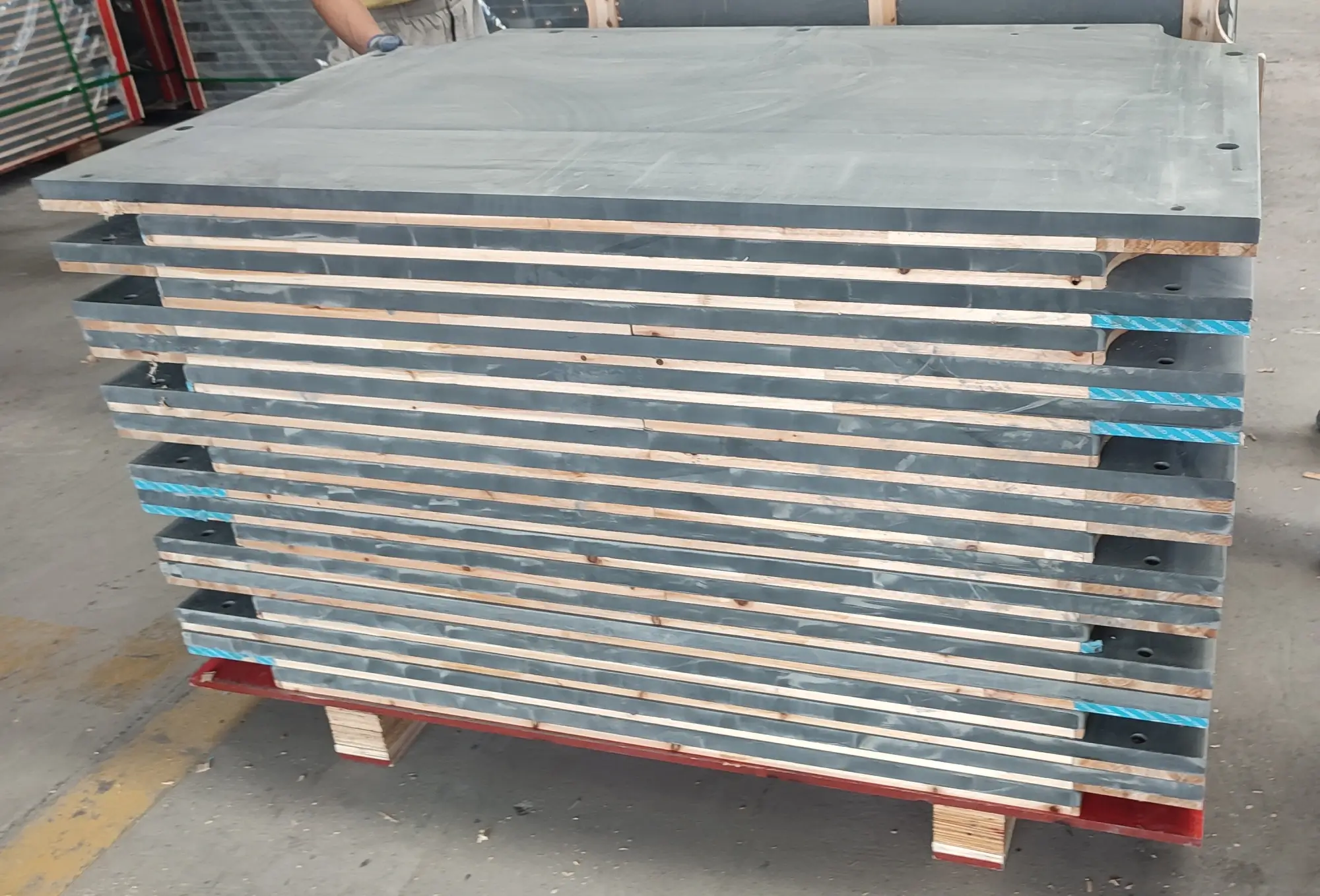
Density is rarely the first line of a billiard quotation, but it is a reliable proxy for what machining will feel like. Our billiard-grade material tests at 2,719–2,819 kg/m³ — dense enough to machine cleanly and to give a table its characteristic solid feel. What matters even more than the number itself is that the density holds within a narrow band between blocks, because consistent density means predictable grinding, drilling and handling behaviour from one batch to the next.
Thickness is where that consistency becomes contractual. Common specifications run from around 19 mm for 7–8 ft pool tables, through 25 mm for 9–10 ft tables, up to 38–50 mm for full-size snooker — with 45 mm being the most requested for 12 ft tables. Those figures vary by manufacturer; what does not vary is the need for the finished panel to hold the specified thickness across the whole surface, not just at the corners.
A few millimetres of uncontrolled variation in a raw slab becomes a real manufacturing problem the moment the panel has to seat into a precisely designed cabinet. Calibration and inspection are therefore not optional extras — they are the difference between a component and a coincidence.
CNC Machining and the Discipline of Tolerance
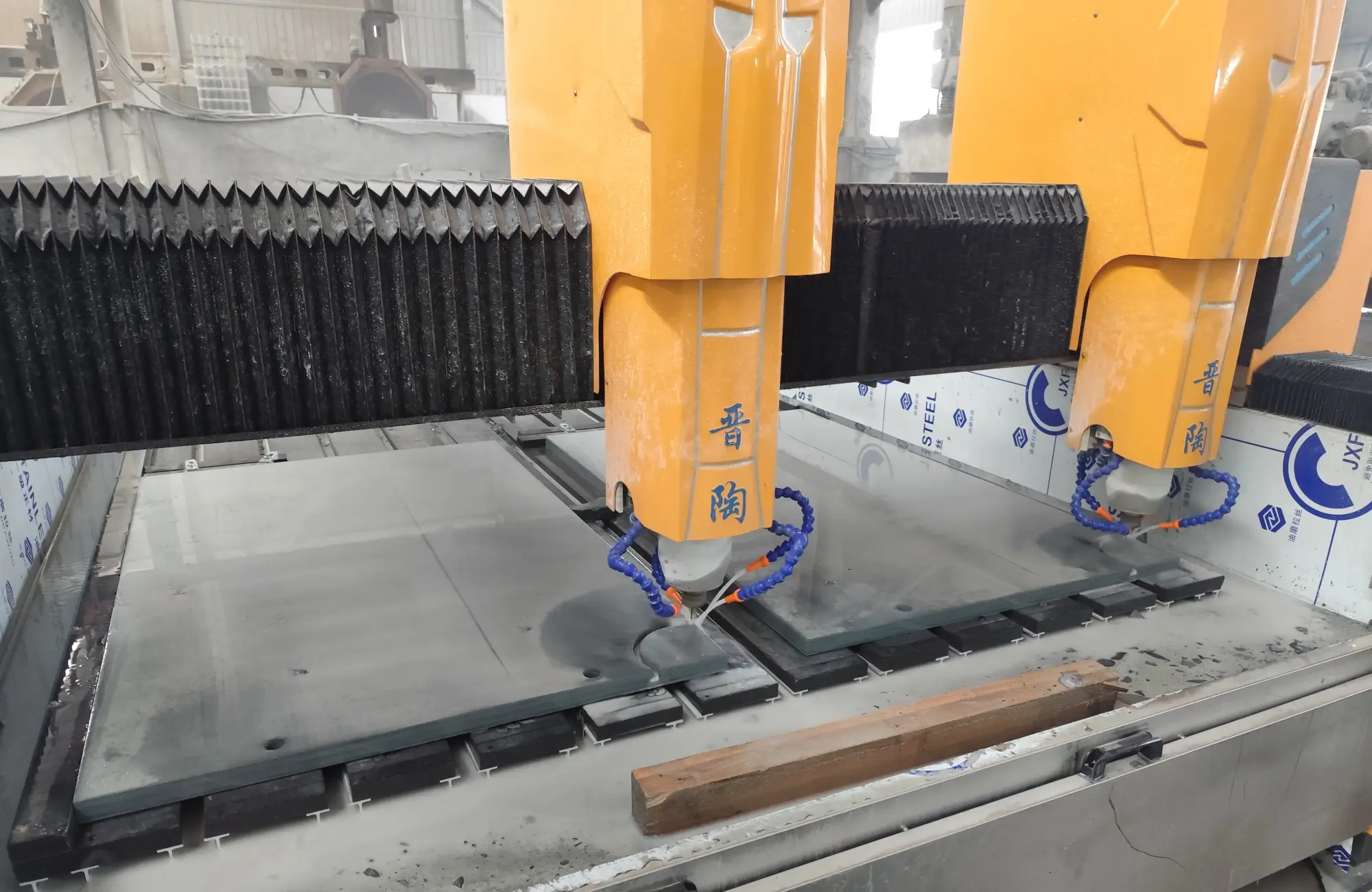
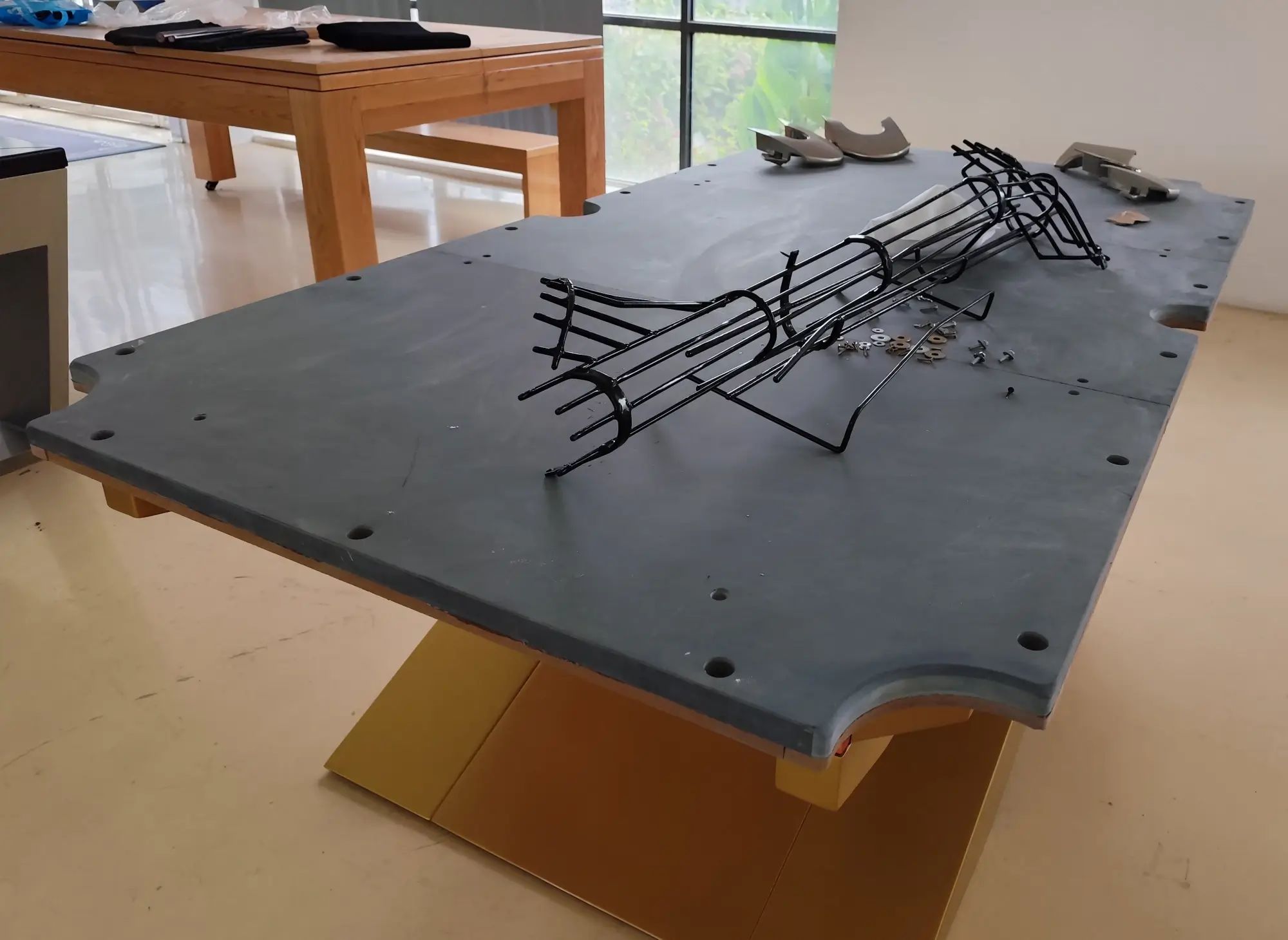
Modern billiard slate is not simply cut into a rectangle. Depending on the table design, a finished panel may need accurate external dimensions, straight machined edges, precise pocket openings, bolt and fixing holes in exact positions, machining around the cushion rails, and prepared centre joints — all repeated across production batches.
This is where CNC capability separates suppliers. Working from digital drawings, the same geometry can be run for order one and order forty-one. Our standard machining holds dimensions to ±0.1 mm; joint faces are finished so that a matched set closes to a gap that a 0.05 mm feeler gauge barely registers. The objective is not one accurate slate. The objective is that the next hundred sets behave like the first approved set.
A supplier who says only “our slate is very accurate” has answered the wrong question. The useful question is: accurate to what specification, checked against what drawing, with what inspection procedure? Professional production works from agreed drawings, agreed tolerances and agreed inspection — the same technical reference on both sides of the order.
Flatness: The Foundation Under the Cloth
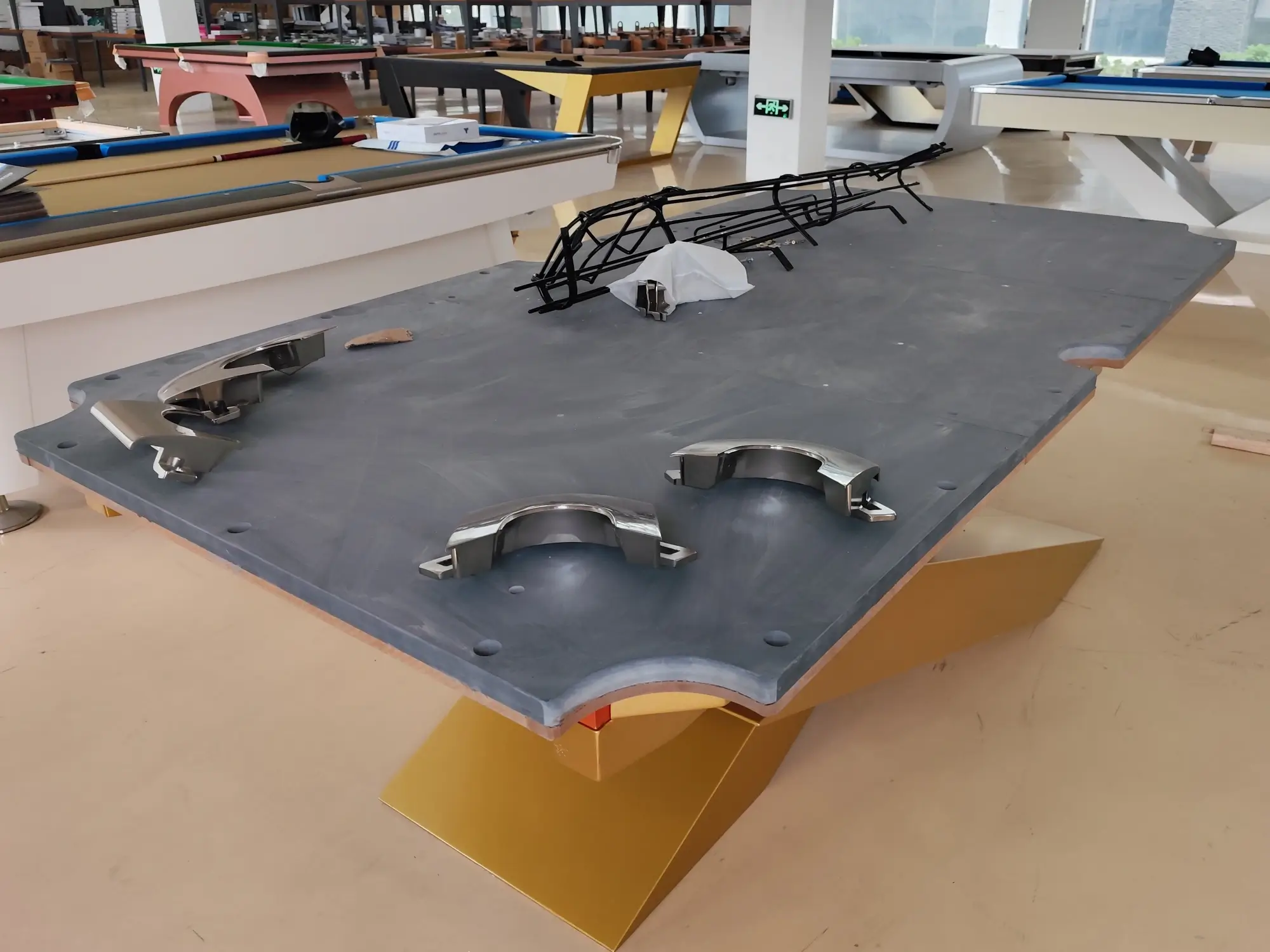
A billiard panel can have an attractive colour and still be unsuitable for a precision table. The surface supports the playing cloth and interacts with the cushion and frame system; unevenness shows up first as levelling work during installation and last as inconsistent ball roll. Appearance, in this product, is almost decorative — flatness is structural.
That is why grinding, calibration and inspection carry so much weight in billiard production. The goal is not to erase every natural characteristic of the stone; it is to control the characteristics that affect assembly and play. Every finished panel in our production passes individual inspection before packing — not a sample from the batch, the panel itself.
Multi-Piece Sets Behave as One Component
Large tables are almost always built on multi-piece slate — three pieces on most full-size tables, five on some designs. This creates a manufacturing requirement that a single-piece product never faces: the pieces must work as a set.
Dimensions, thickness, joint geometry and reference positions all have to correspond. Producing three individually acceptable panels is not the same as producing one matched set. In practice, matched sets are machined and inspected together, so the seam closes as a near-invisible line and the assembled surface reads as one plane under the cloth.
For the manufacturer, that means the supplier must control the complete set — not treat each piece as an independent stone product. For the player, it is the difference between a table that plays true and a table with a story to tell about its centre line.
The Jiujiang Processing Ecosystem
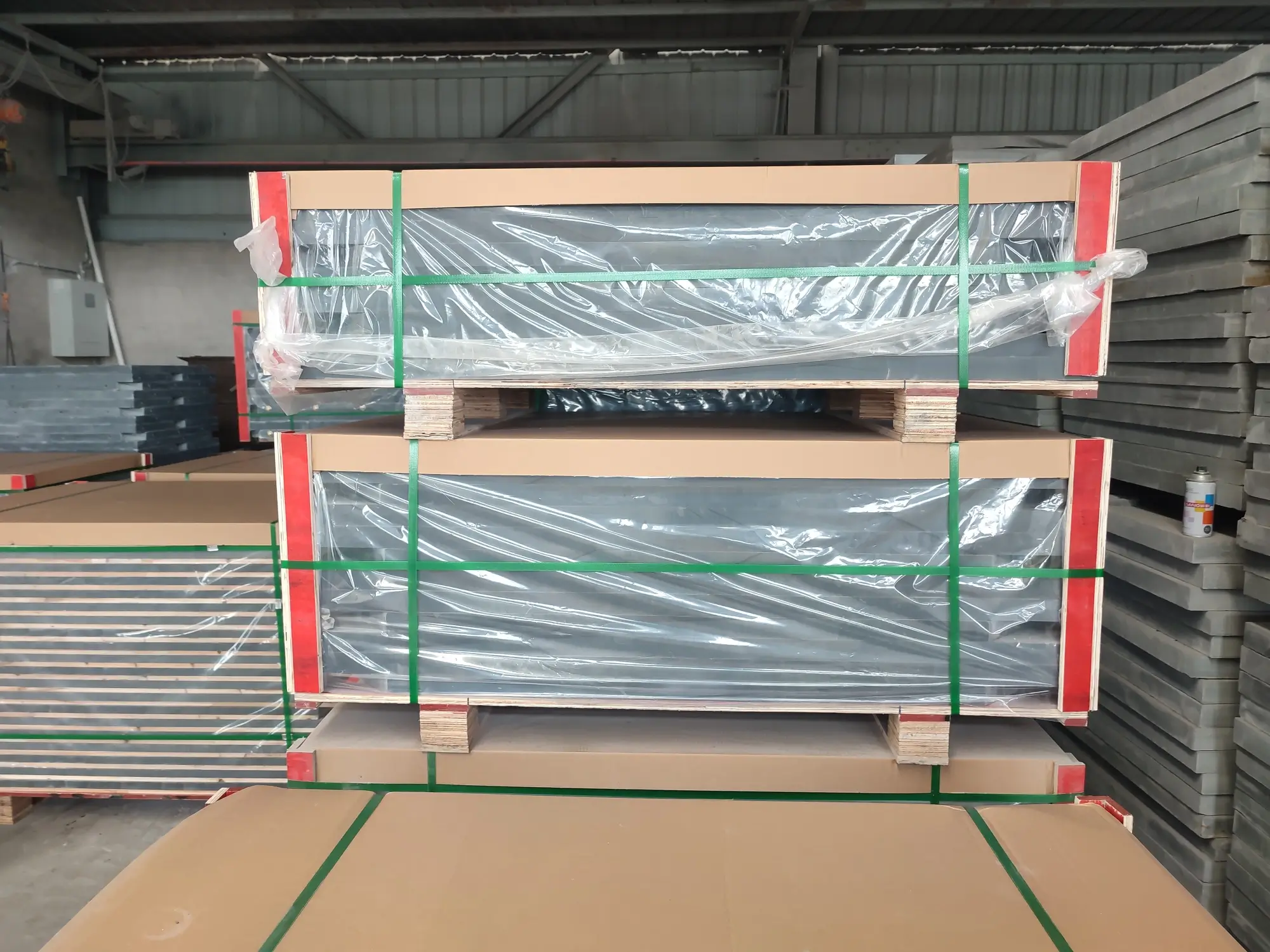
Table builders keep sourcing from Jiujiang for a reason that no single quarry can offer: the region carries the whole chain in one place. Raw block selection, cutting, calibration, grinding, CNC machining, drilling, edge processing, inspection, heavy-stone packing and container loading are all coordinated within one production area — and the factory sits roughly forty minutes from Jiujiang Port on the Yangtze, which connects to Shanghai for ocean transhipment.
For an overseas manufacturer, that concentration simplifies sourcing in a way that a scattered supply chain cannot. When the block selector, the calibration line and the CNC programmer are in the same facility, a drawing change is communicated once, not three times through three companies.
For our own place in that chain — specifications, capabilities and current slate offerings — see Jiujiang Billiard Slate.
Repeat Orders and Supply Stability
A table manufacturer rarely needs one set of slate. A table manufacturer needs a repeatable supply — and this is where the buying logic diverges most sharply from ordinary stone purchasing.
Once a factory has developed a table model around a particular slate specification, changing the material source means re-doing engineering work: re-checking cabinet fits, re-approving drawings, re-training assembly, re-qualifying the whole product. The slate supplier becomes part of the manufacturer’s production system, which is why the questions that matter are not about this order but about the next five:
- Can the same thickness be supplied next year?
- Can the same table drawing be used for future orders?
- Can machining positions be repeated?
- Can replacement sets be produced later for warranty or service stock?
- Will packaging and container loading stay consistent?
Our export record — billiard and roofing slate shipped to more than thirty countries — exists precisely because customers test those questions across years, not across one container. A supplier who cannot answer them is selling stone; a supplier who can is supplying a production line.
The Real OEM Cost Calculation
The cheapest slate is not necessarily the lowest-cost slate. A table factory that accounts for its own time works with a longer formula than price per square metre:
material cost + processing cost + inspection cost + assembly cost + rejection risk + logistics cost
Every line in that formula is affected by consistency. A slate that arrives with drifting thickness, fragile edges or unmatched sets converts its discount into machining breakage, additional levelling work, incorrect hole positions, joint-fitting problems, higher inspection rates, rejected pieces and replacement delays. The original saving quietly disappears — usually into labour hours that never appear on the slate invoice.
This is also why the relationship between an OEM table builder and a slate source is closer to component manufacturing than to stone trading. The buyer’s drawing specifies table size, number of pieces, thickness, overall dimensions, joint configuration, pocket positions, fixing holes, surface requirements, edge treatment, packing and acceptable tolerances. The supplier is not selling slate; the supplier is manufacturing a part that has to fit another company’s product. For a structured walk-through of that OEM process from a buyer’s perspective, see the billiard slate buying guide.
Questions That Qualify a Slate Supplier
Before placing a first production order, a table builder can qualify a supplier with questions across five areas:
- Material — Where does the slate come from? How is raw material selected? What density range can be expected, and how consistent is it between blocks?
- Dimensions — What finished dimensions can be controlled? What thickness tolerance is available? How is flatness measured and inspected?
- Machining — Can the supplier work from CAD drawings? Can pocket and fixing-hole positions be controlled? Can the same machining program be repeated for future orders?
- Production — Are multi-piece sets machined and inspected as matched sets? How are rejected pieces handled? Can replacement pieces be produced later?
- Export — How are heavy slate sets packed? How many sets fit in a container? What protection is used against edge damage? Has the supplier produced for overseas table manufacturers before?
The answers reveal far more about a supplier’s capability than any catalogue photograph. A factory that answers with drawings, tolerance tables and inspection procedures is showing you its production system; a supplier that answers with adjectives is showing you its brochure.
Evaluate by Specification, Not by Region
One caution belongs in every sourcing article, including this one: “Jiujiang slate” is not a quality guarantee by itself. Natural stone varies between quarries, benches and individual blocks, and processing quality varies between factories. The region supplies the ecosystem — the rock, the machinery, the packing chain, the export experience — but the specification is still what you should buy against.
A serious buyer should still request representative samples, technical specifications, dimensional tolerances, flatness data, machining drawings, inspection records where appropriate, and production photographs or video. The supplier’s actual capability matters more than the name of the producing region.
Understood this way, the answer to “why do billiard table builders source from Jiujiang?” is not a slogan. It is a supply base that can be qualified the way manufacturers qualify any component source: against drawings, tolerances, matched sets, inspection discipline and repeatable supply. The strongest sourcing decision is always the one that can be verified — block by block, set by set, container by container.
For manufacturers new to importing slate from China, the logistics side — incoterms, container planning, customs documentation — is covered in the billiard slate import guide.
Frequently Asked Questions
Why do billiard table manufacturers treat slate as a component rather than a material?
Because the slate has to function inside a manufactured product. Its dimensions must fit a cabinet design, its thickness must seat the frame, its flatness determines how the cloth plays, and its machining positions must accept pockets, bolts and cushions. A stone that is judged only as material — by colour or appearance — ignores everything that happens at the table factory. Judged as a component, the same stone is assessed by drawings, tolerances, inspection records and repeatable behaviour across orders.
Can a Jiujiang supplier machine slate from my own table drawings?
Yes — that is the normal working method for OEM orders. The buyer supplies the table drawing and slate specification: table size, number of pieces, thickness, finished dimensions, joint configuration, pocket positions, fixing holes, surface requirements, edge treatment, packing and acceptable tolerances. The supplier machines to that drawing and repeats the same program for future orders. A quotation based on your actual drawing, rather than a generic slate price, is the first sign of a component supplier rather than a stone trader.
How do table builders check consistency between production batches?
Three practical methods. First, retain a sealed reference set from the approved first order and compare subsequent containers against it — dimensions, thickness, colour and machined geometry. Second, review the supplier's inspection records for each batch rather than relying on a single certificate. Third, track a small number of measurable values over time, such as thickness readings at defined points and seam gaps on matched sets. A supplier whose second container matches the first on those values is demonstrating the consistency that OEM production depends on.
What should the first order from a new slate supplier include?
Treat the first order as a qualification run rather than a production run. Include the full technical specification and drawings; request pre-production photos or video of blocks and machining; inspect the first finished set before container loading (in person or through a third-party inspector); retain sealed reference panels from the approved set; and document every tolerance you actually measured. The order should be large enough to reveal batch behaviour but small enough that any surprise is inexpensive.
Should OEM table builders qualify one slate supplier or several?
Most manufacturers work with one primary supplier and keep at least one qualified alternative. Splitting supply across several sources multiplies qualification work — every new supplier means new drawings to approve, new batch behaviour to learn and new packing to verify. A single qualified supplier who holds the specification is usually the more efficient production arrangement. The alternative supplier exists for continuity risk, not for price negotiation — and should be qualified with the same drawings and the same inspection standards as the primary.
What happens if a slate set fails inspection after machining?
It depends on where the failure is caught and what the agreement says. In our production, every finished panel passes individual inspection before packing, and rejected pieces are re-machined or replaced within the batch — a table set ships complete or not at all. For the buyer, the important protection is contractual: the specification should state the tolerance limits, the inspection method and the remedy for rejected pieces, including whether replacements are produced before shipment or from service stock later. A supplier's answer to this question tells you how production actually works, not just how marketing does.
Related Reading
Send your table drawing first
A useful quotation is based on the actual requirements of your table — size, pieces, thickness, machining, tolerances and packing — not on a generic slate price. Tell us what your table needs to play true.