
Jiujiang Slate Density: Why 2.7–2.8 g/cm³ Decides More Than You Think
Quick Answer: Jiujiang slate tests at 2.7–2.8 g/cm³ — as dense as good roofing slate gets anywhere in the world. That single figure drives four things you actually pay for: frost resistance on the roof, weight per square metre on the structure, how many square metres fit in a container, and how flat a billiard bed stays after machining. It is also the one certificate number you can verify yourself, with a kitchen scale, before you send a single dollar.
Pick up a slate tile. A standard 600×300×8 mm roofing slate from our yard weighs about 4 kg — not "light for stone", not "surprisingly heavy", just a solid, honest weight that tells your hands something before any certificate does. That weight is density made physical. Everything else in this article is just that hand-feel translated into numbers.
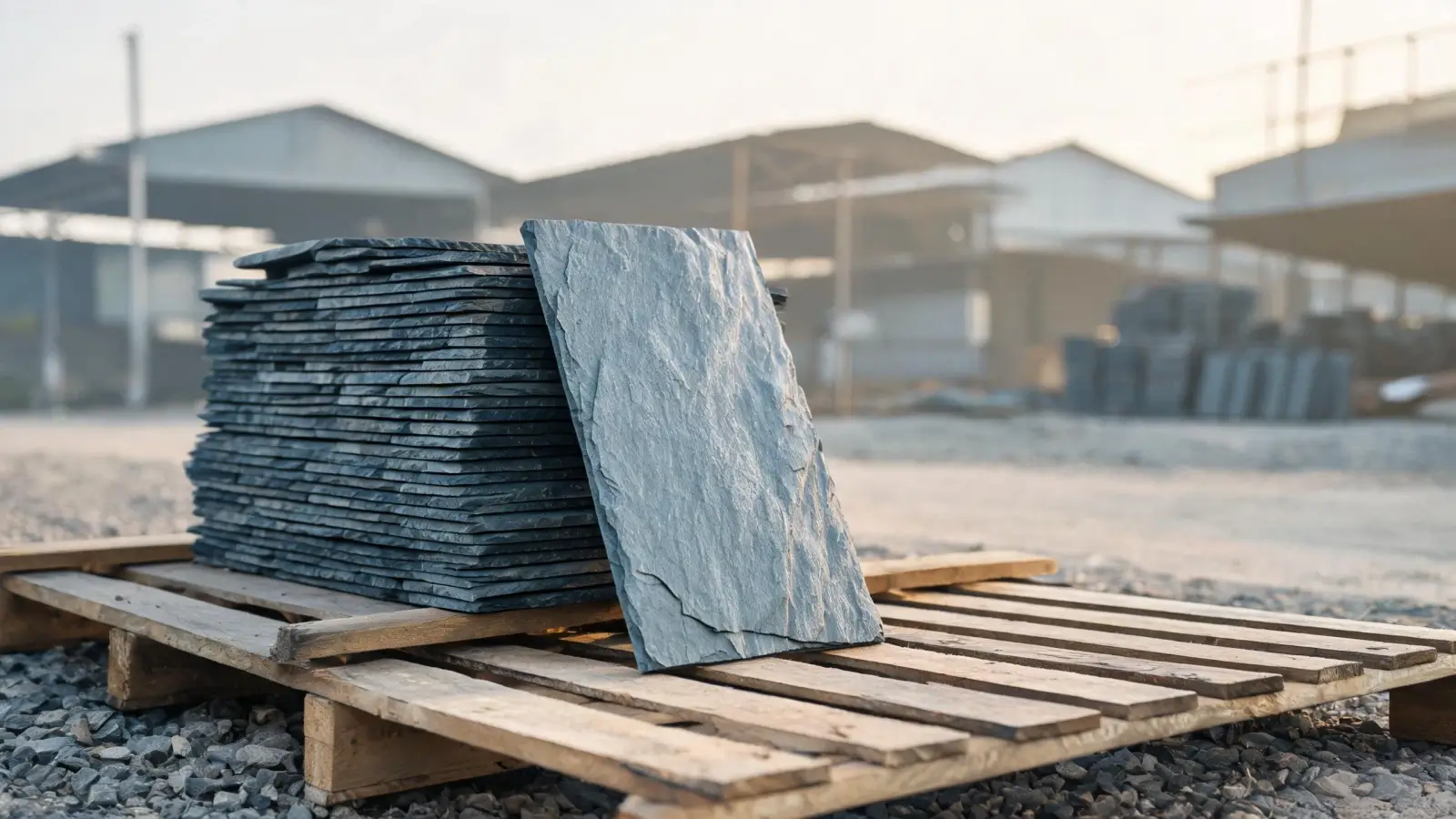
Most buyers meet density as a line on a test report, between water absorption and flexural strength, and skip straight past it. That is a mistake worth correcting, because among all the figures on that sheet, density is the only one your hands can check in advance. This guide explains what the 2.7–2.8 g/cm³ figure actually is, how to measure it yourself on a spare sample, and what it decides — on a roof in winter, in a container at the port, and on a billiard table that has to stay flat for thirty years.
What Density Actually Is — and Why Slate Is Good at It
Density is simply how much mineral is packed into a given volume. Write it as mass divided by volume, and it reads innocent enough. What it hides is a story about empty space.
Rock is not solid all the way through. Between the mineral grains there are pores — microscopic gaps, some of them connected like tiny tunnels, some sealed shut. A stone with many connected pores drinks water the way a sponge does. A stone with few, poorly connected pores barely drinks at all. Density is the first rough measure of how much of that empty space exists: heavier for the same size means more mineral, fewer gaps, a tighter stone.
Slate earns its density from its history. The rock that became Jiujiang slate started as muddy sediment on a sea floor, then spent geological time under heat and pressure recrystallising. The clay minerals re-formed as flaky micas, and the pressure aligned those flakes and pressed them together, interleaved with quartz grains, into an interlocked skeleton — a mineral frame with almost no room left between the parts. Under magnification, a fresh cleavage face of our slate shows exactly that: sheet after sheet of interlocked grains, so tight the surface looks almost silky.
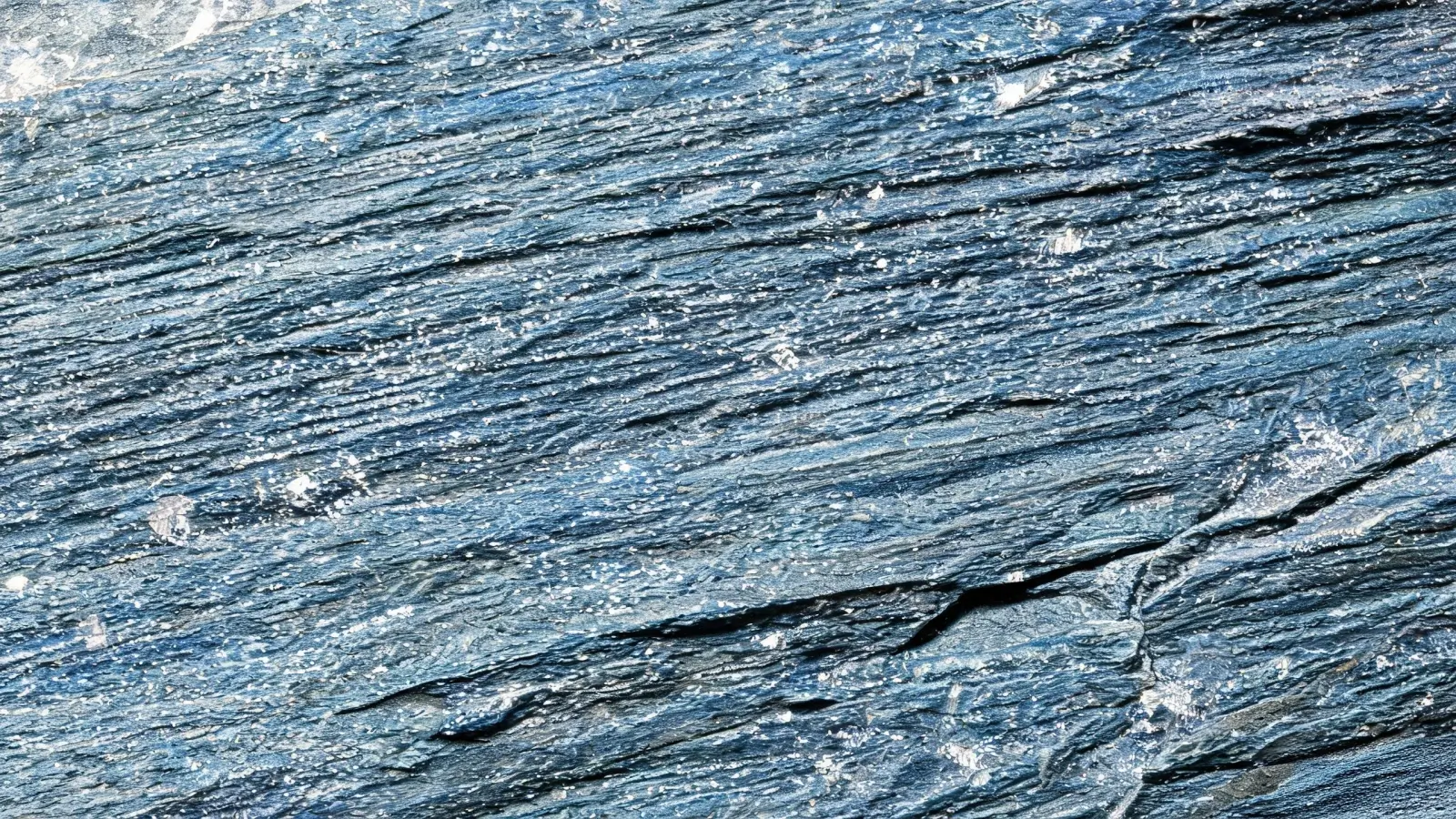
The mica-quartz skeleton explains two things at once. First, why our slate sits at 2.7–2.8 g/cm³ — near the top of the 2.6–2.9 range that natural roofing slates occupy anywhere in the world. Second, why it behaves the way it does in the cold: the pores that remain are small and poorly connected, so water has a hard road in. You can read the full chain from mineral skeleton to weathering behaviour in the geology of Jiujiang slate, or the whole property map in Jiujiang Slate Properties Explained.
Test It Yourself: Two Ten-Minute Checks on a Spare Sample
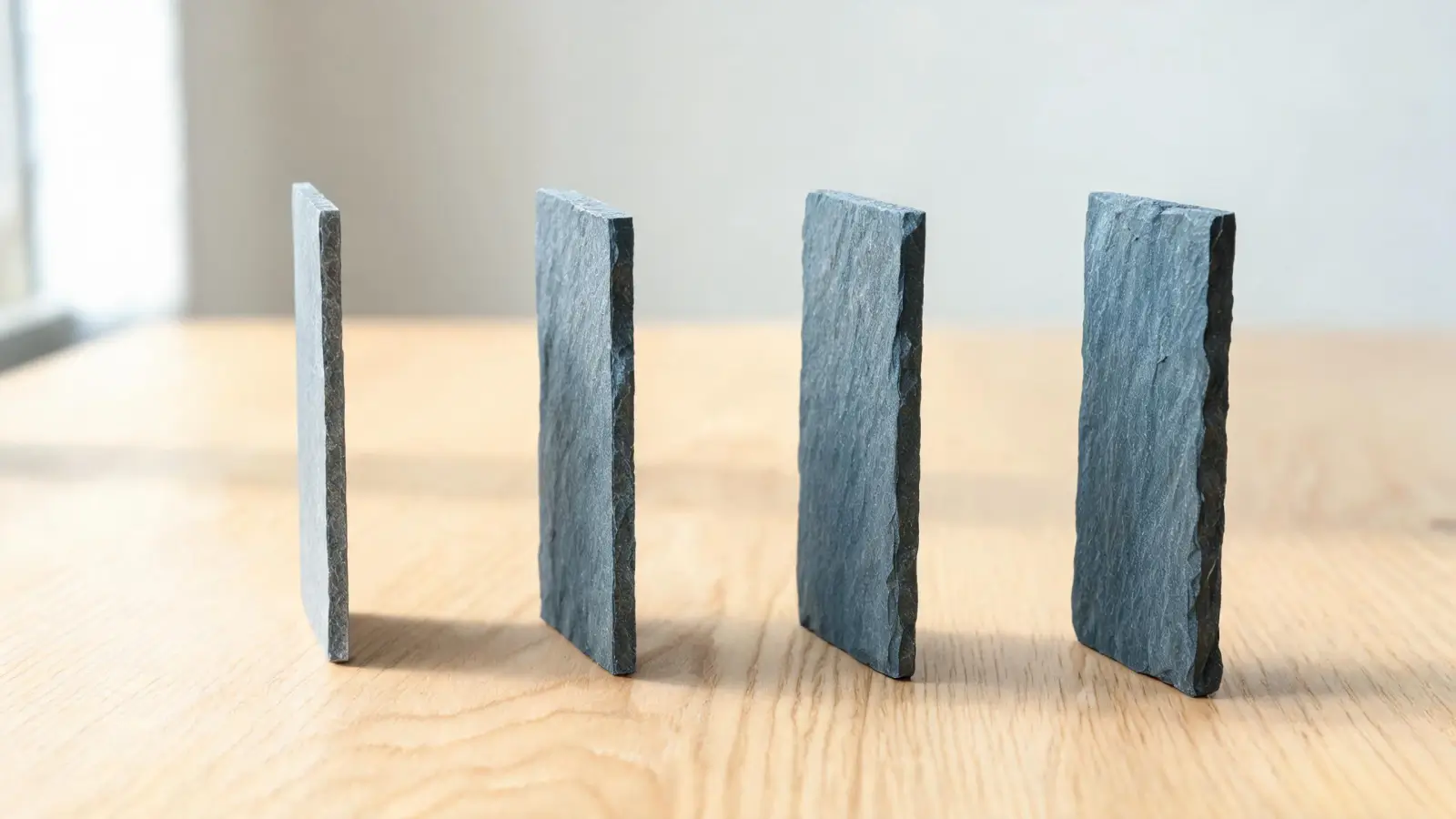
You should not have to take a supplier's word for a number this important, and with density you don't. Ask for a spare sample or two alongside your colour samples, clear ten minutes at a bench, and run either of these. The first needs a kitchen scale and a caliper. The second needs nothing but a bucket of water and a needle — and it is the one I like better, because it is harder to fool.
Method one — weigh and measure. This is the direct calculation.
- weigh the sample on the scale and note the mass in grams;
- measure length, width and thickness with the caliper, in centimetres, and multiply the three to get volume;
- divide mass by volume. For Jiujiang slate the answer lands between 2.7 and 2.8.
One honest warning about your own accuracy: an error of half a millimetre on an 8 mm thickness is already a 6% swing in your result. Measure the thickness at several points and average — slate faces are riven, not ground, and the honest sample will vary by a few tenths. Your kitchen bench will give you 2.6–2.9 at best, and that is fine. You are not replacing the certificate; you are checking that nobody sent you foam dressed as stone.
Method two — the bucket and the needle. This one tests density indirectly, through buoyancy, and needs no numbers until the end. Push a small sample under water in a bucket with a needle, in a film of water free of bubbles, and watch what happens when you release it.
Stone of 2.7 g/cm³ sinks fast — nearly three times denser than the water it displaces. A faked or resin-filled sample often sits oddly: too slow on the sink, or drifting at an angle, because fillers are lighter than mineral. Compare against a second sample from a different batch of the same supplier. Same origin, same formation, same behaviour — both drop like a coin. That consistency of behaviour is the real result, and it matters more than the third decimal place. For the standardised laboratory versions of these properties, our published figures sit on the test results page.
Why Dense Means a Warmer Winter for Your Roof
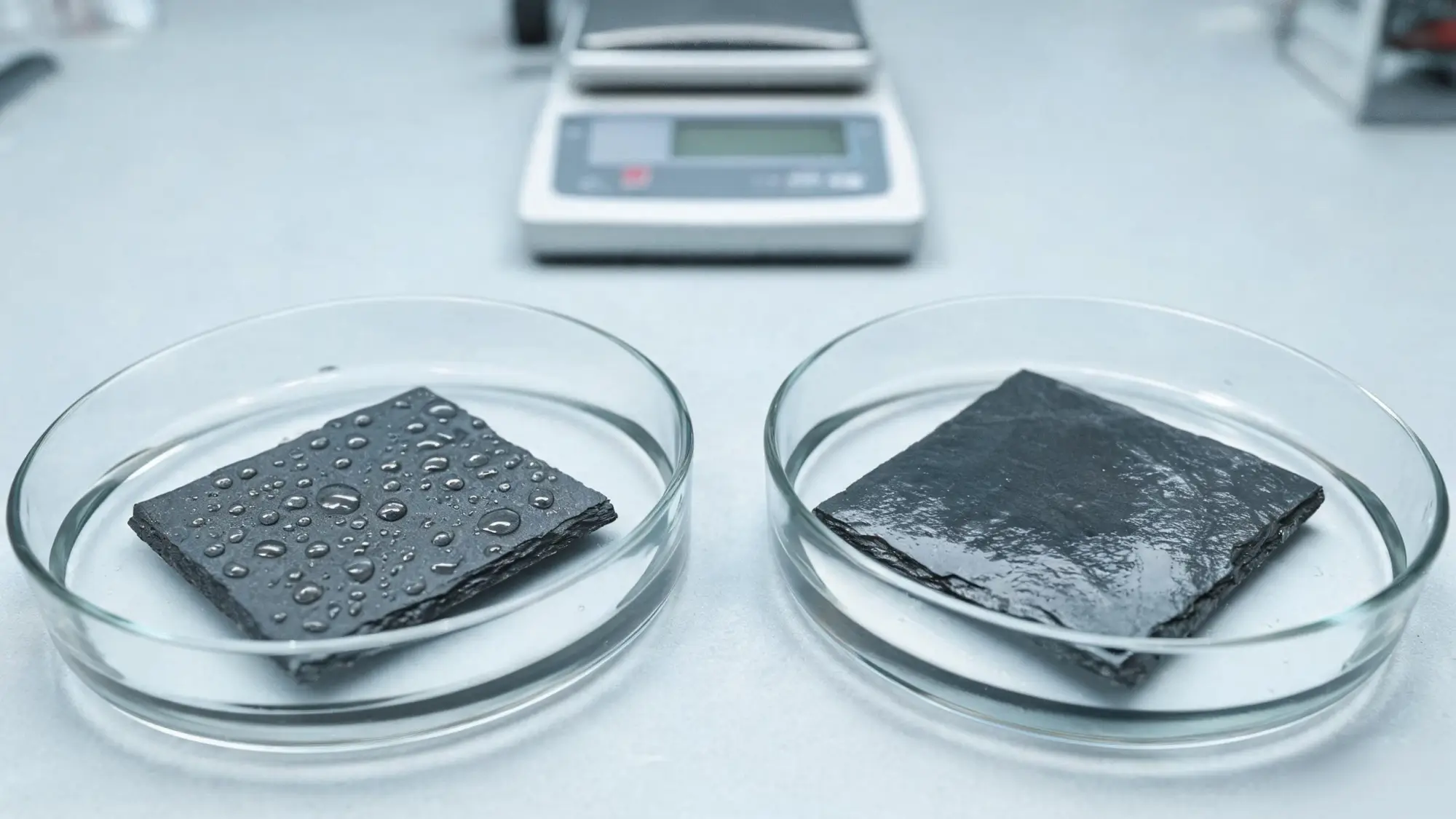
Frost does not break roofs directly — it works through water. Water enters the pores, freezes, expands by about 9%, and repeats, cycle after cycle, until micro-cracks join up into visible breaks. Every step of that attack depends on one precondition: connected pore space for the water to live in. Dense slate starves the attack at step one.
That is the whole logic behind reading density as a winter-survival number. At 2.7–2.8 g/cm³ the matrix is tight enough that water struggles to penetrate at all — a behaviour you can confirm from the other side of the certificate, since our water absorption reads 0.2%, a figure that is only possible when there is very little connected porosity to fill. Density and absorption are two views of the same fact: how a slate handles water is decided largely by how much empty space it has, which is another way of saying how dense it is.
And there is the hundred-year proof in the ground. The graveyard headstones of this region — the same rock, the same formation — have stood through roughly a century of Jiangxi winters plus decades more in exported headstones across Europe. The stone in those graves was never tested in a laboratory before being installed, yet it held, because tight mineral matrices age slowly. When you buy a roof today you get the same formation with the advantage of a certificate on top; the difference is you get to read the density rather than trust it.
Same Stone, Tighter Tolerance: Density on a Billiard Bed
Billiard slate asks the opposite question of the same property. A roof wants a tile that refuses water; a table wants a slab that refuses to move — flat today, flat next decade, no matter what the room's humidity does. Density delivers that in two passes.
The first pass is stability. A dense, low-porosity slab barely absorbs moisture from the air, so the panel that leaves the factory at flat stays flat in the game room. The second pass is machining, and it is the one people overlook. CNC tooling reads resistance. A panel whose density wanders across its area forces the cutter through hard patches and soft patches in the same pass, and the cut depth wanders with it. A panel of uniform density presents the same resistance everywhere, so the tool holds its line — and that is how our beds hold a tolerance of ±0.1 mm across a full playing surface.
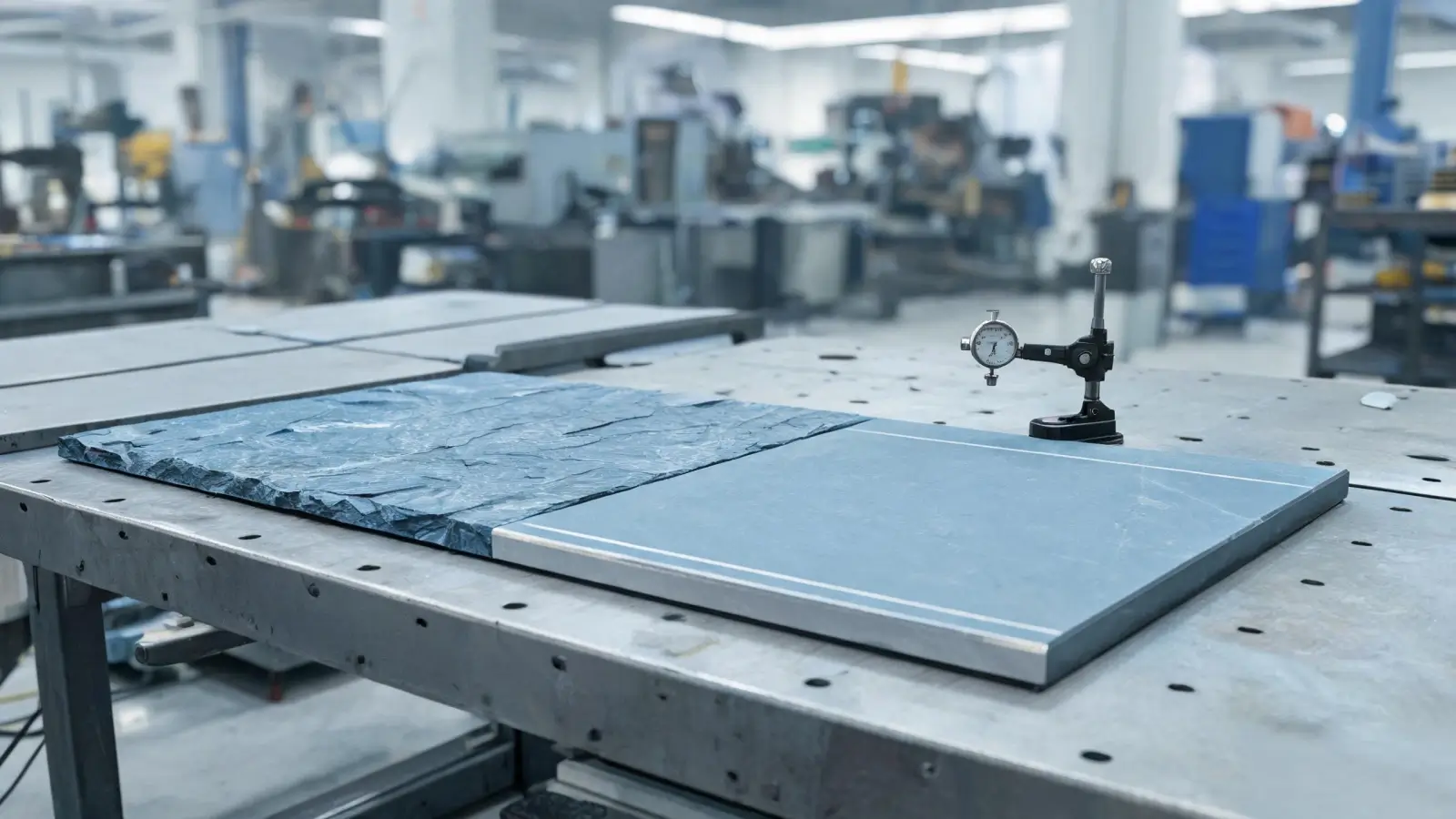
Then there is the honest weight of the thing. A full 9-foot bed panel of our slate runs to roughly 150 kg — a three-person lift every time it moves, which is exactly why the crate it ships in is built like furniture and why installers plan the stairs before the delivery date. That is density at its least abstract: not a number on a sheet, but the reason three grown men are sweating on your staircase. See the panels themselves at billiard slate.
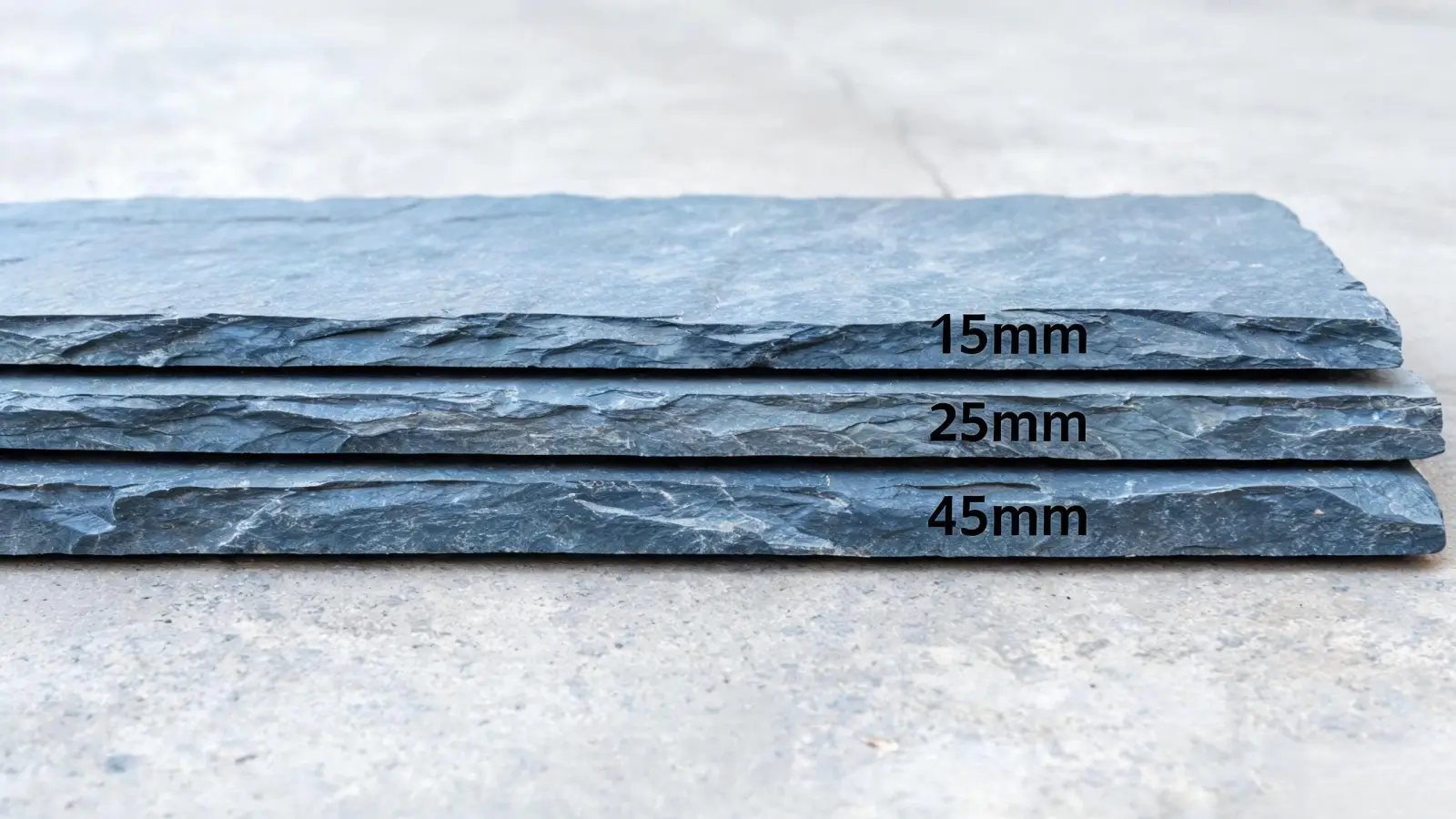
The same density runs through every thickness the quarry cuts — 15, 25, 45 mm, the figure holds; only the weight changes with the caliper. One quarry, one skeleton, many cuts.
The Weight Conversation: Dense Does Not Mean a Heavier Roof
Here is the confusion that costs buyers the most. "Dense" sounds like it means "heavy", and heavy sounds like a problem for the roof structure. Run the maths before worrying.
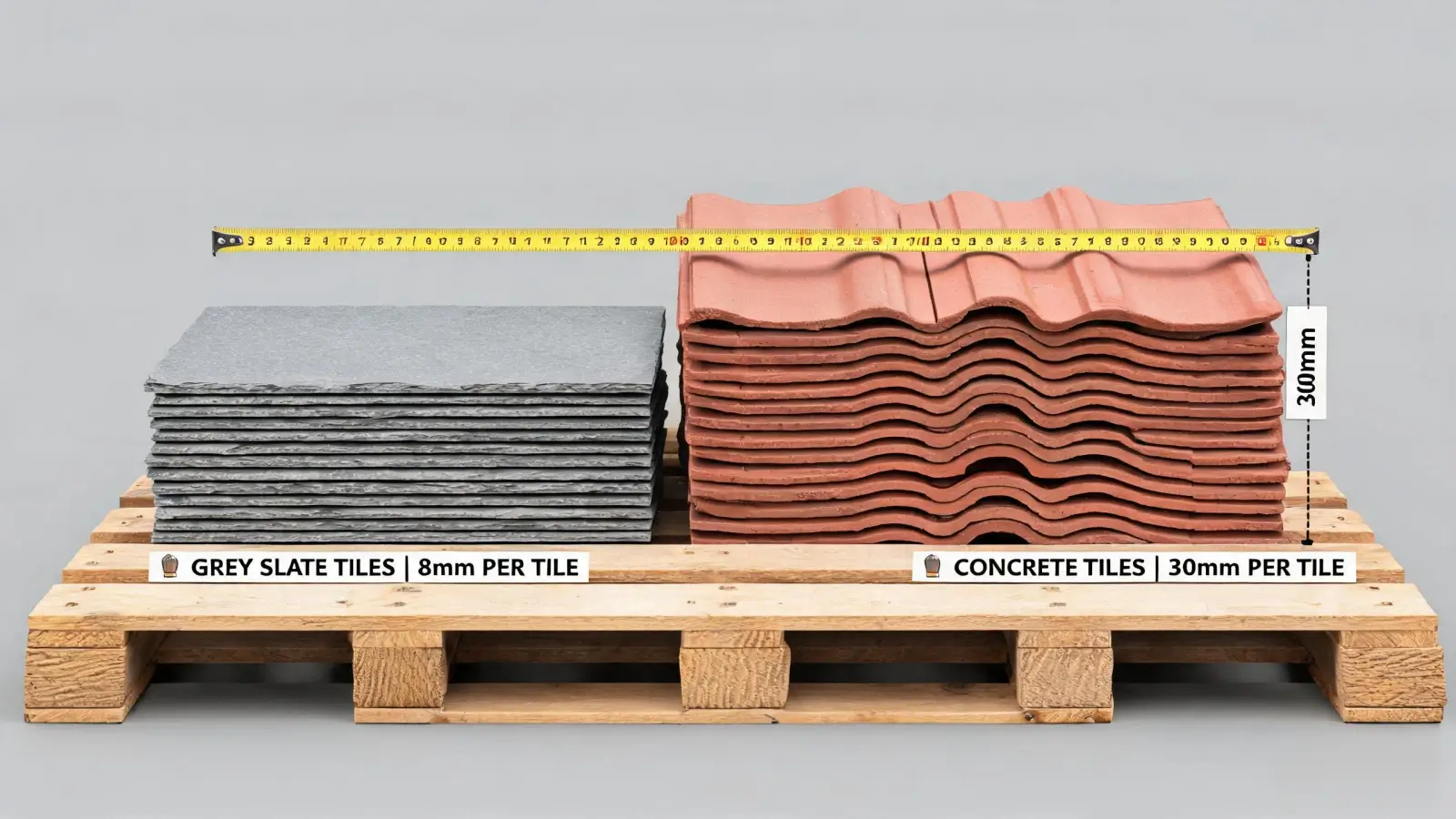
One rule does the whole job: at 2.7–2.8 g/cm³, every millimetre of slate thickness adds about 2.7 kg to a square metre of roof. A 7 mm tile puts roughly 19 kg/m² on the structure; 8 mm about 22; 9 mm about 24. Now put the alternatives beside it. Concrete interlocking tiles ask a roof for 45–65 kg/m². Clay tiles commonly land around 40–50. Both are roughly double a slate roof, because those products are thick and hollow-profiled where slate is thin and solid — density concentrated into a slimmer material.
| Roof covering | Typical weight | Why |
|---|---|---|
| Jiujiang slate, 7–9 mm | 19–24 kg/m² | Dense stone, thin profile |
| Clay tiles | ~40–50 kg/m² | Lighter mineral, thick interlocking shape |
| Concrete tiles | ~45–65 kg/m² | Lighter mineral, thick profiled profile |
The practical takeaways: a modern trussed roof shrugs off a slate load without reinforcement, and even most Victorian and Edwardian roofs in Britain were designed for heavier coverings than a slate roof applies today. The conversation to have with your structural engineer is short: give him the thickness, multiply by 2.7, done. If your project is a reroof or a listed building where every kilogram is negotiated, that one-line formula is the difference between a confident order and an argument.
And the same 2.7 constant quietly runs the commercial side of your order. One cubic metre of this stone is 2.7 tonnes; a 20-foot container runs to roughly 27.5 tonnes loaded; so the maths of how many square metres fit in a container — the number that decides your landed cost — starts from the same figure as your roof load. Density is the one number that follows this stone from the mountain to your structure to your invoice. For that commercial chain, see the technical data page and our slate belt overview.
How to Read the Certificate — and How the Number Is Verified Here
On an EN 12326 or ASTM C406 report, density appears as a plain figure in g/cm³, sometimes alongside a companion kg/m³ reading (2.7–2.8 g/cm³ is 2,700–2,800 kg/m³ — same fact, different units). Treat the number the way this guide has taught you to treat the stone: as something checkable.
Check first that the report belongs to a batch, not a museum. Ask for the batch number, ask how many samples were cut, ask whether the range across samples was reported — a single polished specimen figure tells you less than a spread of honest readings from different slabs. Then run your own bench test on your own samples and see where the honest band sits. If a supplier declines to let you test, or cannot produce a batch-linked figure, that silence is your answer.
For our part, the checking is not an event, it is a routine — every production batch is measured and the figures are filed; the 100% inspection process keeps slab-level honesty behind the batch figures, and the region's geology keeps the whole belt inside a narrow, consistent band, which is why the certificate holds not just for one order but for the tenth container after it.
Frequently Asked Questions
Is 2.7–2.8 g/cm³ a good density for roofing slate?
Slate anywhere in the world runs roughly 2.6–2.9 g/cm³, and 2.7–2.8 sits high in that band. More density generally means fewer connected pores, which supports low water absorption and better frost behaviour. It is a good figure — provided the rest of the report (absorption, flexural strength, freeze–thaw) agrees with it, which in Jiujiang slate's case it does.
My kitchen-scale test gave 2.65, not 2.75. Should I worry?
Probably not. A home bench test carries the errors of the scale and the caliper, and half a millimetre of thickness error on an 8 mm tile already shifts the result by about 6%. Measure thickness at several points and average, then expect your honest home result to land somewhere between 2.6 and 2.9. You are checking that the stone is genuine and consistent, not re-certifying it.
Can a supplier fake the density figure on a certificate?
A paper figure can be written, but the stone itself cannot act. Density is mass behaviour of the actual mineral matrix — you can pick a flattering sample to send to a lab, but the containers you receive are cut from the same formation and behave the same way in your own bucket test. That is precisely why the DIY tests in this guide are worth your ten minutes: they verify the physical stone in your hands, not the paperwork.
Does a dense roof mean my house structure needs strengthening?
Usually the opposite of what people fear. Because slate is used thin (7–9 mm), a slate roof typically loads a structure at 19–24 kg/m², versus 45–65 kg/m² for concrete interlocking tiles. Most modern trussed roofs accept slate without reinforcement, and many older houses were designed for heavier coverings. Give your structural engineer the tile thickness and let him multiply by 2.7 — that is the whole calculation.
Why does the same density matter for a billiard table?
Two reasons. A dense, low-porosity panel absorbs almost no atmospheric moisture, so it stays dimensionally stable — flat through decades of humidity swings. And uniform density lets CNC machining meet consistent resistance across the whole slab, which is how the ±0.1 mm flatness tolerance on a playing surface is achievable at all.
How does density affect how many square metres fit in one container?
Directly. One cubic metre of Jiujiang slate weighs about 2.7 tonnes, and a 20-foot container is weight-limited at roughly 27.5 tonnes loaded — before it is volume-full, it is weight-full. The loading plan for your order, and therefore your cost per square metre delivered, is arithmetic that starts from the density figure.
Related Reading
Density you can check before you commit.
Send us your project details and we will courier sample tiles with the batch certificate alongside — weigh them, dunk them, measure them on your own bench. Then ask us for the loading maths and the m² per container, and see how one honest number carries the whole order.