
Documents Required for Importing Roofing Slate: Complete Checklist
The short version: a normal roofing slate shipment travels with a commercial invoice, a packing list and a transport document — a bill of lading or a sea waybill — plus a certificate of origin where the destination or the buyer requires one. The stone itself is a mineral, so it needs no phytosanitary certificate, but its solid-wood crates must carry the ISPM 15 treatment mark. A test report is rarely a border requirement, yet it is the document that proves the slate is the grade that was paid for. The delays that cost real time are rarely a missing page; they are one field carrying different values on different pages.
Part of the Roofing Slate Guide's Buying & Importing section — the paperwork half of the import story, alongside Shipping Roofing Slate Internationally on the transport side and How to Read a Roofing Slate Test Report on the quality side.
Roofing slate is one of the simpler products to import from a documentation point of view. It is stone: it does not spoil, it is not a plant, and it carries no conformity mark of the kind attached to machinery or electronics. What makes the import file worth a page of its own is that slate is heavy, it travels in wooden crates, and its quality cannot be read from a photograph. Three separate systems — customs, the carrier and the buyer's own quality check — each ask for their own paper, and each quotes the same shipment data in a slightly different way.
This page sets out the documents in the order they are normally assembled, explains what each one does, and — in the places where absolute claims are common — what it does not do. It is written from the importer's side of the desk, but the same file serves the exporter, the freight forwarder and the customs broker.
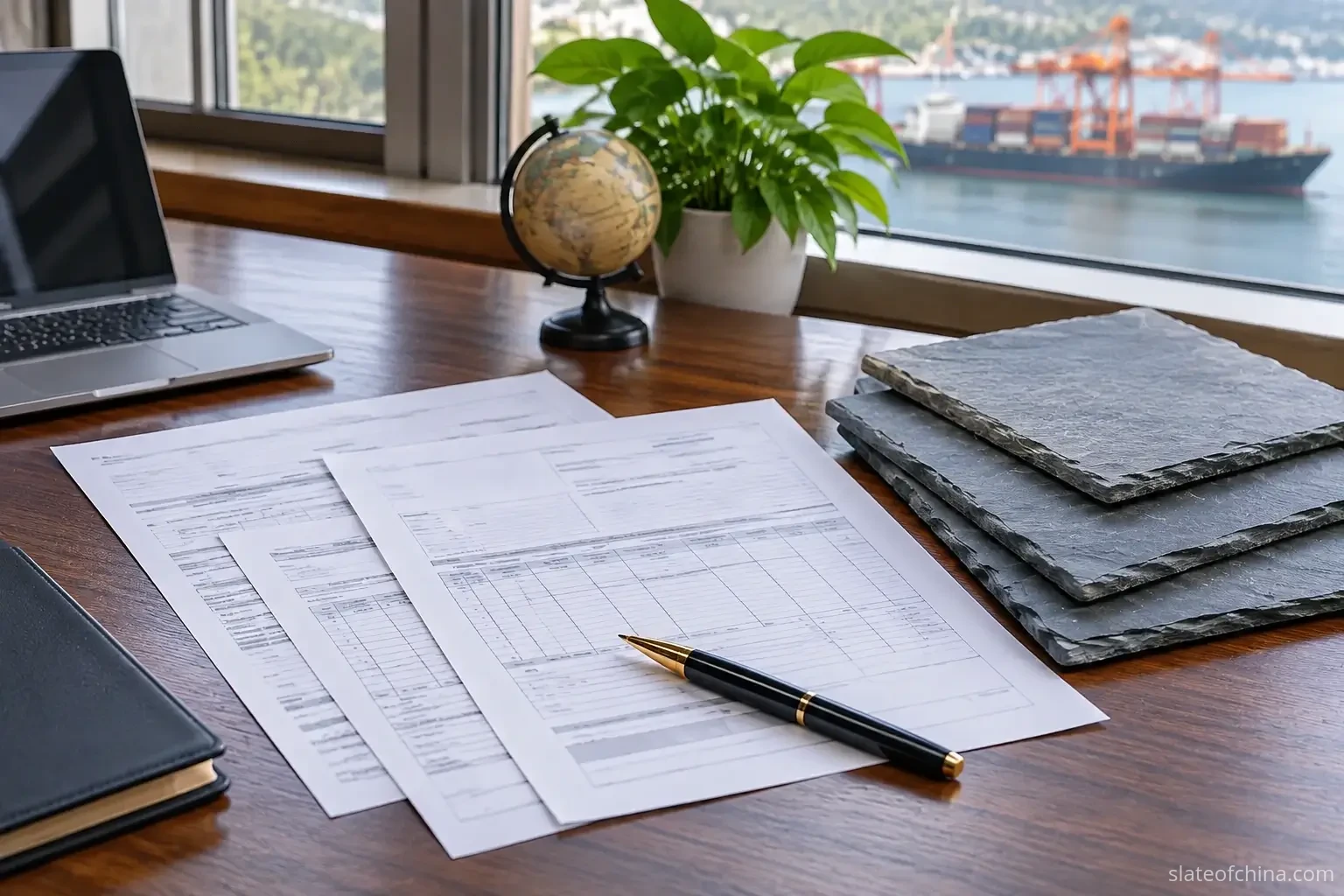
The Document Set at a Glance
Six documents are normally involved in a slate shipment. Only part of them are customs documents in the strict sense; the others belong to wood packaging compliance and to product quality. Keeping that distinction in mind avoids two common mistakes: treating a test report as if the border had demanded it, and treating a crate mark as if it replaced a certificate.
| Document | What it establishes | Who normally issues it | File family |
|---|---|---|---|
| Commercial invoice | The sale itself: goods description, quantity, value, currency, Incoterm, payment terms | The exporter | Commercial / customs |
| Packing list | The physical content: crate count, marks, dimensions, net and gross weights, per-crate detail | The exporter | Commercial / customs |
| Bill of lading / sea waybill | Receipt for the goods and the contract of carriage; a negotiable bill of lading can also function as a document of title | The carrier or freight forwarder | Transport |
| Certificate of origin | Where the goods were produced — for duty treatment and trade statistics, not a quality statement | The exporter, with a chamber of commerce or issuing authority | Customs |
| ISPM 15 mark on the crates | Solid-wood packaging has been treated against pests — the mark itself is the evidence | A registered treatment provider; the mark is applied by the crate maker | Phytosanitary / customs |
| Test report (EN 12326 / ASTM C406) | Product performance evidence: water absorption, strength, freeze–thaw behaviour and grade | An independent testing laboratory | Quality assurance |
Buyers who already have the file in order and are comparing specifications next can review the roofing slate range — thicknesses, sizes and finishes are listed per product line, and each line states which report covers it.
Customs Documents and Commercial Documents Are Not the Same File
The customs side of the file is the part the border examines: invoice, packing list, transport document, origin evidence where required, and wood packaging compliance. These are checked against the import declaration, so the figures on them must be able to survive a line-by-line comparison.
The commercial side is what the transaction runs on: the test report, the sample approval record, the pre-shipment inspection report, the packing photographs. Customs in most destinations does not ask for these at release — but the buyer's bank, insurer, architect or end client will, and a claim without a test report is a much weaker file than a claim with one.
The distinction matters for where effort goes. A missing quality document will not normally stop a container at the border; a missing or illegible ISPM 15 mark can stop it entirely, because wood packaging is treated as a biosecurity matter, not a paperwork matter. The sections that follow take the documents one at a time, in the order they are usually assembled.
Commercial Invoice: What the Officer Actually Reads
Two lines on the invoice carry most of the weight. The first is the goods description. "Stone slabs" invites a question; "natural roofing slate, blue-grey, 500 × 250 × 6–8 mm, 24 crates" answers one. A description specific enough to identify the product also keeps the invoice, the packing list and the declaration telling the same story, which is what a reviewing officer is actually looking for.
The second is the tariff classification. Worked slate sits in HS heading 68.03, but the national tariff line below the heading — and any note attached to it — varies by destination and is the importer's responsibility to confirm with a broker, not something to copy blindly from a supplier document. The invoice supports the classification; it does not settle it.
Beyond those two lines, the invoice states the value basis and Incoterm, the currency, and the payment terms. Corrections are made by reissuing the document with a new reference, not by overtyping figures — a visibly amended invoice is a weaker document than a cleanly reissued one, and the corrected version should be kept in the file alongside the original.
Packing List and the Three Weight Figures
The packing list is the physical inventory of the shipment: how many crates, what marks are stencilled on them, what each crate holds, and the quantities and dimensions in total. It is also where weight data lives, and weight is where most confusion gathers — because a slate shipment carries three different weight figures, each with its own meaning.
| Figure | What it measures | Who uses it |
|---|---|---|
| Net weight | The slate itself, without packaging | Customs valuation and statistics |
| Gross weight | Slate plus crates, dunnage and strapping — the whole handling unit | Customs, the carrier, the terminal |
| VGM | The verified gross mass of the loaded container, declared under SOLAS before sailing | The shipping line and port safety systems |
None of the three is "the right one" — they answer different questions. The checking discipline is that each figure is compared with its own counterpart: the gross weight on the invoice with the gross weight on the packing list and the transport document, the VGM with the weighing record, the net weight with the packing detail. A gross figure and a net figure a hundred kilos apart is not an error; the same field saying two different values on two documents is. And if two documents repeat exactly the same weighed figure, that is normal, not suspicious — both are quoting one weighing.
On a typical 20 ft container of roofing slate the gross weight lands in the mid-twenties of tonnes, so weight is the field every system checks twice. Per-crate weights on the packing list also let the buyer verify nothing was short-loaded, and give the roofer on site a realistic figure for handling.
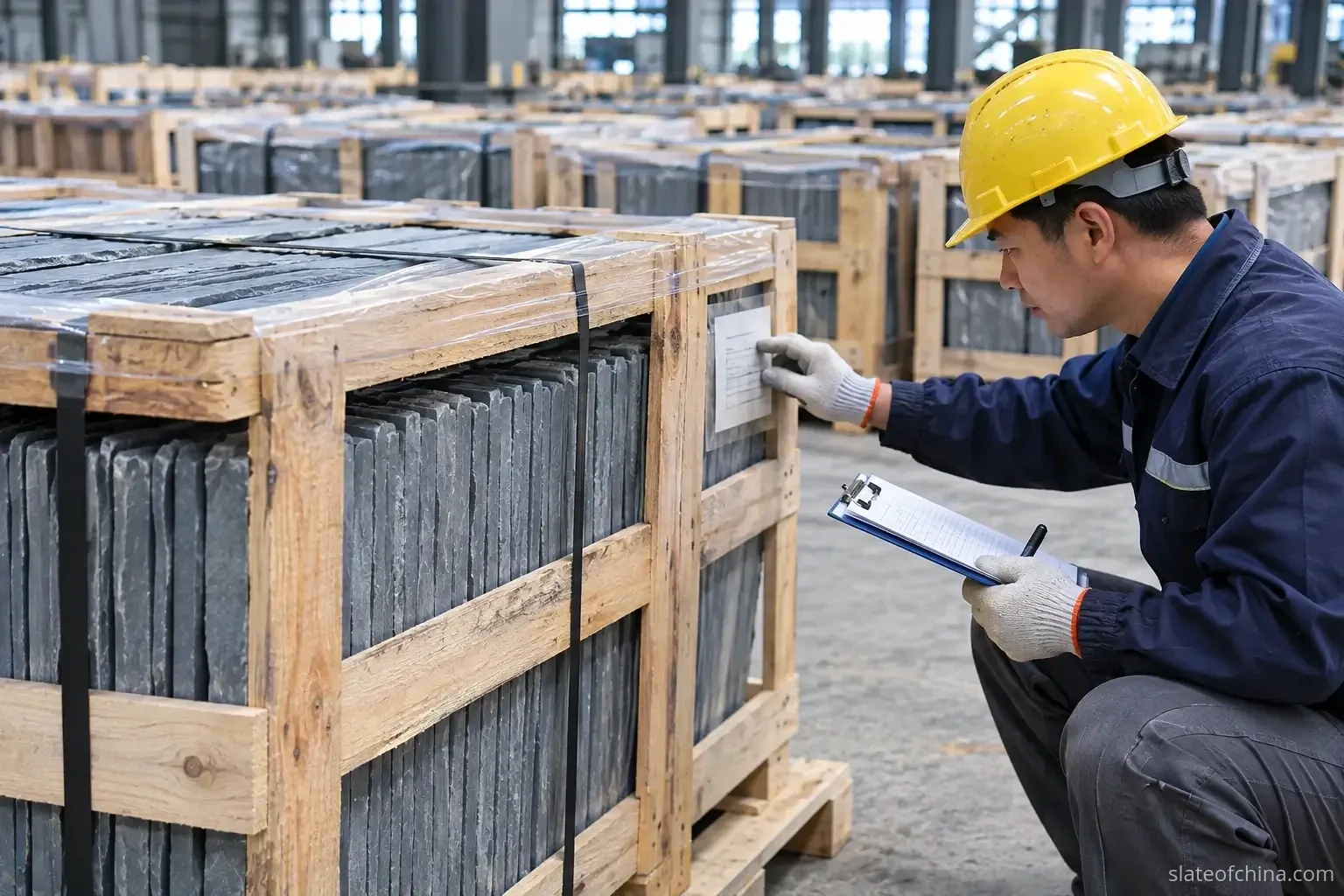
Three Cross-Checks Before the Container Is Sealed
Before the doors close, one person with the three core papers side by side can catch almost everything that later becomes a hold. The checks are short:
- Weight, like with like. Gross weight identical across invoice, packing list and transport document; net weight consistent with the packing detail; VGM declared from a real weighing. No fixed tolerance is "safe" — the aim is one value per field, each traceable to one weighing.
- Package count and marks. The same crate count on every document, and the stencilled marks on the crates matching the packing list. The count is how a shortage or an overage is first noticed, sometimes months later at a claim.
- Lot traceability. The lot or batch reference on the packing list connecting to the test report, so the delivered stone and the tested stone can be tied together. The report does not need a crate-by-crate number list — it needs to state clearly which sample was tested and how that sample relates to the shipment.
Ten minutes at a desk, before the seal, replaces four days of document traffic after the vessel sails. This is the same discipline a pre-shipment inspection formalises when a third party does the checking.
Bill of Lading: Receipt, Contract and — Sometimes — Title
A bill of lading does three jobs at once. It is a receipt for what the carrier took on board, it is the contract of carriage, and — when it is issued "to order" and made negotiable — it is also a document of title that can be endorsed and transferred, which is what allows cargo to be sold in transit and released against presentation of an original.
The distinction matters because not every transport document does the third job. A sea waybill is a receipt and contract only, with no original to present — right for routine shipments between known parties. A telex release surrenders the originals at origin so the cargo can be released at destination without them — convenient, but it removes the control that a negotiable document gives a seller who has not been paid in full. Choosing between these forms is a payment-and-control decision, not a formality. The mechanics, including how the balance payment unlocks the document, are covered in the shipping guide.
For the import file itself, the practical points are smaller: the B/L must agree with the packing list on crate count, weight, container and seal numbers, and the shipper, consignee and notify party must be spelled exactly as they appear on the invoice and the declaration. A one-letter difference in a consignee name is the kind of small thing that turns into a correction fee and a lost day.
Certificate of Origin: What It Proves and What It Does Not
A certificate of origin states where the goods were produced. That is all it does — but two very different things flow from it, and conflating them is the most common origin mistake.
A non-preferential certificate supports the declaration of origin for duty classification, statistics, and measures such as anti-dumping or quota where they apply. A preferential rate, by contrast, exists only when the destination has a trade agreement with the origin country and the goods meet that agreement's rules of origin — usually evidenced by a specific certificate or an origin declaration in a prescribed format. Where no agreement applies, the standard rate is charged even with a certificate sitting in the file. The certificate is a supporting document to a rate; it is not the rate itself.
Two questions to the broker settle the whole matter for a route: is a certificate of origin required for entry at all, and is any preferential treatment available for goods of this origin. Both are answerable before the container sails, and neither is guessable from another buyer's experience on a different route.
Wood Packaging and the ISPM 15 Mark
Roofing slate travels on solid-wood crates and pallets, and solid-wood packaging is regulated as a plant-health risk in most markets. The international standard is ISPM 15: the wood must be treated — heat treatment is the common route — and stamped with the compliant mark. The mark carries the IPPC symbol, the country code, a code identifying the treatment provider, and the treatment abbreviation such as HT. The mark is the evidence; the crates do not travel with a separate certificate. Processed wood such as plywood is generally outside the requirement, but mixed crates should be checked rather than assumed.
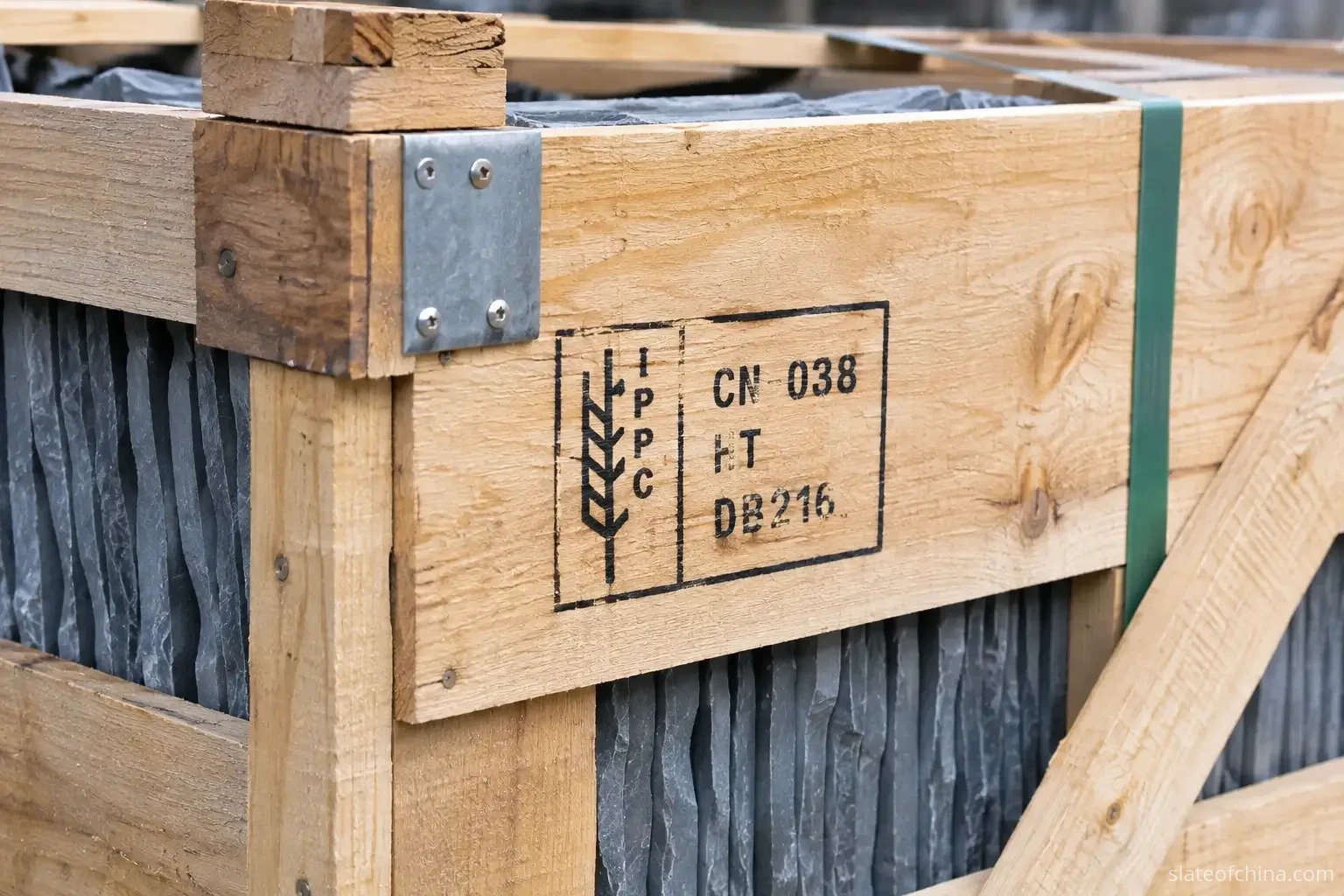
What the mark does not do is satisfy every other wood-related requirement a destination may impose. Some routes add declarations, treat certain wood types differently, or inspect on arrival regardless of the mark; requirements also change. The practical habit is to confirm packaging compliance for the specific route with the broker — and, on the buying side, to ask the supplier for a photograph of the actual stamp before ordering, the way the crate standards page describes. Unmarked or illegible timber can be held, treated, destroyed or re-exported at the importer's cost, which is a heavier consequence than any paperwork error elsewhere in the file.
Test Reports: Traceability, Not Permission
Most borders do not ask for a slate test report. The buyer's side of the transaction does: the report is what an architect specifies against, what an insurer reads, and what separates "slate of the grade ordered" from "slate that arrived". For natural roofing slate the reference standards are EN 12326 in Europe — part 1 setting the product specification, part 2 the test methods — and ASTM C406 in North America, which grades slate S1, S2 or S3 largely on water absorption. The two systems are not interchangeable; the report should name the standard it was tested to. Reading the six lines that matter is covered in the test report guide.
The part worth insisting on is traceability. A usable report identifies the laboratory, the date, the test methods, the results — and the sample: what it was, and which lot of production it represents. The delivered shipment should be linkable to that lot through the packing list. A report does not become invalid because it lacks a crate-by-crate number list, and a shipment is not automatically suspect because a crate mark differs from a report reference; what matters is that the supplier can state, in writing, how the tested sample relates to the stone in the container. If that statement cannot be produced, the report belongs to some other batch of slate.
Buyers who want the evidence before committing to a full order will find batch-linked results, where published, on the test results page, and the sample approval page explains how a physical sample and its paperwork become the reference for the whole production run.

Pre-Shipment Document Verification Checklist
The table below is the working version of this whole page — one line per field, designed to be printed or copied and run through before the container is sealed. It works equally well from the exporter's desk or the importer's, and it doubles as the checklist for reviewing draft documents before they are issued.
| Item | What to verify | Where it appears |
|---|---|---|
| Exporter and consignee details | Legal names and addresses identical across the set; consignee matches the intended importer of record | Invoice, packing list, transport document |
| Product description and classification | Description specific and consistent; national tariff line confirmed by the importer or broker | Invoice, import declaration |
| Invoice number and commercial value | One invoice reference across the set; price basis, currency and Incoterm stated | Invoice, transport document, declaration |
| Packing quantities and weights | Crate count consistent; net, gross and VGM each stated with its own basis and compared like with like | Packing list, transport document, VGM declaration |
| Container and seal numbers | Identical across documents and consistent with loading photographs | Transport document, packing list |
| Country of origin | Stated consistently; preferential claim, if any, backed by the correct certificate or declaration for that agreement | Invoice, certificate of origin, declaration |
| Wood packaging compliance | ISPM 15 mark present, legible and correctly formed on solid-wood crates; route-specific requirements confirmed | Crate photographs, treatment records |
| Test report traceability | Laboratory, methods, sample and lot stated; the relationship between tested sample and delivered lot explained in writing | Test report, packing list |
| Destination-specific requirements | Confirmed in writing with the broker: declarations, labelling, wood rules, any additional certificates for this route | Broker instruction, route file |
| Document set retained | Final versions archived per shipment, including any corrected documents, before sailing | Shipment file |
If a Shipment Is Held at the Border
A hold is normally a question about data, not an accusation about goods, and questions have a sequence. When the call comes:
- Get the reason in writing, verbatim. "Document discrepancy" is not a reason; the flagged field and the flagged document are.
- Pull the matching documents and compare the flagged field across the invoice, packing list and transport document. Most data holds end here, at a typed difference.
- If the documents agree but the flag says otherwise, send the set to the exporter and the forwarder with one question: which of these figures is wrong, and on whose paper.
- If the documents disagree with each other, a corrected document from the issuer resolves it — a corrected packing list or invoice, reissued with a new reference rather than overtyped.
- If the wood is the issue, isolate the affected packaging. One non-compliant crate can be treated or set aside while the rest of the lot clears; mixing it back in risks the whole shipment.
- Keep the goods under control until the issue closes. A discrepancy resolved before release stays a correction; the same discrepancy after the goods have moved becomes a file that follows the shipment for months.
The expensive part of a hold is almost always time — storage, demurrage, a missed project date — rather than the correction itself. That cost is what the checklist above exists to avoid.
Keeping One File per Shipment
The habit that makes all of this easy is unglamorous: one file per container, started the day the order is placed, not the day the ship docks. Sample approval record, quotation, production details, packing photographs, the document set, and every corrected version — all in one labelled folder, physical or cloud, keyed to the order number.
Started early, the file builds itself: each stage of the order adds its own paper, and arrival day becomes a ten-minute read instead of an assembly job from three inboxes. Started late, the same file is a reconstruction — and reconstruction is where numbers drift. The sample approval page is where the trail begins on most orders; the arrival inspection page is where it ends, with a checking routine that assumes the paper is already in order.
Frequently Asked Questions
What documents are required to import roofing slate?
The core set is the commercial invoice, the packing list and the transport document — a bill of lading or sea waybill — plus a certificate of origin where the destination or the buyer requires one. Solid-wood crates must carry the ISPM 15 mark, and a test report is the quality evidence the buyer, bank or insurer will ask for. The exact list depends on the destination and should be confirmed with the broker before the container sails.
Is a certificate of origin required for slate?
Not everywhere, and it does not by itself lower the duty. A non-preferential certificate simply proves where the goods were produced. A preferential rate applies only when a trade agreement and its rules of origin are met, which usually means a specific certificate or origin declaration. Where no agreement applies, the standard rate is charged even with a certificate in the file. Confirm the requirement with the broker or forwarder before shipping.
Do I need a phytosanitary certificate for roofing slate?
The stone itself is a mineral, so it is not subject to plant quarantine. The solid-wood packaging is: in most markets the crates must be treated and marked to ISPM 15. Some destinations add requirements for certain wood types or additional declarations, so the packaging question is worth confirming for the specific route rather than assuming the mark alone satisfies everything.
Why was my slate container held at customs?
The usual reasons are data that disagrees across documents — a weight, a crate count or a container number written differently — a missing or illegible ISPM 15 mark, or a question about valuation or classification. The first step is to ask for the exact reason in writing, then compare the flagged field across the invoice, packing list and transport document before anything else is done.
Which documents must agree with each other?
The commercial invoice, the packing list and the transport document must tell the same story: same crate count, same gross weight, same container and seal numbers, same marks. Net weight, gross weight and the SOLAS verified gross mass are three different figures by design, so each should be stated with its basis and compared like with like.
Can I import roofing slate without a test report?
Customs rarely asks for one, so the container can normally clear without it. The report is what proves the slate meets the specification that was paid for, and it is the document a bank, insurer, architect or end client will request. A usable report identifies the laboratory, the sample, the methods and the lot the sample represents.
Related Reading
Request a roofing slate quotation with a destination-specific shipping and document checklist.
Every quotation can be issued with the document set named for the destination port and market — invoice, packing list, transport document, origin evidence, ISPM 15 compliance and the batch-linked test report. contact us for the checklist with your quotation · browse the roofing slate range · view published test results