
Roofing Slate Quantity Calculator: How Many Slates Do You Actually Need?
Quick Answer: To calculate how many slates you need: (1) find your sloped roof area in m² — multiply the flat plan area by a slope factor (e.g. 1.22 at 35°); (2) find the slates per m² for your size and headlap — a 500×250 mm slate at 75 mm headlap gives 18.8 slates per m² (budget on 19); (3) multiply the two; (4) add waste — normally 5–8%, more on steep or complicated roofs. A typical 100 m² roof takes roughly 1,880 slates of 500×250 before waste.
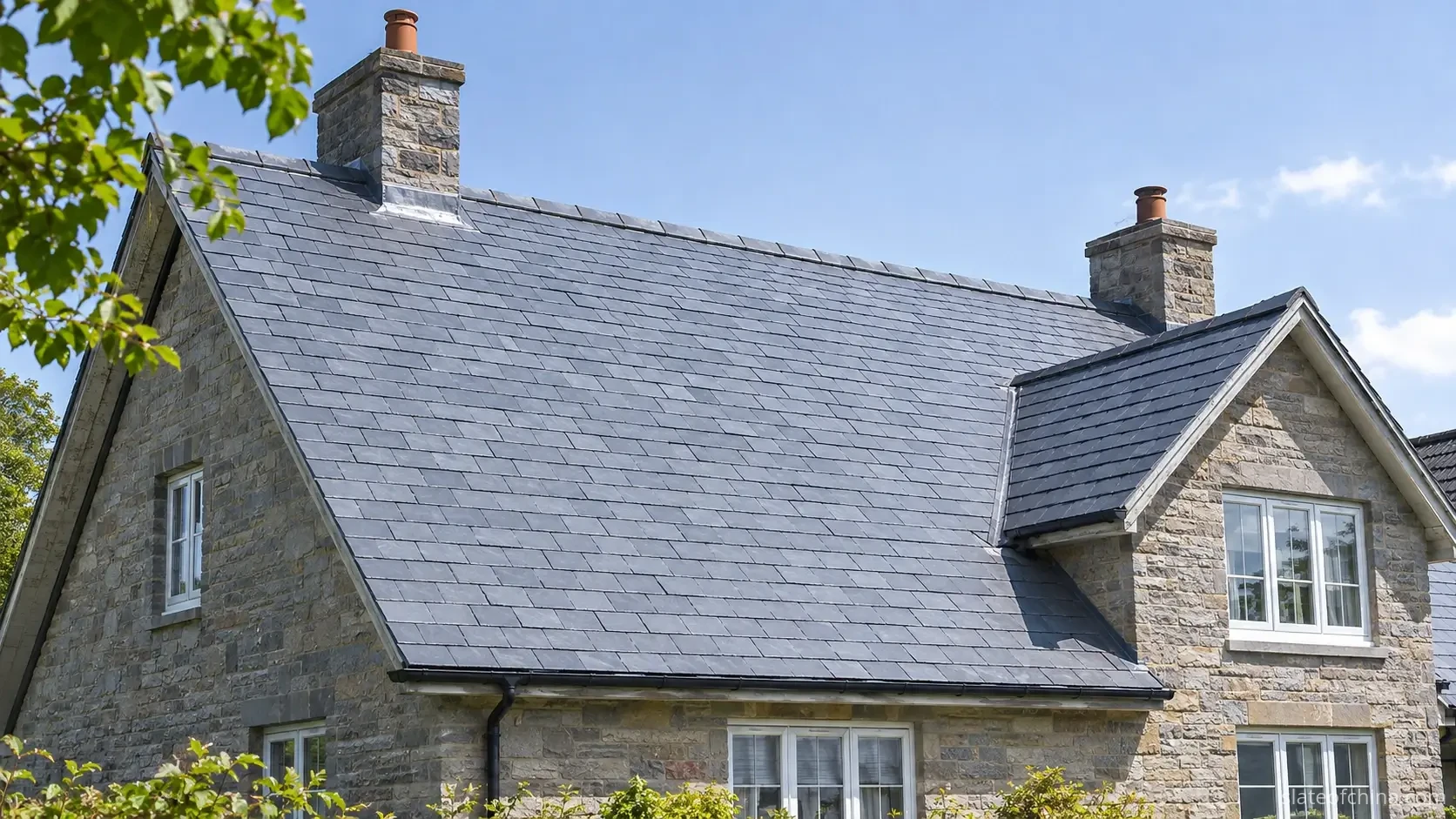
Every week someone emails us asking the same thing: "My roof is roughly 12 by 6 metres, how many slates do I need?" And every week the answer starts with three questions back: what size slate, what headlap, and how steep is the roof. Get those three right, and the maths takes about two minutes on a scrap of paper. Get them wrong, and you'll either order a container more than you need or find yourself short-handed halfway up the ladder.
I'm going to walk you through the exact method I use when we fill orders for 500 m² apartment blocks and 12 m² outhouse roofs. No guesswork — just measurements, a calculator, and one or two numbers you'll remember forever.
Slate Quantity Calculator
Fill in your roof and slate, hit the calculator. It works for any slate size and any pitch.
Measure horizontally on the plan — roof length and roof depth are not measured along the slope. For a gable roof, enter the full roof footprint with both slopes included; the result is for the whole roof, not a single slope.
The Formula, In Plain English
Underneath every slate roof calculator is one formula, and once you've seen it, you'll never be able to un-see it:
Total slates = (plan area × slope factor) × slates per m² × (1 + waste)
That's the whole magic. Four multiplications. Let's take each part, because the places where roofs go wrong are almost always in the measurement, not the arithmetic.
Step 1 — Find the Real Roof Area (the One Everyone Gets Wrong)
Most people measure the floor plan — 12 m by 6 m — and multiply to 72 m². That's the area on the ground, but the slates are lying on a slope. The slope is always bigger.
Multiply your flat measurement by a pitch factor (the reciprocal of the cosine of the roof angle):
| Roof pitch | Slope factor | Example: 72 m² flat measure |
|---|---|---|
| 20° | 1.064 | 76.6 m² |
| 25° | 1.103 | 79.4 m² |
| 30° | 1.155 | 83.2 m² |
| 35° | 1.221 | 87.9 m² |
| 40° | 1.305 | 94.0 m² |
| 45° | 1.414 | 101.8 m² |
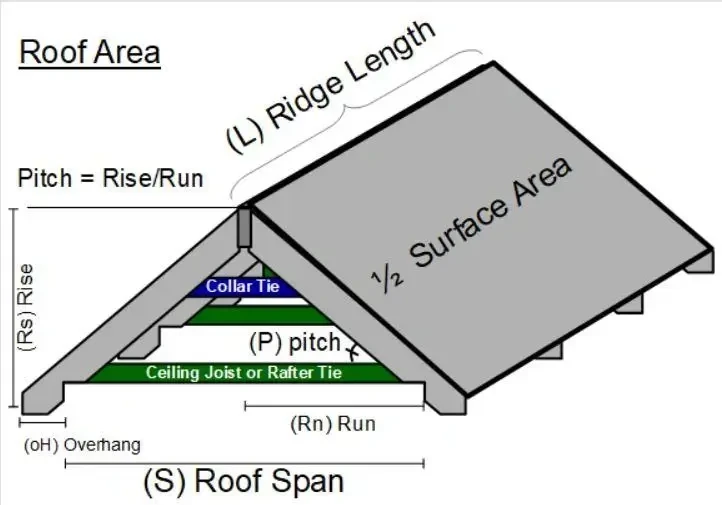
Notice the difference between 20° and 45° on the same 12×6 plan: about 25 m² of extra slope area. That's a whole stack of slates you'd miss if you ordered by floor plan alone. If your roof has hips, valleys, dormers or gable returns, take each slope as a separate rectangle (or triangle) and add them up — never measure the whole building as one big flat rectangle.
One measurement pitfall: if the 6 m in our example is the horizontal depth of a single roof slope (half the span), the 72 m² only covers one side of a gable roof. Multiply by the number of slopes — a gable roof has two. When in doubt, enter the total roof footprint: length × the full horizontal span, and the calculator counts the whole roof for you.
Step 2 — Slate Gauge: The Numbers That Come From Your Headlap
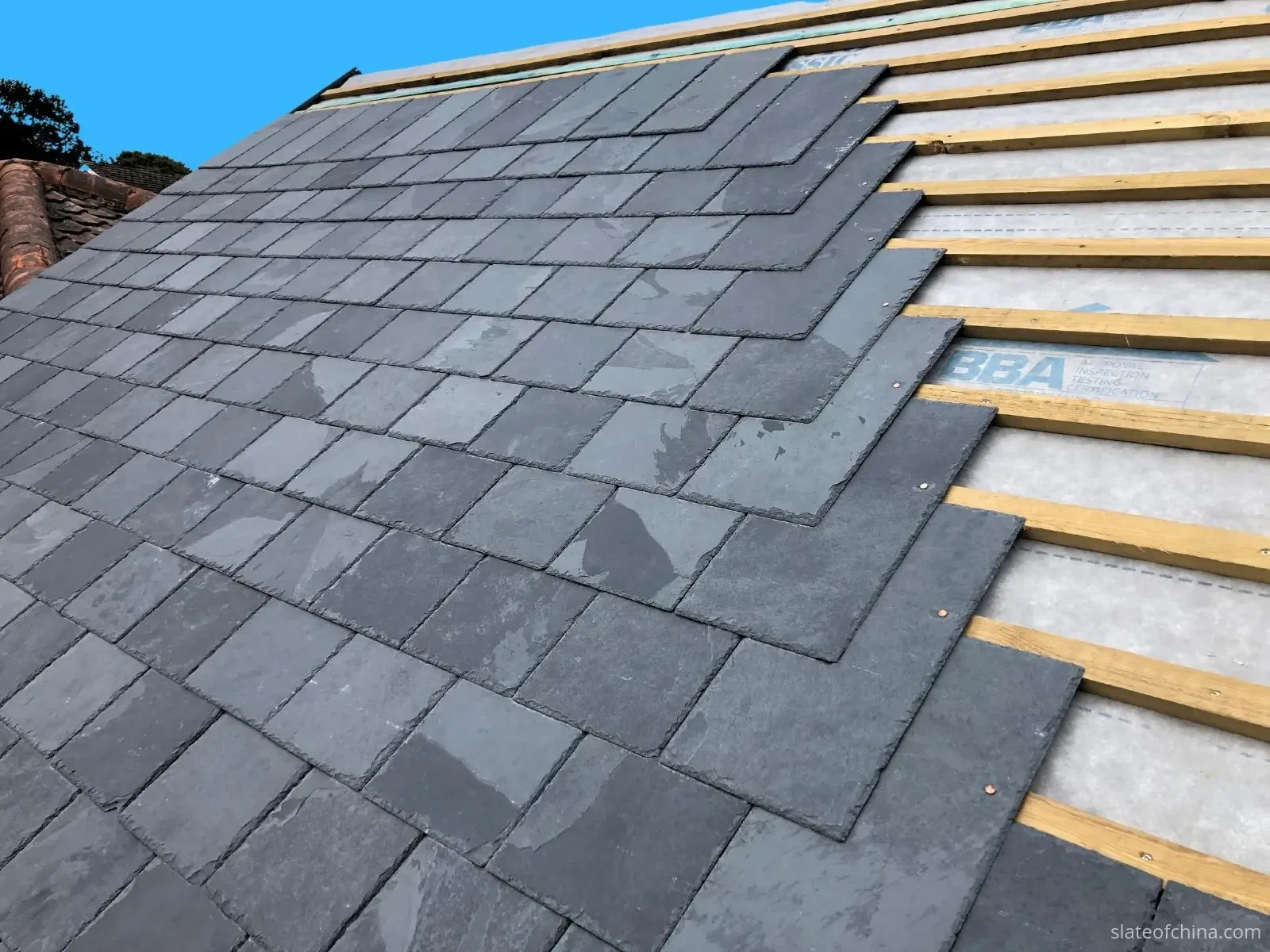
Your slates don't cover the full length of the tile. Every course overlaps the one below by the headlap — the distance the slate sits over the tail of the slate two rows below. Headlap is what keeps wind-blown rain from getting in, and it's what makes the roof a roof.
Headlap is a design decision, not a fixed universal number. In UK and European practice 75 mm is a common starting point for many pitched roofs, and 100 mm (sometimes 110 mm) is often specified on exposed coastal sites, at lower pitches or in taller buildings. These are example figures rather than a universal spec — the value is set by the roof design, the exposure class and the local code, not simply "steeper always means more". Confirm the headlap your project uses before you calculate, because it directly changes the slates-per-m² number.

Gauge (exposure) = (slate length − headlap) ÷ 2
So a 500 mm slate at 75 mm headlap is exposed 212.5 mm: (500 − 75) ÷ 2 = 212.5 mm of visible slate per course. Every calculator in the world that covers roofing slate uses this same line.
Step 3 — Slates Per Square Metre (and Per Square)
Once you have the gauge, everything else is division:
Slates per m² = 1,000,000 ÷ (gauge × slate width)
For a 500×250 slate at 75 mm headlap: gauge = 212.5 mm; one slate covers 212.5 × 250 = 53,125 mm² = 0.053 m². So 1 m² / 0.053 = 18.8 — the exact figure is 18.8 slates per m² (call it 19 for budgeting).
| Slate size (mm) | Headlap (mm) | Gauge (mm) | Slates per m² |
|---|---|---|---|
| 500×250 | 75 | 212.5 | 18.8 → 19 |
| 500×250 | 100 | 200 | 20.0 |
| 600×300 | 100 | 250 | 13.3 |
| 600×300 | 75 | 262.5 | 12.7 → 13 |
| 450×250 | 75 | 187.5 | 21.3 |
| 400×250 | 75 | 162.5 | 24.6 |
| 400×200 | 75 | 162.5 | 30.8 |
| 300×200 | 75 | 112.5 | 44.4 |
If you're working in imperial, remember the rule of thumb: a square is 100 ft² ≈ 9.29 m². So 500×250 at 18.8/m² works out to roughly 175 slates per square.
Step 4 — Waste: The Number That Saves You a Second Container
Now take the raw count and add waste — and this is where a lot of people come unstuck.
There are three types of waste to think about:
- Cutting waste — slates cut for eaves, gables, hips, valleys, verges and around dormers. On a plain rectangular roof with no hips, that's small: 3–5%. Add 2–3% for every hip or valley.
- Defective slates — even on our own factory runs, we pull a small fraction at 100% inspection that isn't quite right — a soft edge, a hairline vein that only shows under tension, the odd sliver that breaks on the way to the crate. That's another 1–2%.
- Transport damage — even with careful packing, a small fraction of slates can knock at the corners or edges in transit. That's why we recommend adding around 2% on top of the cutting waste; the practical figure varies with the route and how the pallets are handled, so it's worth confirming with your supplier.
All together: 5–8% waste is the working range for a simple roof, 10–12% for steep or complicated ones. And here's the money rule: order the spare slates in the same batch. A roof is a 100-year decision — that handful of spares will probably be damaged or long gone by the time you need a replacement, and a late top-up from a different production batch means a slightly different colour that sits there like a sore thumb. Better to pay for one extra crate now than two phone calls and a mismatch later.
A Real Example, Done End to End
Let's price a 12 × 6 m, 35° gable roof in 500 × 250 mm slate at 75 mm head:
- Flat measure: 12 × 6 = 72 m².
- Slope factor at 35° = 1.221 → 72 × 1.221 = 87.9 m².
- Slates per m² at 500×250 = 18.8 → 87.9 × 18.8 ≈ 1,652.
- Add 8% waste → 1,652 × 1.08 ≈ 1,784 slates.
That's it. For a typical UK slate of 4–6 mm thickness, 1,784 slates weighs roughly 2,400–3,700 kg plus pallets — worth confirming with your supplier that the roof structure and transport weight match before you commit.
Checklist Before You Order
| Check | Why it matters |
|---|---|
| Measure each slope separately | Hips, valleys and gable ends change the real area more than you think. |
| Confirm the headlap with your roofer | 75 mm vs 100 mm changes slates per m² by nearly a whole slate on 500×250. |
| Use the pitch factor, not the floor plan | On steep roofs the slope area is 20% more than the plan. |
| Round up, never down | Always round to the next whole slate — and the next crate or two. |
| Order the full quantity from the same batch | Colour and surface consistency across the whole roof. |
| Add transport-damage allowance | 2% is the least of our shipments; it covers corners and edges. |
| Check the total weight against your structure | 19 slates/m² at 4 mm ≈ 26 kg/m²; at 6 mm ≈ 38 kg/m². |
If you need the per-size coverage in one glance without doing the division yourself, our slates per square metre reference page has a full table with the most common UK and European sizes — the same numbers our sales team uses when quoting.
Why People Order Too Much or Too Little — And How We Fix It
Over the years we've re-quoted plenty of jobs where the mistake wasn't the multiplication — it was the roof measurement or the waste allowance. One importer ordered for the flat plan of a big house with a 45° attic and came up around 25% short; the container arrived, the slater laid half, and the re-order cost them more than two weeks' lead time. That's exactly the kind of miss that an accurate roof area and a sensible waste figure avoid.
That's also why our factory stamps every order with a coverage note on the packing list: how many m², how many slates, which headlap, which gauge. If it doesn't match your own count, you check with us before the container ships — not after.
Frequently Asked Questions
How many roofing slates do I need per square metre?
For 500×250 slates at 75 mm headlap, about 19 slates per m² (the gauge is 212.5 mm). Smaller sizes use more: 400×250 gives roughly 25 per m², and 300×200 gives 44. The exact number depends on the headlap you fix, so always confirm with your roofer before ordering.
How do I calculate the roof area for slate?
Measure the plan (length × width) and multiply by the slope factor for your pitch: 1.10 at 25°, 1.16 at 30°, 1.22 at 35°, 1.31 at 40°, 1.41 at 45°. Then multiply the slope area by the slates-per-m² for your size. That's your base count before waste.
What headlap should I use for roof slate?
75 mm is a common starting point for many pitched roofs, and 100–110 mm is used at lower pitches or on exposed coastal sites. Headlap is a design decision set by the roof, the exposure and the local code — not a fixed universal number — so confirm it with your roofer before ordering.
What is the minimum roof pitch for slate?
Natural slate is usually recommended for pitches of 20° and above. Below 20°, the exposure must be reduced and headlap increased, and many roofs simply switch to different systems. Our roof pitch guide goes through this in more depth.
How many square metres does a 20ft container of slate cover?
It varies with slate size and thickness, but a practical figure is around 300–500 m² of roof coverage per 20ft container for 500×250 roofing slate — the weight of slate usually fills the container by weight before volume. Your supplier's packing list will state the exact m² per pallet; ask for it before you book the box.
Need the numbers to line up before you order?
We calculate coverage on every quote — size, headlap, gauge, slates per m² and m² per container. Browse our roofing slate products or see how we test every batch.
Or contact us with your roof measurements — we'll send you the count and the quote.