
Specifying Natural Slate: A Short Guide for Architects
The short version. A slate specification earns its keep when every clause can be checked — against a standard, a tolerance, or an approved sample. Start with the application, not the colour. Put each standard citation where it answers a question. And write acceptance in words a site team can verify, not phrases nobody can measure.
A good natural slate specification can fail long before a single tile is ordered. Not because the stone is wrong, but because the document is too light to hold a decision. The words "premium natural slate, dark grey" read well in a proposal deck. On a site meeting, across a delivery that runs a shade greener than the swatch, they settle nothing. The whole purpose of a written specification is that it can be verified. If a clause cannot be checked against a standard, a tolerance, or an approved sample, it will not survive contact with the contractor.
This is a working note on how to write those clauses: the sections, the standard citations, the test references, and the wording that keeps an architect's intent intact from procurement to handover.

Start from the application, not the colour
A slate that carries a roof well may be a poor choice on a floor, and the reverse is just as often true. Each application brings its own exposure, loading and finishing conditions, so the first decision in a specification is not which shade looks best but what the material actually has to do.
A roofing slate sits inside a weathertight assembly. It answers to pitch, headlap, underlayment and fixing, and its thickness changes the weight on the structure. A slate wall cladding is a ventilated or drained assembly with a substrate, rails and restraints of its own. A floor finish answers to traffic, wear and slip resistance, and an interior wall to panel thickness and substrate compatibility.
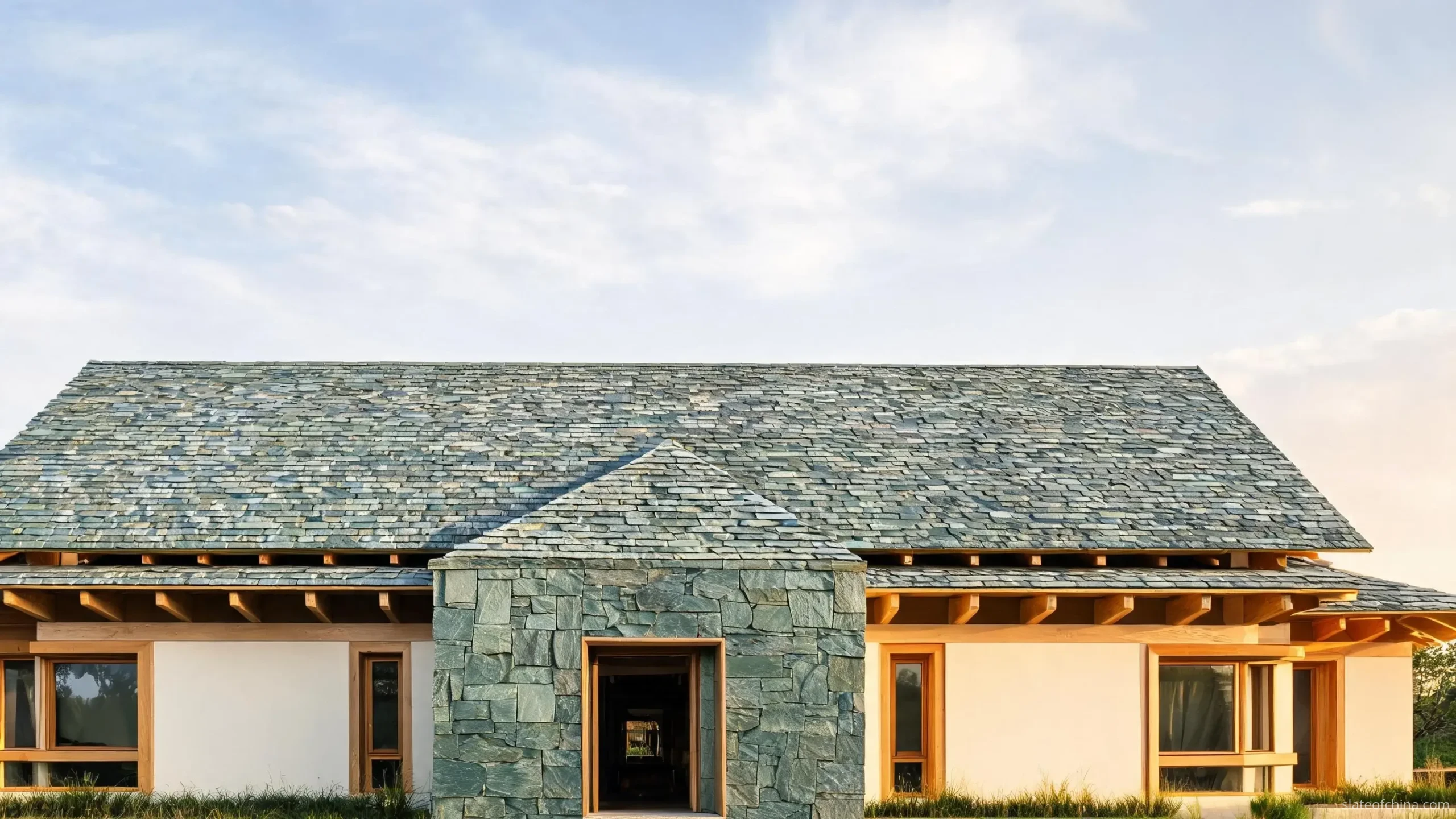
Working rule: Never assume that slate suitable for one application is automatically suitable for another. The product standard, the testing and the detailing all have to match the intended use.
Give the document a spine: the three-part structure
In North American construction documentation, the familiar three-part structure gives a specification section a readable spine. For slate shingles, a useful starting point is section 07 31 26.
Part 1 — General: Scope, referenced standards, submittals, samples, quality assurance, delivery, storage and preinstallation meetings.
Part 2 — Products: Slate source, grade, size, thickness, colour range, physical properties, testing, and accessories.
Part 3 — Execution: Substrate verification, installation, mock-ups, workmanship, field quality control, protection and final acceptance.
The value of the spine is that it forces the specifier to decide what belongs in each list before the document goes out. A European project can keep the same logic inside its national format; the underlying discipline is unchanged.
Put each standard citation where it answers a question
A test method, a product specification and an installation standard are three different tools. The specification should cite each in the part where that question is asked, not dump them in a single references line and hope for the best.
For a roofing slate in North America, ASTM C406/C406M is the product specification; ASTM C120 covers flexural testing, ASTM C121 water absorption and ASTM C217 weather resistance. In Europe, EN 12326-1 sets the product requirements for natural slate and carbonate slate for discontinuous roofing and external cladding, with EN 12326-2 providing the associated test methods, while EN 1341, EN 12058 and EN 1469 govern external paving, floor finishes and wall cladding respectively.
| Standard | Primary role |
|---|---|
| ASTM C406/C406M | Roofing slate product specification |
| ASTM C120/C120M | Flexural strength testing |
| ASTM C121/C121M | Water absorption testing |
| ASTM C217/C217M | Weather resistance testing |
| EN 12326-1 | Natural slate product requirements for roofing and external cladding |
| EN 12326-2 | Associated test methods |
The roles are not interchangeable: a product standard sets requirements, a test method generates evidence — which is exactly why each citation belongs in the part of the document where that question is answered.
A full walk of what each EN and ASTM standard covers, and where a roofing report does not certify a floor, sits in the architectural slate standards guide. The one line to keep here is the discipline: an EN class and an ASTM class are not interchangeable without a documented assessment, and a citation should name the edition, because methods change when a standard is revised.
Say what the product must measure: dimension, thickness, appearance
The products part is where a slate stops being a mood and becomes a list of measurable requirements.
Origin and identification: Specify the approved product and supplier, and a declared source where traceability is required. Slate from different geological formations splits, weathers and colours differently, so the identity should stay consistent across the approved samples, the laboratory reports and the delivered batches.
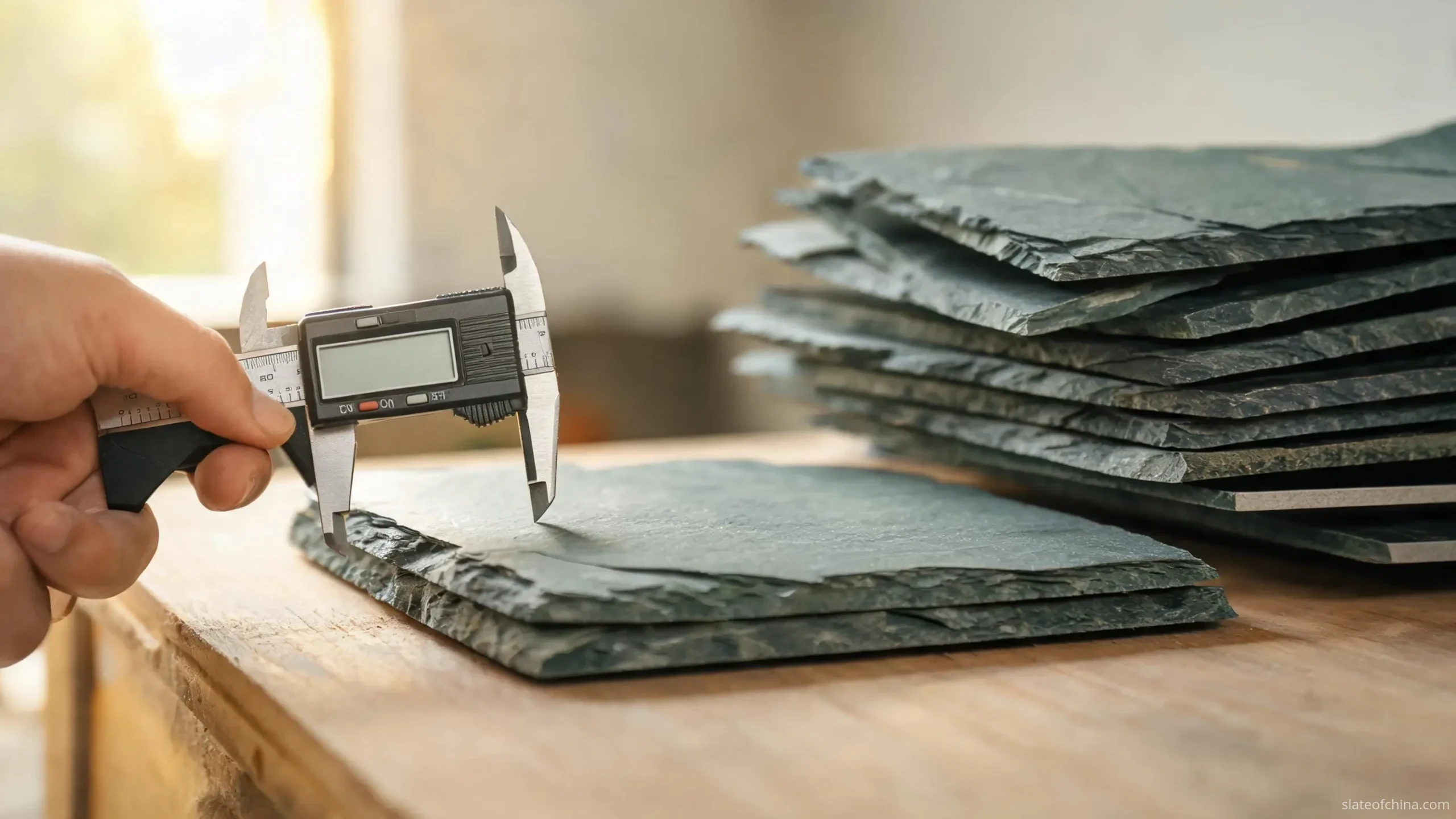
Dimensions and tolerance: A nominal length, width and thickness are not enough. State the permitted tolerance and any sorting or grading requirement. Thickness changes weight and fixing on a roof, and the fixing method on a wall. There is no universal tolerance to copy in; the workable range depends on the product, the application, the governing standard and the approved system design.

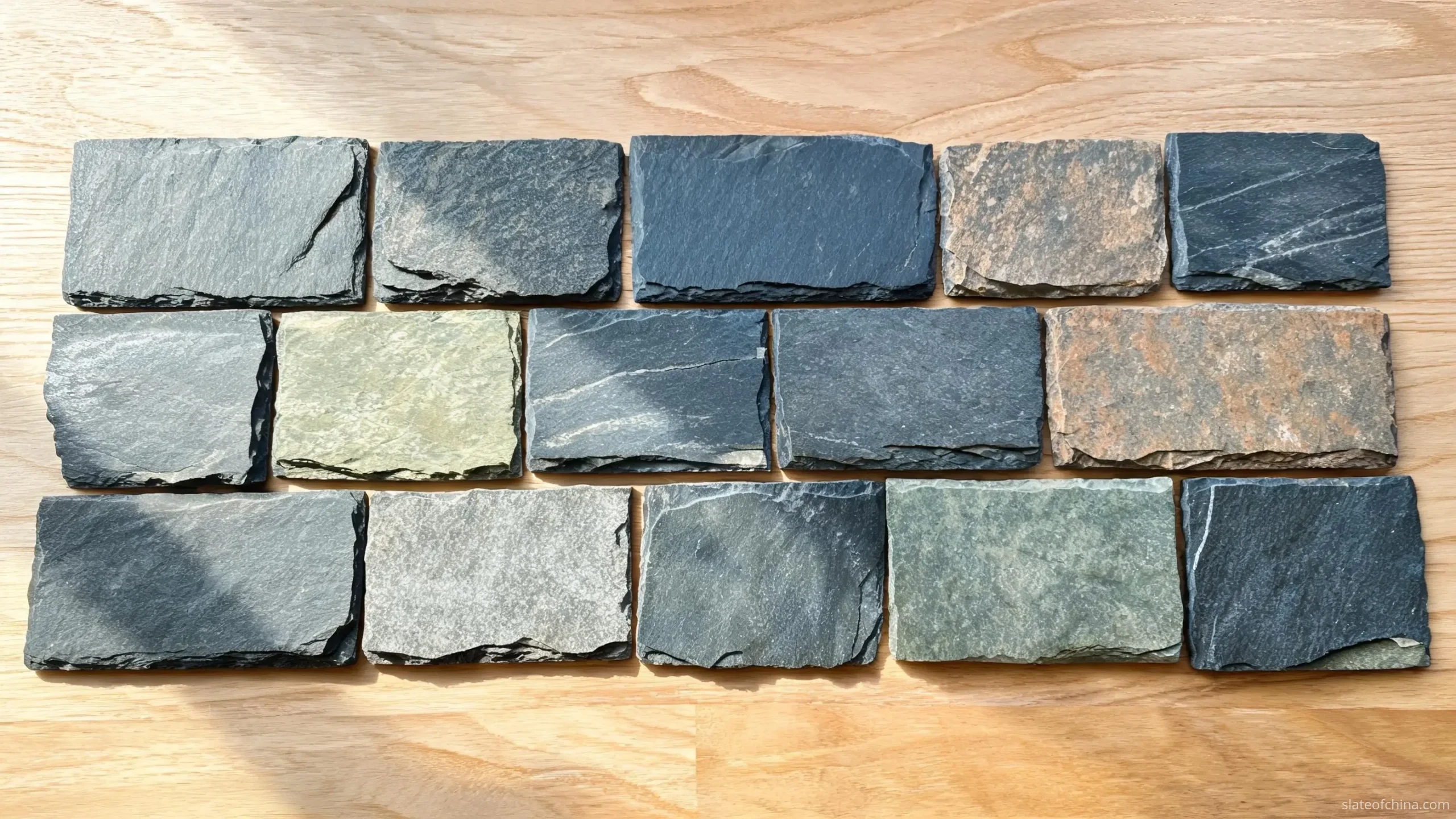
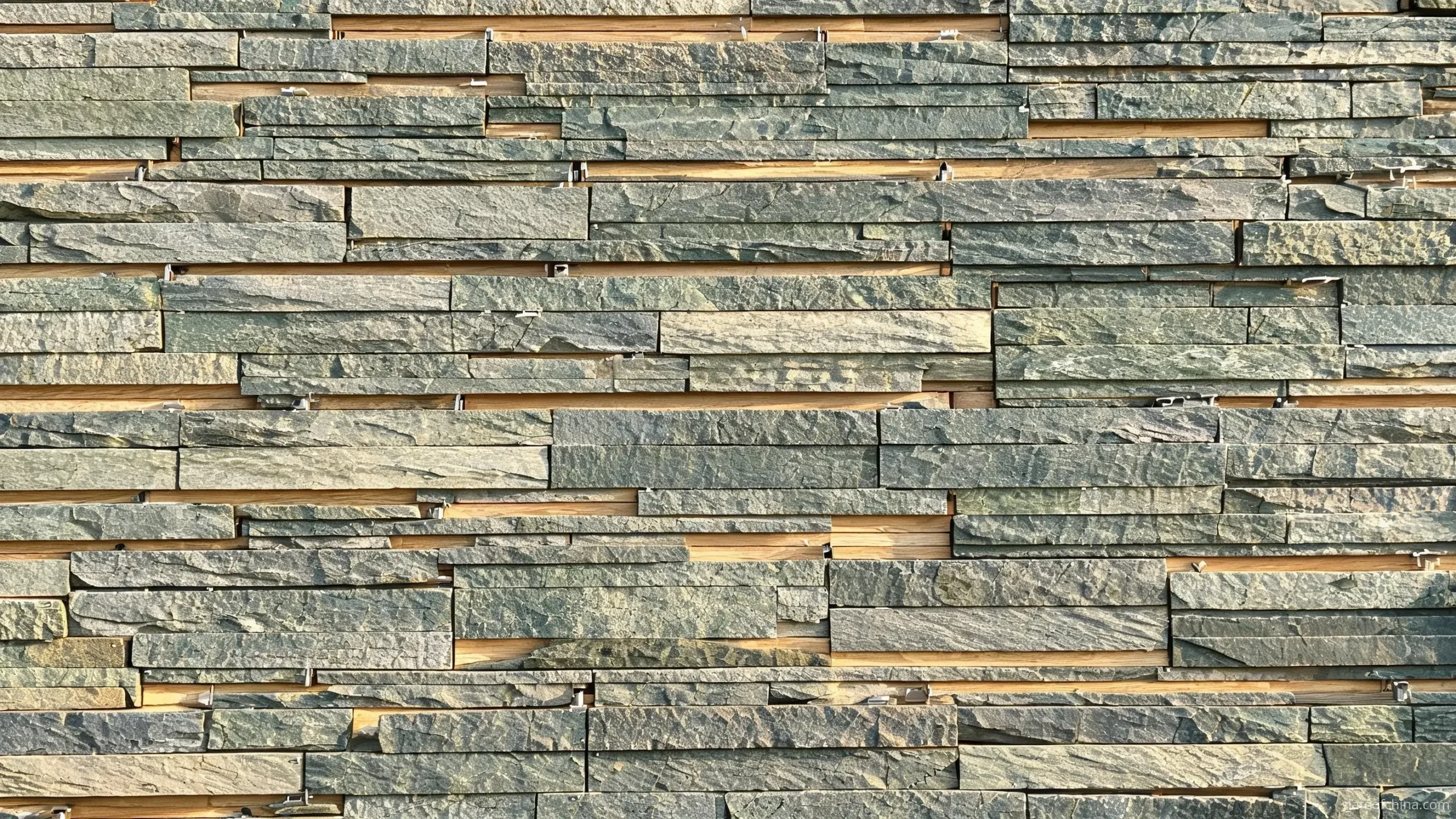
Colour and texture: Natural slate is a variable material. A useful specification defines an approved range of shade, tone and grain, and a clear boundary between that variation and a real defect — a crack, an unsuitable inclusion or delamination — so a contractor can tell one from the other.
Water absorption and durability: Water absorption is a real indicator in an exposed environment, but it is not the whole story. Review the relevant classification, flexural performance and weather resistance, and reflect freeze–thaw or aggressive conditions where the site demands it. Do not publish a figure for a product without a report that names it.
Require a test report that names the slate
The most common failure in procurement is a report that does not belong to the offered stone. A folder of certificates tells you nothing until each one can be tied to the boards that will actually ship.
Before you approve, run the report through six questions: which product does it name, or is it an adequately traceable representative? which method and edition does it cite? are the measured values or classifications shown? do they meet the project requirement? is the laboratory competent for that test, remembering an ISO/IEC 17025 claim only covers the accredited scope? can the tested material be connected to the product being supplied?
A useful clause is short: submit identifiable test reports showing the proposed natural slate, the applicable test methods, the measured results or classifications, and sufficient traceability to demonstrate compliance with the specified requirements. That is more honest than a request for "international quality certificates".

On the supplier's side of the desk the discipline is the same. If someone asks us for "a certificate", we ask three things back — which standard, which edition, which product — because a named test and a named stone are the only combination that carries weight on the order. For a look at test data published at product level, see our Jiujiang slate test results page.
Approve a range of samples, not one perfect piece
One handsome tile is an anchor, not an answer. Natural slate varies, and a single piece cannot show the range a finished roof or facade will present. Where the look matters, ask for a representative selection and, where several elements combine — size, coursing, joint alignment, fixing visibility, transitions to adjacent materials — a project mock-up.
The approval process should settle four points: what is the approved colour and texture range? what dimensional and edge variation is acceptable? what difference between individual pieces is expected? which approved set is kept as the reference for comparing against delivery?
A site-ready sentence: provide a representative sample range showing the expected variation in colour, texture, thickness and edge, and retain the approved set as the reference for evaluating delivered material and completed work.

Coordinate the slate with the system around it
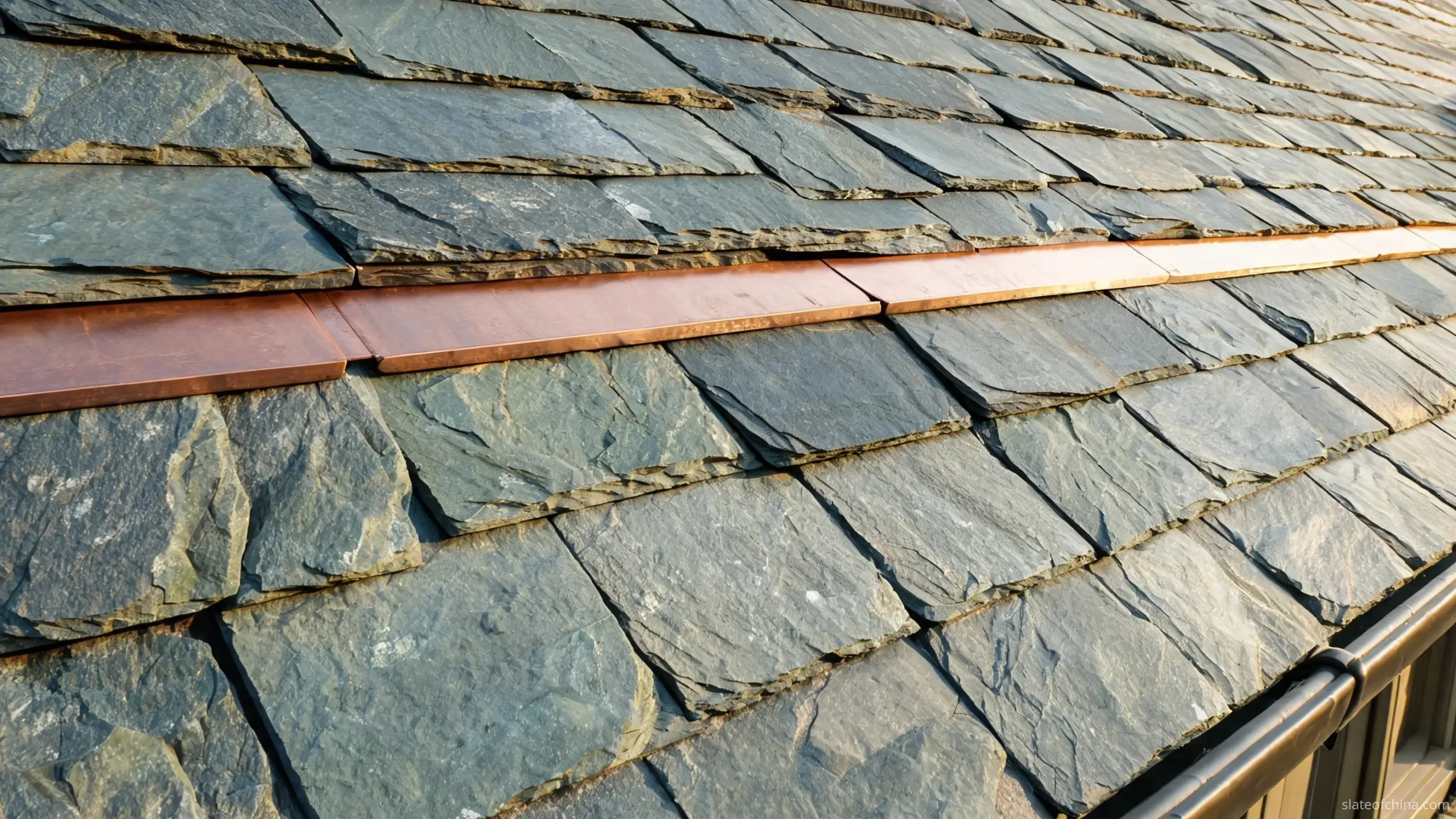
Product compliance is not assembly compliance. A slate can meet its own material standard while the finished roof or facade still fails, because the failure sits in the design of the assembly, not in the stone. The specification should therefore state who owns the system design and the installation, and what must be coordinated, rather than assume a good material implies a good envelope.
For a roof, coordinate the pitch, the headlap, the layout, the slate dimensions and fixing locations, the underlay and substrate, the fastener type and corrosion resistance, the flashings at valley, eave, ridge and penetration, and the wind, snow and drainage loads. For a cladding, coordinate the supporting structure, the fixings, the ventilation or drainage strategy, the movement joints and the relevant structural and fire requirements.
Write clauses that survive a site meeting
This is where the specification earns its keep. Compare the phrasing that fails a dispute with the wording a site manager can actually verify.
| Weak wording | Strong, verifiable wording |
|---|---|
| Use high-quality natural slate. | Provide the approved natural slate product meeting the stated material standard and acceptance criteria. |
| Colour shall be dark grey. | Colour and texture shall fall within the approved representative sample range. |
| Thickness approximately 6 mm. | Provide the stated nominal thickness within the documented and approved tolerances. |
| Install to best practice. | Install in accordance with the approved drawings and the approved installation method. |
| Provide test certificates. | Submit identifiable test reports demonstrating compliance with the specified methods and criteria. |
| Reject defective slate. | Reject pieces with defects exceeding the defined material and workmanship acceptance criteria. |
The goal is not a longer document. It is a document in which each critical requirement is anchored to a standard, a tolerance or an approved sample, so that a genuine disagreement can be settled on the numbers instead of on whoever speaks loudest.
A short drafting frame for a slate shingle section
This is an editable skeleton to adapt, not a complete project specification. Bracketed items are the project's to complete, and the final text has to be coordinated with local codes and the roof system design.
| Part | What to write |
|---|---|
| Part 1 — General | Scope; references to [ASTM C406/C406M, edition] or other project-applicable standard; submittals of product identification, technical data, test reports, samples, shop drawings and installation instructions; a representative sample range for approval. |
| Part 2 — Products | [Approved product, supplier, source]; [length x width x nominal thickness] within [approved tolerances]; performance meeting the [specified classification]; appearance matching the approved sample range; compatible approved fixings and accessories. |
| Part 3 — Execution | Verify the substrate before installation; install per approved drawings and procedures; coordinate headlap, fixing, flashing, drainage and penetrations; reject nonconforming material; complete inspection and acceptance against approved samples. |
Example material clause — natural slate roofing (illustrative template to adapt, not a complete specification):
Provide natural roofing slate complying with [applicable standard and edition], nominal dimensions [length × width × thickness], within the approved dimensional tolerances. The product shall meet [specified performance classification], supported by identifiable test documentation for the proposed product. Colour, texture and edge characteristics shall be consistent with the approved representative sample range.
For a European project, revise the standard, the terminology and the format to the national system rather than swapping an ASTM number for an EN number and calling it done.
Plan for delivery and site acceptance before the truck arrives
Delivery is where the paper meets the job. The specification should give the contractor a checkable list: identity, quantity, dimensions, condition and batch where relevant, against the approved samples — and identify mixed, damaged or non-conforming material before it is built in.
Where a preinstallation meeting is required, gather the architect, contractor, the relevant specialists and the supplier, and settle the mock-up, the sequencing, the protection of completed work, the interfaces and the inspection responsibilities while they are still cheap to change.

Six mistakes that send a specification back to the drawing board
- Choosing appearance without performance: A beautiful slate does not establish compliance with a material standard.
- Listing standards without requiring a result: A citation should lead to a classification or acceptance criterion, or it is decoration.
- Confusing natural variation with unlimited variation: The range should be approved, not used to excuse an unrelated substitution.
- Ignoring the system interfaces: The valley, the rail fixing and the drainage decide the finished assembly.
- Approving untraceable paperwork: The test evidence must be traceable to the proposed product or a demonstrably representative material source.
- Leaving inspection rules until after delivery: Acceptance is only useful when it is agreed before procurement.
A quick checklist before you issue
- Application and scope are defined in one sentence.
- Applicable standards and editions are named.
- Source and product designation are documented.
- Dimensions, thickness and tolerances are stated.
- Performance and test evidence are defined.
- Representative samples and a mock-up are required.
- Fixing, substrate and interfaces are coordinated.
- Delivery and site acceptance criteria are written.
- Installation responsibility and inspection steps are documented.
Working with a supplier while the spec is still open
Engaging a supplier early helps an architect test a practical size, confirm the natural appearance range, and see which technical documents actually exist for the product. Supplier information should support the design, not replace it — the responsibility for the system and the acceptance stays with the designer.
At Slate of China we work with natural slate for architectural applications, and the same discipline applies on our side: an intended application, dimensions, quantities, project location and applicable standards will get a far more useful answer than a generic request for a swatch. Claims about a product are only put into a document when they belong to that product, with its method and its batch.
A good slate specification protects the design intent
Natural slate brings a texture, a depth and an endurance to a building that few materials match. The specification is the small amount of discipline that lets that character survive an order, a delivery and a site. It is not the longest document that wins; it is the one in which every requirement can be checked — by the designer, the supplier and the installer — against a standard, a tolerance, or an approved sample.

Frequently asked questions
What is the difference between an ASTM C406 and EN 12326 citation for slate?
ASTM C406/C406M is a North American product specification for roofing slate. EN 12326 covers natural slate for discontinuous roofing and external cladding in Europe. The two test and classify differently, so a class under one is not interchangeable with a class under the other without a documented assessment.
Why will a roofing test report not certify a slate floor?
Because standards follow the finished product, not the material. The evidence for a roofing product supports a roof; it does not by itself establish that the same stone meets the standard for a floor, a wall cladding or a paving.
What thickness tolerance should I write into the specification?
There is no universal value. The workable range depends on the product, the application, the governing standard and the approved system design. State the nominal thickness and a tolerance that matches the approved product and the supplier's stated capability.
How should I ask for samples in the specification?
Require a representative selection showing the expected variation in colour, texture, thickness and edge, keep the approved set as the reference, and require the delivered material to fall within it. A single sample shows a texture, not the range.
What makes a test report useful for the project?
A useful report names the proposed product or an adequately traceable representative, cites the test method and edition, shows the measured results or classifications, and connects the tested material to the product being supplied.
Do I need a mock-up for a slate project?
Not always, but it earns its keep wherever several elements shape the appearance — size, coursing, joint alignment, fixing visibility and the transition to adjacent materials — or where the visual look is a contract condition.
How do I write a clause that survives a site meeting?
Make it verifiable. Anchor each dimension, tolerance and test to a standard, a tolerance or an approved sample, and give the acceptance criteria, rather than phrases such as high quality or best practice that nobody can check.
Related reading
Need to specify natural slate for an upcoming project?
Share your application, preferred slate size and thickness, estimated quantity, project location, and the standards the project works to. We will review suitable product options with you and confirm available samples and product-specific technical documentation — so that what goes into your specification can be checked.
Discuss your project with Slate of China