
Slate Mosaic and Accent Panels
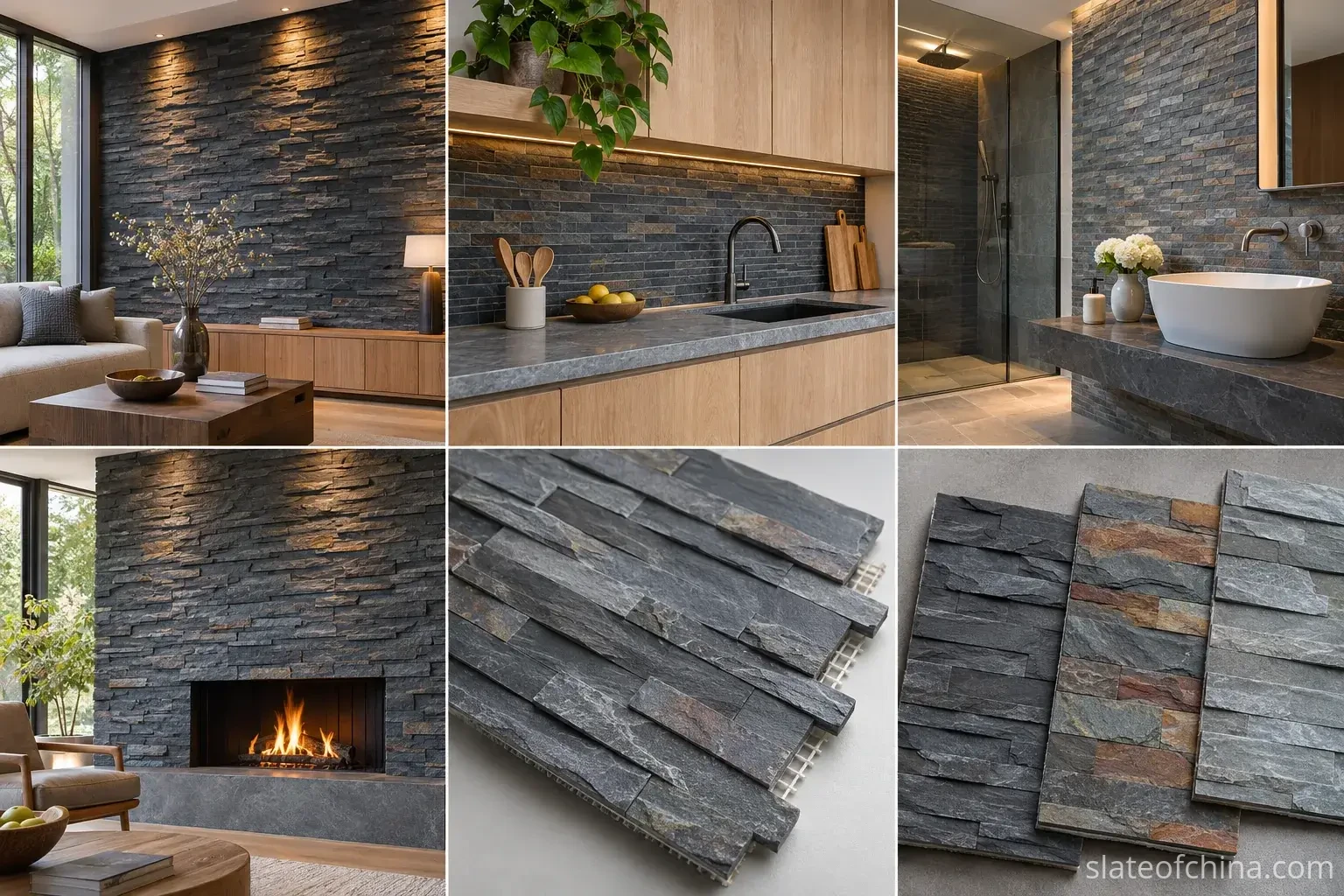
A slate mosaic is chosen from a single sheet and lived with as an entire wall. In a showroom, the product is a neat square that one person can hold up to the light. On site, the same product becomes thousands of small stones spread across a feature wall, a backsplash or a fireplace surround — and the wall is where any weakness in colour, thickness or assembly finally shows.
That gap between the sample and the finished wall is what this page is about. It covers the small-format side of natural slate wall cladding — strip mosaics, mixed-size modules, geometric patterns and the accent panels built from the same stone — along with the sizes these products actually come in, the rooms they work best in, and the checks at sampling for colour and calibration that decide whether the wall that ships matches the wall that was approved.
Most of the work of buying small-format slate well happens before production starts. The sections below move from format to pattern to size, then slow down where the money is: colour ranges, thickness calibration, assembly quality and the written specification. One principle repeats along the way, and it is worth stating up front — small-format slate is specified, sampled and approved in ranges, not in single pieces.
The short version: Slate mosaic tiles are small pieces of natural slate — narrow strips, small rectangles or mixed modules — assembled into mesh-mounted sheets or larger accent panels for walls. Typical uses run from kitchen backsplashes and bathroom accent walls to fireplace surrounds and commercial feature walls. Because every piece of natural slate varies in colour and thickness, the sample check that matters is a range check: read colour across several sheets, measure thickness across individual pieces, test the mesh or panel assembly, and approve the agreed ranges in writing rather than one attractive sheet.
What a slate mosaic actually is
A slate mosaic is a decorative wall product made from many small pieces of natural slate, arranged into a repeating or mixed pattern and supplied in a form an installer can actually handle. Three constructions cover most of the market:
- Loose pieces — individual small stones, hand-laid one by one; the freest layout and the slowest coverage.
- Mesh-mounted sheets — small slate pieces pre-attached to a fibre or plastic mesh backing, commonly around 300 × 300 mm; the standard format for strip and geometric mosaics.
- Preassembled accent panels — narrow strips already built into larger boards, often with a split-face texture and interlocking ends, for fast coverage of bigger walls.
The panel families — ledger strips, Z-shaped panels, mushroom stone and split-face boards — have their own page in Stone Veneer and Ledger Panels. This page stays with the small-format side of the wall cladding range: the strips, modules and patterns that read as texture rather than as masonry, and the sampling discipline they demand.
These formats look similar in photographs and behave very differently on site. A flat mesh sheet suits a kitchen backsplash that gets wiped daily; a deeper split-face panel suits a dry feature wall where shadow matters more than cleanability. The choice is about appearance, cleaning, substrate and exposure — not about which product is "better".
The pattern families and how they read
In small-format slate, the pattern is the product. The arrangement of the pieces does more to a wall than the colour does; two mosaics cut from the same block can read as completely different materials.
Linear strip mosaics use narrow rectangular strips — commonly in the 15–30 mm face-height band — set in horizontal running-bond courses. The wall reads as fine horizontal movement: contemporary, quiet, effective behind counters and along long walls. Dark grey and charcoal strips give a restrained modern look; mixed grey and rustic tones introduce more visible variation.
Mixed-size modules combine pieces of different lengths and heights in a repeating arrangement, so the wall reads as handcrafted rather than manufactured. One caution is worth keeping: irregularity in the pattern is a design decision, not a manufacturing excuse — a well-made mixed module still holds controlled overall dimensions and consistent assembly.
Geometric mosaics — squares, rectangles, herringbone, basket-weave — put the pattern itself in the foreground, which suits bathrooms, splash zones and smaller decorative areas. Not every slate variety takes kindly to intricate shapes: the stone's cleavage and cutting behaviour limit how small and how angled a piece can be cut cleanly, so geometric layouts should be sampled early, not assumed.
Stacked accent panels deliver the layered, shadowed look of stacked stone at installation speed, and their families and sizes are described in detail on the ledger panels page. They appear here only where sampling intersects them.
| Pattern | How the wall reads | Where it works best |
|---|---|---|
| Linear strips | Fine horizontal movement, contemporary | Backsplashes, long walls, modern interiors |
| Mixed modules | Handcrafted, irregular rhythm | Feature walls, rustic and transitional interiors |
| Geometric layouts | The pattern itself is the focal point | Bathrooms, splash zones, decorative areas |
| Stacked accent panels | Layered depth and shadow | Fireplaces, reception walls, large features |
Sizes: what the catalogue number hides
There is no universal size standard for natural slate mosaic. Dimensions vary with the stone, the maker and the assembly method, and catalogue numbers describe intentions more often than deliveries. The figures below are illustrative market ranges — starting points for a specification, not stock sizes — and every dimension on a live order must be confirmed with the supplier.
| Format | Example dimensions | What they suit |
|---|---|---|
| Narrow strips | 15–30 mm face height; fixed or mixed lengths | Linear and fine-texture patterns |
| Small rectangles | 25 × 50, 25 × 75 or 50 × 100 mm | Repeating geometric layouts |
| Mesh sheets | Around 300 × 300 mm; 300 × 600 also common | Modular handling on site |
| Accent panels | Around 150 × 600 mm | Fast coverage of larger walls |
| Flat mosaic pieces | About 6–10 mm nominal thickness | Flat wall finishes, subject to suitability |
| Split-face relief | About 8–20 mm overall depth, or more | Stronger relief and shadow effects |
The arithmetic of a nominal size is straightforward: a 300 × 300 mm sheet has a nominal face of 0.09 m², and for a regular square sheet that figure holds. What the label alone cannot tell you is how much wall a laid area of that sheet actually covers. The joints between pieces inside the sheet are already part of its face; it is the joints left between one sheet and the next, staggered or interlocking edges, and the supplier's own coverage convention that move the final number. For planning, four figures matter more than the catalogue label: the actual sheet coverage as the supplier defines it, the piece dimensions, the joint width and the overall thickness range. Ask for those four in writing.
The arithmetic explains why sampling matters. A 40 m² feature wall at 0.09 m² nominal per sheet takes roughly 445 sheets before allowing for joints and cutting loss — and if each sheet carries fifty to sixty pieces, the wall is assembled from something like twenty-five thousand individual stones. No sheet on a sample table can speak for twenty-five thousand pieces. In slate mosaic, you approve a range, not a piece.
Where small-format slate works best
Small-format slate can sit quietly in the background or carry a room, depending on colour, pattern and light. Five settings cover most of the demand.
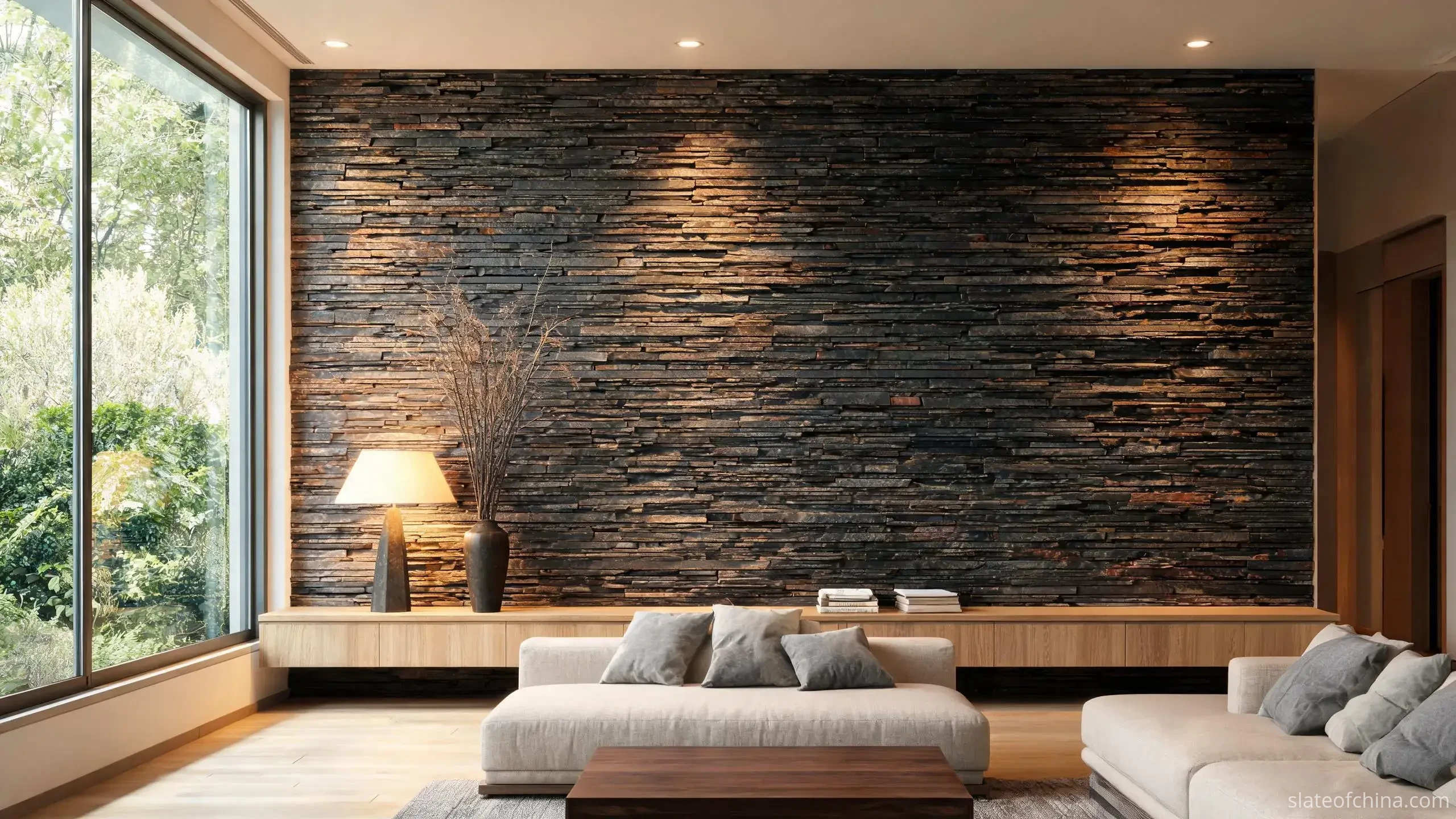
Living room feature walls. Charcoal and black slate accent walls give a minimalist interior depth without decoration, pairing naturally with light walls, timber furniture, brushed metal and warm indirect lighting. Most designers keep slate to one focal wall rather than every surface — texture this strong works by contrast.
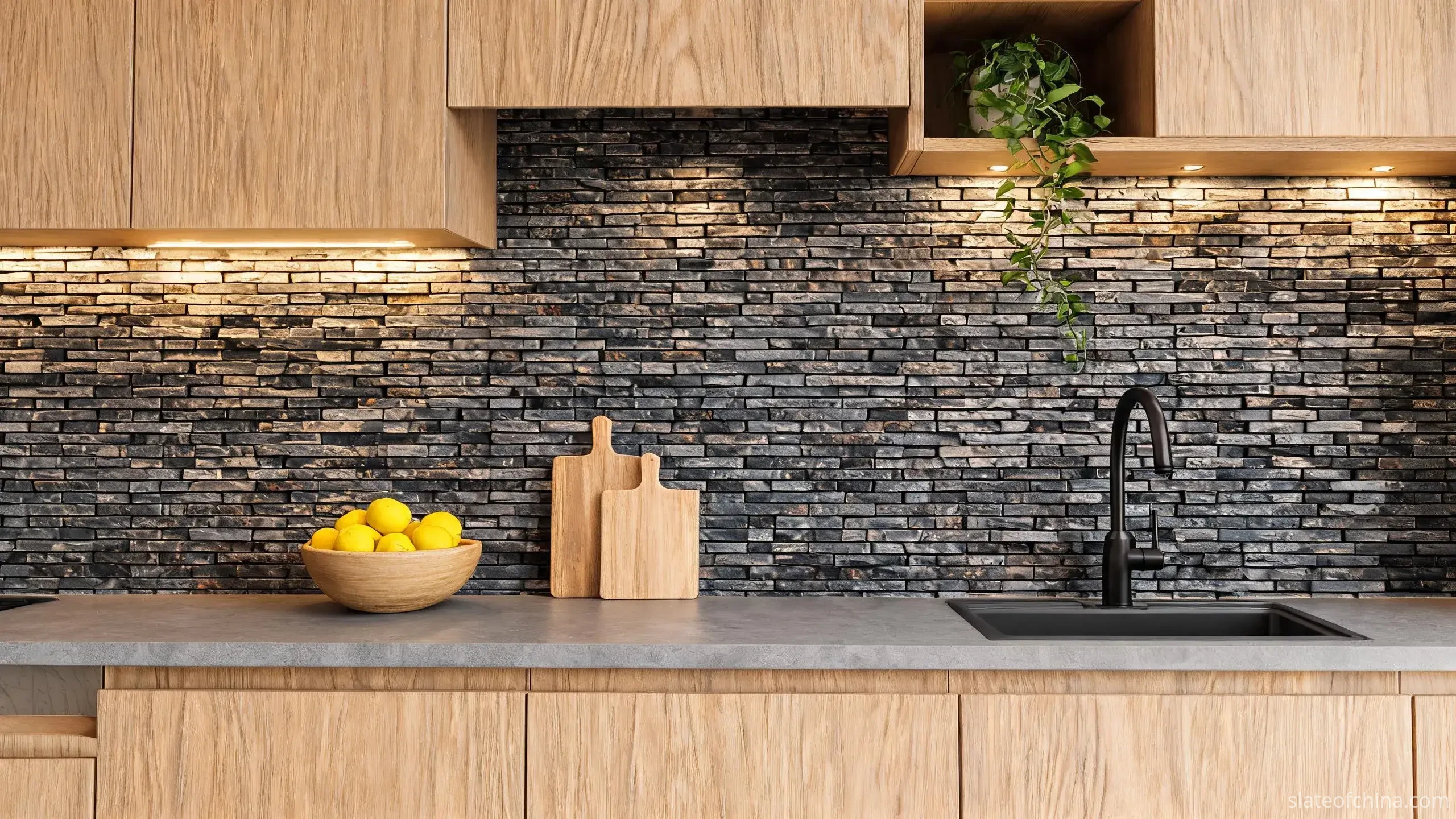
Kitchen backsplashes. Slate mosaic backsplash tiles bring natural texture behind counters and hobs, where a painted wall would scrub away. Smaller, flatter pieces are easier to wipe than deep split-face relief — behind a cooking surface, grease finds every cleft. Before a product is approved for a kitchen, the intended grout and sealer should be tested on a sample, and the cleaning method checked against textured stone.

Bathroom accent walls. A slate wall turns a plain bathroom toward spa, particularly beside warm timber and neutral ceramics. The distinction that matters is dry versus wet: a decorative accent wall near a vanity is a different job from a shower enclosure. In wet areas, the stone, the backing, the adhesive, the waterproofing and the maintenance regime must all be verified together — the stone surface itself is a finish, not a waterproofing system.
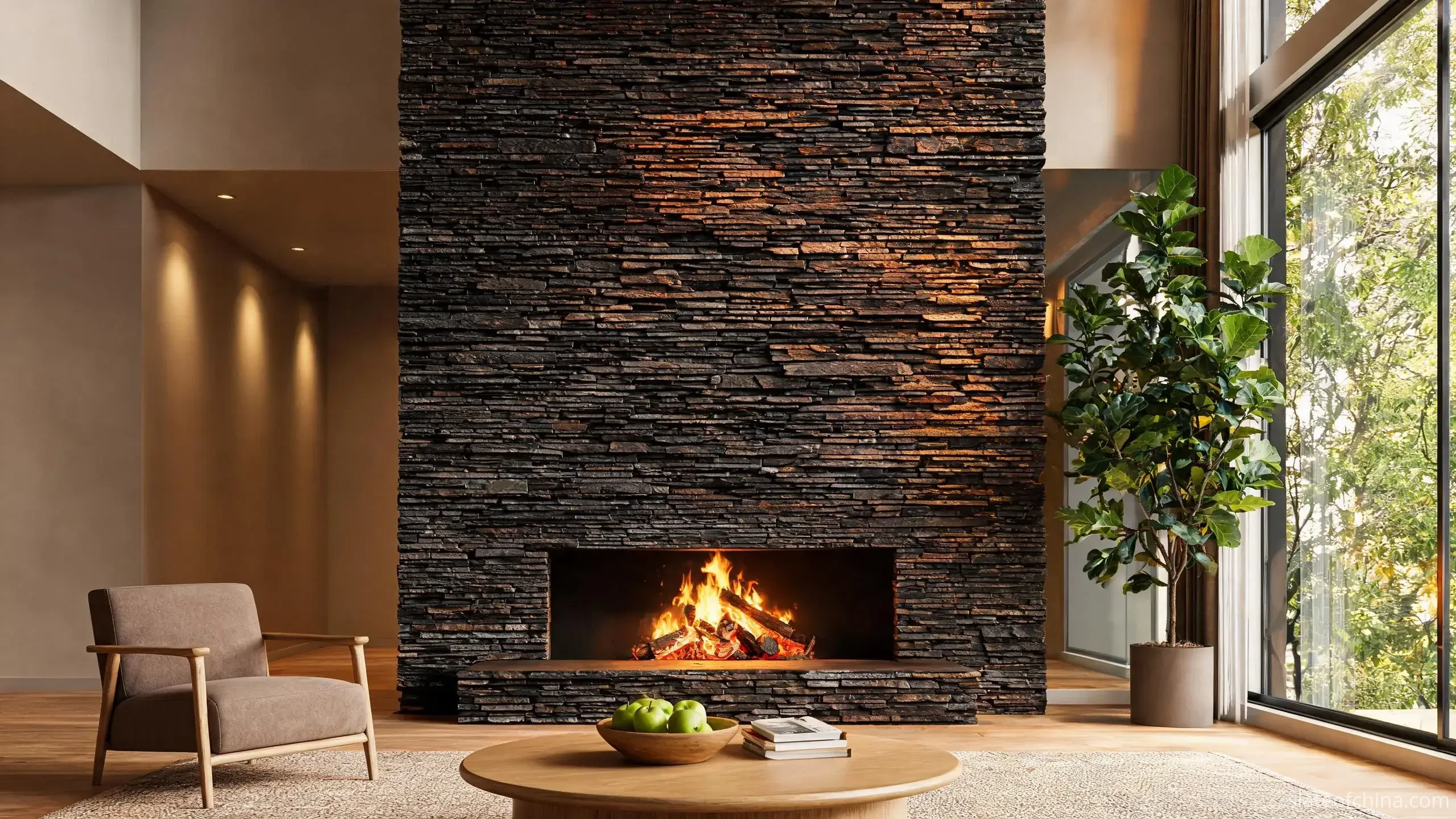
Fireplace surrounds. Dark slate reads at its best around fire: the layered surface catches warm light and returns it as texture. The construction, though, belongs to the fireplace maker's documentation — clearance requirements, and the temperature limits of adhesives, mesh backings and any sealant. A decorative panel is never assumed suitable for direct or high-temperature exposure without project-specific verification.
Commercial interiors. Hotels, restaurants, receptions and retail spaces use slate accent panels to give a room a material identity that paint cannot. Commercial specification adds its own questions: impact resistance, cleaning access, fire-performance requirements, and whether the same pattern can be supplied again years later for an extension or a repair.
Everything above is an interior conversation. Taking small-format slate outdoors changes the questions — climate, moisture, freeze-thaw where relevant, substrate and attachment — and the family-level fork between interior and exterior cladding is mapped in Slate Wall Cladding: The Buyer's Overview.
Colour: approve the range, not the sheet
Colour variation is not a defect in a natural slate mosaic; it is the material. Depending on the variety, a range can run from charcoal black and deep grey through silver-grey and greenish-grey to rustic browns and earthy mineral tones — and what varies is not just the base shade. Mineral markings, surface sheen and texture all differ from piece to piece and batch to batch.

In a mosaic, colour mixing happens at two levels, and both are manufacturing decisions as much as geology. Within a sheet, the assembler chooses which pieces sit next to which — a sheet can be built dark and quiet or deliberately contrasted. Across a batch, sheets cut on different days from different blocks can skew lighter or heavier than the sample. A sample sheet that happens to be mostly dark charcoal says nothing about a production run that is largely silver-grey; both are honest natural slate, and they are visibly different walls.
The professional response is to sample for the range, not the lucky sheet:
- Ask for representative samples — several sheets from production material, not a display piece chosen for its photograph.
- For larger projects, approve a mock-up panel or a control sample set that stays with the order as the reference for production and for any dispute.
- Lay the sheets together under lighting close to the site's own. Colour approval under showroom LEDs is not colour approval under warm domestic lighting.
- Step back two or three metres. At arm's length a mosaic is pieces; across the room it is a surface — and the wall will be judged from across the room.
- Compare dry and damp. Moisture darkens slate temporarily, and some treatments change colour permanently, so a wet corner of the sample shows the darker end of the range.
- Check for balance rather than uniformity: no sheet reading conspicuously light or dark against its neighbours, and no patch of repeated tone that will print itself across the wall.
One practice from the installation side is worth ordering around. Installers blend sheets from several cartons as they work — the ceramic-tile habit of box rotation, applied to stone. Ordering the full wall from one approved colour range, and blending during installation, keeps a large wall from mapping the batch boundaries of its own cartons.
The broader method — how to read a colour range in architectural slate before approving one — is covered in Architectural Slate Colour and Texture. For mosaics the conclusion is the same, compressed: you approve a range, not a sheet, and the range goes into the order in writing.
Calibration and thickness: the same rule in millimetres
Slate splits along its natural cleavage planes, so every piece carries a naturally cleft face and a thickness that varies. In a large tile, that variation is one edge condition a setter can manage. In a mosaic it is every joint: hundreds of small pieces side by side, each with its own bed thickness, and the differences read as lippage — ridges between neighbouring pieces — at exactly the close range where backsplashes and vanity walls are viewed.
Calibrated slate has had its back machined or ground to bring the pieces toward a consistent bed thickness. The reward is a flatter plane, more even adhesive control and easier alignment, which is why calibrated product dominates wherever a mosaic will be read at arm's length. "Calibrated" is a direction, not a promise — it does not mean perfectly uniform, and the tolerance still has to be agreed and written.
Uncalibrated, natural-cleft product keeps more of its original thickness variation. On a rustic feature wall viewed from across a room, that variation is part of the look; where a wall will be touched, wiped or read closely, it becomes an installation problem. The general trade-off between the two — and how to read the back of a tile — is laid out in Calibrated vs Hand-Cleft Slate. The mosaic-specific question is narrower: how much variation, measured how, across how many pieces.
Three numbers describe any mosaic's thickness, and a quotation that gives only one of them is hiding the others: the stone thickness, the supplied sheet or panel thickness as it leaves the factory (stone plus its mesh or backing), and the installed assembly thickness once site adhesive is added. Face relief — how far the split surface rises above the bed — reads across all three and matters most on split-face product. The same distinction applies to preassembled panels, and it is set out on the ledger panels page. On a sample, the work is a caliper protocol — measure ten pieces across three different sheets, record the minimum, the maximum and the spread, and repeat the protocol on each production batch's sample when an order spans batches. The number that protects the order is a range in millimetres, not a single nominal figure.
For stacked accent panels, add the maximum overall depth and the fit between adjacent modules. A single panel can measure perfectly while three side by side reveal gaps that only appear at scale — which is why panel sampling is done in groups, not singles.
What holds a mosaic together: mesh and assembly quality
A mosaic sheet is not a stone product with a backing; it is an assembly — stone, mesh, adhesive — and its quality lives in the assembly. A sheet of perfectly good slate assembled badly will fail as a wall product long before the stone itself gives any trouble.
Most wall mosaics ride on a fibre or plastic mesh. The mesh should be flat, fully bonded and compatible with the setting system, because the wall adhesive has to bond through or around the backing to reach the stone. A mesh that cups, delaminates at the edges or blocks adhesive contact is a hidden defect that no product photograph shows.

There is a low-tech first screen worth running on every sample: try to lift one piece at its corner with a fingernail. An easy release is a finding rather than a verdict — it calls for a closer look at how the mesh is bonded across the whole sheet, and where the order justifies it, an agreed formal peel or pull test with the supplier. Humidity in a bathroom, heat in a container and an installer's fingers adjusting a joint will all load that bond in ways a fingernail can only hint at.
Edge quality also reads differently at small scale. On a 300 mm tile, a chipped corner is a flaw; on a 25 mm piece, a chip is a visible percentage of the face. Inspect edges for clean cutting or splitting, and read the joint spacing within the sheet — uneven joints are assembly drift, not natural variation, and they compound across a wall.
Then push two sheets together on the sample bench and read the transition. The joints between sheets should carry the same rhythm as the joints within the sheet; when they do not, the finished wall prints a faint rectangular grid — the outline of every sheet — across the pattern. That failure is invisible in a single-sheet photograph and obvious on a large wall, which is exactly why adjacent-sheet fit belongs at sampling.
| Check | What good looks like | Red flag |
|---|---|---|
| Mesh bond | Flat, fully bonded mesh; corner-peel screen shows no easy release | Easy release at corners; mesh cups or delaminates — check further |
| Joint spacing | Even joints within each sheet | Uneven spacing that compounds sheet to sheet |
| Edge quality | Clean cut or split edges | Chips that read as a share of each small face |
| Sheet-to-sheet fit | Adjacent sheets continue the pattern | Visible sheet outlines or mismatched rhythm |
| Backing flatness | Sheets lie flat on the bench | Warped sheets that will mirror on the wall |
From sample to finished wall
A mosaic is only as flat as its substrate. The wall needs to be structurally sound, flat enough that adhesive beds stay thin and even, and able to carry the finished assembly. Setting materials should be specified for natural stone and applied per the manufacturer's documentation and the project's standards; the fixing routes for stone cladding generally — mortar, adhesive, clips and rainscreen — are compared in Slate Cladding Fixing Methods.
The classic mosaic failure is the sheet line: rectangular shadows where each mesh sheet meets the next, caused when the spacing between sheets differs from the spacing between pieces within a sheet. The fix is dry layout — setting out sheets before any adhesive, adjusting or lifting individual pieces so the pattern reads as one continuous surface. A good installer plans for it; a buyer who knows to ask for it shortens the argument.
Grout colour rewrites a mosaic. Dark grout merges the pieces into a continuous, quiet surface; contrasting grout picks out every piece and makes geometric patterns graphic. On cleft and split-face slate, grout residue lodges in the texture, so the cleaning method — and a grout-release treatment where one is needed — should be tested on the sample. Some heavily textured products are effectively impossible to grout cleanly without one.
Sealing is a per-product decision, depending on the slate, the exposure and the look wanted. Where a sealer is used, it is tested on the sample for colour change and residue. And the standing rule holds everywhere: a sealer manages staining and cleaning; it does not waterproof anything. In wet areas the waterproofing system is specified separately from the decorative finish.
Stone surfaces move with the building. Corners, changes of plane and substrate joints need movement accommodation detailed with suitable profiles or systems — not grout rigidly poured through every change of direction.
The ten-point sampling checklist
Everything above compresses into a bench routine. Run it on the samples before production is confirmed, and attach the results to the order:
| # | What to check | What good looks like |
|---|---|---|
| 1 | Colour range | Several production sheets together show the agreed range — not one attractive sheet |
| 2 | Sheet balance | No sheet reads conspicuously light or dark against its neighbours |
| 3 | Piece dimensions | Measured pieces within the agreed variation for length, width and height |
| 4 | Sheet coverage | Actual coverage, joint width and piece count confirmed against the nominal size |
| 5 | Thickness range | Caliper minimum, maximum and spread across pieces, written into the order |
| 6 | Calibration | Calibrated backs consistent; face relief, supplied and installed thickness as agreed |
| 7 | Edge quality | Clean edges; chipping within agreed limits for the piece size |
| 8 | Mesh bond | Corner-peel screen shows no easy release; mesh flat and compatible with the setting system |
| 9 | Sheet-to-sheet fit | Adjacent sheets carry the pattern without visible seams |
| 10 | Compatibility | Adhesive, grout and sealer tested on the samples; approved references and tolerances documented |
For importers and distributors, the checklist is a dispute-prevention device: it converts "the goods do not match the sample" from an argument into a documented comparison. For architects, it is the honest way to specify a material that cannot be controlled like a manufactured ceramic tile — by describing the range that was approved, and holding production to it.
Writing the specification for an import order
A product name is not a specification. A slate mosaic order that survives its own production run is specified line by line:
| Item | What to write |
|---|---|
| Stone material | Slate variety, plus an approved material reference or sample |
| Colour | The agreed range, with approved control samples kept as the production reference |
| Pattern | Linear, staggered, mixed module, geometric or stacked — with a drawing where the layout matters |
| Individual pieces | Length, width and height, and the allowed variation for each |
| Sheet or panel | Nominal size, actual coverage and the tolerances that apply |
| Thickness | Nominal, minimum, maximum, and the calibration method |
| Finish | Natural cleft, split-face, honed or other agreed finish |
| Backing | Mesh, preassembled panel or loose pieces |
| Intended use | Dry interior, wet interior or exterior — stated, not assumed |
| Quality criteria | Chipping, cracks, assembly accuracy and acceptable natural variation, in numbers where possible |
| Packing | Sheets or pieces per box, protection and pallet requirements |
On larger orders, add production-batch photographs, packing details and pre-shipment inspection to the contract. Where the mosaic is destined for wet areas, exteriors or regulated commercial buildings, the relevant technical evidence should be reviewed before the order is confirmed — not after the container arrives.
Frequently asked questions
Are slate mosaic tiles suitable for bathroom walls?
They can be, when the stone, the backing and the installation system are chosen for the location. A dry accent wall beside a vanity is a lighter brief than a shower enclosure; in wet areas the waterproofing, adhesive and maintenance regime must be verified together, because the stone surface is a finish, not a waterproofing system.
What sizes do slate mosaic sheets come in?
Common market formats include strip faces of roughly 15–30 mm, small rectangles such as 25 × 50 or 50 × 100 mm, and sheets around 300 × 300 or 300 × 600 mm. Dimensions vary by maker and are illustrative unless confirmed — ask for actual coverage, joint width and thickness range rather than the nominal catalogue size.
Do natural slate mosaics vary in colour between batches?
Yes. Shade, mineral markings and texture vary from piece to piece and batch to batch; that variation is part of the material. Buyers should approve a representative colour range with control samples rather than a single display sheet, and blend sheets from several cartons during installation.
What does calibrated mean for slate mosaic?
The back of each piece has been machined or ground toward a consistent thickness, which makes alignment easier and the finished plane flatter. It does not mean perfectly uniform — the minimum, maximum and spread should still be measured on samples and written into the order.
Can slate mosaic tiles be used as a kitchen backsplash?
Yes, provided the product and installation system suit the exposure. Flatter, smaller pieces are easier to wipe clean than deep split-face relief, and the intended grout, cleaning method and sealer should all be tested on samples before the product is approved.
How many mosaic sheets do I need per square metre?
A 300 × 300 mm sheet has a nominal area of 0.09 m², which works out to about eleven sheets per square metre before joints and cutting loss. Order against the supplier's stated actual coverage rather than the nominal figure, and add a cutting allowance for edges and openings.
Should slate mosaic be sealed?
It depends on the slate, the exposure and the appearance wanted. Some products benefit from a compatible penetrating sealer or grout-release treatment; others are left natural. Test any treatment on a sample first, and remember that sealing manages staining — it does not provide waterproofing.
What should I check when a slate mosaic sample arrives?
Read colour across several sheets under lighting close to the site's, measure thickness across pieces with a caliper, run the corner-peel screen on the mesh, and push two sheets together to check the pattern transition. Document the approved ranges and keep reference samples for production.
The piece sells the wall; the range delivers it
The best slate mosaic for a project is rarely the darkest, the most uniform or the most heavily textured one on the market. It is the product whose natural character, dimensions and manufacturing consistency match the design and the conditions it will live in — a calibrated linear mosaic behind a worktop that gets wiped daily, or a deeper split-face panel on a wall that only gets photographed.
Sampling is where that match is proven. A single piece of slate sells the wall; the written range — of colour, of thickness, of assembly — is what delivers it. Approve the range, keep the reference samples, and the wall that ships will be the wall that was approved.
Need slate mosaic or accent panels for a project?
Whether the brief is a linear backsplash, a mixed-module feature wall or stacked accent panels, Slate of China can help review suitable patterns, dimensions, finishes and sampling arrangements. Share your preferred pattern, sheet or piece dimensions, finish, approximate wall area, application and destination port — the team can walk through available options, packing and quotation details.
Before putting a specification together, you can also browse the current Slate Mosaic product page to see the formats and packing in production.
Contact Slate of China to discuss your slate mosaic requirements.