
Landscape Slate: Natural Stone in Gardens and Grounds
Five families of garden stone — steppers, edging, block, gravel and water — and the job each does in a scheme.
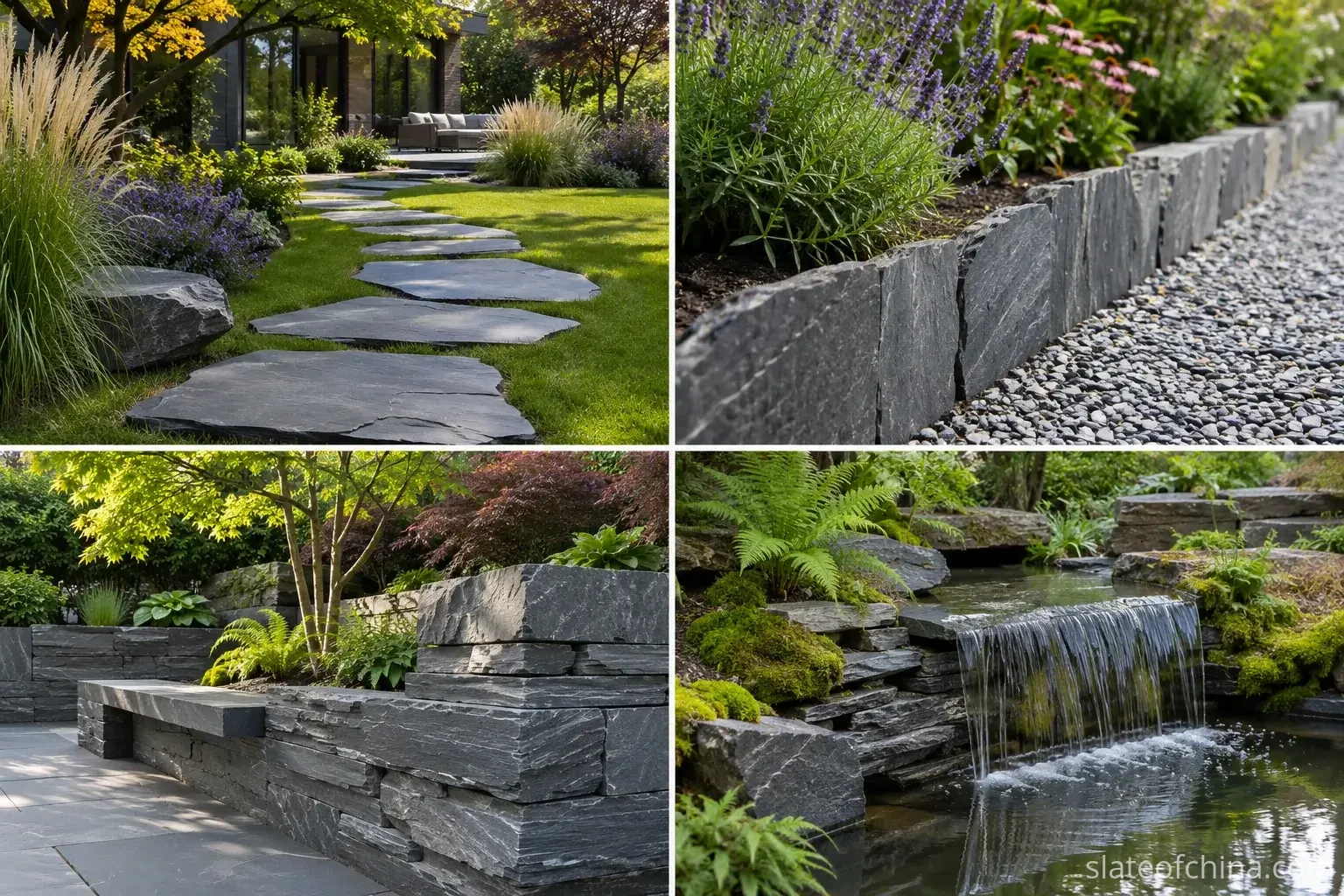
| Family of slate | The job it does |
|---|---|
| Slate stepping stones | Guides movement — a place to step, a route through planting |
| Slate garden edging | Holds the line between two surfaces |
| Slate landscaping blocks | Adds mass and level — structure in three dimensions |
| Slate gravel and chippings | Covers the ground with texture and tone |
| Slate water features | Echoes water — movement, sound, reflection |
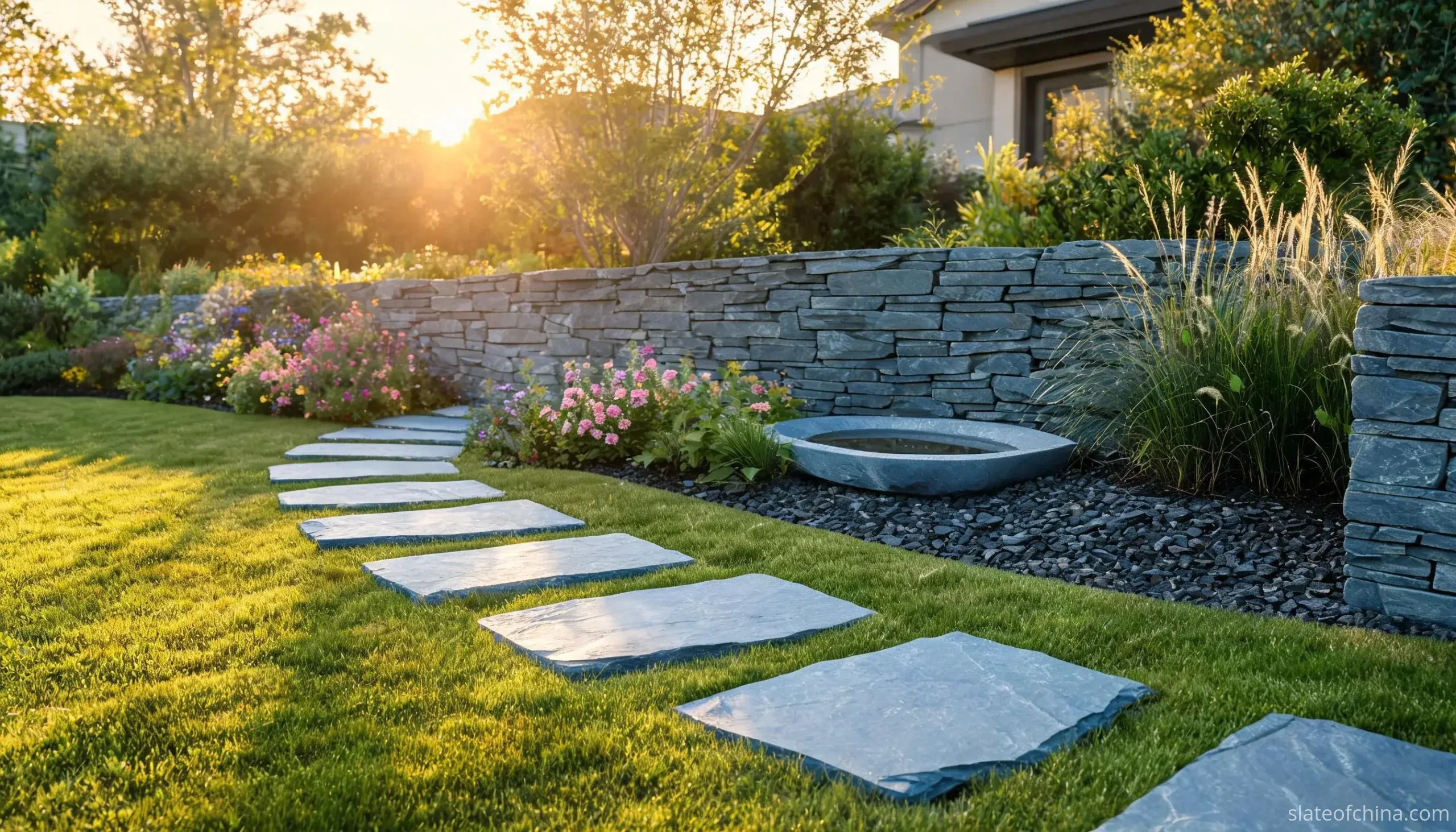
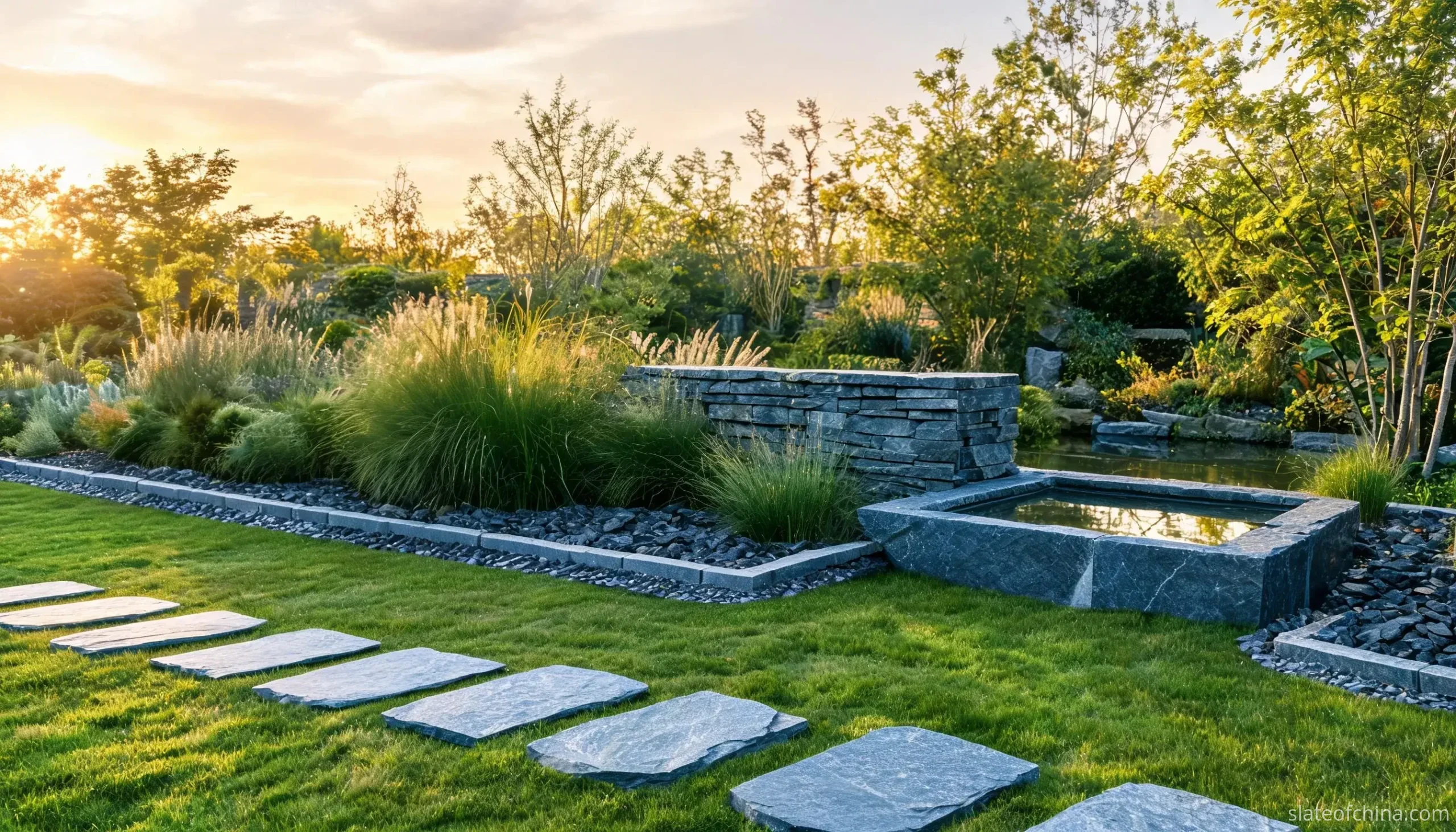
Walk a small garden from the gate to the back wall and you meet, one after another, the five jobs this guide is about. A few flat stones get you across the lawn without trampling it. A low line of stone keeps the bed from spilling onto the path. A short wall holds the raised bed at a comfortable height. Gravel settles the ground around the grasses so it stays tidy. And at the far end, water runs over a dark stone lip and disappears into a basin. Five different products, one quiet material, one coherent garden.
That is the reason landscape slate is worth understanding as a family of materials rather than a single product. The stone itself is a fine-grained metamorphic rock that splits into relatively flat plates — its natural cleavage, not sawing, produces many of the faces used in gardens. Because it splits, it can be a thin stepping stone, a thin edging strip, a thick block, a chipped aggregate or a smooth spillway lip. One material, many jobs.
This page is the entry to natural slate landscaping and the families it is built from. It maps the five, says what each one does in a scheme, and tells you what to check before you spend money on it. Deeper guides on each family — formats, thicknesses, laying patterns, actual sourcing — follow from here; this page is meant to give you the map, not to drown you in specification. The companion project-set view of garden layers — paving, steps, water features and grounds read as one drawing — lives in Jiujiang Slate for Outdoor Architecture.
A Garden Is Five Jobs
Before any colour, any texture, any slab size, a landscape is a set of jobs that have to be done. Movement has to be guided. One surface has to be kept apart from the next. Levels have to be built and held. Ground has to be covered. And water, if it is part of the plan, has to be held and shown. Slate happens to be unusually good at each of these five, because its cleavage allows it to be a flat plate for one job and a thick block for another.
The temptation in a slate garden is to use the same product everywhere — one slab, repeated over paths, beds, steps and borders, in the hope that repetition will read as coherence. In practice the opposite is usually more successful: let each family do its own job, at its own scale, and let the shared colour do the connecting. A large flat stepper, a narrow upright edging, a deep block and a fine gravel are four different objects doing four different things. Set against the same plantings they hold together precisely because they are different.
That is the design point of the whole family. The stone in a garden is most useful when it is distributed by job, not by area.
The Job First, Then the Stone
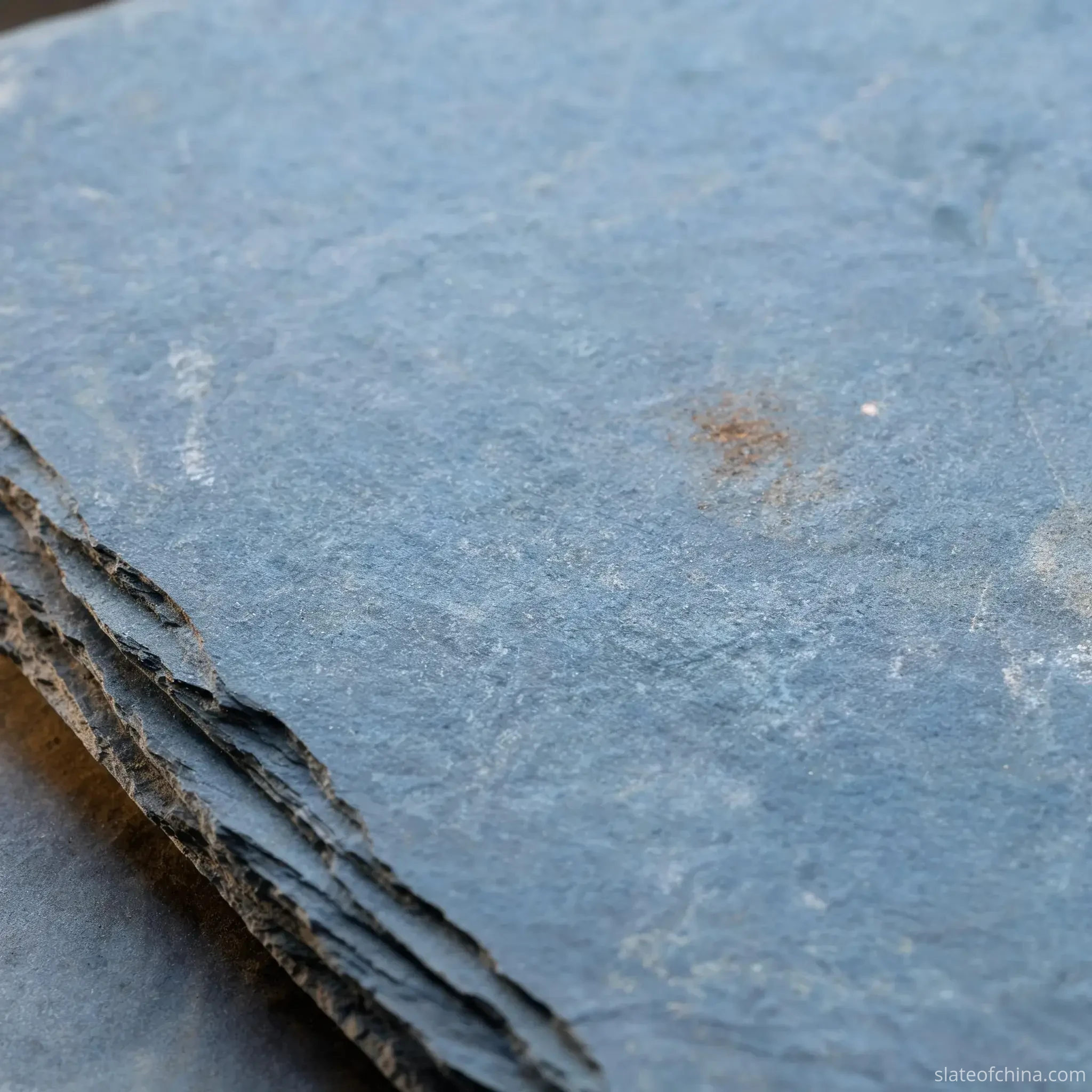
Landscape slate suits a garden for reasons that are partly material and partly visual. The material reasons are the same ones that make it durable outdoors when properly selected: it splits to flat plate, it has a low water absorption for many varieties, and it carries a restrained palette — charcoal, blue-grey, green, occasionally rust or purple — that sits quietly among foliage. The visual reason is that its natural faces are matt and layered, not polished and mirror-like, so it reads as part of the ground and the plants rather than as something imposed on them.
Two cautions keep this honest. First, not every slate variety suits every outdoor job: water absorption, freeze-thaw behaviour, thickness and surface condition all need to be matched to the use and the local climate. Second, a split face is not automatically slip-proof in the wet, and a decorative stone is not automatically a structural one. Each point comes back later; the short version is to check the stone against the job rather than assuming slate is slate.
The Five Families, and the Work Each One Does
The five families are mapped one by one below, so the shape of the whole palette is clear before you go deeper into any single one.
One shared rule across every family: choose the job first, then the stone. If you are choosing a stone because it looks nice on a supplier’s page before you have decided what it is being asked to do, you are choosing the wrong end. Decide what has to happen in that part of the garden, then pick the family that does that job, then narrow to a specific product by its test data and finish.

Slate Stepping Stones for Garden Paths
The steppers’ job is to guide. A stepping stone path is the quietest way to move people through a garden — the stones tell the foot where it is expected to go, while the lawn or planting between them stays soft and green. That is the whole difference between a slate stepping stone path and a continuous paved path: the path of continuous paving claims the ground; a stepping path merely borrows it. Where the plan calls for the continuous paved route itself, the slate patio paving guide takes over that decision.
Stepping stones earn their keep on a planted lawn or in a border where a broad paved route would be wrong. Irregular slabs suit a naturalistic or Japanese-inspired planting; sawn rectangular slabs make a clean rhythmic pattern for a more contemporary garden. For a comfortable pedestrian path, a stone width in the range of roughly 400–600 mm across is a common starting point, with a centre-to-centre spacing around 600 mm; the final rhythm always has to be tested by walking the route, not read from a drawing.
The thickness decision is not cosmetic. A stone that spans an edge or a soft spot needs enough depth and strength to stay sound under foot, and the way the stone is bedded matters as much as the stone itself. Stones set into a lawn should sit at a level that a mower can pass over cleanly; stones set in gravel can finish slightly proud so loose material does not collect on the face. The foundation is the quiet partner of the stepper, and the design tip is always the same: lay the stones loose, walk the route several times, and only then set them in place.

Hand-off: the route you have just walked needs a line where it meets the bed — that is the edging’s job.
Slate Garden Edging and Landscape Borders
The edging’s job is to hold the line. Edging is the smallest piece of stone in a garden and often the one that decides whether a garden reads as deliberate or accidental. It holds a boundary — the line where a lawn meets a bed, where a gravel path meets the soil, where planting is kept inside its own edge. It is the quiet work in a scheme: nobody points at it, but remove it and the whole thing looks loose.
Two settings do most of the work. Upright edging — narrow pieces stood on edge with their natural faces showing — reads clearly beside ornamental grasses and informal planting. Low horizontal edging sits flatter and is more at home along a path or a low raised bed. Both can follow gentle curves, which is why edging is usually built from shorter, carefully selected pieces rather than long straight strips.
For a contemporary look, pick a strip of even height and even colour. For a more rustic, natural garden, allow controlled variation in height and surface. The most useful design question when specifying edging: does it need to retain soil or a change of level, or is it purely holding a line? That decides the embedment and the weight of the stone. Edging that retains soil on a slope or supports a raised bed requires a more substantial specification than a thin decorative border used simply to separate grass from gravel.

Hand-off: once the line is held, the bed behind it often wants a level change — that is the block’s job.
Slate Landscaping Blocks and Garden Walls
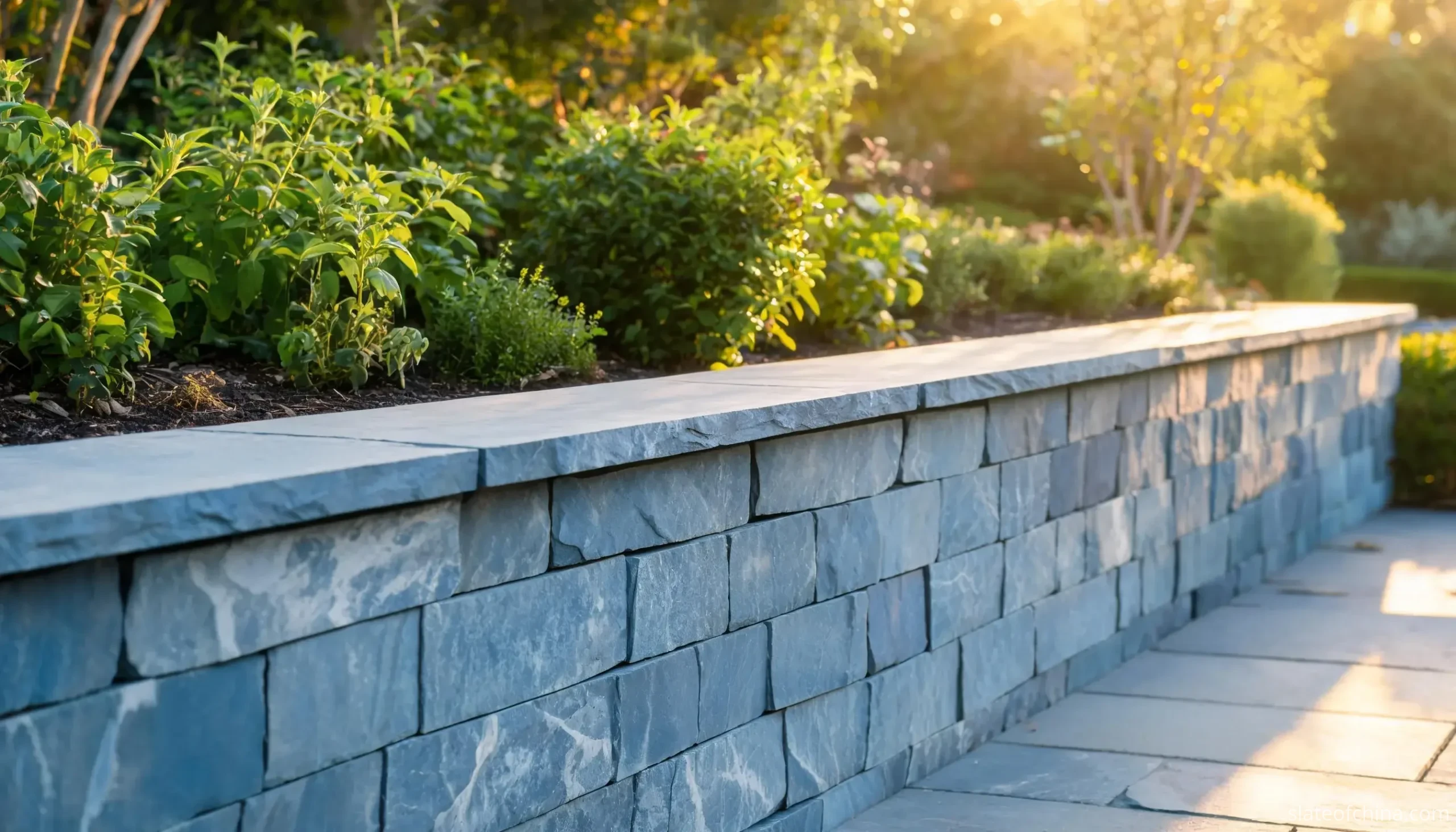
The blocks’ job is mass and level. Where the steppers and the edging are flat, slate blocks bring thickness into the garden: raising a bed to a comfortable height, holding a level, framing a step, making a seat or marking a focus. A block is the only family in this palette that works in three dimensions, and the one that gives a garden architectural weight.
The usual jobs are raised beds, low walls, steps and transitions, and built-in seating. A low wall of stacked slate is one of the most useful structures in a garden, because it can be a raised bed frame and a seat and a visual anchor all at once. But the crucial and often missed distinction is structural. A dry-stacked decorative wall is not the same as a retaining wall. It can look substantial and still be a veneer in engineering terms. Anything that holds back soil, supports a person sitting, or takes a load needs to be designed as structure, with sound foundations and proper drainage, and its stone must be verified for strength — not assumed.
The design advice is to use mass sparingly. One low wall or a single well-chosen feature block anchors a small garden far better than a ring of dry masonry round the edge of it. Let the block do its job once, with focus, rather than scattering them at every opportunity.
Hand-off: structure settled, the bare ground under the plants still asks to be covered — that is the gravel’s job.
Decorative Slate Gravel and Chippings
The gravel’s job is to cover the ground. Slate gravel and chippings are the ground-cover family of the palette: texture and tone across a surface — a bed that reads as one calm plane, a planting ground that stays tidy, a minimalist patch of dark aggregate that gives the green something to sit on. Angular slate chippings look clearly different from rounded river pebbles, which is often exactly what a garden needs: the sharp, layered, unmistakably slate character.
Where they earn their keep is planting beds and decorative paths. The sharp angular shape is part of the appeal, but it is also the reason for one caution: decorative slate chippings are not a substitute for a properly engineered drainage aggregate. Flat particles and a high fine content can compact and reduce the movement of water through the ground. Where the intention is a surface that will be walked on, the grading and bedding have to be chosen for that, with a separator where the chippings meet the soil and an edge restraint to keep the loose material where it belongs.
Two practical points keep a gravel surface honest: keep to one dominant colour so the plane does not fragment, and test the depth and particle size against weeds and leaf fall, not appearance alone.

Hand-off: a covered ground can finally carry the last element without looking crowded — that is the water’s job.
Slate Water Features for Gardens and Ponds
The water’s job is to echo. Water is the one family in this palette that is not a hardscape at all, and it works by opposites: instead of marking, holding or covering, it adds movement, sound and reflection. Slate earns a place here because its dark colour and layered edge give the water something to run over and something to catch the light against. A slate cascade, a spillway that lets water drop over a stone lip into a basin, a pond edging that joins the water to the shore — these are the quiet forms of a water feature that read as part of the garden, not as a contrivance.
The engineering of water is where the care sits. Slate is a decorative material, not a waterproof liner. A water feature needs a designed waterproofing layer, proper support, drainage and a way to reach the pump and the seal for maintenance, and the stone around the water has to be suitable for prolonged wetting in the local freeze–thaw climate. Mineral deposits, algae and water chemistry all arrive eventually, and they are managed by the design, not by the stone.
A small slate spillway with a controlled flow is often a stronger focal point in a compact garden than an oversized fountain, because the water, the sound and the reflection do the work, not the size of the structure.

The Stone Passes the Job Along
The most successful slate landscapes are the ones where the families hand the work to each other in sequence. A scheme reads as a single material, but it is five distinct jobs carried out at five different scales. Picture a contemporary garden: large slate steppers cross the lawn from the terrace; a low edging holds the perennial border in place; dark chippings keep the ground plane quiet around the grasses; at the far end a low block wall frames a seat beside a modest water basin. No two of those use the same format of slate, and the garden holds because they share one palette.

Five rules tie a coordinated scheme together:
- Run one dominant stone colour through the whole garden, and let the variations within it do the work.
- Vary the scale deliberately — large steppers, narrow edging, fine chippings — so the same material never reads as a single repeated note.
- Balance the hardscape against planting; slate’s angular character is strongest when it is softened by foliage.
- Decide texture by job: a natural split face for the quiet, organic reads; sawn edges where you want a clean architectural line.
- Design the maintenance in from the start — drainage, access for cleaning, and where the growth will sit.
Choosing Across Landscape Styles
Every family above can serve most styles of garden, but each garden will lean on a different two or three. That is the practical payoff of treating slate garden stone as a family rather than a single product.
In a modern minimal garden, the steppers and the edging do most of the job: large, sawn, rectangular slabs, straight edges, a restrained charcoal palette, and a light hand on the blocks and gravel so the contrast between pale paving, concrete and foliage stays strong.
In a naturalistic or cottage garden, the same families reverse their roles. Irregular steppers, softer and lower boundaries, and the chippings pulling the bed together. Let the stone sit back and let the foliage and flowers do the loud talking.
In a Japanese-inspired garden, proportion is everything. A few carefully placed steppers, quiet transitions and a short palette matter far more than the amount of stone. Do not decorate the route; let the stone itself be the restraint.
In a rustic or woodland garden, combine irregular stone, low walls and a gently curving path, and allow the landscape to feel settled rather than laid out. The stone does less organising and more grounding.

Landscape Slate Selection Guide
Collected into one table, the practical half of the five jobs — what each family is typically asked to do, and what to verify with the supplier before ordering it.
| What the garden needs | Slate form that does it | What to verify before ordering |
|---|---|---|
| Movement across a lawn or planted border | Stepping stones — irregular or sawn rectangles | Thickness and strength for foot traffic; wet slip performance; bedding design |
| A clean line between two surfaces | Edging strips — upright or flat | Exposed height and embedment; whether the edging retains soil or only separates surfaces |
| Level changes, raised beds, seating, focal mass | Landscaping blocks and walling stone | Stone strength and geometry for the intended use; engineering design where a wall retains soil or carries load |
| A calm ground plane around planting | Decorative gravel and chippings | Grading and depth; separator layer; edge restraints; drainage role |
| Movement, sound and reflection | Water feature stone — spillways, cascades, pond edging | Durability under prolonged wetting; wet-surface finish; waterproofing as a designed system |
| Cold or wet-exposed sites | Any family | Freeze–thaw test data for the specific stone, and drainage provision in the installation |
No thickness figure, load rating or price belongs in a table like this — those numbers attach to a specific stone and a specific supplier, and they are exactly the questions this selection guide sends you to ask.
What to Check Before You Specify
Every family above works, but only if the specific stone is matched to the specific job. Before you settle on a product, run the stone against these questions:
| What to check | Why it matters |
|---|---|
| Thickness and size | Steppers and blocks are chosen by load and span, not by looks |
| Surface finish | Split face for the quiet, sawn edge for a clean line; each has its place |
| Water absorption | Relevant to wet exposure and winter survival |
| Freeze–thaw | Cold climates are the hard test for any outdoor stone |
| Strength for structural use | Blocks and walls holding loads are structural work, not decorative |
| Colour variation | A sourced range runs within its own limits — match the plan to the range |
None of these is a reason to rule slate out; they are the questions that turn an attractive product listing into a stone that works. If in doubt on a wet surface or a load-bearing element, ask for the relevant results and confirm the specification with the supplier before anything is ordered, following the decision order set out in how to choose architectural slate.
Groundwork, Drainage and the Wet Season
The longevity of any slate garden lives in the ground below the stone, not in the stone alone. Steppers, edging, blocks and chippings all rely on a stable, well-drained foundation matched to the soil and the frost line. Surface water has to be taken away from vulnerable points — a path beside a building, a raised bed holding back soil, the edge of a pond — and that is a matter of falls and drainage outlets, not of the stone’s opinion.
In the wet season, keep slip risk in mind. A matt split face is useful, but wet slate, moss and algae all change the wet traction; keep the surface free of organic build-up and, where safety matters, check the relevant test result for that finish. Cleaning is the gentle end of the same rule: sweep and hose, remove organic debris, and keep acids and untested chemicals away from the face. Test any cleaning product on an out-of-the-way patch first.
Periodic checks catch the small failures early: a stepper that rocks, an edging that has moved, a drain that has blocked, a wall that leans even a little. After a hard winter or a storm, give the stone a walk-through and correct what has shifted. A well-chosen landscape stone for gardens earns that care back every season.
Frequently Asked Questions About Landscape Slate
Is natural slate suitable for garden landscaping?
Yes, when the right form is matched to the job. Properly selected slate works for steppers, edging, decorative ground cover, low walls and water-feature surrounds. Suitability depends on the specific stone, the intended use and the local climate, so the useful habit is to check the family against the job.
Are slate stepping stones slippery when wet?
It depends on the finish and the weather. A natural split face provides useful texture, but wet slate with moss or algae can be slippery. Keep the surface clean and, where slip safety matters, ask for the wet test result for that finish before you specify.
What is the best slate for a garden path?
Choose a thickness and strength matched to foot traffic, with a surface you are comfortable with in the wet. There is no single best — the choice couples the stone’s size, thickness and finish with the way the bed is prepared beneath it.
Can slate chippings be used around plants?
Yes, slate chippings work as a decorative mineral mulch around suitable planting. Before choosing them, consider the soil beneath, the plant’s needs, the surface temperature on a hot day and how you will keep the bed tidy.
Can slate be used for a garden retaining wall?
Only if it is designed and verified for it. A stacked decorative wall is not automatically a retaining wall: retaining needs sound foundations, drainage and a checked stone. Do not assume a decorative block is a structural walling unit.
Does slate fade in the garden?
The appearance of slate changes slowly with exposure — surface deposits, weathering and the mineral character of the source all play a part. Colour stability varies by source, so where long-term colour matters, look at representative samples and ask about performance information rather than guessing from a photo.
Is slate suited to gardens in freezing climates?
Some slate varieties do well through a freeze–thaw cycle; others do not. The decisive points are the relevant test data for the stone, good drainage, and installation that lets water escape rather than trap against the face.
Related Reading
Planning a landscape slate project?
Tell us which landscape elements you need, your preferred stone colour family, approximate dimensions and quantity, and the destination. Slate of China can then help review suitable material options, representative samples, available finishes and export packing requirements — for steppers, edging, blocks, chippings and water-feature pieces — before anything is cut or crated.
Load-bearing, structural and water-tight decisions are verified by the responsible project professionals. Browse the architectural slate guide while the enquiry is being prepared, or request landscape slate information.