
Importing Mixed Stone Orders: Slate, Granite and Other Stone in One Container
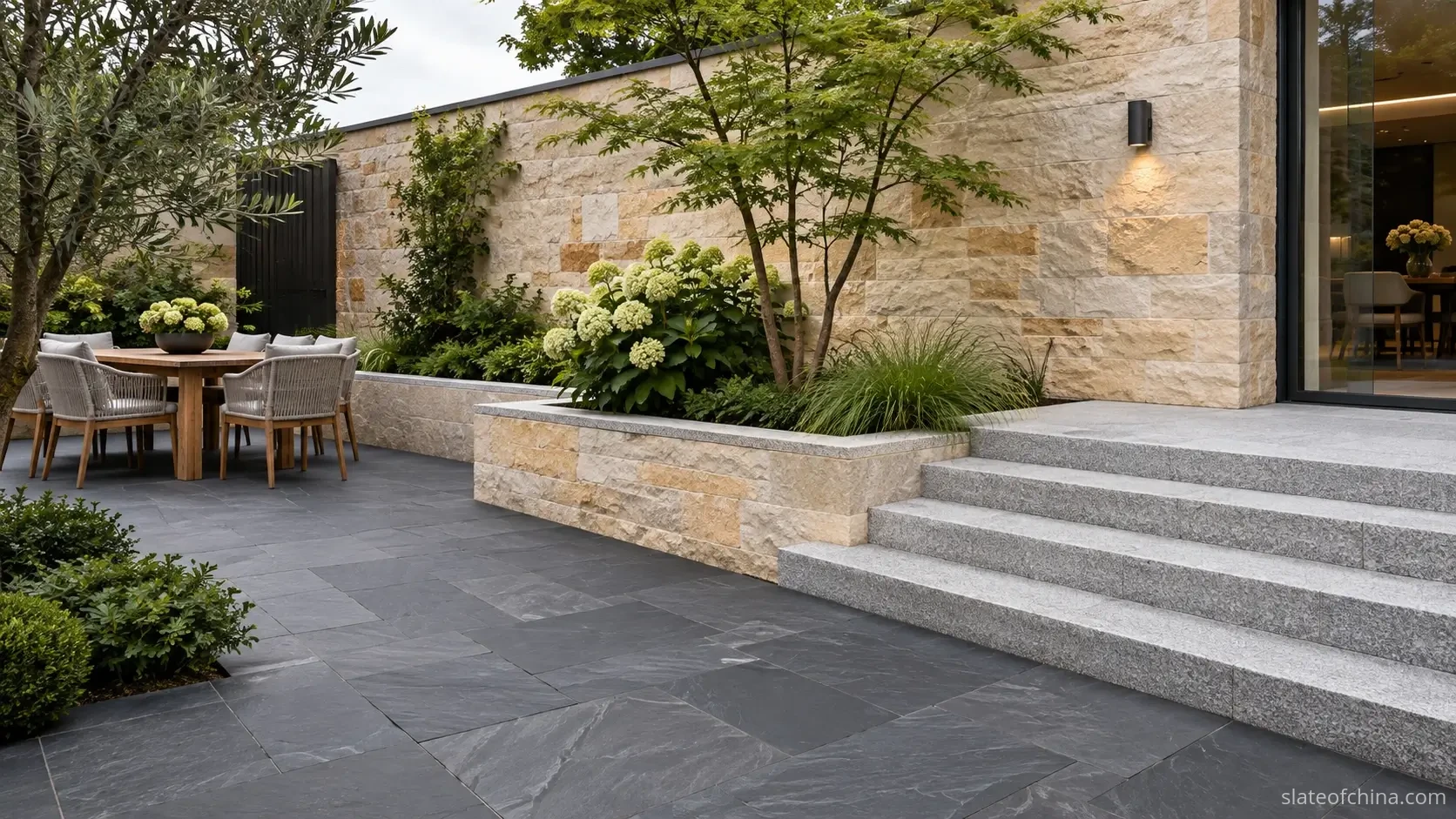
One project can need three kinds of stone at once. A courtyard might take charcoal slate paving, grey granite steps and a pale limestone coping. Sending all three through one exporter and landing them in a single container cuts duplicated transport and one layer of paperwork. It can also turn one late item, a narrow crate or a muddled invoice into a problem for the whole order. The real question is not whether slate and granite can share a container. It is whether they can share a safe loading plan, a realistic completion date and a transparent cost calculation.
Quick answer: Slate, granite and other stone can often travel in one container, normally in separate, clearly identified packages. Confirm completion dates, weights, dimensions and a full cost split before you book, and give every product a code line that follows through the paperwork. Appoint one coordinator when several factories are involved. Split the order when loading, timing or handling costs outweigh the saving.
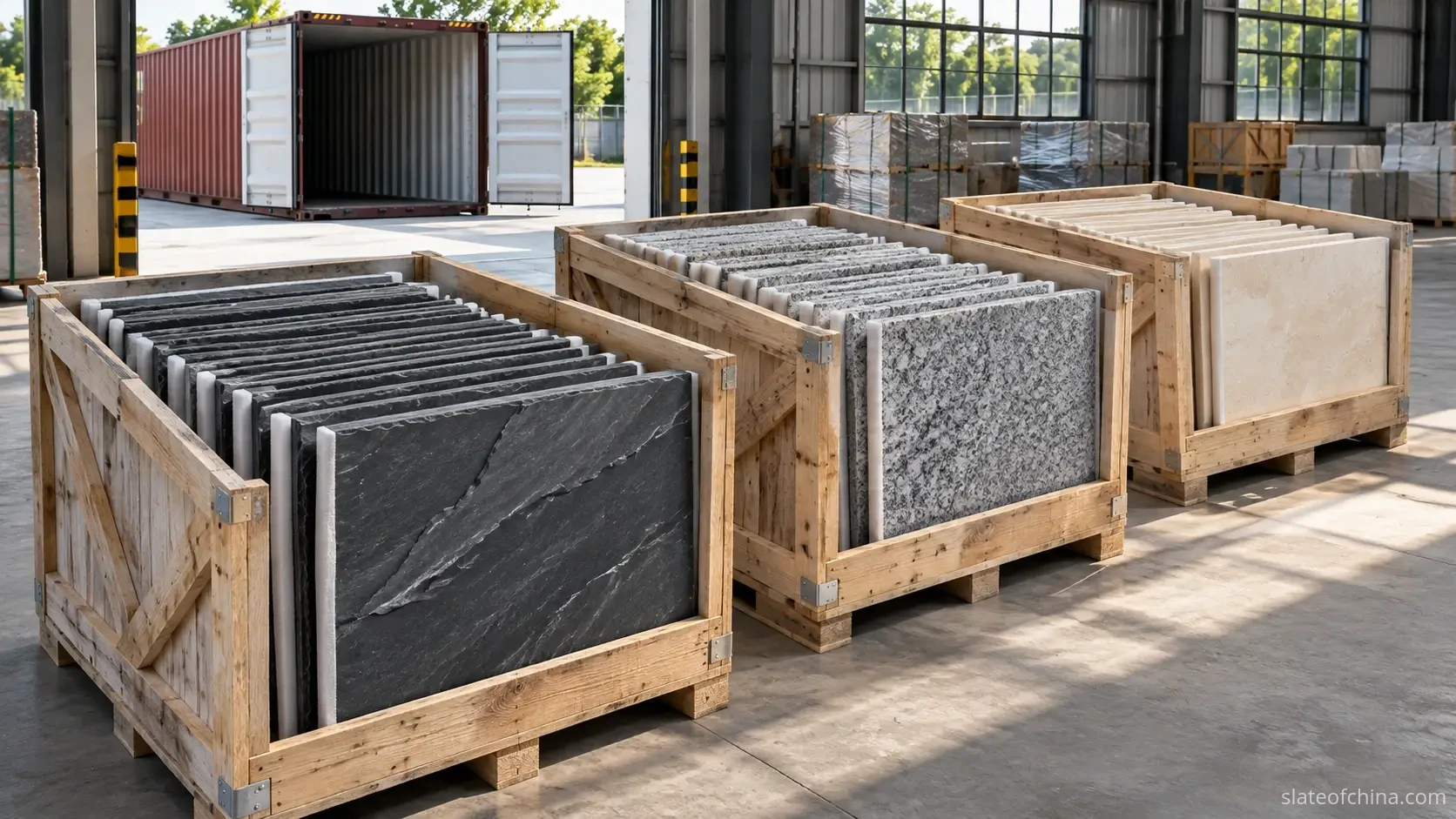
What Counts as a Mixed Stone Order
Before anything else, decide what “mixed” means in your case. The coordination effort changes a lot between the three common arrangements.
| Order arrangement | Typical example | Main coordination issue |
|---|---|---|
| One factory, several products | Slate paving, wall cladding and coping | Different production and packing requirements |
| One exporter, several supplying factories | Slate tiles, granite steps and limestone caps | Collection, inspection and responsibility |
| Buyer consolidating separate purchases | Several suppliers delivering to a nominated warehouse | Delivery cutoffs, documentation and release authority |
Two terms get confused here. A mixed FCL order is a container you book for your own goods even though it holds several product lines — a full container load of your own assortment. LCL means sharing container space with other shipments through a consolidator. Mixing products does not automatically mean LCL. For dense stone an FCL can make sense before every cubic metre is full, because weight fills the limit long before volume does. LCL suits a small trial order, but compare origin and destination handling, minimum charges, transfers and the packing at both ends. Neither option is always cheaper.
Product Specifications, Samples and Ready Dates
“Grey slate and granite, one container” is not a workable specification. Give every product a code line — SL-P01, GR-P02, LM-P03 — and use that code on the quotation, the approved-sample record, the packing list and the crate labels. A master order schedule keeps each line visible.
| Field | Example entry |
|---|---|
| Line code | SL-P01 |
| Material and reference | Charcoal natural slate; approved reference samples |
| Intended use | External pedestrian paving |
| Format and thickness | 600 × 400 × 20 mm; agreed tolerances |
| Finish and edge | Natural cleft face, sawn edges |
| Quantity and unit | 180 m²; piece count reconciled |
| Acceptance requirements | Colour range, edge quality, relevant test evidence |
| Package information | Pieces per crate, crate dimensions, net and gross mass |
| Timing | Production completion and warehouse delivery cutoff |
| Destination handling | Forklift capacity and access restrictions |
Granite steps need extra fields — profiles, nosing, exposed edges and the drawing revision. Wall caps or coping need slopes, corners, end pieces and any specified drip detail. Calibrated slate needs a note on which surfaces are processed and the agreed thickness tolerance. Every product carries its own set of attributes, so keep them in the same table rather than scattered across the emails.
Approve each stone separately. One attractive slate sample does not approve the colour range of the granite or the edge quality of the limestone. Record sample IDs, photographs and written acceptance limits, and state whether approval covers appearance only or also dimensions and finish. The separate stone sample approval guide covers that process in more depth.
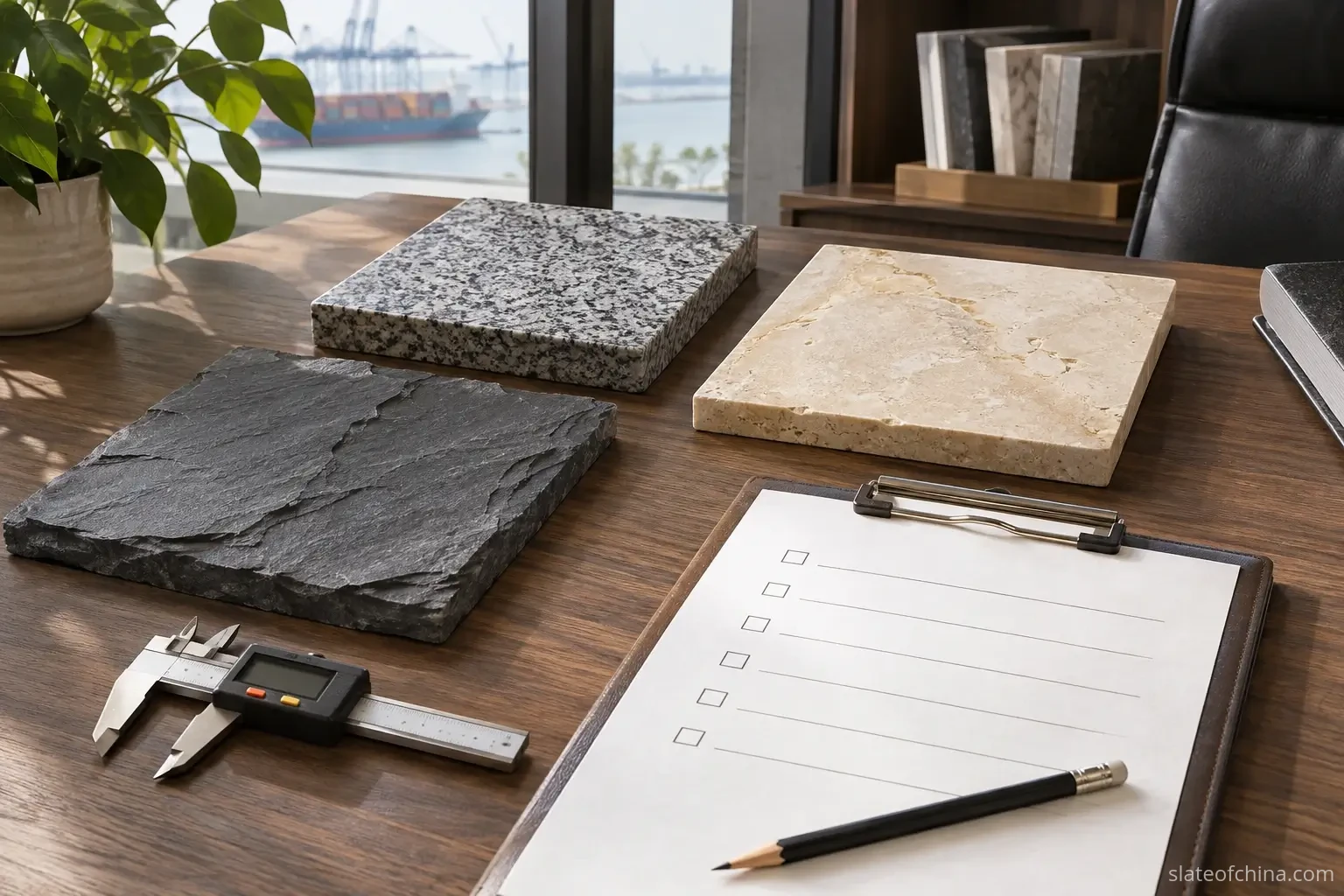
The dates schedule is where a mixed order usually fails first. If one line is not approved or a custom piece is being remade, the whole container can be held back. That is the moment to start thinking about a split — not later, after the goods are already waiting.
How to Estimate Mixed Stone Container Weight
Stone is dense, so usable capacity depends on more than cubic metres. Container payload, road and ocean limits, floor loading, crate footprints and unloading equipment all matter. Use a preliminary weight calculation before you choose the container.
Stone mass = area × thickness in metres × assumed density.
The figures below use assumed densities only to illustrate the planning. Replace them with data for the actual material and confirm the final packed weights.
| Product | Area | Thickness | Assumed density | Estimated stone mass |
|---|---|---|---|---|
| Slate paving | 180 m² | 0.020 m | 2,750 kg/m³ | 9,900 kg |
| Granite paving | 100 m² | 0.030 m | 2,700 kg/m³ | 8,100 kg |
| Limestone tiles | 50 m² | 0.020 m | 2,600 kg/m³ | 2,600 kg |
| Total stone only | 330 m² | 20,600 kg |
Suppose crates, protection and securing materials add about 1,400 kg. The preliminary cargo mass becomes about 22,000 kg, before adding the container’s own tare for a total packed-container estimate. This is an arithmetic example, not an approved loading plan or a standard payload allowance.
Natural cleft surfaces, thickness variation, profiles and cut-outs all move the estimate. Do not use the stone-only total as the cargo gross weight, and do not confuse cargo gross weight with the verified gross mass (VGM), which includes the container itself. SOLAS requires the shipper to obtain and document the VGM before a packed container is loaded onto a covered vessel. VGM is established by weighing the packed container or, where permitted, by an approved calculation covering the contents, packing and securing materials plus the container tare. A planning spreadsheet does not establish compliance on its own.

A 40-foot container gives more space but not double the usable weight capacity of a 20-foot unit. Ask the forwarder to confirm the suitable equipment and the permitted load for the complete route, and check the inland limits at the destination as well.
Export Packing for Slate, Granite and Other Stone
Mixed stone should normally mean separate packages sharing one container, not loose slate, granite and limestone squeezed into the same crate.
For many slate building products, upright on-edge packing in a well-made wooden crate is the practical starting point. It avoids a deep flat stack that loads the lower pieces. Upright packing still needs adequate base support, separators and restraint: standing a tile on edge does not make it immune to breakage. The crate has to stop the pieces moving and keep the weight on the base.
| Product characteristic | Packaging question to resolve |
|---|---|
| Cleft slate tiles | Are bases and edges supported without damaging the surface ridges? |
| Finished granite faces | Are non-abrasive separators protecting faces and corners? |
| Pale or porous limestone | Can wet timber, dirt or packing materials cause staining? |
| Profiled steps and coping | Are projections supported and protected from point loads? |
| Oversized pieces | Can the package be lifted and restrained with suitable equipment? |
Do not assume a crate can carry another crate above it. Specify stacking permission and limits only after the package has been assessed. Crate height, lifting points and fork entry need to suit both the loading site and the receiving warehouse. For the slate side in more depth, the slate packing and crating guide walks through the crate details.
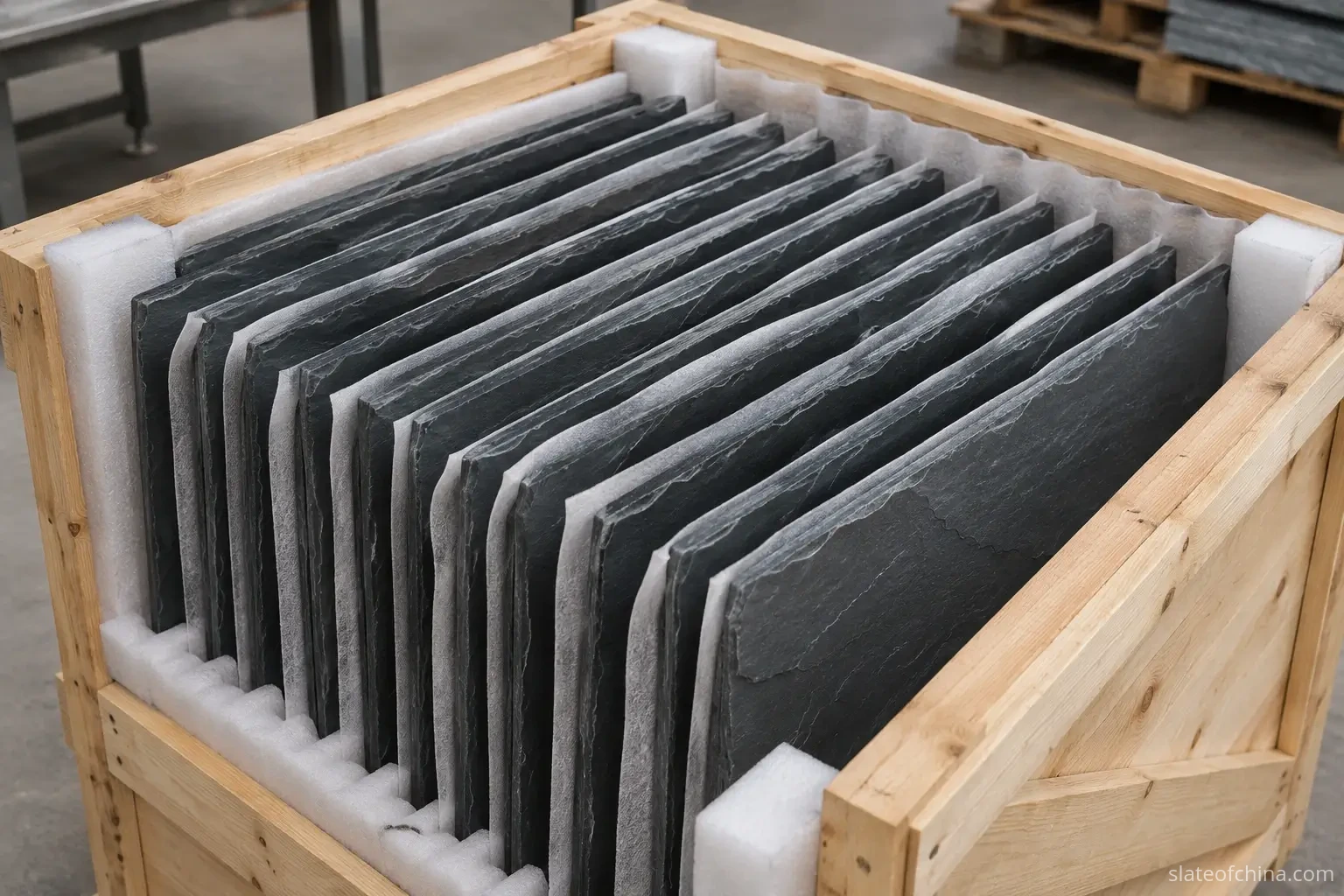
Wood packaging needs its own check. ISPM 15 addresses regulated raw-wood packaging, including relevant dunnage. Packaging made wholly from processed wood such as plywood is generally outside its scope, but a plywood-sided crate may still have solid-wood bases, runners or braces that need compliant treatment and marking. Check every component and the destination’s implementation requirements. A compliant mark does not replace sound crate design.
Mixed Stone Shipping Costs and Consolidation Fees
A mixed order can remove duplicated transport costs while adding consolidation work. Compare the full cost rather than the price of the stone.
| Cost group | What to identify |
|---|---|
| Stone products | Price by line, material, finish, thickness, quantity and unit |
| Product-specific packing | Crates, separators, profile protection and special supports |
| Origin consolidation | Factory collections, inspection, storage and repacking |
| Export and transport | Origin handling, documentation, ocean carriage, agreed insurance |
| Destination costs | Handling, clearance, inland delivery and unloading |
| Contingencies | Waiting, examinations, rehandling and delayed-project exposure |
Use the same named place and the same Incoterms rule when comparing quotations, and ask the seller to list inclusions and exclusions. Incoterms do not settle every commercial question: inspection, payment, acceptance and claims still need their own agreement. Check insurance against the actual goods, packing, transfers and policy terms. “Insured” does not mean every chip or delay is covered.
Loading and Unloading as One Plan
A mixed container loading plan should identify every package, its gross mass, its external dimensions and its proposed position. It should also address concentrated floor loads, weight distribution and cargo restraint.
The IMO/ILO/UNECE CTU Code gives guidance on packing and securing cargo across the transport chain. It is a code of practice, not a substitute for a competent packer’s assessment of one stone shipment.
Ask the loading team to resolve these points before stuffing:
- How will the heaviest packages be distributed and their loads supported?
- What blocking and restraint will prevent movement during transport?
- Is the container, its floor and its securing points in sound condition?
- Can the receiver remove the first crate without destabilising the rest?
- Does the lifting capacity cover the heaviest package at the actual load centre?
- Can the doors open and the restraints be released safely?
Do not let a preferred unloading sequence override a safe loading arrangement. If project phases need a particular sequence, give that to the planner early rather than after the container is full. Request crate photographs before loading, progress photographs during loading and a final loading record. Photographs help trace a shipment, but they do not prove that the hidden supports or restraint are adequate.
Give Multi-Supplier Consolidation One Coordinator
If several factories supply the order, name one party to coordinate the handoffs. This might be the exporter, a consolidation warehouse or a buyer-appointed logistics provider. Put the scope in writing.
Agree who collects goods, checks incoming quantities, inspects packaging, approves rework, compiles shipment records, authorises loading and communicates with the forwarder. Clarify whether the coordinator is checking package condition only or also inspecting the stone. Set three dates: the production completion date, the warehouse receiving cutoff and the latest date for excluding a delayed line. Also agree storage charges, rehandling charges and who pays if a supplier misses the cutoff.
The container’s departure can become dependent on the slowest product line. Standard slate paving may be ready while custom granite corners are still being remade. A clear exclusion decision is more useful than an open promise to wait “a few more days.” If you are ordering custom pieces, the custom granite and cut-to-size stone notes cover the drawing and first-off checks.
Keep Each Product Visible in the Paperwork
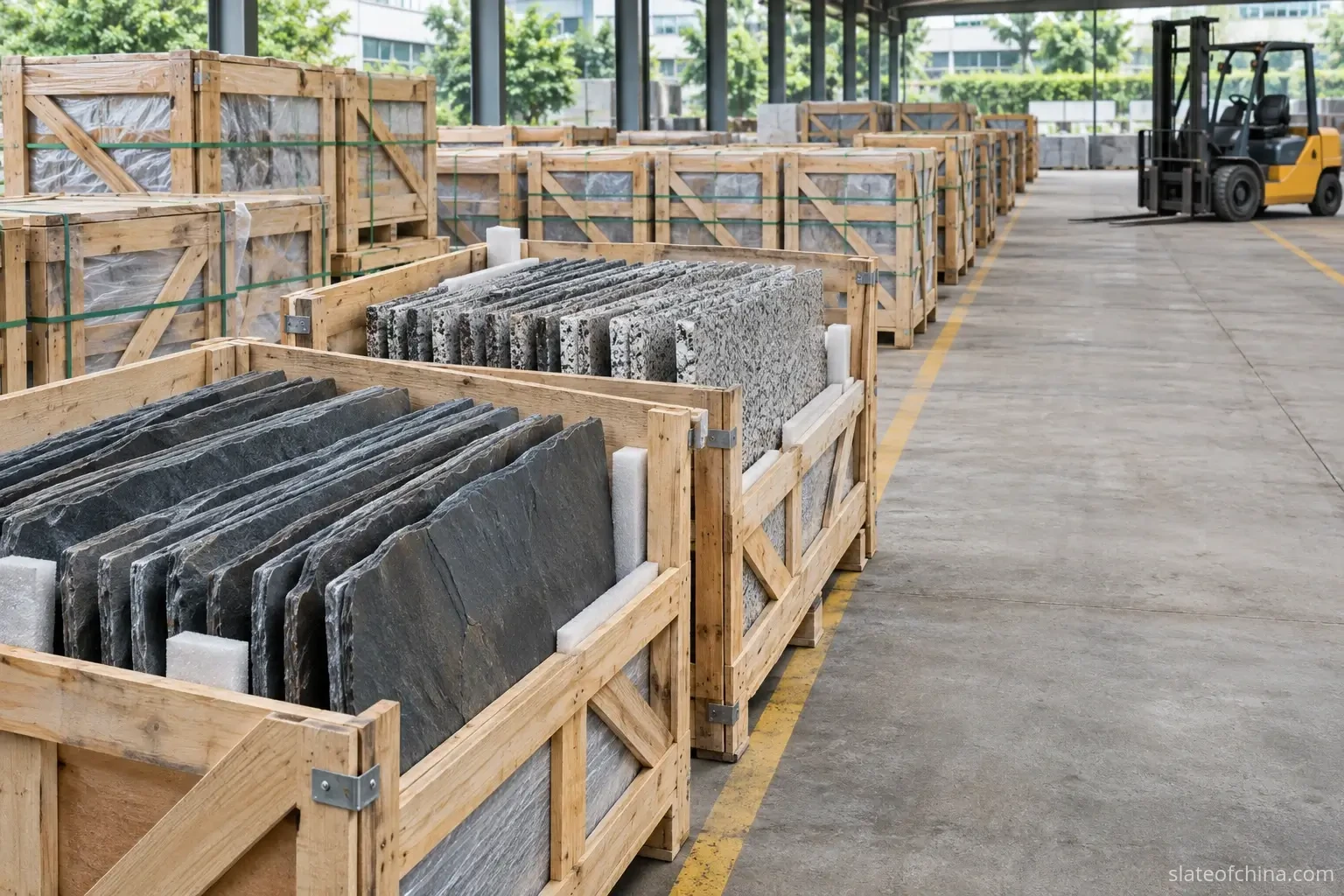
One container does not make all the goods one product. Keep the line descriptions clear and keep a trace between the commercial documents and the physical crates.
The packing list should reconcile the line code, stone description, format, quantity, piece count where relevant, package IDs, dimensions and net and gross weights. The invoice and shipment records should be consistent with the sale and the broker’s requirements. If you buy from several sellers, they may each need their own commercial record even when their goods travel together.
Do not assign one customs classification to every line simply because all the goods are stone. The applicable classification and measures can depend on material, processing, use, origin and destination. Send the destination broker actual product descriptions before shipment, and ask which classification, valuation, origin evidence, duties and product documents apply. Avoid relying on one universal code.
For a crate that contains more than one line, provide a sub-list. Separate crates are easier to identify, inspect and claim against than mixed contents inside one crate.
When Splitting the Shipment Is Smarter
A mixed FCL is not the only option. Compare one mixed FCL, separate FCL shipments, or a main FCL followed by a smaller shipment, using current written quotations and the same scope of costs.
| Situation | Why separation may be worthwhile |
|---|---|
| One urgent product and an unfinished custom line | Avoid holding installation-critical material |
| Factories far apart | Collection and repeated handling may erase the freight saving |
| Different receiving locations | Avoid unloading and redistributing heavy goods twice |
| Very different handling needs | Keep oversized slabs separate from standard tile crates |
| Unresolved import requirements for one product | Reduce the exposure of ready goods to a shared delay |
| Replacement or small trial quantities | Compare a smaller shipment against postponing the main order |
Here is a hypothetical decision, not a freight quotation. Suppose combining the goods avoids USD 2,000 in duplicated transport but adds USD 700 in collection, inspection and consolidation. The apparent saving is USD 1,300. If waiting for the custom pieces then adds USD 500 in storage and USD 1,200 in project delay costs, the mixed option is USD 400 more expensive overall.
Net mixing benefit = avoided separate-shipment costs − extra consolidation costs − additional delay and handling exposure.
Give a reasonable allowance for the uncertain costs and test both an on-time and a delayed scenario. Avoid false precision where a project delay could dwarf a small freight saving.
What to Send for a Useful Quotation
Copy this enquiry structure and complete one product table for the whole order:
We are planning a mixed natural stone shipment to [destination port and final delivery location]. Please quote the attached product lines separately and propose a consolidation arrangement. For each line, confirm the material reference, dimensions, thickness, finish, quantity, completion date, crate count, crate dimensions, net weight and gross weight. Please state the quotation basis, named place, packing inclusions, collection and consolidation charges, inspection scope, proposed timing and exclusions. Please also identify any line that would be more economical to ship separately. Our receiving equipment and access limits are [details].
Once you have a mixed-container quotation, attribute the shared costs to each stone line rather than dividing everything by square metre. Three small rules keep each product’s landed cost honest:
| Shared or direct cost | How to attribute it |
|---|---|
| Dedicated crates and special supports | Assign directly to the product that needs them |
| Weight-based shared costs (carriage, port handling) | Split by each line’s packed gross weight |
| Space-based shared costs (storage) | Split by crate footprint or occupied volume |
Attach marked drawings for custom parts and state the revision. Identify urgent lines and indicate whether partial shipment is acceptable. Do not ask for a guaranteed quantity per container before the crate and route constraints have been checked. If you are assembling the spec from scratch, the stone specification sheet guide walks through each field.
A Better Mixed Order Starts Before the Booking
The most useful mixed order combines products that are ready together, pack together and arrive where one design needs them. Keep the stone selection specific, the schedule complete and the responsibility for each handover clear.
For your next enquiry, prepare the product schedule first. Then ask for two answers: the proposed mixed shipment and the practical alternative if one line is delayed. That makes the saving visible before the order becomes difficult to change. When the stones arrive, the two families still meet in the finished design — the mixing stone families guide covers the site side of that junction.
Frequently asked questions
Can slate and granite be shipped in the same container?
Often, yes. They need compatible packages, a sensible weight distribution and restraint plan, and clear identification. Separate crates are usually easier to inspect and trace than mixing different products inside one crate.
Is there a minimum order for mixed stone orders?
There is no universal minimum order quantity (MOQ). It can apply by material, size, finish or custom-processing run. A supplier that accepts a mixed container may still require a minimum quantity for each product line.
Is a mixed stone container cheaper than separate shipments?
It can be, especially when the goods are ready together and the origins are close. Compare collection, packing, warehouse work, destination charges and delay costs alongside the ocean freight.
How much stone fits in a 20-foot container?
There is no reliable single square-metre figure. Thickness, density, packaging, crate geometry, permitted payload and inland restrictions all change the answer. Start with a line-by-line weight and package schedule.
Can different factories deliver into one export container?
Yes, subject to an agreed consolidation and documentation arrangement. Name the coordinator, the receiving cutoff, the inspection scope and the loading-release authority before the goods move.
Should I add spare pieces?
Consider spares for repairs and installation losses, particularly for batch-sensitive colours and custom components. Agree quantities by product and project rather than applying one percentage to everything. Label the spares and include their weight and cost in the schedule.
Reference Notes
- IMO — Verification of the gross mass of a packed container: imo.org
- IPPC — ISPM 15, Regulation of wood packaging material in international trade: ippc.int
- IMO/ILO/UNECE — Code of Practice for Packing of Cargo Transport Units (CTU Code): imo.org
Related reading
Planning a mixed slate and granite container?
Send the product schedule with a line code for each material, the finish, thickness, quantity and destination port. We review the product schedule and the packed weight and confirm the separate packages. Whether a single mixed container is viable on your route is then verified with the forwarder or the loading team before we recommend a plan. Contact us with the schedule.