
Packaging and Crating Slate for Export
Timber crates of slate have a habit of arriving looking perfect. The boards are sound, the straps are taut, the pallet has not splintered. Then the receiver opens the lid and finds a honed tile with a rubbed face, a paving slab with a hairline crack where the support ended, or a large-format panel that shifted against its neighbour. The packing did its job of getting to the door. It simply was not written for everything the crate went through on the way.
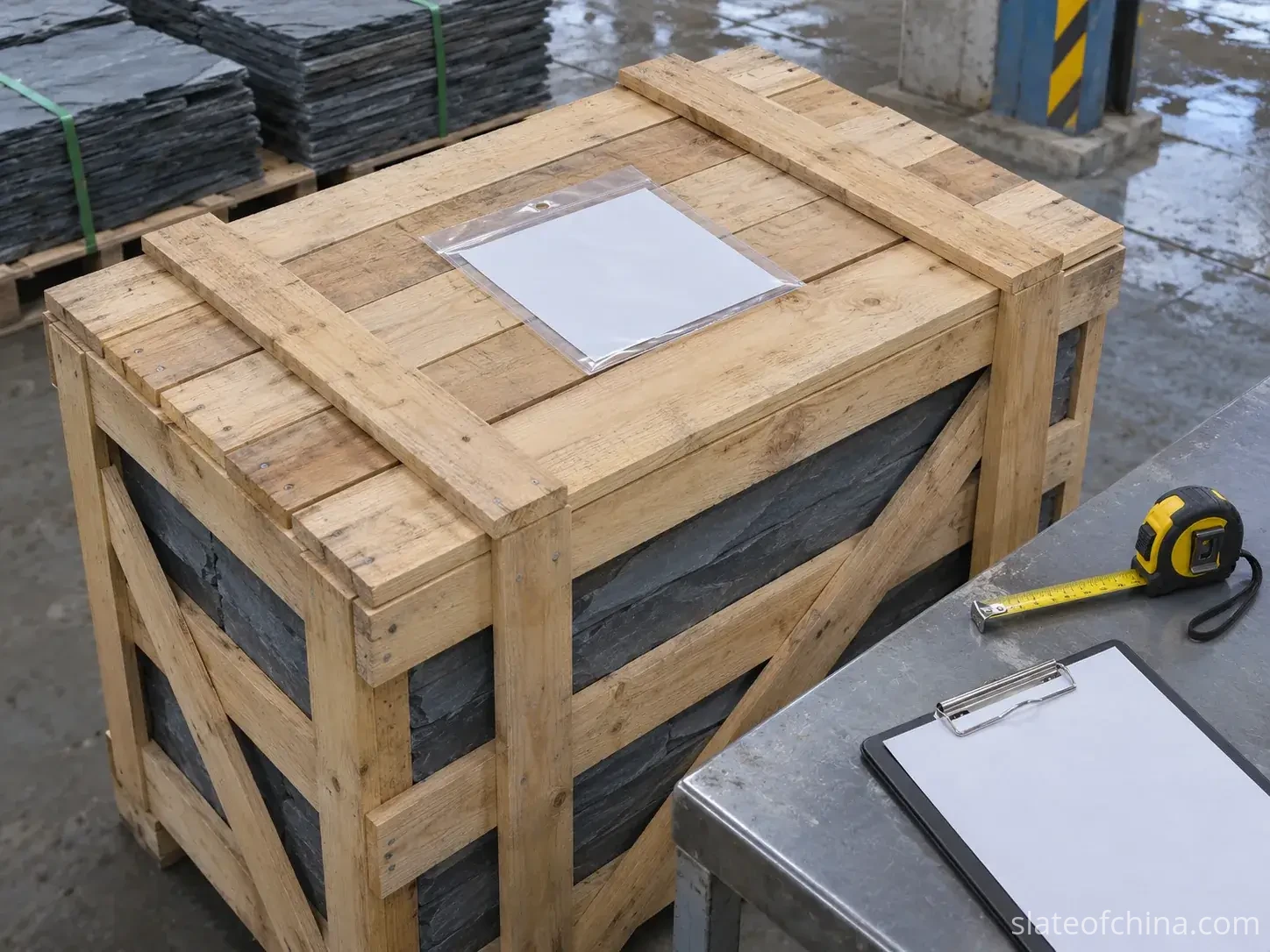
Export packing for slate does three jobs at once, and a quotation that only says “export wooden crate” settles none of them. It protects each piece. It holds the pieces together as one stable shipping unit. And it keeps that unit in place inside the container. In our production, architectural slate is normally packed upright — each piece standing on its lower edge inside a wooden crate — and the support, padding and restraint built around that upright pack depend on the slate itself: its dimensions, finish and geometry, the route, and how the receiver will unload it.
You are not packing for the ocean. You are packing for the next handover — the fork that lifts the crate, the truck that brakes, the crane that sets it down, the crew that opens the lid. Each section below is one handover to confirm before the crate moves on.
In brief — a sound pack answers three questions before anything is loaded:
- Piece level: is every face protected, every edge guarded, and is nothing rubbing?
- Unit level: is the package stable, stackable, and handled the way its base is built?
- Container level: is the package blocked and lashed so it cannot slide, tilt or crush its neighbour?
What the packing has to survive
Handover to confirm — every move between the factory floor and the receiver’s site.
The ocean crossing is only one leg. A crate may be picked up on the fork, slid into a container, hauled by truck, handled at a terminal, carried by ship, hauled again and opened at a site you will never see. A less-than-container-load (LCL) shipment adds extra handling at consolidation and deconsolidation points, where a crate can be dropped, re-palletized or sat on by something heavier.
| What happens in transit | What can happen to slate | What to settle before shipment |
|---|---|---|
| Repeated vibration and jolts | Fine face scratches, edge chips and rubbing between pieces | Clean interleaving, snug internal blocking and protected corners |
| Forklift handling and set-down | Broken runners, tilted loads, forks striking stone | A suitable base, marked fork entry, verified package weight |
| Braking, vessel motion and cargo shift | Crate movement, impact, slab breakage | Package restraint plus a separate container securing plan |
| Temperature swings and humidity | Wet packaging, transfer marks or surface staining on susceptible finishes | Dry packing materials, a dry container, a moisture plan for the voyage |
| Stacking or mixed cargo | Crushed top protection, pressure on exposed stone | A defined stacking status and a crate rated for any approved load above it |

Crates, pallets or transport frames?
Handover to confirm — which package actually protects the most fragile piece in the order.
Start from the piece that breaks first. A simple rectangle of thick, natural-cleft paving behaves differently from a thin honed tile, and both behave differently from a long hearth slab with a cut-out for the firebox. The package should be chosen for the vulnerable piece, not for the largest piece.
| Slate product | Packing approach to discuss | Detail worth agreeing |
|---|---|---|
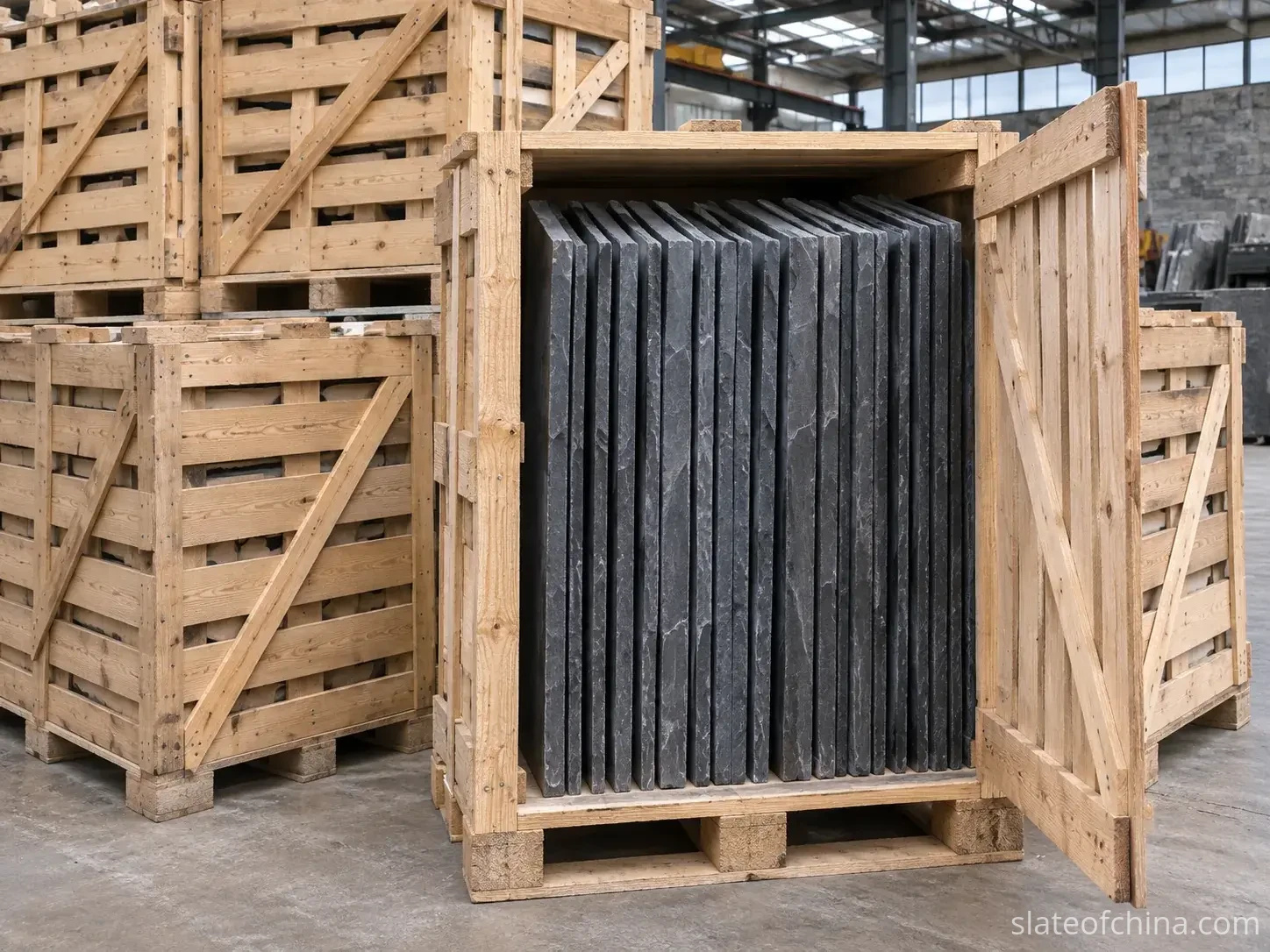
| Thick rectangular paving slabs | Wooden crate with the slabs packed upright on their lower edges | Lower-edge support, snug blocking, package height, protected edges |
| Honed floor tiles and flat wall cladding | Upright in a wooden crate, with protective cartons or divided bundles where suitable | Face separation, corner guards, lot identification |
| Ledger panels, mosaics, corner units | Product-specific cartons or partitions in an outer shipping unit | Clearance around projecting faces, separate identifiers for corner units |
| Irregular flagstone and stepping stones | Contained crate or pallet box with packing suited to the shapes | High points, unsupported ends, movement between pieces |
| Large-format panels, hearths, cut-to-size slabs | Purpose-built supported crate or rated transport frame | Orientation, bearing points, restraint, lift method, unloading sequence |
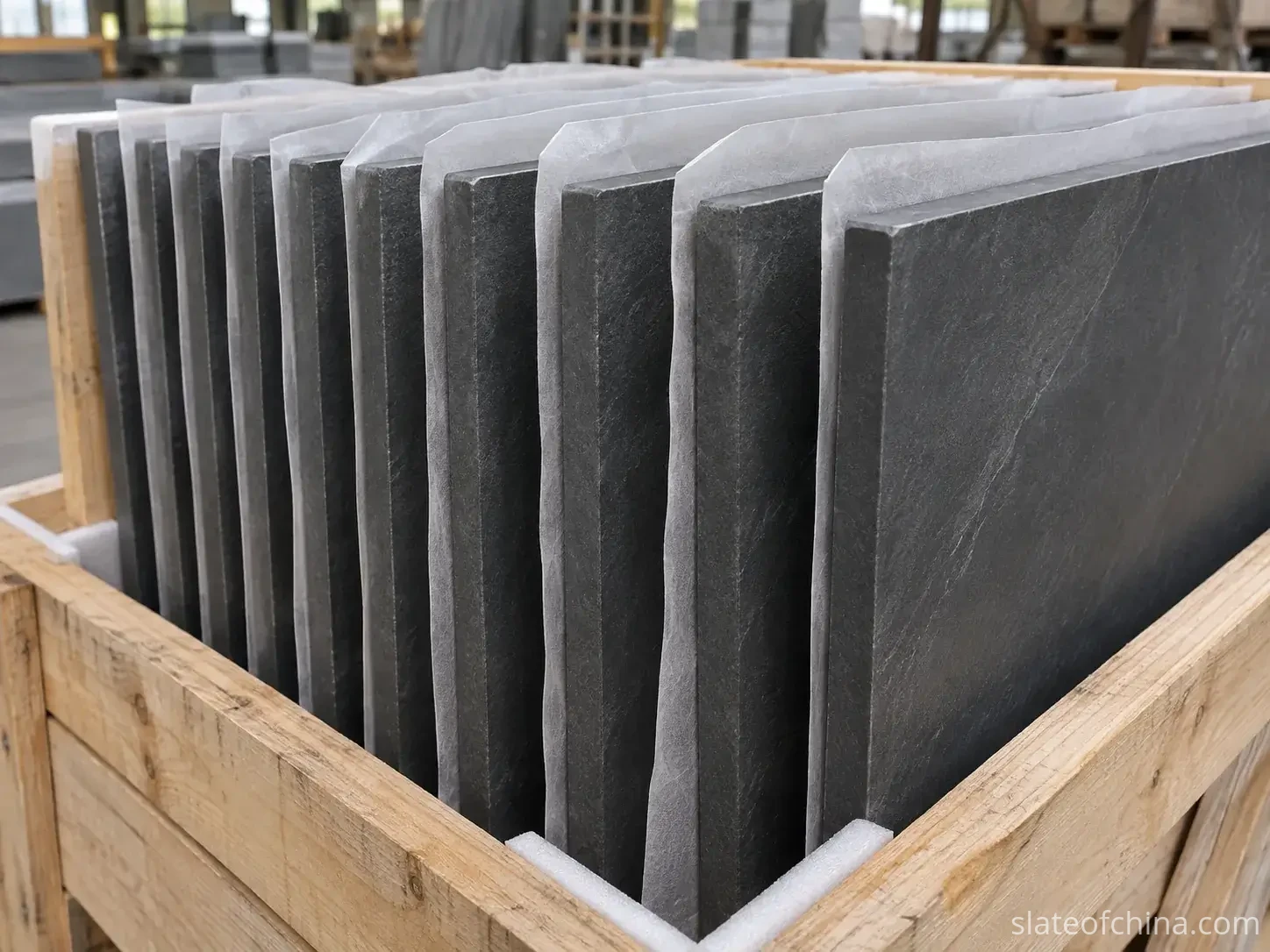
A pallet gives the load a base to be handled on. A crate can add side and top protection. A transport frame supports and restrains the stone in a defined position. Ask for a sketch or photographs of the proposed arrangement, including the base and how the stone bears on it. The phrase “export wooden crate” on a quotation leaves every one of those details open.
Why architectural slate travels upright
In production, slates stand on their lower edge inside the crate, face to face like books on a shelf. The reason is mechanical. When pieces are stacked flat, the lower pieces carry the weight of everything above them, and an uneven support or a single raised contact point can concentrate that load and crack the stone — particularly while the pack is being handled. Standing each piece upright transfers its weight to the supported lower edge and takes that stacked crushing load off the stone.
Upright does not mean unsupported. The crate still needs a base that carries the lower edges, protection at the bearing points, and blocking or restraint that keeps the pieces from shifting or tipping on the road. Choose the interleaving to suit the finish and guard the exposed edges and corners. Flat stacking remains an option for compact, robust formats with full, even support — but it is the exception, and it should be agreed as such.
For a large slate hearth, confirm the packing orientation against the actual drawing. Cut-outs, narrow bridges, projecting corners and finished edges can change where the piece may safely bear. If a transport frame is proposed, agree with the packing team and with the receiver on how the stone stays restrained all the way through transport and unloading. A frame built for workshop storage should only travel if it has been assessed for the journey. Moving and releasing restrained slabs carries its own risks, worth reviewing before anyone puts a crane or fork under them.

Interleaving and strapping do different jobs
Handover to confirm — what separates the faces, and what holds the straps, are not the same thing.
Interleaving separates surfaces that would otherwise rub. Use clean separators compatible with the actual finish. For honed, brushed or otherwise sensitive faces, check the proposed material against a production sample for rubbing, indentation and colour transfer — including the damp conditions the pack may face. Natural-cleft slate can also rub where high points touch, and stone dust trapped between faces acts like sandpaper on a long voyage.
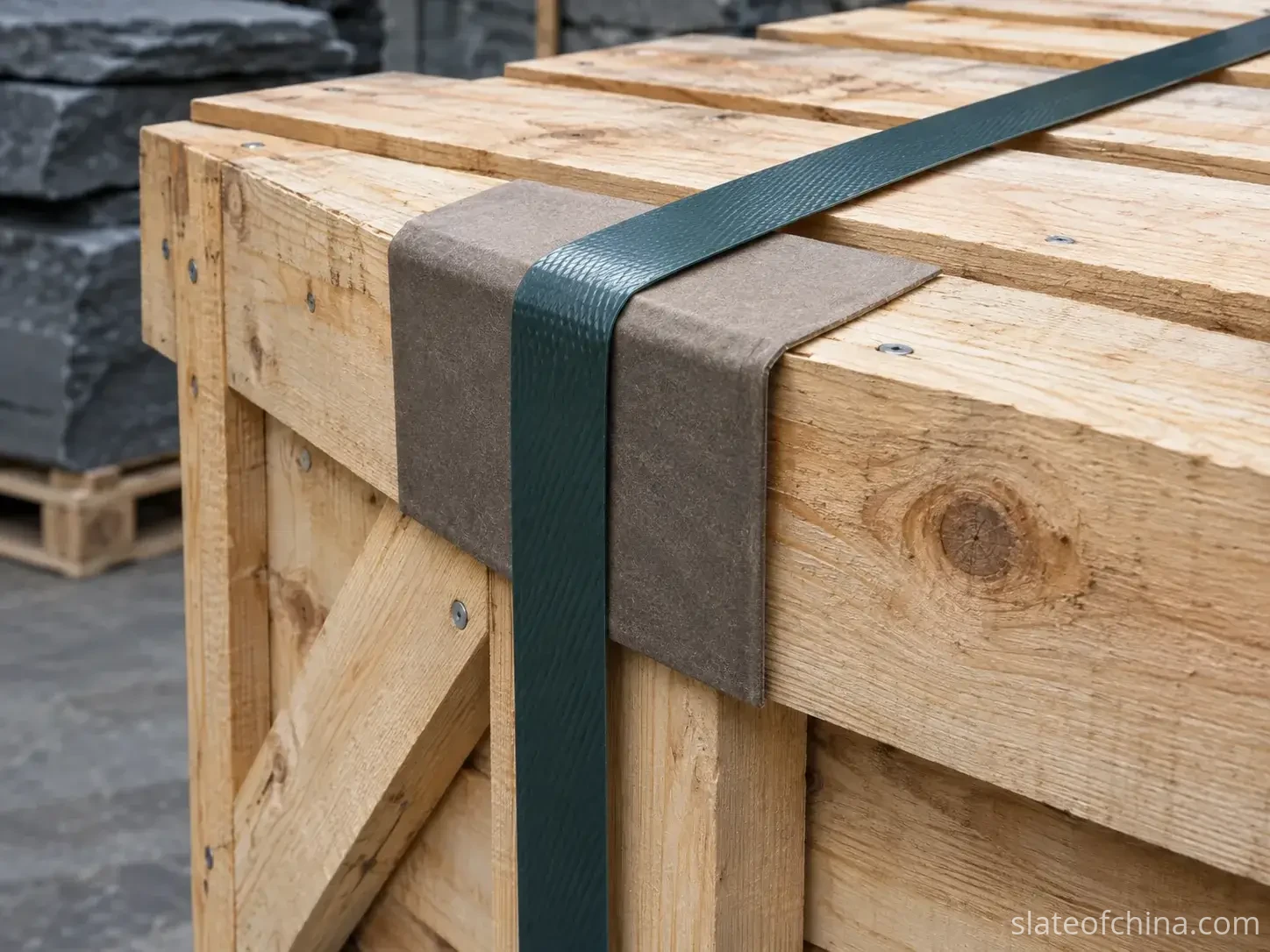
Edge and corner guards protect vulnerable arrises and spread strap pressure where it is needed. A strap drawn over a bare narrow edge concentrates force; a guard lets it pass without digging in. Confirm the strap pattern, the contact points and the tension with the packer. And note that product straps and container lashings answer two different questions: straps hold the package together, blocking and lashings keep the package from moving relative to the container. Both matter even when a crate looks tightly banded.
Plan for condensation before the ship is sealed
Handover to confirm — what a dry-looking container can still do to damp packaging.
A container that looks perfectly dry can still sweat. When the steel walls cool, moisture condenses on them and drips, and it can gather where damp packaging is held against a face. Moisture can come from the stone itself, from the timber, from cardboard or from trapped air. Low water absorption in the stone says little about how the finished face or its packaging will look after a damp voyage — the damage is often to the finish, not the mineral.
Agree on dry loading conditions, dry packing materials, and an inspection of the container before packing. Where the route warrants it, review the cover, barrier and desiccant strategy with the packer. A top cover may shield against drips; a sealed barrier needs dry contents and a moisture plan sized for the volume it encloses. Wrapping a wet pack traps moisture rather than keeping it out. Ask the receiver how the crates will be stored after arrival — especially if they will sit for weeks before installation. The IMO/ILO/UNECE CTU Code covers condensation and cargo restraint in practical detail.

ISPM 15 and wooden crates for stone export
Handover to confirm — which timber is regulated, and which mark is separate from the crate number.
When the destination applies ISPM 15 to regulated solid wood packaging, check the crates, pallets, skids and any loose timber dunnage used to brace the load. Confirm the destination requirements with the importer or broker. For regulated packaging, ask the packer to verify the applicable treatment and official marking, and to provide legible photos of the marks. Keep those photos separate from ordinary crate IDs and shipping labels — they answer different questions.
Packaging made wholly from qualifying processed wood such as plywood is generally outside the scope of the standard. A plywood-sided box can still have solid-wood runners, and loose timber blocking can be added after the crates are built. Ask what every component is made from before you assume anything.
Keep the ISPM 15 check separate from the crate strength check. The mark concerns phytosanitary treatment and traceability; package strength depends on design and construction. A correctly marked crate can still be under-built, and a stout crate can still arrive without the right mark. The IPPC publishes the standard and its marking scheme — see the IPPC publication on ISPM 15.
How much slate can go in one crate or container
Handover to confirm — start with the heaviest package the receiver’s equipment can lift, at the real load centre.
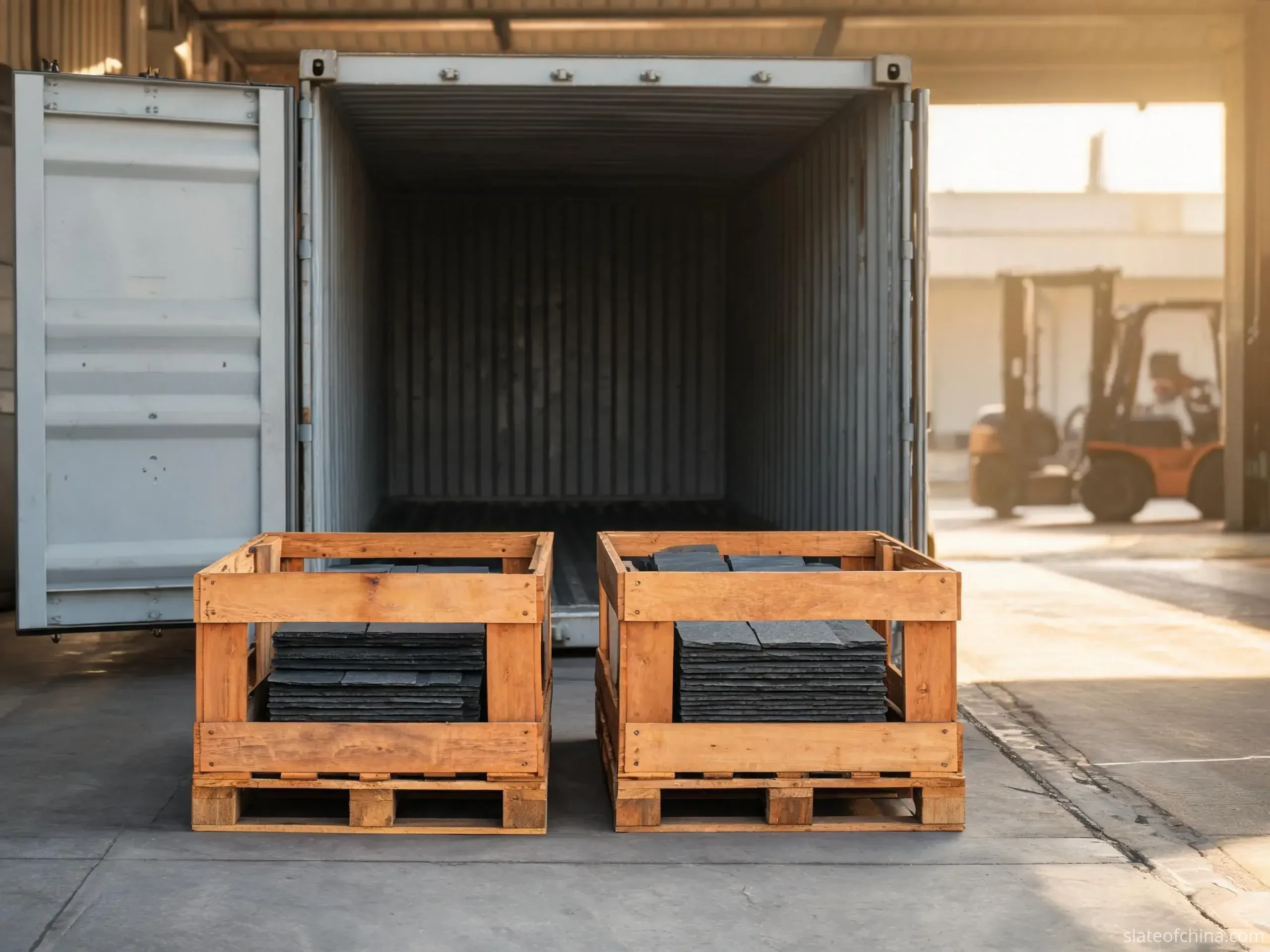
Begin with the receiver’s unloading equipment and the heaviest package it will actually handle — confirm the fork approach, the required lift height and the rated capacity at the load centre. Then review the container plan with the packer and the freight provider: payload, load distribution, concentrated loads on the floor, securing provisions, and road limits for the route. A heavy crate on narrow runners can overload a floor point even when the total cargo mass is inside the container’s payload. Weight is the handover most often left unplanned — a crate is only as safe as the next machine asked to lift it.
Worked example — slate paving. Take a nominal 600 × 300 × 25 mm paving slab and an assumed density of 2,750 kg/m³ for illustration.
- One slab is about 12.38 kg.
- 80 pieces cover about 14.4 m² at nominal face dimensions, before joints.
- 80 pieces are about 990 kg of net stone, before rounding.
- If the crate and protective materials weigh 65 kg, one packed crate is about 1,055 kg gross.
- Twenty such crates are about 21,100 kg of packaged cargo, before separate container blocking and securing materials.
These figures only show the arithmetic. Confirm finished sizes, weight variation and actual packed weights before you book. Under the SOLAS rules for applicable sea shipments, the verified gross mass (VGM) is the mass of the packed container — the container tare plus all cargo, packaging, dunnage and securing materials, established by the approved calculation or by weighing the packed container. The IMO guidance on safe transport of containers explains the approved methods.
The packing brief to paste into your RFQ
Handover to confirm — put the receiver’s real limits in writing before the pack is made.
Packing is easier to agree before the order than to argue about afterwards. The table below is a short brief; past it into your request and mark anything that is not standard.
| Field | What to send or ask for |
|---|---|
| Product and exposure | SKU, dimensions and thickness, finish, visible faces, vulnerable edges, destination |
| Shipping unit | Proposed crate, pallet or frame; packing orientation; pieces or net m² per package |
| Stone protection | Separators, edge guards, bearing locations, blocking, moisture protection |
| Package limits | Maximum gross mass and dimensions, permitted stacking, fork entry, receiving equipment |
| Timber and route | Destination wood-packaging requirements, solid-wood components and dunnage, FCL or LCL |
| Traceability | Crate ID, SKU, finish, batch where relevant, quantities, gross mass, packing-list reference |
| Approval | First-pack photos or a sketch before repeating the pack, and how changes are approved |
| Dispatch records | Package list, actual gross masses, crate photos, loading and securing photos, seal number |
Wording you can put on the purchase order
Submit the proposed packing for approval before packing the order. Show product orientation, support and separators, protection of finished edges, maximum package gross mass, and the agreed handling method. Identify each crate by SKU, batch and quantity where applicable, and match the crate IDs to the packing list. Obtain written approval for any change that affects protection, handling or package mass.
Add the receiver’s actual limits and any destination-specific requirements to the order. If the shipment mixes formats, ask for a crate-by-crate list so installers can find the pieces they need without opening every pack.
What to photograph before the container is sealed
Handover to confirm — the pack is only approved when the evidence can see it.
The photographs are worth taking while everything is still visible, because they are the record a freight claim will ask for later.
- First pack, open. Record the lower-edge support, the upright orientation, the interleaving and the blocking before the crate is closed.
- Finished crates. Capture crate IDs, fork entry, condition, and any wood-packaging marks. Link each photo to the packing list.
- Empty container. Record the number and the condition of floor, walls, roof and doors before loading.
- Loaded container. Photograph positions and securing details before they are obscured. Finish with a doors-open overview and the applied seal.
At arrival, record the seal and the condition before disturbing the cargo where it is safe to do so. If a load looks shifted or unstable, keep people clear and have a qualified handler assess it before unloading. If there is damage, keep photos tied to crate IDs and preserve the packaging where it is safe. Follow the notice and evidence requirements in the carriage and insurance documents.
Pack for the ocean and the crate may survive the water. Pack for every handover and the stone inside survives the journey.
Frequently asked questions
Is stretch wrap enough for slate paving pallets?
Stretch wrap helps contain a suitable load and keep dirt off it, but it does not protect the faces or hold the pieces in place by itself. Review how the pieces are supported, how the unit will be handled, and how it will be secured in transit. For heavy or irregular paving the pack usually also needs a rigid base, blocking, edge protection and a proper restraint system.
Can honed slate and natural-cleft slate share a crate?
They can share an outer crate if the arrangement keeps the finishes safely separated, supports the different sizes and profiles, and lets the receiver identify and unload each pack. Where a honed or polished face would bear against the high points of cleft pieces, ask for separate compartments or separate packs.
What is the best packing for a first slate order?
Ask for first-pack photos that show the parts a buyer normally cannot see — the base, the bearing points and the separators. Approve the pack using the actual formats, finishes and receiving equipment you will use. If the goods travel LCL, ask how the pack will be handled at consolidation and delivery, and agree its stacking status in advance.
Does a plywood crate need an ISPM 15 mark?
Regulated solid wood packaging carries the treatment mark; packaging made wholly from qualifying processed wood such as plywood is usually outside the scope. The catch is what else is in the box — solid-wood runners, and loose timber blocking added after the crates were built. Ask what every component is made from before you assume the mark is not needed.
How heavy should a crate of slate be to be safe to lift?
There is no single safe weight. Start from the equipment that will lift it — a fork driver at a small site may be limited well below a quayside crane. Confirm the fork approach, the lift height and the rated capacity at the actual load centre, and keep the package within that. A crate of several tons needs the right lifting points, not just a strong box.
Should large slate pieces travel flat or on edge?
Most architectural slate travels upright on its lower edge. For large cut-to-size slabs, we confirm the packing orientation against the drawing and the receiving site’s unloading method; the piece normally travels in a purpose-built crate or a rated transport frame that supports the lower edge and restrains it. Flat stacking is kept for compact, robust formats with full, even support, because in a flat stack the lower pieces carry the weight of everything above them.
What actually keeps a slate crate from moving inside the container?
The product straps keep the package together; they do not stop the crate sliding. Blocking and lashing at the container level, matched to the route, hold the package in place. Ask the packer for the two plans separately — the banding on the crate and the blocking plan inside the container — and photograph both before the doors close.
Get a packing plan written for your order
We pack and ship architectural slate from our factory, and we will put the packing method, the weights and the container plan on paper before we build a single crate. Tell us the slate, the finish and the destination — we will confirm what the crate has to survive on your route and what we will photograph for you. Send your project details and ask for the packing brief.