
Slate Edging, Borders and Raised Beds
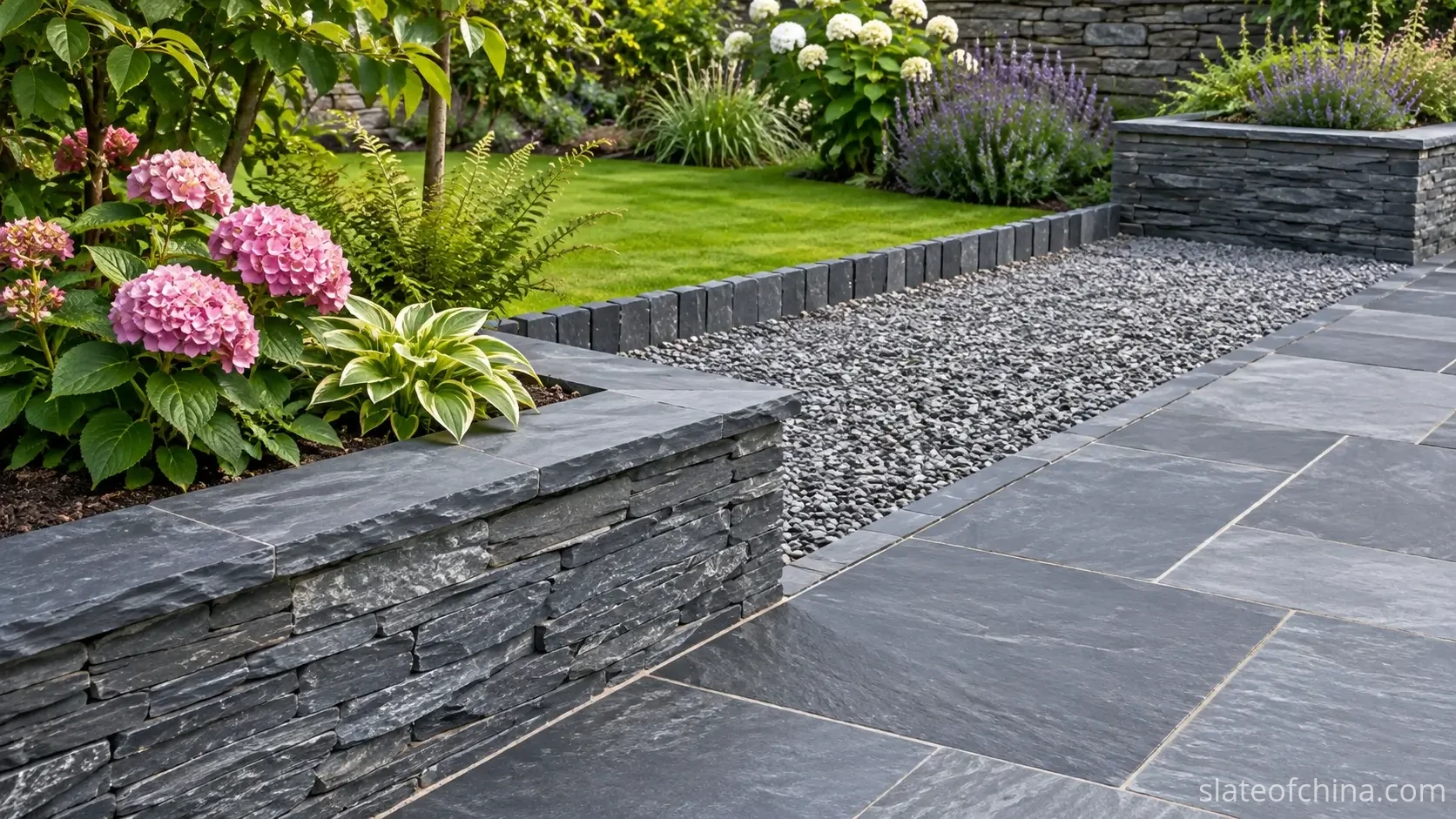
Run a mower along a border for one full season, and you will learn which edges were specified and which were improvised. The specified line still runs straight in October. The improvised one has surrendered its corners to the grass, shed its gravel into the lawn, and drifted a hand's width toward the fence.
That is the quiet work of garden edging: holding the lines between surfaces so that everything else can relax. A lawn can be mown cleanly if the edge gives the mower something to follow. Gravel stays where it was raked if something contains it. A planting bed keeps its shape, season after season, if the boundary is built rather than wished for. Natural slate garden edging does this work well because the material is suited to it — it splits into straight, stable pieces, it weathers without demanding attention, and its dark charcoal tones make a crisp line against grass, gravel and soil alike.
This guide treats slate edging the way it deserves to be treated: like the paving it borders. The garden edging stone itself is only half the decision — the posture it is set in, the depth it is embedded, the base beneath it and the water around it do the rest. What follows works through the two postures slate edging takes, the four lines a garden most often asks it to hold, and the sizes, embedment and installation details that keep those lines straight past October.
Quick answer: flat slate strips finish an edge like a small paving unit — wide, visible, laid on full support. Standing slate stones hold an edge like a small vertical element — narrow, crisp, embedded and haunched. Lawns and gravel usually ask for standing stone; paving edges and bed copings usually ask for strips; raised beds are walls, and belong to engineered construction rather than to edging. However the line runs, it is specified like the paving it borders: base, levels, drainage, tolerance — confirmed in writing.
Two Postures: Flat Strips and Standing Stones
Natural slate reaches a garden boundary in one of two postures, and they are engineered differently even when they are cut from the same block. Getting the posture right matters more than getting the colour right — a colour can be matched later, but a strip asked to do a standing stone's job will fail slowly, and visibly.
Flat Slate Edging Strips
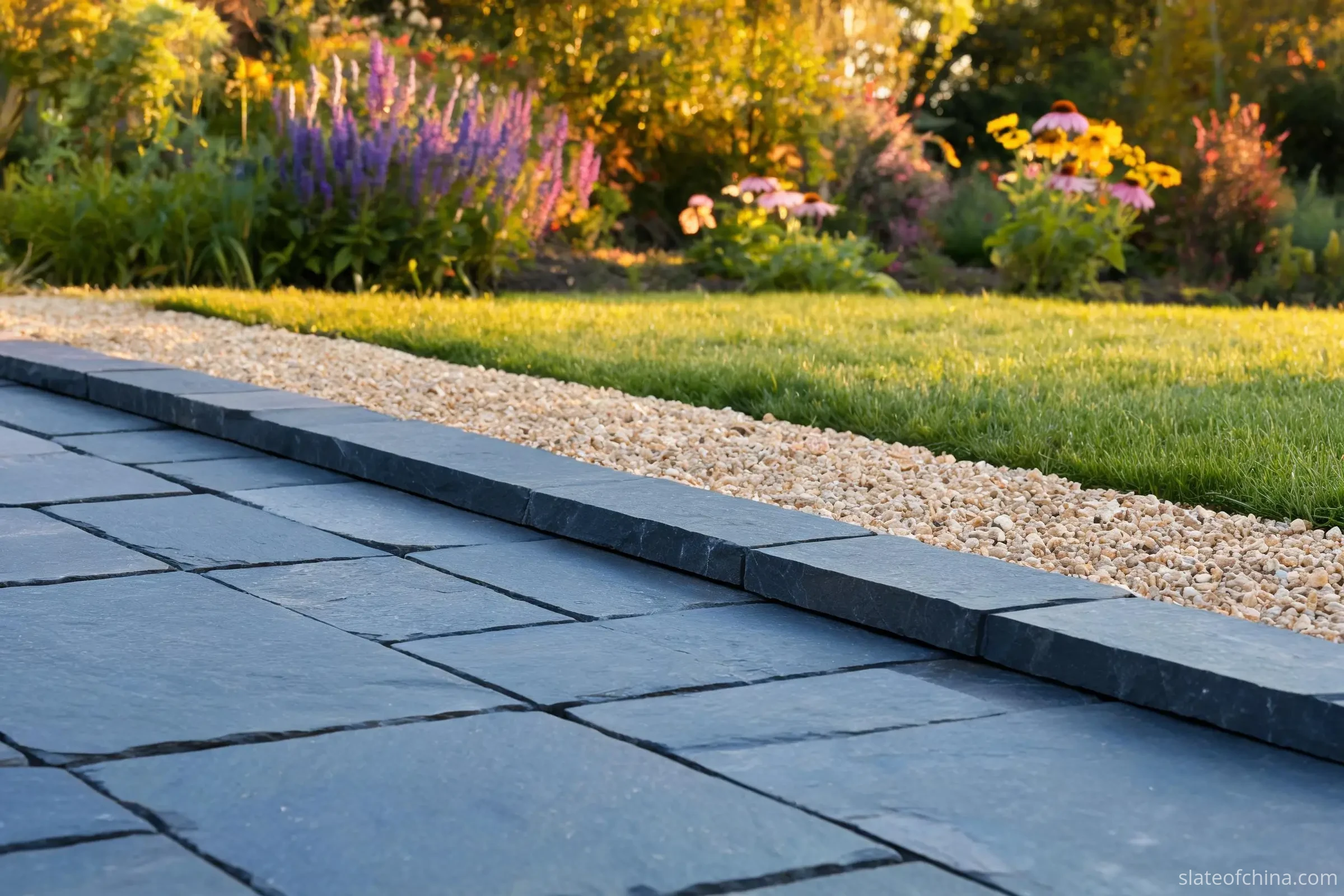
Flat strips are laid like small paving units. They sit on a prepared bed, present a wide visible surface, and finish an edge the way a threshold finishes a floor: a deliberate transition rather than a barrier. Along a pathway, a terrace or the shoulder of a planting bed, a horizontal slate border reads as part of the surface family beside it — which is why designers use it where the edge is meant to be seen, as borders along paving, coordinated bands around paved areas, and coping strips capping low walls and beds.
Because a strip works like paving, it is specified like paving: full support on a prepared base, thickness matched to the loading, joints treated deliberately. A strip bridging a soft spot will rock and crack exactly as a thin flag would.
Vertical Slate Edging, Set Upright
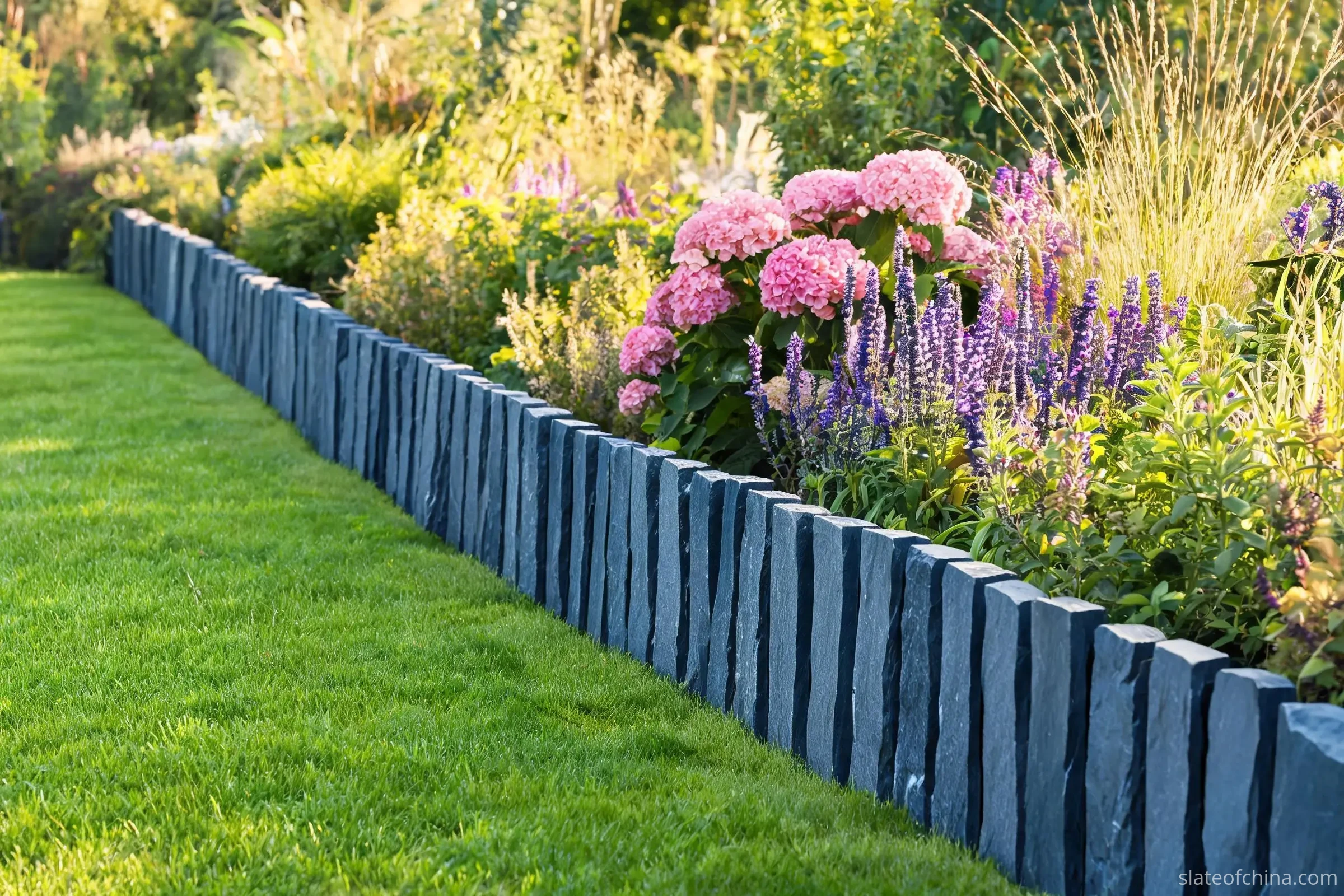
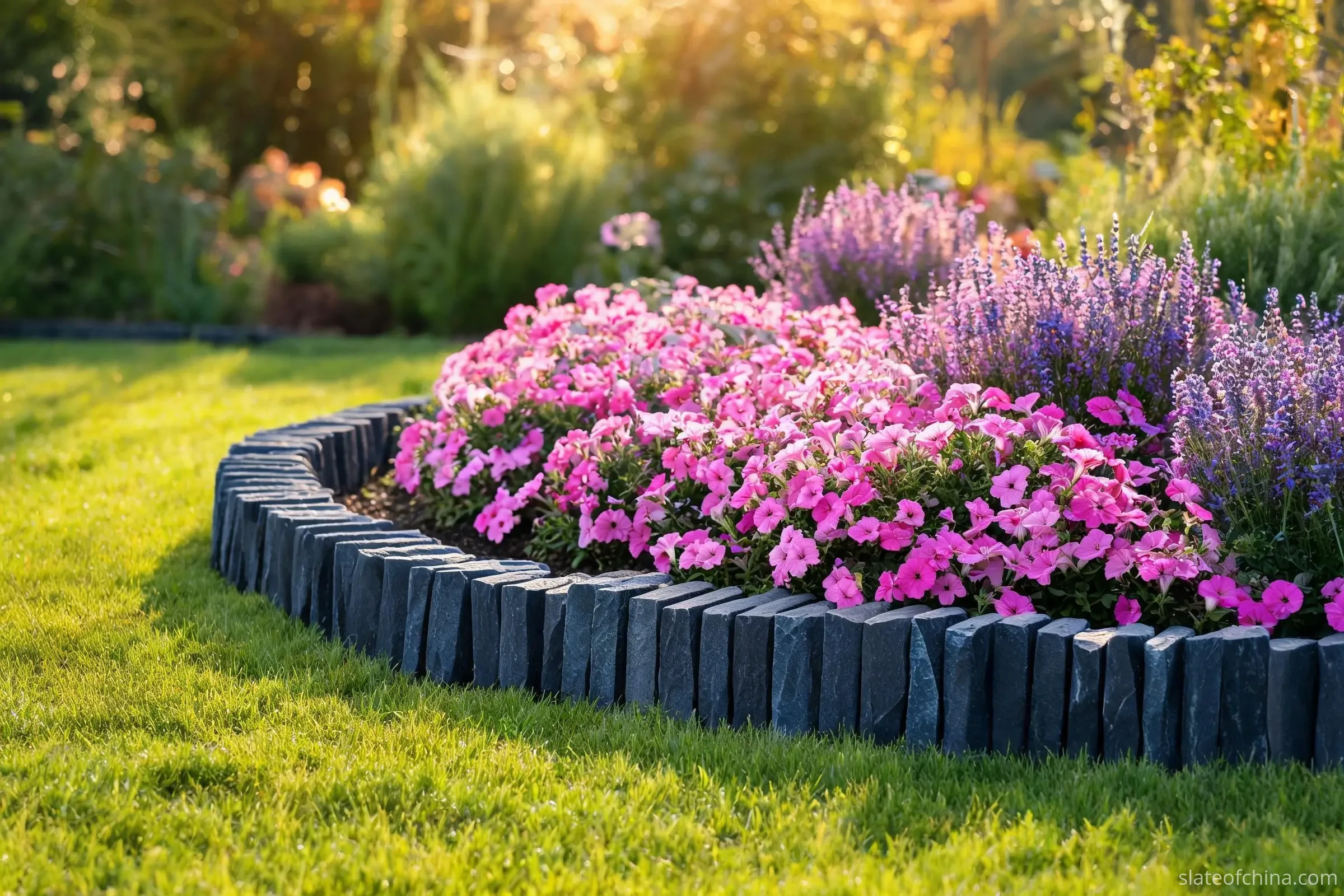
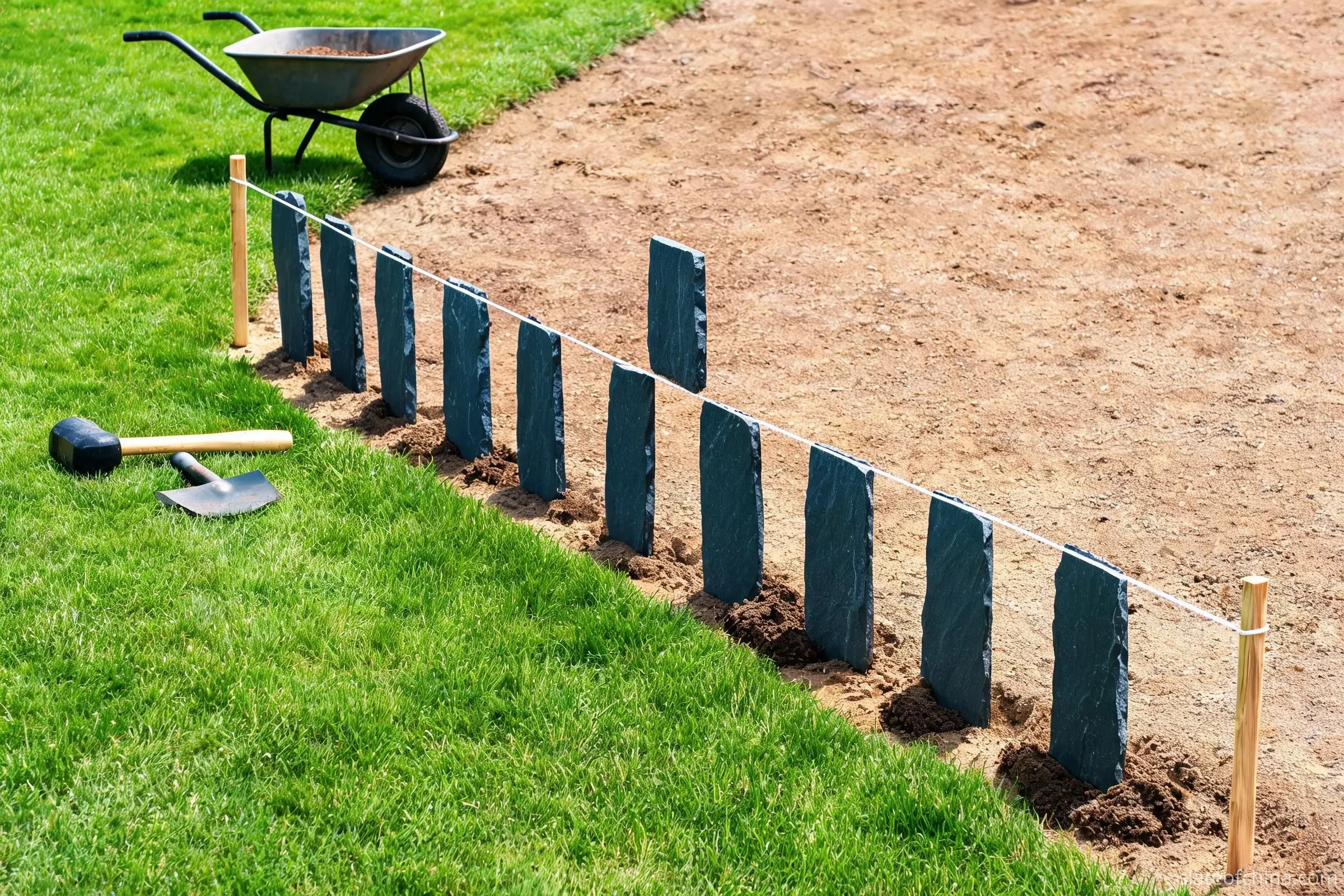
Standing stones are set upright — a small fence made of stone. They present a narrow face to the garden and hold a line with a crispness no flat surface can match, which is why vertical slate edging is the default choice between lawn and bed, and along gravel paths, where the edge's whole job is definition and restraint.
Because a standing stone works vertically, it is specified like a small structural element: a meaningful share of its height in the ground, bedding or haunching to hold it plumb, and a thickness suited to the duty. Set too shallow, it leans. Set without support, it rocks. Asked to hold back soil it was never meant to hold, it fails.
| Posture | What it does | How it works | Best at |
|---|---|---|---|
| Flat strips | Finishes an edge — a wide, visible transition | Full support, like a small paving unit | Patio and path borders, copings |
| Standing stones | Defines and contains — a narrow, crisp line | Embedded and haunched, like a small vertical element | Lawn lines, gravel restraint |
There is a third scale, and it is not really edging at all: the raised bed, where slate becomes coping, facing or part of a constructed wall. That scale has its own section, because it has its own engineering.

The Lawn Line: Slate Edging Between Grass and Beds
A lawn meeting a planting bed is the most-edged line in any garden, and the one where the edge earns its keep weekly. Without a boundary, grass creeps into the bed and mulch migrates onto the turf; with natural stone lawn edging in place, a strimmer pass or a mower wheel along the stone keeps the line clean in minutes.
Dark standing slate against green grass is the classic slate flower bed edging look — the contrast does the design work with nothing else needed. For a restrained border, keep the visible height low and the tops aligned. For a more expressive one, stagger the visible heights in a rhythm, or mix lengths so the line reads as composed rather than ruled.
The mower decides more edging details than designers like to admit. A line set flush with the turf, or a controlled few millimetres proud, lets a mower wheel ride along the stone and cut the grass clean to the edge. A tall, sharp-edged line forces the strimmer out every week and invites chipped blades and scalped turf. Sharp or protruding edges should never become an avoidable maintenance hazard.
The Gravel Line: Holding Aggregate Where It Was Raked
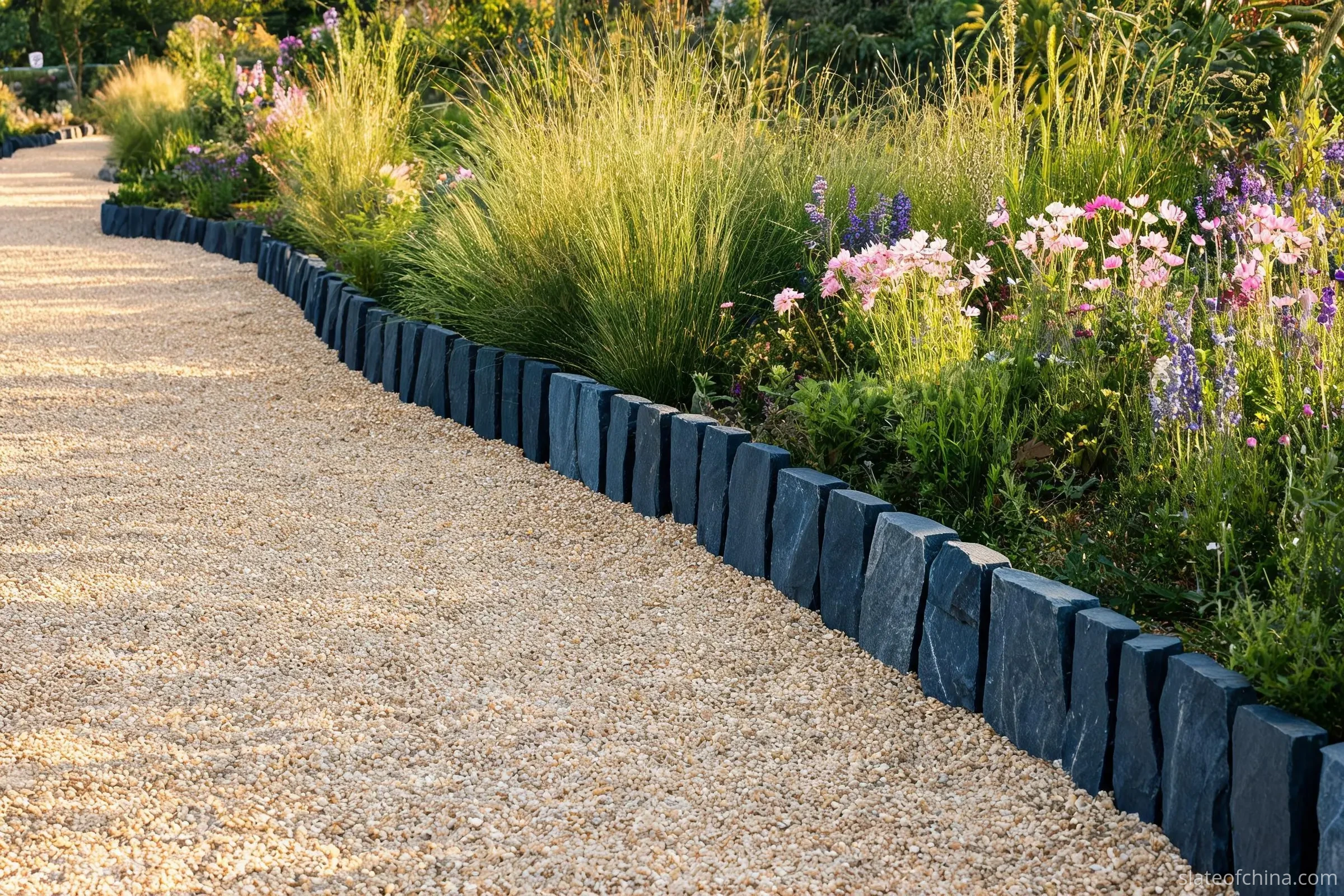
Gravel gives a garden loose texture and easy drainage, and it gives the same garden a permanent ambition: to migrate. Every footstep, every rake, every hard rain moves aggregate downhill and sideways, and the edge's job is to call a halt.
The working rule is simple: whatever contains the gravel should stand at least as high as the finished gravel surface. An edge set lower lets stone ride over the lip with every pass. An edge set slightly higher keeps the surface contained and reads as a deliberate line — and dark slate standing above pale gravel is one of the sharpest looks in contemporary landscaping precisely because the height that makes it handsome is the height that makes it work.
Straight runs suit long contemporary paths, where full-length strips keep the line architectural. Gentle curves are better followed with shorter segments, jointed close, so the stone bends with the route instead of fighting it. In every case the edging system must be stable enough for the gravel depth, the foot traffic and the ground beneath — which is a specification question, not a styling one.
The Paving Line: Borders That Finish a Surface
Where a paved surface meets gravel, lawn or soil, the border is the full stop at the end of the sentence: the detail that tells the eye the surface was designed to end here. Coordinated slate paving borders let one material carry the whole composition — surface, edge and step reading as a family — while a contrasting border turns the paving edge into a deliberate feature.
That is why slate garden borders are specified together with the paving they finish, not chosen after it: base preparation carried under the edge, levels coordinated, drainage falls maintained past the boundary, movement accommodated. The paving side of that discipline is covered in the slate paving guide, and every rule of it applies to the strip that finishes the edge.
One caution is worth its own sentence: a decorative border is not automatically an edge restraint. Some paving systems need a proper restraint at the boundary to stop lateral creep, and a thin decorative strip asked to do that job will let the pavement migrate. Where a border sits at a paving edge, the restraint question is settled first, and the border is then detailed to suit.
The Level Line: Slate Raised Beds and Low Walls
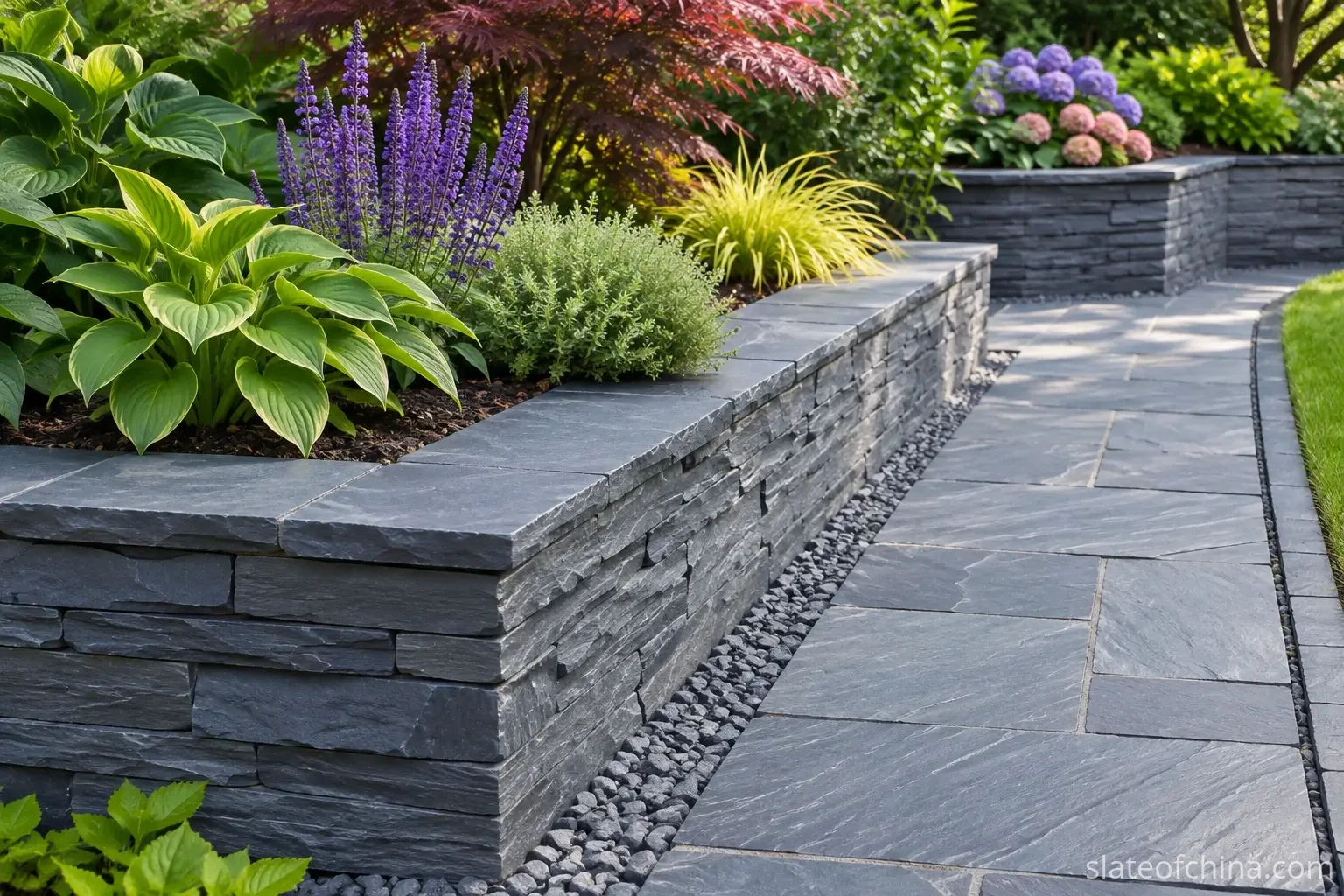
Slate raised garden beds lift the planting closer to the gardener and give a design its winter structure. Slate participates in two honest ways: as coping — the flat strips that cap the wall and give the bed its finished edge, wide enough to sit on or rest a trowel on where the height allows — and as facing, the visible skin of a constructed wall.
The structural line: a raised bed is a small retaining wall. It must resist the pressure of soil and water behind it, through every saturated winter, and that is wall engineering, not edging. Thin decorative slate panels should never be relied upon to retain soil unless an engineered system specifically permits that use. The honest specification is a designed wall — masonry, block or another structural core — with slate as the visible face and coping.
Inside the bed, drainage gets a vote as well: excess water needs a path out, so the bed's build-up — drainage layer, soil, mulch — is designed with the wall, not poured against it and hoped for. For bed and wall cladding options, the wall cladding slate range covers formats and finishes.
Slate Edging Sizes, Thicknesses and Embedment
Edging is specified in three numbers: what shows, what sits in the ground, and how thick the stone is. The ranges below are design and enquiry dimensions for the two postures — not a stock list — and what a supplier can actually cut depends on the raw material, the processing available and the duty the line must carry.
| Format | Illustrative dimensions | Typical duty |
|---|---|---|
| Flat border strips | 150–300 mm wide × 20–40 mm thick | Finishing paved edges and copings |
| Standing edge stones | 100–300 mm high × 30–60 mm thick × 200–600 mm long | Lawn lines and gravel restraint |
| Raised bed coping strips | 300–400 mm wide × 20–40 mm and thicker | Capping low walls and beds |
| Bed facing panels | Heights per wall design, thickness per system | Visible face of engineered walls |
Suppliers describe and grade edging stone in different ways — by length bands, by height bands, by the piece, or by the running metre — and two orders described the same way can arrive with quite different usable dimensions. Confirm the measurement basis and the thickness tolerance in writing before ordering; it is cheaper than discovering the difference at unloading.
The sizes are only half of the order. The other half is how the stone is sold and finished, and four details are worth fixing before a quotation is built:
| Ordering detail | What to fix |
|---|---|
| Ordering unit | By the piece, by the running metre, or as a batch — which one the quotation is built on |
| Edge treatment | Natural split edge or sawn edge, as actually produced for the order |
| Thickness tolerance | The acceptable variation, confirmed in writing rather than assumed |
| Length mix | Uniform lengths, or an agreed distribution across a mixed batch |
For standing stones, the number that decides the line's future is embedment. For non-structural, low borders, a widely used starting point is to set at least as much stone in the ground as stands clear above it — but it is a preliminary reference, not an engineering rule: the actual depth must follow from the loads, the base, the soil and the local frost conditions of the site. Shallow-set stones are the ones that lean after the first winter. The proportion is a specification decision confirmed on site — not a constant that travels with the stone.
How Much Slate Edging Do You Need?
Edging is ordered by the piece, by the running metre, or as a mixed batch, and the arithmetic changes with each. A worked example shows the shape of it.
Take a straight garden boundary of 24 metres, to be held with standing stones 600 millimetres long, laid end to end. Ignoring joints and cuts, the line needs 24 ÷ 0.6 = 40 pieces. Add a contingency for corners, cuts and the occasional spoiled piece — a common allowance in landscaping orders is around five per cent, which takes this line to 42 — and the figure is still illustrative, because a real order follows a real layout, not a rule of thumb.
Joint width matters at scale. Forty pieces with a 5 mm joint between them consume 200 mm of the run — a third of a stone — and curves consume more again, because a bending line wants shorter pieces and more of them. Before ordering, lay the route out, count from the drawing rather than from the metre tape, and confirm the count against the supplier's packing units: an order rounded to a crating multiple and an order to exact count are two different orders.
How to Install Slate Edging: Setting the Line
Installing edging is shorter work than installing paving, but it rests on the same logic: a continuous prepared bed, not a series of individual holes. The line is only ever as true as the ground beneath it.
- Set out the line. Straight runs with a string line; curves with a hose or marking paint, walked and adjusted until the route reads right before anything is dug.
- Excavate a continuous trench. Deep and wide enough for the stone, its bedding and any sub-base the duty requires — one trench, not a hole per stone, is what keeps the line true.
- Compact the base. Firm the trench bottom, and add a compacted granular sub-base where the ground is soft, wet or frost-prone, or where the edge will take real traffic.
- Bed the stones. Strips on full support, like small paving units. Standing stones set to line and plumb on compacted bedding, held by haunches on both faces where the design calls for them.
- Check the line as you build. Tops aligned or deliberately staggered, faces plumb, joints consistent — a few millimetres of drift per stone becomes a visible wander over ten metres.
- Haunch and backfill. Complete the haunches or backfill and compact in thin lifts, so the stone is held by the ground rather than merely standing in it.
- Test the finished line. Walk it, work the mower along it, rock the occasional stone — and re-set anything that moves before the garden grows over the evidence.

Water, Frost and Ground Movement
An edge is a small dam by accident. It stands in the way of water moving across the garden, so levels and falls deserve a minute of thought: surface water should be able to cross or leave the line, not pool against it. The wider drainage rules for paved ground — falls, joints, and where the water actually goes — are covered in the paving drainage guide, and they apply to the edge before the paving, not after it.
Frost works on shallow things. Ground that freezes and thaws heaves shallow-set stones and leans shallow lines; embedment is the defence, and it is cheaper than re-setting a border every spring. Mulching shifts lines too, quietly: a few seasons of top-dressing raise the bed side of a lawn edge by a centimetre or two, turning a flush line into a proud one — which, for a mower, is usually an improvement rather than a problem, and worth knowing before the line is blamed for moving.
Common Mistakes with Slate Edging
Even good stone fails at a bad line. Seven mistakes cover most of what goes wrong:
| Common mistake | What happens | Better approach |
|---|---|---|
| Stones set too shallow | Leaning after the first winter | Embed properly, confirmed for the site |
| A hole per stone, not a trench | A wavy line and uneven tops | One continuous, prepared bed |
| Decorative strips asked to restrain | Gravel spreads, the paving edge creeps | Settle the restraint duty first |
| Thin panels asked to hold soil | Bow and crack under soil and water pressure | An engineered wall system for raised beds |
| No thought for the mower | Chipped blades, scalped turf, weekly strimming | Flush, or a controlled few millimetres proud |
| Water with nowhere to go | Pooling, frost damage, migrating fines | Plan levels and drainage with the line |
| Mixed measurement bases when ordering | A batch that is not what was imagined | Confirm basis and tolerance in writing |
The principle behind all seven is the one this guide keeps returning to: a line is finished when it is stable, properly embedded and comfortable to maintain. Its looks come after that, not before.
Maintenance and Repairs
Well-set edging asks for remarkably little. Sweep or hose the line clean, keep soil and mulch from burying it, and cut grass back from the stone face before it creeps over. Because edging is installed as individual pieces rather than a monolithic pour, a damaged or stained stone in a dry-set or accessible system can be lifted and replaced without disturbing its neighbours.
After hard winters, walk the line and look for heave. A stone that has lifted or leaned is re-set, not shimmed: lift it, rebed it and rehaunch it, after asking why it moved — the answer is usually shallow embedment, and it is usually fixable. Sealing is a case-by-case decision, as it is for paving: sample-tested first, and never assumed to substitute for drainage or embedment.
What to Check Before Ordering Slate Edging from a Supplier
For contractors and importers specifying slate landscape edging at scale, the fastest route to an accurate quotation is a complete one. An enquiry that already carries the following details can be answered without a round of clarification:
- the posture and format — flat strips, standing stones, coping or facing
- the dimensional range, including the visible height for standing stones
- nominal thickness and the surface finish
- total quantity, and whether lengths should be uniform or mixed
- the destination market or port
In return, it is reasonable to expect the supplier to confirm in writing: the measurement basis behind the quoted sizes, the thickness tolerance, the edge treatment as produced, the physical test reports relevant to the intended application, and the packing method for international transport. Sample approval and production consistency complete the picture.
For irregular or mixed-length batches, agree how lengths will be distributed. A border designed around consistent pieces reads very differently from one built from a mixed-length batch, and both can be honest products — the design should know which it is ordering.
China is an established source of natural slate and stone for architectural and landscaping work, and Slate of China works with international customers across these materials. Depending on the raw material available and a project's processing requirements, enquiries can cover long strip formats for standing and flat edging, coping profiles, and dimensions adjusted to the line the design needs. For a project enquiry, send the format and dimensions — flat strips or standing stones — together with the visible height, nominal thickness, surface finish, quantity and destination market; those details determine what the material can support and how the order should be packed.
Frequently Asked Questions
What height should slate lawn edging show above the ground?
There is no single correct height. Low, aligned tops read restrained and are easiest to mow along; taller or staggered tops add rhythm but ask for more strimming. Whatever the visible height, the embedded share matters as much as the showing one, and both are confirmed against the site.
How deep should slate edging be set?
For non-structural, low borders, a widely used starting point is at least as much stone in the ground as stands clear above it — a preliminary reference rather than an engineering rule. The actual depth follows from the loads, the base, the soil and the local frost conditions, confirmed for the site.
Can slate edging hold back soil or gravel on its own?
Gravel, yes — containing aggregate is a normal duty for a properly set standing stone. Soil pressure is different: a raised bed is a small retaining wall and needs an engineered wall system, and thin decorative slate should not be relied on to retain soil unless the system is specifically designed for it.
Do slate edging strips need mortar or concrete?
It depends on the duty. Flat strips are usually bedded like small paving units on a prepared base, and standing stones are commonly held by compacted bedding and haunches. Mortar or concrete appears where the design or the loading calls for it — the method follows the specification, not the habit.
Can slate edging follow curves?
Yes. Gentle curves are followed with shorter segments set close together, while long straight strips suit formal, contemporary lines. The tighter the curve, the shorter the piece.
How does slate edging stand up to frost and rain?
Suitable slate performs well, but performance depends on the specific stone, its exposure, and the drainage and embedment around it. For demanding climates, ask for the relevant test information for the proposed source before ordering.
What sizes do slate edging strips and standing stones come in?
Flat strips and standing stones are commonly offered in the broad ranges described in this guide, but ranges and grading methods vary by supplier. Treat published sizes as enquiry ranges, and confirm the actual dimensional range, measurement basis and tolerance in writing.
Related Reading
Specifying a slate border or raised bed?
Send the line you need held — lawn edge, gravel path, terrace border or bed coping — with the format and dimensions, visible height, nominal thickness, surface finish, quantity and destination port. Landscape contractors, importers and wholesale buyers can expect the same review in return: what the current material and processing can support, how sizes and tolerances are measured, and how the order will be crated for transport — confirmed before production, not after a claim.
Request slate edging information
Final formats, tolerances and finishes depend on the material available and the project's requirements, and are confirmed in writing before production.