
Billiard Slate Export Packing: Pallets, Wooden Crates & A-Frame Support
I have opened more packing than I care to count, and the ones I remember are not the ones that arrived whole. They are the ones where the outside looked fine — strapping intact, timber unmarked — and inside, a heavy slate panel had shifted during transport and ground its machined edge against something hard. A pallet or crate can arrive looking perfectly intact while the slate inside has been damaged. The outside tells one story; the inside can tell another.
There is no single standard way to pack billiard slate for export. The packing method depends on the slate size, the number of sets, the shipping method and the handling conditions along the route. Most billiard slate travels in full-container-load (FCL) shipments, and most of those shipments use a method that may surprise first-time buyers who expect a wooden crate: several sets of the same specification, each panel stacked flat with protective separators between them, all secured on a reinforced wooden pallet. An A-frame vertical support structure is used for certain large individual panels. A fully enclosed wooden crate is mainly used for LCL shipments where the slate needs four-sided protection against other cargo.
This guide covers all three methods — and the principles that connect them. Not the thickness of the wood, but whether the slate can move. Not the crate, but what the packing prevents. The full shipping process is covered separately; this page focuses on the packing itself.
The short version: there is no single packing method for all billiard slate. Flat pallet packing — multiple sets stacked horizontally on a reinforced pallet with separators between panels — is the most common method for FCL shipments. A-frame support is used for large individual panels where vertical positioning provides better handling and support. Reinforced wooden crates are mainly used for LCL shipments or when additional four-sided protection is required. In every case, the packing system must do three things: support the weight, control movement, and protect vulnerable edges.
Flat Pallet Packing: The Most Common Method
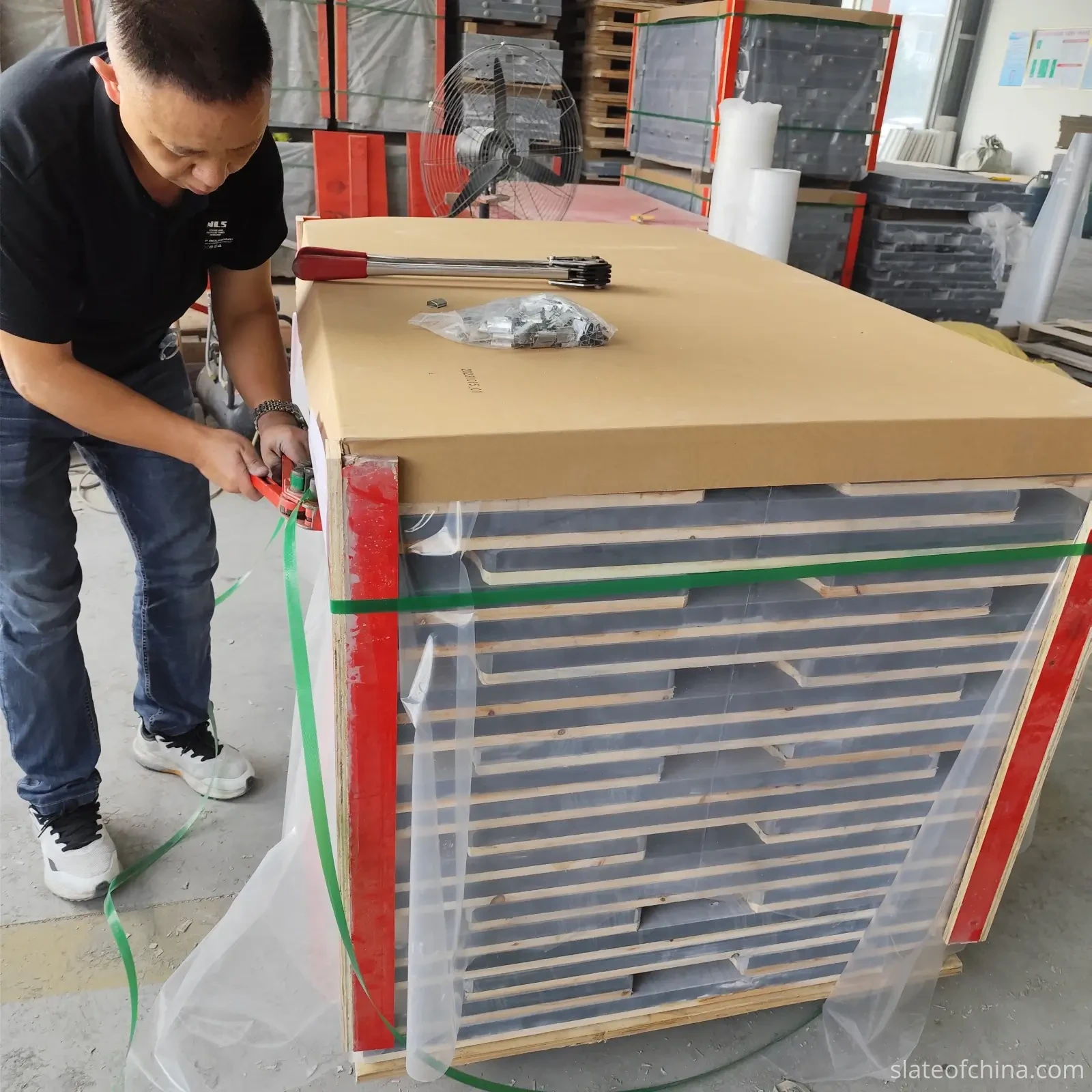
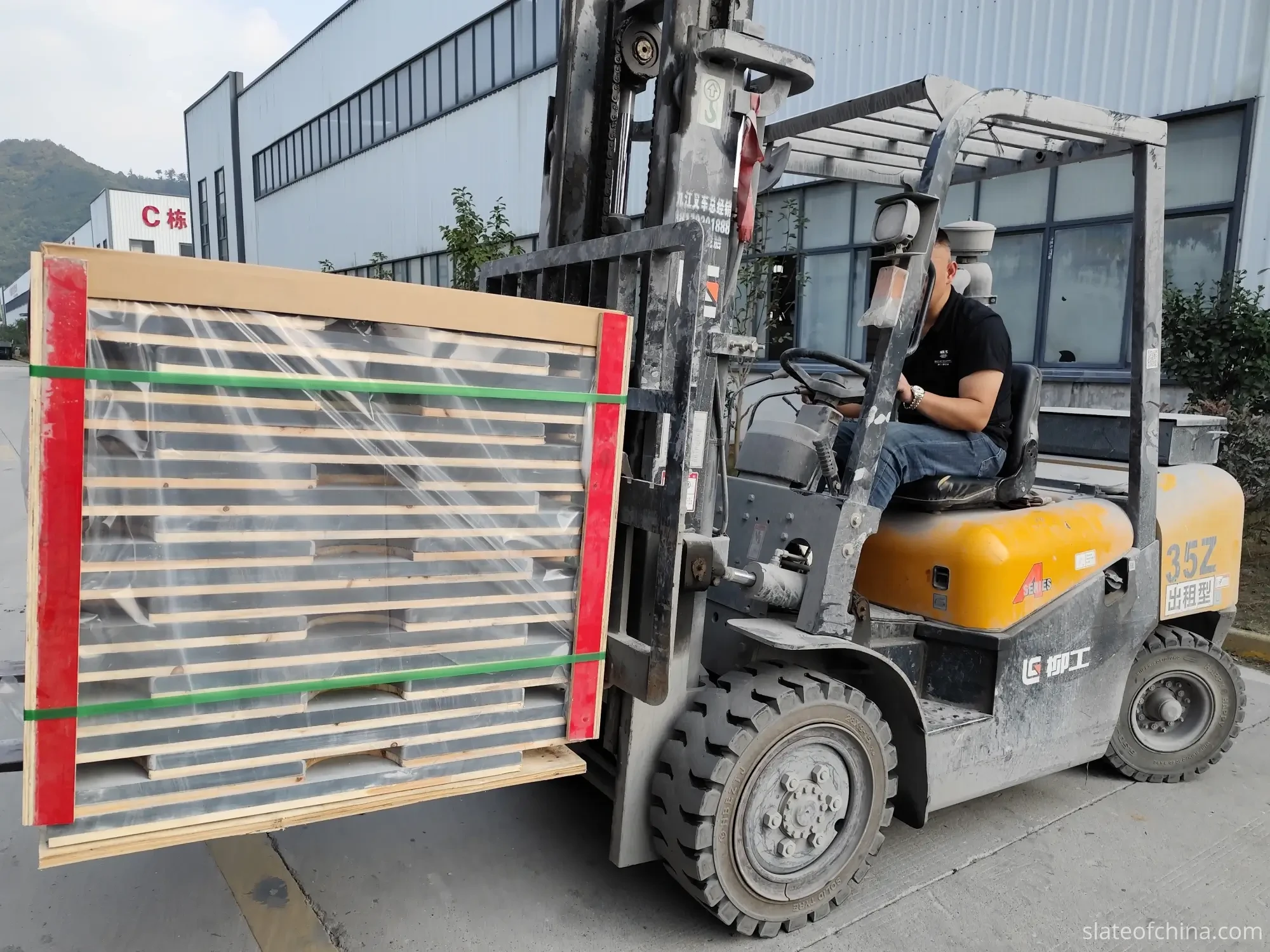
For most FCL billiard slate shipments, several sets of the same specification are packed together on a single pallet. Each slate panel is laid flat, with a protective separator — foam, EPE, felt, or other cushioning material — between every panel to prevent direct stone-to-stone contact. The stack is built up layer by layer, corners and edges protected, then strapped and secured to the pallet base.
This method is efficient for a simple reason: flat stacking uses pallet and container space better than any vertical arrangement. Multiple sets of identical-size slate can be stacked uniformly, the pallet footprint is predictable, and the container can be loaded row by row without wasted vertical space. Forklift handling at both the factory and the destination is straightforward — the pallet is a standard shape, regardless of how many sets it carries.
The critical detail is not the pallet itself but what happens between the panels. Without separators, the flat faces of adjacent slate panels can rub against each other during vibration, producing surface marks that are invisible until the cloth goes on. Without edge protection at the corners of the stack, a forklift impact at the warehouse can chip the corner of the panel nearest the outside. The separator and the corner guard are the working parts of the system; the pallet is the platform.
When A-Frame Support Is Used
Not every billiard slate shipment is a stack of identical panels. When the order involves a large individual panel — for example, a single-piece slate approximately 200 × 100 cm or larger — flat stacking may not be the most practical option. A single large panel laid flat on a pallet is difficult to handle, takes up a disproportionate amount of floor space, and puts its entire weight on one contact plane.
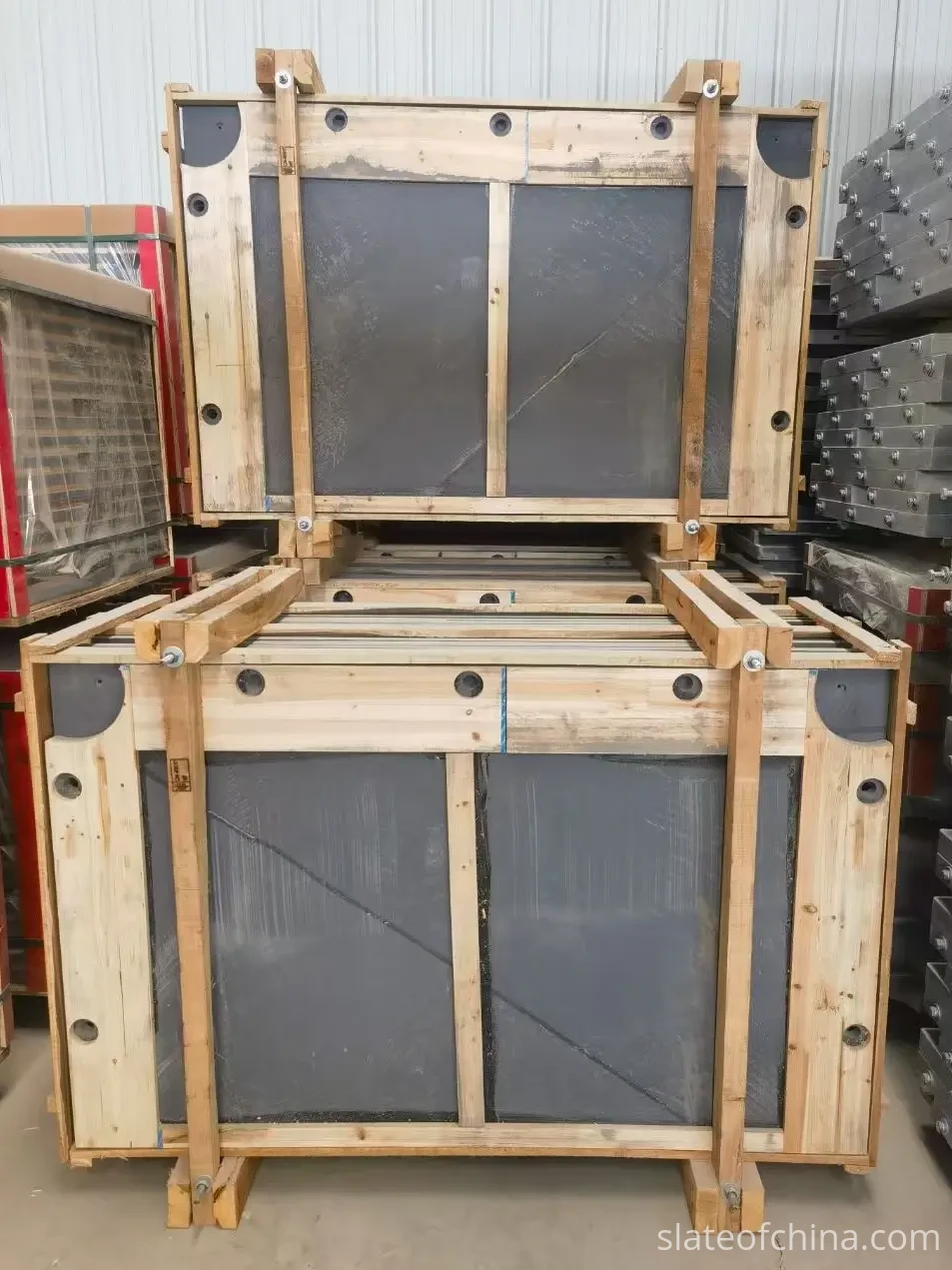
In these cases, an A-frame support structure can be used. The A-frame holds the panel in a controlled inclined or vertical position, with the weight travelling through the wooden frame to the pallet base rather than through the panel's own flat face. Separators between panels keep the faces from touching. The panels are supported individually by the frame rather than stacked directly on top of one another, with each panel's weight distributed across a long edge support.
An A-frame is one effective solution for large panels, but it is not the default packing method for billiard slate. For multiple sets of the same specification, flat pallet packing is generally more efficient — it uses less vertical space, loads more uniformly into a container, and requires less structural material. An A-frame becomes useful when the panel size or the order configuration makes flat stacking impractical.
The diagram above shows the functional layers of an A-frame structure: the inclined frame carries the panel weight, foam or EPE separators keep faces apart, edge protection guards the vulnerable corners, a restraint strap prevents longitudinal movement, and the reinforced pallet base provides forklift access at both ends.
When an Enclosed Wooden Crate Is Needed
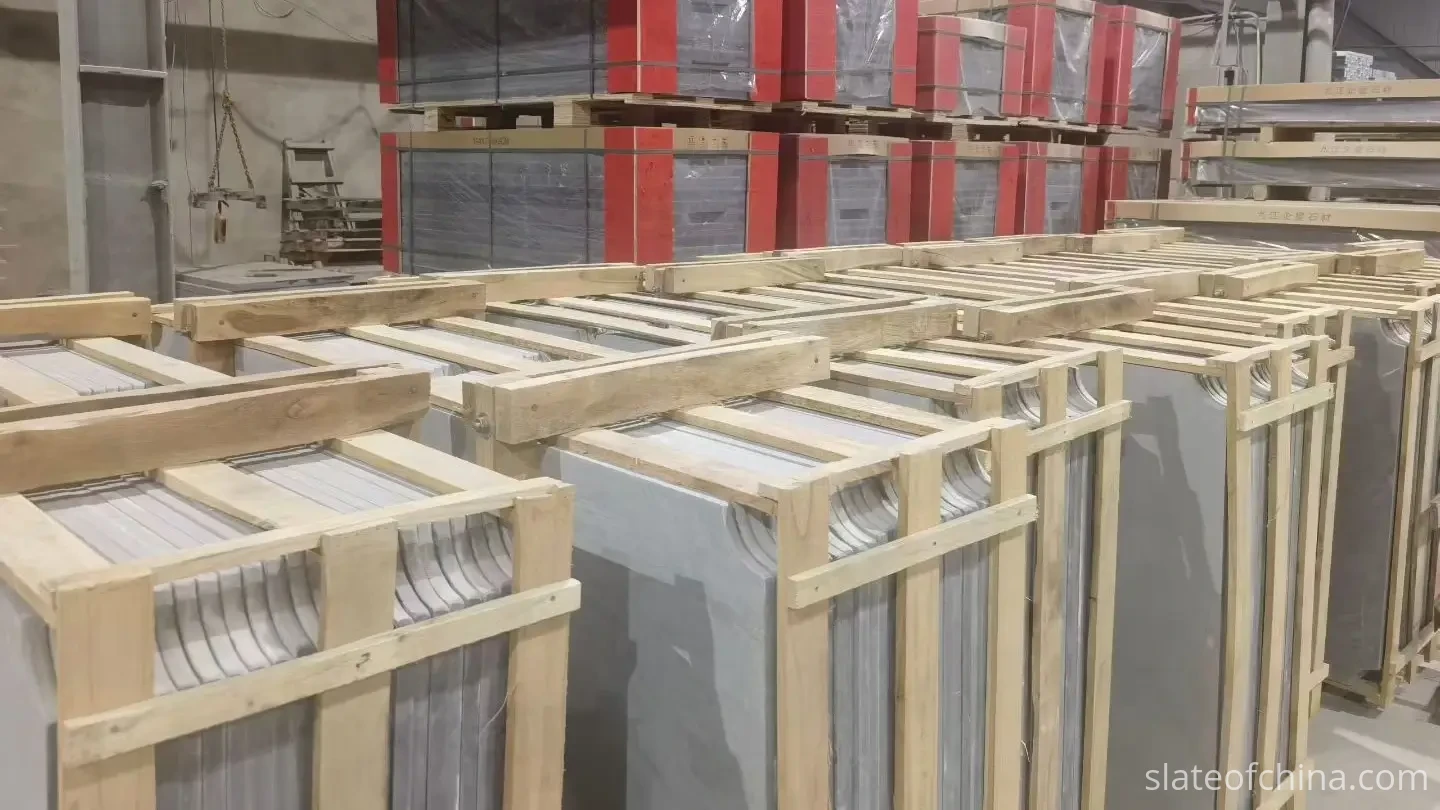
Most FCL shipments of billiard slate travel on pallets — flat-stacked or A-frame, depending on the panel size. But when the shipment is small, or when it travels as LCL — consolidated with other cargo in a shared container — an open pallet may not provide enough protection. In these cases, an enclosed wooden crate with four solid sides is built around the pallet or the A-frame structure.
The decision between pallet and crate comes down to one question: will the slate share container space with other cargo? If the slate fills its own container (FCL), the container itself acts as the outer shell — there is no other cargo to collide with. If the slate shares a container (LCL), it will experience more handling stages and may have other cargo loaded against it. An enclosed crate provides the four-sided protection that environment requires.
How Billiard Slate Is Protected Between Layers
Whether the slate is flat-stacked on a pallet or standing in an A-frame, the protection between panels is what decides whether the slate arrives whole or damaged. The pallet or crate is the platform; the internal protection is the system.
Separators
Every panel must be separated from its neighbour by a layer of protective material — foam, EPE, felt, or other cushioning material. Without separators, the flat faces of adjacent slate panels can rub against each other during vibration, producing surface marks that are invisible until the cloth goes on the table.
Edge and Corner Protection
The four corners, the long and short edges, the three-piece joint areas, the pocket openings and the drilled holes are the priority zones. Edge protection — foam corner guards, corrugated wraps, felt strips — prevents concentrated impact from being transferred directly to a vulnerable stone edge. A thin foam strip between a slate corner and a wooden batten may not look like much, but it is the difference between a corner that arrives intact and one that arrives with a flake missing.
Movement Restraint
The slate and the packing components must be restrained so the slate cannot shift during transport. A common mistake is to think the packing only needs to be strong. Strength matters, but movement control matters just as much. A heavy slate panel that shifts inside the packing hits something — the frame, a batten, a separator edge, or another panel. Repeated small movements gradually damage edges and machined areas in ways that are invisible from outside the packing. A lighter pallet with good internal restraint protects the slate better than a massive crate that lets the stone rattle inside.
Machined Surfaces Need More Care
A raw slab with unfinished edges can be handled with less care than a finished slate that has already been CNC machined, surface ground, drilled, pocket cut, joint machined, and had mounting holes drilled. A three-piece slate with precisely machined centre joints should not be allowed to strike another piece during transport — the joint face is the one surface that determines whether the three pieces align flat on the table frame. A chipped joint edge means a seam the buyer can feel under the cloth, and no amount of shimming will fix it. This is why packing should be considered together with the machining process, not as a separate step.
Which Packing Method, and When
| Packing Method | Typical Application | Main Advantage |
|---|---|---|
| Flat pallet packing | Multiple sets of similar-size slate (most common) | Efficient stacking and container utilisation |
| A-frame support | Large individual panels (e.g. ~200 × 100 cm) | Independent vertical support for panels too large to flat-stack efficiently |
| Reinforced wooden crate | LCL or additional four-sided protection | Protection during repeated handling and contact with other cargo |
| Custom packing | Special OEM requirements | Designed around the actual slate and customer requirements |
The right packing method depends on the slate, the shipping method and the handling conditions — not on a universal rule. A wooden crate is not automatically better than a pallet. It is a more protective method for a more demanding handling environment.
FCL vs LCL Packing
The choice between pallet and crate is not a quality choice — it is a logistics choice. The same billiard slate set can travel safely on a pallet in an FCL container, or inside a reinforced crate in an LCL consolidation, depending on how it will be handled.
| Shipping Method | Typical Packing | Main Reason |
|---|---|---|
| FCL container | Wooden pallet + protective supports | Efficient loading and container utilisation |
| LCL shipment | Reinforced wooden crate / A-frame | Additional protection during repeated handling |
| Special / OEM | Custom packing | Based on product and customer requirements |
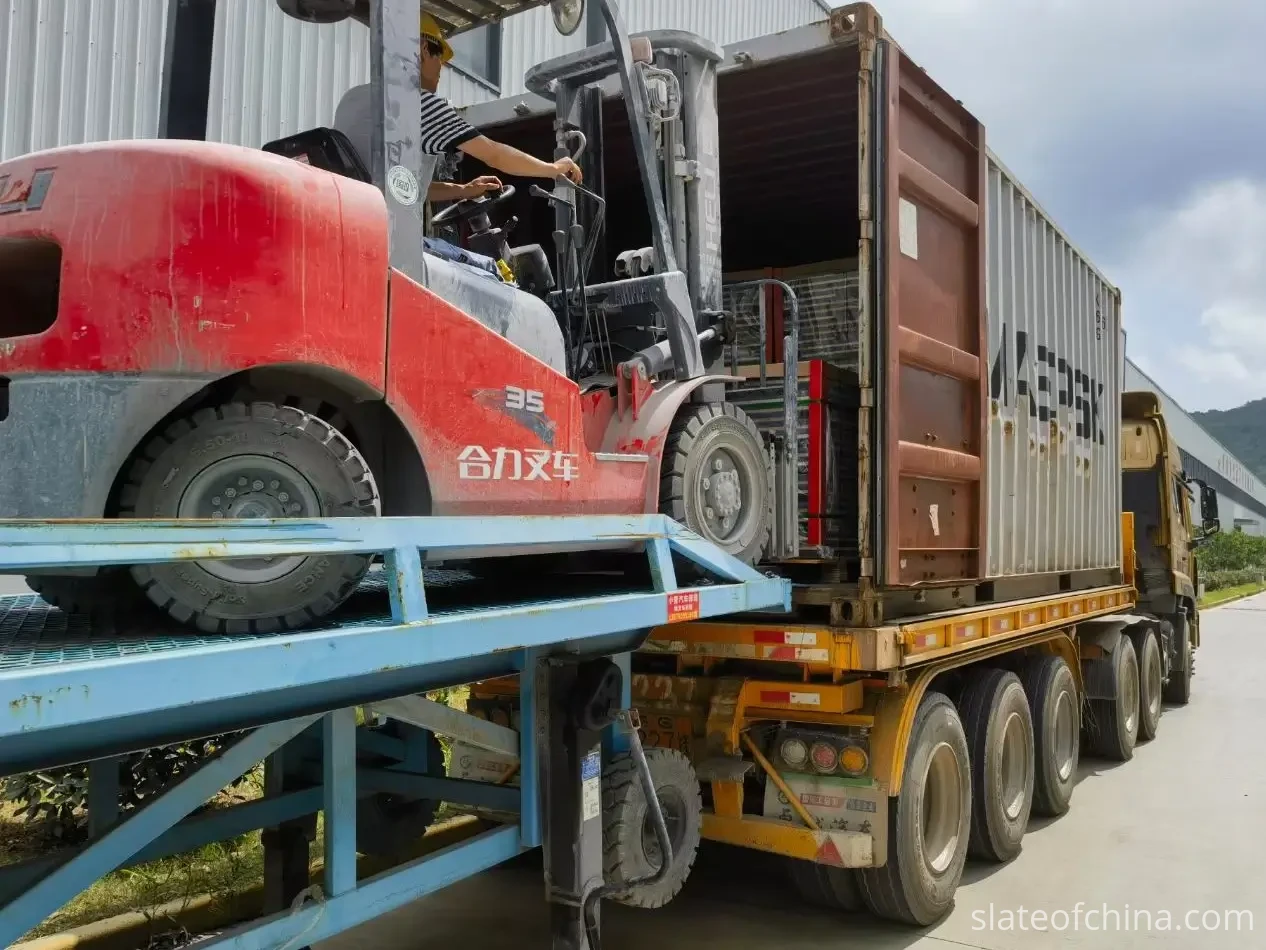
For FCL shipments, pallet-based packing — flat-stacked or A-frame — is generally the most practical choice for container loading. For LCL, an enclosed wooden crate provides the four-sided protection the shared-container environment requires. The packing system only works when the cargo is properly secured inside the container; the full container loading process is covered in our container loading guide.
What Buyers Should Confirm Before Shipment
When buying billiard slate internationally, the question to ask is not simply "Do you use wooden crates?" A better question is: "What packing method do you use for this shipment, and why?"
For OEM orders, the following items should be confirmed before production begins:
| Item | Confirmation |
|---|---|
| Table type | Pool / Snooker / Chinese 8-ball / Carom / Other |
| Slate size | Length × Width |
| Slate thickness | Actual finished thickness |
| Number of pieces | 1 / 3 / 5 / Custom |
| Approx. slate weight | Per piece / Per set |
| Machining | Joint / Pocket / Holes / Other |
| Packing type | Flat pallet / A-frame / Enclosed crate / Custom |
| Shipping method | FCL / LCL / Other |
| Destination | Port / Country |
| Unloading method | Forklift / Crane / Manual |
For OEM orders, export packing should be confirmed as part of the purchase specification, not left to the packing team after production. A complete OEM order specification includes the slate specification, the machining drawing, the inspection standard, and the packing standard — packing is the fourth document, not an afterthought. The buying guide covers the full sourcing sequence; the table above is the packing-specific subset.
For buyers who want a ready-made reference, the following example packing specification can be copied directly into a purchase order:
| Item | Typical Requirement |
|---|---|
| Packing type | Flat pallet (FCL) or enclosed wooden crate (LCL) |
| Slate separation | Protective foam or EPE sheet between each panel |
| Edge protection | Corners and machined edges protected with foam guards |
| Internal restraint | Slate secured against longitudinal and lateral movement |
| Base | Reinforced for actual gross weight; forklift access both sides |
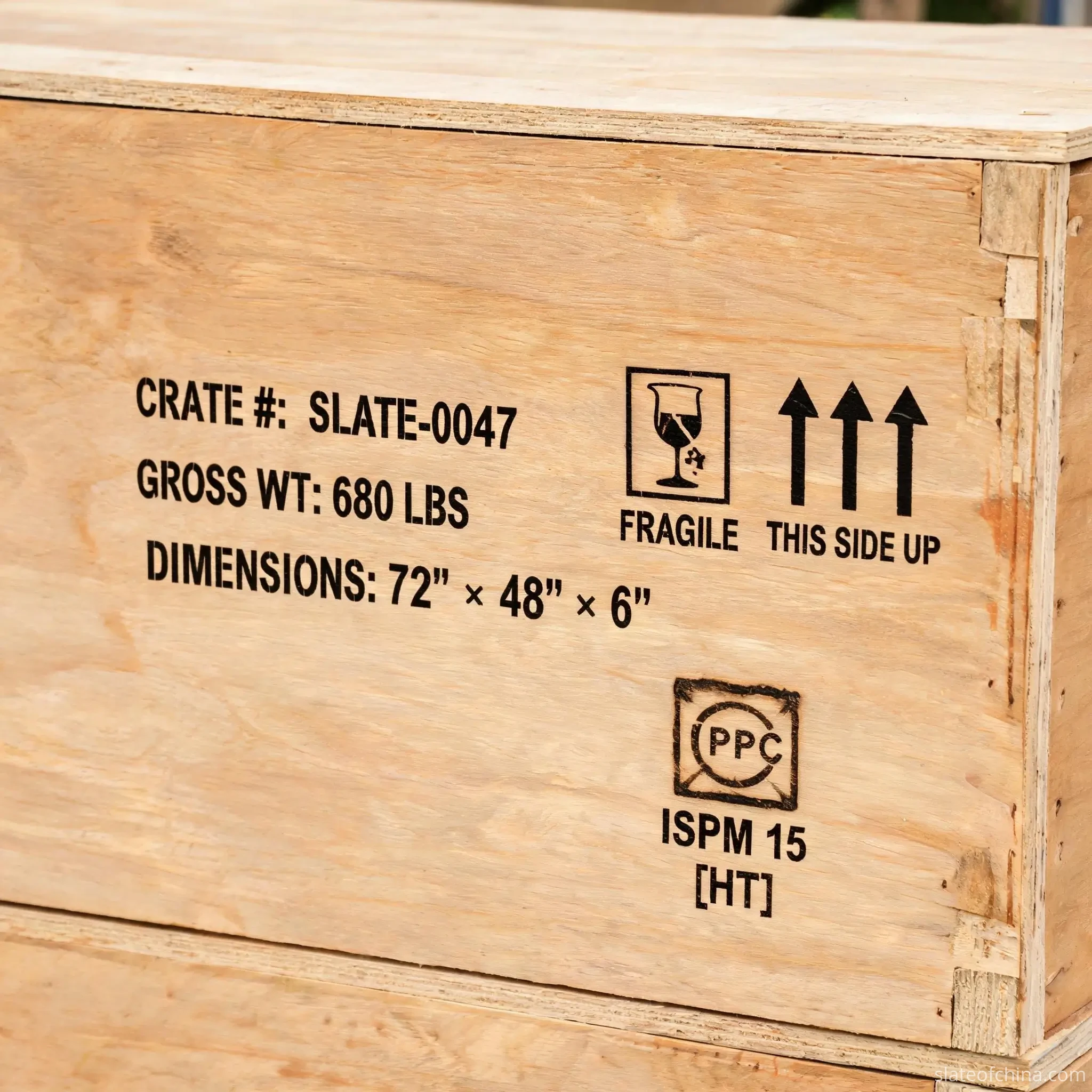
| Marking | Pallet/crate No., gross weight, dimensions, fragile and this-way-up marks |
| Wood treatment | ISPM 15 / IPPC mark where applicable to the destination |
| Photos | Packing and container-loading photographs recorded and supplied |
Why Packing Photos Matter More Than Words
For a first-time buyer, a packing description on a quotation is not always enough. A few photographs can answer many practical questions immediately. Useful billiard slate packing photos should show: the slate before packing, separators between panels, edge and corner protection, the pallet or crate structure, restraint and securing, the closed packing, markings, forklift handling, and container loading. For OEM customers, these photographs also become part of the order confirmation process — visual evidence that the packing method is actually being used, not just described.
The Real Cost of Saving on Packing
Some buyers try to minimise export packing costs. This is understandable — but billiard slate is a high-weight, precision-machined product. Saving a small amount on the packing can create a much larger problem if the slate arrives with damaged edges or machined surfaces. The correct question is not "How can we make the packing as cheap as possible?" but "What is the most economical packing system that provides reliable protection for this particular slate?"
The best packing method is not necessarily the heaviest one. It is the method that provides sufficient protection for the actual shipping and handling conditions. For FCL shipments, pallet-based packing can provide an efficient balance between protection and container utilisation. For LCL shipments or situations requiring additional side protection, reinforced wooden crates can provide an extra layer of protection. The cheapest packing is the one that delivers the slate whole, the first time.
Export Packing Checklist
Before shipment, the following checklist can be useful:
Slate
- Correct slate dimensions confirmed
- Correct thickness confirmed
- Correct number of pieces per set confirmed
- Machining completed according to drawing
- Surface, edges, corners and joints inspected
Internal Packing
- Slate pieces separated with foam or EPE between each panel
- Vulnerable edges and machined areas protected
- Cushioning installed where required
- Slate movement controlled — no panel can shift freely
Pallet or Crate
- Flat pallet, A-frame or enclosed crate matched to the shipment
- Base reinforced for actual shipment weight
- Forklift access checked at factory and destination
- Packing closed, strapped and secured
Export Marking
- Pallet or crate number marked
- Gross weight and dimensions marked
- Handling marks applied (fragile, this way up)
- Customer or order reference marked
- ISPM 15 / IPPC stamp where applicable
Shipping
- Container loading plan confirmed
- Cargo secured inside container
- Packing list completed
- Packing photos recorded
Frequently Asked Questions
How is billiard slate usually packed for export?
For most FCL shipments, several sets of the same specification are stacked flat on a reinforced wooden pallet, with foam or EPE separators between each panel, corners protected, and the stack strapped and secured. This is the most common export packing method. A-frame vertical support is used for large individual panels, and fully enclosed wooden crates are mainly used for LCL shipments where four-sided protection is needed.
When is an A-frame used for billiard slate packing?
An A-frame support structure is used when the order involves large individual panels — for example, a single-piece slate approximately 200 × 100 cm or larger — where flat stacking is not practical due to the panel size. For multiple sets of standard-size slate, flat pallet packing is generally more efficient and uses container space better. The A-frame is one effective solution, not the default method.
Does billiard slate usually travel on pallets or in wooden crates?
Most full-container-load (FCL) shipments travel on wooden pallets — flat-stacked for multiple sets, or A-frame for large individual panels. Enclosed wooden crates with four solid sides are used for less-than-container-load (LCL) shipments or small orders where the slate shares container space with other cargo and needs four-sided protection. The packing principles — support, control movement, protect — are the same for both.
How much does a pallet or crate of billiard slate weigh?
It depends on the table type, slate thickness and number of pieces per pallet or crate. As a typical example, a 9 ft three-piece pool table set at 25 mm weighs roughly 250–270 kg; a 12 ft five-piece snooker set at 45 mm can approach 800 kg. The gross weight of each pallet or crate — slate plus timber — should be marked on the outside and confirmed before container loading and unloading.
What is ISPM 15 and does it apply to billiard slate packing?
ISPM 15 is the international standard for phytosanitary treatment of wood packaging material. It requires timber used in export packing to be heat-treated or fumigated and stamped with the IPPC mark. For international shipments where ISPM 15 requirements apply, the wooden packaging should carry the appropriate IPPC / ISPM 15 mark; the stamp should be visible on the timber. The exact requirements depend on the destination country's import regulations.
How do I check the packing when the container arrives?
Photograph the pallets or crates as they sit in the container before moving anything. Check for visible damage to the exterior, then open one unit and inspect: are the slate pieces still in their original positions, are the separators intact, are the edges and corners protected, is there any sign of moisture. Report any damage inside the claim window written into the contract. The packing list and packing photos from the factory are your reference for comparison.
Can billiard slate be shipped by LCL (less than container load)?
It can, but with caveats. LCL shipments involve multiple handling stages and consolidation with other cargo, which increases the risk of impact and movement. For heavy billiard slate, a full container load (FCL) is generally preferred because the pallets can be secured directly to the container floor. When LCL is necessary, an enclosed wooden crate with four-sided solid protection is used rather than an open pallet. The full container loading process is covered in our container loading guide.
Need a Custom Packing Plan?
If you are sourcing pool table slate, snooker slate, Chinese 8-ball slate or OEM billiard slate from China, send us your table type, finished slate dimensions, thickness, number of pieces per set, required quantity, machining drawing and destination port. We will confirm the suitable packing configuration — flat pallet, A-frame, or enclosed crate — together with the slate specification and export shipment.
We select pallet or crate packing according to the slate specification, shipping method, destination and handling requirements. For FCL shipments, pallet-based packing can improve container efficiency; for LCL or higher-protection requirements, reinforced wooden crates can provide additional protection. Request a Billiard Slate Quotation | View Billiard Slate Products