
CNC Drilling and Mounting Holes: Why the Smallest Features Decide Whether the Slate Fits
What Every Hole on a Billiard Slate Has to Answer
- Type — through, blind, countersunk or threaded. The table design and hardware decide; the stone follows.
- Diameter — not the bolt size, but the clearance the bolt needs. A 10 mm bolt does not always mean a 10 mm hole.
- Depth — how deep the hole goes, and whether it breaks through. A blind hole is a specification, not a partial cut.
- Position — where the centre sits, measured from a datum. A hole in the wrong place is still wrong, even if the diameter is perfect.
- Countersink or counterbore — the recess that lets the fastener sit flush. Angle and depth, not just diameter.
- Thread — if the hole is threaded, the complete specification. Metric, imperial, pitch, depth — never assume the standard.
A 10 mm hole in the right place is a mounting point. The same 10 mm hole, three millimetres to the left, is a rework order.
We have seen this happen in OEM production: the slate itself was flat and correctly machined, but several rail-bolt holes did not match the customer's frame. The slate could not be assembled without rework — the bolts would not pass through the frame brackets and into the slate at the same time, and there was no way to fix it without redrilling. The kind of delay a buyer remembers is not the flatness number on the inspection record; it is the week the shipment sat waiting for a rework decision.
This is the lesson that every table manufacturer already knows but every slate buyer eventually learns the hard way: the holes are the smallest features on a billiard slate, and they are the features that decide whether the slate fits the table. A panel can be perfectly flat, accurately sized and properly ground, and still fail at assembly if the mounting holes are in the wrong position, the wrong depth, or the wrong thread specification.
This page is about how those holes are specified, machined and inspected — and what an OEM buyer or table manufacturer needs to confirm before the drilling programme is written. It is not a guide to CNC machines (that is covered in the CNC machining guide) or to pocket openings (that is covered in the pocket opening machining page). It is about the billiard table slate bolt holes, screw holes, countersinks and threads that connect the slate to the table — and the specification discipline that keeps those connections from becoming the most expensive part of the order.
What Every Hole Has to Answer
Before a drilling programme is written, every hole on the slate has to answer six questions. If any one of them is left open, the hole is not yet specified — it is a proposal, and proposals become rework.
The six questions are simple. What type of hole is it? — through, blind, countersunk, counterbored, or threaded. What diameter? — not the bolt diameter, but the clearance the bolt requires in the stone. How deep? — all the way through, or to a controlled depth, and if controlled, what depth. Where is the centre? — measured from a defined datum, not from an edge that may have shifted during grinding. Does it need a recess? — a countersink or counterbore for the fastener head, and if so, what angle, what diameter, what depth. If threaded, what thread? — the complete specification, not just the diameter.
These six answers are what the CNC programme needs to turn a coordinate on a drawing into a hole in the stone. They seem obvious, but in practice the most common cause of drilling-related assembly problems is not that the answers were wrong — it is that the answers were never written down. A drawing that says "drill 10 mm hole here" has answered the diameter and the approximate position, but it has not answered the type, the depth, the countersink, or the thread. When the factory has to guess the rest, the result is a hole that might fit — or might not.
Rail Bolts and Slate Bolts Are Not the Same Job
Not every hole on a billiard slate serves the same purpose, and the distinction matters because the two types of holes are specified from different references.
Rail bolt holes are related to the attachment of the table rails. Their location depends on the rail construction, the cushion system, the rail-bolt arrangement, and the table manufacturer's design. Two tables with the same playing-area dimensions may use completely different rail-bolt patterns, because the rails are designed differently. A "standard rail-bolt pattern" is a phrase that sounds precise but does not exist in practice — the pattern is in the drawing, not in the game.
Slate-to-frame mounting holes secure the slate to the supporting table structure. Depending on the table design, they may be positioned around the perimeter, in the centre, or in specific structural locations defined by the frame engineering. These holes have to line up with the frame brackets or mounting plates, and a small position error means the slate does not sit in its designed position — or sits in the right position but cannot be fastened.
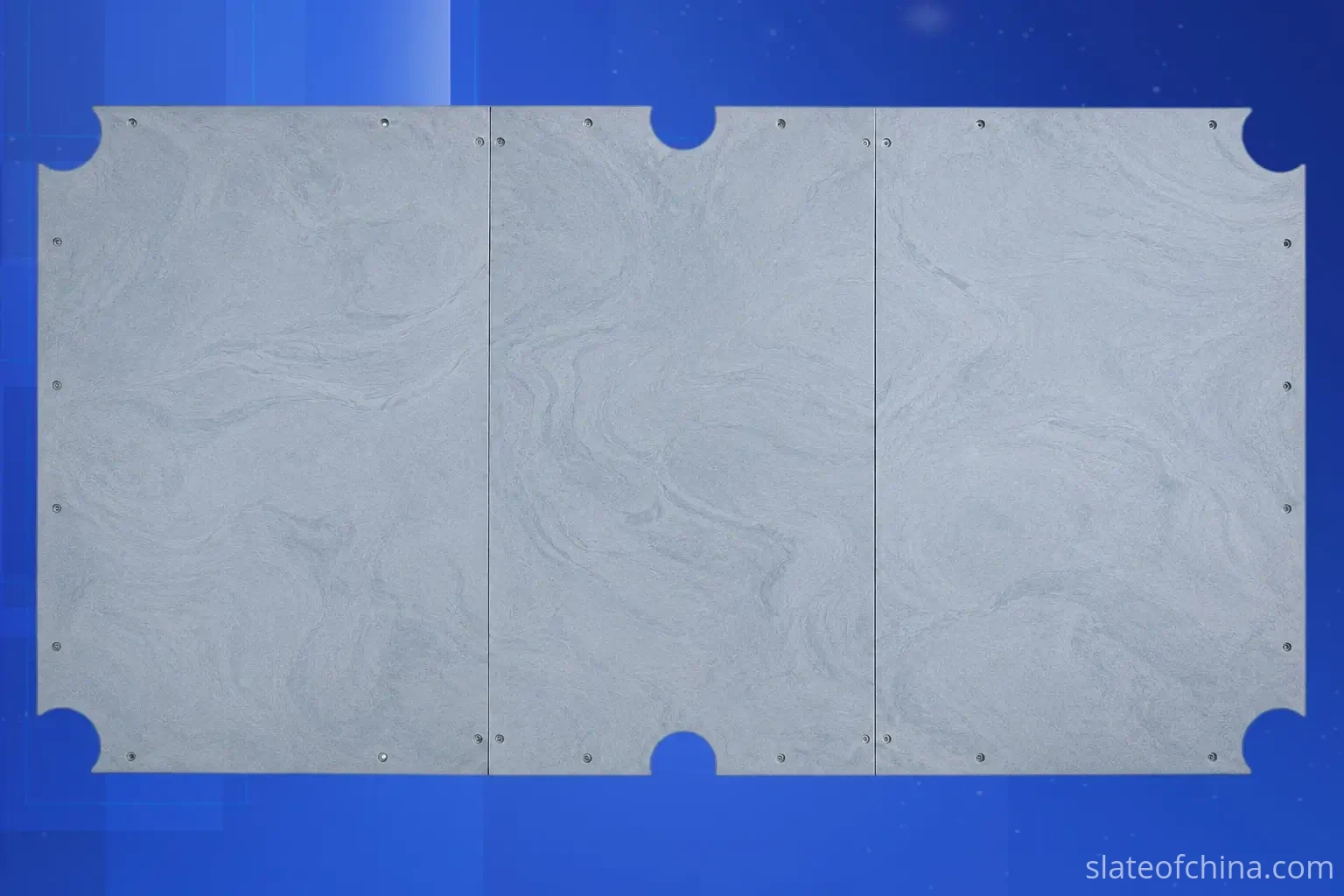
The practical implication for a buyer is this: when you specify the drilling, you are specifying two different hole systems that happen to be on the same panel. The rail-bolt holes come from the rail design; the slate-to-frame holes come from the frame design. Both sets of coordinates have to be on the drawing, and both have to be confirmed before the CNC programme is written. A drawing that shows the slate outline but only labels the rail-bolt holes is missing half the specification.
This is also why a table model name is not enough. "9 ft pool table" tells us the playing area, but it does not tell us where the rail bolts sit, where the frame brackets sit, or how the two hole systems relate to each other. The comparison of pool, snooker and Chinese 8-ball slate covers this from the table-type perspective; this page covers it from the drilling specification perspective.
Through, Blind, and Threaded — Three Holes, Three Specifications
The most fundamental division in billiard slate drilling is between through holes, blind holes, and threaded holes. They look similar from above — a circle in the stone — but they are machined differently, inspected differently, and serve different hardware.
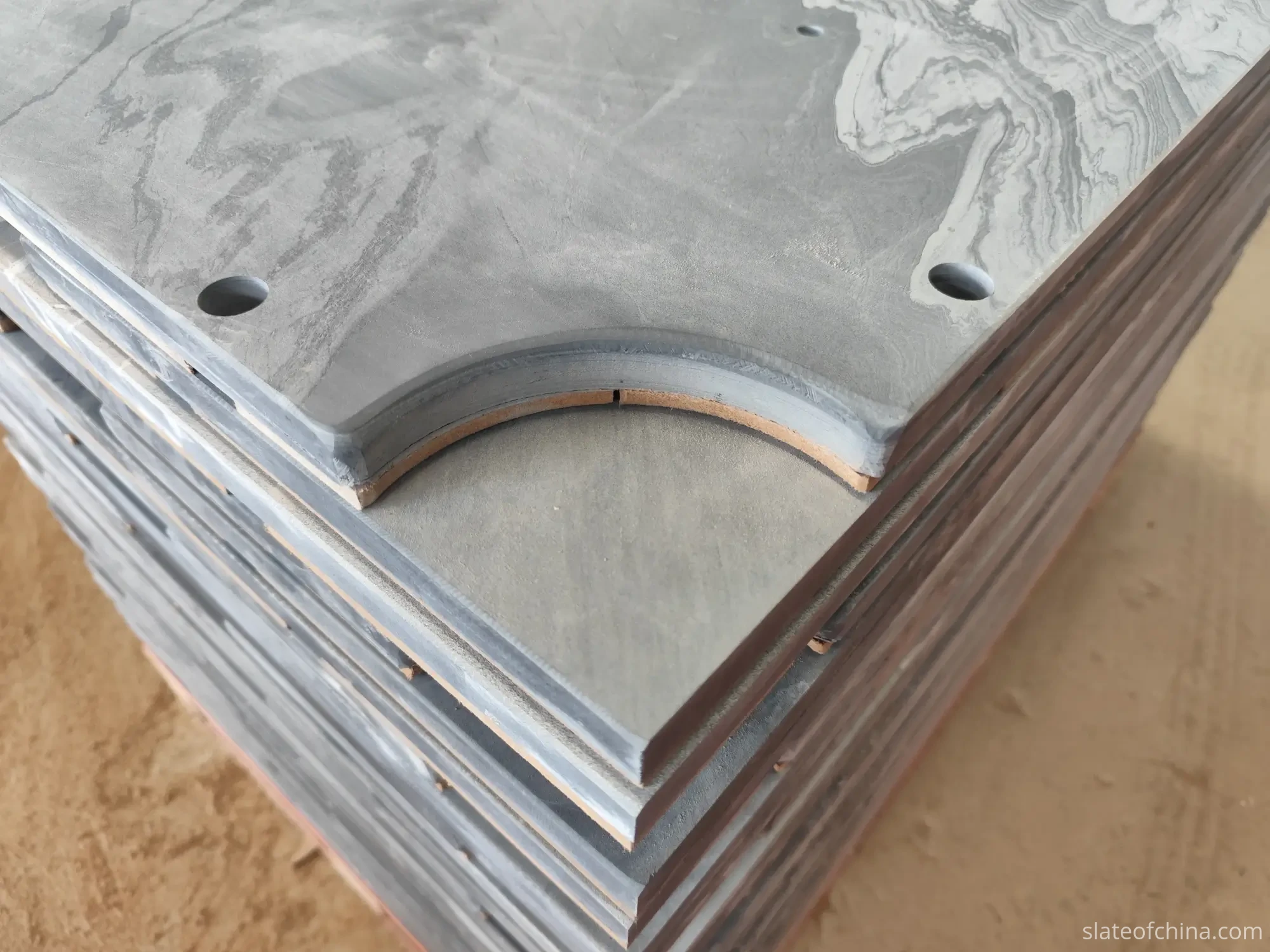
A through hole passes completely through the slate. It is used for bolts that pass through the slate and into the frame or supporting structure below. The diameter has to provide the required clearance for the specified fastener while maintaining enough material around the hole to preserve the panel's structural integrity. The edge condition on both sides of the panel matters — the entry side should be clean, and the exit side should not show excessive breakout or chipping.
A blind hole does not pass all the way through. It is specified when the table design requires a particular mounting arrangement, or when the manufacturer does not want the hole visible on the opposite surface. The critical specification for a blind hole is depth — and depth has to come from the engineering drawing, not from the operator's judgement. A blind hole that is too shallow will not accept the fastener; one that is too deep may compromise the panel.
A threaded hole is the most demanding of the three. When the table design requires the slate itself to contain a thread — for a rail bolt that screws directly into the stone, or for an insert that is threaded into the slate — the machining specification has to include the thread standard, the thread size, the thread pitch, the thread depth, the hole depth, the threaded length, and the position tolerance. A thread specification should never be guessed from the bolt diameter alone. "M8" tells you the nominal diameter; it does not tell you the pitch, the depth, or the engagement length. An imperial thread should be identified by its complete specification, not described as "an 8 mm bolt" — because an imperial thread and a metric thread of the same nominal diameter are not interchangeable.
For OEM production, the safest method is always the same: provide the exact thread specification or an engineering drawing that states it. The rule is simple — match the hole to the customer's hardware specification, not to an assumed industry standard.
The Countersink Is Not a Finish Detail
Buyers often think of a countersink as a cosmetic finishing step. It is not. A countersink is a geometric specification that determines whether the fastener head sits correctly in the stone, and getting it wrong means the fastener either protrudes above the surface or does not seat properly — both of which affect the table assembly.
A countersink creates a conical recess around the opening of a hole. It allows the head of a flat-head or countersunk fastener to sit flush with, or below, the slate surface. But a countersink cannot be specified by diameter alone. The drawing should state the hole diameter, the countersink diameter, the countersink angle, and the countersink depth — because different bolts require different seating geometry.
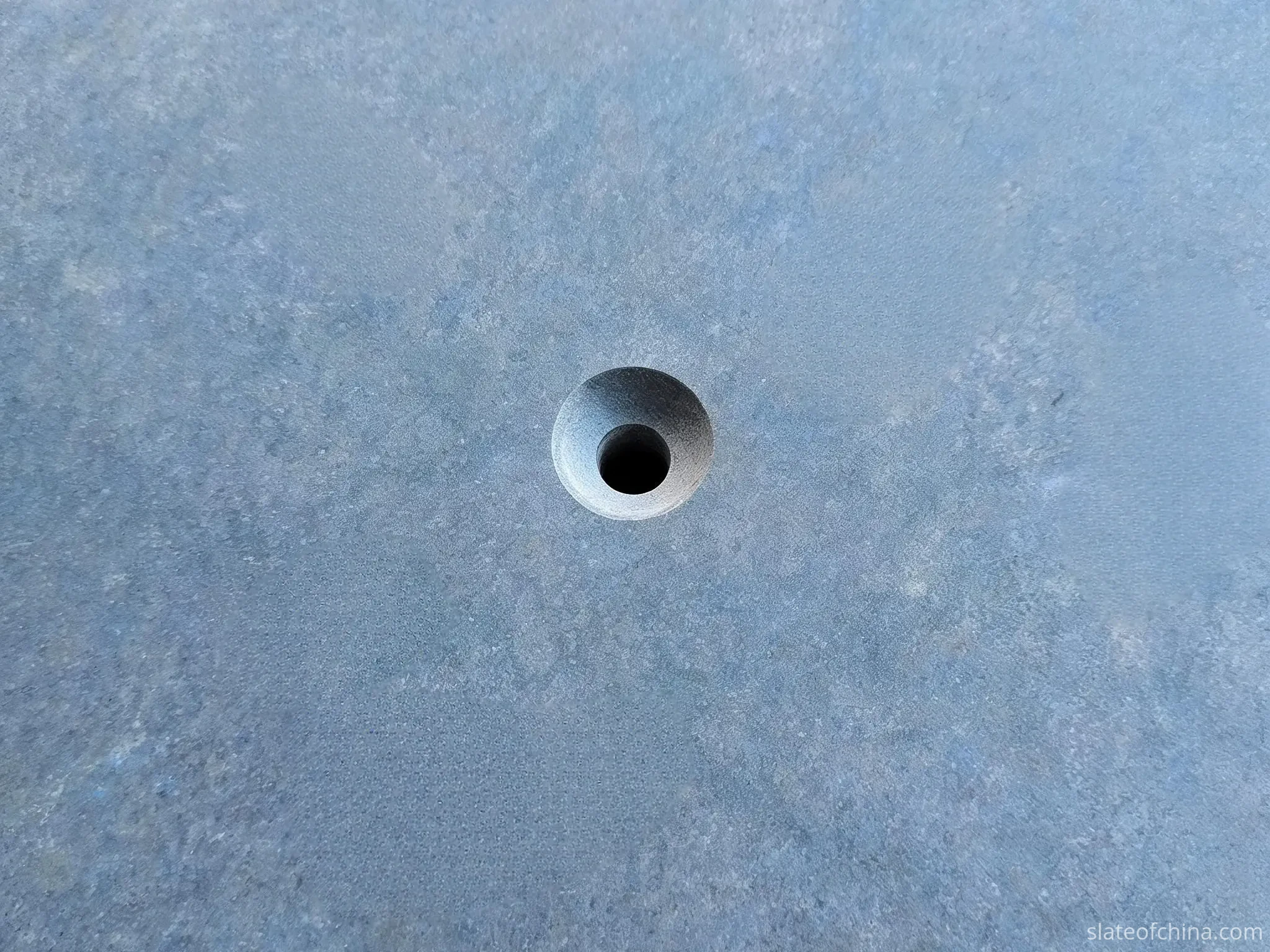
A counterbore is the cylindrical cousin of a countersink. Instead of a conical recess, it creates a flat-bottomed cylindrical recess for a bolt head or a nut that requires a flat seating surface. Whether the drawing calls for a countersink or a counterbore depends on the hardware — and the hardware specification should never be left to the factory's interpretation.
In our production process, the countersink or counterbore is machined in the same CNC programme as the hole itself, so the recess and the hole are concentric. This matters because a countersink that is off-centre from the hole produces a fastener that sits at an angle — and an angled fastener is not a reliable mounting point. When the countersink and the hole are in the same programme, they are controlled from the same coordinates, and the geometry stays true.
Position Beats Diameter Every Time
When buyers discuss CNC drilling, the conversation usually starts with hole diameter. Diameter is easy to specify, easy to measure, and easy to check. But position is the dimension that actually decides whether the slate fits the table.
A hole specified as 10 mm in diameter is not useful if its centre is several millimetres away from where the frame bracket expects it. The bolt will not pass through both the bracket and the slate at the same time, and enlarging the hole to compensate is not a solution — it creates a loose fit that will shift under play. The correct approach is to get the position right in the first place, and position is controlled by the datum reference.
A complete drilling specification defines the hole centre relative to reliable reference points. Typical references include the slate edge, a centreline, the playing-area corner, the pocket centre, a datum hole, or another machined feature. For production, a CAD drawing with clearly defined datums is far safer than a hand-marked photograph or a verbal description — because the CNC programme reads coordinates, not intentions.
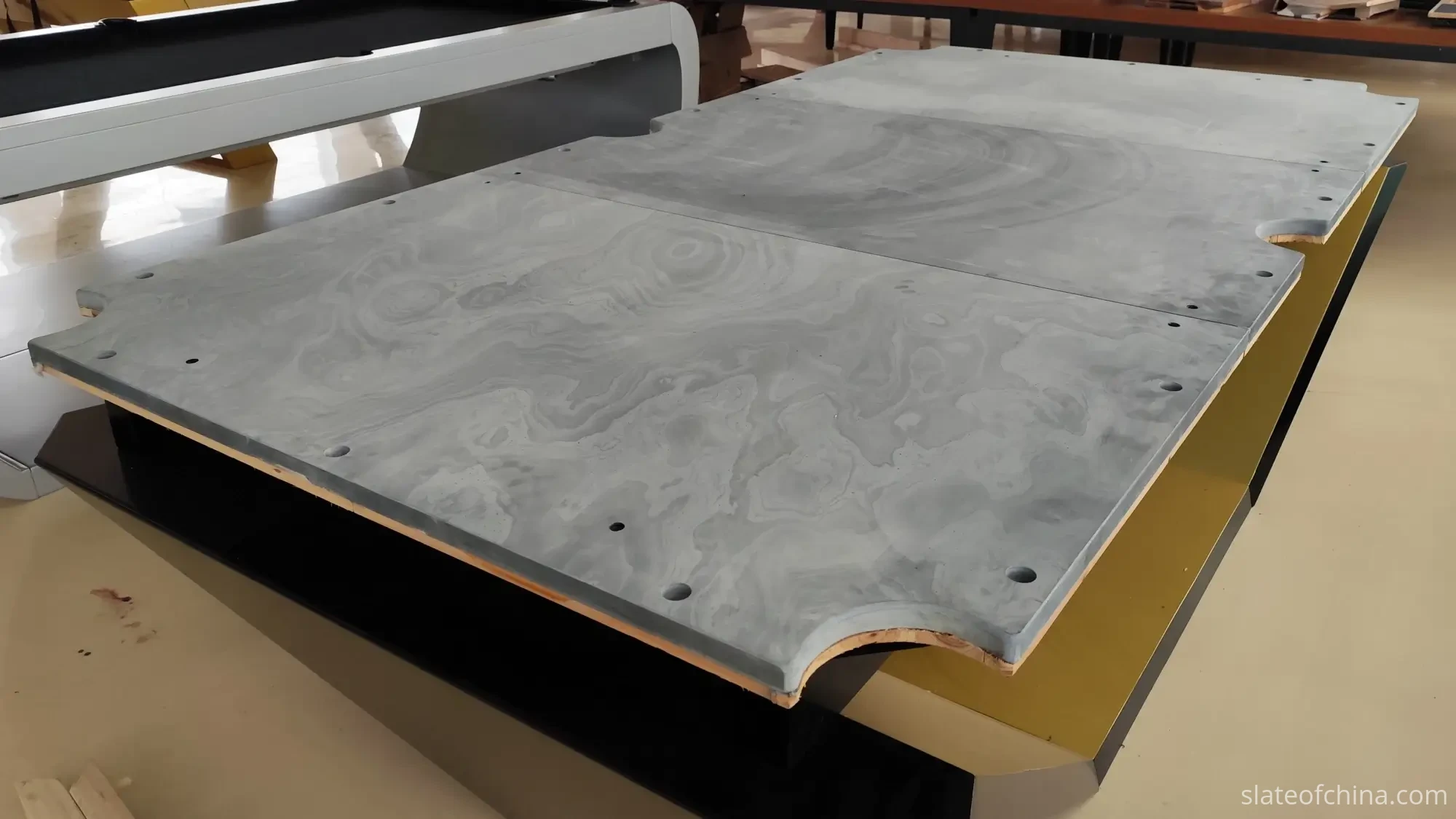
This is also where the distinction between the hole diameter and the clearance becomes important. The correct clearance hole depends on the fastener specification and the engineering requirement, not on the bolt diameter alone. Using the bolt diameter as the hole diameter produces a hole that is too tight — the bolt may bind, or may not pass through at all if there is any position variation in the frame. The clearance has to be specified, and it has to be consistent with the position tolerance.
Thread Specifications: Where Assumptions Become Rework
Threaded mounting holes require more specification discipline than any other hole type. Depending on the target market and the table design, customers may work with different thread standards and hardware systems — and a thread that is "close enough" is not close enough.
The drawing should identify the actual thread requirement. For a metric thread, this means the diameter, the pitch, the depth, and whether the thread is through or blind. For an imperial thread, it means the complete specification — UNC, UNF, or BSW, the nominal size, the threads per inch, and the depth. "M8" alone may not communicate every detail required for production if the drawing requires a specific pitch, depth, or tolerance. Similarly, an imperial thread should be identified by its complete specification rather than simply being described as an "8 mm bolt."
The most common thread-related problem in OEM production is not the wrong thread — it is the assumed thread. A buyer who writes "M8" on the drawing may assume that the factory knows the pitch, the depth, and the engagement length. The factory may assume a standard pitch, a standard depth, and a standard engagement. When the assumptions do not match, the threaded holes do not accept the customer's bolts — and the set goes back to the machine for a re-thread, which is slower and riskier than the original drilling.
The fix is simple: state the complete thread specification on the drawing, or provide a bolt sample and let the factory measure it. A bolt sample eliminates every assumption about pitch, depth, and tolerance — because the sample is the specification.
Why There Is No Universal Billiard Slate Hole Pattern
This is the point that surprises many first-time buyers, and it is worth stating clearly: there is no single universal CNC hole pattern that can be safely applied to every billiard table.
Pool tables can have different rail constructions, frame designs, slate thicknesses, and mounting systems — so pool table slate mounting holes have to be confirmed from the specific table design, not from the table size.
Snooker tables commonly use multi-piece slate assemblies, and the mounting and rail-hole arrangement is closely related to the table's construction. Snooker slate mounting holes are specified from the table's rail and frame design — the slate dimensions alone are not enough to determine the complete drilling pattern.
Chinese 8-ball tables use their own rail and frame designs, and the safest approach is to work from the customer's CAD drawing or physical template.
Carom tables have different playing-area and rail requirements from pocket tables, so their machining pattern is treated separately.
Russian pyramid tables may require table-specific mounting-hole configurations, and the complete drilling drawing should be confirmed before machining.
Even two tables with the same playing-area dimensions may use different mounting-hole layouts. The game determines the pocket style; the table manufacturer determines the holes. This is why the drawing — not the table name — is the controlling document for the drilling programme. A more detailed comparison of how different table types affect slate specifications is covered in the pool vs snooker vs Chinese 8-ball guide.
The Drawing Is the Only Safe Reference
For OEM customers, the most efficient approach is to treat the slate as a component of the complete table system. Instead of asking only "can you drill holes in the slate?", a better technical question is "can you manufacture the slate according to our table's complete drilling and machining drawing?"
A professional slate supplier should be able to work with CAD drawings, DXF files, PDF engineering drawings, hole coordinates, bolt specifications, physical templates, existing slate samples, table frame dimensions, and rail hardware samples. The supplier can then confirm the machining requirements before production — and flag any specification that is incomplete or ambiguous before the cutting tool moves.
The workflow is straightforward: customer drawing arrives, the drawing is reviewed against the slate dimensions and the hardware specification, the hole coordinates are confirmed, the CNC programme is written, a first piece is inspected, and only then does batch machining begin. For repeat orders, the approved drawing becomes the production reference — and the drawing, not the operator's memory, is what keeps the next set identical to the first. The OEM manufacturing process guide covers this workflow in the context of the complete order.
How CNC Drilling Holds Position
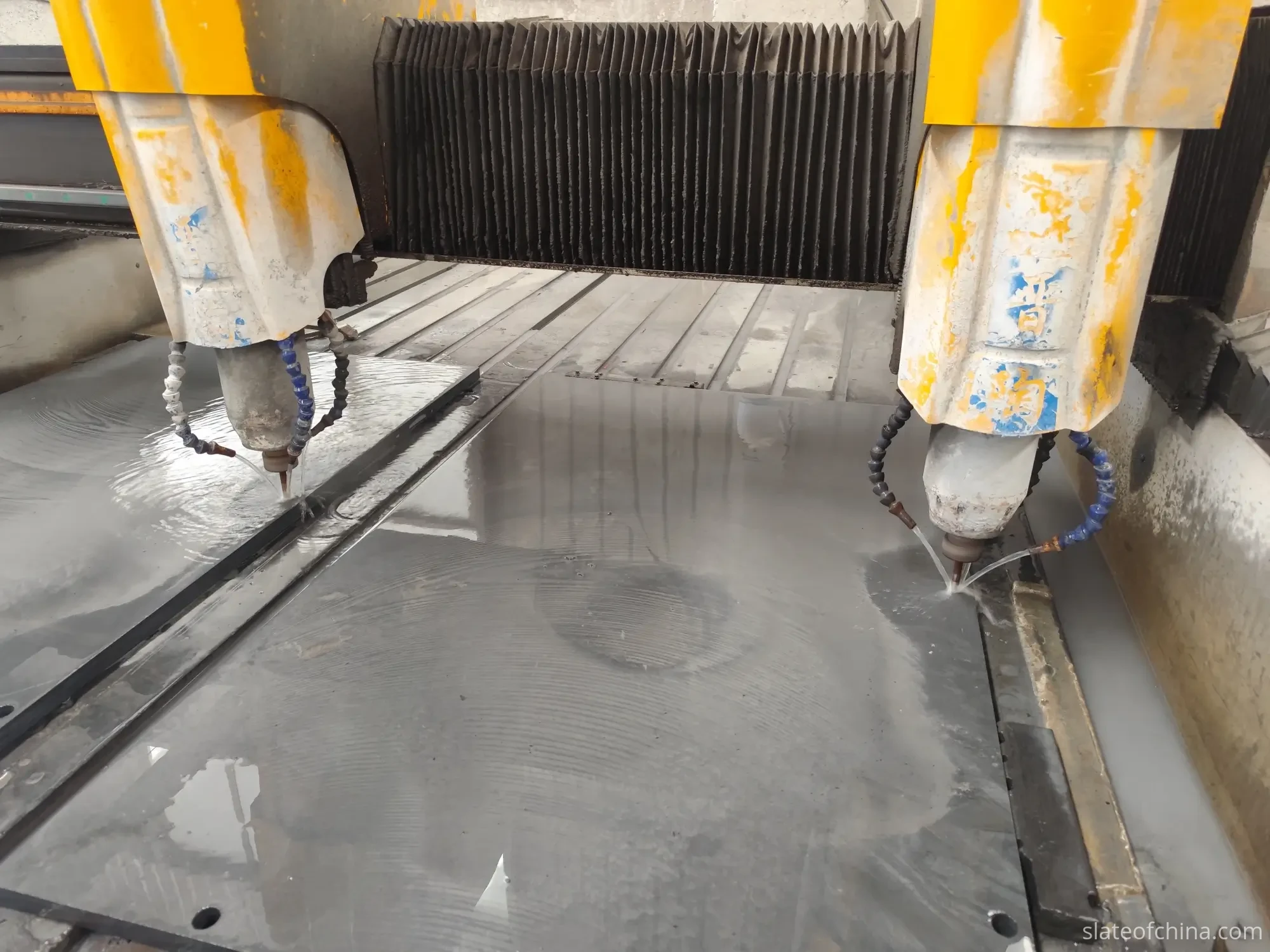
CNC machining allows the drilling programme to follow a defined coordinate system. Before production, the machining team establishes the slate reference position and programmes the required hole coordinates. The panel is located on the machine table, the datum is set, and every hole is drilled at the coordinates the programme specifies — not where an operator marks by eye.
In our production process, the drilling coordinates are derived from the same reference system that was used to machine the panel outline, the pocket openings, and the joint edges. This means the holes sit in the same relationship to the panel geometry as the drawing specifies — and a hole that is on the drawing at 1270 mm from the datum edge is drilled at 1270 mm from the datum edge, not at 1267 or 1273.
For a multi-piece set, the programme is written once and applied to each piece. The CNC programme is the memory — it does not drift between panels the way a manual layout can. This is what keeps the hole pattern consistent from piece to piece across a production run, and it is why a repeat order can be produced months later with the same hole positions as the first batch. The machines behind this precision are described in the CNC machining guide.
Can an Old Slate Serve as a Template?
Yes — sometimes an existing slate can help reproduce a drilling pattern. This is common when a buyer is reproducing an older table model, or when the original drawing has been lost. But using an old slate as the only reference is less reliable than having an engineering drawing.
An existing slate may already contain previous modifications, enlarged holes, repairs, wear, non-standard adjustments, and manufacturing tolerances from its original production. If the old slate is used as the only reference, the new slate inherits all of those deviations — and the "copy" is not a copy, it is a copy of the copy's wear.
The better approach is to combine the physical sample with measurements and, where possible, a reverse-engineered CAD drawing. The sample provides the geometry; the drawing provides the specification; and the drawing, once approved by the customer, becomes the production reference. For repeat OEM production, the confirmed drawing should become the reference — not the old slate.
The replacement slate guide covers this process in detail for buyers who are measuring an existing table to order a new bed.
How a Drilled Slate Is Inspected
CNC machining is only useful when the finished slate is inspected. A hole that the programme was supposed to produce is not the same as a hole that the machine actually produced — and the difference is what inspection is for.
A typical drilled-slate inspection covers six things:
- Hole diameter — the drilled hole is checked against the specified diameter, using a pin gauge or a calibrated internal measurement.
- Hole depth — important for blind holes and threaded holes, where the depth is part of the specification. Through holes are checked for clean breakthrough.
- Hole position — the centre position is checked against the specified datum, using the same reference system the CNC programme used.
- Countersink — the diameter, angle, and depth of the countersink are checked against the drawing, confirming that the recess matches the fastener geometry.
- Thread — for threaded holes, the thread specification and usable thread depth are checked with a thread gauge or a go/no-go plug.
- Quantity — every required hole is verified as present. A missing hole is not a tolerance issue; it is a programme or setup error that has to be caught before the set ships.

The inspection scope — whether every piece is checked or a sampling plan is used — is agreed in the order, in the same way as the rest of the quality control scope. Hole accuracy should also be considered together with the slate's overall dimensions and other machined features, which are covered in the technical specifications reference. Surface defects around the holes — chips, cracks, or tool marks — are judged using the criteria in the common defects guide.
The Drilling Checklist for OEM Buyers
If you are ordering custom billiard slate with drilled mounting holes, the most efficient way to communicate the requirement is a drilling table on the drawing. A drilling table lists every hole, its type, its dimensions, its position, and its specification — and it makes the communication far clearer than describing hole positions in an email.
| Item | What to Specify |
|---|---|
| Hole number | H01, H02, H03 — each hole identified so it can be cross-referenced on the drawing |
| Hole type | Through, blind, countersunk, counterbored, or threaded |
| Diameter | The clearance diameter — not the bolt diameter |
| Depth | Through, or a specified depth for blind and threaded holes |
| Thread | Complete thread specification — standard, size, pitch, depth, engagement length |
| Countersink | Diameter + angle + depth, or "none" |
| X position | From a defined datum — not from an estimated edge |
| Y position | From a defined datum — not from an estimated edge |
| Quantity | Number of holes of this specification per slate section |
| Tolerance | Customer requirement — especially for critical hole locations |
Billiard Slate Hole Specification Cheat Sheet
The table below is a quick-reference summary of every dimension a drilling specification has to cover. You can save it, forward it to your engineering team, or use it as a checklist when preparing a drawing for custom billiard slate drilling.
| Requirement | What the Drawing Should Show |
|---|---|
| Hole type | Through, blind, or threaded |
| Hole diameter | Finished clearance diameter — not the bolt diameter |
| Hole depth | Through, or a specified depth for blind and threaded holes |
| X / Y position | From a defined datum — not from an estimated edge |
| Countersink | Diameter + angle + depth |
| Thread | Standard + size + pitch + depth + engagement length |
| Tolerance | Position and dimensional tolerance |
| Quantity | Number of holes per slate section |
Beyond the drilling table, the information that helps us produce the right slate the first time includes: the table type (pool, snooker, Chinese 8-ball, carom, Russian pyramid, or another design); the table model, if applicable; the slate dimensions (length, width, thickness, and number of pieces); the playing-area dimensions; the hardware specification (bolt diameter, thread, head type); the tolerance requirements (especially for critical hole locations); and reference samples, if reproducing an existing table. The full information checklist for custom production is covered in the technical specifications page.
What Goes Wrong When the Drawing Is Incomplete
Most drilling problems are not machining errors — they are specification gaps. The slate arrives at the assembly floor, the bolt will not pass through, and the investigation traces the problem back to a drawing that never stated the position, the depth, the countersink angle, or the thread pitch. Here are the mistakes we see most often, and what prevents each one.
Assuming every table uses the same hole pattern. It does not. A similar table size does not guarantee an identical mounting pattern. The hole layout is table-specific, and the drawing is the only reliable reference.
Providing only the hole diameter. A 10 mm hole still needs a defined location, a depth, and possibly a countersink or thread specification. Diameter alone is not a drilling specification.
Using the bolt diameter as the hole diameter. The correct clearance hole depends on the fastener and the engineering requirement. A bolt that just fits in a hole that is exactly its diameter will bind if there is any position variation in the frame.
Specifying "countersunk" without an angle. Countersink geometry has to match the bolt head. A 90-degree countersink will not seat an 82-degree screw correctly, and the difference is visible at assembly.
Specifying a thread without enough information. Thread diameter alone may not define the complete requirement. State the standard, the pitch, the depth, and the engagement length — or send a bolt sample.
Measuring from an unreliable edge. A hole position should be referenced from controlled datums or clearly defined features. An edge that has been ground during processing may have shifted by a fraction of a millimetre — and a fraction of a millimetre is enough to misalign a bolt.
Changing the drawing after production starts. Late changes can result in setup changes, additional machining, or rejected components. The drawing should be frozen before the CNC programme is written — and if a change is necessary, it should be communicated before the tool starts moving, not after.
Every one of these mistakes is preventable. The prevention is the same thing every time: a complete drawing, confirmed before production, with every hole specified by type, diameter, depth, position, countersink, and thread. The slate that arrives ready to fit is the slate that was specified ready to fit.
Frequently Asked Questions
What is CNC drilling for billiard slate?
CNC drilling is the machining process used to create mounting holes, rail-bolt holes, countersinks and threads in a billiard slate panel, according to the positions and specifications defined in the table manufacturer's drawing. The CNC programme follows a coordinate system that controls hole position, diameter, depth and countersink geometry — so the CNC drilled billiard slate has holes where the table frame and rail hardware expect them.
Are billiard slate mounting holes the same for every table?
No. Mounting-hole patterns are table-specific, not game-specific. Two 9-foot pool tables from different manufacturers may use completely different hole layouts, because the rail construction, the frame design, and the hardware vary by brand. The drawing — not the table name — is the controlling document for the drilling programme.
What is the difference between a through hole and a blind hole in billiard slate?
A through hole passes completely through the slate panel, allowing a bolt to pass through into the frame or supporting structure below. A blind hole is machined to a controlled depth and does not break through the opposite surface. Blind holes are specified when the table design requires a particular mounting arrangement or when the hole should not be visible on the underside. The depth of a blind hole has to be stated on the drawing — it is a specification, not a partial cut.
How is a countersink specified on a billiard slate drawing?
A countersink should be specified by its diameter, its angle, and its depth — not by diameter alone. The angle has to match the fastener head (common angles include 82 and 90 degrees), and the depth has to be sufficient for the head to sit flush or below the slate surface. The drawing should also state the hole diameter beneath the countersink and the position of the hole centre from a defined datum.
Can you drill threaded holes in billiard slate?
Yes. Threaded holes can be machined in billiard slate when the table design requires the slate to contain a thread — for example, for a rail bolt that screws directly into the stone, or for a threaded insert. The thread specification should include the standard (metric or imperial), the size, the pitch, the depth, and the engagement length. Thread diameter alone is not enough — M8 does not define the pitch, depth, or tolerance. A bolt sample or a complete engineering drawing is the safest reference.
Can an existing slate be used as a drilling template?
Yes, but with caution. An existing slate can be measured to reproduce a drilling pattern, but it may already contain modifications, enlarged holes, wear, or manufacturing tolerances from its original production. Using it as the only reference means the new slate inherits those deviations. The better approach is to combine the physical sample with a reverse-engineered drawing that is approved by the customer before mass production.
Can you drill mounting holes from a physical template if I don't have a CAD drawing?
Yes. A physical slate sample, a template, a bolt sample, or detailed measurements can be used as a starting reference for custom billiard slate drilling. The sample or template provides the geometry — hole positions, depths, countersink shapes — and the factory can work from that to establish the drilling programme. However, for repeat OEM production, we recommend converting the measurements into an approved drawing before mass production. A confirmed drawing is a more reliable production reference than a physical sample, because it eliminates the ambiguity that comes from wear, modifications, and measurement tolerances in the original part.
What information should I send to order drilled billiard slate?
The most useful information is a CAD or engineering drawing with a drilling table that lists every hole by number, type, diameter, depth, countersink specification, thread specification (if applicable), X and Y position from a defined datum, quantity, and tolerance. If a drawing is not available, an approved sample, a physical template, or a bolt sample can help establish the specification. A table model name alone is not sufficient — the hole geometry cannot be assumed.
Related Reading
Send Us Your Drilling Drawing — We Will Confirm the Hole Specification
If you are sourcing billiard slate with custom mounting holes — whether for a new OEM model, a repeat production run, or custom drilled pool table slate to match an existing table — send us your table drawing, an approved sample, or a bolt specification. Before production, we can review:
- ✓Hole type, diameter and depth for every hole
- ✓Countersink or counterbore angle and depth
- ✓Thread specification — standard, pitch, depth, engagement
- ✓Hole position from defined datums
- ✓Rail-bolt vs slate-to-frame hole systems
- ✓Multi-piece configuration and joint positions
We can confirm whether the drawing provides enough information for CNC drilling — and flag any specification that needs clarification before the cutting tool moves.
Don't have a CAD drawing? Send us photos, measurements, an existing slate sample, or a bolt sample. We can help clarify the machining information before production. Start the conversation here.