
Common Billiard Slate Defects: 9 Types to Check Before You Accept a Shipment
The short answer:
Not every mark on a slate panel is a defect. Before rejecting or accepting a shipment, sort what you see into four severity tiers:
| ACCEPT | Natural mineral lines, subtle colour variation, minor surface texture — does not affect machining, installation or play. |
| MONITOR | Small edge chips outside the playing area, shallow pits in non-critical zones — document with photos, evaluate against the agreed spec. |
| REPAIR | Grinding marks, minor edge fractures, small corner breaks — can be corrected before installation if the playing surface is not compromised. |
| REJECT | Through-thickness cracks, broken corners extending into the body, delamination, dimensional errors outside tolerance — compromise structural integrity or table performance. |
The acceptance standard should always be agreed between buyer and supplier before production, not debated after the container arrives.
The crate is open. You have twelve panels on the floor, strong daylight from the warehouse door, and about an hour before the truck leaves. Some panels look perfect. A few have marks you cannot identify from a photograph. One has a line running across the surface that could be a mineral vein or could be a crack — and the difference matters.
This is the moment most billiard slate quality inspections are won or lost. Not because the defects are hard to see, but because they are hard to classify. A hairline mineral vein is a natural characteristic. A hairline crack is a structural failure. They can look identical in a compressed online photograph, yet one goes on the table and the other goes back to the supplier.
This guide walks through the most common billiard slate defects — cracks, edge and corner damage, surface pits, scratches, grinding irregularities, thickness variation, machining errors, delamination and colour variation — and gives you a practical framework for sorting what you see into accept, monitor, repair or reject.
What Counts as a Billiard Slate Defect?
A billiard slate defect is any condition that falls outside the agreed requirements for flatness, thickness, dimensions, surface condition, edge condition or structural integrity. Because slate is a natural material, visual variation alone does not automatically count as a defect.
The useful distinction is between four categories:
- Natural characteristics — mineral lines, subtle colour variation, natural texture. These are properties of the stone, not manufacturing faults.
- Cosmetic imperfections — minor marks that do not affect machining, installation or play. A shallow scratch that disappears under the cloth is cosmetic.
- Functional defects — conditions that may affect the playing surface, joint alignment, installation or durability. A deep pit in the playing area is functional.
- Structural defects — cracks or damage that may compromise the slate itself. A through-thickness crack near a joint is structural.
The boundary between these categories depends on the application, the machining process and the agreed tolerance. A small edge chip on a panel that will be hidden under a rail is a different matter from the same chip on a joint edge that must align precisely with the neighbouring panel. This is why a single accept/reject rule does not work — and why the four-tier severity framework in the next section is a more reliable tool.
The Defect Severity Framework
When you are standing in front of an open crate with a clipboard, you need a decision-making tool, not a textbook. The framework below sorts every defect you encounter into one of four severity tiers, each with a clear action.
| Tier | What it means | Typical examples | Action |
|---|---|---|---|
| 1 — Accept | Natural or cosmetic. No effect on function, installation or play. | Mineral veins, colour variation, natural texture | Accept and document |
| 2 — Monitor | Minor issue in a non-critical location. Does not affect play but needs a record. | Small edge chip outside playing area, shallow pit on edge | Photograph, measure, compare against spec |
| 3 — Repair | Correctable before installation. Playing surface can be restored. | Grinding marks, minor surface scratches, small corner break | Arrange repair or regrind before assembly |
| 4 — Reject | Compromises structural integrity, playing surface or dimensional accuracy. | Through-thickness cracks, delamination, tolerance failures | Reject the piece, request replacement |
A defect can shift between tiers depending on its location and the agreed specification. A 3 mm edge chip on the long edge of a centre panel — hidden under the rail bolt area — may be Tier 2 (Monitor). The same chip on a joint edge that must meet its neighbour flush may be Tier 3 (Repair) or even Tier 4 (Reject) if it prevents alignment. Always evaluate in context.
1. Cracks in Billiard Slate
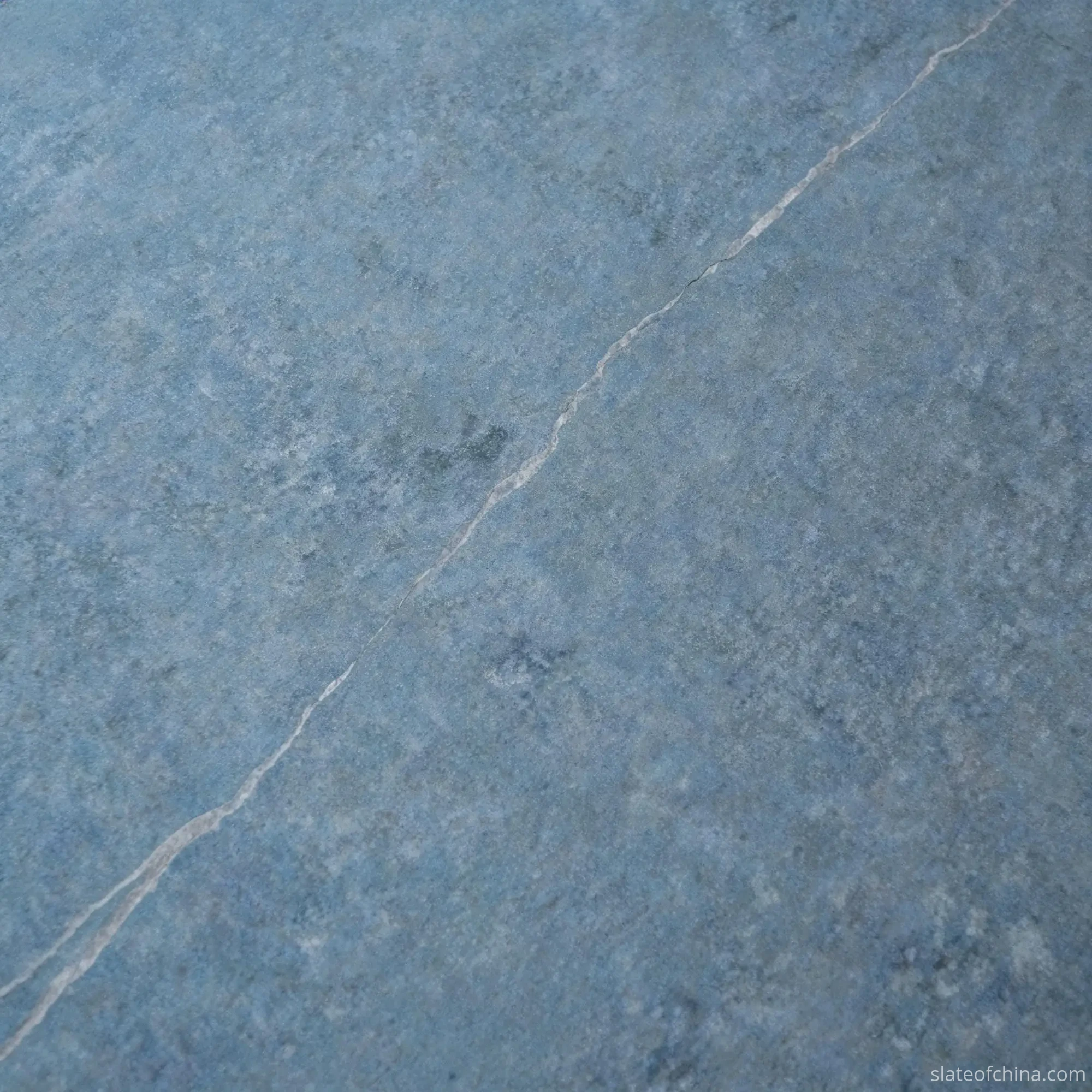
Cracks are the most important defect to check during billiard slate inspection, and the hardest to judge from photographs alone. Not every visible line is a crack. Natural mineral veins and geological lines can look like cracks in a photo but are completely integrated within the stone. The question is whether the line represents an actual fracture through the material.
What to look for:
- A visible opening or separation in the stone
- A line that continues through the thickness of the panel
- A line that can be felt with a fingernail catching on the surface
- A crack extending from an edge toward the centre of the panel
- Fresh-looking fracture surfaces (lighter than the surrounding stone)
- Multiple connected cracks, or damage radiating from drilled holes
Why cracks matter: A significant crack can affect structural strength, installation, slate joint alignment, long-term stability, grinding and finishing, and transport resistance. For multi-piece billiard slate, cracks near the joint areas or mounting areas deserve particular attention.
Natural vein vs. crack: This distinction is critical when buying natural billiard slate. A mineral vein may appear as a line across the stone but remains completely integrated — flush with the surface, with no separation. A crack represents a physical fracture: the stone has separated along that line. When a photograph is not enough to tell the difference, ask the supplier for close-up photographs, side or edge photographs, a video inspection, and measurements or inspection records. Do not judge a suspected crack solely from a compressed online photograph.
Severity ruling: A confirmed through-thickness crack is likely Tier 4 (Reject), but the final call depends on the agreed specification and the crack's location relative to joints and mounting points. A surface-only hairline that does not continue through the thickness may be Tier 2 (Monitor) if it is away from critical areas. The key question is whether the condition can be reliably corrected while still meeting the agreed specification — if it cannot, reject.
2. Chipped or Damaged Edges and Corners
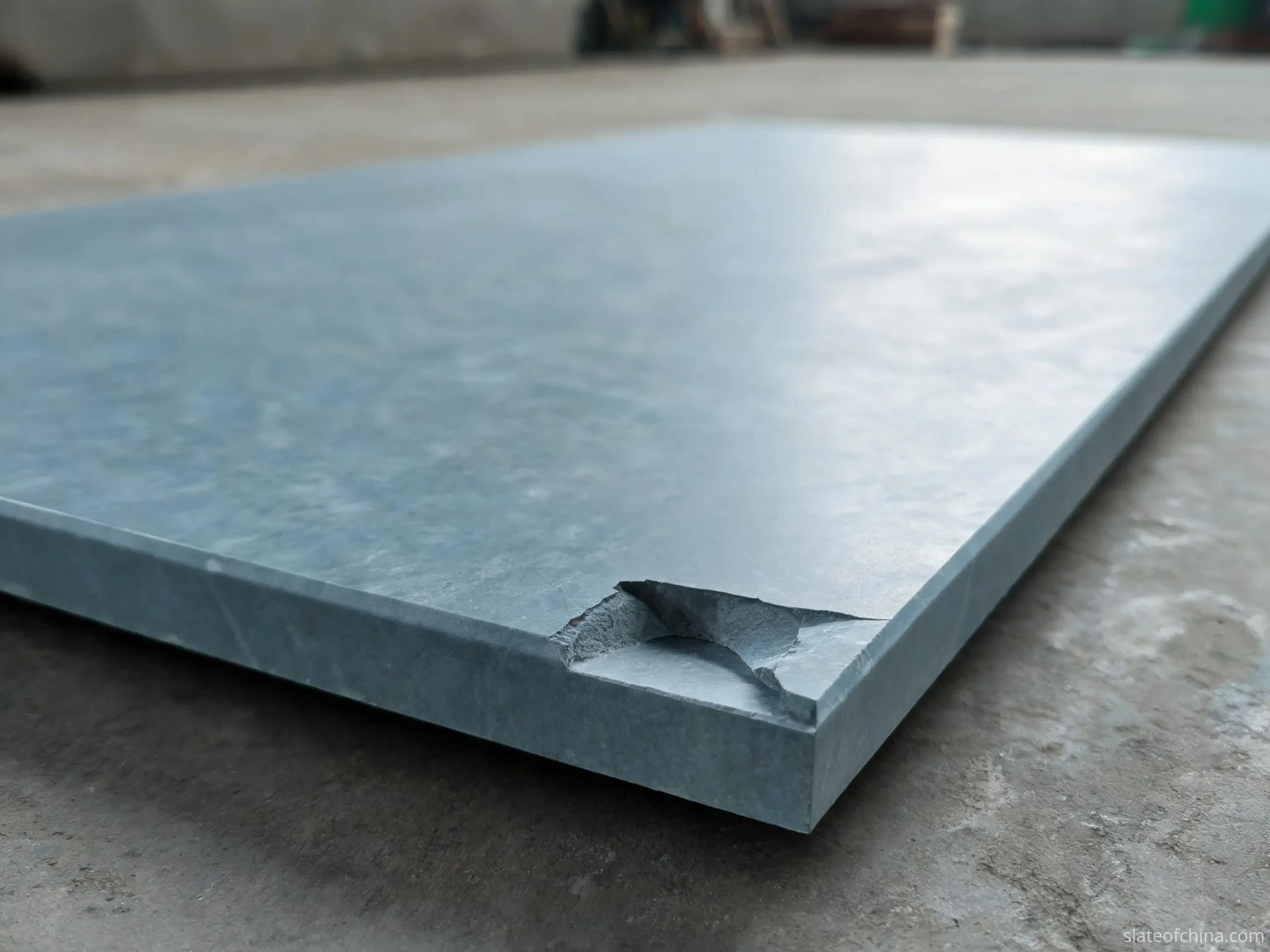
Edge and corner damage is the most common problem to find after transportation, and the one most often confused about whether it matters. Billiard slate is heavy — a three-piece 9 ft set can weigh 250–270 kg — and its edges and corners are vulnerable to impact during loading, unloading and handling.
Typical edge and corner defects include:
- Small chips along the long or short edges
- Broken corners (the most vulnerable points during forklift handling and stacking pressure)
- Crushed edges from strapping or banding pressure
- Long edge fractures extending parallel to the edge
- Impact marks from contact with the container wall or other panels
- Delamination or separation starting from an edge
Corners deserve particular attention because they are the first points of contact during any impact. A corner may be damaged by forklift handling, incorrect lifting, impact against the container wall, insufficient packaging, stacking pressure, or rough unloading. Photographs of all four corners of every panel are useful during pre-shipment inspection.
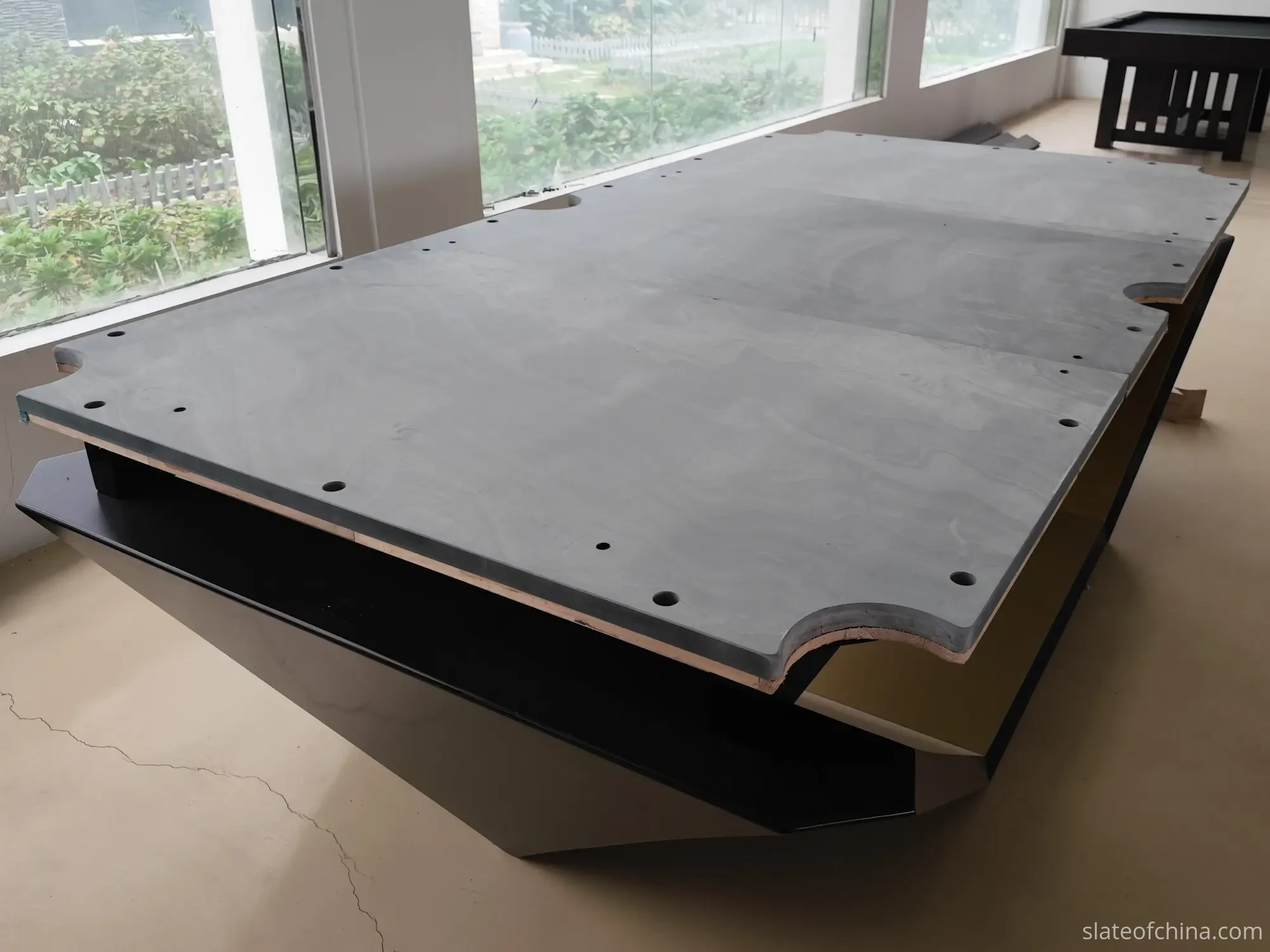
Where to inspect: Check all four corners of every panel, the full length of long edges, short edges, and — for multi-piece slate — the joint edges where two panels will meet. The joint edges are the most critical because accurate alignment during installation depends on them. Areas around mounting holes and areas that contact the table frame also need attention.
Severity ruling: A small corner chip outside the playing area and away from joints is Tier 2 (Monitor) — document and evaluate against spec. A chip on a joint edge that prevents flush alignment is Tier 3 (Repair) or Tier 4 (Reject) depending on whether it can be corrected. A broken corner that extends into the body of the slate is likely Tier 4 (Reject) — investigate carefully, as this may indicate the panel has experienced a significant impact that could have caused internal damage not visible on the surface. As with all rulings, evaluate against the agreed specification and the specific location on the panel.
3. Surface Pits and Small Holes
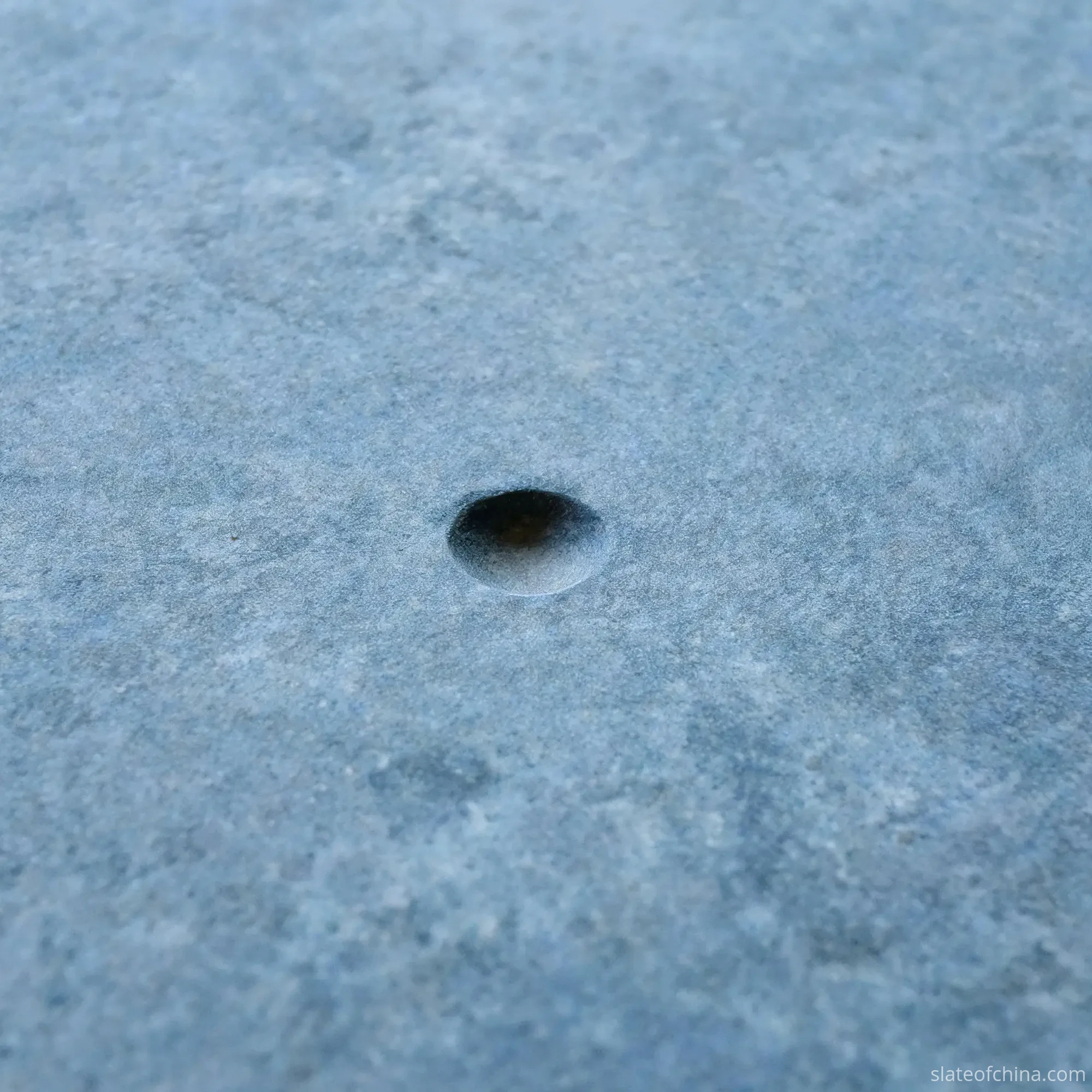
Natural slate can contain small pits, pores or mineral-related depressions. A small pit does not automatically mean the slate is unusable — the important factors are size, depth, location, number, whether it remains after grinding, and whether it affects the finished playing surface.
Why location matters: A small pit on an edge or near the rail bolt area may have little effect on table performance. A deep depression in the finished playing area is more significant because the playing surface must provide a consistent foundation for the cloth and table setup. For this reason, buyers should evaluate surface pits after the agreed machining and finishing process, rather than judging raw blocks alone.
Severity ruling: A few shallow natural pits in non-playing areas are Tier 1 (Accept) or Tier 2 (Monitor). A deep pit in the playing surface that remains after final grinding is Tier 3 (Repair) if it can be addressed in finishing, or Tier 4 (Reject) if it creates a visible irregularity under the cloth.
4. Surface Marks and Scratches
Surface marks can occur during quarrying, cutting, transportation, grinding, handling and packaging. Some marks are removed during subsequent grinding; others are permanent. When inspecting finished billiard slate, the task is to distinguish between a superficial handling mark and a permanent defect.
If you find a surface mark, check:
- Is it only visible, or can it be felt with a fingernail?
- How deep is it?
- Does it disappear after grinding?
- Is it located in the playing area or near a joint?
- Does it affect flatness?
- Does it continue across a joint line?
- Is it present on several pieces, or just one?
A photograph under strong side lighting can make a very minor mark appear much deeper than it actually is. Use consistent lighting and, where necessary, tactile inspection — run a fingernail across the mark to judge whether it is superficial or structural.
Severity ruling: A deep scratch across a joint area that affects flatness is likely Tier 4 (Reject), but evaluate against the agreed tolerance — the question is whether regrinding can restore the surface within specification.
5. Uneven Grinding or Surface Irregularities
For billiard slate, surface quality is more than appearance. A panel can look attractive while still requiring further machining. Potential problems include uneven grinding, local high spots, local low spots, grinding marks, inconsistent surface finish, insufficient machining, and flatness outside the agreed tolerance.
The correct inspection method must include measurement, not just visual inspection. Depending on the specification, buyers may check flatness using suitable straightedges, precision measuring equipment or other agreed methods. The actual tolerance should be established according to the table manufacturer's requirements rather than assuming every billiard slate product uses the same tolerance.
Severity ruling: Flatness outside the agreed tolerance is likely Tier 4 (Reject), even if the panel looks visually perfect — but the ruling depends on whether the tolerance can be restored by regrinding within the agreed specification.
6. Thickness Variation
Thickness is a critical dimensional characteristic for billiard slate. Natural stone is not produced from a perfectly uniform manufactured sheet, so the raw material requires controlled processing.
During inspection, check:
- Overall thickness at multiple points on each panel
- Thickness consistency between pieces in a set
- Machined thickness versus nominal thickness
- The thickness tolerance specified in the purchase order
A 25 mm pool table slate and a 45 mm snooker slate are different products with different requirements. Do not evaluate thickness from a single measurement at one location — measure multiple points and compare the results with the agreed specification. Thickness consistency between mating pieces is especially important for multi-piece sets, as the joint must be flush.
Severity ruling: A dimensional error outside tolerance is likely Tier 4 (Reject) — even if the slate looks visually perfect. However, evaluate against the agreed specification: if the error is within a correctable range and does not affect mating pieces, it may be Tier 3 (Repair). For detailed measurement methods, see our thickness and dimensional inspection guide.
7. Damaged or Misaligned Drilled Holes
Some billiard slate is supplied with holes or machining features for installation. Possible defects include incorrect hole position, hole diameter outside specification, chipped hole edges, cracks extending from holes, burrs or machining damage, and hole spacing errors.
The hole itself may be small, but an incorrectly positioned hole can create significant problems during table assembly. For OEM customers, drawings should specify hole positions, diameters, depth, countersinking or recess requirements, and reference dimensions. The supplier should manufacture according to the approved drawing rather than relying only on a general table size.
Severity ruling: Incorrect hole position or diameter outside specification is likely Tier 4 (Reject) — the panel will not assemble correctly without rework that may compromise the stone. However, if the error is minor and correctable within the agreed drawing, it may be Tier 3 (Repair).
8. Delamination or Layer Separation
Slate is a naturally layered stone. Its geological structure is one reason it can be split and processed into relatively flat slabs. However, abnormal separation or weakness between layers can become a quality concern.
Look for:
- Layers visibly separating along an edge
- Loose flakes that can be lifted or peeled away
- Weak edges that crumble under light pressure
- Areas that separate easily following the stone's natural structure
- Unusual fractures that run parallel to the surface rather than through it
A natural layered appearance on a cut edge should not automatically be classified as delamination. The important question is whether the material remains stable and suitable for the intended billiard application. A panel that is structurally sound but shows natural layering on its edge is different from one where the layers are actively separating.
Severity ruling: Natural layering visible on a cut edge with no separation is Tier 1 (Accept). Loose flakes or weak edges are Tier 2 (Monitor) if localised, or Tier 4 (Reject) if the separation extends into the panel body.
9. Colour and Mineral Variation
Colour variation is often mistaken for a defect. Natural slate contains variations caused by its mineral composition and geological formation. You may see dark and light areas, mineral veins, fine lines, slight changes in tone, and natural texture variation.
For most billiard slate applications, these characteristics do not affect performance. The playing surface is covered with cloth, and minor tonal variation underneath is invisible and irrelevant to play. However, if a customer requires a particular visual appearance — for example, when matching panels across multiple containers or production batches — the acceptable colour range should be agreed before production.
Severity ruling: Natural colour and mineral variation is Tier 1 (Accept). Variation that falls outside an agreed colour specification is Tier 2 (Monitor) — document and discuss with the supplier. This is not a structural concern, but a visual specification issue.
How to Inspect Billiard Slate for Defects
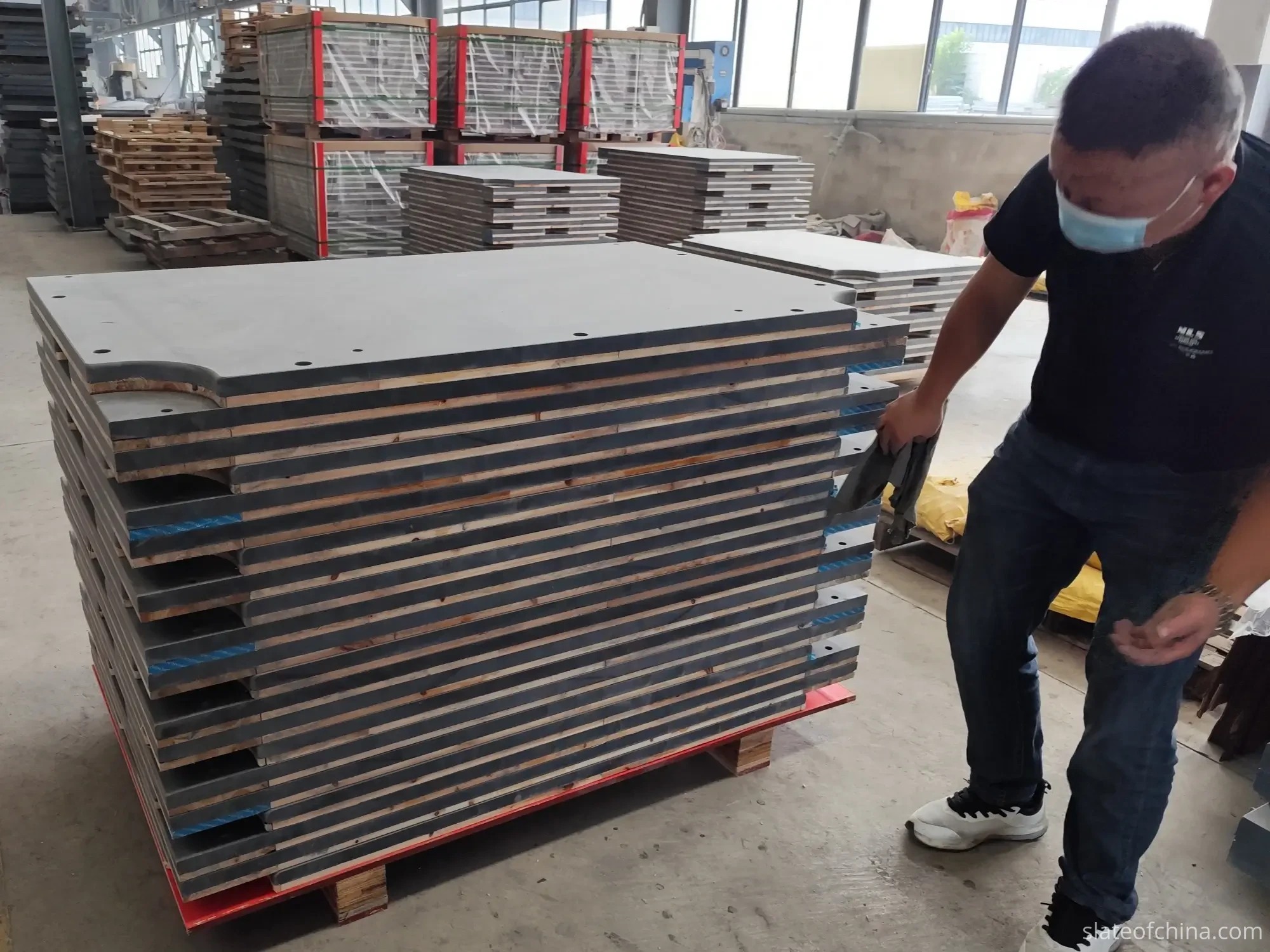
A practical billiard slate inspection can be divided into six stages. The sequence matters — you want to catch transport damage before you start measuring, and you want to record everything before the panels are moved.
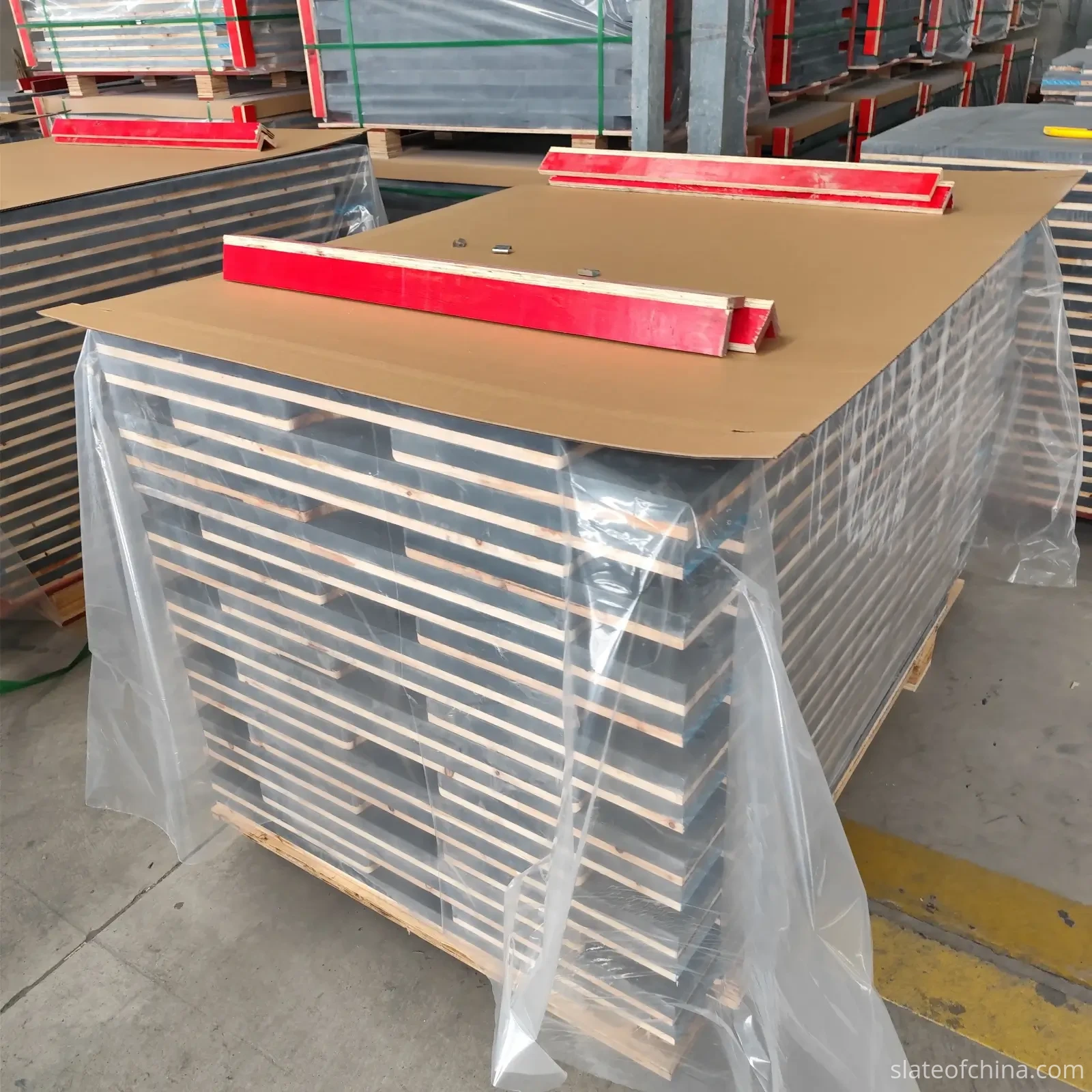
Step 1: Check the packaging. Before opening, inspect the crate or pallet for crushed supports, broken corners, signs of impact, movement inside the package, water exposure, and damaged protective materials. Take photographs before unpacking if transport damage is suspected. The condition of the packaging tells you what to expect inside — a crate that has taken a heavy impact is more likely to contain edge and corner damage.
Step 2: Inspect edges and corners. Check every piece for chips, cracks, broken corners, edge fractures and impact damage. For multi-piece slate, inspect the joint edges carefully — these are the most important edges on the panel. Photograph all four corners of each panel.
Step 3: Inspect the playing surface. Use good lighting and examine the entire surface for cracks, deep pits, scratches, abnormal depressions, grinding problems and other visible damage. Do not inspect only the centre of the slate — scan the complete surface, including the edges and areas near mounting holes.
Step 4: Measure dimensions. Verify length, width, thickness, hole positions, hole dimensions and other machining dimensions against the purchase specification. Measure thickness at multiple points on each panel, not just once.
Step 5: Check flatness. Flatness should be checked using an appropriate measurement method and the agreed tolerance. For professional OEM orders, the inspection method should ideally be established before production begins. See our detailed flatness inspection guide for the full procedure.
Step 6: Record defects. Do not rely on memory or verbal descriptions. For each significant defect, record the slate piece number, defect location, defect type, approximate size, photograph, measurement if applicable, and your acceptance or rejection decision. This makes communication between buyer and supplier much easier and creates a record that can be used for claims if needed.
Billiard Slate Defect Inspection Checklist
| Inspection item | What to check | Potential concern |
|---|---|---|
| Cracks | Surface and edges, both sides | Structural damage |
| Edges | Chips, breaks, fractures along all edges | Installation and alignment problems |
| Corners | Impact damage, broken corners | Handling and transport damage |
| Surface | Pits, scratches, marks, depressions | Playing-surface quality |
| Flatness | High and low areas against tolerance | Table performance, ball roll |
| Thickness | Multiple measurement points per panel | Dimensional inconsistency, joint mismatch |
| Dimensions | Length and width against drawing | Installation problems |
| Joint edges | Straightness, damage, alignment | Joint alignment, seam visibility |
| Drilled holes | Position, diameter, edge condition | Assembly problems |
| Layer structure | Loose or separating layers | Material stability |
| Colour | Batch consistency against spec | Appearance requirements |
Which Billiard Slate Defects Are Acceptable?
There is no universal answer. Acceptance depends on the intended application, machining process, agreed tolerance and the customer's quality standard.
- A minor natural mineral line is usually acceptable.
- A small edge chip outside the playing area may be acceptable or repairable.
- A deep pit in the playing area requires further evaluation.
- A significant crack requires rejection.
- A dimensional error outside the agreed tolerance requires rejection — even if the slate looks visually perfect.
This is why professional buyers define quality requirements before production, rather than deciding everything after the container arrives. The most expensive defect is not the one you find — it is the one you cannot agree on because the specification was never written down.
How to Reduce Billiard Slate Defects Before Shipment
The best time to control defects is before the slate reaches the customer. A supplier quality-control process can include raw material selection, block inspection, cutting, thickness calibration, surface grinding, dimensional machining, hole machining where required, edge and corner inspection, final flatness inspection, final dimensional inspection, packaging inspection, and pre-shipment photographs and records.
For OEM customers, an approved drawing and a written inspection specification can significantly reduce misunderstandings. The specification should cover what is acceptable, what is not, and what the tolerance bands are — so that when a panel arrives with a minor edge chip, the answer is already on paper rather than negotiated by email under time pressure.
For a full walkthrough of the supplier-side quality control process, see our surface quality inspection guide and the buyer's quality control checklist.
What Should Buyers Ask a Billiard Slate Supplier?
Before placing an order, ask the supplier:
- What natural characteristics are normally present in your slate?
- How do you inspect for cracks, and how do you distinguish them from mineral veins?
- What flatness tolerance do you guarantee, and how is it measured?
- What thickness tolerance do you use?
- How are edges and corners protected during shipment?
- Can you provide pre-shipment inspection photographs of the actual finished pieces?
- What packaging method do you use for export, and what is the normal breakage allowance?
- What happens if transport damage is discovered after arrival?
These questions are often more useful than simply asking whether the slate is "high quality." A supplier who can answer specifically — with tolerance numbers, inspection methods and packaging details — is one who has already thought about defect prevention. For a full list of supplier evaluation questions, see our manufacturer selection guide.
Final Takeaway
Common billiard slate defects include cracks, edge and corner chips, pits, scratches, grinding irregularities, thickness variation, machining errors and abnormal layer separation. But natural slate also contains geological characteristics — mineral veins, colour variation, texture — that should not automatically be treated as defects.
The most reliable approach is to evaluate billiard slate according to measurable requirements: structural integrity, flatness, dimensions, machining accuracy, surface condition and edge condition. The goal is not to find a piece of natural stone with no visible variation. The goal is to receive stable, accurately machined slate that meets the agreed technical requirements for the intended billiard table.
Sort what you see into the four severity tiers. Photograph everything. Measure against the spec, not against a photograph. And when in doubt, ask for more information before you make the call.
Frequently Asked Questions
How can I tell a natural mineral vein from a crack in billiard slate?
A mineral vein appears as a line on the surface but is integrated into the stone — it is flush, with no opening or separation. A crack represents a physical fracture: the stone has separated along that line. Run a fingernail across the line — if it catches, it may be a crack. Check the edge of the panel: if the line continues through the thickness, it is almost certainly a crack. When a photograph is not enough, ask the supplier for close-up and edge photographs or a video inspection.
Are small edge chips on billiard slate acceptable?
It depends on location. A small chip on an edge that will be hidden under the rail is usually acceptable or monitorable. The same chip on a joint edge that must align flush with the neighbouring panel is more serious and may require repair or rejection. Always evaluate edge chips against the agreed specification and the specific location on the panel.
What is the most common billiard slate defect found after shipping?
Edge and corner damage is the most common defect found after transportation. Billiard slate is heavy and its corners are vulnerable to impact during loading, unloading and handling. This is why corner protectors, proper packaging and careful forklift handling are essential — and why all four corners of every panel should be photographed during pre-shipment and arrival inspection.
Should I reject a billiard slate panel with a surface pit?
Not automatically. A few shallow natural pits in non-playing areas may have little practical significance. A deep pit in the finished playing area is more serious because the surface must provide a consistent foundation for the cloth. Evaluate pits after the agreed machining and finishing process, and judge them by size, depth, location and whether they remain after final grinding.
Can a billiard slate panel with a crack be repaired?
A surface-only hairline that does not continue through the thickness may be monitored depending on its location. A through-thickness crack — one that separates the stone — is a structural defect and the panel should be rejected. Repairing a through-thickness crack is not recommended for a precision playing surface, as the repair may not maintain the flatness and stability required for consistent ball roll over time.
How do I inspect billiard slate flatness for defects?
Use an appropriate measurement method — a precision straightedge, feeler gauges or specialised measuring equipment — and compare the results against the agreed tolerance. Inspect the full surface, not just the centre. For multi-piece sets, check that mating panels are flush at the joints. The flatness tolerance should be established according to the table manufacturer's requirements before production begins.
What should I do if I find defects when my billiard slate arrives?
Document every defect with photographs, measurements and piece numbers before moving the panels. Sort each defect into the severity framework — accept, monitor, repair or reject. Contact the supplier with the evidence and refer to the agreed specification. If the specification was not written before the order, agree on the acceptance criteria now and use the documentation to support your position. Most quality issues are resolved faster with clear records than with verbal descriptions.
Related Reading
Not Sure Whether a Mark Is a Vein or a Crack?
If you have found a line, a chip or a mark on your billiard slate and you are not sure whether it is a natural mineral feature or a defect that needs action, send us a close-up photograph together with your slate specification. We can help you classify it against the agreed tolerance and advise on the appropriate severity tier — accept, monitor, repair or reject.
Send a photo and your specification →
Slate of China — Precision Beneath Every Great Table.