
Slate Surface Grinding: How Billiard Slate Is Ground Flat and Checked
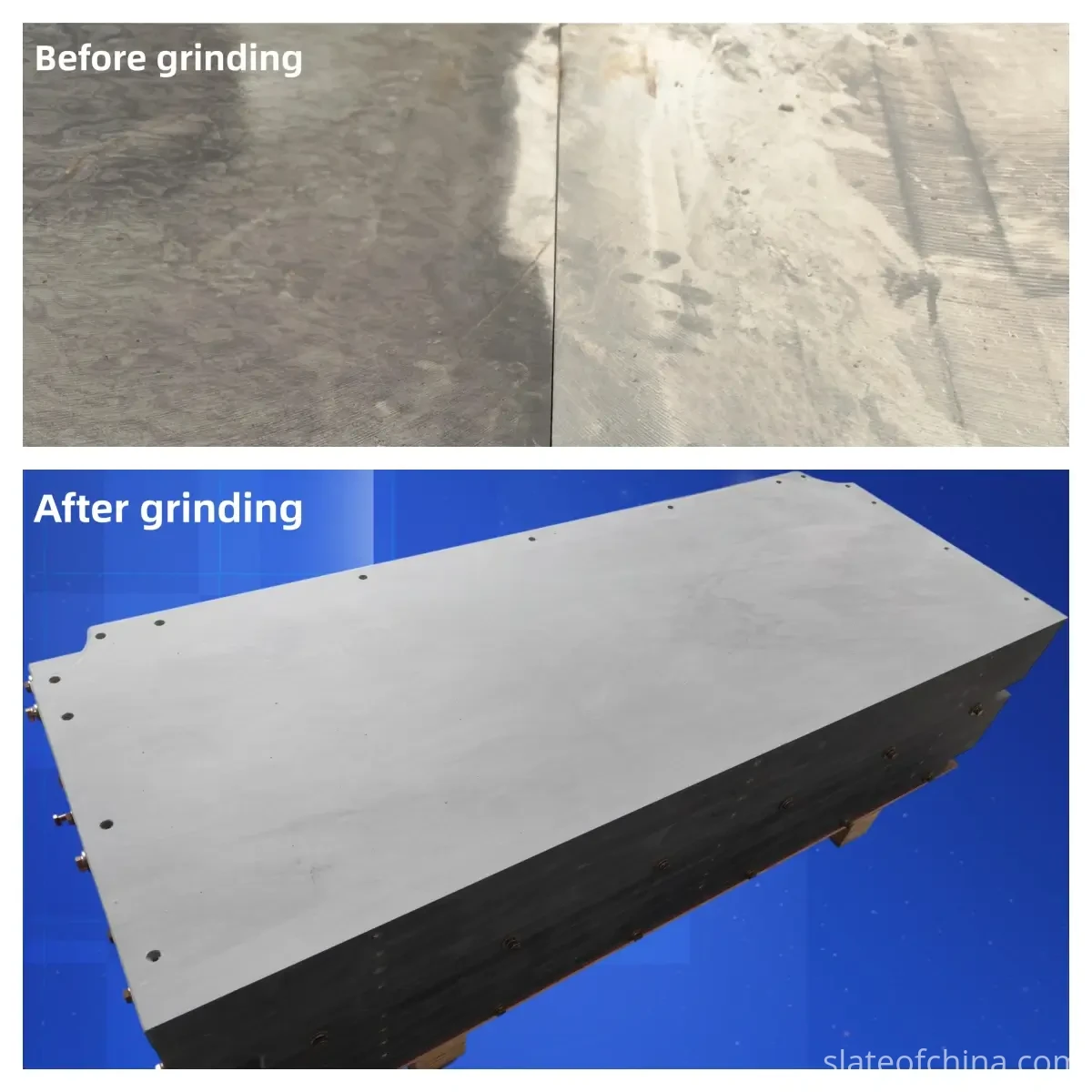
Run your palm across a slate slab that has just come off the saw, and you feel it: a faint ripple, the ghost of the blade's path, a surface that is close but not there. Now run the same hand across a slab that has been through the grinding pass. The ripple is gone. What was a cut stone is now a machined surface.
That difference — the distance between cut and ground — is what this page is about. The billiard slate grinding process is one of the key machining stages that turns quarried natural slate into a controlled billiard-table playing surface. It is a single step, but it is the step that establishes the geometry everything else depends on.
We grind slate beds in our Jiujiang factory every working day. This is what we do, why we do it, how we check the result, and what a buyer should ask to confirm it was done properly.
What Grinding Removes
Natural slate leaves the quarry with excellent geological properties — fine grain, high density, low water absorption — but it does not leave the quarry flat. A slab that has been sawn to the right length and width still carries the signature of the cutting process: saw marks, minor surface waves, local high spots, and small thickness variations across the face.
None of these are defects in the stone. They are the normal result of cutting a natural material with a blade. A sawn slab can look clean and still not meet the surface condition a billiard table needs.
Grinding removes these. It takes a surface that is approximately right and makes it controlled. The high spots are brought down. The saw marks are erased. The face of the slab is brought to a consistent plane that the cloth can lie on without following hidden bumps.
The distinction worth remembering is this: cutting determines the shape; grinding determines the surface. A slab can be the right length, the right width, and the right thickness on paper, and still not be ready for a billiard table until the playing face has been ground.
What Grinding Does Not Do
Grinding is not polishing. This is the most common misunderstanding we encounter when buyers visit the factory or compare suppliers.
A polished stone surface — the kind you see on kitchen countertops or decorative wall panels — is smooth, reflective, and glossy. It looks beautiful. But a billiard playing surface is never polished, for a simple reason: the surface is covered by cloth. Nobody sees it. What matters is not how it looks but how flat it is.
Polishing solves an appearance problem. Grinding solves a geometry problem. The two processes use different abrasives, different pressures, and different objectives. A supplier who tells you the slate is "polished flat" may be describing two things at once, or may not understand the distinction. The correct term for what a billiard slate needs is ground flat — a controlled machining operation, not a cosmetic finish.
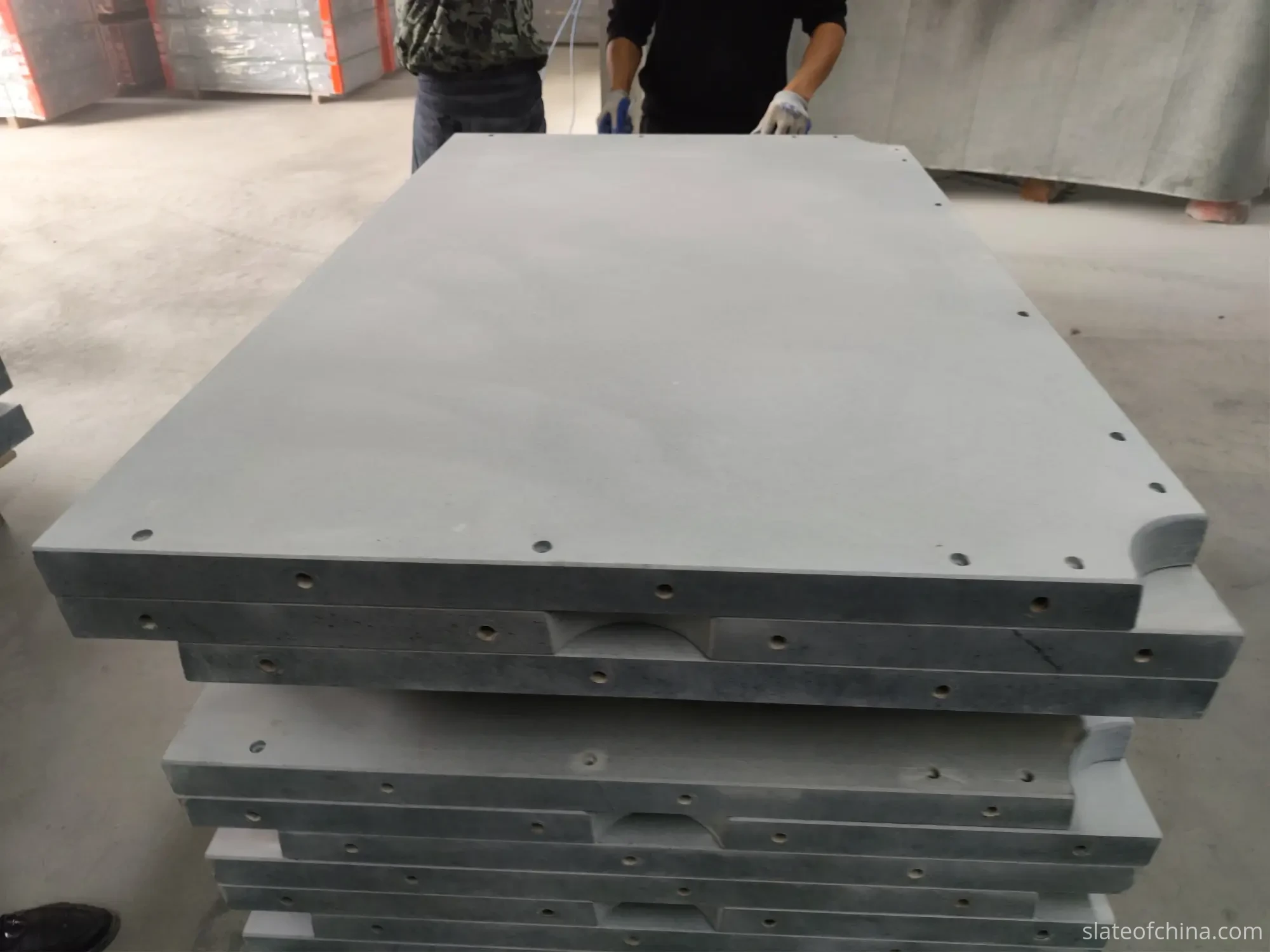
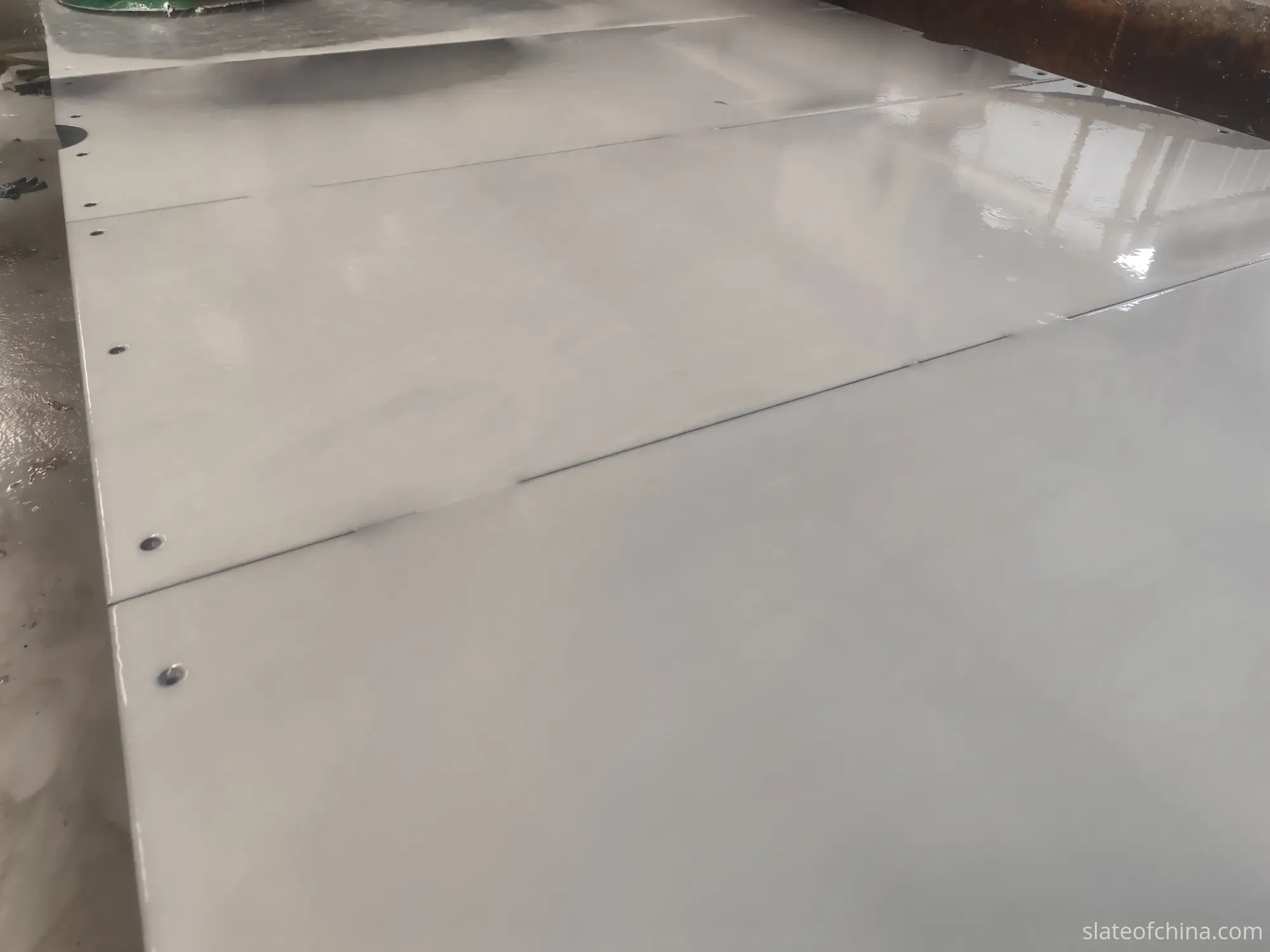
The finished ground surface has a uniform, matte appearance — not shiny, not reflective. If you run a straightedge across it, the edge sits flush. That is the point.
A Common Mistake: Judging Slate by Appearance
Many suppliers show photographs of slate that looks glossy, smooth, and uniform — and call it "flat." A surface can look smooth and consistent without being sufficiently flat. Conversely, a ground surface does not need to be glossy to perform well. In fact, a high-gloss surface on billiard slate is a warning sign, not a quality signal.
What matters beneath the cloth is geometry — not appearance. A matte, uniform surface that meets the flatness specification is what a billiard table needs. A shiny surface that does not meet the flatness specification is not. Gloss is not flatness.
This is why a buyer should ask how flatness was measured, not just how the surface looks in a photograph. A photograph can show surface condition. It cannot confirm flatness. Only a measurement method can do that.
How the Surface Is Ground
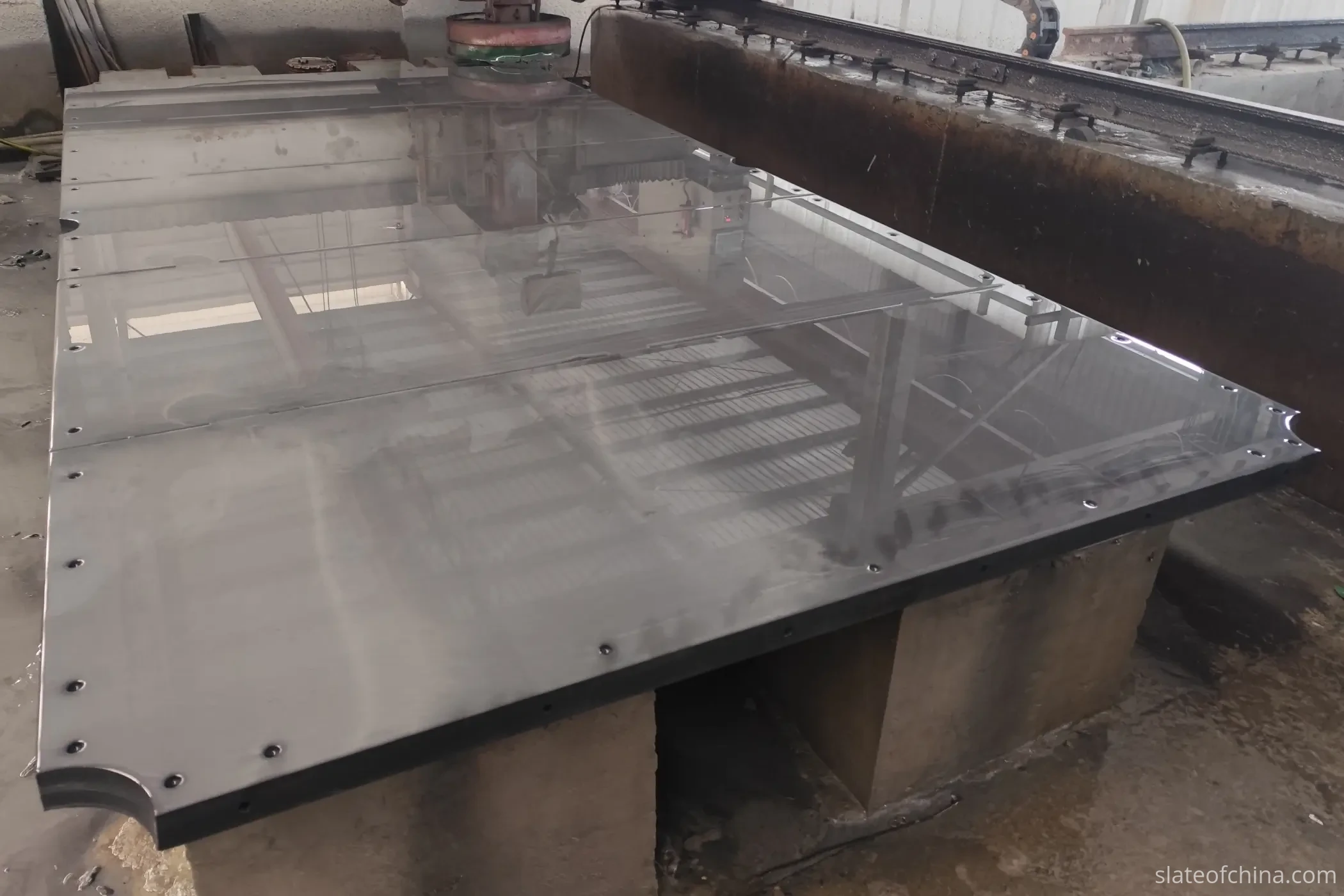
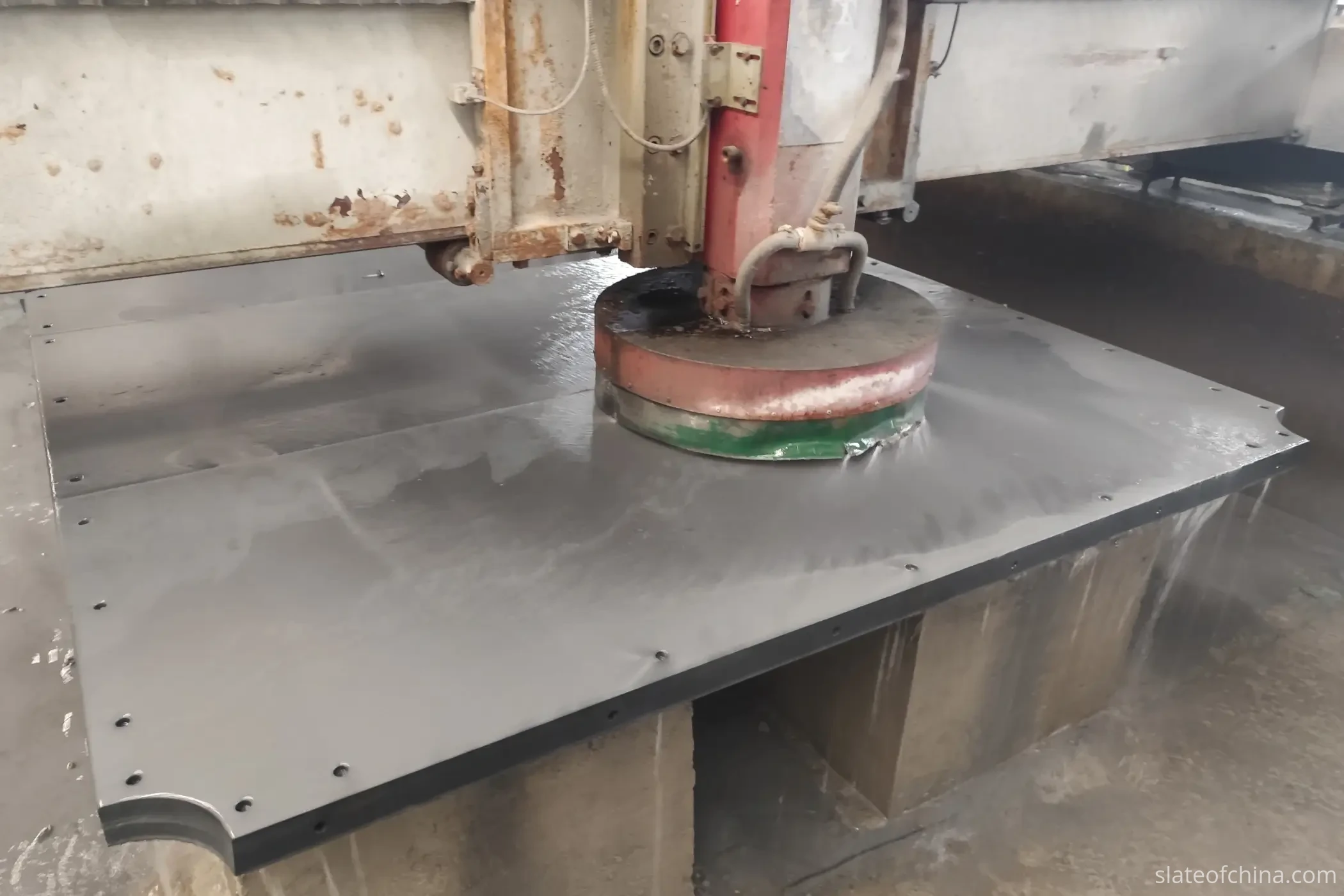
The basic principle is straightforward: a rotating abrasive tool moves across the slate face, removing a small, controlled amount of material from the high areas until the entire surface reaches the required condition.
| Stage | Surface Condition | Ready for Final Table Assembly? |
|---|---|---|
| Saw-cut | Saw marks, waviness, local high spots, thickness varies | No |
| Rough grinding | Major irregularities removed, surface approaching flat | Not yet |
| Finish grinding | Controlled flatness and thickness, uniform matte finish | Yes, subject to inspection |
| Final inspection | Flatness, thickness and joints checked against the drawing | Ready for next manufacturing stage |
In practice, the process involves several stages:
Securing and Supporting the Slab
A billiard slate panel — especially a large one — cannot simply be placed on a bench and expected to grind accurately. The slab must be properly supported so that it does not flex, rock, or shift during machining. A 9-foot three-piece set panel or a 12-foot snooker panel is a heavy, rigid object, but on the wrong support it can still settle unevenly. The grinding setup needs to hold the slab stable while allowing the grinding head to travel across the full playing surface.
Rough Grinding — Removing the Bulk of the Irregularity
The first pass uses a coarser abrasive to remove the larger surface variations left by the saw. Saw marks, local high spots, and the most visible waviness are addressed in this stage. The objective is not a finished surface but a surface that is already much closer to flat than it was when it came off the saw.
Finishing Grinding — Bringing the Surface to Tolerance
The second pass uses a finer abrasive to bring the surface to its final condition. The finer grit removes less material per pass but produces a more controlled surface. At this stage, the goal is no longer to remove large irregularities but to hold the flatness that was established in the rough pass.
The specific grit ranges and number of stages depend on the machine, abrasive system, slate condition, and required finish. Different manufacturers use different approaches — the ranges described above are examples of one production method, not a universal industry standard.
Grinding Path and Overlap
The grinding head does not make a single pass across the slab. It travels in a series of overlapping passes, so that no strip of the surface is left at a slightly different level from its neighbour. Without overlap, you would get a series of parallel grooves — each one flat within itself but with a small step between each band. The overlap eliminates those steps.
The exact overlap depends on the machine, grinding wheel, and operating procedure. In our production process, the passes are typically overlapped by approximately 30% of the previous pass width — but the principle matters more than the specific number: every part of the surface has to be ground, with no unaddressed strips between bands.
Multi-Piece Sets — Grinding as a Matched Group
A three-piece or five-piece billiard slate set is not a collection of independent slabs. The pieces must work together as a single playing surface. For this reason, the pieces of a set are ground in the same setup, on the same machine, in the same sequence. The grinding tolerance is not just "each piece is flat" — it is "each piece is flat, and the pieces match each other at the joints."
This is one of the reasons that a properly manufactured billiard slate set involves more than cutting three pieces of stone to the same size. The set has to be ground as a group, checked as a group, and packed as a group.
How Much Material Is Removed
Grinding removes material — that is its job. But it is not the same as "making the slate as thin as possible." The objective is controlled correction, not aggressive stock removal.
If a slab comes off the saw already close to the required surface condition, only a small amount of material needs to be removed. If the sawn surface has more variation, more material must be ground away to bring it flat. The operator balances two things: correcting the surface and preserving the final thickness.
This is why the grinding process has to work to a drawing, not to a guess. If the finished slate is specified at 25 mm, the grinding operator knows the starting thickness and the target thickness, and the amount of material available for grinding is the difference. Grinding "until it looks flat" without reference to a drawing is how slates end up under-thickness.
For a billiard slate supplied to a specified thickness — whether 19 mm, 25 mm, 38 mm, 45 mm, or 50 mm — the final product must be controlled against the customer's dimensional specification, not ground freely and measured afterwards.
How Flatness Is Checked After Grinding
Grinding is the process; flatness is the result that must be measured. A ground surface is not automatically a flat surface — it is a surface that has been brought closer to flat, and the remaining deviation has to be confirmed by inspection.
Grinding is only half the job. The other half is confirming that the grinding produced the required result. A surface that "looks flat" under factory lighting is not the same as a surface that meets a flatness specification.
Straightedge and Feeler Gauge
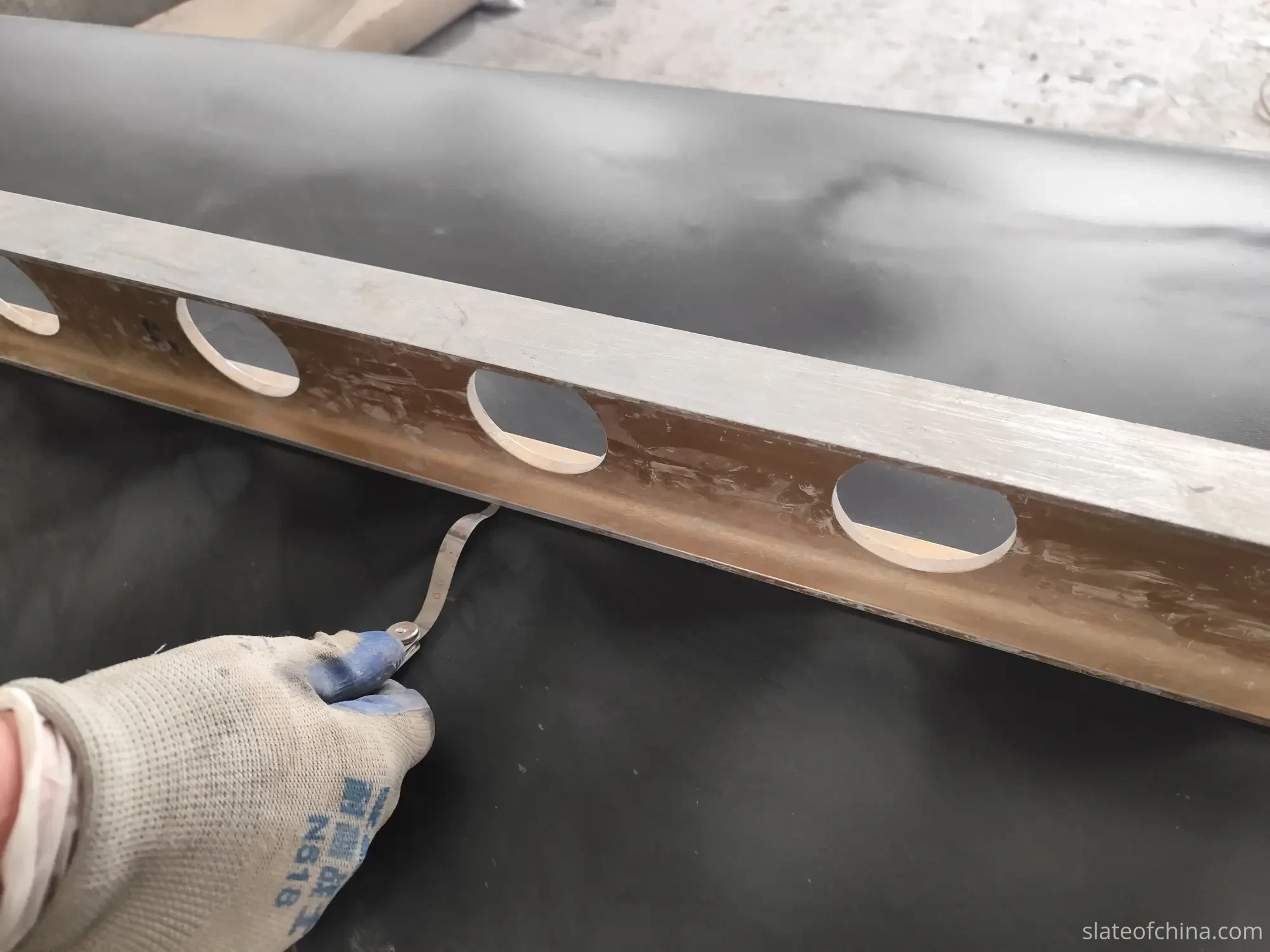
The primary inspection tool is a precision straightedge placed across the surface in multiple directions. Where the straightedge contacts the surface, the inspector checks for gaps between the edge and the slate. A feeler gauge — a set of thin metal blades of known thickness — is used to measure the size of any gap found.
This is a simple method, but it works, and it is repeatable when used systematically. The key word is systematically. Placing a straightedge once in the centre of the slab and finding no gap does not mean the slab is flat. It means the centre is flat. The edges may not be.
The Minimum Grid: Five Points
A meaningful flatness check needs to cover the surface, not just one spot. For our practical inspection, five points — four corners and the centre — provide a basic starting pattern. At each point, the straightedge is placed across the local area, and any gap is measured with the feeler gauge.
Five points is a starting point, not a fixed rule. Larger panels — 9-foot, 10-foot, 12-foot — should be checked at additional locations along the edges, at intermediate areas, and across the centre. The objective is to find out whether a problem is localised, concentrated near one edge, or spread across the entire face.
The inspection should record the maximum measured deviation — the largest gap found across all measurement points — rather than simply reporting that the slate is "flat." A meaningful inspection record shows the measurement location, the measured gap at each point, and the maximum deviation found across the entire playing surface. This turns a visual check into a document that can be compared against the agreed tolerance.
Why Measuring Only the Centre Is Not Enough
Picture a slate that is perfectly flat in the centre but rises slightly along one edge. A single centre measurement shows zero gap. The slate passes — on paper. But when the cloth is stretched over it and a ball rolls near that edge, the ball follows the rise. The playing surface is not true.
The same logic applies in reverse: a slab that dips in the middle but sits flat at the four corners will pass a corner-only check and fail in play. This is why a flatness claim has to be tied to a measurement pattern, not just a number.
When a supplier says "our slate is very flat," the natural follow-up question is: flat measured where, over what area, and with what tool? A flatness number without a measurement method is just an adjective.
Multi-Piece Flatness — Checking the Joints
For a three-piece or five-piece set, individual flatness is not the complete picture. The joints between pieces must also be checked. A straightedge is placed across the joint line, spanning both pieces, to confirm that the two surfaces are at the same level. A gap at the joint — even a small one — creates a step in the playing surface that the cloth will bridge but not hide.
Set-level inspection is why a billiard slate set needs to be ground together and checked together, not ground separately and hoped to match.
For OEM production, the billiard slate grinding tolerance — the acceptable flatness deviation after grinding — should be agreed before production and linked to a defined measurement method. A billiard slate surface tolerance is meaningful only when the reference length, measurement method, and acceptance limit are clearly defined. A number without a method is an adjective.
Thickness and Flatness Are Related — But Not the Same
Buyers sometimes assume that a thicker slate is automatically flatter. It is a reasonable assumption — more material means more rigidity — but it confuses two separate specifications.
Thickness is a dimensional number. Flatness is a geometric condition. A 50 mm slab can have an improperly ground surface. A 25 mm slab can have a carefully ground and controlled surface. Thickness contributes to structural stability, but it does not guarantee surface flatness. Only the grinding and inspection process does that.
When evaluating a supplier, ask for both: the thickness specification and the surface flatness specification. If the supplier only talks about thickness, they may be answering a different question than the one you are asking.
Why Grinding Quality Matters to Ball Roll
The reason all of this matters is performance. The cloth, the cushion system, the table frame, and the installation all influence how a ball behaves. But the slate provides the plane beneath the cloth. The cloth does not reproduce every microscopic variation in the stone, but larger or systematic deviations in the slate surface can influence the final playing surface — and on a table that players expect to roll true, that is enough to matter.
A serious player does not need the slate to look flat. They need it to be flat. The difference between those two statements is what surface grinding is for.
This is why professional billiard slate manufacturing places grinding and inspection at the centre of the process, not at the end. Grinding is not a finishing touch — it is the step that turns a cut stone into a playing surface.
Snooker Slate vs Pool Slate — Same Principle, Different Scale
The grinding principle is the same for all table types, but the practical requirements differ.
Snooker tables are large. A 12-foot snooker slate set may have five pieces, each with substantial dimensions. The grinding setup has to handle a longer travel distance, and the set-matching inspection has to cover more joint lines. The scale makes systematic flatness checking more important, not less — on a large table, a small edge deviation is further from the centre and can affect a ball over a longer travel distance.
Pool tables come in a range of sizes — 7, 8, 9, and 10 foot — and the slate may be one piece or three. The grinding tolerance is no less critical, but the inspection pattern can be simpler on a smaller panel. The five-point grid is the minimum; additional points are added for larger slabs.
For OEM production — where we supply slate to a table manufacturer's drawing — the grinding specification has to match the manufacturer's engineering requirements. The table builder decides what flatness they need for their frame, their cloth, and their target market. Our job is to meet it, document it, and confirm it.
What Happens After Grinding
Grinding is normally not the end of the manufacturing process. Depending on the product, subsequent operations may include:
- Final dimensional inspection — confirming the full set of measurements against the drawing
- CNC machining — pocket cuts, bolt holes, and edge profiling to the table manufacturer's specification
- Joint preparation — matching the joint faces so the pieces align when assembled
- Cleaning — removing grinding dust and any residue from the surface
- Final quality inspection — a last check of the surface, edges, and set matching
- Protective packaging — the ground surface must be protected from scratches, impact, and contamination during handling and shipping
The playing surface should be protected after grinding because a well-machined face can be damaged by careless handling. A scratch from a misplaced tool, a chip from a forklift edge, or grit trapped between stacked panels can undo what the grinding process achieved. This is why packaging is not an afterthought — it is part of delivering a ground slate in the condition it left the machine.
When Does Billiard Slate Need Re-Grinding?
Under normal manufacturing flow, a slate panel is ground once and moves on to the next stage. But in certain situations, a panel may need to go back to the grinding machine:
- Surface damage during transportation — a scratch or chip that can be ground out without going under-thickness
- Excessive local high spots found at final inspection — areas that were missed or that developed after the first grinding pass
- Machining deviation — a previous processing step left the surface outside the agreed tolerance
- Incorrect thickness after earlier processing — where re-grinding can bring the panel back within the thickness range
- Damage during table installation — a panel dropped or scraped on-site that needs the surface restored
- Replacement slate that does not meet the required specification — a panel sourced elsewhere that needs to be brought into tolerance before it can be used
Re-grinding is not always the best solution. The amount of material that can safely be removed depends on the remaining thickness and the required specification. If the damage is deep and the panel is already close to the minimum thickness, re-grinding may bring it under tolerance — and the correct decision is to replace the panel, not force it through another pass.
This is particularly relevant for replacement billiard slate: a replacement panel must match not only the dimensions of the original but also its surface condition. If a replacement panel arrives with a surface that does not meet the flatness specification, re-grinding may be an option — but only if the thickness allows it.
What a Buyer Should Ask About Grinding
If you are sourcing billiard slate for an OEM table, importing slate for assembly, or buying replacement panels, the question "is the slate flat?" is a start, but it is not enough. Here are more specific questions that help you understand whether a supplier's grinding process is under control:
1. Is the entire playing surface ground, or only part of it?
For a professional billiard slate, the entire playing surface should be ground — not just the centre, not just the edges, not just the areas that are easy to reach.
2. How is flatness measured?
Ask whether the supplier uses a straightedge and feeler gauge, a precision measurement system, or another method. The method matters as much as the number.
3. Over what area and at how many points is flatness checked?
A flatness claim without a measurement area and a point count is not a specification. Five points is a basic starting pattern; larger panels should be checked at additional locations.
4. Are multi-piece sets ground and checked together?
For three-piece and five-piece sets, ask whether the pieces are ground as a matched group and inspected across the joints, not just individually.
5. What is the final thickness tolerance?
The grinding process removes material. The supplier should be able to confirm the finished thickness range, not just the nominal thickness.
6. Can the supplier provide inspection records?
For larger OEM orders, a documented inspection record — showing what was measured, where, and what the result was — gives far more confidence than a verbal assurance.
7. Is the surface ground or polished?
This question sounds basic, but it catches a real confusion. A billiard slate should be ground flat, not polished shiny. If the supplier describes the surface as polished, ask them to clarify what they mean.
A Practical Incoming Check for Buyers
When a container arrives, you do not need a laboratory to perform a useful first check on the ground surface. A practical inspection takes a straightedge, a feeler gauge, and a few minutes per panel:
Step 1 — Look at the surface. Place the panel under raking light — a torch held at a low angle across the face. Saw marks, grinding swirls, and any unevenness will show as shadows. A well-ground surface will have a uniform, matte appearance with no visible saw marks.
Step 2 — Lay the straightedge. Place a precision straightedge across the surface in several directions — lengthwise, crosswise, and diagonally. Look for light leaking under the edge.
Step 3 — Measure any gap. Where you see light under the straightedge, insert a feeler gauge to measure the gap. Record the location and the size.
Step 4 — Check the joints. For a multi-piece set, place the straightedge across the joint line. The two surfaces should be at the same level.
Step 5 — Record what you found. Photographs and measurement notes are useful if you need to discuss a discrepancy with the supplier.
For commercial shipments, the buyer and supplier should agree on the inspection method and the acceptance standard before production starts — not after a dispute arises. A grinding specification that both sides understand is cheaper than a disagreement that neither side expected.
Grinding Is Where Natural Slate Becomes a Playing Surface
Quarrying gives the slate its natural properties. Grinding gives the surface its working geometry. Inspection confirms whether that geometry meets the specification.
That three-step logic — from material, to machined surface, to verified result — is what separates a piece of natural stone from a billiard-table playing surface. Surface grinding is one of the key steps in that chain, and the step where the playing surface is actually established.
When evaluating a supplier, do not judge the slate only by colour, thickness, or appearance. Ask about the process — how the surface was ground, how flatness was checked, and whether the result was documented. A professional supplier should be able to explain the grinding process and provide a clear inspection method. The more precise the table, the more important the process behind the slate.
Frequently Asked Questions
Is billiard slate polished or ground?
Billiard slate is ground, not polished. The objective of grinding is to create a flat, controlled surface geometry — not a shiny, reflective finish. A polished surface looks smooth but does not guarantee flatness. A ground surface may look matte, but it meets the dimensional and geometric specification the table needs. Since the playing surface is covered by cloth, what matters underneath is flatness, not appearance.
Why does billiard slate need to be ground?
A sawn slate slab — even one cut to the correct length and width — still carries saw marks, minor surface waves, and local high spots from the cutting process. Grinding removes these irregularities and brings the playing face to a controlled, flat plane suitable for cloth installation and accurate ball movement. Without grinding, the cloth would follow the underlying surface geometry, and balls would not roll true.
Can natural slate be perfectly flat?
Natural stone has inherent variation, and "perfectly flat" is not a practical manufacturing target. The objective is to achieve the flatness tolerance required by the table design and agreed between the supplier and the buyer. This tolerance should be stated as a number plus a measurement method — for example, a maximum gap under a straightedge of a specified size, measured at a defined set of points across the surface.
Does grinding make the slate too thin?
Grinding removes material, but a controlled process manages the removal so the finished slate remains within the specified thickness tolerance. The grinding operator works to a drawing that specifies the target thickness, and the amount of material available for grinding is the difference between the sawn starting thickness and the finished requirement. Grinding "until it looks flat" without reference to a drawing is how slates end up under-thickness — which is why the process must be controlled, not freehand.
Does a thicker slate mean a flatter surface?
Not necessarily. Thickness and flatness are separate specifications. A thicker slate provides greater structural rigidity, but the surface flatness depends on the grinding and inspection process, not on the thickness alone. A 25 mm slate with a carefully ground surface can be flatter than a 50 mm slate with a poorly controlled surface. Buyers should request both specifications rather than using thickness as a proxy for flatness.
What should a buyer ask a supplier about surface grinding?
Ask whether the entire playing surface is ground (not just part of it), how flatness is measured (straightedge and feeler gauge, or another system), over what area and at how many points the surface is checked, whether multi-piece sets are ground and inspected as a matched group, what the final thickness tolerance is, and whether the supplier can provide documented inspection records. A supplier who can answer these questions specifically — rather than with "our slate is very flat" — is one whose grinding process is under control.
Ask Us About Your Grinding Specification
If you are sourcing slate for a pool table, snooker table, Chinese 8-ball table, or OEM production, send us your table size, slate dimensions, thickness, number of pieces, and machining requirements. We can confirm the grinding specification and inspection method before production.
Contact Us View Billiard Slate Products