
Natural Slate vs Alternative Playing Surfaces: The Honest Performance Difference
Quick answer: natural slate is the most stable and accurate bed for serious and commercial pool tables — ground flat, indifferent to the weather in the room, precision-machinable to the drawing, and re-levellable for decades. Non-slate materials such as MDF, plywood and slate-look composites are lighter and cheaper, which makes them the honest engineering choice for recreational and entry-level tables; what they cannot match is slate's long-term dimensional stability. The honest difference is that each material holds a different amount of the same promise — the ball rolling the same line in year five as in week one — and the trouble starts when the box claims more than the bed delivers.
| Candidate bed | The promise it can honestly keep |
|---|---|
| Natural slate | Stays as flat as the day it was ground — in any room, for decades. The benchmark for professional and commercial play. |
| Slate-look composite | Light, stable in a dry room, at an entry price. Honest value — provided the wording never claims stone. |
| MDF | Flat on delivery day at a fraction of the cost and weight. The right bed for occasional play; the wrong one for a decade of it in a damp room. |
| Plywood | The strongest wood-based bed per kilogram, and lighter still. Sensible in portable designs; still reads the seasons like any wood. |
The quick comparison, for the procurement file — every row is argued through in the sections below:
| Factor | Natural slate | MDF / composite |
|---|---|---|
| Playing accuracy | Excellent — ground flat, holds its plane for decades | Moderate — depends on the room it lives in |
| Long-term flatness | Very stable | More sensitive to moisture, load and time |
| Typical nine-foot bed weight | Heavy — around 250–270 kg per set | Lightweight — typically in the tens of kilograms |
| Installation | Requires skilled levelling; set fitted as one plane | Easier — two people and an afternoon |
| Commercial use | Preferred — built for re-cloth cycles and resale | Limited — service economics work against it |
| Tournament & professional tables | The standard | Rare to none |
| Cost per table | Higher | Lower |
The complaint that settles most bed-material debates never mentions materials. It arrives in year three, forwarded by a retailer: a customer says the table has started rolling towards one corner, the table lives in a finished basement, the purchase price was real money — and somewhere on the box, in a typeface chosen by the marketing department, was the word slate. The product committee opens the file. Underneath the complaint sits a decision made years earlier, in a warm meeting room, when nobody was thinking about warranty exposure at all: which bed goes in which model.
This page is the evaluation that meeting should have run, and it is written for the people who sit in that meeting — pool table manufacturers, distributors, importers and the product teams behind them. For them the playing surface is never only a cost line: the material under the cloth decides ball roll consistency, product positioning, warranty exposure and a decade of service requirements. We cut and export slate beds for a living, so treat us as an interested party — but the table-building industry knows the honest version of this comparison already, because most manufacturers run both lines at once: a slate line that pays our invoices and a composite line that competes with it on the retail floor every day. What follows is how the comparison looks when it is written for a product committee rather than a brochure: natural slate, slate-look composite boards, MDF and plywood, each judged on a single question — what promise can this material actually keep?
One boundary first, because it saves everyone time. If the question is why are pool tables made with slate at all — the physics of a slow roll, the century and a half of evidence, the fitter's eye view — that case is made properly on Why Are Pool Tables Made with Slate?, and this page deliberately starts where that one stops. It takes the questions a builder or brand owner meets next: what exactly are the alternatives, which promises do they keep, which markets do they serve honestly — and what does each bed really cost after the container is opened.
The Bed Decision Is a Warranty Decision
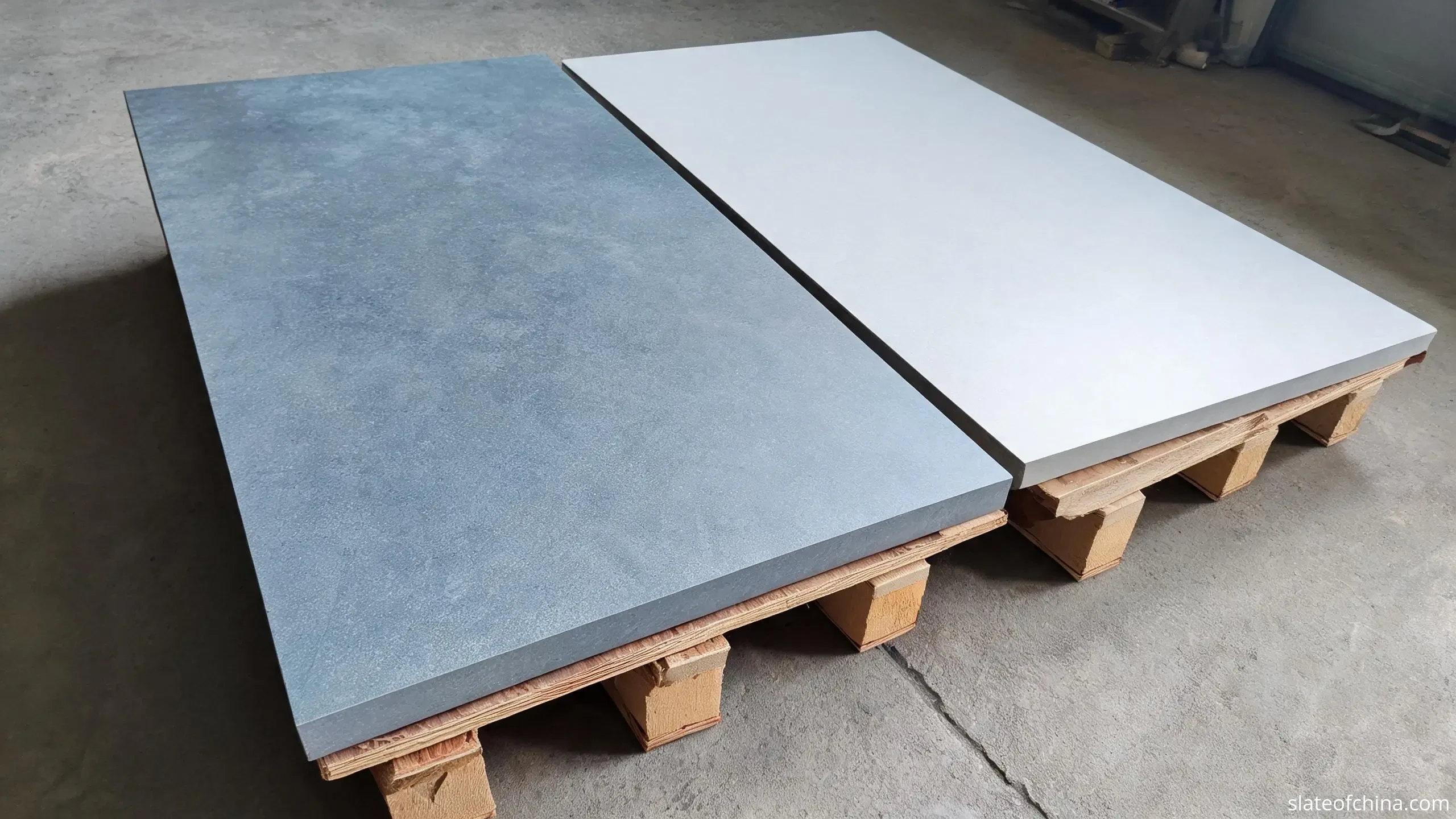
On the design calendar, the bed is a line item — one cell in a bill of materials, decided in an afternoon. In the service ledger, it is the most asymmetric component in the whole product. Frame faults are repairable. Cloth is consumable. Cushion rubber ages and is replaced as a matter of course. The bed is the one part whose typical failure mode is not "a repair visit" but "a discussion about who pays".
Run the two failure models side by side. A stone bed that has settled — a leg has sunk, a floor has flexed, a shipment was handled by a cheerful crew — is corrected with a level, shims and an hour of labour; the material itself has not moved, so the geometry comes back. A board bed that has swollen or taken a permanent set is a different animal: no tool turns a swollen panel back into a flat one, and the discussion about who pays ends, more often than not, with the brand paying. One material's worst year is a service visit. The other's is a replacement, a freight bill and a customer who tells the story for years.
There is also a quiet, compounding cost that never reaches the complaints log. Every time a fitter strips a table to change cloth — in a busy commercial hall that happens on a cycle of a year or two, sometimes less — the bed underneath gets handled, walked on and re-judged. Stone shrugs at that loop indefinitely. Every cycle on a board bed is a small audit of the room it lives in, and rooms are not kind forever.
None of that is an argument against board beds. It is an argument for knowing which promise each bed is signing, because the customer holds the brand to the promise, never to the material. With that frame in place, the candidates can be examined properly.
What a "Slate-Look Composite" Bed Actually Is
The category name is honest about its own problem: these are panels engineered to look like slate, which is not the same as behaving like slate. Composition varies by maker, but the family is consistent — wood fibre or mineral filler, bonded with resin, sometimes laid over a fibreglass or fibre backing sheet, pressed under heat into a panel of uniform thickness. The brand names you may have met, Slatron and PermaSlate among them, are proprietary labels for boards in this family. Useful materials, honestly deployed at the entry tier. But there is no quarried stone in a slate-look board, and the name on the label is doing work the material cannot.
The most important engineering sentence in this section concerns where flatness comes from. A slate bed is flat because material was removed: the face is ground and lapped, verified with straightedges and gauges, and the pockets and bolt holes are machined to the table factory's drawing. A composite bed is flat because material was pressed: the mould handed it uniformity in a single operation. Both methods produce a genuinely flat panel on day one. The difference emerges the day that flatness is questioned. A stone face can be re-ground. Nobody re-presses a composite bed in the field.
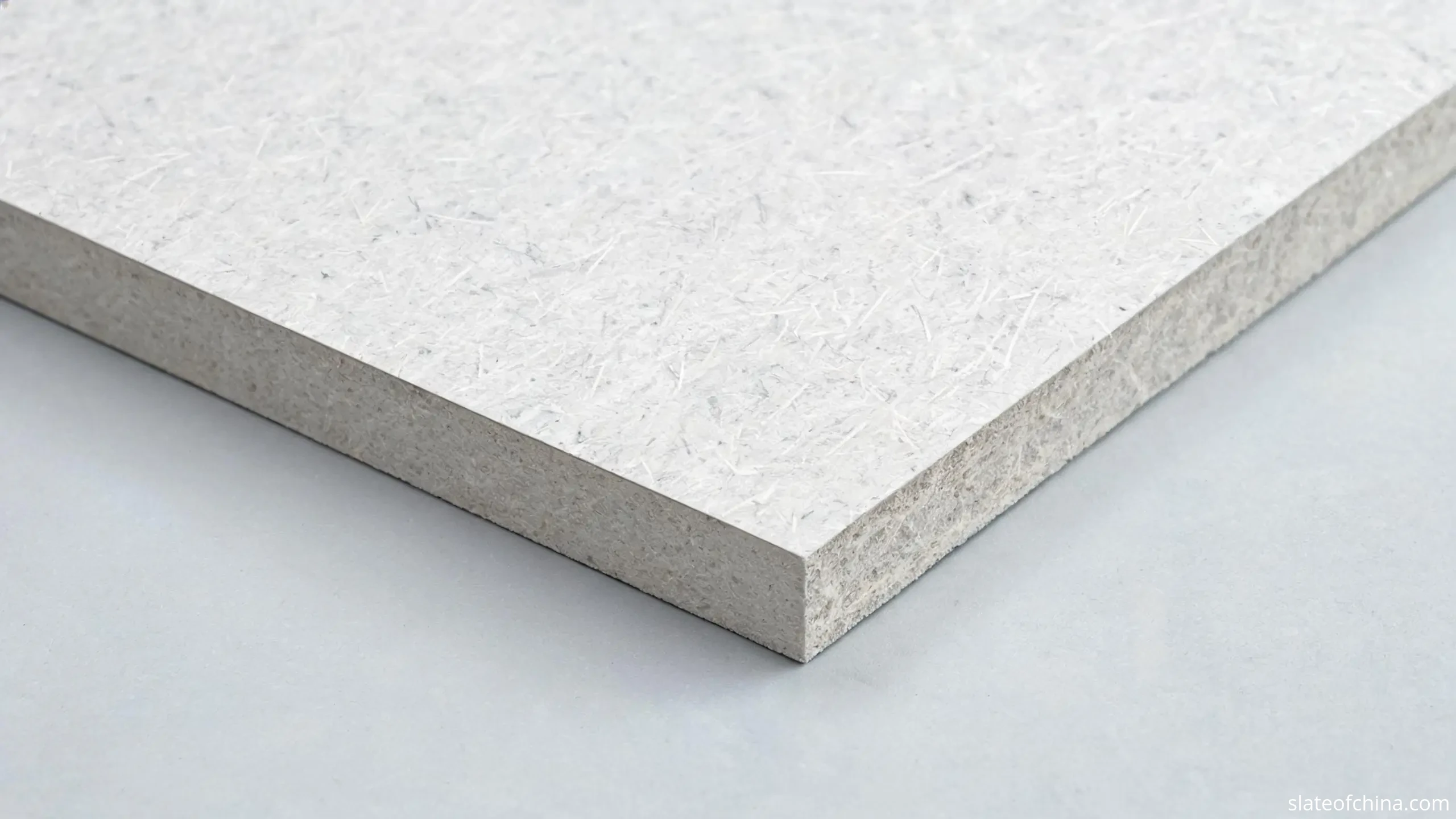
That single asymmetry explains most of what follows. Seams on a multi-piece composite bed are moulded or sawn rather than machined to match each other, so the seam-fitting that lets a three-piece stone bed read as one plane becomes, on a composite, an exercise in tolerance and luck. Pocket openings are cut to nominal sizes with generous clearances. The resin binder does give the board a usefully better moisture demeanour than raw MDF — a slate-look panel will shrug at a spill that would ruin an MDF edge — but "better than MDF" is a modest ceiling: the fibres still drink, the resins still creep under sustained load, and a panel that spends five years bolted to a frame in a room that changes with the seasons is not the panel that left the press.
Where the material earns its keep honestly is weight and price. A nine-foot composite bed usually lands somewhere in the tens of kilograms — a fraction of the 250–270 kg of a comparable stone set — and it machines quickly, packs flat and ships in volumes stone can never touch. For a children's table, a portable line, a price-led retail product, that bundle is not a compromise; it is the correct engineering answer. The product only fails when the claim outruns the material — a failure that is entirely within a brand's control, and the subject this page will keep returning to.
Synthetic Slate, Slatron and the Other Names Borrowed From Stone
The family goes by more names than one section can hold. Marketing copy says synthetic slate; American retail listings say Slatron; spec sheets say slate-look, slate-effect or PermaSlate. Buyers who search Slatron vs slate pool table, synthetic slate pool table — or the bluntest version of the question, fake slate pool table — are all asking the same thing: is there any quarried stone in this bed? For every panel in this family the answer is no. A composite slate pool table bed is a resin-and-fibre engineering product: affordable, useful and entirely stone-free. The material itself is not fake — only an overreaching claim can be. These beds earn their place in entry and portable lines, and how to audit the wording that sells them — four numbers and a scale — is the business of the spec-sheet section below.
MDF and Plywood: The Wood-Based Candidates
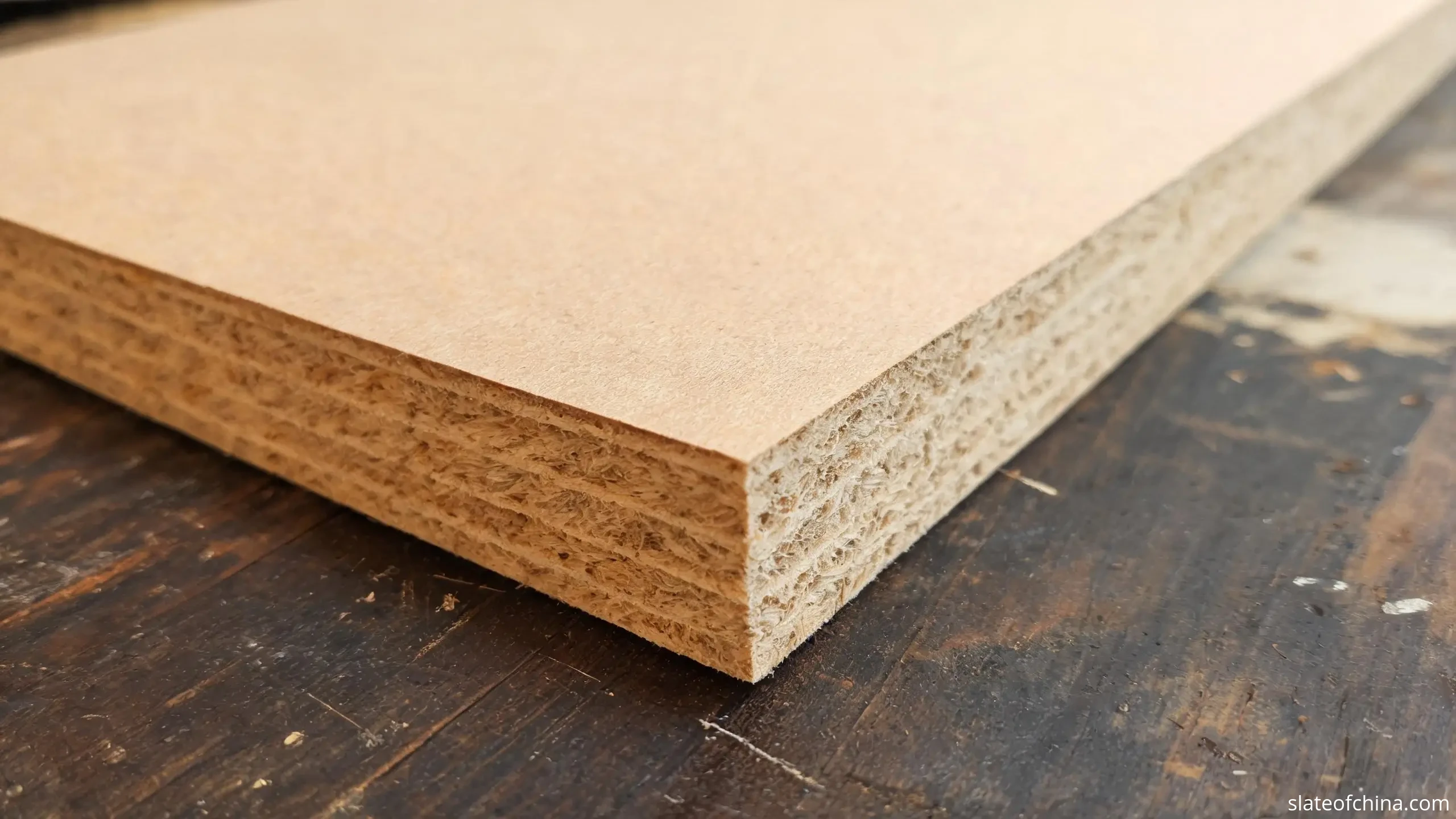
MDF is wood fibre and resin, compressed under heat and pressure into a board of remarkable uniformity, and it sits at the centre of the MDF vs slate pool table debate on every retail floor. Off the press it is genuinely flat — the press is generous — and for a bed that starts life flat and then lives in a dry, stable, occasionally used room, it is a defensible choice at a defensible price. A nine-foot MDF bed weighs roughly 65 to 70 kilograms: two people, one afternoon, no crane. Its weaknesses are wood's weaknesses, amplified: it is more sensitive to moisture changes than natural slate, it swells and holds the swelling, and under sustained load it creeps. The repair model is the same as the composite's, minus even the resin's moisture ceiling: once an MDF bed has taken a set or a spill, replacement is the only tool in the box.
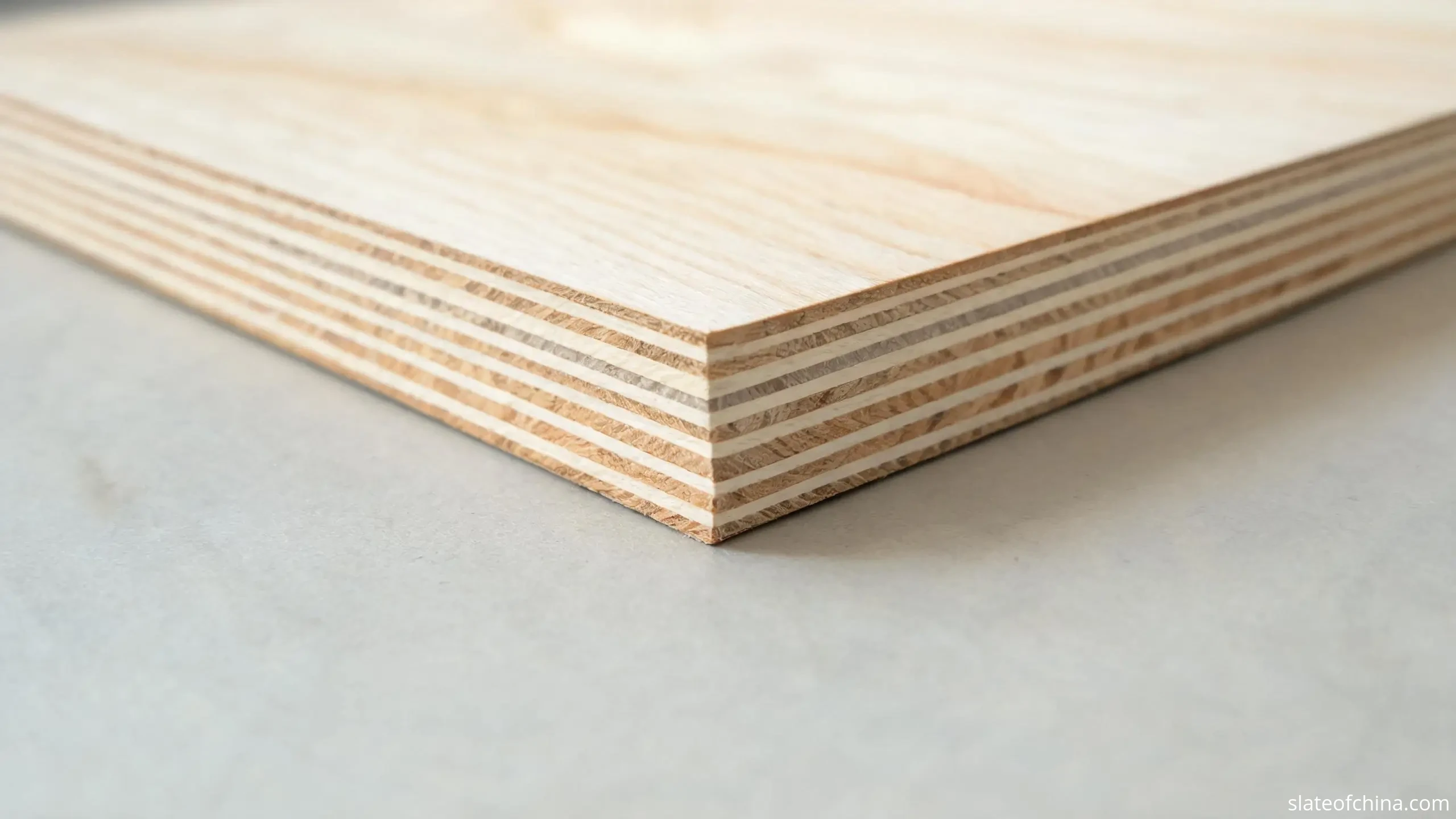
Plywood is the better structural wood. Its cross-banded layers — veneers glued with the grain rotated between plies — give it real strength for its weight, better screw-holding than MDF, and a decent tolerance for being lifted, folded and carried, which is why it turns up in portable and folding designs where lightness is the entire product brief. A nine-foot plywood bed comes in lighter than the MDF equivalent. But the layers are wood, and wood keeps its own calendar: it takes in and gives off moisture with the seasons, moving differently across each veneer until the panel sits where the room tells it to. On a folding table that travels to the village hall twice a month, nobody will ever subject the bed to a slow roll — and that is precisely the point. Plywood beds belong in products that never promise tournament physics.
Particle Board, Honeycomb and the Rest of the Non-Slate Family
Three more candidates turn up in the entry tier, each worth a line. Particle board, the cheapest of all, behaves like MDF's nervous sibling: the same moisture sensitivity with less structural integrity, reserved for the lightest children's tables. Honeycomb panels build a bed around a paper or aluminium core faced with thin boards — remarkably light for their area, which is the entire point in portable designs, and about as far from a precision plane as a bed can be and still be called one. Fibreglass-composite beds press resin and glass fibre into shaped panels: stiff and moisture-tolerant by board standards, still pressed rather than ground, still holding a board's contract with the room. None of these is a scam in a child's playroom. All of them become one the day the box claims tournament physics.
Note the pattern forming across the three alternatives. Composite, MDF and plywood differ in detail — moisture ceiling, strength, price, screw-holding — but they share the two traits that decide product-line arguments. Their flatness is inherited from a press rather than earned by machining, so it cannot be restored in the field. And their behaviour in year five is largely a function of the room they were sold into. A stone bed's story is about the stone. A board bed's story is about the customer's basement.
Slate vs Composite, Side by Side
The screening table at the top of the page answers the first question. This one answers the more expensive one — not "which material wins" but "what each bed commits the brand to" after the container is opened.
| What each bed commits you to | Natural slate | Slate-look composite |
|---|---|---|
| Where flatness comes from | Ground, lapped and verified by measurement | Inherited from the press; uniform as moulded |
| A damp year in a domestic room | Essentially unchanged | Survives better than MDF, still moves with fibre and resin |
| Seams on a multi-piece bed | Joint faces machined to match; set levelled as one plane | Moulded or sawn; seam quality rests on tolerance |
| Bed re-trued in service | Re-shim and re-level; the geometry returns | No field fix — replacement is the repair |
| Typical nine-foot bed weight | Around 250–270 kg (25 mm, three-piece) | Typically in the tens of kilograms |
| Freight per container | Hits the weight ceiling long before the volume ceiling | Hits the volume ceiling before it notices the weight limit |
| Honest home in a product line | Professional, commercial and premium home tiers | Entry, children's and portable tiers |
Typical behaviour of well-made beds in each material; exact weights depend on finished dimensions, machining and density. A poorly built slate table is not automatically better than a well-built light table — construction decides how much of any material's promise survives assembly.
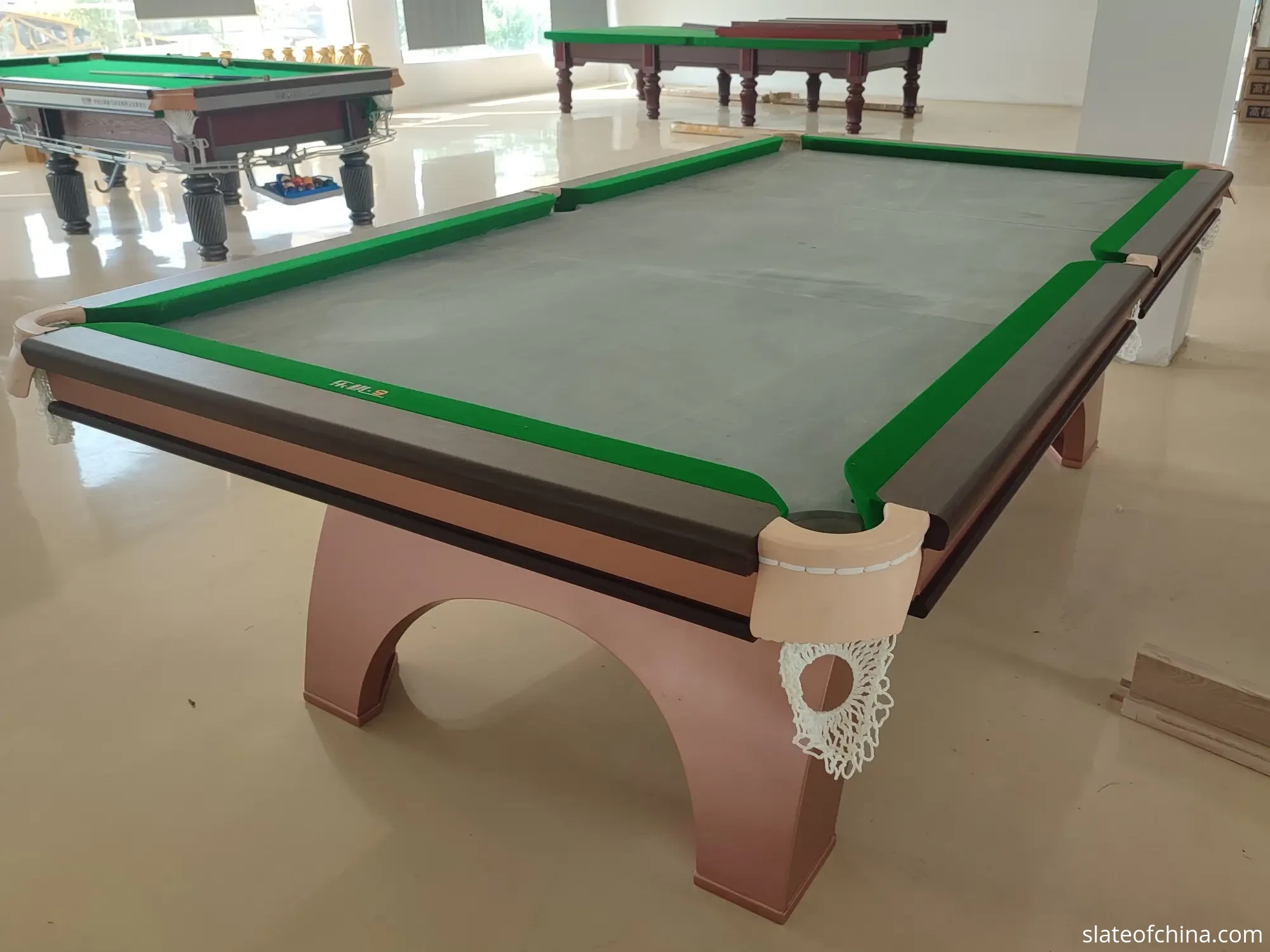
Two rows decide most product-line arguments. The freight row is the honest reason composites exist: boards reach a container's volume ceiling before they ever notice its weight limit, so a brand can ship several times the bed count per container and retail at a price stone cannot follow. The re-truing row is the honest reason composites stop at the entry tier: a material whose flatness was inherited rather than earned cannot be restored once the room has taxed it, and every unit sold is a small bet on a stranger's basement. Both rows are true at once, which is exactly why the tier question — not the materials question — is the real one.
Why the Professional Tier Defaults to Slate
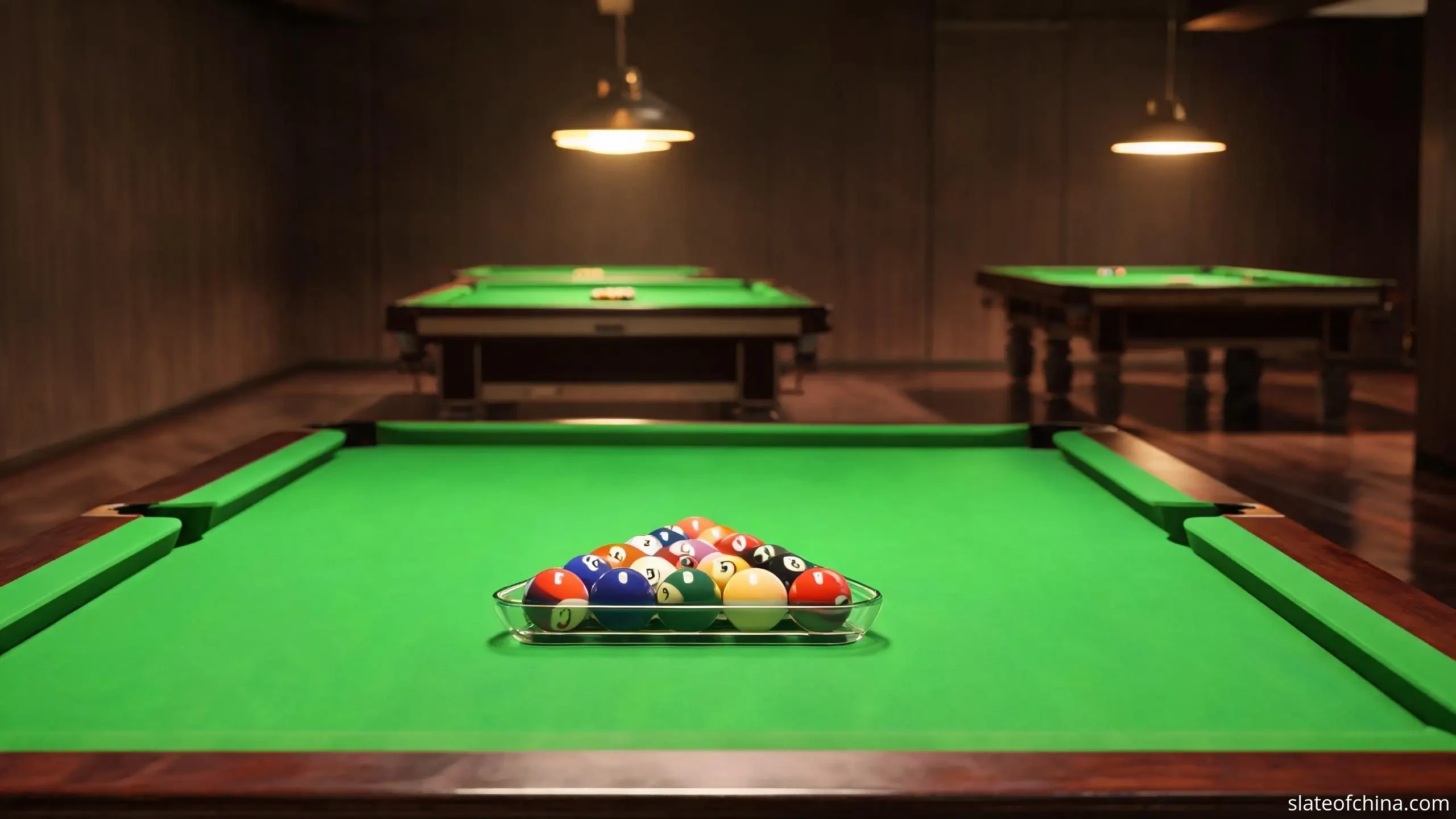
Start with what a commercial table actually is: an income asset. A hall table earns its keep seven nights a week, under traffic a home table never sees. So the operator's questions are not "which material feels premium" but "what does this bed cost me in service, downtime and resale" — and on those three ledgers, stone has never had a serious rival in a century and a half of trying.
On service, the economics are lopsided in stone's favour. Cloth on a busy table is a consumable on a one-to-two-year cycle, and every re-cloth doubles as a bed inspection — a moment when a stone bed simply passes again while a board bed is re-audited against the room it lives in. Levelling a stone bed is routine maintenance a fitter can price in minutes. A board bed has no equivalent routine, because its failure mode is not a maintenance item but a replacement one.
On the physics, professional play asks the bed to hold a machined plane under decades of bolt torque, temperature swings and cushion impacts. Stone creeps at rates no table will ever notice; wood-based boards creep at rates a fitter can detect within a table's first few years. Then there is the mass. Roughly a quarter-tonne of stone under the cloth is what makes a hard shot into the cushion sound like a full stop rather than a debate — the bed soaks the collision instead of donating it back to the rebound. The material's deeper case — density, stability, machinability — is laid out on Why Jiujiang Slate Works for Billiard Tables and What Is Billiard Slate?; this page stays on the comparison.
On resale, ask any operator what a five-year-old composite table fetches second-hand; the silence is the data. Slate tables have a second life — a whole secondary market exists for used stone beds and tables — which is the market quietly announcing which component holds its value. Count the natural slate billiard table benefits on those three ledgers — service, physics, resale — and every line points the same way. That is why tournament specification sheets do not offer a composite alternative, and why the question why do professional pool tables use slate has kept one honest answer since the professional game was invented.
Are Non-Slate Tables Bad Tables?
Put "slate vs non slate pool table" into a search engine and the first page of answers mostly reads like a moral judgement: one material virtuous, the others frauds. Ask are slate pool tables better and you get the same sermon. The truth is more useful than that. A composite bed under a child's first table — upstairs room, dry, a price point a family can absorb — is not a compromise. It is correct engineering. Put stone in that product and you have not improved it; you have priced a seven-year-old out of the game and asked a parent to carry 90-kilogram panels up a staircase. Materials have jobs. Honesty is matching the material to the job.
Walk the retail floor and the two markets are visible in the shelving. Big-box retail is composite and MDF territory: light boxes, low prices, tables that live upstairs and move house in a hatchback. Specialist dealers are slate territory: tables sold on play, service and resale. Most established table brands serve both — two product lines and, this is the part that matters, two honestly different spec sheets.
Because the failure is never the material. It is the claim. A composite bed sold as a composite bed is a decent product doing a decent job. The same bed sold in stone's vocabulary — slate-effect, Slatron, PermaSlate, "the same as slate but lighter" — is a warranty claim waiting for a date. The bed does not change when the wording does, but the brand's exposure does.
That reframes the whole debate for a builder. The question was never "which material is best" — no material is best; each is best at a different promise. The question is whether the product's documentation tells the customer which promise they are buying. The next two sections turn that principle into decisions: which bed belongs in which tier, and what an honest spec sheet says.
Matching the Bed to the Promise
This is the table this page was written to hand you. If the underlying question is the best playing surface for a pool table, the honest answer is conditional — best at what promise, sold at what price, living in whose room. Table types and their dimensions are compared in detail on Pool vs Snooker vs Chinese 8-Ball Slate; here the axis is the promise, and the commercial-versus-home decision falls out of it directly.
| Product tier | Bed that can keep the promise | Why |
|---|---|---|
| Tournament & professional spec | Natural slate, ground and machined to drawing | The bed must hold its plane for decades of bolt torque, traffic and re-cloths — and be re-levellable when the building moves. |
| Commercial hall & club | Natural slate | Service economics: levelling is maintenance, re-cloth cycles double as bed inspections, resale value holds. |
| Premium home table | Natural slate | The buyer is paying for a table that outlives the house's other furniture; the bed is the reason it can. |
| Mid-range family line | Either — honestly labelled | A well-made composite board serves a dry room and weekly play well; stone upgrades the promise and the price together. |
| Portable & folding designs | Plywood or composite | The product brief is weight; a bed that survives the car boot is the correct engineering, not a corner cut. |
| Children's & entry retail | Composite or MDF | Occasional play, upstairs rooms, price-led purchase; stone here is over-engineering at the customer's expense. |
The middle row is where brands get into trouble, and it is worth saying plainly: "either, honestly labelled" is a strategy; "either, identically worded" is how warranty files get started. A mid-range family table can be a good product on a good composite bed — plenty are. It only becomes a bad product when the box borrows stone's vocabulary to justify a stone-adjacent price, and the bed arrives unable to honor either.
The beds behind every tier in that table exist as catalogue items rather than abstractions: pool table slate in the standard sizes, snooker, carom and Chinese 8-ball slate for the thicker, fussier formats, and custom CNC-machined beds cut to your drawing for everything the catalogue does not already hold.
What an Honest Spec Sheet Says
If one section of this comparison had to be taped above a product manager's desk, it is this one. Bed claims have a grammar, and the grammar is easy to audit.
| What the documentation says | What is actually under the cloth | The audit |
|---|---|---|
| "Natural slate bed, 25 mm, three-piece" | Quarried stone, ground flat, machined to the drawing | Honest — and verifiable: material, thickness, pieces and a weight that agrees |
| "High-density engineered bed" | A composite or high-grade board | Honest wording for the tier — provided no stone vocabulary rides along |
| "MDF bed, 19 mm" | Exactly what it says | Honest — and better commercial practice than most of the market manages |
| "Slate-effect bed", "Slatron", "PermaSlate" | Pressed composite panels — no quarried stone in them | The material is fine for the tier; the name borrows a reputation the bed cannot honor in service |
| Just "slate", with no thickness and no piece count | Ask — in writing | Under-specified: a real stone bed always travels with numbers |
And because marketing departments are creative, here is the verification step every brand already owns: the scale at the receiving dock. Physics does not negotiate. A nine-foot natural slate bed at 25 mm cannot weigh 70 kilograms; a bed that weighs 70 kilograms is telling you what it is made of, whatever the box says. Weigh one inbound bed and the wording question answers itself. A brand that specifies stone should expect — and welcome — that test on every shipment.
For the buying side of that audit, what a slate supplier should be able to show rather than claim, the inspection numbers live on Billiard Slate Quality & Test Data, and the full sourcing route is in the Billiard Slate Buying Guide. The two pages together are the paperwork half of a bed decision; this page is the materials half.
Before the Slate Line Goes Into Production
If the committee's decision lands where professional logic usually does — stone in the top tiers — four practical notes will save the line more grief than any spec argument.
Thickness follows the table, not the brochure. A 25 mm bed on a nine-foot frame is a designed pair, not a default.
Is Heavier Slate Always Better?
No — and the belief that it is costs buyers real money every year. The purpose of slate thickness is not to add weight for its own sake; the correct thickness follows the table size, the frame design, the support structure beneath, the game the table is built for and the way it will be installed and re-levelled. A 45 mm snooker bed is not better than a 25 mm pool bed — they are two correctly engineered answers to two different tables, and swapping them makes both tables worse. Professional pool table slate for a nine-foot frame lands at 25 mm because the span and the frame were designed around that number; anything thicker on the same frame is just freight. The full ladder — which thickness for which table, and why snooker goes thicker — is tabulated in the Billiard Slate Technical Specifications, and the thickness decision path runs through How to Choose Billiard Slate.
Matched sets, machined to drawing. A three-piece bed is one component made in three parts: joint faces machined to match, pockets and bolt holes cut to the drawing, and each set checked before packing rather than matched for the first time in the container. What those checks should be able to show — not claim, show — is the business of the quality and test data page.
Weight is a logistics decision made in the design meeting. Roughly 250–270 kg per nine-foot bed drives freight quotations, floor loads and unloading crews; a bed line planned around those numbers arrives as a plan, not a surprise. The container and documentation side of that arithmetic is laid out in the import guide.
Paper before stone. Drawing, written specification and a physical sample, agreed in that order, before production begins. It is the cheapest insurance in this industry, and it is the step most warranty files skipped.
What Slate Buyers Should Ask Their Supplier
Six questions, in writing, before an order is confirmed — each one filters a different kind of supplier:
- Is the bed natural stone or a composite? The honest answer is one sentence and a specification. Anything that starts with "it is basically the same as slate" has answered a different question.
- What thickness and flatness tolerances do you hold, and how are they measured? A supplier should be able to show the inspection method and the numbers behind it, not claim them — what those numbers should look like is laid out on the quality and test data page.
- Can you CNC-machine pockets and bed contours to my drawing? Pocket openings and rail-bolt positions are table-specific; a supplier who cannot cut to a drawing cannot supply an OEM line.
- Are mounting holes produced to the drawing, and verified? Hole position is the difference between a drop-in bed and a re-drilling session on your assembly floor.
- How is each piece inspected before packing, and what evidence travels with the shipment? Flatness, thickness, seam matching, surface — ask what is checked per set and what the buyer actually receives.
- Where is the slate quarried, and how is a set packed for export? Origin tells you what the industry already knows about the stone; the packing design is what carries it through the ocean leg. Both answers should arrive with photos.
If the line stays on boards instead, ask the board supplier with equal formality: the core material actually inside the bed, its moisture resistance after a spill, its long-term deformation behaviour under a frame's bolt load — ask for the test, not the adjective — and replacement availability, because on a board bed replacement is the repair. A board supplier who answers those four in writing is a supplier worth building a recreational line on.
For the wider audit — the ten questions that separate a real billiard slate supplier from a trading desk — there is a page of its own: How to Choose a Billiard Slate Manufacturer.
The Bottom Line
Strip the comparison to a single sentence and it reads: the alternatives are honest materials for promises they were built to keep, and natural slate remains the benchmark for the one promise none of them can make — a bed that holds a machined plane for decades, in any room, and can be re-true if the building moves rather than the material.
For a table builder or brand owner, the slate vs non slate pool table beds decision is not a materials debate at all. It is a documentation debate, a warranty-cost debate and a product-line architecture debate, and all three are settled on the day the spec sheet is written honestly. The brands that get this right run both lines profitably for decades — boards upstairs at the entry price, stone wherever the game gets serious — and never once have to explain why the box and the bed disagree. The rest of the Billiard Slate Guide covers everything that follows the decision: sizes, machining, inspection, and the route from a drawing to a container.
Frequently Asked Questions
What is a slate-look composite pool table bed made of?
Wood fibre or mineral filler bonded with resin, often laid over a fibreglass or fibre backing sheet, pressed under heat into a uniform panel. Brand names such as Slatron and PermaSlate belong to this family. There is no quarried stone in them — the flatness comes from the press, not from grinding.
Is Slatron the same as natural slate?
No. Slatron is a proprietary composite panel — a resin-bonded board, not quarried stone. It is a reasonable material for entry-level and children's tables, and a misleading one whenever the wording implies stone. The verification is simple: material, thickness, piece count and a weight that agrees. A nine-foot stone bed at 25 mm cannot weigh in the tens of kilograms.
How long do composite and MDF beds last compared with slate?
In a dry room with occasional play, a well-made composite or MDF bed can run for many years. What shortens their life is the environment — moisture, sustained load, frequent assembly and disassembly — and their failures are not repairable in the field. A slate bed's limiting factor is essentially the rest of the table: frames, cloth and cushions all expire before the stone does.
Which bed material is best for a commercial pool hall?
Natural slate. A commercial table is an income asset: it is re-clothed every year or two, and every re-cloth doubles as a bed inspection. It needs periodic re-levelling that stone accepts and boards cannot, and it holds resale value in a way composite tables rarely do.
Can a non-slate pool table be a good product?
Yes — for the promise it is built to keep. Children's tables, portable and folding designs, and price-led entry lines are correctly engineered around composite, MDF or plywood beds. The failure mode is never the material; it is a specification sheet that claims stone's performance while shipping a board's.
How much heavier is a slate bed than a composite or MDF bed?
A typical nine-foot slate bed at 25 mm weighs around 250–270 kg in three pieces. The same footprint in MDF comes to roughly 65–70 kg, and a composite or plywood bed is lighter still. That ratio matters commercially: it drives freight quotations, unloading crews, and whether the customer's floor gets asked a question before purchase.
Should a table brand offer both slate and non-slate lines?
Many established brands do, profitably. The workable pattern is tiered: stone wherever the product promises serious or commercial play, boards wherever the product's honest job is lightness and price. The discipline that keeps both lines healthy is documentation — each tier's spec sheet says exactly what is under the cloth, and the warranty model matches it.
Related Billiard Slate Guides
Building a Table Range? Start With the Bed.
Send your table type, finished bed dimensions, thickness, piece count and destination port. We grind and CNC-machine natural slate beds to your drawing, check every set before packing, and ship from Jiujiang to table builders in more than 30 countries — send a drawing for an OEM quotation, or start with a single sample set to prove the machining. And if your range also runs an entry tier on boards — good. That tier keeps the game growing, and we will tell you honestly where the line between the two should sit.
Request a Bed Specification & Quote →
Or browse the billiard slate range →
Straight to the beds: pool table slate · snooker, carom & Chinese 8-ball slate · custom CNC billiard slate