
2026 Billiard Slate Industry Report
Executive Summary
- Demand is bifurcating — standard sizes still drive volume, but custom and OEM specifications are the fastest-growing segment of the billiard slate market.
- China's integrated supply chain — from quarry to CNC machining to export packing in a single production region — gives it cost and flexibility advantages that are structurally difficult to replicate elsewhere.
- Pricing is driven by processing complexity, not raw stone cost. Comparing suppliers by USD per square metre is one of the most common — and most expensive — mistakes buyers make.
- The real risk in sourcing billiard slate is not price. It is flatness deviation, machining inaccuracy, and inadequate export packing.
- The market is moving toward supplier transparency: buyers who request factory evidence, QC records, and production videos are making better decisions than those who compare catalogue claims.
I have been tracking billiard slate exports from China for over fifteen years. Five years ago, most buyer inquiries started with price. Today, they start with capability — can you machine to this drawing, what flatness tolerance do you hold, how do you pack for a forty-day sea voyage. That shift in the first question tells you more about the state of this industry than any market forecast.
This report is not a prediction. It is a procurement briefing — written for table manufacturers, importers, distributors, and OEM buyers who need to understand what is actually happening in the billiard slate supply chain and what it means for their sourcing decisions.
About This Report
This report is based primarily on our experience supplying billiard slate from China — including buyer inquiries, production requirements, OEM discussions, export orders, and factory observations over more than fifteen years. It is intended as a practical sourcing reference rather than a statistical forecast of the global billiard industry. Where no reliable public market data is available, we avoid presenting estimates as official market statistics. The observations here reflect what we see and hear from buyers, not a database we do not have.
The Global Demand Picture
Billiard slate demand is not a single market. It is four overlapping markets with different specifications, different volume profiles, and different growth signals. Understanding which one you are buying into determines what you should expect from your supplier.
North America remains the largest volume destination for pool table slate. The most common sizes are 7ft, 8ft, and 9ft, and the demand is steady rather than spectacular — driven by replacement tables, club refurbishment, and new residential installations. What has changed is not the volume but the specification: more buyers now request CNC-machined sets with specific bolt hole patterns and pocket layouts rather than generic slabs.
Europe is the most specification-diverse market. Snooker slate — 12ft, five-piece, 45mm thick — is a specialised product that requires significant production and packing capability. Carom slate, used for the pocketless three-rail tables common in France, Belgium, and the Netherlands, demands its own machining logic. Pool slate for the UK and European club markets rounds out the picture. A supplier serving the European market needs to handle all three.
In our inquiry and production experience, Asia appears to be the most active growth market, with Chinese 8-ball accounting for a significant share of the increase. This variant uses larger, thicker slate than standard pool tables, and the volume of C8B-related orders we have handled has grown noticeably over the past five years. Korean carom is a smaller but steady niche that follows its own specification conventions.
The Middle East and Latin America have been sending more inquiries each year — commercial venues and entertainment complexes in the Gulf states, cost-conscious pool table markets in Latin America. Neither is high-volume yet, but the trend in our inbox is clear.
| Region | Typical Slate Demand | Growth Signal |
|---|---|---|
| North America | 7ft, 8ft, 9ft pool table slate | Steady volume; increasing spec complexity |
| Europe | 12ft snooker, carom, pool | Specification-diverse; snooker specialist |
| Asia | Chinese 8-ball, carom | Most active growth in our orders; C8B-driven |
| Middle East | Commercial venues, entertainment | Increasing inquiries; club-driven |
| Latin America | Cost-conscious pool slate | Growing; price-sensitive segment |
What connects all these markets is that natural slate remains the standard for professional and tournament-level tables. The reasons are physical, not traditional. Slate has a density of around 2.7 tonnes per cubic metre. It does not expand and contract with humidity the way wood does. It holds a precision-ground flat surface for decades. Composite alternatives can pass a spirit level on delivery day; five years later, they cannot. We have written about why pool tables are made with slate in detail elsewhere — the short version is that no alternative material matches slate's combination of flatness stability, density, and longevity.
Where the Stone Comes From
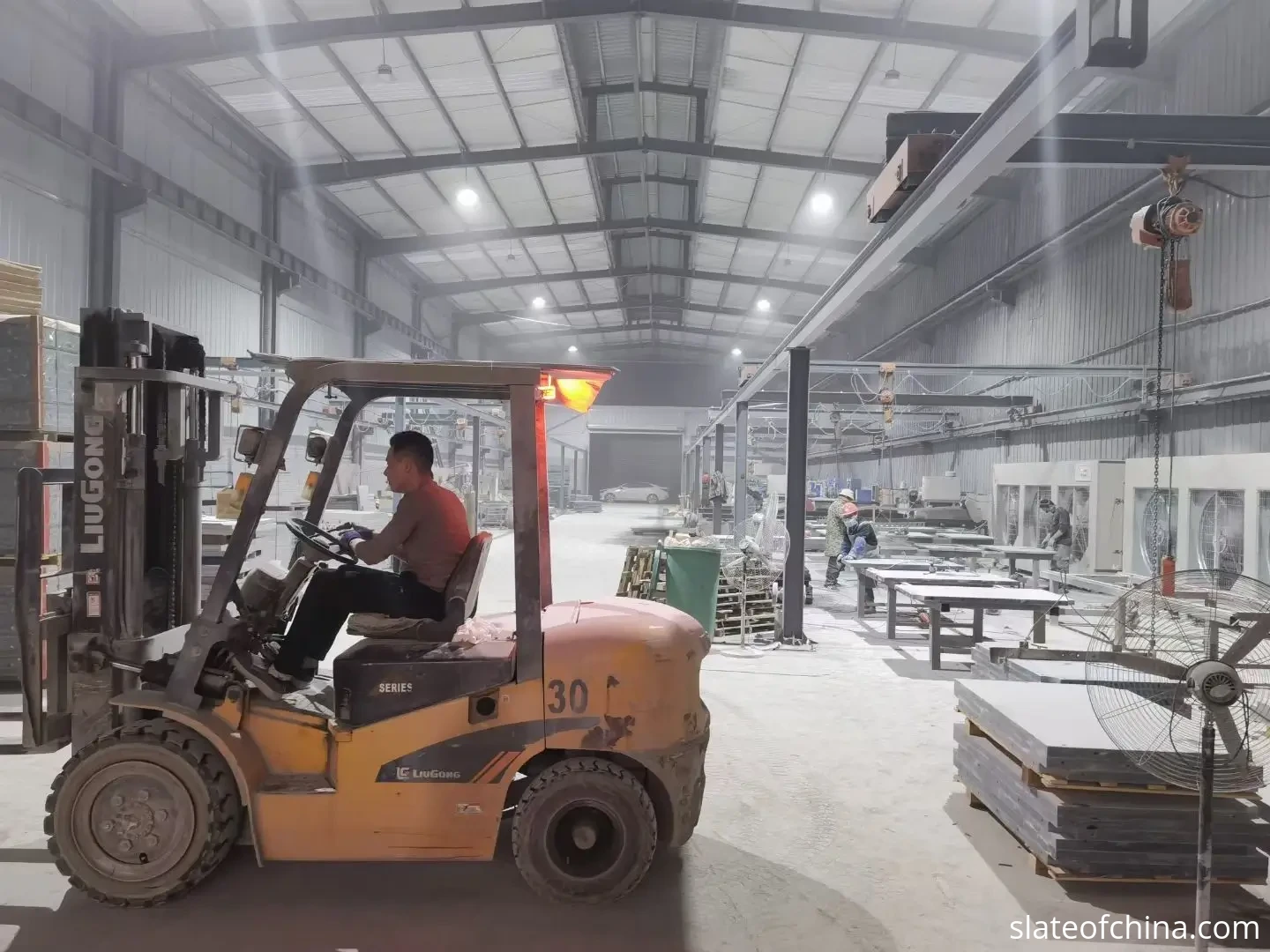
The billiard slate supply chain is not just about having quarries. It is about having the full chain — from block extraction through CNC machining to export packing — under one roof or at least within one region. That integration is what separates a manufacturer from a supplier, and it directly affects what a buyer can expect in terms of quality, customisation, and accountability.
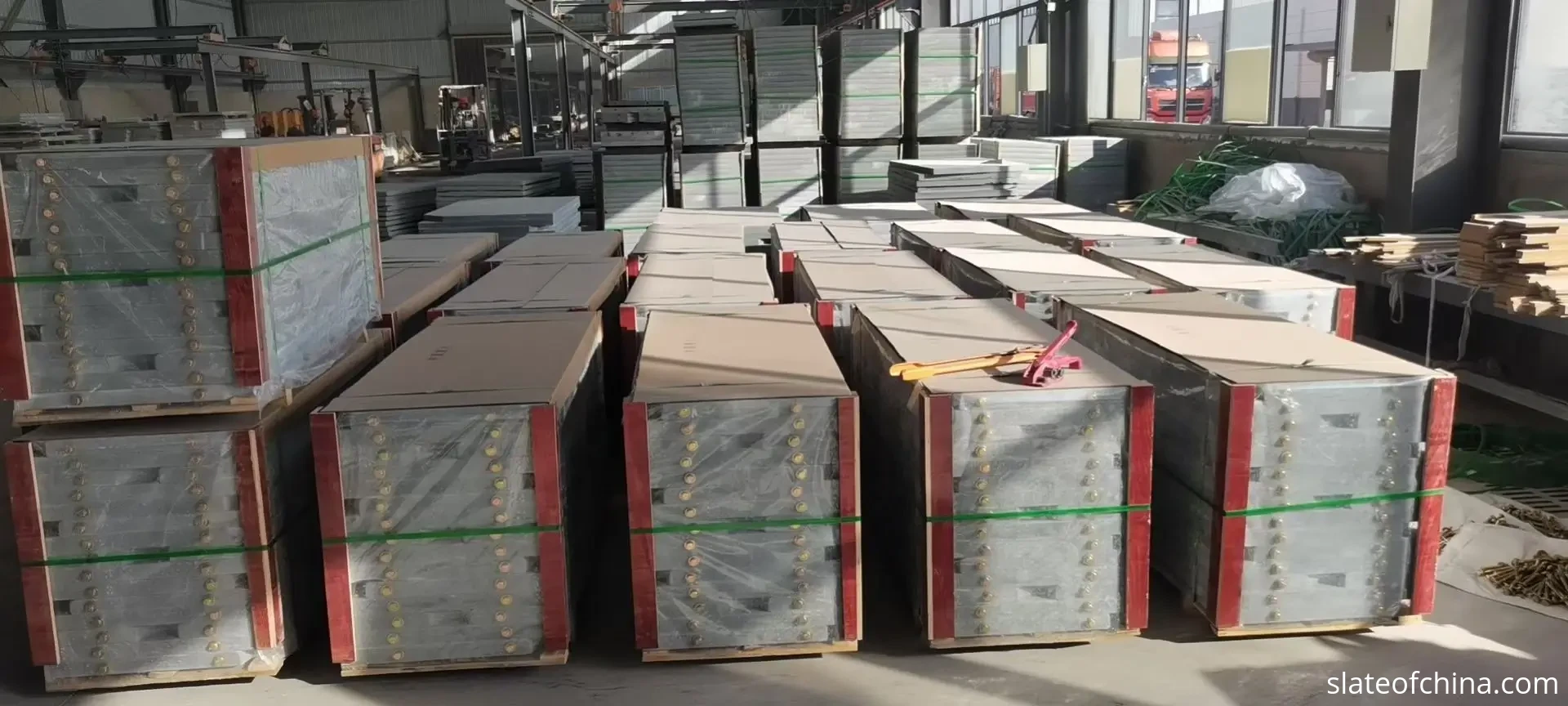
China has developed one of the most complete billiard slate supply chains in the world. The chain covers seven stages: natural slate quarry resources, block cutting, thickness calibration, surface grinding, CNC machining, quality inspection, and export packing. This integration matters because it gives manufacturers control over the entire process — and gives the buyer a single point of accountability when something goes wrong. A supplier who buys semi-finished slabs from someone else and resells them cannot offer that.

Within China, the Jiujiang and Lushan area in Jiangxi Province is one of the most established slate production regions. The advantages are practical rather than promotional. The local resources are part of the same geological belt that has been quarried for generations. The processing chain from raw block to finished set is mature. And the factory is about forty minutes from Jiujiang port, which means a container can be loaded and on the water without a long inland haul.
For buyers, the question "where does the stone come from" is not academic. It determines whether the supplier can control quality at every stage, or whether they are buying semi-finished slabs from someone else and hoping for the best. When a buyer asks a supplier "do you process the slate yourself or buy it in," the answer tells you whether you are dealing with a manufacturer or a trader.
What Actually Drives the Price
Many buyers ask: "How much does billiard slate cost?" The honest answer is that it depends on three things, and raw stone is not the biggest one.
Thickness. Slate thickness ranges from 19mm for smaller pool tables to 45mm for professional snooker. Thicker slate means more raw material, more processing time, and significantly more shipping weight. A 9ft three-piece set at 25mm weighs around 250 to 270 kg. The same set at 30mm weighs well over 300 kg. Thickness is the single biggest multiplier in billiard slate pricing.
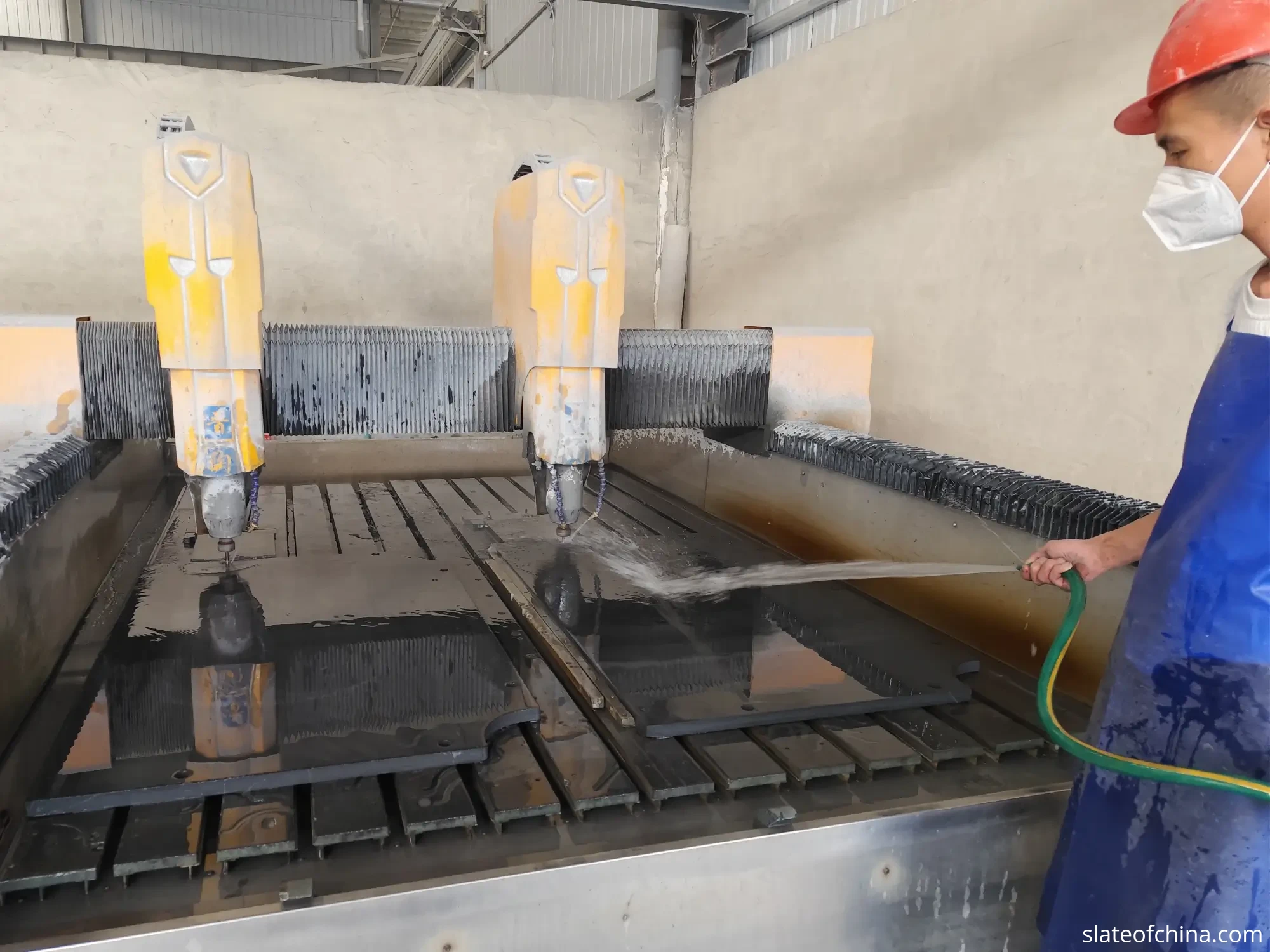
Processing complexity. A raw slab and a finished billiard slate set are completely different products. Finished pricing includes cutting, grinding, calibration, CNC machining (pocket openings, bolt holes, levelling holes, joint edges), inspection, and export packing. Two suppliers quoting the same USD per square metre may be quoting entirely different things — one for a rough-cut slab, the other for a CNC-finished, inspected, crated set. I have seen buyers choose the cheaper quote and discover on arrival that the pockets were uncut and the holes were missing.
Order quantity. Wholesale pricing depends heavily on volume. A trial order of one or two sets tests the supplier but carries a premium. Regular OEM supply gets better pricing because the factory can plan production around it. Full container orders get the best per-unit economics because they eliminate the inefficiency of partial loads. Long-term cooperation provides price stability that spot purchasing cannot match.
The practical takeaway: compare finished set prices, not area prices. Compare with the same Incoterm. Compare what is included — machining, inspection, packing — not just the stone. The technical specifications page breaks down the dimensions and tolerances that determine what "finished" actually means for each table type.
What should be included in a billiard slate quotation?
| Quotation item | What to confirm |
|---|---|
| Slate dimensions | Finished dimensions, not rough-cut size |
| Thickness | Actual finished thickness (19mm / 25mm / 30mm / 45mm) |
| Piece count | 1-piece, 3-piece, 5-piece — matches the table frame? |
| Machining | Pockets, bolt holes, leveling holes, joint edges — all included? |
| Inspection | Flatness and dimensional inspection — measured or only claimed? |
| Packing | Export wooden crate with edge and moisture protection |
| Incoterm | EXW, FOB, CIF — comparing on the same basis? |
| Quantity | Trial order, regular order, or full container |
This is why two suppliers quoting the same table size can produce prices that differ by 30% or more — and why the cheaper one is not always cheaper.
The Shift Toward Custom and OEM
Standard sizes are not going away. But the fastest-growing segment of demand is for custom and OEM specifications, and the shift is visible in the language buyers use to search.
Five years ago, most buyers searched for "pool table slate supplier." Today, an increasing number search for "custom billiard slate manufacturer." The difference is significant. A supplier sells you a product from a catalogue. A manufacturer works with you to produce to your drawing — and keeps consistency across repeat orders.
This shift is driven by table manufacturers who are differentiating their products through unique designs. Non-standard dimensions. Custom pocket layouts. Specific thickness options. Branding. For these buyers, the question is not "what do you have in stock" but "can you produce to this specification and hold the same tolerance on the fiftieth set as the first."
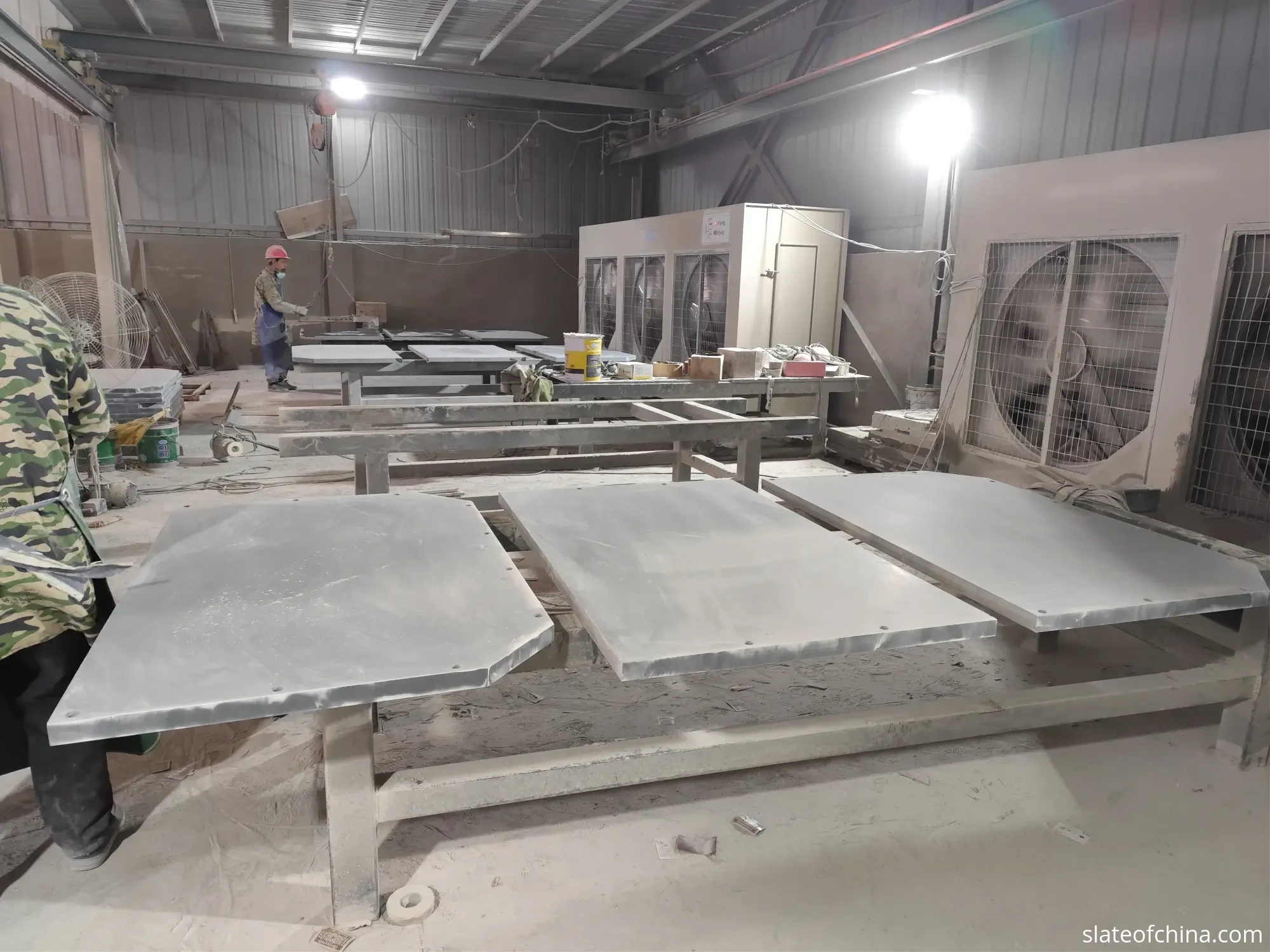
What this means for sourcing: buyers need to evaluate not just the supplier's current product range but their engineering capability. Can they read a technical drawing and identify specification gaps before production starts? Can they produce a prototype? Can they maintain batch-to-batch consistency? These are manufacturing questions, not trading questions. Our custom billiard slate manufacturing guide covers the drawing-to-production workflow in detail, and the OEM billiard slate page addresses what happens after the first sample — the part where consistency becomes the real challenge.
For buyers serving the American market specifically, the American pool table slate guide covers the specifications and engineering review steps that are particular to that market.
The Risk Map for Buyers
Choosing a supplier by price alone creates three categories of risk. None of them show up in the quotation — they show up on the buyer's shop floor, during assembly, or at the customer's premises.
Flatness deviations. Small deviations in flatness affect ball speed, ball direction, and the professional play experience. The tolerance that matters is not the nominal number on a spec sheet but the actual measured flatness of the delivered set. A supplier who claims ±0.1mm but cannot show you how they measure it is making a marketing claim, not a quality commitment. Our billiard slate quality and test data page breaks down what these numbers mean and how they are measured.
Machining inaccuracy. Incorrect machining — pocket openings that do not match the rail system, bolt holes in the wrong position, joint edges that do not align — causes installation difficulties, alignment problems, and table assembly delays. A low-cost supplier without precise processing capability may deliver stone that costs more in labour and after-sales issues than the saving on the stone itself.
Export packing failures. Billiard slate is heavy and fragile. Improper packing — inadequate edge protection, missing moisture barriers, incorrect container loading — causes cracked edges, damaged corners, and expensive replacement shipments. Breakage risk is generally lower with properly secured full-container shipments than with LCL handling, where additional loading and unloading can increase exposure to impact. The export packing and container loading guide covers what proper packing looks like.
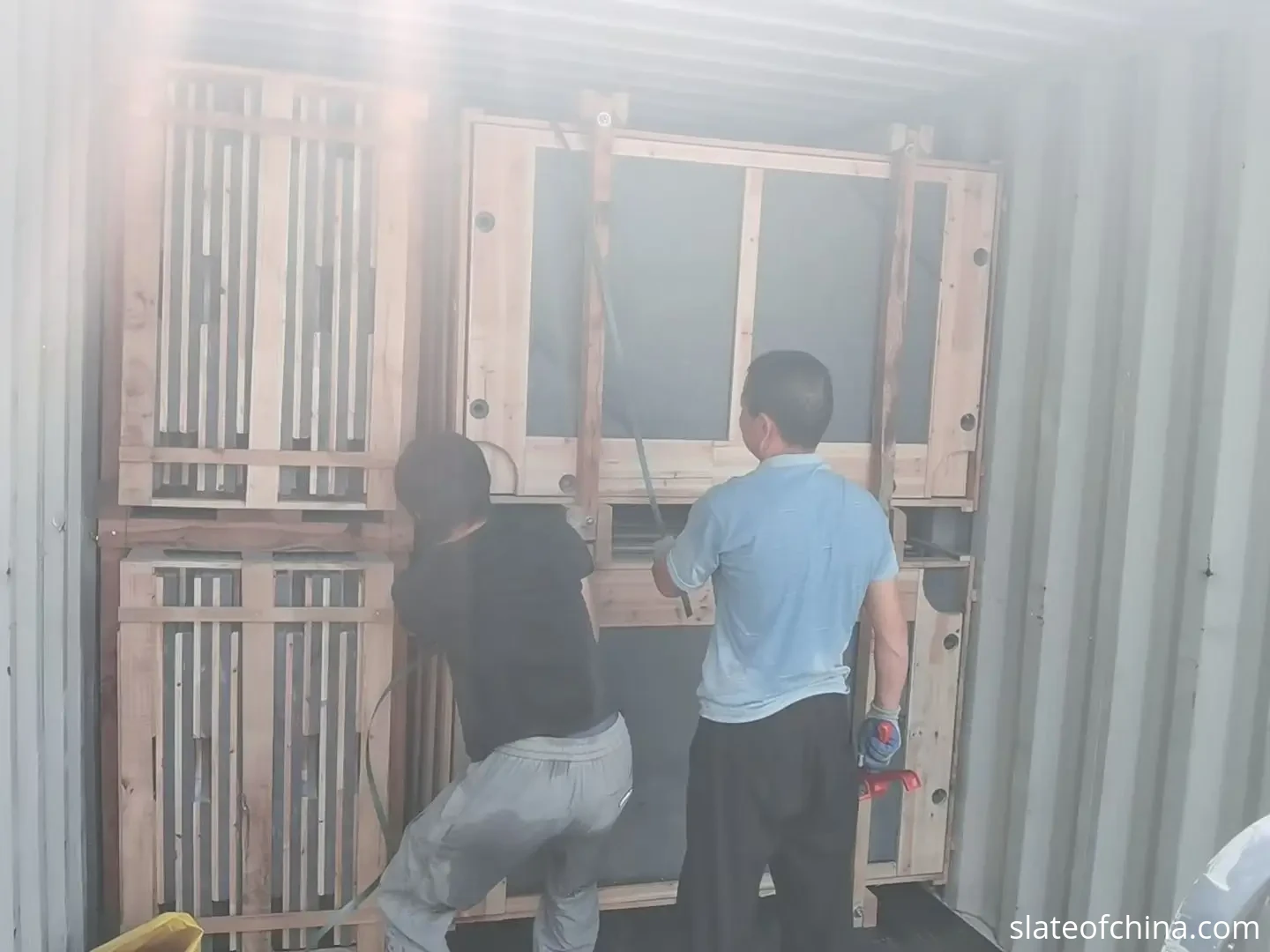
The common thread: the cheapest supplier is rarely the lowest-cost supplier. The real cost includes the stone, the machining, the packing, the freight, and the cost of fixing problems when any stage goes wrong. For a structured approach to evaluating suppliers — what to ask, what to verify, what to walk away from — see our guide on how to choose a billiard slate manufacturer.
What the Next Two Years Look Like
Three trends are shaping the next phase of the billiard slate industry. None of them are predictions — they are observations from current buyer behaviour that are accelerating.
Higher precision manufacturing. Buyers are increasingly requesting CNC accuracy, digital drawings, and inspection records — not as luxuries but as baseline expectations. The supplier who can document their flatness tolerance and show QC data has a structural advantage over the one who simply says "good quality." This trend is most visible in the OEM and custom segments, where buyers need to verify that the fiftieth set matches the first.
More customised production. OEM cooperation is becoming the norm, not the exception, as billiard brands develop unique table designs. The ability to produce from a drawing — and maintain consistency across batches — is becoming the core competency, not just the ability to cut stone.
Greater supplier transparency. Professional buyers are evaluating suppliers through factory evidence, production videos, quality data, and customer references. A buyer who can see the quarry, the factory floor, the CNC station, and the QC records is in a fundamentally better position than one comparing PDF brochures.
The industry is moving from supplying stone to providing manufacturing solutions. For buyers, the right supplier is not necessarily the cheapest. It is the one that can consistently deliver accurate, durable, export-ready billiard slate — and prove it.
Frequently Asked Questions
Is the global billiard slate market growing or shrinking?
The market for professional and high-end billiard tables is stable to growing, driven by replacement demand, club refurbishment, and the rapid expansion of Chinese 8-ball in Asia. The volume segment — standard pool tables — is steady. The value segment — custom, OEM, and tournament-grade slate — is growing faster. What is changing is not total demand but specification complexity. Buyers want finished, machined, inspected sets, not cut stone, and that shift is reshaping what suppliers need to offer.
Why has China become a major source for billiard slate?
China has developed one of the most complete billiard slate supply chains in a single integrated production region. The Jiujiang and Lushan area combines natural quarry resources, experienced labour, a mature processing chain from raw block to finished set, and port logistics. This integration gives manufacturers cost and flexibility advantages that are difficult to replicate in regions where the chain is fragmented across multiple suppliers. It also gives buyers a single point of accountability — the factory that cut the stone is the same factory that machined it, inspected it, and packed it for export.
What does a finished billiard slate set actually cost?
There is no single answer because "finished" means different things. A raw-cut slab, a ground-and-calibrated panel, and a CNC-machined set with pocket openings, bolt holes, and export packing are three different products at three different price points. Thickness, processing complexity, order quantity, and current freight rates all factor in. The most useful comparison is finished set price FOB — not price per square metre, which can hide as much as it reveals. Ask suppliers to quote on the same basis: same Incoterm, same included processing, same packing standard.
What is the difference between a slate supplier and a slate manufacturer?
A supplier may source semi-finished slabs from multiple quarries and resell them. A manufacturer controls the production process from raw block through CNC machining and export packing. The distinction matters because it affects quality control, customisation capability, and accountability when something goes wrong. A manufacturer can produce to your drawing and maintain consistency across repeat orders. A supplier can only sell you what they have. The simplest test: ask whether they process the slate themselves or buy it in.
How long does it take to produce and ship a billiard slate order from China?
Standard sizes in regular production typically take four to six weeks from order confirmation to container loading, plus twenty-five to forty days sea transit to most destinations. Custom specifications require additional time for engineering review, drawing confirmation, and prototype approval — expect eight to twelve weeks or more depending on complexity. China's Lunar New Year period in January or February is an annual production shutdown that affects any order timing. Planning around it is part of sourcing from China.
Should I order standard sizes or request custom specifications?
If you are building standard table models with established designs, standard sizes are more economical and faster to produce. If you are differentiating your product through unique dimensions, pocket layouts, or branding, custom specifications are the right path — but they require a supplier with engineering capability, not just cutting capacity. Many buyers start with standard sizes to test a supplier's quality and reliability, then move to custom specifications once the relationship is established.
Looking for a billiard slate supplier who can produce to your specification — and prove it?
Send us your drawing, specification, or inquiry. We manufacture billiard slate from raw block through CNC machining and export packing — in one factory, under one quality standard.