
History of Slate Production in Jiujiang
There is a paragraph in our family genealogy — written roughly two hundred years ago — that the older generation calls "the stone record." It says, in essence, that our ancestors worked stone, shipped it by boat to the Fujian coast, and came home for New Year with seaweed and dried seafood that nobody locally had ever seen. The family grew prosperous from stone. That short passage is the reason I believe this rock is worth a lifetime of work. It is also the reason Jiujiang's slate history does not start with export containers. It starts a long, long time before that.
People around here have been splitting this stone for over a thousand years. They made inkstones from it in the Song dynasty. They roofed their houses with it, carved steles from it, built bridges and academy walls with it, and yes — they shipped it by water to other provinces long before the word "export" meant anything. The stone was never newly discovered. It was always here, always being used. What changed in the late twentieth century was the scale, the machines, and the destination: from wooden boats to Fujian to steel containers to thirty-plus countries.
If you are sourcing slate from Jiujiang today, you are not buying from a region that woke up one morning and decided to make roofing tiles for Europe. You are buying from a place where the stone has been tested — by scholars, by roofers, by weather, and by families like mine — for centuries before your test report was printed.
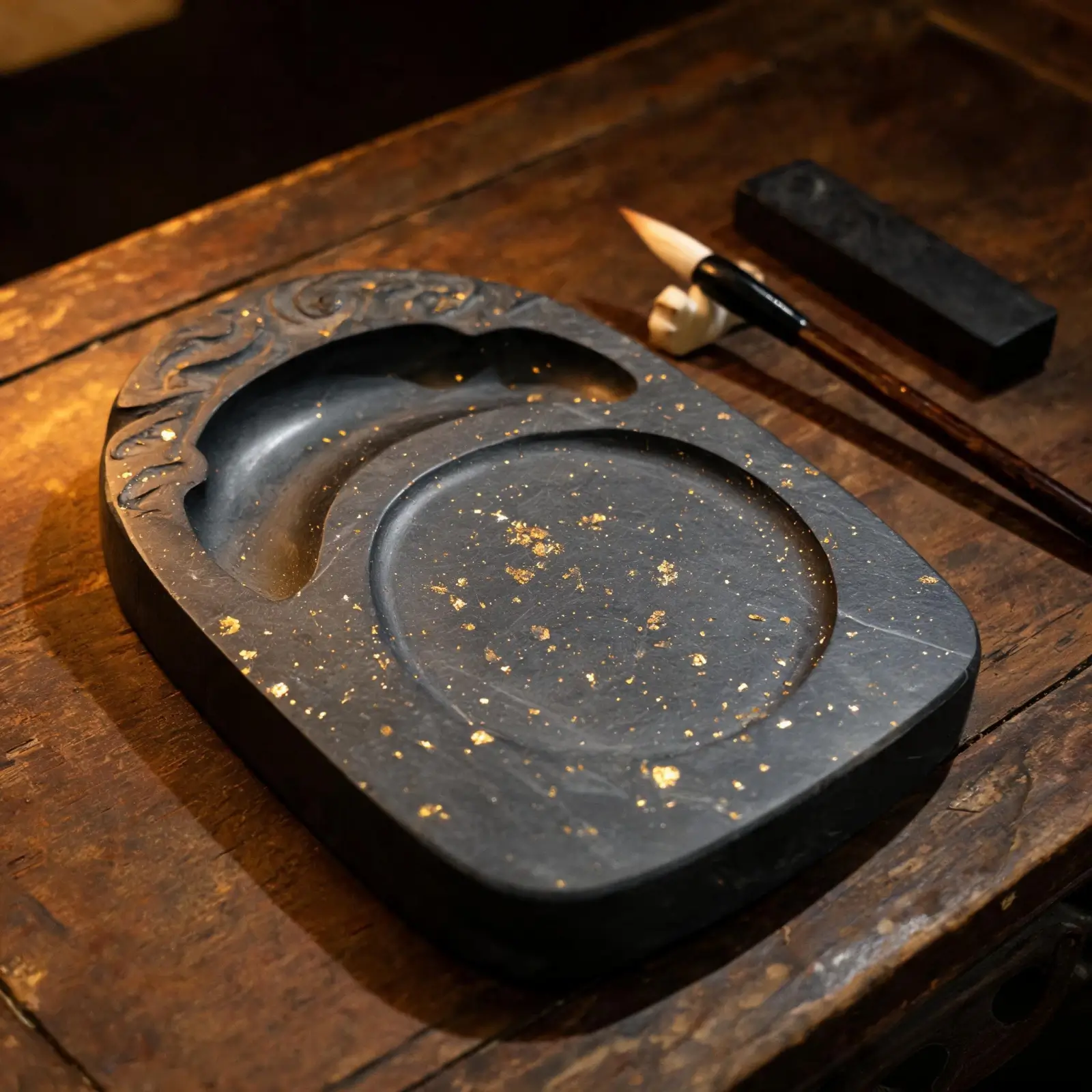
Act One: The Inkstone Period
The earliest recorded use of Jiujiang slate that I can point to with confidence is the gold-star inkstone — jinxing yan in Chinese. The "gold stars" are not decoration. They are natural pyrite crystals — iron sulphide — scattered through the stone. When you polish a piece of our slate, those same gold flecks show up. The geologists call it pyrite; the Song dynasty craftsmen called it gold stars. Same mineral, same rock, a thousand years apart.
The gold-star inkstone has been made continuously from local slate since the Song dynasty, which puts the starting point somewhere around the 10th to 11th century. That is not a marketing claim — it is a craft tradition you can still see today in workshops around Lushan. An inkstone has to do two things: hold ink without the ink seeping through, and give a smooth grinding surface. If the slate were porous, the ink would soak into the stone. If the grain were coarse, the ink would come out gritty. The fact that scholars chose this specific stone for a precision tool, a thousand years ago, tells you something about its density and fineness that a modern water-absorption test only confirms with numbers.
I mention the inkstone first because it is the earliest proof that people understood what this rock could do. They were not geologists. They did not have EN 12326 or ASTM C406. But they knew: this stone is dense, this stone is fine-grained, this stone takes a polish, and this stone does not drink water. That knowledge was the foundation. Everything after — the roofing, the billiard beds, the export — is a different application of the same properties those Song dynasty craftsmen already understood.
Act Two: The Building Stone
While scholars were grinding ink on polished slate, the villages around Lushan and Xingzi were doing something less glamorous but more telling: they were roofing their houses with the same stone. Not every house — good slate was not cheap, and thatch was free — but the houses that still stand today in the foothills have grey-blue slate on their roofs, split by hand, laid in overlapping courses, held by iron nails or wooden pegs. Some of those roofs are well over a hundred years old. The tiles are still there.
Then there is the architectural evidence at Bai Lu Dong — the White Deer Grotto Academy, one of the Four Great Academies of classical China, where the neo-Confucian philosopher Zhu Xi taught in the 12th century. The steles, the column bases, the paving stones — much of the stone you see in that compound is local grey-blue slate. When one of China's most important educational institutions needed a stone that would hold carved characters for centuries and survive foot traffic and mountain rain, it used the same rock we split today. That is not a heritage story I am telling you for atmosphere. It is evidence: the stone was selected for permanence by people who had centuries of experience with local materials.
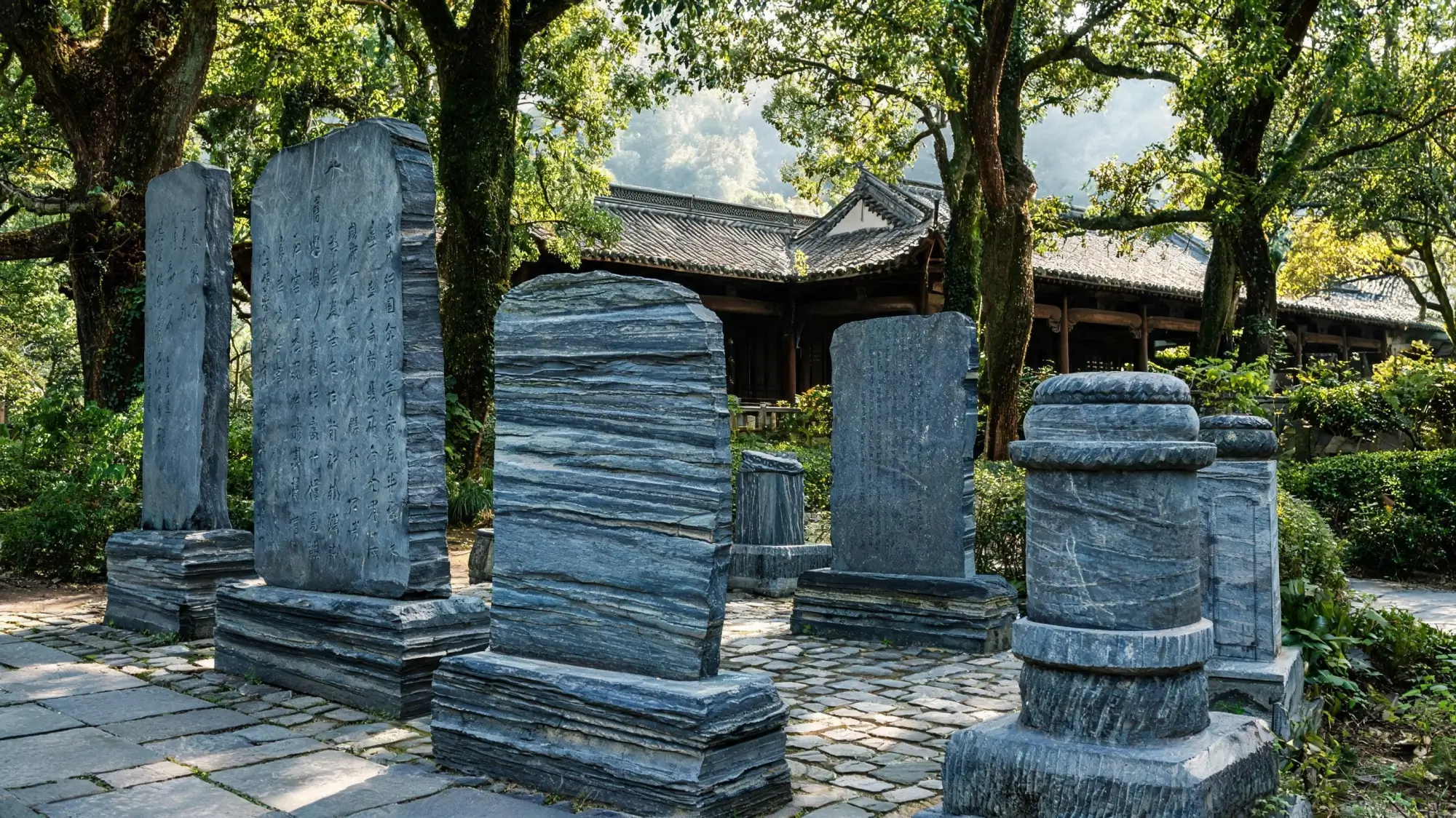
Nearby, the Guanyin Bridge — built in 1014 during the Northern Song — is a granite arch, not slate. I mention it only to say: building with stone is not new in this area. The tradition goes back a millennium. Slate was the finer material for surfaces, carving and roofing; granite was the structural material for bridges and foundations. Both came from the same mountain system. The point is that Lushan has been a stone country for as long as people have lived here — which is a much longer time than it has been an export region.
One more piece of evidence sits quietly in the villages: the Xiufeng scenic area below Lushan. There, a large Guanyin statue is carved from local slate, and the paths, walls and paving throughout the site are laid in the same stone. The people who built those paths did not have a specification sheet. They looked around at what was available, what was hard, what shed water, what survived foot traffic — and they chose this slate. Local people selecting their own local stone for their own high-traffic outdoor surfaces is, in my view, more convincing than any laboratory abrasion test.
Act Three: From the Mountain to the Sea
This is where the family story comes in. The genealogy entry I mentioned is not a legend — it is a practical record. Seven or eight generations back, my ancestors were quarrying stone in the hills around what is now Hengtang, dressing it into slabs, loading it onto wooden boats, and shipping it down the Yangtze waterway system to the Fujian coast. They came back with sea products — kelp, dried fish — that were abundant on the coast but scarce inland, and sold those for the New Year market. The family grew from the stone trade.
I tell this story not to write a family history but to make a commercial point: Jiujiang stone has been a waterborne trade product for at least two centuries. The route is the same. The Yangtze River system connects Jiujiang to the sea the same way it did when my ancestors' boats were made of wood. Today, instead of a wooden cargo boat with a man poling at the stern, we have a container ship leaving Jiujiang Port, transferring at Shanghai, and arriving in Rotterdam or Hamburg. The stone is the same. The water route is the same. Only the vessel changed.
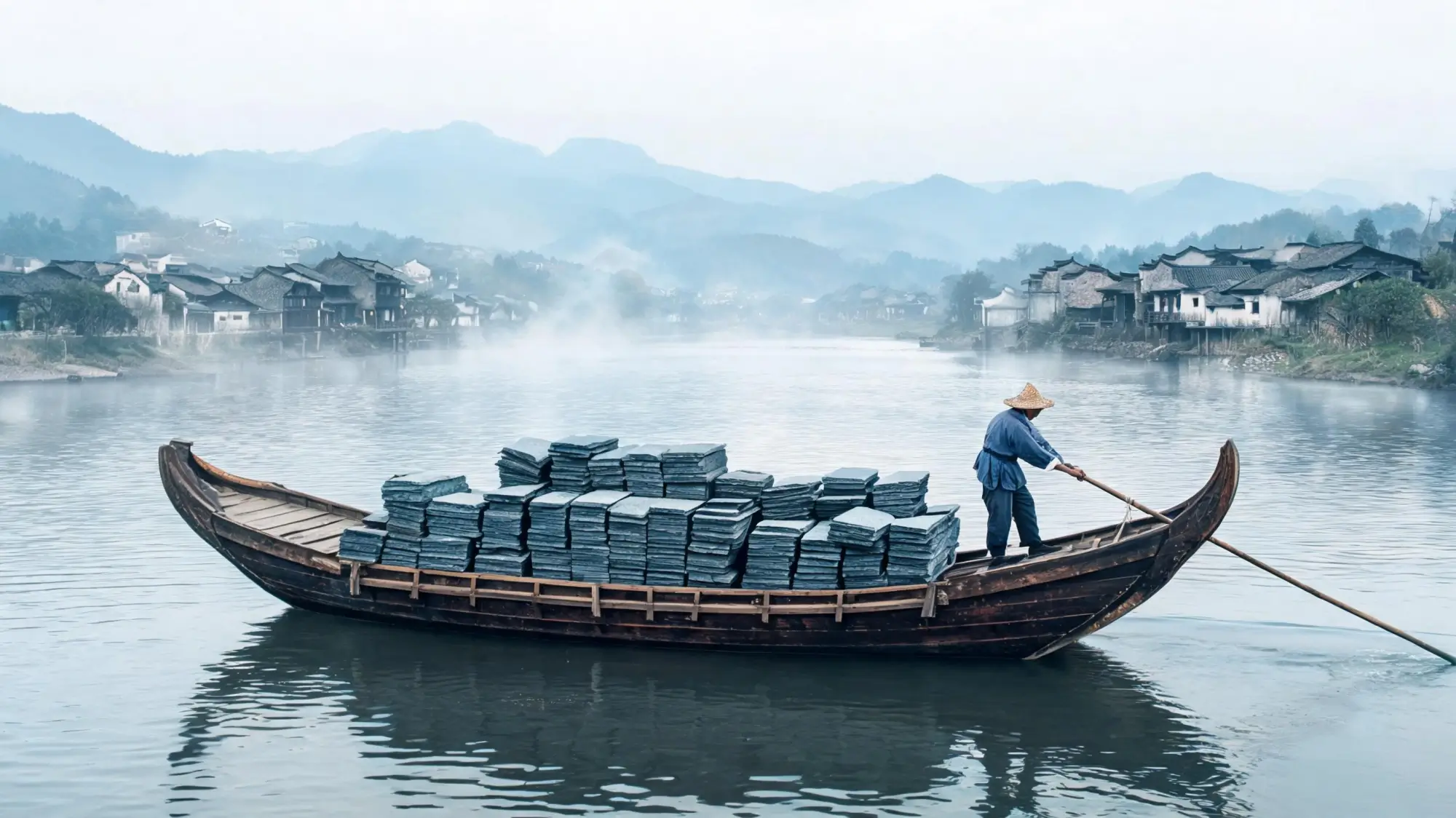
This matters to a buyer because it explains something about the supply chain that a factory tour alone will not. When you ask whether Jiujiang can reliably ship to your port, you are not asking about a capability that was invented last year. You are asking about a trade route that has been operating for generations. The port, the waterway, the loading skill — these are not new infrastructure. They are old habits with better equipment.
Act Four: The Tombstone Argument
Of all the evidence I could give you for the durability of this stone, the one I trust most is not in a laboratory. It is in the village graveyards around Hengtang and Xingzi. There are slate tombstones in those graveyards that have been standing outdoors — in the rain, the sun, the frost, the humidity of a Jiangxi lakeside climate — for around two hundred years. The surfaces are still flat. The carved characters are still legible. There is no cracking, no spalling, no delamination.
I am not saying every slate tombstone lasts two hundred years. I am saying the ones made from the better beds of local slate — the denser, lower-absorption rock that our quarry also targets — have lasted that long. Which is exactly the point: the slate that we select today for roofing and billiard beds is from the same beds that produced those tombstones. The selection criteria have not changed. Dense stone, fine grain, low water absorption, clean cleavage. The Song dynasty inkstone makers knew it. The village roofers knew it. The tombstone carvers knew it. We know it now, and we have the test data to prove it — but the proof was standing in a graveyard before the test was written.
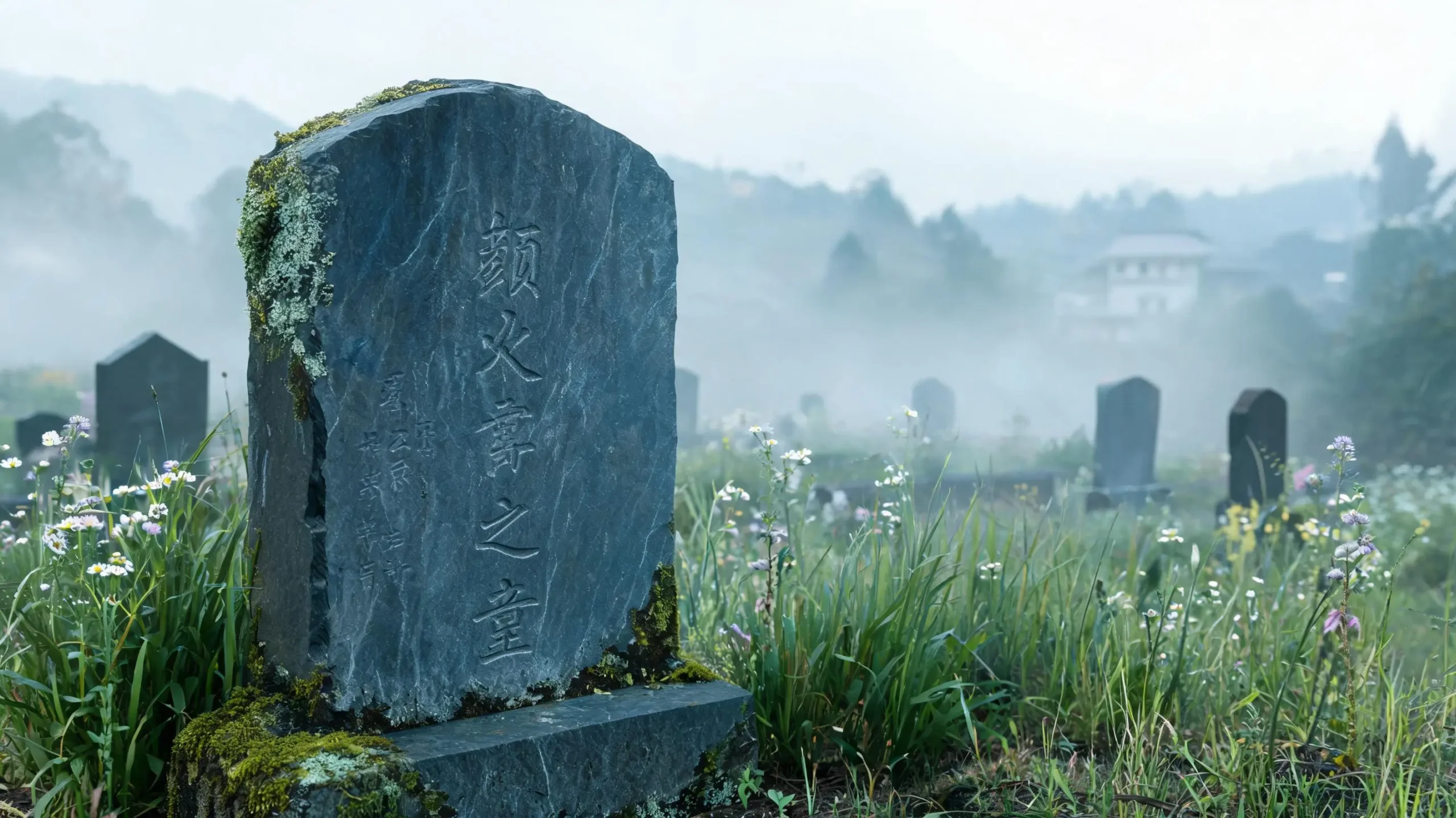
The Jiangxi climate is not gentle. Summer brings heavy rain and high humidity — Poyang Lake, China's largest freshwater lake, is right next door, and the air holds moisture for months. Winter brings cold snaps that drop below freezing, followed by rapid warming. That cycle — wet, freeze, thaw, wet again — is exactly what the EN 12326 and ASTM C406 freeze-thaw tests simulate in a laboratory. Our slate passes 120 cycles with zero weight loss. But a tombstone has been through roughly 200 winters of real, uncontrolled freeze-thaw. If the stone were going to fail, it would have failed by now.
When I talk to buyers from Norway, Sweden, or Canada — places where freeze-thaw is the make-or-break question — I mention the tombstones. Not because a graveyard is a sales pitch, but because it is the most honest answer to "how do you know this stone will survive my climate?" We know because it has survived ours, for two centuries, with no laboratory and no warranty.
Act Five: From Village Trade to Global Export
The jump from local and regional trade to international export happened in the 1990s, when a handful of factories in the Hengtang area — including ours — began investing in wire saws, surface grinders and CNC machining. The first export market for Jiujiang roofing slate was Europe, specifically the UK and Norway. Billiard slate followed, as table manufacturers in several countries discovered that the same dense, flat-splitting rock that made good roof tiles also made excellent table beds — once you could machine it to the right tolerance.
The change was not in the stone. The stone had been the same for four hundred million years. The change was in the tools and the standards. A wire saw lets you cut a block that a hundred men with chisels could not. A CNC machine lets you hold ±0.1 mm flatness on a billiard bed that no hand-grinder can match. And the EN 12326 / ASTM C406 testing regime lets you prove, with printed numbers, what the inkstone makers and the tombstone carvers already knew by feel.
Today, Jiujiang slate goes to over thirty countries. Our factory ships roofing slate in wooden crates and billiard slate in protected pallets, from Jiujiang Port down the Yangtze to Shanghai, then by sea to wherever the container is bound. The route my ancestors took by wooden boat is now taken by container ship. The stone in the hold is the same grey-blue, fine-grained, low-absorption slate that has been coming out of these hills for a thousand years.
| Period | What was made | How it was used | What it proves |
|---|---|---|---|
| Song dynasty (10th–13th c.) | Gold-star inkstones | Scholarly tool — grinding ink | Density, fine grain, water resistance recognised 1,000 years ago |
| Song–Qing (11th–19th c.) | Roofing tiles, steles, academy stonework | Village roofs, Bai Lu Dong Academy, Xiufeng paving | Local people selected this stone for permanence |
| ~19th century | Dressed slate blocks | Boated to Fujian coast — family stone trade | Waterborne stone trade is a centuries-old habit, not a new capability |
| ~200 years ago – present | Tombstones | Village graveyards — outdoor weathering | 200 years of real freeze-thaw with no failure — nature's durability test |
| 1990s – today | Roofing slate, billiard slate, paving | Export to 30+ countries via Jiujiang Port | Same stone, same route, new tools and standards |
That table is the whole argument of this article in five lines. If you remember nothing else, remember this: the stone was never newly discovered. It was recognised a thousand years ago, used for centuries, traded by water for generations, and only recently shipped in containers. Your test report is the latest piece of evidence — not the first.
Frequently Asked Questions
How long has slate been produced in Jiujiang?
The earliest confirmed use is the gold-star inkstone, a craft that dates back to the Song dynasty — roughly a thousand years. Roofing and building use in the villages around Lushan goes back at least as far, though precise dates are hard to pin down. The export trade in its modern form began in the 1990s, but the stone itself has been worked continuously for far longer than that.
Why was this specific stone chosen for inkstones and buildings?
Because it is dense, fine-grained and has very low water absorption. An inkstone must hold ink without seeping; a roof tile must shed rain without soaking it up. The same properties that made the stone good for grinding ink in the 11th century — density, fine grain, low porosity — are what make it pass EN 12326 and ASTM C406 today. The Song dynasty craftsmen identified the right stone by feel; the modern tests confirm it with numbers.
What does the 200-year-old tombstone actually prove about durability?
It proves that the better beds of Jiujiang slate can survive roughly two centuries of real, uncontrolled outdoor weathering — rain, sun, frost, humidity — without cracking, spalling or delaminating. The Jiangxi climate includes wet summers and freezing winters, so the stone has been through hundreds of natural freeze-thaw cycles. A laboratory test simulates 120 cycles; the tombstone has done far more, with no laboratory and no warranty.
Is the family boat-trade story relevant to modern sourcing?
Yes, because it shows that Jiujiang's waterborne stone trade is a long-established route, not a recent capability. The Yangtze waterway from Jiujiang to the sea has been used for stone transport for generations. Today's container shipments follow the same river path; only the vessel has changed from wooden boat to container ship. When you ask whether the supply chain is reliable, the answer is: it has been reliable for longer than most countries have existed.
When did Jiujiang start exporting slate internationally?
The modern export trade began in the 1990s, when local factories invested in wire saws, grinders and CNC machines. The first international markets were in Europe — particularly the UK and Norway for roofing slate. Billiard slate exports followed as table manufacturers found that the same dense, flat-splitting stone worked well for table beds. Today Jiujiang slate ships to over thirty countries.
Related Reading
Sourcing Slate From a Region With a Thousand-Year Track Record
The stone we ship today has been tested by scholars, roofers, carvers and weather for a thousand years before it reaches your container. If you want to see the evidence — the test data, the factory, or a sample of the same dense, fine-grained slate that Song dynasty craftsmen chose for their inkstones — we are ready to send it.