
What Is Jiujiang Slate?
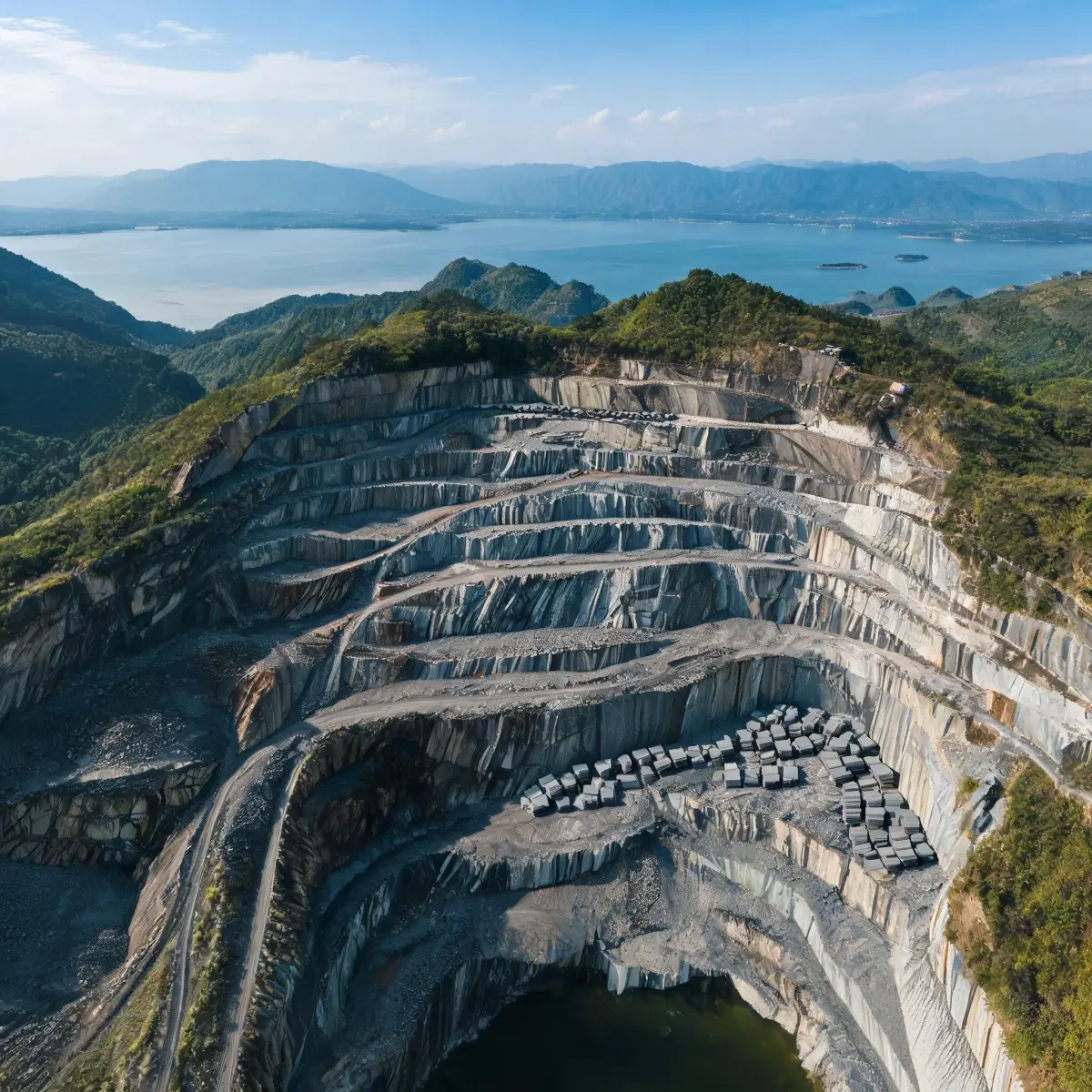
Jiujiang slate is a dense, fine-grained metamorphic rock quarried in the foothills of Mount Lu (Lushan) in Jiangxi Province, China. From this one rock, two very different industries produce their raw material: roofing slate tiles exported to 30+ countries, and precision-machined billiard table beds used worldwide. It is not a new stone — local craftsmen have worked it for over a thousand years.
A Stone From a Named Place
Most slate on the international market arrives with very little context. You get a country name, maybe a region, and that is it. Jiujiang slate is different in one small but important way: it comes from a place that has a real name on the map, and that name has been there for a very long time.
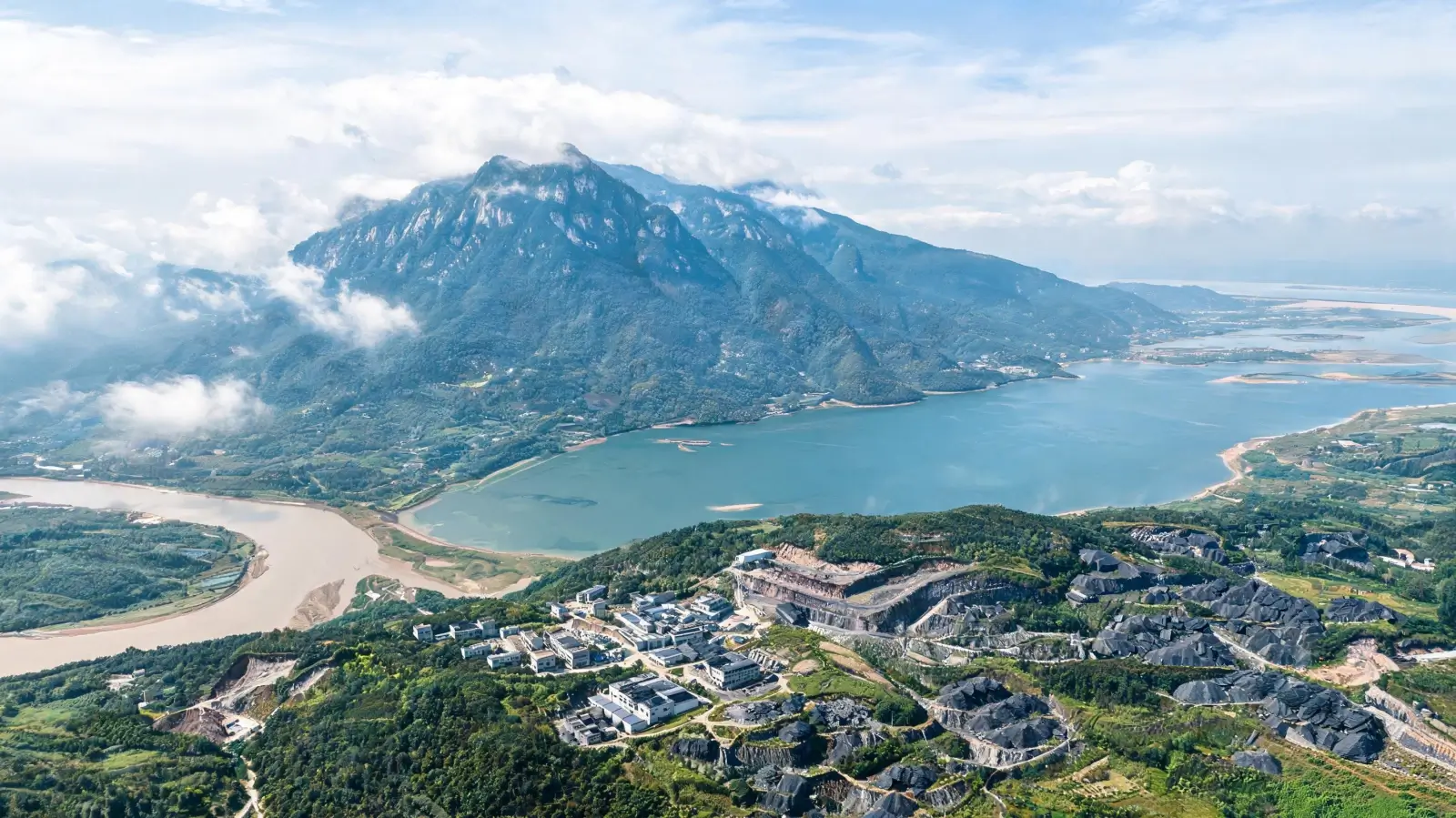
The quarries sit in the foothills of Lushan — a mountain designated as a UNESCO World Cultural Landscape Heritage site and a Global Geopark, a mountain that has drawn scholars and poets for well over a thousand years. To the east lies Poyang Lake, China's largest freshwater lake. The Yangtze River flows through Jiujiang city itself, one of the five major hub ports along its middle-lower reaches. So when we say "Jiujiang slate," we are pointing to a specific spot: a mountain, a lake, a river, and a city — all real, all verifiable on any map.
This matters to buyers because slate quality depends entirely on geology. A rock that formed under the right pressure, the right temperature, and the right mineral conditions will perform for a century on a roof or a decade on a pool table. Vague origin claims make that geology unverifiable. A named place makes it real.
What Kind of Rock Is It?
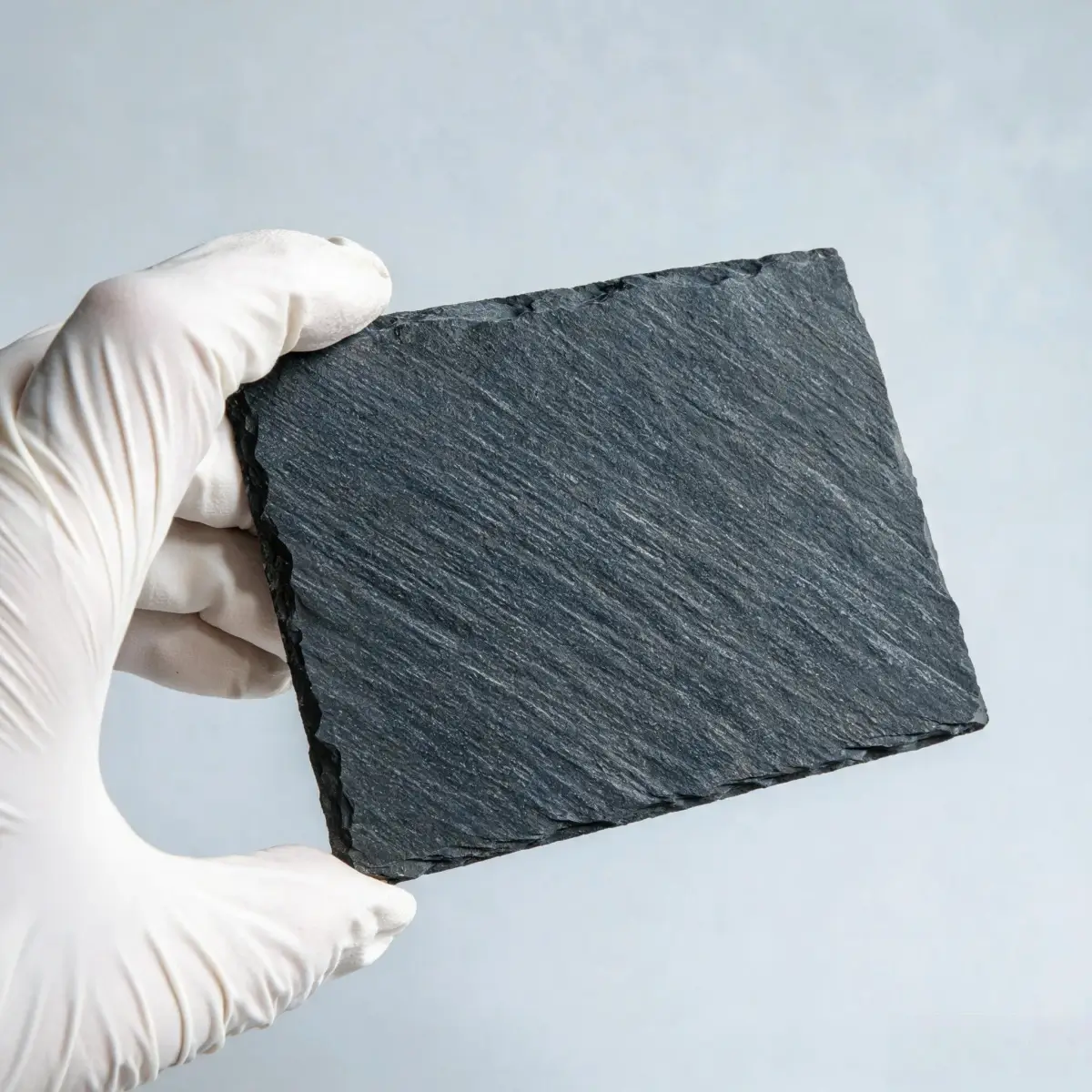
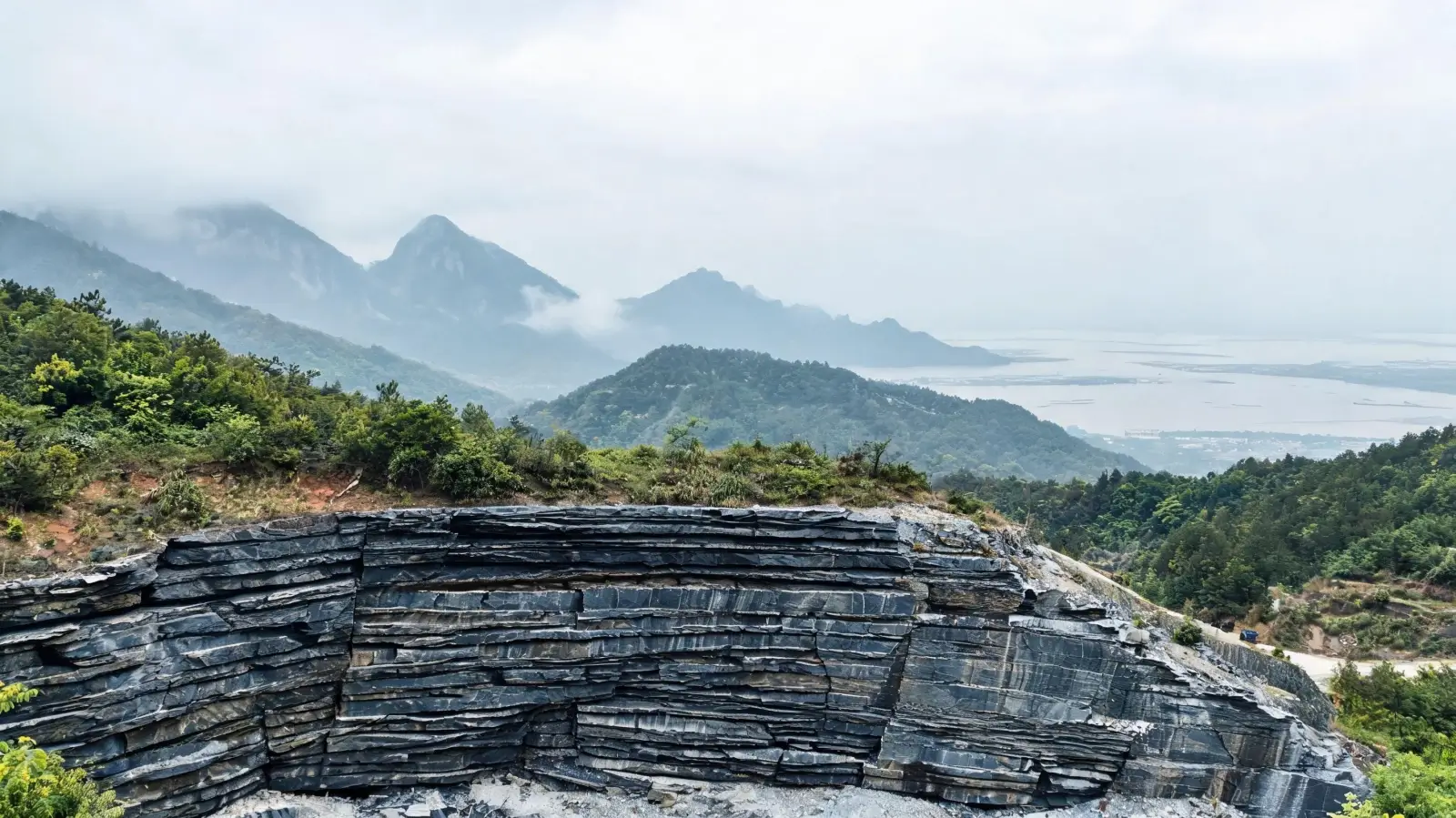
Jiujiang slate is a metamorphic rock. That means it started as something else — in this case, fine-grained shale deposits laid down in an ancient marine basin — and was transformed by heat and pressure deep in the earth over hundreds of millions of years. The result is a rock with a very specific set of properties that happen to suit two very different uses.
It is dense — 2.7 to 2.8 g/cm³, which is heavy for slate. That density is the root of everything else: it is why the stone resists water, holds up under frost, and machines to tight tolerances without crumbling.
It has extremely low water absorption. Our tested values are among the lowest in the industry, and we publish them openly — you can check the test results yourself. Low absorption means the stone does not soak up rain, does not freeze and crack in winter, and does not stain easily. For a roof tile in Norway or a table bed in a humid climate, this is the figure that decides whether the stone lasts decades or fails in years.
And it splits cleanly. Slate has a natural cleavage — a direction along which the rock separates into flat sheets. Jiujiang slate's cleavage is remarkably even and predictable. A skilled splitter can take a rough block and produce thin, flat tiles using a chisel and nothing else. That same block, cut thick instead of split thin, can be ground and machined to a flatness tolerance of ±0.2 mm on CNC equipment — the precision a billiard table demands.
We have a full page on the geology of Jiujiang slate for anyone who wants the mineral composition, the cleavage mechanics, and the formation history. For now, the key point is this: the rock is dense, it is dry, and it splits clean.
One Rock, Two Industries
Here is something that surprises most first-time visitors to our factory: the same pile of raw blocks feeds both the roofing slate line and the billiard slate line. Not different quarries, not different rock types — the same geological formation, cut from the same mountain.
How does one rock serve two such different purposes? The answer is density and processing route.
Roofing slate needs to be thin — 5 to 8 mm for standard tiles. The splitter takes a block, reads the grain, and produces flat tiles with a slightly textured natural surface, the "cleft" that gives a slate roof its character. Density and low water absorption matter here because the tile has to survive frost, rain, and sun for decades without flaking or curling. Roughly 80% of what we ship is roofing slate, and it goes to buyers across more than 30 countries — many in cold, coastal climates where cheaper, more porous stone would not last a winter.
Billiard slate needs to be thick — 25 to 50 mm — and machined flat to within ±0.2 mm across the entire playing surface. The same block that could be split into roofing tiles can instead be cut into thick slabs, ground flat on large surface grinders, and then precision-machined on CNC equipment to create the bed of a pool table or snooker table. Here, density matters for a different reason: a dense stone machines cleanly, holds its flatness over time, and does not warp. A billiard bed that moves is unplayable, and the only way to guarantee stability is to start with rock that is dense and consistent enough to hold a tolerance.
The shared requirement is density. A less dense slate — one with higher porosity or more mineral variation — might split into acceptable roofing tiles but would never machine to billiard tolerances. Jiujiang slate happens to be dense enough and consistent enough to do both. That is why the region developed two industries around one rock.
If you want to see how the same stone is processed for each use, our roofing slate production page and the Billiard Slate Guide cover the two manufacturing routes in detail.
Jiujiang, Lushan, Xingzi — Same Place, Different Names
If you have been researching Chinese slate, you have probably seen the same stone called by three different names: Jiujiang slate, Lushan slate, and Xingzi slate. Some suppliers add "Jiangxi slate" for good measure. This confuses buyers, and understandably so.
The explanation is straightforward. Jiujiang is the prefecture-level city. Lushan is the mountain that dominates the landscape — and, since 2016, also the name of the county-level city that was formerly Xingzi County. Xingzi is the old county name, still used by many in the trade out of habit. Our factory sits in what is now Lushan City — formerly Xingzi County, redesignated as a city in 2016 and named after the mountain that has made the region famous.
So Jiujiang, Lushan, and Xingzi all refer to the same slate-producing area. The stone is the same. The quarries are the same. The three names are just different levels of administrative geography pointing at one place on the map. When a supplier offers "Lushan slate" and another offers "Xingzi slate," they are likely selling the same rock from the same belt — possibly even from the same quarry face.
If you want the full breakdown — including why "Lushan slate" has become the more common name in international trade and how to make sure you are comparing like for like — we cover that in Jiujiang, Lushan or Xingzi Slate: What's in a Name?
Not a Newly Discovered Stone
Jiujiang slate is not a stone that was "discovered" for export in the last few decades. People here have been working it for over a thousand years.
Since the Song Dynasty, local craftsmen have used this same dark, fine-grained slate to carve "Golden Star" inkstones — prized calligraphy tools named for the tiny pyrite crystals that glitter in the stone's surface, like gold flecks in dark water. The tradition continues today. You can buy a Golden Star inkstone made from the same rock that ends up on a roof in Norway or under a pool table in Texas.
And long before any export market existed, the villages around the quarries used this slate to roof their own houses. If you drive through the countryside near our factory, you can still see old slate roofs on farmhouses — some a century or more old, still weathertight. This is not a stone that needed a marketing campaign to prove its durability. It already had a thousand years of local use behind it before the first container left the port.
We go deeper into this history — from the early inkstone carvers to the village roofers to today's global export — in History of Slate Production in Jiujiang.
What This Guide Covers
This article is the entry point for the Jiujiang Slate Guide. The guide is organised into 14 sections covering more than 80 articles on the region, the rock, testing, production and sourcing.
A few places to go next, depending on what you need:
If you want to understand where exactly this stone comes from — the geography, the towns, the transport routes — start with Where Is Jiujiang Slate From?
If you want the geological detail — mineral composition, cleavage mechanics, density — go to The Geology of Jiujiang Slate.
If you want the honest comparison with Spanish, Welsh and Indian slate before you commit to an origin, read Jiujiang Slate vs Spanish, Welsh and Indian Slate.
If you want to see the test data behind the claims, our Jiujiang Slate Test Results are public.
If you are sourcing slate and want product specifications, visit our Roofing Slate Guide or Billiard Slate Guide — those are where sizes, thicknesses, grades, installation and buying details live.
Frequently Asked Questions
Is Jiujiang slate the same as "Chinese slate"?
Not exactly. "Chinese slate" is a broad term that can refer to slate from several provinces — Jiangxi, Shaanxi, Hebei and others. Jiujiang slate specifically comes from the slate belt around Lushan in Jiangxi Province. The geological formation, density and splitting characteristics differ between regions, so "Chinese slate" is not one uniform product. If a supplier simply says "Chinese slate" without naming the region, it is worth asking which province and which quarry belt.
Why do some suppliers call it "Lushan slate" and others "Xingzi slate"?
They are referring to the same place. Xingzi was the old county name; in 2016 it was redesignated as Lushan City, named after the mountain. "Lushan slate" has become more common in international trade because the mountain is better known abroad, but the stone is the same. Our factory is in Lushan City (formerly Xingzi County) — the three names all point to the same slate-producing area.
Can I visit the quarry or factory?
Yes. Over the years we have regularly hosted overseas buyers who want to see the quarry face, the splitting floor and the CNC machining line in person. The nearest major airport is in Nanchang, about 40 minutes by road from our factory in Lushan City. If you are planning a visit, contact us and we will arrange the itinerary.
Is Jiujiang slate suitable for cold climates like Scandinavia or Canada?
Yes — this is one of its strongest applications. Jiujiang slate's low water absorption (tested values among the lowest in the industry) means it resists freeze-thaw damage exceptionally well. A significant share of our roofing slate exports go to Norway, Sweden and other cold-climate markets. The test results page has the freeze-thaw cycle data.
How is Jiujiang slate different from Spanish or Welsh slate?
Each origin has its own geological history, colour range and price point. Spanish slate (typically from the Cantabrian mountains) offers a wide colour range and high volume; Welsh slate (from North Wales) has heritage appeal and a long track record on historic buildings; Jiujiang slate offers high density, very low water absorption and competitive pricing with consistent quality across batches. The honest comparison — including density, colour, price and supply — is covered in our origin comparison page.
Related Reading
Start With a Sample
The best way to understand Jiujiang slate is to hold a piece in your hand. We send free samples of our roofing slate and billiard slate to qualified buyers worldwide — so you can check the density, the colour, the cleavage surface and the machining quality before you commit to an order.